cancer etiology 1
It is a disease that is increasing ,it is
a disease that's increasing in
incidents as well as every year it
kills more and more people. We
hate cancer, we want to find ways
to find cancer and treat cancer.
cancer etiology 2
I hope that this introduction will
give you a sense of the problem.
Not only how it affects people and
their families, but the biology of
how it starts, and what many of the
questions are in learning how to try
to understand cancer better, and to
treat cancer better
cancer etiology 3
lung cancer
colon cancer
breast cancer
prostate cancer
stomach
liver cancer.
Cancer types
cancer etiology 4
What is cancer?
In it's simplest form
,it means uncontrolled growth.
It's the disease caused by
an uncontrolled division of abnormal cells
in the part of the body
cancer etiology 5
It's often also referred to as a tumor.
Tumor is defined as a swelling of
a part of the body, generally
without inflammation, caused by an
abnormal growthof tissue whether
benign of malignant. Cancer is also
sometimes referred to as a
neoplasm. Which is defined as a
new and abnormal growth of tissue
in some part of the body.
cancer etiology 6
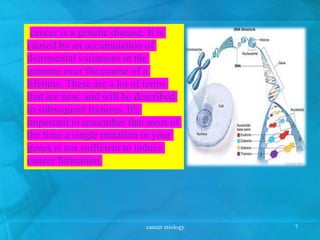
cancer is a genetic disease. It is
caused by an accumulation of
detrimental variations in the
genome over the course of a
lifetime. These are a lot of terms
that are new, and will be described
in subsequent lectures. It's
important to remember that most of
the time a single mutation in your
genes is not sufficient to induce
cancer formation.
cancer etiology 7
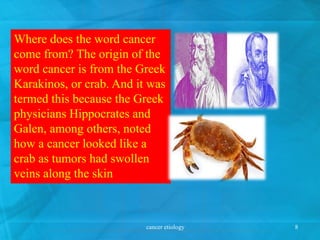
Where does the word cancer
come from? The origin of the
word cancer is from the Greek
Karakinos, or crab. And it was
termed this because the Greek
physicians Hippocrates and
Galen, among others, noted
how a cancer looked like a
crab as tumors had swollen
veins along the skin
cancer etiology 8
cancer etiology 9
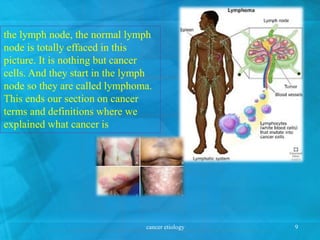
the lymph node, the normal lymph
node is totally effaced in this
picture. It is nothing but cancer
cells. And they start in the lymph
node so they are called lymphoma.
This ends our section on cancer
terms and definitions where we
explained what cancer is
It then evolved to the Latin term cancer
which also means crab or later,
malignant tumor. Interestingly enough
in the old English
cancer meant spreading sore or cancer.
The study of cancer is oncology, and
where does the word oncology come
from? It literally means a branch of
science that deals with tumors and
cancers. The word onco means bulk or
mass or tumor, while logy means study.
cancer etiology 10
it's the study of a bulk or a tumor. An important word in
cancer is metastasis. Metastasis is the spreading of
cancer from a primary site to distant organs and it
literally comes from the Greek word metastasis, which
is removing, removal or migration, a changing
,a change, or revolution.
So again the metastasis, which means the spread of
cancer from primary site, to distant organs is an
important to learn early in the study of cancer.
Where does cancer start? Cancers are classified
according to the tissue where they originate.
cancer etiology 11
There are four main types. Carcinomas arise in
epithelial tissue that is found in the internal and
external linings of the body. Adenocarcinomas,
which are the most common form of cancer
develop in an organ or gland. For example,
prostate cancer, breast cancer, liver cancer.
Squamous cell carcinomas develop in the
squamous epithelium of organs, including the
skin, bladder , esophagus, and lung. Sarcomas,
which account for less than 10% of all cancers,
arise from connective tissue that is found in
bones, tendons, cartilage, muscle, and fat.
Leukemias are cancers of the blood that originate
in the bone marrow and Lymphoma refers to
cancers that develop in the lymph system. This is
a schematic of what cancer looks like
cancer etiology 12
cancer of the cervix. you can see
normal cells lining an organ and
you can see that each cell looks the
same. And each nucleus, inside the
cell which contains the DNA, looks
the same. The first step toward
scarcer is hyperplasia, where
you get a growth in the number of
cells. It's a proliferation in the
number of cells, and they start to
look a little bit atypical. As cancer
progresses you get mild dysplasia
where the cells start to bunch up on
each other and they start to have
abnormal nuclei and abnormal
shapes.
cancer etiology 13
This gets more severe and you
develop carcinoma in situ or cancer
in place. This is where the cells are
growing in an uncontrolled fashion,
they look abnormal and their nuclei
look abnormal. When cancer starts
to invade in metastasis that's when
we refer to it as a carcinoma.
cancer etiology 14
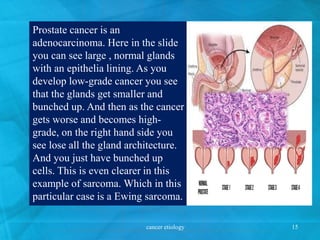
Prostate cancer is an
adenocarcinoma. Here in the slide
you can see large , normal glands
with an epithelia lining. As you
develop low-grade cancer you see
that the glands get smaller and
bunched up. And then as the cancer
gets worse and becomes high-
grade, on the right hand side you
see lose all the gland architecture.
And you just have bunched up
cells. This is even clearer in this
example of sarcoma. Which in this
particular case is a Ewing sarcoma.
cancer etiology 15
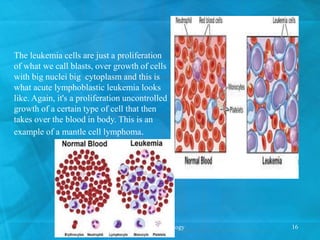
The leukemia cells are just a proliferation
of what we call blasts, over growth of cells
with big nuclei big cytoplasm and this is
what acute lymphoblastic leukemia looks
like. Again, it's a proliferation uncontrolled
growth of a certain type of cell that then
takes over the blood in body. This is an
example of a mantle cell lymphoma.
cancer etiology 16

cancer introduction .pdf

  • 1.
  • 2.
    It is adisease that is increasing ,it is a disease that's increasing in incidents as well as every year it kills more and more people. We hate cancer, we want to find ways to find cancer and treat cancer. cancer etiology 2
  • 3.
    I hope thatthis introduction will give you a sense of the problem. Not only how it affects people and their families, but the biology of how it starts, and what many of the questions are in learning how to try to understand cancer better, and to treat cancer better cancer etiology 3
  • 4.
    lung cancer colon cancer breastcancer prostate cancer stomach liver cancer. Cancer types cancer etiology 4
  • 5.
    What is cancer? Init's simplest form ,it means uncontrolled growth. It's the disease caused by an uncontrolled division of abnormal cells in the part of the body cancer etiology 5
  • 6.
    It's often alsoreferred to as a tumor. Tumor is defined as a swelling of a part of the body, generally without inflammation, caused by an abnormal growthof tissue whether benign of malignant. Cancer is also sometimes referred to as a neoplasm. Which is defined as a new and abnormal growth of tissue in some part of the body. cancer etiology 6
  • 7.
    cancer is agenetic disease. It is caused by an accumulation of detrimental variations in the genome over the course of a lifetime. These are a lot of terms that are new, and will be described in subsequent lectures. It's important to remember that most of the time a single mutation in your genes is not sufficient to induce cancer formation. cancer etiology 7
  • 8.
    Where does theword cancer come from? The origin of the word cancer is from the Greek Karakinos, or crab. And it was termed this because the Greek physicians Hippocrates and Galen, among others, noted how a cancer looked like a crab as tumors had swollen veins along the skin cancer etiology 8
  • 9.
    cancer etiology 9 thelymph node, the normal lymph node is totally effaced in this picture. It is nothing but cancer cells. And they start in the lymph node so they are called lymphoma. This ends our section on cancer terms and definitions where we explained what cancer is
  • 10.
    It then evolvedto the Latin term cancer which also means crab or later, malignant tumor. Interestingly enough in the old English cancer meant spreading sore or cancer. The study of cancer is oncology, and where does the word oncology come from? It literally means a branch of science that deals with tumors and cancers. The word onco means bulk or mass or tumor, while logy means study. cancer etiology 10
  • 11.
    it's the studyof a bulk or a tumor. An important word in cancer is metastasis. Metastasis is the spreading of cancer from a primary site to distant organs and it literally comes from the Greek word metastasis, which is removing, removal or migration, a changing ,a change, or revolution. So again the metastasis, which means the spread of cancer from primary site, to distant organs is an important to learn early in the study of cancer. Where does cancer start? Cancers are classified according to the tissue where they originate. cancer etiology 11
  • 12.
    There are fourmain types. Carcinomas arise in epithelial tissue that is found in the internal and external linings of the body. Adenocarcinomas, which are the most common form of cancer develop in an organ or gland. For example, prostate cancer, breast cancer, liver cancer. Squamous cell carcinomas develop in the squamous epithelium of organs, including the skin, bladder , esophagus, and lung. Sarcomas, which account for less than 10% of all cancers, arise from connective tissue that is found in bones, tendons, cartilage, muscle, and fat. Leukemias are cancers of the blood that originate in the bone marrow and Lymphoma refers to cancers that develop in the lymph system. This is a schematic of what cancer looks like cancer etiology 12
  • 13.
    cancer of thecervix. you can see normal cells lining an organ and you can see that each cell looks the same. And each nucleus, inside the cell which contains the DNA, looks the same. The first step toward scarcer is hyperplasia, where you get a growth in the number of cells. It's a proliferation in the number of cells, and they start to look a little bit atypical. As cancer progresses you get mild dysplasia where the cells start to bunch up on each other and they start to have abnormal nuclei and abnormal shapes. cancer etiology 13
  • 14.
    This gets moresevere and you develop carcinoma in situ or cancer in place. This is where the cells are growing in an uncontrolled fashion, they look abnormal and their nuclei look abnormal. When cancer starts to invade in metastasis that's when we refer to it as a carcinoma. cancer etiology 14
  • 15.
    Prostate cancer isan adenocarcinoma. Here in the slide you can see large , normal glands with an epithelia lining. As you develop low-grade cancer you see that the glands get smaller and bunched up. And then as the cancer gets worse and becomes high- grade, on the right hand side you see lose all the gland architecture. And you just have bunched up cells. This is even clearer in this example of sarcoma. Which in this particular case is a Ewing sarcoma. cancer etiology 15
  • 16.
    The leukemia cellsare just a proliferation of what we call blasts, over growth of cells with big nuclei big cytoplasm and this is what acute lymphoblastic leukemia looks like. Again, it's a proliferation uncontrolled growth of a certain type of cell that then takes over the blood in body. This is an example of a mantle cell lymphoma. cancer etiology 16