1www.EmailDelivered.com (C) Copyright 2013
Do you use email in your business? The CAN-
SPAM Act, a law that sets the rules for com-
mercial email, establishes requirements for
CAN SPAM ACT:
commercial messages, gives recipients the
right to have you stop emailing them, and
spells out tough penalties for violations.
Despite its name, the CAN-SPAM Act doesn’t
apply just to bulk email. It covers all commer-
cial messages, which the law defines as “any
electronic mail message the primary purpose
of which is the commercial advertisement or
promotion of a commercial product or ser-
vice,” including email that promotes content
on commercial websites. The law makes no
exception for business-to-business email.
That means all email – for example, a mes-
sage to former customers announcing a new
product line – must comply with the law.
WWW.EMAILDELIVERED.COM 2
CAN SPAM ACT
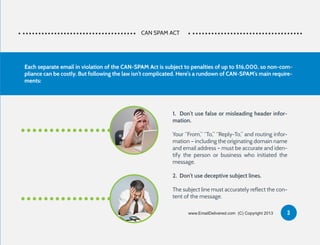
1. Don’t use false or misleading header infor-
mation.
Your “From,” “To,” “Reply-To,” and routing infor-
mation – including the originating domain name
and email address – must be accurate and iden-
tify the person or business who initiated the
message.
2. Don’t use deceptive subject lines.
The subject line must accurately reflect the con-
tent of the message.
Each separate email in violation of the CAN-SPAM Act is subject to penalties of up to $16,000, so non-com-
pliance can be costly. But following the law isn’t complicated. Here’s a rundown of CAN-SPAM’s main require-
ments:
3www.EmailDelivered.com (C) Copyright 2013
3. Identify the message as an ad.
The law gives you a lot of leeway in how to do this, but
you must disclose clearly and conspicuously that your
message is an advertisement.
4. Tell recipients where you’re located.
Your message must include your valid physical postal
address. This can be your current street address, a post
office box you’ve registered with the U.S. Postal Service,
or a private mailbox you’ve registered with a commercial
mail receiving agency established under Postal Service
regulations.
CAN SPAM ACT
WWW.EMAILDELIVERED.COM 4
5. Tell recipients how to opt out of receiving future email from you.
Your message must include a clear and conspicuous explanation of
how the recipient can opt out of getting email from you in the fu-
ture. Craft the notice in a way that’s easy for an ordinary person to
recognize, read, and understand. Creative use of type size, color, and
location can improve clarity. Give a return email address or anoth-
er easy Internet-based way to allow people to communicate their
choice to you. You may create a menu to allow a recipient to opt out
of certain types of messages, but you must include the option to
stop all commercial messages from you. Make sure your spam filter
doesn’t block these opt-out requests.
Tell recipients how to opt out of receiving future email from
CAN SPAM ACT
5www.EmailDelivered.com (C) Copyright 2013
6. Honor opt-out requests promptly.
Any opt-out mechanism you offer must be
able to process opt-out requests for at least 30
days after you send your message. You must
honor a recipient’s opt-out request within 10
business days. You can’t charge a fee, require
the recipient to give you any personally iden-
tifying information beyond an email address,
or make the recipient take any step other than
sending a reply email or visiting a single page
on an Internet website as a condition for hon-
oring an opt-out request. Once people have
told you they don’t want to receive more mes-
sages from you, you can’t sell or transfer their
email addresses, even in the form of a mailing
list. The only exception is that you may trans-
fer the addresses to a company you’ve hired
to help you comply with the CAN-SPAM Act.
Honor recipient’s opt-out request
CAN SPAM ACT
WWW.EMAILDELIVERED.COM 6
7. Monitor what others are doing on your behalf.
The law makes clear that even if you hire another
company to handle your email marketing, you can’t
contract away your legal responsibility to comply
with the law. Both the company whose product is
promoted in the message and the company that
actually sends the message may be held legally re-
sponsible.
CAN SPAM ACT
7www.EmailDelivered.com (C) Copyright 2013

Can Spam Act

  • 1.
  • 2.
    Do you useemail in your business? The CAN- SPAM Act, a law that sets the rules for com- mercial email, establishes requirements for CAN SPAM ACT: commercial messages, gives recipients the right to have you stop emailing them, and spells out tough penalties for violations. Despite its name, the CAN-SPAM Act doesn’t apply just to bulk email. It covers all commer- cial messages, which the law defines as “any electronic mail message the primary purpose of which is the commercial advertisement or promotion of a commercial product or ser- vice,” including email that promotes content on commercial websites. The law makes no exception for business-to-business email. That means all email – for example, a mes- sage to former customers announcing a new product line – must comply with the law. WWW.EMAILDELIVERED.COM 2
  • 3.
    CAN SPAM ACT 1.Don’t use false or misleading header infor- mation. Your “From,” “To,” “Reply-To,” and routing infor- mation – including the originating domain name and email address – must be accurate and iden- tify the person or business who initiated the message. 2. Don’t use deceptive subject lines. The subject line must accurately reflect the con- tent of the message. Each separate email in violation of the CAN-SPAM Act is subject to penalties of up to $16,000, so non-com- pliance can be costly. But following the law isn’t complicated. Here’s a rundown of CAN-SPAM’s main require- ments: 3www.EmailDelivered.com (C) Copyright 2013
  • 4.
    3. Identify themessage as an ad. The law gives you a lot of leeway in how to do this, but you must disclose clearly and conspicuously that your message is an advertisement. 4. Tell recipients where you’re located. Your message must include your valid physical postal address. This can be your current street address, a post office box you’ve registered with the U.S. Postal Service, or a private mailbox you’ve registered with a commercial mail receiving agency established under Postal Service regulations. CAN SPAM ACT WWW.EMAILDELIVERED.COM 4
  • 5.
    5. Tell recipientshow to opt out of receiving future email from you. Your message must include a clear and conspicuous explanation of how the recipient can opt out of getting email from you in the fu- ture. Craft the notice in a way that’s easy for an ordinary person to recognize, read, and understand. Creative use of type size, color, and location can improve clarity. Give a return email address or anoth- er easy Internet-based way to allow people to communicate their choice to you. You may create a menu to allow a recipient to opt out of certain types of messages, but you must include the option to stop all commercial messages from you. Make sure your spam filter doesn’t block these opt-out requests. Tell recipients how to opt out of receiving future email from CAN SPAM ACT 5www.EmailDelivered.com (C) Copyright 2013
  • 6.
    6. Honor opt-outrequests promptly. Any opt-out mechanism you offer must be able to process opt-out requests for at least 30 days after you send your message. You must honor a recipient’s opt-out request within 10 business days. You can’t charge a fee, require the recipient to give you any personally iden- tifying information beyond an email address, or make the recipient take any step other than sending a reply email or visiting a single page on an Internet website as a condition for hon- oring an opt-out request. Once people have told you they don’t want to receive more mes- sages from you, you can’t sell or transfer their email addresses, even in the form of a mailing list. The only exception is that you may trans- fer the addresses to a company you’ve hired to help you comply with the CAN-SPAM Act. Honor recipient’s opt-out request CAN SPAM ACT WWW.EMAILDELIVERED.COM 6
  • 7.
    7. Monitor whatothers are doing on your behalf. The law makes clear that even if you hire another company to handle your email marketing, you can’t contract away your legal responsibility to comply with the law. Both the company whose product is promoted in the message and the company that actually sends the message may be held legally re- sponsible. CAN SPAM ACT 7www.EmailDelivered.com (C) Copyright 2013