Executive Summary

2012 Debit Issuer Study


               Steve Sievert
        Executive Vice President, PULSE
              November 29, 2012
Study Overview

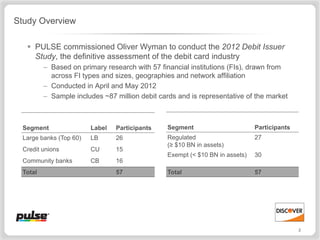
    PULSE commissioned Oliver Wyman to conduct the 2012 Debit Issuer
     Study, the definitive assessment of the debit card industry
         – Based on primary research with 57 financial institutions (FIs), drawn from
           across FI types and sizes, geographies and network affiliation
         – Conducted in April and May 2012
         – Sample includes ~87 million debit cards and is representative of the market


 Segment                Label   Participants    Segment                       Participants
 Large banks (Top 60)   LB      26              Regulated                     27
                                                (≥ $10 BN in assets)
 Credit unions          CU      15
                                                Exempt (< $10 BN in assets)   30
 Community banks        CB      16
 Total                          57              Total                         57


                                                                                             2
Summary of Key Findings

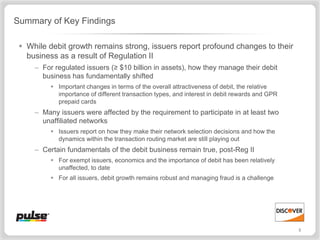
  While debit growth remains strong, issuers report profound changes to their
   business as a result of Regulation II
     – For regulated issuers (≥ $10 billion in assets), how they manage their debit
       business has fundamentally shifted
           Important changes in terms of the overall attractiveness of debit, the relative
            importance of different transaction types, and interest in debit rewards and GPR
            prepaid cards
     – Many issuers were affected by the requirement to participate in at least two
       unaffiliated networks
           Issuers report on how they make their network selection decisions and how the
            dynamics within the transaction routing market are still playing out
     – Certain fundamentals of the debit business remain true, post-Reg II
           For exempt issuers, economics and the importance of debit has been relatively
            unaffected, to date
           For all issuers, debit growth remains robust and managing fraud is a challenge


                                                                                               3
Summary of Key Findings (cont’d)

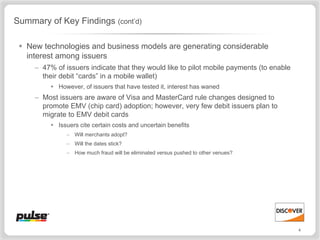
  New technologies and business models are generating considerable
   interest among issuers
     – 47% of issuers indicate that they would like to pilot mobile payments (to enable
       their debit “cards” in a mobile wallet)
           However, of issuers that have tested it, interest has waned
     – Most issuers are aware of Visa and MasterCard rule changes designed to
       promote EMV (chip card) adoption; however, very few debit issuers plan to
       migrate to EMV debit cards
           Issuers cite certain costs and uncertain benefits
               – Will merchants adopt?
               – Will the dates stick?
               – How much fraud will be eliminated versus pushed to other venues?


                                                                                          4
What Changed with Regulation II’s
Interchange Cap Provision


                                    5
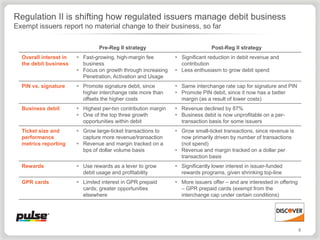
Regulation II is shifting how regulated issuers manage debit business
Exempt issuers report no material change to their business, so far

                                 Pre-Reg II strategy                            Post-Reg II strategy
  Overall interest in    Fast-growing, high-margin fee          Significant reduction in debit revenue and
  the debit business      business                                contribution
                         Focus on growth through increasing     Less enthusiasm to grow debit spend
                          Penetration, Activation and Usage
  PIN vs. signature      Promote signature debit, since         Same interchange rate cap for signature and PIN
                          higher interchange rate more than      Promote PIN debit, since it now has a better
                          offsets the higher costs                margin (as a result of lower costs)
  Business debit         Highest per-txn contribution margin    Revenue declined by 87%
                         One of the top three growth            Business debit is now unprofitable on a per-
                          opportunities within debit              transaction basis for some issuers
  Ticket size and        Grow large-ticket transactions to      Grow small-ticket transactions, since revenue is
  performance             capture more revenue/transaction        now primarily driven by number of transactions
  metrics reporting      Revenue and margin tracked on a         (not spend)
                          bps of dollar volume basis             Revenue and margin tracked on a dollar per
                                                                  transaction basis
  Rewards                Use rewards as a lever to grow         Significantly lower interest in issuer-funded
                          debit usage and profitability           rewards programs, given shrinking top-line
  GPR cards              Limited interest in GPR prepaid        More issuers offer – and are interested in offering
                          cards; greater opportunities            – GPR prepaid cards (exempt from the
                          elsewhere                               interchange cap under certain conditions)


                                                                                                                        6
Overall interest in debit business
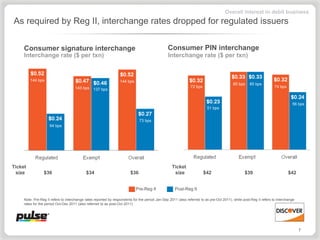
As required by Reg II, interchange rates dropped for regulated issuers


     Consumer signature interchange                                                             Consumer PIN interchange
     Interchange rate ($ per txn)                                                               Interchange rate ($ per txn)


         144 bps                                                  144 bps
                                                                                                                                          85 bps    85 bps
                                     143 bps 137 bps                                                          72 bps                                                74 bps


                                                                                                                                                                               56 bps
                                                                                                                         51 bps


                                                                              73 bps
                     64 bps


Ticket                                                                                             Ticket
 size            $36                        $34                         $36                         size               $42                       $39                         $42


                                                                            Pre-Reg II               Post-Reg II

     Note: Pre-Reg II refers to interchange rates reported by respondents for the period Jan-Sep 2011 (also referred to as pre-Oct 2011), while post-Reg II refers to interchange
     rates for the period Oct-Dec 2011 (also referred to as post-Oct 2011)


                                                                                                                                                                                    7
Overall interest in debit business
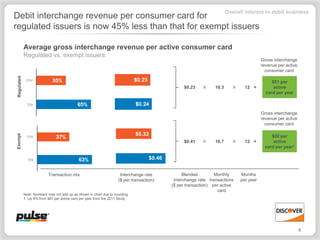
Debit interchange revenue per consumer card for
regulated issuers is now 45% less than that for exempt issuers

            Average gross interchange revenue per active consumer card
            Regulated vs. exempt issuers
                                                                                                                                         Gross interchange
                                                                                                                                         revenue per active
                                                                                                                                           consumer card
Regulated


                                                                                                                                              $51 per
                                                                                                  $0.23   ×      18.3     ×     12 =           active
                                                                                                                                           card per year


                                                                                                                                         Gross interchange
                                                                                                                                         revenue per active
                                                                                                                                           consumer card

                                                                             $0.33
Exempt


                                                                                                                                             $92 per
                                                                                                  $0.41   ×      18.7     ×     12 =          active
                                                                                                                                          card per year1

                                                                                    $0.46


                          Transaction mix                            Interchange rate            Blended         Monthly      Months
                                                                    ($ per transaction)      interchange rate transactions    per year
                                                                                            ($ per transaction) per active
                                                                                                                  card
            Note: Numbers may not add up as shown in chart due to rounding
            1. Up 6% from $87 per active card per year from the 2011 Study


                                                                                                                                                              8
PIN vs. signature
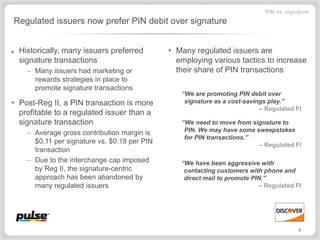
Regulated issuers now prefer PIN debit over signature


■   Historically, many issuers preferred         Many regulated issuers are
    signature transactions                        employing various tactics to increase
      – Many issuers had marketing or             their share of PIN transactions
        rewards strategies in place to
        promote signature transactions
                                                   “We are promoting PIN debit over
 Post-Reg II, a PIN transaction is more            signature as a cost-savings play.”
                                                                             – Regulated FI
  profitable to a regulated issuer than a
  signature transaction                            “We need to move from signature to
      – Average gross contribution margin is        PIN. We may have some sweepstakes
                                                    for PIN transactions.”
        $0.11 per signature vs. $0.18 per PIN                              – Regulated FI
        transaction
      – Due to the interchange cap imposed         “We have been aggressive with
        by Reg II, the signature-centric            contacting customers with phone and
        approach has been abandoned by              direct mail to promote PIN.”
        many regulated issuers                                               – Regulated FI


                                                                                           9
PIN vs. signature
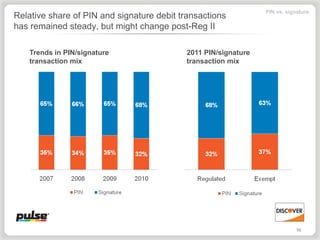
Relative share of PIN and signature debit transactions
has remained steady, but might change post-Reg II

   Trends in PIN/signature                 2011 PIN/signature
   transaction mix                         transaction mix


                                                                            10
Business debit
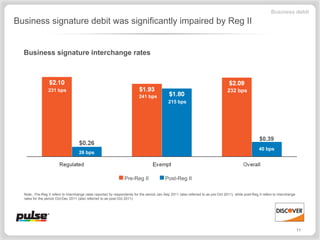
Business signature debit was significantly impaired by Reg II


  Business signature interchange rates


                 231 bps                                                                                                           232 bps
                                                                           241 bps
                                                                                              215 bps


                                                                                                                                                        $0.39
                                                                                                                                                       40 bps
                                     26 bps


                                                                  Pre-Reg II                Post-Reg II

  Note:, Pre-Reg II refers to interchange rates reported by respondents for the period Jan-Sep 2011 (also referred to as pre-Oct 2011), while post-Reg II refers to interchange
  rates for the period Oct-Dec 2011 (also referred to as post-Oct 2011)


                                                                                                                                                                                  11
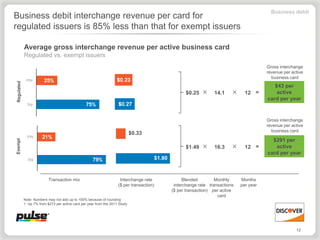
Business debit
Business debit interchange revenue per card for
regulated issuers is 85% less than that for exempt issuers

            Average gross interchange revenue per active business card
            Regulated vs. exempt issuers
                                                                                                                                           Gross interchange
                                                                                                                                           revenue per active
                                                                                                                                             business card
Regulated


                                                                                                                                              $43 per
                                                                                                     $0.25 ×       14.1     ×     12 =         active
                                                                                                                                           card per year


                                                                                                                                           Gross interchange
                                                                                                                                           revenue per active
                                                                                                                                             business card
                                                                              $0.33
                                                                                                                                             $291 per
Exempt


                                                                                                     $1.49 ×       16.3     ×     12 =        active
                                                                                                                                           card per year
                                                                                       $1.80


                           Transaction mix                            Interchange rate              Blended         Monthly     Months
                                                                     ($ per transaction)        interchange rate transactions   per year
                                                                                               ($ per transaction) per active
                                                                                                                     card
            Note: Numbers may not add up to 100% because of rounding
            1. Up 7% from $273 per active card per year from the 2011 Study


                                                                                                                                                         12
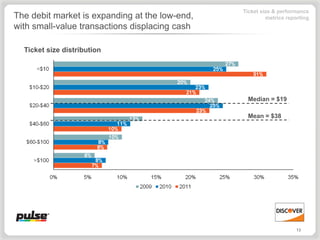
Ticket size & performance
The debit market is expanding at the low-end,            metrics reporting
with small-value transactions displacing cash

  Ticket size distribution


                                                 Median = $19

                                                 Mean = $38


                                                                     13
Ticket size & performance
                                                                                  metrics reporting
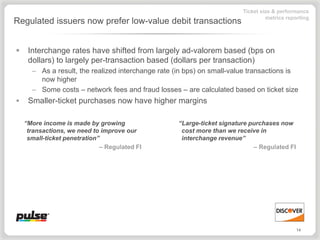
Regulated issuers now prefer low-value debit transactions


    Interchange rates have shifted from largely ad-valorem based (bps on
     dollars) to largely per-transaction based (dollars per transaction)
      – As a result, the realized interchange rate (in bps) on small-value transactions is
        now higher
      – Some costs – network fees and fraud losses – are calculated based on ticket size
    Smaller-ticket purchases now have higher margins

    “More income is made by growing                 “Large-ticket signature purchases now
     transactions, we need to improve our            cost more than we receive in
     small-ticket penetration”                       interchange revenue”
                              – Regulated FI                                 – Regulated FI


                                                                                              14
Rewards
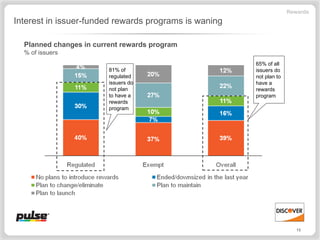
Interest in issuer-funded rewards programs is waning

  Planned changes in current rewards program
  % of issuers
                                                       65% of all
                         81% of                        issuers do
                         regulated                     not plan to
                         issuers do                    have a
                         not plan                      rewards
                         to have a                     program
                         rewards
                         program


                                                                        15
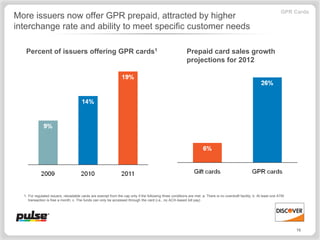
GPR Cards
More issuers now offer GPR prepaid, attracted by higher
interchange rate and ability to meet specific customer needs

   Percent of issuers offering GPR cards1                                                                  Prepaid card sales growth
                                                                                                           projections for 2012

                                                                                                                    13%


  1. For regulated issuers, reloadable cards are exempt from the cap only if the following three conditions are met: a. There is no overdraft facility; b. At least one ATM
     transaction is free a month; c. The funds can only be accessed through the card (i.e., no ACH-based bill pay)


                                                                                                                                                                              16
What Changed with Regulation II’s
Network Exclusivity Provision


                                    17
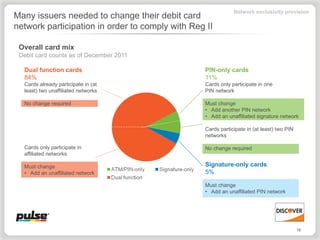
Network exclusivity provision
Many issuers needed to change their debit card
network participation in order to comply with Reg II

 Overall card mix
 Debit card counts as of December 2011

  Dual function cards                             PIN-only cards
  84%                                             11%
  Cards already participate in (at                Cards only participate in one
  least) two unaffiliated networks                PIN network

  No change required                              Must change
                                                  • Add another PIN network
                                                  • Add an unaffiliated signature network

                                                  Cards participate in (at least) two PIN
                                                  networks

  Cards only participate in                       No change required
  affiliated networks

  Must change                                     Signature-only cards
  • Add an unaffiliated network                   5%

                                                  Must change
                                                  • Add an unaffiliated PIN network


                                                                                            18
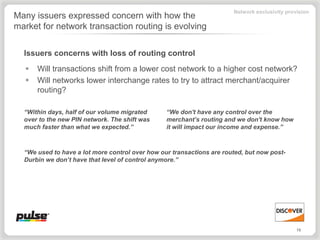
Network exclusivity provision
Many issuers expressed concern with how the
market for network transaction routing is evolving


  Issuers concerns with loss of routing control
      Will transactions shift from a lower cost network to a higher cost network?
      Will networks lower interchange rates to try to attract merchant/acquirer
       routing?

  “Within days, half of our volume migrated      “We don't have any control over the
  over to the new PIN network. The shift was     merchant’s routing and we don't know how
  much faster than what we expected.”            it will impact our income and expense.”


  “We used to have a lot more control over how our transactions are routed, but now post-
  Durbin we don’t have that level of control anymore.”


                                                                                               19
Certain Fundamentals are Unchanged


                                     20
Market characteristics that did not change post-Reg II


   Exempt         Debit economics for exempt issuers have not been significantly impacted
   issuers’        by Reg II – at least, not to date – and hence their view of debit is relatively
   interest in     unaffected by it
   debit            – Interchange has declined by 0-3%, as compared to 30-60% for regulated issuers
                    – Exempt issuers are focused on improving debit performance metrics, rewards
                      programs and growing the business
   Debit          Consumer usage of debit continues to grow strongly; growth in 2011
   growth          exceeded issuers’ expectations
                  Issuers expect the positive trend to continue
   Fraud as a     Fraud continues to be one of the top challenges facing the industry,
   key             impacting both regulated and exempt issuers
   challenge      Issuers expect fraud rates to remain steady or increase in the future; few
                   predict declines
   Outlook for    All issuers agree that regulatory pressure and fraud are the biggest
   debit           challenges to their debit business
                  Exempt issuers see more growth opportunities in the debit business;
                   regulated issuers show greater interest in cost reduction opportunities


                                                                                                      21
Debit growth
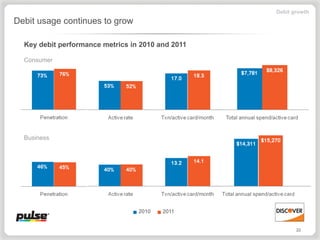
Debit usage continues to grow

  Key debit performance metrics in 2010 and 2011

  Consumer


  Business


                                  2010   2011


                                                          22
Debit growth
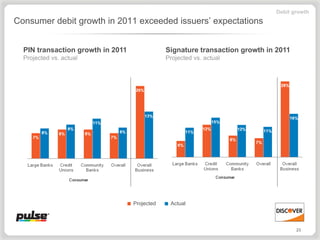
Consumer debit growth in 2011 exceeded issuers’ expectations


  PIN transaction growth in 2011               Signature transaction growth in 2011
  Projected vs. actual                         Projected vs. actual


                                   Projected    Actual


                                                                                      23
Debit growth
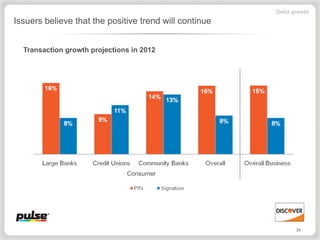
Issuers believe that the positive trend will continue


  Transaction growth projections in 2012


                               Consumer


                                                               24
Fraud as a key challenge
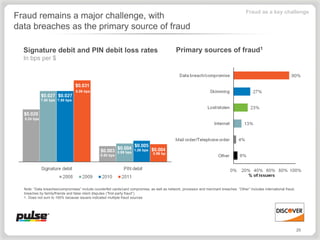
Fraud remains a major challenge, with
data breaches as the primary source of fraud

  Signature debit and PIN debit loss rates                                                     Primary sources of fraud1
  In bps per $


                                 8.06 bps
                                  8.06 bps

             7.50 bps 7.50 bps
             7.50 bps 7.50 bps


  5.24 bps


                                                                      1.26 bps
                                                            0.99 bps
                                                                   1.26 bps      0.99 bp
                                                 0.80 bps


  Note: “Data breaches/compromises” include counterfeit cards/card compromise, as well as network, processor and merchant breaches. “Other” includes international fraud,
  breaches by family/friends and false client disputes (“first-party fraud”)
  1. Does not sum to 100% because issuers indicated multiple fraud sources


                                                                                                                                                                            25
Fraud as a key challenge
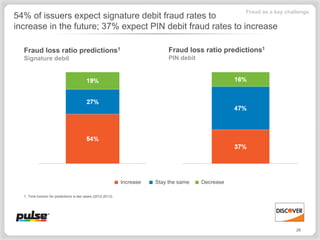
54% of issuers expect signature debit fraud rates to
increase in the future; 37% expect PIN debit fraud rates to increase

  Fraud loss ratio predictions1                                              Fraud loss ratio predictions1
  Signature debit                                                            PIN debit


                                                             Increase   Stay the same    Decrease

  1. Time horizon for predictions is two years (2012-2013)


                                                                                                                       26
Outlook for debit
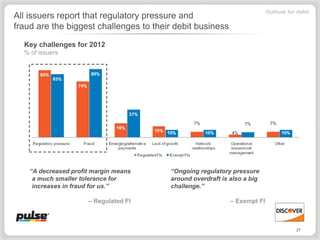
All issuers report that regulatory pressure and
fraud are the biggest challenges to their debit business

  Key challenges for 2012
  % of issuers


    “A decreased profit margin means    “Ongoing regulatory pressure
     a much smaller tolerance for       around overdraft is also a big
     increases in fraud for us.”        challenge.”

                      – Regulated FI                        – Exempt FI


                                                                                      27
Outlook for debit
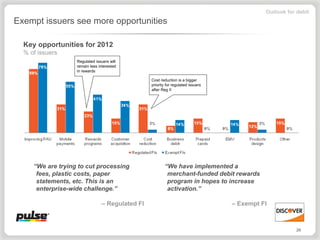
Exempt issuers see more opportunities

  Key opportunities for 2012
  % of issuers
                   Regulated issuers will
                   remain less interested
                   in rewards

                                                 Cost reduction is a bigger
                                                 priority for regulated issuers
                                                 after Reg II


     “We are trying to cut processing                   “We have implemented a
      fees, plastic costs, paper                         merchant-funded debit rewards
      statements, etc. This is an                        program in hopes to increase
      enterprise-wide challenge.”                        activation.”

                                – Regulated FI                                    – Exempt FI


                                                                                                        28
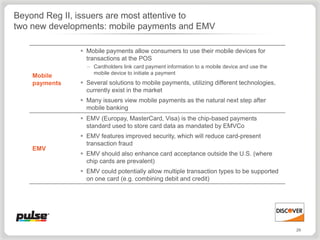
Beyond Reg II, issuers are most attentive to
two new developments: mobile payments and EMV

                Mobile payments allow consumers to use their mobile devices for
                 transactions at the POS
                 – Cardholders link card payment information to a mobile device and use the
                   mobile device to initiate a payment
    Mobile
    payments    Several solutions to mobile payments, utilizing different technologies,
                 currently exist in the market
                Many issuers view mobile payments as the natural next step after
                 mobile banking
                EMV (Europay, MasterCard, Visa) is the chip-based payments
                 standard used to store card data as mandated by EMVCo
                EMV features improved security, which will reduce card-present
                 transaction fraud
    EMV
                EMV should also enhance card acceptance outside the U.S. (where
                 chip cards are prevalent)
                EMV could potentially allow multiple transaction types to be supported
                 on one card (e.g. combining debit and credit)


                                                                                              29
Mobile payments
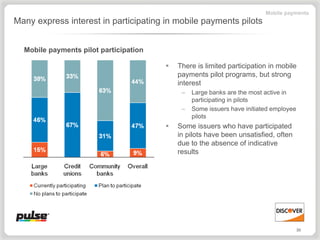
Many express interest in participating in mobile payments pilots


  Mobile payments pilot participation

                                           There is limited participation in mobile
                                            payments pilot programs, but strong
                                            interest
                                             –   Large banks are the most active in
                                                 participating in pilots
                                             –   Some issuers have initiated employee
                                                 pilots
                                           Some issuers who have participated
                                            in pilots have been unsatisfied, often
                                            due to the absence of indicative
                                            results


                                                                                        30
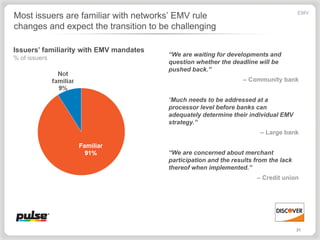
Most issuers are familiar with networks’ EMV rule                                      EMV

changes and expect the transition to be challenging

Issuers’ familiarity with EMV mandates
                                         “We are waiting for developments and
% of issuers
                                         question whether the deadline will be
                                         pushed back.”
                                                                  – Community bank


                                         “Much needs to be addressed at a
                                         processor level before banks can
                                         adequately determine their individual EMV
                                         strategy.”
                                                                         – Large bank


                                         “We are concerned about merchant
                                         participation and the results from the lack
                                         thereof when implemented.”
                                                                       – Credit union


                                                                                       31
EMV
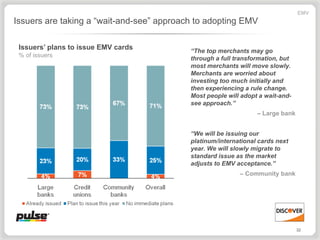
Issuers are taking a “wait-and-see” approach to adopting EMV

 Issuers’ plans to issue EMV cards         “The top merchants may go
 % of issuers
                                           through a full transformation, but
                                           most merchants will move slowly.
                                           Merchants are worried about
                                           investing too much initially and
                                           then experiencing a rule change.
                                           Most people will adopt a wait-and-
                                           see approach.”
                                                                 – Large bank


                                           “We will be issuing our
                                           platinum/international cards next
                                           year. We will slowly migrate to
                                           standard issue as the market
                                           adjusts to EMV acceptance.”
                                                           – Community bank


                                                                                32
Summary

    Debit growth continues to be strong despite profound changes to debit as
     a result of Reg II
      – Regulated issuers are investing less in debit and are pursuing different tactics
        than in the past (e.g. scaling back or discontinuing rewards programs,
        promoting PIN over signature)
      – The environment doesn’t seem to have changed for exempt issuers. Debit
        economics are similar – for now
      – The requirement to participate in at least two unaffiliated networks resulted in
        major shifts in PIN network affiliations, routing dynamics are still playing out
    New technologies are generating significant interest among issuers.
     Mobile payments and EMV are generating the usual mix of emotions
     associated with change – excitement, skepticism and trepidation
      – Issuers who have tested mobile payments are not particularly enthusiastic, but
        many issuers are still interested in piloting the technology
      – Very few issuers plan to migrate to EMV, largely driven by certain costs and
        uncertain benefits


                                                                                           33
Questions?


             34
Thank You


salesperson@pulsenetwork.com
pulsenetwork.com


                                           35

2012 Debit Issuer Study Key Findings: Despite New Regulation, Debit Continues to Grow (Webinar Slides)

  • 1.
    Executive Summary 2012 DebitIssuer Study Steve Sievert Executive Vice President, PULSE November 29, 2012
  • 2.
    Study Overview  PULSE commissioned Oliver Wyman to conduct the 2012 Debit Issuer Study, the definitive assessment of the debit card industry – Based on primary research with 57 financial institutions (FIs), drawn from across FI types and sizes, geographies and network affiliation – Conducted in April and May 2012 – Sample includes ~87 million debit cards and is representative of the market Segment Label Participants Segment Participants Large banks (Top 60) LB 26 Regulated 27 (≥ $10 BN in assets) Credit unions CU 15 Exempt (< $10 BN in assets) 30 Community banks CB 16 Total 57 Total 57 2
  • 3.
    Summary of KeyFindings  While debit growth remains strong, issuers report profound changes to their business as a result of Regulation II – For regulated issuers (≥ $10 billion in assets), how they manage their debit business has fundamentally shifted  Important changes in terms of the overall attractiveness of debit, the relative importance of different transaction types, and interest in debit rewards and GPR prepaid cards – Many issuers were affected by the requirement to participate in at least two unaffiliated networks  Issuers report on how they make their network selection decisions and how the dynamics within the transaction routing market are still playing out – Certain fundamentals of the debit business remain true, post-Reg II  For exempt issuers, economics and the importance of debit has been relatively unaffected, to date  For all issuers, debit growth remains robust and managing fraud is a challenge 3
  • 4.
    Summary of KeyFindings (cont’d)  New technologies and business models are generating considerable interest among issuers – 47% of issuers indicate that they would like to pilot mobile payments (to enable their debit “cards” in a mobile wallet)  However, of issuers that have tested it, interest has waned – Most issuers are aware of Visa and MasterCard rule changes designed to promote EMV (chip card) adoption; however, very few debit issuers plan to migrate to EMV debit cards  Issuers cite certain costs and uncertain benefits – Will merchants adopt? – Will the dates stick? – How much fraud will be eliminated versus pushed to other venues? 4
  • 5.
    What Changed withRegulation II’s Interchange Cap Provision 5
  • 6.
    Regulation II isshifting how regulated issuers manage debit business Exempt issuers report no material change to their business, so far Pre-Reg II strategy Post-Reg II strategy Overall interest in  Fast-growing, high-margin fee  Significant reduction in debit revenue and the debit business business contribution  Focus on growth through increasing  Less enthusiasm to grow debit spend Penetration, Activation and Usage PIN vs. signature  Promote signature debit, since  Same interchange rate cap for signature and PIN higher interchange rate more than  Promote PIN debit, since it now has a better offsets the higher costs margin (as a result of lower costs) Business debit  Highest per-txn contribution margin  Revenue declined by 87%  One of the top three growth  Business debit is now unprofitable on a per- opportunities within debit transaction basis for some issuers Ticket size and  Grow large-ticket transactions to  Grow small-ticket transactions, since revenue is performance capture more revenue/transaction now primarily driven by number of transactions metrics reporting  Revenue and margin tracked on a (not spend) bps of dollar volume basis  Revenue and margin tracked on a dollar per transaction basis Rewards  Use rewards as a lever to grow  Significantly lower interest in issuer-funded debit usage and profitability rewards programs, given shrinking top-line GPR cards  Limited interest in GPR prepaid  More issuers offer – and are interested in offering cards; greater opportunities – GPR prepaid cards (exempt from the elsewhere interchange cap under certain conditions) 6
  • 7.
    Overall interest indebit business As required by Reg II, interchange rates dropped for regulated issuers Consumer signature interchange Consumer PIN interchange Interchange rate ($ per txn) Interchange rate ($ per txn) 144 bps 144 bps 85 bps 85 bps 143 bps 137 bps 72 bps 74 bps 56 bps 51 bps 73 bps 64 bps Ticket Ticket size $36 $34 $36 size $42 $39 $42 Pre-Reg II Post-Reg II Note: Pre-Reg II refers to interchange rates reported by respondents for the period Jan-Sep 2011 (also referred to as pre-Oct 2011), while post-Reg II refers to interchange rates for the period Oct-Dec 2011 (also referred to as post-Oct 2011) 7
  • 8.
    Overall interest indebit business Debit interchange revenue per consumer card for regulated issuers is now 45% less than that for exempt issuers Average gross interchange revenue per active consumer card Regulated vs. exempt issuers Gross interchange revenue per active consumer card Regulated $51 per $0.23 × 18.3 × 12 = active card per year Gross interchange revenue per active consumer card $0.33 Exempt $92 per $0.41 × 18.7 × 12 = active card per year1 $0.46 Transaction mix Interchange rate Blended Monthly Months ($ per transaction) interchange rate transactions per year ($ per transaction) per active card Note: Numbers may not add up as shown in chart due to rounding 1. Up 6% from $87 per active card per year from the 2011 Study 8
  • 9.
    PIN vs. signature Regulatedissuers now prefer PIN debit over signature ■ Historically, many issuers preferred  Many regulated issuers are signature transactions employing various tactics to increase – Many issuers had marketing or their share of PIN transactions rewards strategies in place to promote signature transactions “We are promoting PIN debit over  Post-Reg II, a PIN transaction is more signature as a cost-savings play.” – Regulated FI profitable to a regulated issuer than a signature transaction “We need to move from signature to – Average gross contribution margin is PIN. We may have some sweepstakes for PIN transactions.” $0.11 per signature vs. $0.18 per PIN – Regulated FI transaction – Due to the interchange cap imposed “We have been aggressive with by Reg II, the signature-centric contacting customers with phone and approach has been abandoned by direct mail to promote PIN.” many regulated issuers – Regulated FI 9
  • 10.
    PIN vs. signature Relativeshare of PIN and signature debit transactions has remained steady, but might change post-Reg II Trends in PIN/signature 2011 PIN/signature transaction mix transaction mix 10
  • 11.
    Business debit Business signaturedebit was significantly impaired by Reg II Business signature interchange rates 231 bps 232 bps 241 bps 215 bps $0.39 40 bps 26 bps Pre-Reg II Post-Reg II Note:, Pre-Reg II refers to interchange rates reported by respondents for the period Jan-Sep 2011 (also referred to as pre-Oct 2011), while post-Reg II refers to interchange rates for the period Oct-Dec 2011 (also referred to as post-Oct 2011) 11
  • 12.
    Business debit Business debitinterchange revenue per card for regulated issuers is 85% less than that for exempt issuers Average gross interchange revenue per active business card Regulated vs. exempt issuers Gross interchange revenue per active business card Regulated $43 per $0.25 × 14.1 × 12 = active card per year Gross interchange revenue per active business card $0.33 $291 per Exempt $1.49 × 16.3 × 12 = active card per year $1.80 Transaction mix Interchange rate Blended Monthly Months ($ per transaction) interchange rate transactions per year ($ per transaction) per active card Note: Numbers may not add up to 100% because of rounding 1. Up 7% from $273 per active card per year from the 2011 Study 12
  • 13.
    Ticket size &performance The debit market is expanding at the low-end, metrics reporting with small-value transactions displacing cash Ticket size distribution Median = $19 Mean = $38 13
  • 14.
    Ticket size &performance metrics reporting Regulated issuers now prefer low-value debit transactions  Interchange rates have shifted from largely ad-valorem based (bps on dollars) to largely per-transaction based (dollars per transaction) – As a result, the realized interchange rate (in bps) on small-value transactions is now higher – Some costs – network fees and fraud losses – are calculated based on ticket size  Smaller-ticket purchases now have higher margins “More income is made by growing “Large-ticket signature purchases now transactions, we need to improve our cost more than we receive in small-ticket penetration” interchange revenue” – Regulated FI – Regulated FI 14
  • 15.
    Rewards Interest in issuer-fundedrewards programs is waning Planned changes in current rewards program % of issuers 65% of all 81% of issuers do regulated not plan to issuers do have a not plan rewards to have a program rewards program 15
  • 16.
    GPR Cards More issuersnow offer GPR prepaid, attracted by higher interchange rate and ability to meet specific customer needs Percent of issuers offering GPR cards1 Prepaid card sales growth projections for 2012 13% 1. For regulated issuers, reloadable cards are exempt from the cap only if the following three conditions are met: a. There is no overdraft facility; b. At least one ATM transaction is free a month; c. The funds can only be accessed through the card (i.e., no ACH-based bill pay) 16
  • 17.
    What Changed withRegulation II’s Network Exclusivity Provision 17
  • 18.
    Network exclusivity provision Manyissuers needed to change their debit card network participation in order to comply with Reg II Overall card mix Debit card counts as of December 2011 Dual function cards PIN-only cards 84% 11% Cards already participate in (at Cards only participate in one least) two unaffiliated networks PIN network No change required Must change • Add another PIN network • Add an unaffiliated signature network Cards participate in (at least) two PIN networks Cards only participate in No change required affiliated networks Must change Signature-only cards • Add an unaffiliated network 5% Must change • Add an unaffiliated PIN network 18
  • 19.
    Network exclusivity provision Manyissuers expressed concern with how the market for network transaction routing is evolving Issuers concerns with loss of routing control  Will transactions shift from a lower cost network to a higher cost network?  Will networks lower interchange rates to try to attract merchant/acquirer routing? “Within days, half of our volume migrated “We don't have any control over the over to the new PIN network. The shift was merchant’s routing and we don't know how much faster than what we expected.” it will impact our income and expense.” “We used to have a lot more control over how our transactions are routed, but now post- Durbin we don’t have that level of control anymore.” 19
  • 20.
  • 21.
    Market characteristics thatdid not change post-Reg II Exempt  Debit economics for exempt issuers have not been significantly impacted issuers’ by Reg II – at least, not to date – and hence their view of debit is relatively interest in unaffected by it debit – Interchange has declined by 0-3%, as compared to 30-60% for regulated issuers – Exempt issuers are focused on improving debit performance metrics, rewards programs and growing the business Debit  Consumer usage of debit continues to grow strongly; growth in 2011 growth exceeded issuers’ expectations  Issuers expect the positive trend to continue Fraud as a  Fraud continues to be one of the top challenges facing the industry, key impacting both regulated and exempt issuers challenge  Issuers expect fraud rates to remain steady or increase in the future; few predict declines Outlook for  All issuers agree that regulatory pressure and fraud are the biggest debit challenges to their debit business  Exempt issuers see more growth opportunities in the debit business; regulated issuers show greater interest in cost reduction opportunities 21
  • 22.
    Debit growth Debit usagecontinues to grow Key debit performance metrics in 2010 and 2011 Consumer Business 2010 2011 22
  • 23.
    Debit growth Consumer debitgrowth in 2011 exceeded issuers’ expectations PIN transaction growth in 2011 Signature transaction growth in 2011 Projected vs. actual Projected vs. actual Projected Actual 23
  • 24.
    Debit growth Issuers believethat the positive trend will continue Transaction growth projections in 2012 Consumer 24
  • 25.
    Fraud as akey challenge Fraud remains a major challenge, with data breaches as the primary source of fraud Signature debit and PIN debit loss rates Primary sources of fraud1 In bps per $ 8.06 bps 8.06 bps 7.50 bps 7.50 bps 7.50 bps 7.50 bps 5.24 bps 1.26 bps 0.99 bps 1.26 bps 0.99 bp 0.80 bps Note: “Data breaches/compromises” include counterfeit cards/card compromise, as well as network, processor and merchant breaches. “Other” includes international fraud, breaches by family/friends and false client disputes (“first-party fraud”) 1. Does not sum to 100% because issuers indicated multiple fraud sources 25
  • 26.
    Fraud as akey challenge 54% of issuers expect signature debit fraud rates to increase in the future; 37% expect PIN debit fraud rates to increase Fraud loss ratio predictions1 Fraud loss ratio predictions1 Signature debit PIN debit Increase Stay the same Decrease 1. Time horizon for predictions is two years (2012-2013) 26
  • 27.
    Outlook for debit Allissuers report that regulatory pressure and fraud are the biggest challenges to their debit business Key challenges for 2012 % of issuers “A decreased profit margin means “Ongoing regulatory pressure a much smaller tolerance for around overdraft is also a big increases in fraud for us.” challenge.” – Regulated FI – Exempt FI 27
  • 28.
    Outlook for debit Exemptissuers see more opportunities Key opportunities for 2012 % of issuers Regulated issuers will remain less interested in rewards Cost reduction is a bigger priority for regulated issuers after Reg II “We are trying to cut processing “We have implemented a fees, plastic costs, paper merchant-funded debit rewards statements, etc. This is an program in hopes to increase enterprise-wide challenge.” activation.” – Regulated FI – Exempt FI 28
  • 29.
    Beyond Reg II,issuers are most attentive to two new developments: mobile payments and EMV  Mobile payments allow consumers to use their mobile devices for transactions at the POS – Cardholders link card payment information to a mobile device and use the mobile device to initiate a payment Mobile payments  Several solutions to mobile payments, utilizing different technologies, currently exist in the market  Many issuers view mobile payments as the natural next step after mobile banking  EMV (Europay, MasterCard, Visa) is the chip-based payments standard used to store card data as mandated by EMVCo  EMV features improved security, which will reduce card-present transaction fraud EMV  EMV should also enhance card acceptance outside the U.S. (where chip cards are prevalent)  EMV could potentially allow multiple transaction types to be supported on one card (e.g. combining debit and credit) 29
  • 30.
    Mobile payments Many expressinterest in participating in mobile payments pilots Mobile payments pilot participation  There is limited participation in mobile payments pilot programs, but strong interest – Large banks are the most active in participating in pilots – Some issuers have initiated employee pilots  Some issuers who have participated in pilots have been unsatisfied, often due to the absence of indicative results 30
  • 31.
    Most issuers arefamiliar with networks’ EMV rule EMV changes and expect the transition to be challenging Issuers’ familiarity with EMV mandates “We are waiting for developments and % of issuers question whether the deadline will be pushed back.” – Community bank “Much needs to be addressed at a processor level before banks can adequately determine their individual EMV strategy.” – Large bank “We are concerned about merchant participation and the results from the lack thereof when implemented.” – Credit union 31
  • 32.
    EMV Issuers are takinga “wait-and-see” approach to adopting EMV Issuers’ plans to issue EMV cards “The top merchants may go % of issuers through a full transformation, but most merchants will move slowly. Merchants are worried about investing too much initially and then experiencing a rule change. Most people will adopt a wait-and- see approach.” – Large bank “We will be issuing our platinum/international cards next year. We will slowly migrate to standard issue as the market adjusts to EMV acceptance.” – Community bank 32
  • 33.
    Summary  Debit growth continues to be strong despite profound changes to debit as a result of Reg II – Regulated issuers are investing less in debit and are pursuing different tactics than in the past (e.g. scaling back or discontinuing rewards programs, promoting PIN over signature) – The environment doesn’t seem to have changed for exempt issuers. Debit economics are similar – for now – The requirement to participate in at least two unaffiliated networks resulted in major shifts in PIN network affiliations, routing dynamics are still playing out  New technologies are generating significant interest among issuers. Mobile payments and EMV are generating the usual mix of emotions associated with change – excitement, skepticism and trepidation – Issuers who have tested mobile payments are not particularly enthusiastic, but many issuers are still interested in piloting the technology – Very few issuers plan to migrate to EMV, largely driven by certain costs and uncertain benefits 33
  • 34.
  • 35.