Cambodia
Qualification
Framework
(CQF)
 Lecturer: MR. VATH VARY
 Tel: 017 471 117
 Email: varyvath@gmail.com
AGA
INSTITUTE
Contents
What is Cambodia
Qualification
Framework?
Purposes
Core elements of CQF
Challenges
Conclusion
MR. VATH VARY
What is Cambodian Qualifications
Framework (CQF)?
 CQF …
 is an instrument for development and classification
qualification based on a set of criteria that is agreed
nationally for specified levels of learning outcome
achieved.
 is a policy and strategy in outcomes, academic levels
and quality of qualification, and is widely recognized
as such as in the international academic and
professional communities.
 is intended to ensure equivalency comparison within
the Kingdom in the standards of national and regional
qualifications.
CQF
MR. VATH VARY
Provide nationally consistent
recognition of outcomes
achieved in each qualification
of education and training;
Provide flexible pathways for
learners between higher
education and technical and
vocational training;
Provide flexible purposes of
education and training.
Encourage people to develop
their knowledge, skills, and
promote lifelong learning;
Purposes
of
CQF
MR. VATH VARY
Provide reference points for
quality assurance in higher
education and technical
and vocational training
Promote mutual
recognition of qualifications
at national and
international level;
Facilitate student and
workforce mobility in the
region.
Purposes
of
CQF
MR. VATH VARY
The principal elements in
the CQF:
1) Characteristics of the
program
2) Characteristics of the degree
holders
3) Learning outcomes
4) Study pathway
Structure
of CQF
MR. VATH VARY
Structure of CQF
MR. VATH VARY
• Levels numbered and linked to qualification titles to describe the increasing
intellectual demand and complexity of learning expected as students to higher
technical or academic awards
Levels
• Points allocated to describe the amount of work or volume of learning expected
for an academic or technical qualifications or for course, study units or other
components of a program
Credits
• The broad categories of types of learning outcomes that a program is intended to
develop.
Learning outcomes
• Help with developing flexible pathways which assist people to move more easily
between technical and vocational education and training, and higher education
sectors and between those sectors and the labor market by providing the basis for
recognition of prior learning, including credit transfer, experience and current
competency
Study Pathway
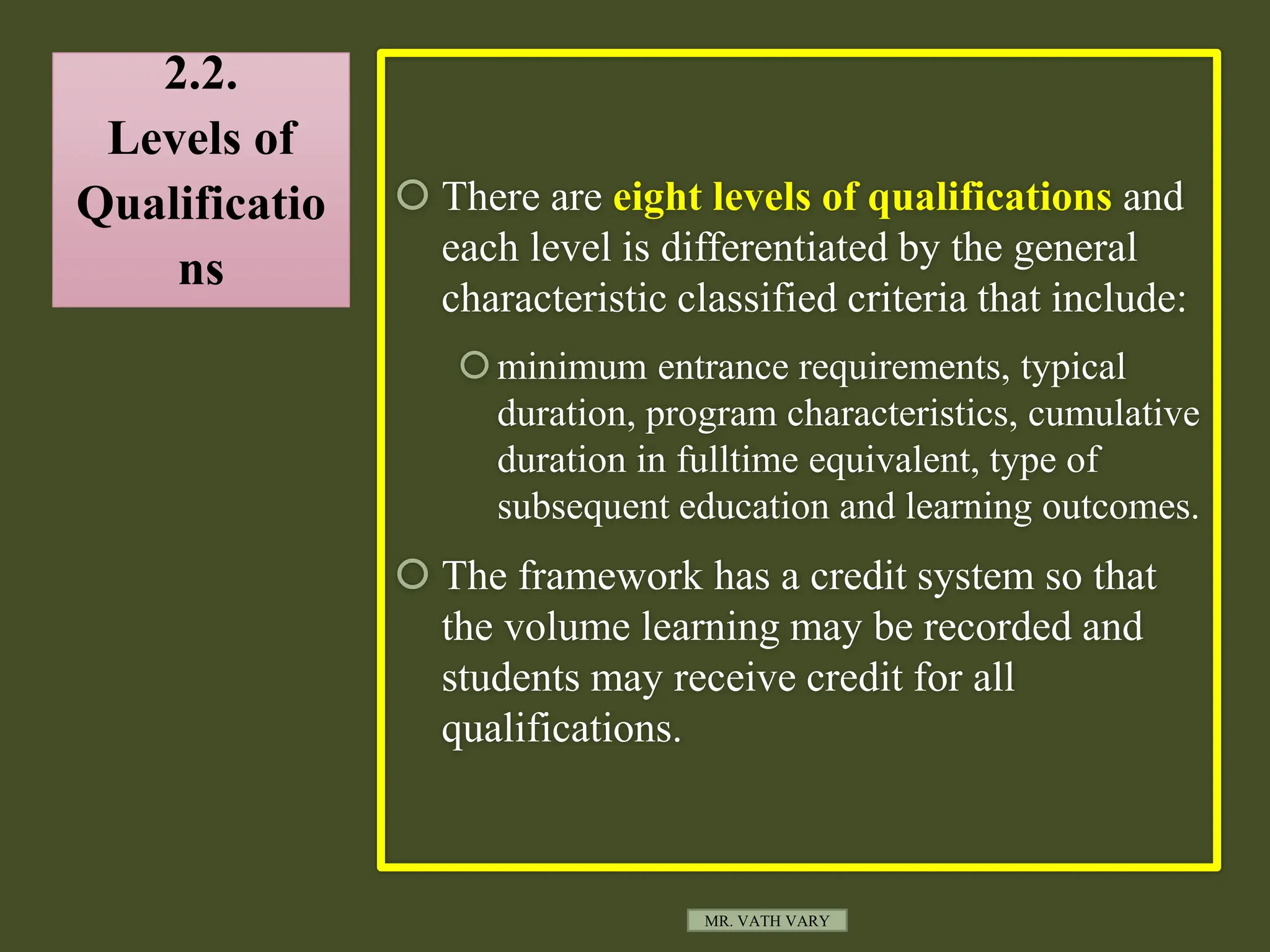
 There are eight levels of qualifications and
each level is differentiated by the general
characteristic classified criteria that include:
minimum entrance requirements, typical
duration, program characteristics, cumulative
duration in fulltime equivalent, type of
subsequent education and learning outcomes.
 The framework has a credit system so that
the volume learning may be recorded and
students may receive credit for all
qualifications.
2.2.
Levels of
Qualificatio
ns
MR. VATH VARY
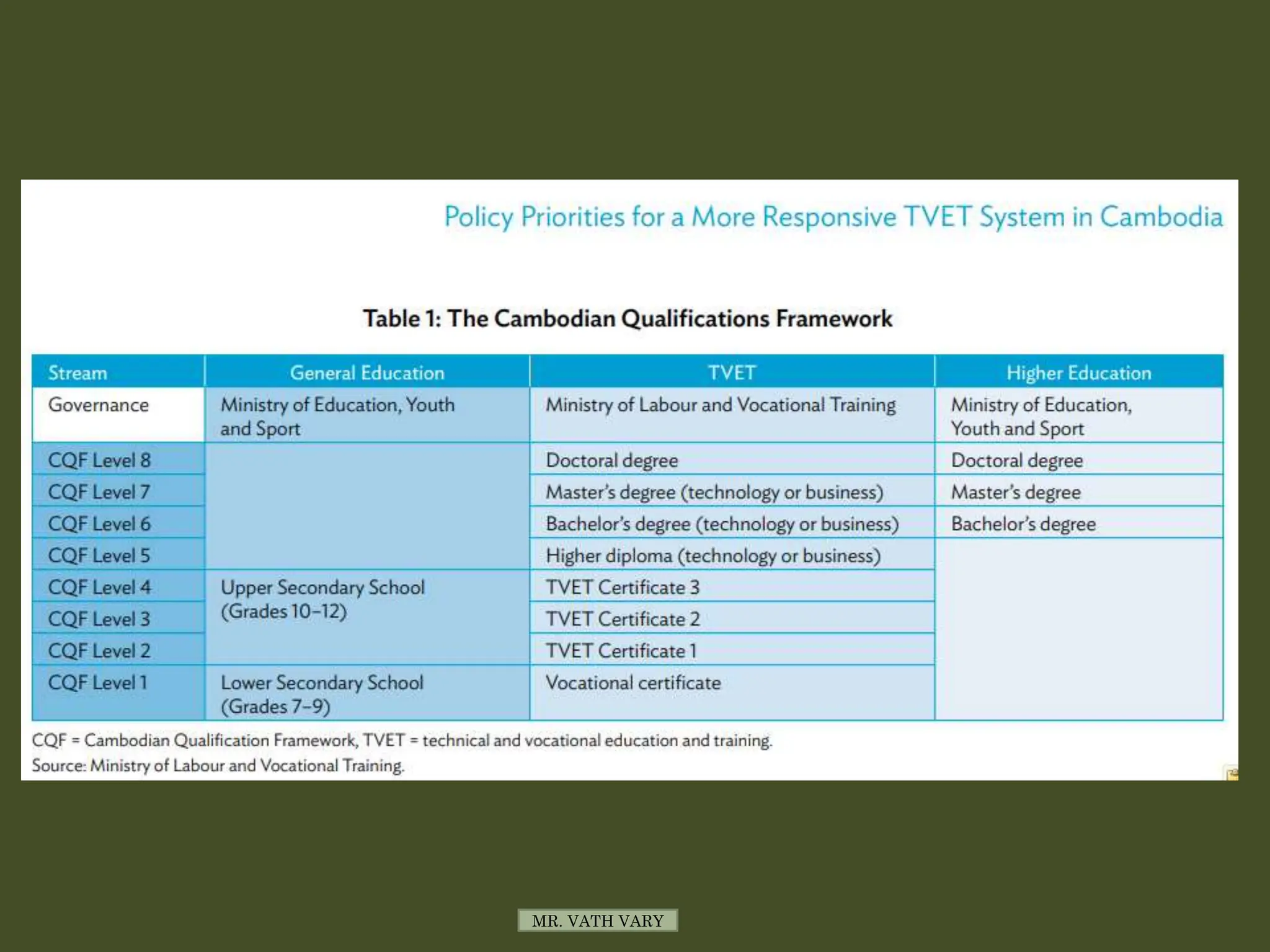
Structure of Levels in CQF
MR. VATH VARY
2.2. Levels of Qualifications
MR. VATH VARY
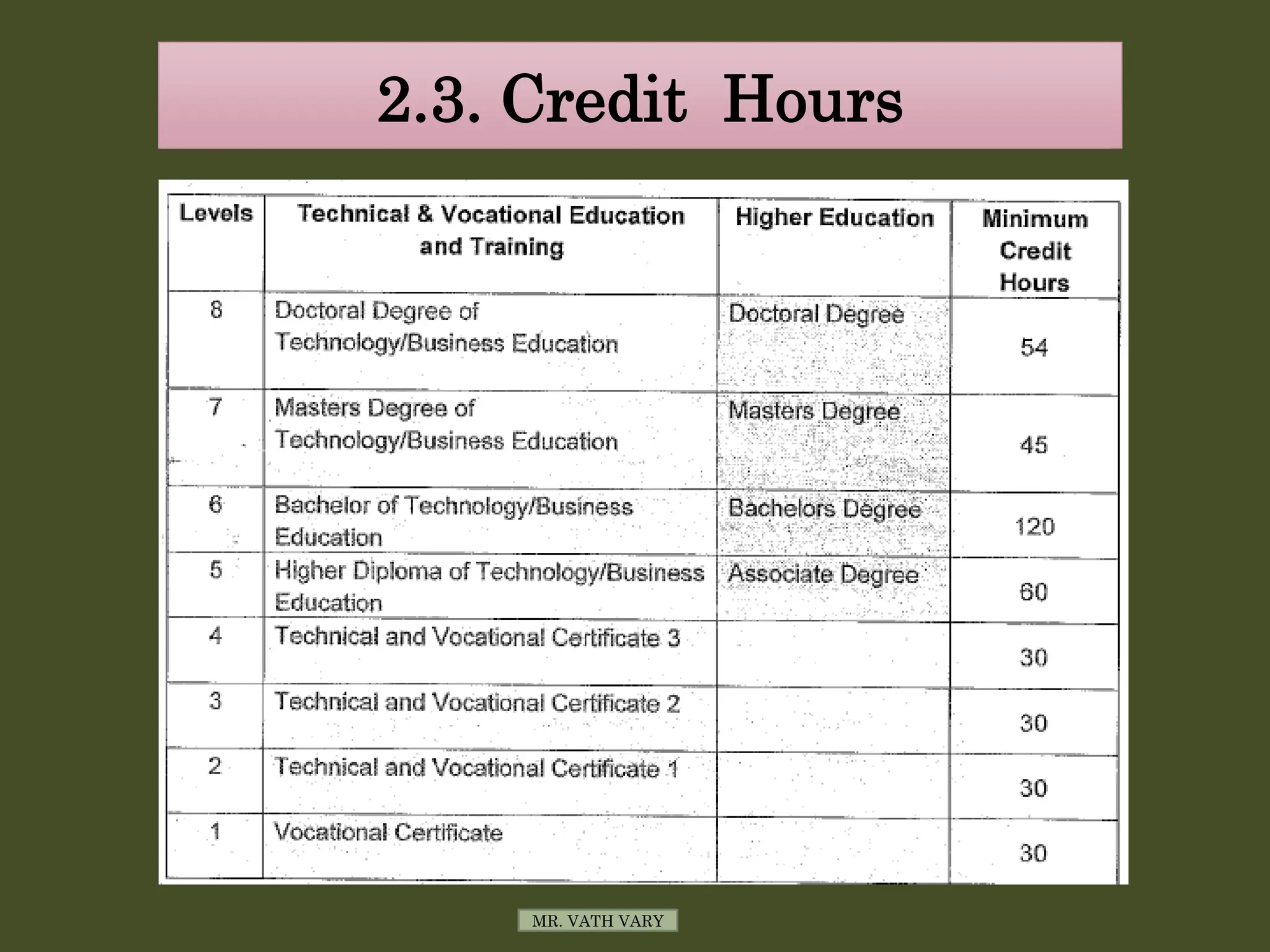
2.3. Credit Hours
MR. VATH VARY
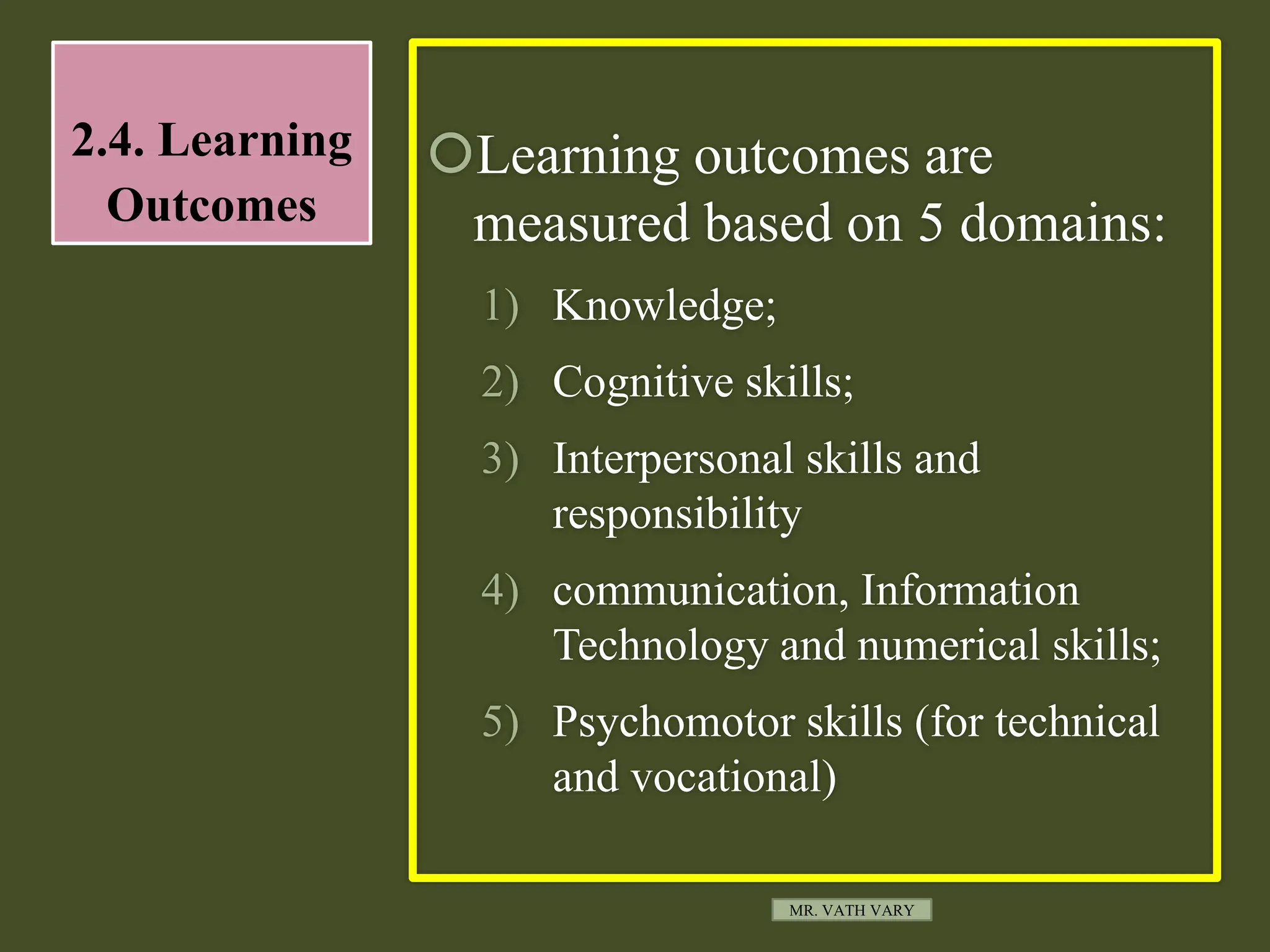
Learning outcomes are
measured based on 5 domains:
1) Knowledge;
2) Cognitive skills;
3) Interpersonal skills and
responsibility
4) communication, Information
Technology and numerical skills;
5) Psychomotor skills (for technical
and vocational)
2.4. Learning
Outcomes
MR. VATH VARY
Knowledge
MR. VATH VARY
• Specific
facts;
• Concepts,
principles
and
theories;
• Procedures
Knowledge
of
The ability to
recall,
understand,
and present
information
MR. VATH VARY
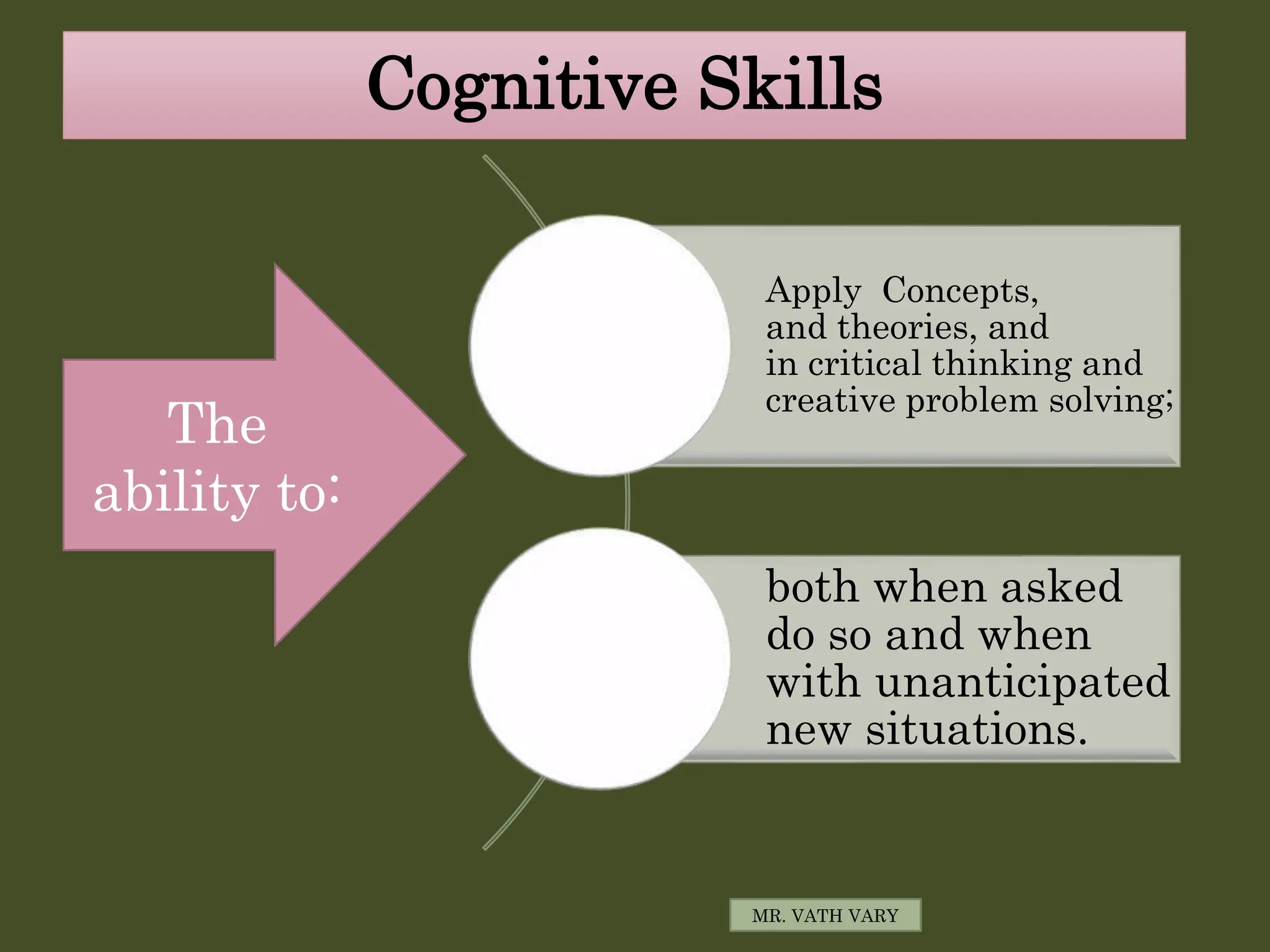
Apply Concepts,
and theories, and
in critical thinking and
creative problem solving;
both when asked
do so and when
with unanticipated
new situations.
Cognitive Skills
The
ability to:
MR. VATH VARY
Perform one or more skills with
become automatic with limited
or mental exertion
Perform of combining than one
skills in sequence with
consistency
Reproduce a skill with
proportion, and exactness and
usually performed independent
original source
Perform skills according to
rather than observation
Psychomotor skills
Apply to only some
programs involving
in technical trades
and occupations such
as tradesman or a
major equipment
operator and for a
surgeon, an artist, or
a musician.
MR. VATH VARY
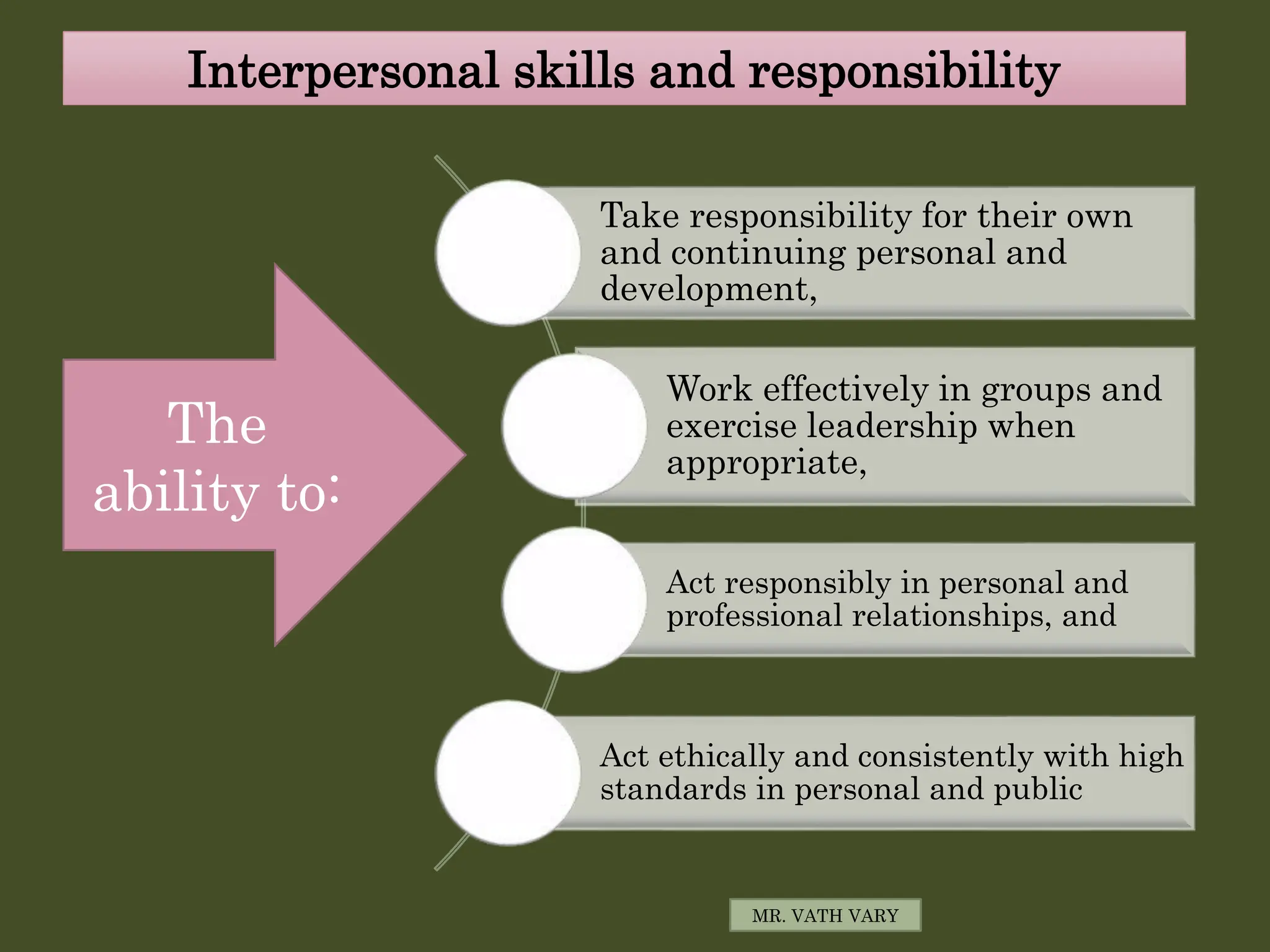
Take responsibility for their own
and continuing personal and
development,
Work effectively in groups and
exercise leadership when
appropriate,
Act responsibly in personal and
professional relationships, and
Act ethically and consistently with high
standards in personal and public
Interpersonal skills and responsibility
The
ability to:
MR. VATH VARY
Communicate effectively
oral and written form,
Use information and
communications
technology, and
Use basic
and statistical
Communication, information technology
and numerical skills
The
ability
to:
MR. VATH VARY
MR. VATH VARY
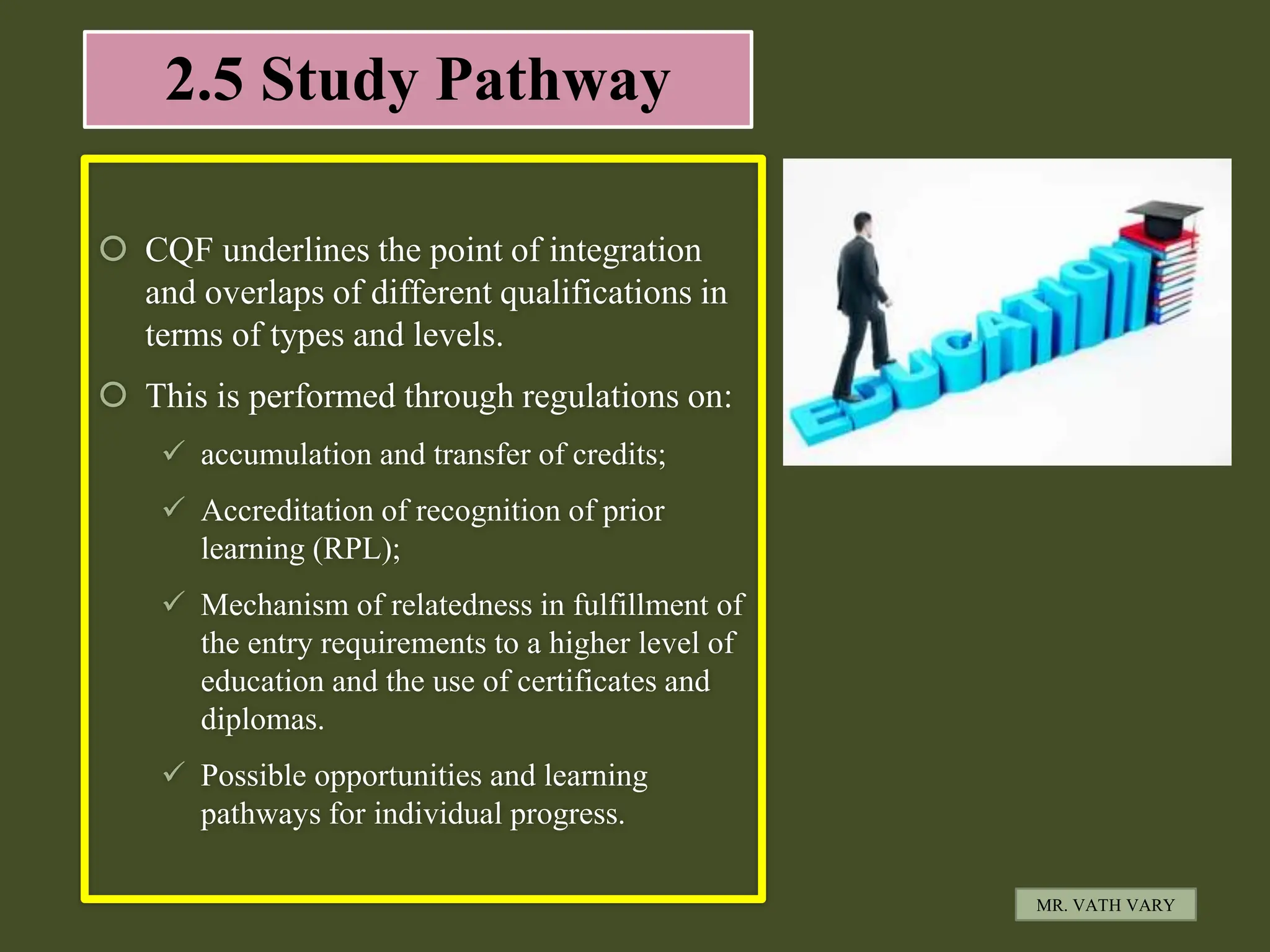
 CQF underlines the point of integration
and overlaps of different qualifications in
terms of types and levels.
 This is performed through regulations on:
 accumulation and transfer of credits;
 Accreditation of recognition of prior
learning (RPL);
 Mechanism of relatedness in fulfillment of
the entry requirements to a higher level of
education and the use of certificates and
diplomas.
 Possible opportunities and learning
pathways for individual progress.
MR. VATH VARY
2.5 Study Pathway
Developed under pressure
 Political
 Financial
 Implemented under
 Limited understanding of its values
 Limited capacity by all stakeholders
 Quality assurance issue
 External
 Internal
MR. VATH VARY
Challenge
 Improve internal and external quality
assurance practices;
 Establish mechanism to support
teachers-
 Center for Teaching and Learning;
 Develop resource guide to help
technical experts to be educators not
just teachers;
 Link practice of NQF by faculty
members with professor status;
 Training or joint workshop for
capacity building.
MR. VATH VARY
Conclusion
MR. VATH VARY

Cambodia Qualification Framework (CQF).ppt

  • 1.
    Cambodia Qualification Framework (CQF)  Lecturer: MR.VATH VARY  Tel: 017 471 117  Email: varyvath@gmail.com AGA INSTITUTE
  • 2.
    Contents What is Cambodia Qualification Framework? Purposes Coreelements of CQF Challenges Conclusion MR. VATH VARY
  • 3.
    What is CambodianQualifications Framework (CQF)?  CQF …  is an instrument for development and classification qualification based on a set of criteria that is agreed nationally for specified levels of learning outcome achieved.  is a policy and strategy in outcomes, academic levels and quality of qualification, and is widely recognized as such as in the international academic and professional communities.  is intended to ensure equivalency comparison within the Kingdom in the standards of national and regional qualifications. CQF MR. VATH VARY
  • 4.
    Provide nationally consistent recognitionof outcomes achieved in each qualification of education and training; Provide flexible pathways for learners between higher education and technical and vocational training; Provide flexible purposes of education and training. Encourage people to develop their knowledge, skills, and promote lifelong learning; Purposes of CQF MR. VATH VARY
  • 5.
    Provide reference pointsfor quality assurance in higher education and technical and vocational training Promote mutual recognition of qualifications at national and international level; Facilitate student and workforce mobility in the region. Purposes of CQF MR. VATH VARY
  • 6.
    The principal elementsin the CQF: 1) Characteristics of the program 2) Characteristics of the degree holders 3) Learning outcomes 4) Study pathway Structure of CQF MR. VATH VARY
  • 7.
    Structure of CQF MR.VATH VARY • Levels numbered and linked to qualification titles to describe the increasing intellectual demand and complexity of learning expected as students to higher technical or academic awards Levels • Points allocated to describe the amount of work or volume of learning expected for an academic or technical qualifications or for course, study units or other components of a program Credits • The broad categories of types of learning outcomes that a program is intended to develop. Learning outcomes • Help with developing flexible pathways which assist people to move more easily between technical and vocational education and training, and higher education sectors and between those sectors and the labor market by providing the basis for recognition of prior learning, including credit transfer, experience and current competency Study Pathway
  • 8.
     There areeight levels of qualifications and each level is differentiated by the general characteristic classified criteria that include: minimum entrance requirements, typical duration, program characteristics, cumulative duration in fulltime equivalent, type of subsequent education and learning outcomes.  The framework has a credit system so that the volume learning may be recorded and students may receive credit for all qualifications. 2.2. Levels of Qualificatio ns MR. VATH VARY
  • 9.
    Structure of Levelsin CQF MR. VATH VARY 2.2. Levels of Qualifications
  • 10.
    MR. VATH VARY 2.3.Credit Hours
  • 11.
  • 12.
    Learning outcomes are measuredbased on 5 domains: 1) Knowledge; 2) Cognitive skills; 3) Interpersonal skills and responsibility 4) communication, Information Technology and numerical skills; 5) Psychomotor skills (for technical and vocational) 2.4. Learning Outcomes MR. VATH VARY
  • 13.
    Knowledge MR. VATH VARY •Specific facts; • Concepts, principles and theories; • Procedures Knowledge of The ability to recall, understand, and present information
  • 14.
    MR. VATH VARY ApplyConcepts, and theories, and in critical thinking and creative problem solving; both when asked do so and when with unanticipated new situations. Cognitive Skills The ability to:
  • 15.
    MR. VATH VARY Performone or more skills with become automatic with limited or mental exertion Perform of combining than one skills in sequence with consistency Reproduce a skill with proportion, and exactness and usually performed independent original source Perform skills according to rather than observation Psychomotor skills Apply to only some programs involving in technical trades and occupations such as tradesman or a major equipment operator and for a surgeon, an artist, or a musician.
  • 16.
    MR. VATH VARY Takeresponsibility for their own and continuing personal and development, Work effectively in groups and exercise leadership when appropriate, Act responsibly in personal and professional relationships, and Act ethically and consistently with high standards in personal and public Interpersonal skills and responsibility The ability to:
  • 17.
    MR. VATH VARY Communicateeffectively oral and written form, Use information and communications technology, and Use basic and statistical Communication, information technology and numerical skills The ability to:
  • 18.
  • 19.
  • 20.
     CQF underlinesthe point of integration and overlaps of different qualifications in terms of types and levels.  This is performed through regulations on:  accumulation and transfer of credits;  Accreditation of recognition of prior learning (RPL);  Mechanism of relatedness in fulfillment of the entry requirements to a higher level of education and the use of certificates and diplomas.  Possible opportunities and learning pathways for individual progress. MR. VATH VARY 2.5 Study Pathway
  • 21.
    Developed under pressure Political  Financial  Implemented under  Limited understanding of its values  Limited capacity by all stakeholders  Quality assurance issue  External  Internal MR. VATH VARY Challenge
  • 22.
     Improve internaland external quality assurance practices;  Establish mechanism to support teachers-  Center for Teaching and Learning;  Develop resource guide to help technical experts to be educators not just teachers;  Link practice of NQF by faculty members with professor status;  Training or joint workshop for capacity building. MR. VATH VARY Conclusion
  • 23.