Jose M Cantera History 141 Arguello 4/29/2009
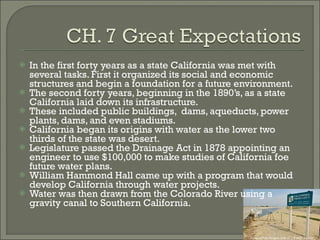
In the first forty years as a state California was met with several tasks. First it organized its social and economic structures and begin a foundation for a future environment. The second forty years, beginning in the 1890’s, as a state California laid down its infrastructure. These included public buildings,  dams, aqueducts, power plants, dams, and even stadiums. California began its origins with water as the lower two thirds of the state was desert. Legislature passed the Drainage Act in 1878 appointing an engineer to use $100,000 to make studies of California foe future water plans. William Hammond Hall came up with a program that would develop California through water projects. Water was then drawn from the Colorado River using a gravity canal to Southern California.
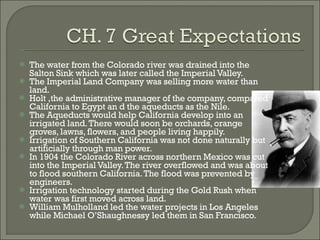
The water from the Colorado river was drained into the Salton Sink which was later called the Imperial Valley. The Imperial Land Company was selling more water than land. Holt ,the administrative manager of the company, compared California to Egypt an d the aqueducts as the Nile. The Aqueducts would help California develop into an irrigated land. There would soon be orchards, orange groves, lawns, flowers, and people living happily. Irrigation of Southern California was not done naturally but artificially through man power. In 1904 the Colorado River across northern Mexico was cut into the Imperial Valley. The river overflowed and was about to flood southern California. The flood was prevented by engineers. Irrigation technology started during the Gold Rush when water was first moved across land. William Mulholland led the water projects in Los Angeles while Michael O’Shaughnessy led them in San Francisco.
It took over six years to built the aqueduct in Los Angeles. 235 miles of construction needed to be done. On Wednesday, November 5, 1913 the water finally came to the residents. Both water and electricity was obtained from the water systems.  They served as many as four million people. Even though the water projects served humanity, they managed to destroy the environment. Lakes were emptied out and valleys were filled up to create reservoirs. A Mediterranean Revival style was present in developing neighbors of San Francisco. Berkeley was turned into a city of redwood bungalows. The university culture of the bay area was being enhanced by the construction of the University of Palo Alto and the University of California at Berkeley. The desire for neoclassical order in the Bay Area was strong enough that architect Daniel Hudson was invited. He called for the transformation of the city.
The Great Depression arrived late to California. The only reason it did not affect the state as much was because of financial diversity. Economy came from several sources.  Agriculture, industry, entertainment, tourism, and services.. This made it hard to be affected from a single source such as industry. The depression made it into California in the early 1930’s. This was caused by the instability of the work force in agriculture. There was also a labor resistant oligarchy in southern California. The Gold Rush influenced several people to pursue personal labor  and benefit directly from working their hands. Physical labor for hire was scarce in the area. Instead people preferred to work in the mines. Unions were also starting to be developed. This led to conflicts regarding labor laws. The Chinese immigrants took over jobs that local people did not want such as building railroads. Grain fields were later created once the rail carts were put in to transport the products.
The problem with the fields of crops was that they required seasonal labor yearlong. There had to be several workers during harvest time and some permanent workers. This resulted in a pattern of migration in California for labor. Immigrants would come and work for a cop one season and when done move to another. Migrant workers were mostly males that came and left often. Soon workers wanted to better their conditions through unions. Their soon began to be violence and deaths as uprisings began to occur. Police officers and people were both killed. Even beer brewers demanded working rights. The outcome and size of the General Strike of 1901 led to the creation of  the Union Labor Party in San Francisco. San Diego was confronted with the Industrial Workers of the World in 1905. They managed to gain reputation for themselves by using violence to have their demands met.
Union members were later known as Wobbliest. During 1910 to 1911 their Wobbliest entered Fresno with demonstrations and the jails were filled  to capacity. In 1912 the Wobbliest got to San Diego for the dock strike. They were pulled off the trains by police officers and put into jail. An activist Emma Goldman came with her lover Ben Reitmen who were both arrested and tortured. By 1913, 2,800 immigrants had arrived to southwestern united States after harvest work was advertised. Living conditions were harsh and pay was $1:50 a day. With the help of IWW activist a strike was formed. A riot broke out during the protest and guns were shot leaving some dead. Two IWWW members were later caught after running away and tried, convicted, and sentenced to life in prison.
California was seized by the military in 1846 and was controlled until 1850. After that and for the rest of the nineteenth century California remained closely tied to the military. From 1891 a cavalry patrolled Yosemite Park. The Spanish-American war of 1898 made the United States an Asian-Pacific  military power. The Navy started to patrol both seas to make itself seem like a power on both oceans. In 1914 the Navy had a large presence in San Diego and established a Pacific fleet during the first world war. The military secured ship repair facilities in San Francisco and Los Angeles. The second world war began and most Americans did not want to enter it. The Attack on Pearl Harbor led FDR to enter the war.
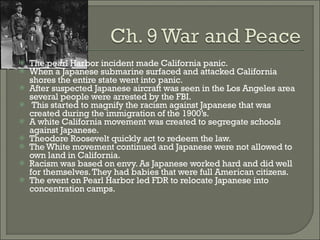
The pearl Harbor incident made California panic. When a Japanese submarine surfaced and attacked California shores the entire state went into panic. After suspected Japanese aircraft was seen in the Los Angeles area several people were arrested by the FBI. This started to magnify the racism against Japanese that was created during the immigration of the 1900’s. A white California movement was created to segregate schools against Japanese. Theodore Roosevelt quickly act to redeem the law. The White movement continued and Japanese were not allowed to own land in California. Racism was based on envy. As Japanese worked hard and did well for themselves. They had babies that were full American citizens. The event on Pearl Harbor led FDR to relocate Japanese into concentration camps.
The entire west coast was declared as a theater of war and all the Japanese were evacuated. On March 18 FDR issued the relocation of all people of Japanese decent to be sent to concentration camps were they would be interrogated. During 1943 the San Francisco area was becoming an important military command center. Several war efforts were being made in California. Many wart vehicles, Jeeps, Trucks, and tanks were being manufactured in California. Many soldiers were shipped out from California to fight in the Pacific. The Bay Area in San Francisco became an army society. In southern California the Navy maintained its presence in Long Beach. The Marines had a depot in San Diego.
www.wikipedia.org California by David Starr

California 789

  • 1.
    Jose M CanteraHistory 141 Arguello 4/29/2009
  • 2.
    In the firstforty years as a state California was met with several tasks. First it organized its social and economic structures and begin a foundation for a future environment. The second forty years, beginning in the 1890’s, as a state California laid down its infrastructure. These included public buildings, dams, aqueducts, power plants, dams, and even stadiums. California began its origins with water as the lower two thirds of the state was desert. Legislature passed the Drainage Act in 1878 appointing an engineer to use $100,000 to make studies of California foe future water plans. William Hammond Hall came up with a program that would develop California through water projects. Water was then drawn from the Colorado River using a gravity canal to Southern California.
  • 3.
    The water fromthe Colorado river was drained into the Salton Sink which was later called the Imperial Valley. The Imperial Land Company was selling more water than land. Holt ,the administrative manager of the company, compared California to Egypt an d the aqueducts as the Nile. The Aqueducts would help California develop into an irrigated land. There would soon be orchards, orange groves, lawns, flowers, and people living happily. Irrigation of Southern California was not done naturally but artificially through man power. In 1904 the Colorado River across northern Mexico was cut into the Imperial Valley. The river overflowed and was about to flood southern California. The flood was prevented by engineers. Irrigation technology started during the Gold Rush when water was first moved across land. William Mulholland led the water projects in Los Angeles while Michael O’Shaughnessy led them in San Francisco.
  • 4.
    It took oversix years to built the aqueduct in Los Angeles. 235 miles of construction needed to be done. On Wednesday, November 5, 1913 the water finally came to the residents. Both water and electricity was obtained from the water systems. They served as many as four million people. Even though the water projects served humanity, they managed to destroy the environment. Lakes were emptied out and valleys were filled up to create reservoirs. A Mediterranean Revival style was present in developing neighbors of San Francisco. Berkeley was turned into a city of redwood bungalows. The university culture of the bay area was being enhanced by the construction of the University of Palo Alto and the University of California at Berkeley. The desire for neoclassical order in the Bay Area was strong enough that architect Daniel Hudson was invited. He called for the transformation of the city.
  • 5.
    The Great Depressionarrived late to California. The only reason it did not affect the state as much was because of financial diversity. Economy came from several sources. Agriculture, industry, entertainment, tourism, and services.. This made it hard to be affected from a single source such as industry. The depression made it into California in the early 1930’s. This was caused by the instability of the work force in agriculture. There was also a labor resistant oligarchy in southern California. The Gold Rush influenced several people to pursue personal labor and benefit directly from working their hands. Physical labor for hire was scarce in the area. Instead people preferred to work in the mines. Unions were also starting to be developed. This led to conflicts regarding labor laws. The Chinese immigrants took over jobs that local people did not want such as building railroads. Grain fields were later created once the rail carts were put in to transport the products.
  • 6.
    The problem withthe fields of crops was that they required seasonal labor yearlong. There had to be several workers during harvest time and some permanent workers. This resulted in a pattern of migration in California for labor. Immigrants would come and work for a cop one season and when done move to another. Migrant workers were mostly males that came and left often. Soon workers wanted to better their conditions through unions. Their soon began to be violence and deaths as uprisings began to occur. Police officers and people were both killed. Even beer brewers demanded working rights. The outcome and size of the General Strike of 1901 led to the creation of the Union Labor Party in San Francisco. San Diego was confronted with the Industrial Workers of the World in 1905. They managed to gain reputation for themselves by using violence to have their demands met.
  • 7.
    Union members werelater known as Wobbliest. During 1910 to 1911 their Wobbliest entered Fresno with demonstrations and the jails were filled to capacity. In 1912 the Wobbliest got to San Diego for the dock strike. They were pulled off the trains by police officers and put into jail. An activist Emma Goldman came with her lover Ben Reitmen who were both arrested and tortured. By 1913, 2,800 immigrants had arrived to southwestern united States after harvest work was advertised. Living conditions were harsh and pay was $1:50 a day. With the help of IWW activist a strike was formed. A riot broke out during the protest and guns were shot leaving some dead. Two IWWW members were later caught after running away and tried, convicted, and sentenced to life in prison.
  • 8.
    California was seizedby the military in 1846 and was controlled until 1850. After that and for the rest of the nineteenth century California remained closely tied to the military. From 1891 a cavalry patrolled Yosemite Park. The Spanish-American war of 1898 made the United States an Asian-Pacific military power. The Navy started to patrol both seas to make itself seem like a power on both oceans. In 1914 the Navy had a large presence in San Diego and established a Pacific fleet during the first world war. The military secured ship repair facilities in San Francisco and Los Angeles. The second world war began and most Americans did not want to enter it. The Attack on Pearl Harbor led FDR to enter the war.
  • 9.
    The pearl Harborincident made California panic. When a Japanese submarine surfaced and attacked California shores the entire state went into panic. After suspected Japanese aircraft was seen in the Los Angeles area several people were arrested by the FBI. This started to magnify the racism against Japanese that was created during the immigration of the 1900’s. A white California movement was created to segregate schools against Japanese. Theodore Roosevelt quickly act to redeem the law. The White movement continued and Japanese were not allowed to own land in California. Racism was based on envy. As Japanese worked hard and did well for themselves. They had babies that were full American citizens. The event on Pearl Harbor led FDR to relocate Japanese into concentration camps.
  • 10.
    The entire westcoast was declared as a theater of war and all the Japanese were evacuated. On March 18 FDR issued the relocation of all people of Japanese decent to be sent to concentration camps were they would be interrogated. During 1943 the San Francisco area was becoming an important military command center. Several war efforts were being made in California. Many wart vehicles, Jeeps, Trucks, and tanks were being manufactured in California. Many soldiers were shipped out from California to fight in the Pacific. The Bay Area in San Francisco became an army society. In southern California the Navy maintained its presence in Long Beach. The Marines had a depot in San Diego.
  • 11.