SOUTHERN PHILIPPINES INSTITUTE
OF SCIENCE AND TECHNOLOGY
Tia Maria Bldg. E. Aguinaldo Highway, Anabu 2A, Imus City, Cavite, 4103
COLLEGE OF ENGINEERING AND COMPUTER STUDIES
OBE-BASED COURSE SYLLABUS
SUBJECT
CODE
CpMATH1
SUBJECT TITLE Calculus 1
CREDIT UNITS 3 Units
CONTACT
HOURS
3 HRS / week
SUBJECT
DESCRIPTION
An introductory course covering the core concepts of limits, continuity and differentiability of functions involving one or more variables. This
also includes the application of differential calculations in solving problems on optimization, rates of change, related rates, tangents and normal,
and approximations; partial differentiation and transcendental curve tracing.
PRE-
REQUISITES
None
CO-
REQUISITES
N/A
INSTITUTIONA
L GRADUATE
OUTCOMES
BSCpE PROGRAM OUTCOMES COURSE INTENDED LEARNING OUTCOMES
INSTRUCTIONAL LEARNING PLAN (ILP)
WEEK TOPIC
Intended Learning Outcomes Suggested Teaching Learning
Activities/STRATEGY/METHOD
Suggested
Assessment
1 Functions; Continuity
and Limits
1. Explain and evaluate the concept of a function,
including domain, range, and types of functions, and apply
these concepts in solving mathematical problems.
1. Graphing and Exploration Using
Technology (Strategy: Inquiry-Based
Learning)
Quiz
Recitation
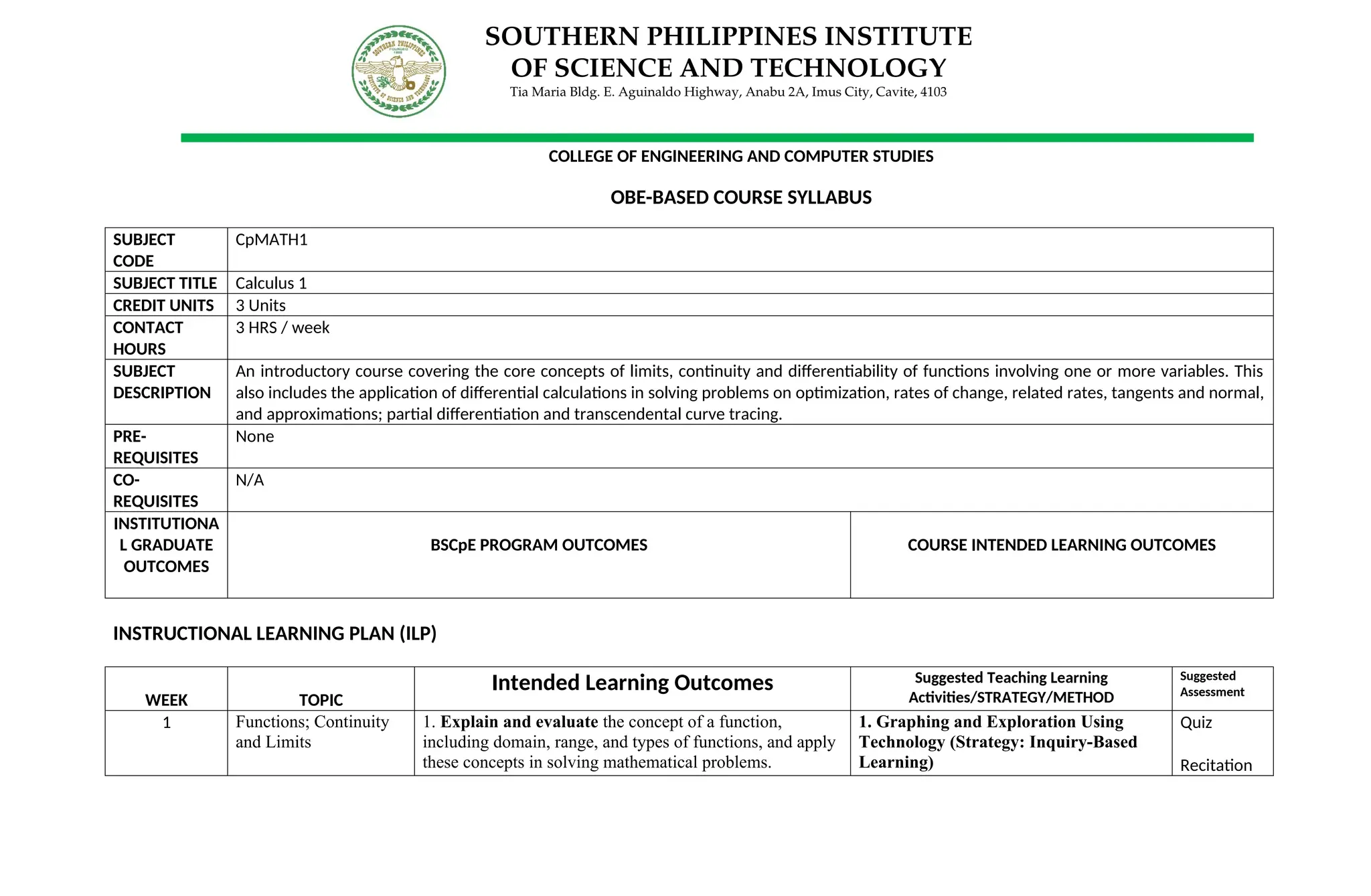
2. Determine the continuity of a function at a point and
analyze the limit of a function using graphical, numerical,
and analytical methods.
Activity: Students use graphing tools (e.g.,
Desmos, GeoGebra, or graphing
calculators) to plot different types of
functions and visually investigate their
continuity and limits at specific points.
2. Concept Mapping and Peer Teaching
(Strategy: Collaborative Learning)
Activity: In small groups, students create a
concept map connecting key ideas:
functions, types of
2
Derivatives & The
Slope
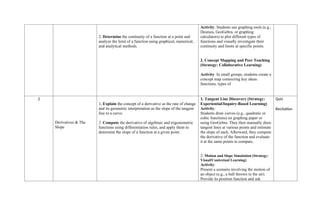
1. Explain the concept of a derivative as the rate of change
and its geometric interpretation as the slope of the tangent
line to a curve.
2. Compute the derivative of algebraic and trigonometric
functions using differentiation rules, and apply them to
determine the slope of a function at a given point.
1. Tangent Line Discovery (Strategy:
Experiential/Inquiry-Based Learning)
Activity:
Students draw curves (e.g., quadratic or
cubic functions) on graphing paper or
using GeoGebra. They then manually draw
tangent lines at various points and estimate
the slope of each. Afterward, they compute
the derivative of the function and evaluate
it at the same points to compare.
2. Motion and Slope Simulation (Strategy:
Visual/Contextual Learning)
Activity:
Present a scenario involving the motion of
an object (e.g., a ball thrown in the air).
Provide its position function and ask
Quiz
Recitation
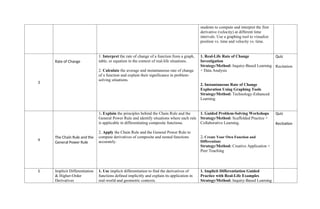
students to compute and interpret the first
derivative (velocity) at different time
intervals. Use a graphing tool to visualize
position vs. time and velocity vs. time.
3
Rate of Change
1. Interpret the rate of change of a function from a graph,
table, or equation in the context of real-life situations.
2. Calculate the average and instantaneous rate of change
of a function and explain their significance in problem-
solving situations.
1. Real-Life Rate of Change
Investigation
Strategy/Method: Inquiry-Based Learning
+ Data Analysis
2. Instantaneous Rate of Change
Exploration Using Graphing Tools
Strategy/Method: Technology-Enhanced
Learning
Quiz
Recitation
4
The Chain Rule and the
General Power Rule
1. Explain the principles behind the Chain Rule and the
General Power Rule and identify situations where each rule
is applicable in differentiating composite functions.
2. Apply the Chain Rule and the General Power Rule to
compute derivatives of composite and nested functions
accurately.
1. Guided Problem-Solving Workshops
Strategy/Method: Scaffolded Practice +
Collaborative Learning.
2. Create Your Own Function and
Differentiate
Strategy/Method: Creative Application +
Peer Teaching
Quiz
Recitation
5 Implicit Differentiation
& Higher-Order
Derivatives
1. Use implicit differentiation to find the derivatives of
functions defined implicitly and explain its application in
real-world and geometric contexts.
1. Implicit Differentiation Guided
Practice with Real-Life Examples
Strategy/Method: Inquiry-Based Learning
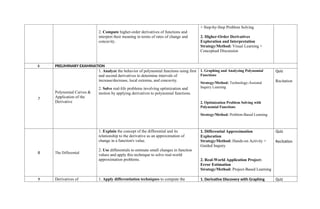
2. Compute higher-order derivatives of functions and
interpret their meaning in terms of rates of change and
concavity.
+ Step-by-Step Problem Solving
2. Higher-Order Derivatives
Exploration and Interpretation
Strategy/Method: Visual Learning +
Conceptual Discussion
6 PRELIMINARY EXAMINATION
7
Polynomial Curves &
Application of the
Derivative
1. Analyze the behavior of polynomial functions using first
and second derivatives to determine intervals of
increase/decrease, local extrema, and concavity.
2. Solve real-life problems involving optimization and
motion by applying derivatives to polynomial functions.
1. Graphing and Analyzing Polynomial
Functions
Strategy/Method: Technology-Assisted
Inquiry Learning
2. Optimization Problem Solving with
Polynomial Functions
Strategy/Method: Problem-Based Learning
Quiz
Recitation
8 The Differential
1. Explain the concept of the differential and its
relationship to the derivative as an approximation of
change in a function's value.
2. Use differentials to estimate small changes in function
values and apply this technique to solve real-world
approximation problems.
1. Differential Approximation
Exploration
Strategy/Method: Hands-on Activity +
Guided Inquiry
2. Real-World Application Project:
Error Estimation
Strategy/Method: Project-Based Learning
Quiz
Recitation
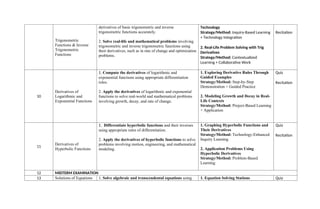
9 Derivatives of 1. Apply differentiation techniques to compute the 1. Derivative Discovery with Graphing Quiz
Trigonometric
Functions & Inverse
Trigonometric
Functions
derivatives of basic trigonometric and inverse
trigonometric functions accurately.
2. Solve real-life and mathematical problems involving
trigonometric and inverse trigonometric functions using
their derivatives, such as in rate of change and optimization
problems.
Technology
Strategy/Method: Inquiry-Based Learning
+ Technology Integration
2. Real-Life Problem Solving with Trig
Derivatives
Strategy/Method: Contextualized
Learning + Collaborative Work
Recitation
10
Derivatives of
Logarithmic and
Exponential Functions
1. Compute the derivatives of logarithmic and
exponential functions using appropriate differentiation
rules.
2. Apply the derivatives of logarithmic and exponential
functions to solve real-world and mathematical problems
involving growth, decay, and rate of change.
1. Exploring Derivative Rules Through
Guided Examples
Strategy/Method: Step-by-Step
Demonstration + Guided Practice
2. Modeling Growth and Decay in Real-
Life Contexts
Strategy/Method: Project-Based Learning
+ Application
Quiz
Recitation
11
Derivatives of
Hyperbolic Functions
1. Differentiate hyperbolic functions and their inverses
using appropriate rules of differentiation.
2. Apply the derivatives of hyperbolic functions to solve
problems involving motion, engineering, and mathematical
modeling.
1. Graphing Hyperbolic Functions and
Their Derivatives
Strategy/Method: Technology-Enhanced
Inquiry Learning
2. Application Problems Using
Hyperbolic Derivatives
Strategy/Method: Problem-Based
Learning
Quiz
Recitation
12 MIDTERM EXAMINATION
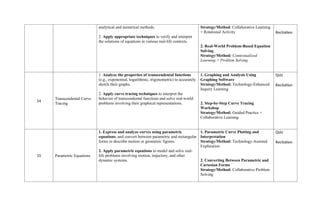
13 Solutions of Equations 1. Solve algebraic and transcendental equations using 1. Equation Solving Stations Quiz
analytical and numerical methods.
2. Apply appropriate techniques to verify and interpret
the solutions of equations in various real-life contexts.
Strategy/Method: Collaborative Learning
+ Rotational Activity
2. Real-World Problem-Based Equation
Solving
Strategy/Method: Contextualized
Learning + Problem Solving
Recitation
14
Transcendental Curve
Tracing
1. Analyze the properties of transcendental functions
(e.g., exponential, logarithmic, trigonometric) to accurately
sketch their graphs.
2. Apply curve tracing techniques to interpret the
behavior of transcendental functions and solve real-world
problems involving their graphical representations.
1. Graphing and Analysis Using
Graphing Software
Strategy/Method: Technology-Enhanced
Inquiry Learning
2. Step-by-Step Curve Tracing
Workshop
Strategy/Method: Guided Practice +
Collaborative Learning
Quiz
Recitation
15 Parametric Equations
1. Express and analyze curves using parametric
equations, and convert between parametric and rectangular
forms to describe motion or geometric figures.
2. Apply parametric equations to model and solve real-
life problems involving motion, trajectory, and other
dynamic systems.
1. Parametric Curve Plotting and
Interpretation
Strategy/Method: Technology-Assisted
Exploration
2. Converting Between Parametric and
Cartesian Forms
Strategy/Method: Collaborative Problem
Solving
Quiz
Recitation
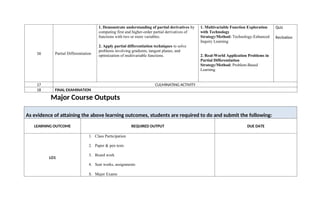
16 Partial Differentiation
1. Demonstrate understanding of partial derivatives by
computing first and higher-order partial derivatives of
functions with two or more variables.
2. Apply partial differentiation techniques to solve
problems involving gradients, tangent planes, and
optimization of multivariable functions.
1. Multivariable Function Exploration
with Technology
Strategy/Method: Technology-Enhanced
Inquiry Learning
2. Real-World Application Problems in
Partial Differentiation
Strategy/Method: Problem-Based
Learning
Quiz
Recitation
17 CULMINATING ACTIVITY
18 FINAL EXAMINATION
Major Course Outputs
As evidence of attaining the above learning outcomes, students are required to do and submit the following:
LEARNING OUTCOME REQUIRED OUTPUT DUE DATE
LO1
1. Class Participation
2. Paper & pen tests
3. Board work
4. Seat works, assignments
5. Major Exams
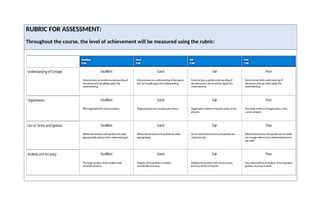
RUBRIC FOR ASSESSMENT:
Throughout the course, the level of achievement will be measured using the rubric:
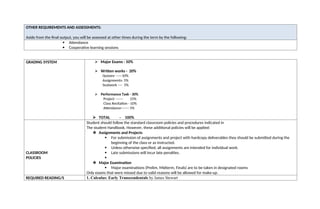
OTHER REQUIREMENTS AND ASSESSMENTS:
Aside from the final output, you will be assessed at other times during the term by the following:
 Attendance
 Cooperative learning sessions
GRADING SYSTEM  Major Exams - 50%
 Written works - 20%
Quizzes- -----10%
Assignments- 5%
Seatwork ---- 5%
 Performance Task - 30%
Project- ------ 15%
Class Recitation - 10%
Attendance------- 5%
 TOTAL – 100%
CLASSROOM
POLICIES
Student should follow the standard classroom policies and procedures indicated in
The student Handbook. However, these additional policies will be applied:
 Assignments and Projects
 For submission of assignments and project with hardcopy deliverables they should be submitted during the
beginning of the class or as instructed.
 Unless otherwise specified, all assignments are intended for individual work.
 Late submissions will incur late penalties.

 Major Examination
 Major examinations (Prelim, Midterm, Finals) are to be taken in designated rooms
Only exams that were missed due to valid reasons will be allowed for make-up.
REQUIRED READING/S 1. Calculus: Early Transcendentals by James Stewart
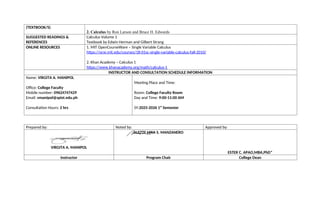
(TEXTBOOK/S)
2. Calculus by Ron Larson and Bruce H. Edwards
SUGGESTED READINGS &
REFERENCES
Calculus Volume 1
Textbook by Edwin Herman and Gilbert Strang
ONLINE RESOURCES 1. MIT OpenCourseWare – Single Variable Calculus
https://ocw.mit.edu/courses/18-01sc-single-variable-calculus-fall-2010/
2. Khan Academy – Calculus 1
https://www.khanacademy.org/math/calculus-1
INSTRUCTOR AND CONSULTATION SCHEDULE INFORMATION
Name: VIRGITA A. MANIPOL
Office: College Faculty
Mobile number: 09624747429
Email: vmanipol@spist.edu.ph
Consultation Hours: 2 hrs
Meeting Place and Time:
Room: College Faculty Room
Day and Time: 9:00-11:00 AM
SY:2025-2026 1st
Semester
Prepared by: Noted by: Approved by:
VIRGITA A. MANIPOL
ALETTE LYKA S. MANZANERO
ESTER C. APAO,MBA,PhD*
Instructor Program Chair College Dean

CALCULUS 1-Outcome Based Education-BASED SYLLABUS.docx

  • 1.
    SOUTHERN PHILIPPINES INSTITUTE OFSCIENCE AND TECHNOLOGY Tia Maria Bldg. E. Aguinaldo Highway, Anabu 2A, Imus City, Cavite, 4103 COLLEGE OF ENGINEERING AND COMPUTER STUDIES OBE-BASED COURSE SYLLABUS SUBJECT CODE CpMATH1 SUBJECT TITLE Calculus 1 CREDIT UNITS 3 Units CONTACT HOURS 3 HRS / week SUBJECT DESCRIPTION An introductory course covering the core concepts of limits, continuity and differentiability of functions involving one or more variables. This also includes the application of differential calculations in solving problems on optimization, rates of change, related rates, tangents and normal, and approximations; partial differentiation and transcendental curve tracing. PRE- REQUISITES None CO- REQUISITES N/A INSTITUTIONA L GRADUATE OUTCOMES BSCpE PROGRAM OUTCOMES COURSE INTENDED LEARNING OUTCOMES INSTRUCTIONAL LEARNING PLAN (ILP) WEEK TOPIC Intended Learning Outcomes Suggested Teaching Learning Activities/STRATEGY/METHOD Suggested Assessment 1 Functions; Continuity and Limits 1. Explain and evaluate the concept of a function, including domain, range, and types of functions, and apply these concepts in solving mathematical problems. 1. Graphing and Exploration Using Technology (Strategy: Inquiry-Based Learning) Quiz Recitation
  • 2.
    2. Determine thecontinuity of a function at a point and analyze the limit of a function using graphical, numerical, and analytical methods. Activity: Students use graphing tools (e.g., Desmos, GeoGebra, or graphing calculators) to plot different types of functions and visually investigate their continuity and limits at specific points. 2. Concept Mapping and Peer Teaching (Strategy: Collaborative Learning) Activity: In small groups, students create a concept map connecting key ideas: functions, types of 2 Derivatives & The Slope 1. Explain the concept of a derivative as the rate of change and its geometric interpretation as the slope of the tangent line to a curve. 2. Compute the derivative of algebraic and trigonometric functions using differentiation rules, and apply them to determine the slope of a function at a given point. 1. Tangent Line Discovery (Strategy: Experiential/Inquiry-Based Learning) Activity: Students draw curves (e.g., quadratic or cubic functions) on graphing paper or using GeoGebra. They then manually draw tangent lines at various points and estimate the slope of each. Afterward, they compute the derivative of the function and evaluate it at the same points to compare. 2. Motion and Slope Simulation (Strategy: Visual/Contextual Learning) Activity: Present a scenario involving the motion of an object (e.g., a ball thrown in the air). Provide its position function and ask Quiz Recitation
  • 3.
    students to computeand interpret the first derivative (velocity) at different time intervals. Use a graphing tool to visualize position vs. time and velocity vs. time. 3 Rate of Change 1. Interpret the rate of change of a function from a graph, table, or equation in the context of real-life situations. 2. Calculate the average and instantaneous rate of change of a function and explain their significance in problem- solving situations. 1. Real-Life Rate of Change Investigation Strategy/Method: Inquiry-Based Learning + Data Analysis 2. Instantaneous Rate of Change Exploration Using Graphing Tools Strategy/Method: Technology-Enhanced Learning Quiz Recitation 4 The Chain Rule and the General Power Rule 1. Explain the principles behind the Chain Rule and the General Power Rule and identify situations where each rule is applicable in differentiating composite functions. 2. Apply the Chain Rule and the General Power Rule to compute derivatives of composite and nested functions accurately. 1. Guided Problem-Solving Workshops Strategy/Method: Scaffolded Practice + Collaborative Learning. 2. Create Your Own Function and Differentiate Strategy/Method: Creative Application + Peer Teaching Quiz Recitation 5 Implicit Differentiation & Higher-Order Derivatives 1. Use implicit differentiation to find the derivatives of functions defined implicitly and explain its application in real-world and geometric contexts. 1. Implicit Differentiation Guided Practice with Real-Life Examples Strategy/Method: Inquiry-Based Learning
  • 4.
    2. Compute higher-orderderivatives of functions and interpret their meaning in terms of rates of change and concavity. + Step-by-Step Problem Solving 2. Higher-Order Derivatives Exploration and Interpretation Strategy/Method: Visual Learning + Conceptual Discussion 6 PRELIMINARY EXAMINATION 7 Polynomial Curves & Application of the Derivative 1. Analyze the behavior of polynomial functions using first and second derivatives to determine intervals of increase/decrease, local extrema, and concavity. 2. Solve real-life problems involving optimization and motion by applying derivatives to polynomial functions. 1. Graphing and Analyzing Polynomial Functions Strategy/Method: Technology-Assisted Inquiry Learning 2. Optimization Problem Solving with Polynomial Functions Strategy/Method: Problem-Based Learning Quiz Recitation 8 The Differential 1. Explain the concept of the differential and its relationship to the derivative as an approximation of change in a function's value. 2. Use differentials to estimate small changes in function values and apply this technique to solve real-world approximation problems. 1. Differential Approximation Exploration Strategy/Method: Hands-on Activity + Guided Inquiry 2. Real-World Application Project: Error Estimation Strategy/Method: Project-Based Learning Quiz Recitation 9 Derivatives of 1. Apply differentiation techniques to compute the 1. Derivative Discovery with Graphing Quiz
  • 5.
    Trigonometric Functions & Inverse Trigonometric Functions derivativesof basic trigonometric and inverse trigonometric functions accurately. 2. Solve real-life and mathematical problems involving trigonometric and inverse trigonometric functions using their derivatives, such as in rate of change and optimization problems. Technology Strategy/Method: Inquiry-Based Learning + Technology Integration 2. Real-Life Problem Solving with Trig Derivatives Strategy/Method: Contextualized Learning + Collaborative Work Recitation 10 Derivatives of Logarithmic and Exponential Functions 1. Compute the derivatives of logarithmic and exponential functions using appropriate differentiation rules. 2. Apply the derivatives of logarithmic and exponential functions to solve real-world and mathematical problems involving growth, decay, and rate of change. 1. Exploring Derivative Rules Through Guided Examples Strategy/Method: Step-by-Step Demonstration + Guided Practice 2. Modeling Growth and Decay in Real- Life Contexts Strategy/Method: Project-Based Learning + Application Quiz Recitation 11 Derivatives of Hyperbolic Functions 1. Differentiate hyperbolic functions and their inverses using appropriate rules of differentiation. 2. Apply the derivatives of hyperbolic functions to solve problems involving motion, engineering, and mathematical modeling. 1. Graphing Hyperbolic Functions and Their Derivatives Strategy/Method: Technology-Enhanced Inquiry Learning 2. Application Problems Using Hyperbolic Derivatives Strategy/Method: Problem-Based Learning Quiz Recitation 12 MIDTERM EXAMINATION 13 Solutions of Equations 1. Solve algebraic and transcendental equations using 1. Equation Solving Stations Quiz
  • 6.
    analytical and numericalmethods. 2. Apply appropriate techniques to verify and interpret the solutions of equations in various real-life contexts. Strategy/Method: Collaborative Learning + Rotational Activity 2. Real-World Problem-Based Equation Solving Strategy/Method: Contextualized Learning + Problem Solving Recitation 14 Transcendental Curve Tracing 1. Analyze the properties of transcendental functions (e.g., exponential, logarithmic, trigonometric) to accurately sketch their graphs. 2. Apply curve tracing techniques to interpret the behavior of transcendental functions and solve real-world problems involving their graphical representations. 1. Graphing and Analysis Using Graphing Software Strategy/Method: Technology-Enhanced Inquiry Learning 2. Step-by-Step Curve Tracing Workshop Strategy/Method: Guided Practice + Collaborative Learning Quiz Recitation 15 Parametric Equations 1. Express and analyze curves using parametric equations, and convert between parametric and rectangular forms to describe motion or geometric figures. 2. Apply parametric equations to model and solve real- life problems involving motion, trajectory, and other dynamic systems. 1. Parametric Curve Plotting and Interpretation Strategy/Method: Technology-Assisted Exploration 2. Converting Between Parametric and Cartesian Forms Strategy/Method: Collaborative Problem Solving Quiz Recitation
  • 7.
    16 Partial Differentiation 1.Demonstrate understanding of partial derivatives by computing first and higher-order partial derivatives of functions with two or more variables. 2. Apply partial differentiation techniques to solve problems involving gradients, tangent planes, and optimization of multivariable functions. 1. Multivariable Function Exploration with Technology Strategy/Method: Technology-Enhanced Inquiry Learning 2. Real-World Application Problems in Partial Differentiation Strategy/Method: Problem-Based Learning Quiz Recitation 17 CULMINATING ACTIVITY 18 FINAL EXAMINATION Major Course Outputs As evidence of attaining the above learning outcomes, students are required to do and submit the following: LEARNING OUTCOME REQUIRED OUTPUT DUE DATE LO1 1. Class Participation 2. Paper & pen tests 3. Board work 4. Seat works, assignments 5. Major Exams
  • 8.
    RUBRIC FOR ASSESSMENT: Throughoutthe course, the level of achievement will be measured using the rubric:
  • 9.
    OTHER REQUIREMENTS ANDASSESSMENTS: Aside from the final output, you will be assessed at other times during the term by the following:  Attendance  Cooperative learning sessions GRADING SYSTEM  Major Exams - 50%  Written works - 20% Quizzes- -----10% Assignments- 5% Seatwork ---- 5%  Performance Task - 30% Project- ------ 15% Class Recitation - 10% Attendance------- 5%  TOTAL – 100% CLASSROOM POLICIES Student should follow the standard classroom policies and procedures indicated in The student Handbook. However, these additional policies will be applied:  Assignments and Projects  For submission of assignments and project with hardcopy deliverables they should be submitted during the beginning of the class or as instructed.  Unless otherwise specified, all assignments are intended for individual work.  Late submissions will incur late penalties.   Major Examination  Major examinations (Prelim, Midterm, Finals) are to be taken in designated rooms Only exams that were missed due to valid reasons will be allowed for make-up. REQUIRED READING/S 1. Calculus: Early Transcendentals by James Stewart
  • 10.
    (TEXTBOOK/S) 2. Calculus byRon Larson and Bruce H. Edwards SUGGESTED READINGS & REFERENCES Calculus Volume 1 Textbook by Edwin Herman and Gilbert Strang ONLINE RESOURCES 1. MIT OpenCourseWare – Single Variable Calculus https://ocw.mit.edu/courses/18-01sc-single-variable-calculus-fall-2010/ 2. Khan Academy – Calculus 1 https://www.khanacademy.org/math/calculus-1 INSTRUCTOR AND CONSULTATION SCHEDULE INFORMATION Name: VIRGITA A. MANIPOL Office: College Faculty Mobile number: 09624747429 Email: vmanipol@spist.edu.ph Consultation Hours: 2 hrs Meeting Place and Time: Room: College Faculty Room Day and Time: 9:00-11:00 AM SY:2025-2026 1st Semester Prepared by: Noted by: Approved by: VIRGITA A. MANIPOL ALETTE LYKA S. MANZANERO ESTER C. APAO,MBA,PhD* Instructor Program Chair College Dean