1
2
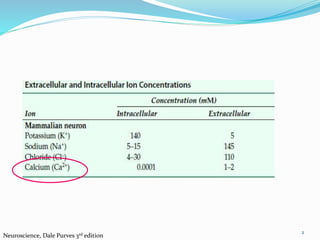
Neuroscience, Dale Purves 3rd edition
3
Divalent Ca2+
is the most common signal transduction element in the cells,
ranging from bacteria to specialised neurons;
Implicated in several physiological processes:
•Excitation-contraction coupling of
-Skeletal muscle
-Smooth muscle, and
-Cardiac muscle;
• Endocrine signalling of peptide hormones;
• Bone Calcification;
• Vitamin D metabolism, etc;
 Ca2+
regulation is a critical process in the biochemical machinery of a neuron
 Maintains neural integrity and integrates diverse cellular functions;
4
Acts as a pluripotent signal for many neuronal functions:
 Synaptic activity;
 Learning and memory consolidation;
 Neuronal developement;
Dysregulation of Ca2+
homeostasis may lead to:
 Excitotoxicity;
 Channelopathies;
 Neurodenegeration.
Calcium in Synaptic Transmission
 The signalling between neurons along a specialised site of communication
called a Synapse;
 Synapses can be:
-Electrical - Type 1
-Chemical - Type 2
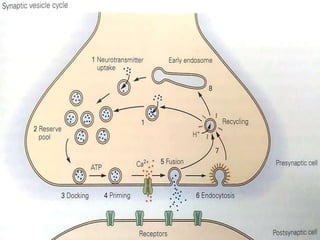
 The sequence of events at a synapse during neurotransmission:
5
6
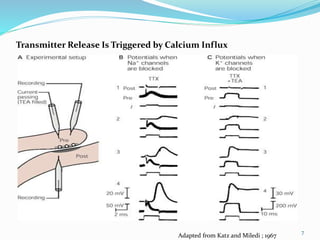
Transmitter Release Is Triggered by Calcium Influx
Adapted from Katz and Miledi ; 1967
7
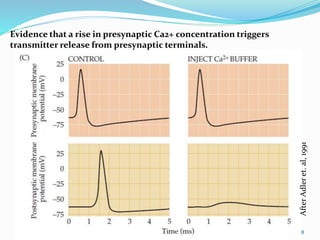
Evidence that a rise in presynaptic Ca2+ concentration triggers
transmitter release from presynaptic terminals.
AfterAdleret.al,1991
8
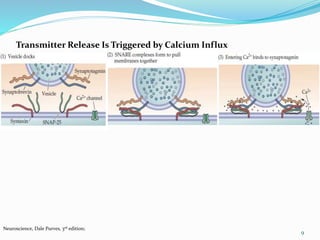
Transmitter Release Is Triggered by Calcium Influx
9
Neuroscience, Dale Purves, 3rd edition;
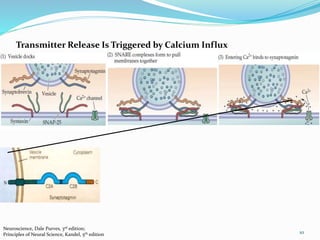
Transmitter Release Is Triggered by Calcium Influx
10
Neuroscience, Dale Purves, 3rd edition;
Principles of Neural Science, Kandel, 5th edition
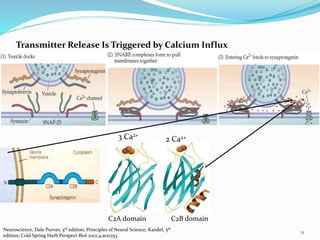
Transmitter Release Is Triggered by Calcium Influx
C2A domain C2B domain
3 Ca2+
2 Ca2+
11
Neuroscience, Dale Purves, 3rd edition; Principles of Neural Science, Kandel, 5th
edition; Cold Spring Harb Perspect Biol 2012;4:a011353
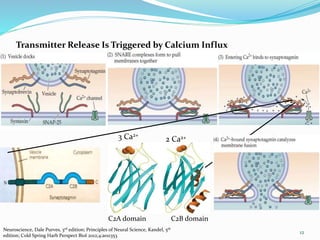
Transmitter Release Is Triggered by Calcium Influx
C2A domain C2B domain
3 Ca2+
2 Ca2+
12
Neuroscience, Dale Purves, 3rd edition; Principles of Neural Science, Kandel, 5th
edition; Cold Spring Harb Perspect Biol 2012;4:a011353
Calcium in Learning and Memory
 Memory:
- Implicit
- Explicit
 Habituation and Sensitisation
 Long term potentiation – explicit memory storage in hippocampus
13
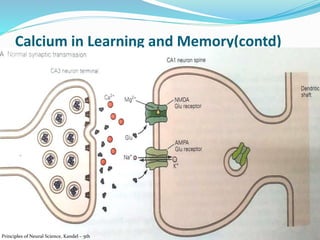
Calcium in Learning and Memory(contd)
14
Principles of Neural Science, Kandel – 5th
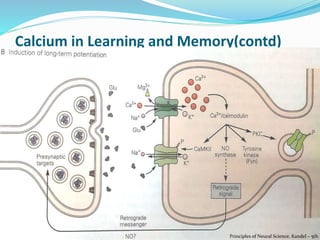
Calcium in Learning and Memory(contd)
15
Principles of Neural Science, Kandel – 5th
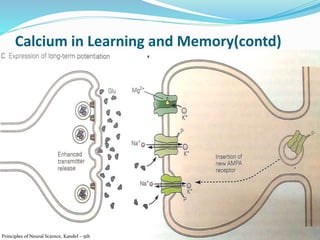
Calcium in Learning and Memory(contd)
16
Principles of Neural Science, Kandel – 5th
Calcium in Neuronal Developement
17
 Calcium-mediated specification of neurotransmitter phenotype
Cold Spring Harb Perspect Biol 2011;3:a004259
Calcium-mediated specification of neurotransmitter phenotype:
 Prior to synaptogenesis a transient and spontaneous calcium activity is
recorded
 Xenopus embryonic spinal cord cells have two types of transient
spontaneous activity: (Gu et al. 1994; Spitzer et al. 1994; Gu and Spitzer 1995, 1997)
-Calcium spikes -Calcium waves
18
Cold Spring Harb Perspect Biol 2011;3:a004259
Calcium-mediated specification of neurotransmitter phenotype:
 Prior to synaptogenesis a transient and spontaneous calcium activity is
recorded
 Xenopus embryonic spinal cord cells have two types of transient
spontaneous activity: (Gu et al. 1994; Spitzer et al. 1994; Gu and Spitzer 1995, 1997)
-Calcium spikes -Calcium waves
 How do they determine the neurotransmitter phenotype?
 Embryonic Xenopus neurons showed that Ca-spikes are necessary and
sufficient for specific NT expression in the spinal neurons.
19
Cold Spring Harb Perspect Biol 2011;3:a004259
Calcium-mediated specification of neurotransmitter phenotype:
Mechanism:
 Intracellular Ca2+ release is needed for this differentiation
 Seems to occur via a frequency-mediated mechanism
regulates gene
expression? Different frequency needed
for each subtype?
 Before synaptogenesis cells showing low spike frequency express glutamate
and with a gradually increasing spike frequency expressed Ach
 Cells showing high spike frequency expressed inhibitory
neurotransmitters, like GABA.
20
Cold Spring Harb Perspect Biol 2011;3:a004259
specific frequency for specific NT?
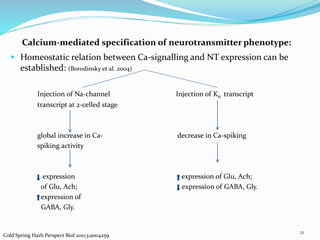
Calcium-mediated specification of neurotransmitter phenotype:
 Homeostatic relation between Ca-signalling and NT expression can be
established: (Borodinsky et al. 2004)
Injection of Na-channel Injection of Kir transcript
transcript at 2-celled stage
global increase in Ca- decrease in Ca-spiking
spiking activity
expression expression of Glu, Ach;
of Glu, Ach; expression of GABA, Gly.
expression of
GABA, Gly.
21
Cold Spring Harb Perspect Biol 2011;3:a004259
22
Cold Spring Harb Perspect Biol 2011;3:a004259
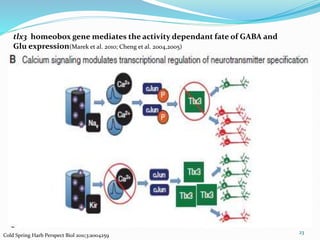
tlx3 homeobox gene mediates the activity dependant fate of GABA and
Glu expression(Marek et al. 2010; Cheng et al. 2004,2005)
23
Cold Spring Harb Perspect Biol 2011;3:a004259
tlx3 homeobox gene mediates the activity dependant fate of GABA and
Glu expression(Marek et al. 2010; Cheng et al. 2004,2005)
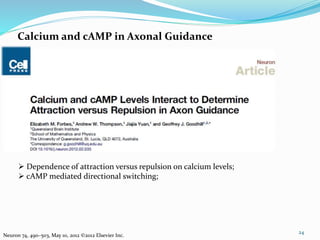
Calcium and cAMP in Axonal Guidance
24
Neuron 74, 490–503, May 10, 2012 ©2012 Elsevier Inc.
 Dependence of attraction versus repulsion on calcium levels;
 cAMP mediated directional switching;
Calcium and cAMP in Axonal Guidance
25
Neuron 74, 490–503, May 10, 2012 ©2012 Elsevier Inc.
 Blocking Ca-entry can turn a attractive cue to a repellant cue (Hong et al.
2000)
 Effectors of Ca-CaM complex in growth cone turning : CaMKII and Calcineurin;
CaMKII – attracts; CaN – repels;
 Baseline calcium level is important is mediating response – interaction of baseline
level and influx/ IC release;
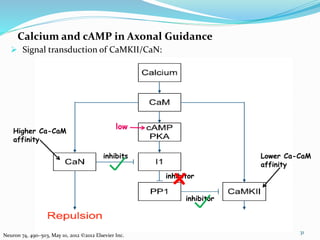
 When baseline level is reduced, small or large local Ca2+ increase lowers
CaMKII:CaN ration and causes repulsion;
Calcium and cAMP in Axonal Guidance
26
Neuron 74, 490–503, May 10, 2012 ©2012 Elsevier Inc.
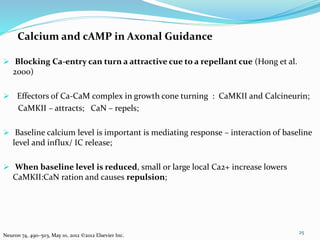
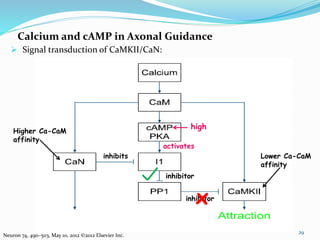
 Signal transduction of CaMKII/CaN:
Higher Ca-CaM
affinity
Lower Ca-CaM
affinity
Calcium and cAMP in Axonal Guidance
27
Neuron 74, 490–503, May 10, 2012 ©2012 Elsevier Inc.
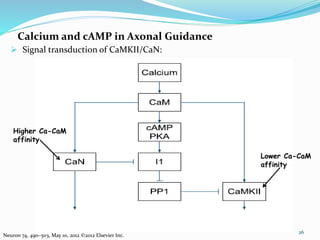
 Signal transduction of CaMKII/CaN:
Higher Ca-CaM
affinity
inhibits
inhibitor
inhibitor
Lower Ca-CaM
affinity
Calcium and cAMP in Axonal Guidance
28
Neuron 74, 490–503, May 10, 2012 ©2012 Elsevier Inc.
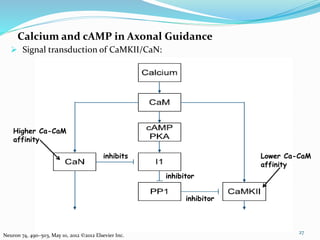
 Signal transduction of CaMKII/CaN:
Higher Ca-CaM
affinity
Lower Ca-CaM
affinity
inhibits
high
inhibitor
inhibitor
Calcium and cAMP in Axonal Guidance
29
Neuron 74, 490–503, May 10, 2012 ©2012 Elsevier Inc.
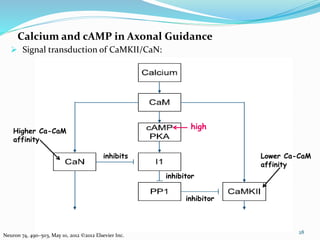
 Signal transduction of CaMKII/CaN:
Higher Ca-CaM
affinity
Lower Ca-CaM
affinity
inhibits
inhibitor
activates
high
inhibitor
x
Calcium and cAMP in Axonal Guidance
30
Neuron 74, 490–503, May 10, 2012 ©2012 Elsevier Inc.
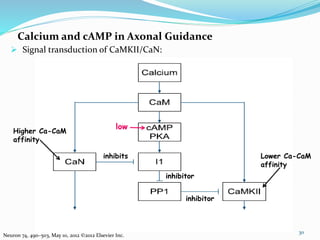
 Signal transduction of CaMKII/CaN:
Higher Ca-CaM
affinity
inhibits
inhibitor
inhibitor
Lower Ca-CaM
affinity
low
Calcium and cAMP in Axonal Guidance
31
Neuron 74, 490–503, May 10, 2012 ©2012 Elsevier Inc.
 Signal transduction of CaMKII/CaN:
Higher Ca-CaM
affinity
inhibits
inhibitor
inhibitor
Lower Ca-CaM
affinity
low
x
Calcium in Excitotoxicity – The Brain’s Exciting Poisons
Neurons devoid of O2 (hypoxia, cardiac arrest, injury)
ATP
Depolarisation
Presynaptic release of Glutamate
Increased postsynaptic [Ca2+] by activation of GluRs
Cyclical release of Glutamate
Overexcitement of neurons and enhanced influx of Na+, K+, Ca2+
Acute effect Chronic Effect
32
Neuroscience, M.F.Bear – 2nd edition
X
Calcium in Excitotoxicity – The Brain’s Exciting Poisons
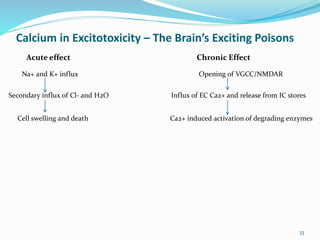
Acute effect Chronic Effect
Na+ and K+ influx Opening of VGCC/NMDAR
Secondary influx of Cl- and H2O Influx of EC Ca2+ and release from IC stores
Cell swelling and death Ca2+ induced activation of degrading enzymes
33
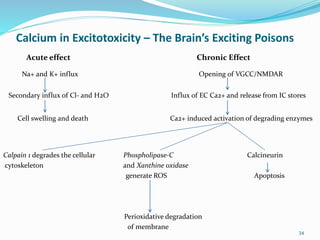
Calcium in Excitotoxicity – The Brain’s Exciting Poisons
Acute effect Chronic Effect
Na+ and K+ influx Opening of VGCC/NMDAR
Secondary influx of Cl- and H2O Influx of EC Ca2+ and release from IC stores
Cell swelling and death Ca2+ induced activation of degrading enzymes
Calpain 1 degrades the cellular Phospholipase-C Calcineurin
cytoskeleton and Xanthine oxidase
generate ROS Apoptosis
Perioxidative degradation
of membrane
34
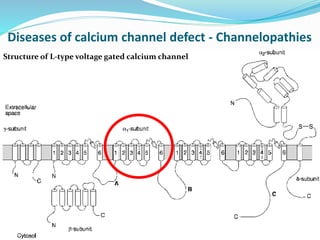
Diseases of calcium channel defect - Channelopathies
35
Structure of L-type voltage gated calcium channel
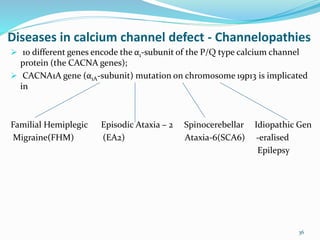
Diseases in calcium channel defect - Channelopathies
 10 different genes encode the α1-subunit of the P/Q type calcium channel
protein (the CACNA genes);
 CACNA1A gene (α1A-subunit) mutation on chromosome 19p13 is implicated
in
Familial Hemiplegic Episodic Ataxia – 2 Spinocerebellar Idiopathic Gen
Migraine(FHM) (EA2) Ataxia-6(SCA6) -eralised
Epilepsy
36
37
38
Alzheimer’s Disease
39
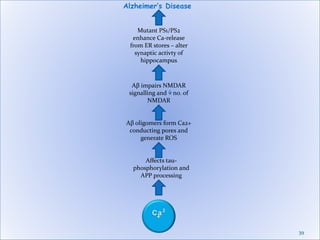
Alzheimer’s Disease
Affects tau-
phosphorylation and
APP processing
Aβ oligomers form Ca2+
conducting pores and
generate ROS
Aβ impairs NMDAR
signalling and no. of
NMDAR
Mutant PS1/PS2
enhance Ca-release
from ER stores – alter
synaptic activty of
hippocampus
40
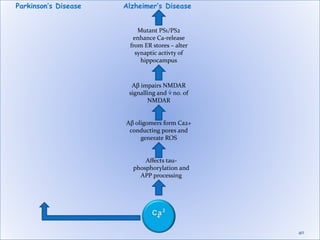
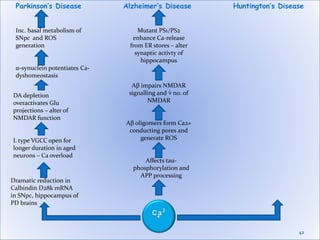
Parkinson’s Disease Alzheimer’s Disease
Affects tau-
phosphorylation and
APP processing
Aβ oligomers form Ca2+
conducting pores and
generate ROS
Aβ impairs NMDAR
signalling and no. of
NMDAR
Mutant PS1/PS2
enhance Ca-release
from ER stores – alter
synaptic activty of
hippocampus
41
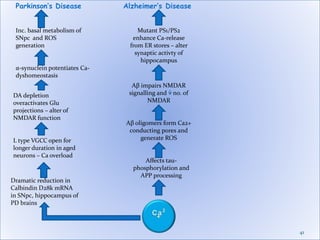
Parkinson’s Disease
Dramatic reduction in
Calbindin D28k mRNA
in SNpc, hippocampus of
PD brains
L type VGCC open for
longer duration in aged
neurons – Ca overload
Inc. basal metabolism of
SNpc and ROS
generation
α-synuclein potentiates Ca-
dyshomeostasis
DA depletion
overactivates Glu
projections – alter of
NMDAR function
Alzheimer’s Disease
Affects tau-
phosphorylation and
APP processing
Aβ oligomers form Ca2+
conducting pores and
generate ROS
Aβ impairs NMDAR
signalling and no. of
NMDAR
Mutant PS1/PS2
enhance Ca-release
from ER stores – alter
synaptic activty of
hippocampus
42
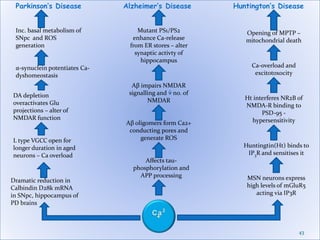
Huntington’s DiseaseParkinson’s Disease
Dramatic reduction in
Calbindin D28k mRNA
in SNpc, hippocampus of
PD brains
L type VGCC open for
longer duration in aged
neurons – Ca overload
Inc. basal metabolism of
SNpc and ROS
generation
α-synuclein potentiates Ca-
dyshomeostasis
DA depletion
overactivates Glu
projections – alter of
NMDAR function
Alzheimer’s Disease
Affects tau-
phosphorylation and
APP processing
Aβ oligomers form Ca2+
conducting pores and
generate ROS
Aβ impairs NMDAR
signalling and no. of
NMDAR
Mutant PS1/PS2
enhance Ca-release
from ER stores – alter
synaptic activty of
hippocampus
43
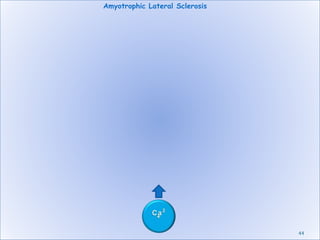
MSN neurons express
high levels of mGluR5
acting via IP3R
Huntingtin(Ht) binds to
IP3R and sensitises it
Ht interferes NR2B of
NMDA-R binding to
PSD-95 -
hypersensitivity
Ca-overload and
excitotoxocity
Opening of MPTP –
mitochondrial death
Huntington’s DiseaseParkinson’s Disease
Dramatic reduction in
Calbindin D28k mRNA
in SNpc, hippocampus of
PD brains
L type VGCC open for
longer duration in aged
neurons – Ca overload
Inc. basal metabolism of
SNpc and ROS
generation
α-synuclein potentiates Ca-
dyshomeostasis
DA depletion
overactivates Glu
projections – alter of
NMDAR function
Alzheimer’s Disease
Affects tau-
phosphorylation and
APP processing
Aβ oligomers form Ca2+
conducting pores and
generate ROS
Aβ impairs NMDAR
signalling and no. of
NMDAR
Mutant PS1/PS2
enhance Ca-release
from ER stores – alter
synaptic activty of
hippocampus
44
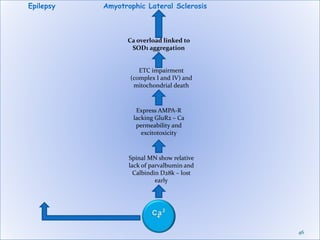
Amyotrophic Lateral Sclerosis
45
Amyotrophic Lateral Sclerosis
Spinal MN show relative
lack of parvalbumin and
Calbindin D28k – lost
early
Express AMPA-R
lacking GluR2 – Ca
permeability and
excitotoxicity
ETC impairment
(complex I and IV) and
mitochondrial death
Ca overload linked to
SOD1 aggregation
46
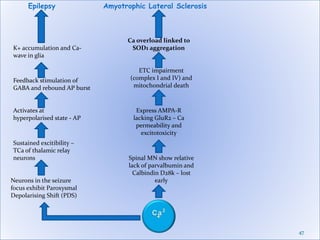
Epilepsy Amyotrophic Lateral Sclerosis
Spinal MN show relative
lack of parvalbumin and
Calbindin D28k – lost
early
Express AMPA-R
lacking GluR2 – Ca
permeability and
excitotoxicity
ETC impairment
(complex I and IV) and
mitochondrial death
Ca overload linked to
SOD1 aggregation
47
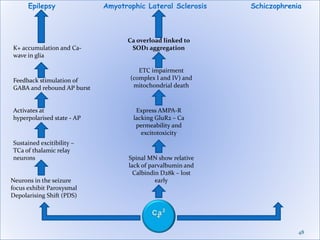
Epilepsy
Neurons in the seizure
focus exhibit Paroxysmal
Depolarising Shift (PDS)
Sustained excitibility –
TCa of thalamic relay
neurons
K+ accumulation and Ca-
wave in glia
Feedback stimulation of
GABA and rebound AP burst
Activates at
hyperpolarised state - AP
Amyotrophic Lateral Sclerosis
Spinal MN show relative
lack of parvalbumin and
Calbindin D28k – lost
early
Express AMPA-R
lacking GluR2 – Ca
permeability and
excitotoxicity
ETC impairment
(complex I and IV) and
mitochondrial death
Ca overload linked to
SOD1 aggregation
48
SchiczophreniaEpilepsy
Neurons in the seizure
focus exhibit Paroxysmal
Depolarising Shift (PDS)
Sustained excitibility –
TCa of thalamic relay
neurons
K+ accumulation and Ca-
wave in glia
Feedback stimulation of
GABA and rebound AP burst
Activates at
hyperpolarised state - AP
Amyotrophic Lateral Sclerosis
Spinal MN show relative
lack of parvalbumin and
Calbindin D28k – lost
early
Express AMPA-R
lacking GluR2 – Ca
permeability and
excitotoxicity
ETC impairment
(complex I and IV) and
mitochondrial death
Ca overload linked to
SOD1 aggregation
49
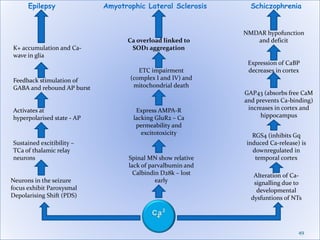
Alteration of Ca-
signalling due to
developmental
dysfuntions of NTs
RGS4 (inhibits Gq
induced Ca-release) is
downregulated in
temporal cortex
GAP43 (absorbs free CaM
and prevents Ca-binding)
increases in cortex and
hippocampus
Expression of CaBP
decreases in cortex
NMDAR hypofunction
and deficit
SchiczophreniaEpilepsy
Neurons in the seizure
focus exhibit Paroxysmal
Depolarising Shift (PDS)
Sustained excitibility –
TCa of thalamic relay
neurons
K+ accumulation and Ca-
wave in glia
Feedback stimulation of
GABA and rebound AP burst
Activates at
hyperpolarised state - AP
Amyotrophic Lateral Sclerosis
Spinal MN show relative
lack of parvalbumin and
Calbindin D28k – lost
early
Express AMPA-R
lacking GluR2 – Ca
permeability and
excitotoxicity
ETC impairment
(complex I and IV) and
mitochondrial death
Ca overload linked to
SOD1 aggregation
50

Calcium in Neuronal Homeostasis

  • 1.
  • 2.
  • 3.
    3 Divalent Ca2+ is themost common signal transduction element in the cells, ranging from bacteria to specialised neurons; Implicated in several physiological processes: •Excitation-contraction coupling of -Skeletal muscle -Smooth muscle, and -Cardiac muscle; • Endocrine signalling of peptide hormones; • Bone Calcification; • Vitamin D metabolism, etc;  Ca2+ regulation is a critical process in the biochemical machinery of a neuron  Maintains neural integrity and integrates diverse cellular functions;
  • 4.
    4 Acts as apluripotent signal for many neuronal functions:  Synaptic activity;  Learning and memory consolidation;  Neuronal developement; Dysregulation of Ca2+ homeostasis may lead to:  Excitotoxicity;  Channelopathies;  Neurodenegeration.
  • 5.
    Calcium in SynapticTransmission  The signalling between neurons along a specialised site of communication called a Synapse;  Synapses can be: -Electrical - Type 1 -Chemical - Type 2  The sequence of events at a synapse during neurotransmission: 5
  • 6.
  • 7.
    Transmitter Release IsTriggered by Calcium Influx Adapted from Katz and Miledi ; 1967 7
  • 8.
    Evidence that arise in presynaptic Ca2+ concentration triggers transmitter release from presynaptic terminals. AfterAdleret.al,1991 8
  • 9.
    Transmitter Release IsTriggered by Calcium Influx 9 Neuroscience, Dale Purves, 3rd edition;
  • 10.
    Transmitter Release IsTriggered by Calcium Influx 10 Neuroscience, Dale Purves, 3rd edition; Principles of Neural Science, Kandel, 5th edition
  • 11.
    Transmitter Release IsTriggered by Calcium Influx C2A domain C2B domain 3 Ca2+ 2 Ca2+ 11 Neuroscience, Dale Purves, 3rd edition; Principles of Neural Science, Kandel, 5th edition; Cold Spring Harb Perspect Biol 2012;4:a011353
  • 12.
    Transmitter Release IsTriggered by Calcium Influx C2A domain C2B domain 3 Ca2+ 2 Ca2+ 12 Neuroscience, Dale Purves, 3rd edition; Principles of Neural Science, Kandel, 5th edition; Cold Spring Harb Perspect Biol 2012;4:a011353
  • 13.
    Calcium in Learningand Memory  Memory: - Implicit - Explicit  Habituation and Sensitisation  Long term potentiation – explicit memory storage in hippocampus 13
  • 14.
    Calcium in Learningand Memory(contd) 14 Principles of Neural Science, Kandel – 5th
  • 15.
    Calcium in Learningand Memory(contd) 15 Principles of Neural Science, Kandel – 5th
  • 16.
    Calcium in Learningand Memory(contd) 16 Principles of Neural Science, Kandel – 5th
  • 17.
    Calcium in NeuronalDevelopement 17  Calcium-mediated specification of neurotransmitter phenotype Cold Spring Harb Perspect Biol 2011;3:a004259
  • 18.
    Calcium-mediated specification ofneurotransmitter phenotype:  Prior to synaptogenesis a transient and spontaneous calcium activity is recorded  Xenopus embryonic spinal cord cells have two types of transient spontaneous activity: (Gu et al. 1994; Spitzer et al. 1994; Gu and Spitzer 1995, 1997) -Calcium spikes -Calcium waves 18 Cold Spring Harb Perspect Biol 2011;3:a004259
  • 19.
    Calcium-mediated specification ofneurotransmitter phenotype:  Prior to synaptogenesis a transient and spontaneous calcium activity is recorded  Xenopus embryonic spinal cord cells have two types of transient spontaneous activity: (Gu et al. 1994; Spitzer et al. 1994; Gu and Spitzer 1995, 1997) -Calcium spikes -Calcium waves  How do they determine the neurotransmitter phenotype?  Embryonic Xenopus neurons showed that Ca-spikes are necessary and sufficient for specific NT expression in the spinal neurons. 19 Cold Spring Harb Perspect Biol 2011;3:a004259
  • 20.
    Calcium-mediated specification ofneurotransmitter phenotype: Mechanism:  Intracellular Ca2+ release is needed for this differentiation  Seems to occur via a frequency-mediated mechanism regulates gene expression? Different frequency needed for each subtype?  Before synaptogenesis cells showing low spike frequency express glutamate and with a gradually increasing spike frequency expressed Ach  Cells showing high spike frequency expressed inhibitory neurotransmitters, like GABA. 20 Cold Spring Harb Perspect Biol 2011;3:a004259 specific frequency for specific NT?
  • 21.
    Calcium-mediated specification ofneurotransmitter phenotype:  Homeostatic relation between Ca-signalling and NT expression can be established: (Borodinsky et al. 2004) Injection of Na-channel Injection of Kir transcript transcript at 2-celled stage global increase in Ca- decrease in Ca-spiking spiking activity expression expression of Glu, Ach; of Glu, Ach; expression of GABA, Gly. expression of GABA, Gly. 21 Cold Spring Harb Perspect Biol 2011;3:a004259
  • 22.
    22 Cold Spring HarbPerspect Biol 2011;3:a004259 tlx3 homeobox gene mediates the activity dependant fate of GABA and Glu expression(Marek et al. 2010; Cheng et al. 2004,2005)
  • 23.
    23 Cold Spring HarbPerspect Biol 2011;3:a004259 tlx3 homeobox gene mediates the activity dependant fate of GABA and Glu expression(Marek et al. 2010; Cheng et al. 2004,2005)
  • 24.
    Calcium and cAMPin Axonal Guidance 24 Neuron 74, 490–503, May 10, 2012 ©2012 Elsevier Inc.  Dependence of attraction versus repulsion on calcium levels;  cAMP mediated directional switching;
  • 25.
    Calcium and cAMPin Axonal Guidance 25 Neuron 74, 490–503, May 10, 2012 ©2012 Elsevier Inc.  Blocking Ca-entry can turn a attractive cue to a repellant cue (Hong et al. 2000)  Effectors of Ca-CaM complex in growth cone turning : CaMKII and Calcineurin; CaMKII – attracts; CaN – repels;  Baseline calcium level is important is mediating response – interaction of baseline level and influx/ IC release;  When baseline level is reduced, small or large local Ca2+ increase lowers CaMKII:CaN ration and causes repulsion;
  • 26.
    Calcium and cAMPin Axonal Guidance 26 Neuron 74, 490–503, May 10, 2012 ©2012 Elsevier Inc.  Signal transduction of CaMKII/CaN: Higher Ca-CaM affinity Lower Ca-CaM affinity
  • 27.
    Calcium and cAMPin Axonal Guidance 27 Neuron 74, 490–503, May 10, 2012 ©2012 Elsevier Inc.  Signal transduction of CaMKII/CaN: Higher Ca-CaM affinity inhibits inhibitor inhibitor Lower Ca-CaM affinity
  • 28.
    Calcium and cAMPin Axonal Guidance 28 Neuron 74, 490–503, May 10, 2012 ©2012 Elsevier Inc.  Signal transduction of CaMKII/CaN: Higher Ca-CaM affinity Lower Ca-CaM affinity inhibits high inhibitor inhibitor
  • 29.
    Calcium and cAMPin Axonal Guidance 29 Neuron 74, 490–503, May 10, 2012 ©2012 Elsevier Inc.  Signal transduction of CaMKII/CaN: Higher Ca-CaM affinity Lower Ca-CaM affinity inhibits inhibitor activates high inhibitor x
  • 30.
    Calcium and cAMPin Axonal Guidance 30 Neuron 74, 490–503, May 10, 2012 ©2012 Elsevier Inc.  Signal transduction of CaMKII/CaN: Higher Ca-CaM affinity inhibits inhibitor inhibitor Lower Ca-CaM affinity low
  • 31.
    Calcium and cAMPin Axonal Guidance 31 Neuron 74, 490–503, May 10, 2012 ©2012 Elsevier Inc.  Signal transduction of CaMKII/CaN: Higher Ca-CaM affinity inhibits inhibitor inhibitor Lower Ca-CaM affinity low x
  • 32.
    Calcium in Excitotoxicity– The Brain’s Exciting Poisons Neurons devoid of O2 (hypoxia, cardiac arrest, injury) ATP Depolarisation Presynaptic release of Glutamate Increased postsynaptic [Ca2+] by activation of GluRs Cyclical release of Glutamate Overexcitement of neurons and enhanced influx of Na+, K+, Ca2+ Acute effect Chronic Effect 32 Neuroscience, M.F.Bear – 2nd edition X
  • 33.
    Calcium in Excitotoxicity– The Brain’s Exciting Poisons Acute effect Chronic Effect Na+ and K+ influx Opening of VGCC/NMDAR Secondary influx of Cl- and H2O Influx of EC Ca2+ and release from IC stores Cell swelling and death Ca2+ induced activation of degrading enzymes 33
  • 34.
    Calcium in Excitotoxicity– The Brain’s Exciting Poisons Acute effect Chronic Effect Na+ and K+ influx Opening of VGCC/NMDAR Secondary influx of Cl- and H2O Influx of EC Ca2+ and release from IC stores Cell swelling and death Ca2+ induced activation of degrading enzymes Calpain 1 degrades the cellular Phospholipase-C Calcineurin cytoskeleton and Xanthine oxidase generate ROS Apoptosis Perioxidative degradation of membrane 34
  • 35.
    Diseases of calciumchannel defect - Channelopathies 35 Structure of L-type voltage gated calcium channel
  • 36.
    Diseases in calciumchannel defect - Channelopathies  10 different genes encode the α1-subunit of the P/Q type calcium channel protein (the CACNA genes);  CACNA1A gene (α1A-subunit) mutation on chromosome 19p13 is implicated in Familial Hemiplegic Episodic Ataxia – 2 Spinocerebellar Idiopathic Gen Migraine(FHM) (EA2) Ataxia-6(SCA6) -eralised Epilepsy 36
  • 37.
  • 38.
  • 39.
    39 Alzheimer’s Disease Affects tau- phosphorylationand APP processing Aβ oligomers form Ca2+ conducting pores and generate ROS Aβ impairs NMDAR signalling and no. of NMDAR Mutant PS1/PS2 enhance Ca-release from ER stores – alter synaptic activty of hippocampus
  • 40.
    40 Parkinson’s Disease Alzheimer’sDisease Affects tau- phosphorylation and APP processing Aβ oligomers form Ca2+ conducting pores and generate ROS Aβ impairs NMDAR signalling and no. of NMDAR Mutant PS1/PS2 enhance Ca-release from ER stores – alter synaptic activty of hippocampus
  • 41.
    41 Parkinson’s Disease Dramatic reductionin Calbindin D28k mRNA in SNpc, hippocampus of PD brains L type VGCC open for longer duration in aged neurons – Ca overload Inc. basal metabolism of SNpc and ROS generation α-synuclein potentiates Ca- dyshomeostasis DA depletion overactivates Glu projections – alter of NMDAR function Alzheimer’s Disease Affects tau- phosphorylation and APP processing Aβ oligomers form Ca2+ conducting pores and generate ROS Aβ impairs NMDAR signalling and no. of NMDAR Mutant PS1/PS2 enhance Ca-release from ER stores – alter synaptic activty of hippocampus
  • 42.
    42 Huntington’s DiseaseParkinson’s Disease Dramaticreduction in Calbindin D28k mRNA in SNpc, hippocampus of PD brains L type VGCC open for longer duration in aged neurons – Ca overload Inc. basal metabolism of SNpc and ROS generation α-synuclein potentiates Ca- dyshomeostasis DA depletion overactivates Glu projections – alter of NMDAR function Alzheimer’s Disease Affects tau- phosphorylation and APP processing Aβ oligomers form Ca2+ conducting pores and generate ROS Aβ impairs NMDAR signalling and no. of NMDAR Mutant PS1/PS2 enhance Ca-release from ER stores – alter synaptic activty of hippocampus
  • 43.
    43 MSN neurons express highlevels of mGluR5 acting via IP3R Huntingtin(Ht) binds to IP3R and sensitises it Ht interferes NR2B of NMDA-R binding to PSD-95 - hypersensitivity Ca-overload and excitotoxocity Opening of MPTP – mitochondrial death Huntington’s DiseaseParkinson’s Disease Dramatic reduction in Calbindin D28k mRNA in SNpc, hippocampus of PD brains L type VGCC open for longer duration in aged neurons – Ca overload Inc. basal metabolism of SNpc and ROS generation α-synuclein potentiates Ca- dyshomeostasis DA depletion overactivates Glu projections – alter of NMDAR function Alzheimer’s Disease Affects tau- phosphorylation and APP processing Aβ oligomers form Ca2+ conducting pores and generate ROS Aβ impairs NMDAR signalling and no. of NMDAR Mutant PS1/PS2 enhance Ca-release from ER stores – alter synaptic activty of hippocampus
  • 44.
  • 45.
    45 Amyotrophic Lateral Sclerosis SpinalMN show relative lack of parvalbumin and Calbindin D28k – lost early Express AMPA-R lacking GluR2 – Ca permeability and excitotoxicity ETC impairment (complex I and IV) and mitochondrial death Ca overload linked to SOD1 aggregation
  • 46.
    46 Epilepsy Amyotrophic LateralSclerosis Spinal MN show relative lack of parvalbumin and Calbindin D28k – lost early Express AMPA-R lacking GluR2 – Ca permeability and excitotoxicity ETC impairment (complex I and IV) and mitochondrial death Ca overload linked to SOD1 aggregation
  • 47.
    47 Epilepsy Neurons in theseizure focus exhibit Paroxysmal Depolarising Shift (PDS) Sustained excitibility – TCa of thalamic relay neurons K+ accumulation and Ca- wave in glia Feedback stimulation of GABA and rebound AP burst Activates at hyperpolarised state - AP Amyotrophic Lateral Sclerosis Spinal MN show relative lack of parvalbumin and Calbindin D28k – lost early Express AMPA-R lacking GluR2 – Ca permeability and excitotoxicity ETC impairment (complex I and IV) and mitochondrial death Ca overload linked to SOD1 aggregation
  • 48.
    48 SchiczophreniaEpilepsy Neurons in theseizure focus exhibit Paroxysmal Depolarising Shift (PDS) Sustained excitibility – TCa of thalamic relay neurons K+ accumulation and Ca- wave in glia Feedback stimulation of GABA and rebound AP burst Activates at hyperpolarised state - AP Amyotrophic Lateral Sclerosis Spinal MN show relative lack of parvalbumin and Calbindin D28k – lost early Express AMPA-R lacking GluR2 – Ca permeability and excitotoxicity ETC impairment (complex I and IV) and mitochondrial death Ca overload linked to SOD1 aggregation
  • 49.
    49 Alteration of Ca- signallingdue to developmental dysfuntions of NTs RGS4 (inhibits Gq induced Ca-release) is downregulated in temporal cortex GAP43 (absorbs free CaM and prevents Ca-binding) increases in cortex and hippocampus Expression of CaBP decreases in cortex NMDAR hypofunction and deficit SchiczophreniaEpilepsy Neurons in the seizure focus exhibit Paroxysmal Depolarising Shift (PDS) Sustained excitibility – TCa of thalamic relay neurons K+ accumulation and Ca- wave in glia Feedback stimulation of GABA and rebound AP burst Activates at hyperpolarised state - AP Amyotrophic Lateral Sclerosis Spinal MN show relative lack of parvalbumin and Calbindin D28k – lost early Express AMPA-R lacking GluR2 – Ca permeability and excitotoxicity ETC impairment (complex I and IV) and mitochondrial death Ca overload linked to SOD1 aggregation
  • 50.