
The Caedmon School
Rosetta Eun Ryong Lee
Seattle Girls’ School
Our Earliest Experience of Difference
And the Lessons We Can Apply to Our Children
Rosetta Eun Ryong Lee (http://tiny.cc/rosettalee)
Agenda
 Getting to Know You
 Story Telling
 What We Wished from Our Adults
 Going Forward
 Questions and Answers
 Resources
Rosetta Eun Ryong Lee (http://tiny.cc/rosettalee)
In Our Conversations…
 Listen to Understand
 Tell Your Truth
 Assume Positive Intent
 Seek Bravery Over Safety
 Practice Empathy
Rosetta Eun Ryong Lee (http://tiny.cc/rosettalee)
Getting to Know You
Warm-Up Questions
Rosetta Eun Ryong Lee (http://tiny.cc/rosettalee)
Do you have any guilty
pleasures?
Do you have a strange non-
negotiable?
Do you have an unusual
phobia?
What is your “showing up
naked to school” dream?
Earliest Memory of Difference
Rosetta Eun Ryong Lee (http://tiny.cc/rosettalee)
Think about a time from your
childhood when you learned
something about identity,
difference or justice.
What happened?
What did you think, and how
did you feel?
Looking back, what do you
wish the caring adults around
you had done or said?
Being That Adult for Children
Rosetta Eun Ryong Lee (http://tiny.cc/rosettalee)
What are the conversations you want to have that
you’re not having?
What are the conversations you want to have better?
Race/Ethnicity
Socioeconomic Class
Gender and Sexuality
Religion
Others?
Going Forward
Rosetta Eun Ryong Lee (http://tiny.cc/rosettalee)
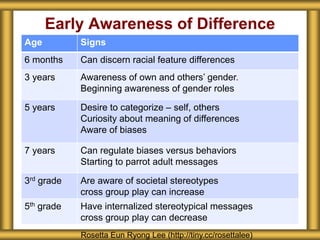
Early Awareness of Difference
Rosetta Eun Ryong Lee (http://tiny.cc/rosettalee)
Age Signs
6 months Can discern racial feature differences
3 years Awareness of own and others’ gender.
Beginning awareness of gender roles
5 years Desire to categorize – self, others
Curiosity about meaning of differences
Aware of biases
7 years Can regulate biases versus behaviors
Starting to parrot adult messages
3rd grade Are aware of societal stereotypes
cross group play can increase
5th grade Have internalized stereotypical messages
cross group play can decrease
Before You Talk
Rosetta Eun Ryong Lee (http://tiny.cc/rosettalee)
 Study up on other parents having
conversations
 Use people, outings, media, etc.
 Identify and clarify where you stand
 Initial verbiage
 Brainstorm follow-up questions
 Practice with others
While You Are Talking
Rosetta Eun Ryong Lee (http://tiny.cc/rosettalee)
 Find out what they’re actually asking/saying
 Find out why they’re asking/saying
 Respond straightforwardly
 Be mindful of emotion
 Be explicit about where you stand
 Model and coach humility, delight, and
curiosity about difference
 “Great question” “What do you think?”
“You’re thinking about that, huh?” and “Let
me think about it some more”
After You Talk
Rosetta Eun Ryong Lee (http://tiny.cc/rosettalee)
 Go back to earlier
 Double-check their understanding
 Re-establish and clarify if needed
 Reconciling disagreements and other
messages
 Follow-up with alternate message givers
Example Statements
Rosetta Eun Ryong Lee (http://tiny.cc/rosettalee)
 “Boys are annoying!”
 “Why is she a different color than me?”
 Her lunch smelled real bad.
 “Why doesn’t he have a daddy?’
 How come we don’t go away on vacations
like everyone else?
 “How come no one looks like me?”
 “Why does he talk so funny?”
 Her house was so small.
Questions and Comments
Rosetta Eun Ryong Lee (http://tiny.cc/rosettalee)
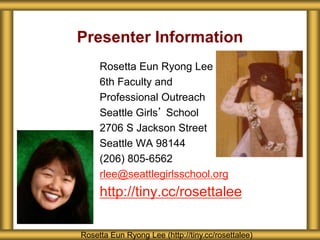
Presenter Information
Rosetta Eun Ryong Lee
6th Faculty and
Professional Outreach
Seattle Girls’ School
2706 S Jackson Street
Seattle WA 98144
(206) 805-6562
rlee@seattlegirlsschool.org
http://tiny.cc/rosettalee
Rosetta Eun Ryong Lee (http://tiny.cc/rosettalee)

Caedmon School Earliest Experience of Difference

  • 1.
    The Caedmon School RosettaEun Ryong Lee Seattle Girls’ School Our Earliest Experience of Difference And the Lessons We Can Apply to Our Children Rosetta Eun Ryong Lee (http://tiny.cc/rosettalee)
  • 2.
    Agenda  Getting toKnow You  Story Telling  What We Wished from Our Adults  Going Forward  Questions and Answers  Resources Rosetta Eun Ryong Lee (http://tiny.cc/rosettalee)
  • 3.
    In Our Conversations… Listen to Understand  Tell Your Truth  Assume Positive Intent  Seek Bravery Over Safety  Practice Empathy Rosetta Eun Ryong Lee (http://tiny.cc/rosettalee)
  • 4.
    Getting to KnowYou Warm-Up Questions Rosetta Eun Ryong Lee (http://tiny.cc/rosettalee) Do you have any guilty pleasures? Do you have a strange non- negotiable? Do you have an unusual phobia? What is your “showing up naked to school” dream?
  • 5.
    Earliest Memory ofDifference Rosetta Eun Ryong Lee (http://tiny.cc/rosettalee) Think about a time from your childhood when you learned something about identity, difference or justice. What happened? What did you think, and how did you feel? Looking back, what do you wish the caring adults around you had done or said?
  • 6.
    Being That Adultfor Children Rosetta Eun Ryong Lee (http://tiny.cc/rosettalee) What are the conversations you want to have that you’re not having? What are the conversations you want to have better? Race/Ethnicity Socioeconomic Class Gender and Sexuality Religion Others?
  • 7.
    Going Forward Rosetta EunRyong Lee (http://tiny.cc/rosettalee)
  • 8.
    Early Awareness ofDifference Rosetta Eun Ryong Lee (http://tiny.cc/rosettalee) Age Signs 6 months Can discern racial feature differences 3 years Awareness of own and others’ gender. Beginning awareness of gender roles 5 years Desire to categorize – self, others Curiosity about meaning of differences Aware of biases 7 years Can regulate biases versus behaviors Starting to parrot adult messages 3rd grade Are aware of societal stereotypes cross group play can increase 5th grade Have internalized stereotypical messages cross group play can decrease
  • 9.
    Before You Talk RosettaEun Ryong Lee (http://tiny.cc/rosettalee)  Study up on other parents having conversations  Use people, outings, media, etc.  Identify and clarify where you stand  Initial verbiage  Brainstorm follow-up questions  Practice with others
  • 10.
    While You AreTalking Rosetta Eun Ryong Lee (http://tiny.cc/rosettalee)  Find out what they’re actually asking/saying  Find out why they’re asking/saying  Respond straightforwardly  Be mindful of emotion  Be explicit about where you stand  Model and coach humility, delight, and curiosity about difference  “Great question” “What do you think?” “You’re thinking about that, huh?” and “Let me think about it some more”
  • 11.
    After You Talk RosettaEun Ryong Lee (http://tiny.cc/rosettalee)  Go back to earlier  Double-check their understanding  Re-establish and clarify if needed  Reconciling disagreements and other messages  Follow-up with alternate message givers
  • 12.
    Example Statements Rosetta EunRyong Lee (http://tiny.cc/rosettalee)  “Boys are annoying!”  “Why is she a different color than me?”  Her lunch smelled real bad.  “Why doesn’t he have a daddy?’  How come we don’t go away on vacations like everyone else?  “How come no one looks like me?”  “Why does he talk so funny?”  Her house was so small.
  • 13.
    Questions and Comments RosettaEun Ryong Lee (http://tiny.cc/rosettalee)
  • 14.
    Presenter Information Rosetta EunRyong Lee 6th Faculty and Professional Outreach Seattle Girls’ School 2706 S Jackson Street Seattle WA 98144 (206) 805-6562 rlee@seattlegirlsschool.org http://tiny.cc/rosettalee Rosetta Eun Ryong Lee (http://tiny.cc/rosettalee)

Editor's Notes