Visit https://ebookultra.com todownload the full version and
explore more ebooks or textbooks
CAD CAM Rapid prototyping Application Evaluation
None
_____ Click the link below to download _____
https://ebookultra.com/download/cad-cam-rapid-prototyping-
application-evaluation-none/
Explore and download more ebooks or textbooks at ebookultra.com
2.
Here are somerecommended products that we believe you will be
interested in. You can click the link to download.
Mastering CAD CAM 2nd Edition Ibrahim Zeid
https://ebookultra.com/download/mastering-cad-cam-2nd-edition-ibrahim-
zeid/
Medical Modelling Second Edition The Application of
Advanced Design and Rapid Prototyping Techniques in
Medicine Richard Bibb
https://ebookultra.com/download/medical-modelling-second-edition-the-
application-of-advanced-design-and-rapid-prototyping-techniques-in-
medicine-richard-bibb/
CAD CAM Principles And Applications 2nd Edition P. N. Rao
https://ebookultra.com/download/cad-cam-principles-and-
applications-2nd-edition-p-n-rao/
Cad Cam Principles And Applications 3Rd Edn 3rd Edition P.
N. Rao
https://ebookultra.com/download/cad-cam-principles-and-
applications-3rd-edn-3rd-edition-p-n-rao/
3.
Rapid prototyping ofbiomaterials Principles and
applications 1st Edition Roger Narayan
https://ebookultra.com/download/rapid-prototyping-of-biomaterials-
principles-and-applications-1st-edition-roger-narayan/
Rapid Prototyping of Biomaterials Principles and
Applications 1st Edition R. Narayan (Eds.)
https://ebookultra.com/download/rapid-prototyping-of-biomaterials-
principles-and-applications-1st-edition-r-narayan-eds/
Rapid Prototyping of Biomaterials Techniques in Additive
Manufacturing 2nd Edition Roger Narayan
https://ebookultra.com/download/rapid-prototyping-of-biomaterials-
techniques-in-additive-manufacturing-2nd-edition-roger-narayan/
Rapid Application Development with Mozilla 1st Edition
Nigel Mcfarlane
https://ebookultra.com/download/rapid-application-development-with-
mozilla-1st-edition-nigel-mcfarlane/
Genesis None
https://ebookultra.com/download/genesis-none/
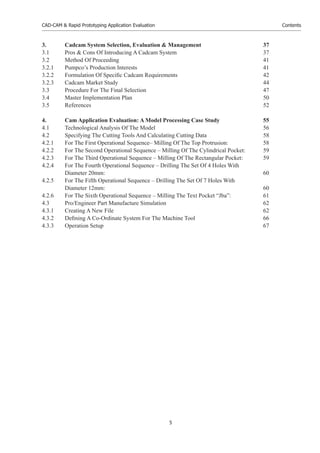
CAD-CAM & RapidPrototyping Application Evaluation
4
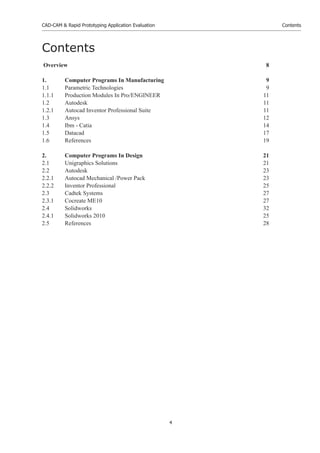
Contents
Contents
Overview 8
1. Computer Programs In Manufacturing 9
1.1 Parametric Technologies 9
1.1.1 Production Modules In Pro/ENGINEER 11
1.2 Autodesk 11
1.2.1 Autocad Inventor Professional Suite 11
1.3 Ansys 12
1.4 Ibm - Catia 14
1.5 Datacad 17
1.6 References 19
2. Computer Programs In Design 21
2.1 Unigraphics Solutions 21
2.2 Autodesk 23
2.2.1 Autocad Mechanical /Power Pack 23
2.2.2 Inventor Professional 25
2.3 Cadtek Systems 27
2.3.1 Cocreate ME10 27
2.4 Solidworks 32
2.4.1 Solidworks 2010 25
2.5 References 28
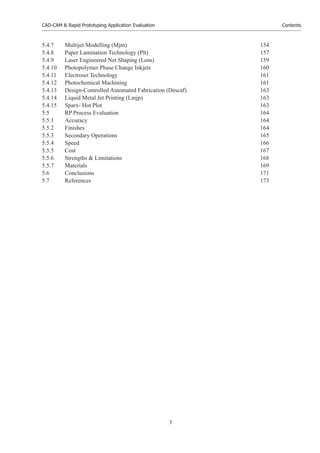
10.
CAD-CAM & RapidPrototyping Application Evaluation
5
Contents
3. Cadcam System Selection, Evaluation & Management 37
3.1 Pros & Cons Of Introducing A Cadcam System 37
3.2 Method Of Proceeding 41
3.2.1 Pumpco’s Production Interests 41
3.2.2 Formulation Of Specific Cadcam Requirements 42
3.2.3 Cadcam Market Study 44
3.3 Procedure For The Final Selection 47
3.4 Master Implementation Plan 50
3.5 References 52
4. Cam Application Evaluation: A Model Processing Case Study 55
4.1 Technological Analysis Of The Model 56
4.2 Specifying The Cutting Tools And Calculating Cutting Data 58
4.2.1 For The First Operational Sequence– Milling Of The Top Protrusion: 58
4.2.2 For The Second Operational Sequence – Milling Of The Cylindrical Pocket: 59
4.2.3 For The Third Operational Sequence – Milling Of The Rectangular Pocket: 59
4.2.4 For The Fourth Operational Sequence – Drilling The Set Of 4 Holes With
Diameter 20mm: 60
4.2.5 For The Fifth Operational Sequence – Drilling The Set Of 7 Holes With
Diameter 12mm: 60
4.2.6 For The Sixth Operational Sequence – Milling The Text Pocket “Jba”: 61
4.3 Pro/Engineer Part Manufacture Simulation 62
4.3.1 Creating A New File 62
4.3.2 Defining A Co-Ordinate System For The Machine Tool 66
4.3.3 Operation Setup 67
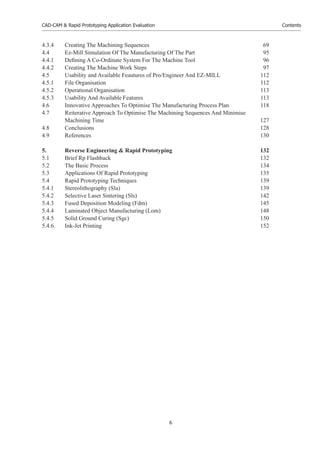
11.
CAD-CAM & RapidPrototyping Application Evaluation
6
Contents
4.3.4 Creating The Machining Sequences 69
4.4 Ez-Mill Simulation Of The Manufacturing Of The Part 95
4.4.1 Defining A Co-Ordinate System For The Machine Tool 96
4.4.2 Creating The Machine Work Steps 97
4.5 Usability and Available Feautures of Pro/Engineer And EZ-MILL 112
4.5.1 File Organisation 112
4.5.2 Operational Organisation 113
4.5.3 Usability And Available Features 113
4.6 Innovative Approaches To Optimise The Manufacturing Process Plan 118
4.7 Reiterative Approach To Optimise The Machining Sequences And Minimise
Machining Time 127
4.8 Conclusions 128
4.9 References 130
5. Reverse Engineering & Rapid Prototyping 132
5.1 Brief Rp Flashback 132
5.2 The Basic Process 134
5.3 Applications Of Rapid Prototyping 135
5.4 Rapid Prototyping Techniques 139
5.4.1 Stereolithography (Sla) 139
5.4.2 Selective Laser Sintering (Sls) 142
5.4.3 Fused Deposition Modeling (Fdm) 145
5.4.4 Laminated Object Manufacturing (Lom) 148
5.4.5 Solid Ground Curing (Sgc) 150
5.4.6. Ink-Jet Printing 152
CAD-CAM & RapidPrototyping Application Evaluation
8
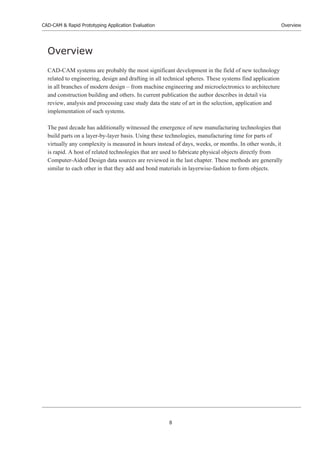
Overview
Overview
CAD-CAM systems are probably the most significant development in the field of new technology
related to engineering, design and drafting in all technical spheres. These systems find application
in all branches of modern design – from machine engineering and microelectronics to architecture
and construction building and others. In current publication the author describes in detail via
review, analysis and processing case study data the state of art in the selection, application and
implementation of such systems.
The past decade has additionally witnessed the emergence of new manufacturing technologies that
build parts on a layer-by-layer basis. Using these technologies, manufacturing time for parts of
virtually any complexity is measured in hours instead of days, weeks, or months. In other words, it
is rapid. A host of related technologies that are used to fabricate physical objects directly from
Computer-Aided Design data sources are reviewed in the last chapter. These methods are generally
similar to each other in that they add and bond materials in layerwise-fashion to form objects.
14.
CAD-CAM & RapidPrototyping Application Evaluation
9
1. Computer Programs in Manufacturing
1. Computer Programs In Manufacturing
1.1 Parametric Technologies
Pro/ENGINEER£
is the best CAD/CAM/CAE system for the last 19 years in a worldwide scale.
Parametric Technologies have achieved these results for less than 23 years. There is one single
reason for this incredible break-through - the company offers revolutionary novel characteristics for
the time. The parametric and associative nature of the application along with design operations,
which in their character are close to the processes, involved in machine building turn the
Pro/ENGINEER into a world leader [1].
Dr Samuel P.Gaisberg found the company in 1985. He used to work as a chief engineer-
programmer in the competitive companies Computervision and Applicon. He left Computervision
in 1984 after his project was rejected. When Parametric Technology Corporation was found in
1985 he succeeded in finding a field for implementing his ideas one of which was the parametric
model of designed parts and assemblies, which allowed for a revolutionary change in the approach
to automated mechanical design.
The Pro-ENGINEER£
leads the chart in this sphere with annual sales revenue of $600.1 million,
which is around a 19% share of total sales of CAD/CAM/CAE systems and an annual growth of
52%. Around 3350 people are employed in the company.
The system has been constantly enlarged and new modules and functions added to it through the
years. In 2002, a new revision of Pro/ENGINEER called Wildfire was released that dramatically
changed the software's graphical user interface. The version Wildfire 4.0 was offered in the market
in 2008, which included over 75 modules and the Pro/ENGINEER£
Wildfire 5.0 version was being
offered in 2009. Attention is drawn mainly on the interface of the system, operation with multi-
component products, data interchange with other CAD/CAM systems and team operation in
Fig. 1.1.
15.
CAD-CAM & RapidPrototyping Application Evaluation
10
1. Computer Programs in Manufacturing
Internet environment. The new model Behavioral Modeler allows for the creation of geometrical
models maintaining certain behaviour when varying its dimensions.
The basic module Pro/Foundation provides Windows interface and automatic dimensioning of 2D
sketches. The Pro/ENGINEER£
Wildfire 5.0 comprises a large class modeler Pro/DESKTOP,
which produces and consumes models created by other modules in the family. This provides
automation of all industrial design activities involved, detail geometry design, preparations for
manufacture, analysis using the method of finite elements and last but not least, overall control of
complicated projects for products comprising over 10 000 components and assemblies. All
modules operate on a general 3D model of the product all dimensions of the product being
parametric.
Pro ENGINEER£
provides the unique capability of competitive design achievable through
simultaneous operation in all product development and production preparation stages. All revisions
made in each design stage are automatically introduced in the other stages. This allows for the
detail design to begin before the operation for industrial design has completed. Eventual corrections
in the latter would be also introduced into the finished NC programs and drawings without any
additional design engineer interference. This operation technique allows the users of
Pre/ENGINEER£
to be always a foot ahead of competitors as they design faster, make their
revisions in the progress of work at each stage without any difficulties, produce less prototypes and
their products have an appearance of maximum optimization, which saves materials and improves
reliability [1].
There are over 130000 installed Pro/ENGINEER£
workstations in over 20 000 companies
worldwide by today’s day. There are hundreds of workstations linked in networks in many of them.
Some of the largest users of the system are Volvo, BMW, Ferrari SpA, Volkswagen, Motorola,
Polaroid, Texas Instruments, Canon, NEC, Silicon Graphics, SUN, PC with Windows. The
minimum hardware required is Pentium 75, 64MB RAM, 500 MB available hard disc space, S3
compatible video controller. For professional applications powerful machines with Z buffer and
Fig. 1.2.
16.
CAD-CAM & RapidPrototyping Application Evaluation
11
1. Computer Programs in Manufacturing
Open GL built-in the graphics card are preferred with a fast disc, at least 17” monitor and the more
memory available the better with a maximum fast processor.
The impressive thing about Parametric Technologies is that a new version of Pro/ENGINEER £
is
released every year and this usually includes 2 – 5 new modules and around 400-500 additions
requested by customers and this is offered for all supported hardware platforms and operation
systems [1].
1.1.1 Production Modules In Pro/ENGINEER
x Pro/CASTING provides means for fast creation of moulding equipment and its
components allowing the design engineer of the moulds to easily determine the geometry
of the casting, the cavities and cores of moulds, to manufacture the finished castings and
improve design to facilitate production.
x Pro/MFG-MILL creates NC programs for milling and drilling operations on 2.5 to 5 axis
machines [2].
x Pro/MFG-TURN creates NC programs for turning operations along 4 axes providing
control for double-carriage lathe centers [2].
x Pro/MFG WEDM creates NC programs for spark erosion along 2 to 4 axes [2].
x Pro/MOLDDESIGN facilitates the design of moulds and tools for processing plastics. It
also performs analysis of the process of filling of the mould. Easily defines complicated
parting surfaces [2].
1.2 Autodesk
1.2.1 Autocad Inventor Professional Suite
Autodesk's manufacturing solutions are used in various manufacturing segments, including
industrial machinery, electro-mechanical, tool and die, industrial equipment, automotive
components, and consumer products. Products include AutoCAD Inventor Suite, AutoCAD
Inventor Professional Suite, AutoCAD Mechanical, Autodesk Vault, Alias Product and Moldflow.
Available at the disposal of the design engineer are all capabilities listed above in the description of
the AutoCAD Inventor Professional Suite but also included in this product is the 3D element
library. Algorithms for engineering calculations of strength and deformations under static load
using the finite element analysis (FEA) method allows the designer to analyse the construction in
Fig. 1.3.
17.
CAD-CAM & RapidPrototyping Application Evaluation
12
1. Computer Programs in Manufacturing
the design stage [2]. Powerful commands for dimensioning and editing of the drawing and model
improve efficiency of AutoCAD Inventor users and reduce time by over 30%.
With a customer base of over 123 000 users AutoCAD Inventor is the product with the fastest
growing market share in the industry. A significant part for this is played by the Autodesk partners
in the MAI program who offer Inventor integrated applications for strength calculations based on
MKE, kinematics and dynamic analysis of mechanisms. In addition CAM applications for 2.5D to
5-axes controls for metal processing machines, mould design, sheet metal components, tolerance
analysis and dimensional build-up [2] are also offered.
With the capabilities, production efficiency and ease of operation it provides the new version of
AutoCAD Inventor Suite is a solution, which gives the users the freedom to create [2].
1.3 Ansys
ANSYS is among the leaders in this type of systems. The program is based on the finite element
theory and is developed in a package adopted in various sectors of industry. ANSYS could be
modified and added to. For example, some specialized modules developed by the Spanish company
Ingiciber SA and the Swedish company Anker-Zemer AB extend the capabilities of the standard
package with means of providing solutions in the area of mechanics of building constructions and
hydrodynamics in a limit-element arrangement [2]. ANSYS, Inc. has acquired a number of
companies since 2000, including ICEM CFD Engineering, CADOE, CFX, Century Dynamics,
Harvard Thermal, Fluent, Inc. and Ansoft.
The pre-processor of ANSYS allows the user to create geometric models and import ready-made
ones. When importing models the product performs retranslation of data in the ANSYS format and
the geometric models could afterwards be modified. The system provides means for building
surface and solid-body geometry and making changes in it. ANSYS solves problems from the area
of thermo-physics, hydrodynamics and the electromagnetic theory and makes parallel calculations
for side loads and optimization procedures [3].
The program provides specialized final elements allowing not only shifting and rotation within the
assemblies but also degree of freedom in temperature, stress, etc. The usage of these elements gives
the customer possibilities to perform consistent analysis.
Fig. 1.4.
18.
CAD-CAM & RapidPrototyping Application Evaluation
13
1. Computer Programs in Manufacturing
The program for non-linear calculations LS-DYNA of the company LSTC is included in ANSYS
as a completely integrated module providing specialized algorithms and support for a number of
materials. The customer could use ANSYS and LS-DYNA to model the material processing
techniques to analyse emergency situation (like, for example car crashes), final deformations, and
interaction between a large numbers of bodies [3]. Solutions could be provided to problems
involved in the behaviour of pre-tensioned constructions (like, for example a body getting into a
motor turbine and seismic analysis of equipment) and problems for investigating constructions
subjected to strong deformations (for example, elastic springing of a thin stamped sheet) [4].
LS-DYNA of LSTC is a multi-functional program using the explicit finite element method and
intended for analysis of dynamic deviations in three-dimensional non-elastic structures. Completely
automated solution and the multiple final result checking functions allow successful application of
the system in most complicated problems involving strikes and moulding [3]. The program
provides over 25 algorithms for contact interaction and methods for solving problems in the area of:
non-linear dynamics, quasi-statics, acoustics, thermo-physics, etc. These analytical instruments
provide modelling of a wide range of real problems [3];
estimates of striking resistance (for example, crash tests) for cars, planes, trains, etc [3].
19.
CAD-CAM & RapidPrototyping Application Evaluation
14
1. Computer Programs in Manufacturing
analysis of the dynamic strength of car parts, body, wheels, etc. when moving on an uneven surface
[4]; occupant safety analysis.
The product provides means for analysis of metal forming, glass forming, and plastic moulding,
rolling, pressing, stamping, etc., hydro-forming (including such involving large deformations),
multi-stage processes, problems of streamlining, explosive loads of products, rivet and bolt
connections, modeling of earthquakes [4].
ANSYS DesignSpace is a CAE product based on ANSYS and associated with leading CAD
products and specifically intended for the design stage preceding the analysis stage. The designers
and engineers involved in the analysis of a certain product are working together using the
DesignSpace Expert automatically keeping a record of their work with DesignSpace Report [5].
The combination between the power of analysis of ANSYS and the CAD integration with
DesignSpace creates a real environment for jointly development.
1.4 Ibm - Catia
CATIA is a highest-class system for automation of engineering labour. It is one of the undisputable
leaders in the world of modern CAD/CAM/CAE systems.
CATIA was created by Dassault Systems and is being distributed by IBM and works on IBM
graphic stations. It is one of the best-known and adopted worldwide systems taking a leading place
in the CAD/CAM/CAE market for over 25 years. Meanwhile, it is one of the fastest developing
systems. Its open and flexible architecture allows at least two new versions to be produced each
year providing new functionalities and improvements [4]. The number of products in the system
has grown up from 58 to 108 for three years and most of them, as well as the system as a whole
have undergone multiple renovations for this period.
In 1998, an entirely rewritten version of CATIA, CATIA V5 was released, with support for UNIX,
Windows NT and Windows XP since 2001. In 2008, Dassault announced and released CATIA
Fig. 1.5.
20.
CAD-CAM & RapidPrototyping Application Evaluation
15
1. Computer Programs in Manufacturing
V6.[4] While the server can run on Microsoft Windows, Linux or AIX, client support for any
operating system other than Microsoft Windows is dropped [4].
CATIA represents a unique integrated solution for creating and developing engineering products
and their optimization in the conditions of team design. This high-tech solution is presently being
used in over 9 thousand companies in the world. Many of the largest world manufacturers as well
as companies with one or two employees draw competitive advantages from it and attain perfection
of design [4].
It improves the entire product line of the system aiming at increasing customer competitiveness in
the design, optimization, production and planning of resources [4]. Small and medium scale
companies are offered a new and convenient to use module for assembling products based on the
abstraction for graphic representation based on the hierarchy tree.
Customers, who consider the shape of the design of significant importance, like for example
consumer goods or cars are offered a new product for efficient and high-quality data exchange
between CATIA and ALIAS. This increases efficiency when designing shapes allowing easy
agreement between the designer and engineer’s activities [4].
The product Generative Shape Modeling dramatically accelerates the process of detail design. The
companies where the usage of highly efficient solid-body modelling is critical are able to take
advantage of the serious improvements in efficiency compared to earlier CATIA. The drawing
generation process has also been accelerated. These improvements are of primal importance for the
design of motors, reducers and all types of machine mechanism where large models are usually
involved [4].
The CATIA new version is a move forward to a new quality level of automation of technological
operations. The Surface Machining Programmer product is a complete and easy to use selection of
means for generating 3D programs for 3-axes milling machines. The Multi-Axis Machining
Programmer product uses leading NCCS technologies and is addressed to the need of complicated
machining in plane building techniques. As a whole, CATIA improves flexibility when selecting
between two types of functionalities: fully interactive geometrically based ones and semi-
automated process-oriented ones [5].
Fig. 1.6.
21.
CAD-CAM & RapidPrototyping Application Evaluation
16
1. Computer Programs in Manufacturing
This version significantly improves the analysis and optimization functions. The product
Generative Part Optimization is intended to provide sensitive analysis and optimization of products
with the aim of ensuring the best quality design in the fastest possible way and with minimum
effort involved. The design engineer is offered intuitive analysis of shell structures, which adds to
the existing functions for three-dimensional stress analysis. The two-dimensional arrangement of
finite elements is significantly improved and enriched with methods allowing integration of
streamlining tests in the design process.
Accelerating the design process for metal ships the CATIA Shipbuilding application has been
completely revised to a site oriented product. It uses the unique intelligence of CATIA AEC
architecture [5]. The product Product Manager Integration provides unique functions for integration
between CAD/CAM/CAE/PDM and company business management systems.
22.
CAD-CAM & RapidPrototyping Application Evaluation
17
1. Computer Programs in Manufacturing
1.5 Datacad
DataCAD’s new version (13 - June 2010) includes [6] an all new AutoCAD compatible
DXF/DWG translator. A digital Terrain Modeler (DTM), an estimator for Windows, an expanded
3D object libraries, improved display performance and WinHelp based online documentation [9].
The sofware is of primarily architectural and construction usage rather than manufacturing.
Transferring files back and forth between DataCAD and AutoCAD is a breeze with DataCAD's
new translator. The DWG translator allows CAD users to benefit from the ease of use of drafting
with DataCAD and easily exchange data with engineers and others who use AutoCAD. The new
translator will convert custom linetypes in DataCAD to AutoCAD format, so your drawings will
display in AutoCAD as they do in DataCAD [10].
Improved display list performance provides faster refresh time, object snapping, entity selection,
and panning and zooming, improving the program's performance by a factor of up to ten times the
speed of DataCAD [11]. The Display List is engineered such that the closer you zoom into the
drawing, the faster it performs. This is particularly important for drafting, where the user frequently
zooms in on the drawing to perform edits and then changes views. Unlike an isolated feature,
display list benefits all DataCAD users immediately and throughout the drawing process with
increased program speed [12].
Fig. 1.8.
Fig. 1.7.
Fig. 1.9.
23.
CAD-CAM & RapidPrototyping Application Evaluation
18
1. Computer Programs in Manufacturing
The Digital Terrain Modeler (DTM) allows you to quickly and easily model site plans from survey
data or contour lines [13]. Making it easier to draft a realistic landscape, allowing for greater
flexibility and creativity in producing realistic models and landscapes and addresses the site-related
aspects of building design [13]. The DTM is, most importantly, easy to use. Simply create contours,
points, or lines at varying Z-heights, and the terrain modeler will calculate a polygon surface
through these points.
There are 1,500 new three-dimensional symbols, including three-dimensional cars and trucks;
parking lot, roadway, and walkway lights; park benches; metal, plastic, and wood objects and
furnishings; as well as everything for the modern cityscape [14]. In addition, DataCAD includes
three-dimensional kitchen and bathroom cabinetry, plumbing fixtures and appliances give you
more options for creating detailed 3D models [14].
DataCAD Estimator for Windows, is also included on the DataCAD. Estimator offers instant
totaling, "what if" capabilities, an extensive help system, tutorials, markups and an unlimited bid
items [15]. The estimator integrates with DataCAD and supports Quicken and Quickbooks formats.
The WinHelp based online documentation is a user-friendly help system [15]. The dual-pane help
window means you no longer need to go back and forth between navigating through the help
system and displaying topics, and the Contents tab remains synchronized with the selected topic so
you can better understand relationships between topics [16]. Printed documentation has also been
improved; a completely revised and expanded reference manual is included with every upgrade.
The manual is structured to reflect the way a CAD user works and includes a tutorial, whose
exercises are synchronized with corresponding reference material [17].
The Productivity Pack includes new 2D and 3D icon toolbars that rapidly access DataCAD most
frequently used functions. So that we can quickly and easily annotate the drawing at the correct
scale with the new notation, dimension and text toolbars. Additional toolbars address 3D modeling,
hatching and common 2D drafting functions [17].
24.
CAD-CAM & RapidPrototyping Application Evaluation
19
1. Computer Programs in Manufacturing
1.6 References
1. B. Bettig, J. Shah. An object-oriented program shell for integrating CAD software tools.
Advances in Engineering Software, Volume 30, Issue 8, August 1999, Pages 529-541.
2. B. Tamm, R. Kyttner, J. Vilipyld, J. Pruuden. A system for CAD/CAM software
development and implementation. Computers in Industry, Volume 5, Issue 4, December
1984, Pages 367-376.
3. CAM software Metal Finishing, Volume 95, Issue 3, March 1997, Page 79.
4. W.L. Chung. Software methodology for a large-scale integrated CAD/CAM system.
Computer-Aided Design, Volume 14, Issue 2, March 1982, Page 110.
5. CAD/CAM software. Computer Integrated Manufacturing Systems, Volume 1, Issue 1,
February 1988, Page 60.
6. Jakob Vlietstra. Integration aspects in CAD and CAM. Computers in Industry, Volume 5,
Issue 4, December 1984, Pages 295-296.
25.
CAD-CAM & RapidPrototyping Application Evaluation
20
1. Computer Programs in Manufacturing
7. Z. Adamczyk. A new approach to CAM systems development for small and medium
enterprises. Journal of Materials Processing Technology, Volume 107, Issues 1-3, 22
November 2000, Pages 173-180.
8. B.K. Choi, Y.C. Chung, J.W. Park, D.H. Kim. Unified cam-system architecture for die and
mould manufacturing. Computer-Aided Design, Volume 26, Issue 3, March 1994, Pages
235-243.
9. B. Kayis, P.A. Iskander. A three-dimensional human model for the IBM/CATIA system.
Applied Ergonomics, Volume 25, Issue 6, December 1994, Pages 395-397.
10. Neil A. Davidoff, Andris Freivalds. A graphic model of the human hand using CATIA.
International Journal of Industrial Ergonomics, Volume 12, Issue 4, December 1993,
Pages 255-264.
11. Gilles Hivet, Philippe Boisse, Consistent 3D geometrical model of fabric elementary cell.
Application to a meshing preprocessor for 3D finite element analysis. Finite Elements in
Analysis and Design, Volume 42, Issue 1, October 2005, Pages 25-49.
12. Pasquale Corbo, Michele Germani, Ferruccio Mandorli, Aesthetic and functional analysis
for product model validation in reverse engineering applications. Computer-Aided Design,
Volume 36, Issue 1, January 2004, Pages 65-74.
13. R Sarma, D Dutta, An integrated system for NC machining of multi-patch surfaces.
Computer-Aided Design, Volume 29, Issue 11, November 1997, Pages 741-749.
A. Cimino, F. Longo, G. Mirabelli, A multimeasure-based methodology for the ergonomic
effective design of manufacturing system workstations. International Journal of Industrial
Ergonomics, Volume 39, Issue 2, March 2009, Pages 447-455.
14. Mattias Lindahl, Engineering designers' experience of design for environment methods and
tools – Requirement definitions from an interview study. Journal of Cleaner Production,
Volume 14, Issue 5, 2006, Pages 487-496.
15. Daizhong Su, Mark Wakelam, Intelligent hybrid system for integration in design and
manufacture. Journal of Materials Processing Technology, Volume 76, Issues 1-3, April
1998, Pages 23-28.
16. Faydor L. Litvin, Alfonso Fuentes, Qi Fan, Robert F. Handschuh, Computerized design,
simulation of meshing, and contact and stress analysis of face-milled formate generated
spiral bevel gears. Mechanism and Machine Theory, Volume 37, Issue 5, May 2002, Pages
441-459.
the extreme styleswith some variation of appearance as compared
with the shoe being worn.
28.
DISCRIMINATION AMONG CUSTOMERS
Thepractice of playing favorites by giving one customer more
considerate service than another is unnatural. It is unfair and
furthermore is not good business. Any short-measure of service is
bound to be noticed and as a result the business is lost to the
salesman and probably lost also to the house. Nothing can be said to
illustrate with more force the advisability of serving all customers
honestly and without discrimination than an experience of a few
months ago as told by the retailer who was successful in securing the
business that had gone a-begging. Such cases are bound to occur
continually unless there is a fixed standard of service.
A certain customer entered one of the city stores, having just
arrived from a camp where he had been spending the summer.
Dressed as he was at the time, his appearance was that of a
laborer, and evidently, on that account, he was treated
indifferently by the salesman. Being dissatisfied the man left
without having made a purchase and then entered another
store where he was treated with all the respect and
consideration due him. Before leaving, he had purchased shoes
to the value of seventy dollars, paid cash for them and then
presented his card with the request that the shoes be
delivered. Not until then was it learned that he was one of the
most influential men in that section of the country.
The secret of success in serving people is to treat them all alike, but to
make each one feel the distinction of individual attention.
29.
INTERRUPTIONS
There are timeswhen it is impossible to avoid interruptions while a
customer is being served. A polite apology is the least that can be
given, but this does not overcome the handicap that has been caused,
and also the feeling that only part service and divided attention is
being given.
Bear in mind that to the customer the salesman represents the store,
and that if the service given is not what it should be the natural
tendency is for the customer to go elsewhere. Quality alone will not
sell goods. Someone has expressed the fact in this way: “An expert
selling force could, if necessary, sell inferior merchandise, but a sales
force without the spirit of true service would bring on failure regardless
of a high standard of merchandise.”
Interruptions are often due to the fact that the salesman’s work is not
properly organized. He may have passed along the preceding order
without the proper instructions, or he may set it aside with the
intention of completing it later, and as a result may be holding up the
work of someone else. In consequence it becomes necessary, perhaps,
that he be interrupted when serving the next customer and thus his
effectiveness as a first-class salesman is reduced. The remedy is to
organize the sale from the time the customer is approached until the
charge is entered and the goods are passed along for delivery. Get the
whole transaction completed and out of the way so that the next
customer may have undivided attention.
VARIETY AMONG PEOPLE
Justas there are no two people exactly alike in physical appearance,
just as there are no two sunsets, trees or no two blades of grass
exactly alike, there are no two people of like personality and mental
development. Variety is a law of nature. One of the greatest
wonders of all creation is that such a range of variety is possible
year after year and century after century, without duplication.
Glancing at a field of daisies or a bouquet of violets the first
impression might be that they are all alike, but we find, of course,
that each one is different in the length of its stem, the size of its
petals and color shadings. As the saying goes, “Variety is the spice of
life.” It is variety that prevents life from becoming monotonous, by
presenting things of everyday life in changed forms and
relationships. Among people the variety of nature and disposition is
the one thing that sets the art of salesmanship apart from
monotonous, machine-like operations and establishes it as an
occupation calling for brains and skill.
Someone may say, “How I wish all customers were like Mrs. Brown
or Mrs. Smith, who always know what they want, who buy without
any fuss and are out of the store again in less time than another
customer takes to decide on the color or style!” That sounds as
though it might be an ideal condition except for the fact that it
would put selling on a plane of service with that offered by the slot
machine. The salesman would become a mere human shoe-handling
machine. The sale to Mrs. Brown is a pleasure to the salesman
simply because it is one of a variety; all of which have been different
in some respects and most of them calling for a higher degree of
personal salesmanship. There are some manufacturing companies
today that have built up such a steady demand for their goods that
the salesman supplying the retailer is often required simply to look
over the dealer’s shelves to see what is needed to make up the
complete stock, make out his order for the required goods and have
32.
it signed bythe retailer. Fine business for the wholesaler and the
dealer! But the salesman runs the risk of becoming a mere stock-
keeper; and his pay is regulated accordingly.
33.
HUMAN NATURE
An understandingof human nature is of especial importance to
people who sell. Every shoe salesman has recognized the fact that
there is among customers a variety of personality or dispositions.
One person is continually in a hurry; another person, although he
may have just as much to do, is never rushed. One person is happy
as a matter of habit; another will appear to be weighted with the
cares of the world—and so it goes, each one contributing to build up
variety in human nature.
The study of human nature is known also as character reading and
as psychology. The purpose of this study is to bring about a clearer
understanding of the laws governing the operation of the human
mind. There is a relationship between a person’s disposition and his
physical appearance as shown by the features of his face, the shape
of his head and such like. The science of analyzing these signs is
known as character reading or character analysis. People who make
a special study of these things are sometimes able to show
remarkable results in reading and understanding people at first
sight. Everybody acquires the habit, more or less, of “sizing-up” a
person who is met for the first time. To the salesman the ability to
do this is a special advantage in that it enables him at once to
understand a customer and to govern his effort to sell accordingly.
Without knowing anything about the details of character reading as
they relate to a study of the proportions and relationship of a
person’s nose, chin, mouth, and so forth, most of us learn to
understand people simply through the impression they make upon
us as we meet them. A person’s general manner of approach, the
expression and tone of voice, come to mean a great deal to us in an
effort to understand those with whom we come in contact. A broad
suggestion on this point is that the salesman should confine at least
his first effort at reading human nature to that of taking a genuine
34.
interest in eachcustomer. He should base his effort to serve upon
personal impressions rather than upon any attempt at analyzing the
customer according to a series of rules. Only after having made a
special study of psychology or character reading would he be in a
position to get results from these sources. Without belittling any of
these things it is safe to say that a goodly share of success in all
retail selling is based upon the policy of considering each customer,
first of all as a fellow human being, and of backing this up with a
genuine effort to serve him well.
35.
TUNING-UP TO THECUSTOMER
Everyone has had the experience at some time or other of listening
to amateur musicians who attempted to produce in harmony without
first having tuned-up to the proper key. Although their efforts and
interest may have been every bit as sincere, although the motions
may have been the same and notes of music the same as those
played by an artist, the effect produced could be nothing but
discord, and the more persistent the effort to continue the more
displeasing would be the result. The position of the salesman in
relation to the customer is precisely the same. Unless he is, at the
outset, able to understand something of the nature of the customer
and the manner in which each one should be treated, there will
surely result a lack of harmony that will end in killing the sale.
The salesman is called upon for the use of tact, which means an
understanding of what is proper to be done under varying conditions
as they arise under different circumstances. The clerk who asked his
customer to go outside and look over the styles in the window, and
to return after he made a selection, stamped himself at once as
being a man without tact. He had not properly tuned-up to his
customer and therefore the remark, although it seemed perfectly
proper to the clerk, could only produce discord on the mind of the
customer.
The salesman’s proper attitude of mind should be that of working
along with the customer. He should train himself, as he proceeds
with the sale, actually to feel the contact of his own foot in the new
shoe as it slips on the customer’s foot. He should experience the
satisfaction of the purchaser, who mentally notes that he has just
spent, perhaps a considerable part of a week’s pay, in a good cause
and with no regrets. He cannot serve the customer and hope
steadily to get satisfactory results unless he can transplant himself
into the customer’s frame of mind. He should be able to consider
36.
himself sitting inthe chair, he should look at the shapes and colors
submitted, through the eyes of the customer, and he should feel the
shoe on his own foot as he adjusts it to the customer’s. Pure
imagination, of course, but how else can he successfully work along
in the sale with his customer—how else can he hope to work in
harmony?
Most customers have a mind of their own and can make a decision
when they feel assured that they have the shoe best suited to their
requirements. It is recognized by merchants that the customer is
more dependent upon the ability of the shoe salesman to supply the
goods needed than he is upon any other salesman from whom he
makes purchases. The shoe salesman who really lives up to his
responsibility is a consulting expert to whom the customer comes for
suggestion and advice, in the same way that the doctor is an expert
to whom the patient comes for help.
The salesman’s responsibility therefore is to think with and not
wholly for the customer.
37.
CHILDREN
Already the facthas been mentioned that there is great variety in
human nature. Although each nature or disposition is slightly
different in some respect from every other disposition, as one blade
of grass is different from another, still it is reasonably possible to
make some broad classifications for the purpose of considering their
points of difference.
The first great distinction among people is that between young and
old. “Men are simply boys grown up,” we say. But the experienced
salesman knows that what will be satisfactory in the nature of
service for the young boy will not do for the “old boy.”
Most youngsters, especially boys, do not like to be sent to the
grocery store on small errands to get supplies of food for the dinner
table. On the other hand, there is generally a change of attitude
when the boy learns that the errand is to a grocer’s where he knows
some good-natured soul will take the trouble and special interest to
hand out, perhaps a cracker to make him happy on the way home.
To use a homely illustration: A butcher in New York city built up a
following among all the children in the neighborhood because he
showed a fatherly interest, and at the same time handed out pieces
of bologna to the youngsters, whenever they came in to buy. He
may have handed out a pound or two in the course of a day; but
some of the young boys have since become old boys and are still
trading at the old stand.
Success in serving children, whether it be food or shoes, is in
showing a genuine interest in them and in pleasing them. The
salesman need not take time off to explain the operations of the
store or department, but he will find his time not lost in spending a
moment to inquire kindly on some minor point concerning the child
and perhaps to learn its name. The child is pleased, and except in
most unusual cases the mother is too.
38.
With children thematter of proper fit should be foremost. In addition
to the fact that the foot is continually growing, it is soft and easily
moulded. An incorrect fit under these conditions should be carefully
guarded against. The matters of wearing quality, price and style
should be of secondary importance to fitting properly. If the parent
seems to be unaware of the full importance of correct fitting the
salesman can generally win a good customer by taking the
necessary time to explain.
39.
TALKATIVE PEOPLE
Something hasalready been said concerning the salesman’s attitude
toward the talkative customer. It is safe to assume that nothing
definite in the nature of a sale will result by encouraging such people
to talk. Knowing practically nothing about shoes, the natural result is
that if they are encouraged to go on the conversation must drift
from the subject of shoes. This means that the sale is then less of a
reality than it was when the customer first sat down in the chair.
A one-sided “conversation” cannot long continue. The salesman
should take part in it only as long as it has some bearing on his
special mission—that of selling shoes. As it continues beyond that
point he should offer no further encouragement to go on, but should
wait with consideration until there is a pause, and then continue
from where he left off with the selling talk.
Oftentimes there will be suggestions made in the course of the
conversation that may later be used in an effort to encourage further
purchases. For example, some reference may be made to the
purchase of an evening gown. At the proper time this will open up
an opportunity to suggest a pair of silk slippers or a satin pump.
However, it is well to complete the first sale before offering
suggestions concerning additional purchases.
40.
PRACTICAL
Certain people thereare of very practical nature who have in mind a
definite notion of the goods they want and who do not take kindly to
open suggestions on the part of the salesman. They will be
recognized by their firm, business-like walk, decisive movements and
steady, well-controlled voice. Such a person will be reached best by
direct and frank statements of facts. If the salesman speaks with an
air of authority this customer will invariably listen and be influenced
in his decision accordingly, although he may not be willing to admit
it.
The practical person will quickly express the feeling if unsatisfied
with a shoe and may resent any direct effort to influence his
judgment. Under the circumstances it will generally be found best to
show another style at once. The practical person is not by any
means always right in his decision, but the effort to correct an error
of judgment, if there should be one, must be made indirectly, in
order that the customer may come to a conclusion through his own
reasoning on the basis of facts given him.
With this type of customer it is unnecessary to mention or call
attention to points that may be observed by a careful examination.
The practical person, as a rule, will notice them. However, some
important point about the quality or kind of leather, the lining or
outer sole, will be well received. Elaborate styles will generally not
be acceptable. Quality and fit on the basis of price will be the
deciding factors.
41.
SILENT
The fact hasalready been mentioned that the silent salesman
causes the customer to be ill at ease. More so, perhaps, is the silent
customer difficult to handle and the cause of embarrassment to the
inexperienced salesman. The natural thing among people is for them
to talk enough so that their thoughts on a subject may be known.
Perhaps the best plan in serving customers who will not express an
opinion is to take it for granted that they agree with everything
being told them and finally to assume that they are satisfied and
ready to make the purchase. To close the sale some definite
suggestion, such as, “In wearing these you will find the cushion pad
of special comfort,” followed by the motion of preparing to write the
ticket, will either close the sale or else cause the customer to
express definitely any opinions or preferences he may have.
42.
UNPLEASANT OR GROUCHY
F.W. Small, shoe buyer and department manager for the Gilchrist
Company, Boston, has this to say concerning the customer who is
unreasonable in his demands for attention and service: “The
grouchy, irritable customer is best served by the salesman who
assumes a jovial, apparently unperturbed, light-hearted manner.
However, he should always be attentive and courteous, for
oftentimes these people are not as bad as they seem. Difficult
circumstances, such as ill health and the like, have probably been
responsible for their unfortunate manner rather than any wish or
desire of their own. If the salesman loses his control and becomes
indifferent or uncivil such customers become offended as much or
even more so than the average person. On the other hand, if the
salesman appears pleased and happy while serving them, although
they may not show it at the time, it is invariably a fact that they are
encouraged and benefited by having come in contact with an
opposite disposition, which they must surely admire. Such a
salesman will be singled out by them for all later business, because
of a feeling they have that he understands them and their needs
better than anyone else.”
It is not an easy matter by any means to accept with a smile
continually unpleasant people, but it is good-paying business for the
salesman. He can best understand them perhaps by considering
them as mental invalids in need of some extra measure of
consideration and service. As Mr. Small points out, they are not as
bad as they may seem, and will remember every effort to please
sometimes longer than will the cheerful customer.
43.
ELDERLY PERSON ORINVALID
It is hardly necessary to say anything concerning the salesman’s
responsibility in serving elderly people and invalids. Almost as if by
instinct a man or woman realizes that such people are entitled to an
added measure of kindness and respect. It is only necessary to
remember that whatever may be the peculiarities of disposition,
these things have almost without exception been brought about by
circumstances and conditions that the individual could not control.
Nothing less than the standard by which the salesman would serve
his own mother or father should be the measure of his effort to
please and serve well.
There are times, of course, when it may seem that an elderly person
should be able to think more quickly or to make a decision with less
fuss. Perhaps two or three other sales might have been made in less
time and with less effort, but who would think of measuring service
with a yardstick under these circumstances.
44.
ABSENT-MINDED
Absent-minded people areoften met with by the salesman, and
might be considered as an annoyance unless they are properly
understood. Almost everybody who ever tried to write a joke has
taken the absent-minded college professor as a subject at some time
or other. The yarn of the old professor who, coming in out of the
rain, put his umbrella to bed and stood in the bath tub, proved him
to be absent-minded—but he was no fool. While the rest of the
world very systematically put their umbrellas where they properly
belonged and went comfortably to bed, he was probably thinking
five years ahead of the rank and file. This is not an argument in
favor of increasing the number of absent-minded people. They are
not all college professors and they may not all be deep thinkers, but
they do deserve to be treated with every possible consideration on
the part of the salesman.
In some stores, where the business is large enough to warrant it,
the management has found it to be good business to have salesmen
of special ability to serve elderly customers and invalids. This
requires a fine degree of salesmanship on the part of the man who
is able to tune himself up to such customers and to understand how
they should be best served. It is an art worth while cultivating.
IN A HURRY
Certaincustomers there are who are required at times to make
purchases in a hurry. When a man has ten minutes to use in buying
a pair of shoes, and is on his way to catch the limited train from New
York to Chicago that leaves twenty minutes later, he is in a hurry. It
is safe to say, too, that he needs the shoes pretty badly. There is
nothing the salesman can do under these conditions that will please
the customer so much as to cut through all the red tape, get right
down to business and get the customer started on his way again
before the ten minutes are up. Excitement would not do it. This
would result in the salesman being unable to think clearly and it
would mean also that the customer in excitement would probably
take whatever was offered—and repent later. Someone has said that
what the salesman needs under these conditions is to be “cool-
headed and hot-footed.”
However, when a customer, especially a man, it not actually in a
hurry it is promptness and dispatch that he wants rather than
“pushing.” The distinction between these was clearly brought out in
a recent article:
All men like promptness and dispatch, but few of them want
to be hurried. It is important to keep in mind the difference
between hurrying the customer and waiting on him with
speed.
Quick, nervous movements or speech on the salesman’s part
do not indicate quick service; they only confuse or annoy the
customer. The salesman who puts the least extra motions in
his work, the fewest words and the keenest attention, is the
one who will serve quickly and best.
Help the man to make his choice without seeming to be
patronizing; try to anticipate his course of thought without
47.
interrupting him. Whenhe steps up in front of you act able
to hurry, but do not suggest hurrying. This is the safe way
because, while men do not like to waste time, few of them,
except on special occasions like catching a train or keeping
an appointment, are in such a hurry that they want to be
shot through the selling process as though they were getting
into a lifeboat.
Reflect confidence in your ability to save the customer’s time
rather than the ability to speed him out of the department.
48.
“ONLY LOOKING”
There area few women who take keen enjoyment in a form of
indoor amusement known as “shopping.” This may be nothing more
than a desire to use what would otherwise be a dull morning by
attending a variety show of merchandise. Such a woman may pass
from one department of a store to another trying on pretty clothes in
each one, and with no thought to buy.
After some experience on the floor the salesman soon learns to
distinguish between the customer who comes for business and the
“looker” who has come to be entertained at the expense of the
salesman’s time and effort while other customers are waiting to be
served. On learning that there is no possibility of making a sale, it is
for the salesman to suggest, perhaps, that he has shown the
principal range of styles and that if there is nothing satisfactory
among them the lady might call later and find what she is looking
for. The salesman should, of course, offer the usual courtesy
extended to customers and should make no intimation of the fact
that he does not care to spend further time showing goods. Skillful
salesmanship has often been accountable for sales in those cases
where there had originally been no intention to buy. Rather than run
the risk of missing a sale it is much better for the salesman to
continue his effort for a while even after he has become convinced
that a purchase is not even being considered. The idle “looker”
today may later be ready and able to buy. Therefore whatever goods
are shown should be shown to advantage in order that they may
make the most favorable impression.
49.
UNDECIDED
Everyone with sellingexperience has met the customer who is
unable to make a decision—the person who is thoroughly satisfied
with the goods but cannot come to the point of saying “yes.” In a
recent booklet written for salespeople[3]
the following important
points are brought out and clearly state the position of the salesman
in relation to the undecided customer.
3. Chats on Garment Salesmanship, by Margaret Sumner.
Now for the woman who needs to be helped in making up
her mind. She is a very trying type and needs careful
coaching, bolstering up and nursing along to the point of
decision. Her other characteristics will be more or less your
guide in showing you how to bring her to the point of
decision, but your own manner must be very firm. Do not let
the least hint of a doubt that she will finally buy creep into
your manner or voice. At the same time don’t try to
overwhelm her with your own forcefulness, for then she will
be frightened. Caution and timidity are the natural weapons
of the weak nature, and in all dealings with such persons you
must use all the kindness and patience at your command.
You have to make decisions for them but let them think that
they are making up their minds. Be very gentle but firm.
The weak person must be led like a little child. She simply
hesitates to make up her mind without any reason at all. Do
not try to reason with her; just be cheerful, smiling and
confident, until you inspire a little confidence in her. Some
remark about the reliability of your goods and the reputation
of their makers and of the store behind them will help.
Other woman find it hard to make decisions when the mind
is a little weakened through worry or too great an
50.
expenditure of nervousenergy. This is the nervous,
unhealthy, irritable type, and your method must be as
cheerful and sympathetic as with the timid woman, but less
insistent. Try to convey the impression, without saying it in
so many words, that it will be a relief to get the matter off
her mind by making a decision now. These poor women run
around from store to store, get half a dozen different styles
and desirable qualities fixed in their minds and then lie
awake at night trying to decide between them. If this
method of shopping is hard upon the salesperson, it is many
times as hard upon the shopper. When such a one leaves
with the promise to “decide later” be just as polite and
cheerful as ever, yet without any abruptness. Leave as good
an impression as possible, remarking that you hope she will
come in later and in many cases she will. Often the
personality of the salesperson is the deciding factor in a case
of this kind without the customer realizing it.
Still another type of customer who is undecided and has difficulty in
coming to a decision is the person who, for example, has a short,
thick foot and always admires the long, slim-looking styles and
wishes to be fitted accordingly. Then there is naturally the opposite
—the person with the long, slim foot who laments of its size, who
thinks of the length, which to her seems enormous. One practical
salesman with years of experience mentions that such a customer, if
well served, can actually be made to feel pleased with the shape of
her foot. He says: “When reasoned with properly the customer can
be made to feel much comforted if not really proud of the shape of
her feet. The salesman can mention, for instance, that the cubic
contents of this 8AA foot is less than a size 5½E—and besides a tall
woman would not be well proportioned if she had short feet, short
arms and short fingers. To be properly proportioned is an advantage
—and before the customer realizes it the size 8AA looks pretty well,
after all, she thinks they will do all right, the price is satisfactory and
the sale is made.”
51.
There is nothingdishonest about this means of serving the
customer. It is a genuine, whole-hearted effort to please her and to
supply her with the shoe she should rightly wear and that will give
her the maximum of service. Hugh Black, a prominent Scotch writer
and a close student of human nature, made the statement, after
having toured the United States, that one of the chief characteristics
of the American people, as he noticed them, was that “no matter
what they are doing they want to be doing something else; and no
matter where they are they would go somewhere else.” It is
perfectly human for everyone to seek variety. The woman with the
long, thin foot has become tired of looking at it and consequently it
seems commonplace. The salesman in mentioning that the slim foot
has its advantages is simply reassuring his customer of a fact, and in
doing so he is serving her well.
One of the fatal mistakes in shoe selling is to attempt to please a
customer with a size or proportion that is not the proper one for her
to wear. This can result in nothing but a loss of business through
dissatisfaction when the shoe fails to give the service expected of it.
To understand the customer, to use tact—but not deceit—in selling
the shoe she should wear, is the responsibility of the salesman.
52.
TWO FRIENDS TOGETHER
Itis not unusual for a customer who may be undecided to bring
along a friend to assist in the selection. The salesman, under these
conditions, may have the task of selling two people the one pair of
shoes, because the sale depends upon the satisfaction of both. The
effort to sell will, of course, be directed to the person who is buying.
However, should there be a difference of opinion between the two
concerning some important point such as size or fit, the salesman
would naturally be supported by the person who favors the shoe he
is suggesting as the most desirable one. Although it would be a
mistake for him to make a controversy of it by setting up sides, he
can assist in bringing about a decision by a suggestion or two in
favor of the person who has agreed with the salesman’s selection.
A woman customer accompanied by her husband, or vice versa,
offers another situation that calls for tact on the part of the
salesman. One good woman explained that her husband had bought
himself a new suit but that she had accompanied him simply to pick
out the one he should have. The shoe salesman under the same
conditions, will soon be able to tell which one of the two is to do the
deciding, and he will then direct his selling effort accordingly.
53.
IGNORANT AND POOR
Asa test in salesmanship and the ability to serve different types of
customers, the question was asked before a training class for retail
salespeople as to the manner in which a customer answering the
following description should be greeted and served:
A woman about thirty enters the store carrying a baby in her
arms and leading another child by the hand. Her clothes are
shabby. She is evidently tired and makes her way to the
nearest chair. She looks discouraged.
The salesman on considering these facts realizes at once that such a
customer cannot be served in the same manner as the care-free
schoolgirl. If he places himself in the position of the tired woman he
will realize that her problems are different and that she requires in a
shoe not only service but quality, fit, style and price to meet her own
circumstances.
The salesman would make no effort to hurry such a customer. He
would realize that she would get genuine comfort by resting for a
minute or two before getting down to business and that she might
not even care to think of shoes while resting. Being discouraged, as
shown by her expression, she would probably be cheered by a
remark and some show of interest in the children. To show an
interest would not mean to pry into her personal affairs or to ask a
lot of questions, but a kindly word would serve to direct the woman’s
thought from her troubles and to put her in a buying frame of mind.
Such a customer would expect shoes that would give her the
maximum of wearing quality for the money she has to spend. Her
appearance indicates that she is poor. She wants the greatest
possible wearing service and comfort that she can get. She deserves
the best fit that it is possible to give her, and she will generally be
glad of the salesman’s suggestions concerning the shoe she should
54.
wear. The matterof pattern and style is not a prime consideration.
Talk quality and supply a strong, serviceable shoe. Show an interest
in the children and they will at once be lined up for the next pair of
shoes the mother is able to buy them. It may have taken ten
minutes longer to serve the woman well, but she has been satisfied
and has been made a steady customer.
55.
STYLE REGARDLESS OFPRICE
A certain amount of almost every store’s trade is made up of the
customer who is interested above all other things in style. Something
has already been said concerning the personal appearance of such a
customer. The whole outfit from hat to shoes will speak in terms of
style.
With the customer who puts style before all other considerations
there is great likelihood of there being objection in the matter of
correct shoe fitting, especially if the person’s foot is unusual in size
or shape. Here the salesman is called in to use all he knows of the
art of tactful selling. Business of the kind where price is no object is
certainly well worth cultivating, but here, as in all other successful
shoe selling, the matter of correct fitting is essential to satisfaction.
Avoid talking in terms of sizes. This always lays bare a tender part of
the customer’s conceit or consciousness and opens up the possibility
of dispute and misunderstanding. It is correct fitting that the
customer is buying and not size marks. The salesman will
concentrate his efforts to give the maximum of style with correct
fitting, but with customers whose first and only thought is style, he
will speak only in terms of style.
56.
ACTUAL OR ASSUMEDFOOT TROUBLES
Among customers there are a certain number who continually have
trouble with their feet but who are never able to come to the point
of realizing that the shoes they insist are the proper size are the real
cause of their great discomfort. The salesman should serve his
customer by furnishing him with a shoe that actually fits the foot
and not one that fits some mistaken idea of size.
J. M. Watson, president of the Guarantee Shoe Company, San
Antonio, Texas, emphasizes very strongly the need to serve the
customer with fit rather than sizes. In explaining the policy of his
company he said:
If the customer asks what size the shoes are, change the
subject if possible. However, if you are pinned down to
where it is necessary to talk size, do so. But do not say
simply “6A”—say “6A, which is the size that fits you.” Then if
the customer should say, “They are too long, I don’t wear a
6A, I wear a 5C,” the salesman would reply: “When I sell you
a shoe you wear a 6A because I do not misfit my customers.
The shoe you have on is exactly the model and size that your
feet require—to give you any other would mean that I would
be selling you the wrong shoe for your feet.”
This is a clear statement of fact, but it is bound to impress the
customer favorably because it is said with an air of authority and
because it brings out the importance of correct fitting. The subject of
shoe fitting will be fully treated in the next following section of the
Course. It is mentioned here simply in its important relation to the
treatment of different types of customers. If the customer actually
has foot trouble he needs expert advice such as the salesman will be
in a position to give after having mastered the section of the Course
on “Correct Shoe Fitting.” On the other hand, if he does not have
57.
foot trouble, heneeds good salesmanship to protect himself from
insisting upon a poorly fitted shoe that would later bring on trouble.
FRESHEN-UP THE SELLINGTALK
The purpose of the selling talk is to assist the customer along in the
sale from the start up to the point of his decision to buy. To exercise
a helpful influence requires of the salesman life, spirit and freshness.
Everyone, in order to make a living for himself, is required to have
and to use a certain amount of selling ability, and in proportion to his
skill in using it will depend the value of his services. The best
newsboy is the one who puts the most life and spirit into his efforts,
the one who lets you know, even though you may be across the
street, or around the corner, that he is on the job and that he has
papers to sell. In short, the most successful newsboy is the one who
is the best salesman.
The president of any business organization, no matter how large his
salary nor how great his importance, must be a salesman. He does
not have a free hand to do as he pleases, but must get his authority
on important matters from the directors, who represent the interests
of the stockholders. Unless the president is salesman enough to
convince the directors that his plans are sound and that they will
prove profitable to the business he cannot expect to receive
authority to proceed with them, and therefore he cannot succeed in
his work. In other words, his problem is exactly the same as that of
the shoe salesman except that he must sell an idea or his opinion,
whereas the retail salesman sells merchandise.
If in presenting a plan to his directors the president of the company
should attempt to do so in some half-hearted, dull and uninterested
manner he could expect to receive in return no greater interest or
enthusiasm than he himself showed. On the other hand, if his selling
talk is stimulating, if his manner indicates confidence, if he is
actually “on fire” in the interest of his proposed plan he can be
assured of having it received and considered favorably. The
salesman is dealing with a live subject. He is called upon to present
60.
facts concerning hisgoods in such a way that the customer will
recognize them as being facts rather than mere opinions. This
means that the selling talk must be made to live—it must be
freshened-up. The salesman must continually guard against
becoming mechanical or stereotyped either in his manner or his
sales talk. He must realize that it is just as important for him to
“launder” his selling talk as it is to launder his linen.
61.
THE OUTSIDER’S POINTOF VIEW
One shoe salesman who has recently moved up to the position of
branch manager, says, in speaking of the need to keep customer
service up to par, and of his method of doing it, that his first duty
each morning is to look over the appearance of his store, his
windows and his stock from the viewpoint of an outsider—to
consider his services as a salesman as they would appeal to the
customer who had never before made a purchase of him. He realizes
that there is the tendency for him to grow “stale” in his efforts and
to fall into the habit of considering the next sale as another
mechanical operation. He says that the danger is to regard today’s
work simply as a continuation from where he left off yesterday and
to overlook the fact that as far as today’s customers are concerned
there might just as well have been no yesterday.
The outsider’s point of view is that each sale is an entirely new
experience. The salesman who is able to get himself into this frame
of mind and to treat the customer on this basis can never become
mechanical. He will never run the danger of losing business through
growing stale in his selling talk and his effort to please. This is the
difference between working for a future and working for the pay
envelope. Every man of responsibility looks further ahead than the
Saturday envelope. He is working for a future that means his
development beyond his present job. His success in reaching it will
depend upon his ability to grow out of one and into a bigger one.
Promotion or success is not an over-night process; it is a natural and
gradual growth cultivated by steady effort. Alexander Hamilton, the
first treasurer of the United States and the greatest financial mind
the country has ever known, was proclaimed a genius both here and
abroad, because of what seemed to be a superhuman understanding
and foresight. His simple reply was that although men gave him
credit for genius, the only genius he had was in being able to work
62.
Welcome to ourwebsite – the ideal destination for book lovers and
knowledge seekers. With a mission to inspire endlessly, we offer a
vast collection of books, ranging from classic literary works to
specialized publications, self-development books, and children's
literature. Each book is a new journey of discovery, expanding
knowledge and enriching the soul of the reade
Our website is not just a platform for buying books, but a bridge
connecting readers to the timeless values of culture and wisdom. With
an elegant, user-friendly interface and an intelligent search system,
we are committed to providing a quick and convenient shopping
experience. Additionally, our special promotions and home delivery
services ensure that you save time and fully enjoy the joy of reading.
Let us accompany you on the journey of exploring knowledge and
personal growth!
ebookultra.com





![CAD-CAM & Rapid Prototyping Application Evaluation
9
1. Computer Programs in Manufacturing
1. Computer Programs In Manufacturing
1.1 Parametric Technologies
Pro/ENGINEER£
is the best CAD/CAM/CAE system for the last 19 years in a worldwide scale.
Parametric Technologies have achieved these results for less than 23 years. There is one single
reason for this incredible break-through - the company offers revolutionary novel characteristics for
the time. The parametric and associative nature of the application along with design operations,
which in their character are close to the processes, involved in machine building turn the
Pro/ENGINEER into a world leader [1].
Dr Samuel P.Gaisberg found the company in 1985. He used to work as a chief engineer-
programmer in the competitive companies Computervision and Applicon. He left Computervision
in 1984 after his project was rejected. When Parametric Technology Corporation was found in
1985 he succeeded in finding a field for implementing his ideas one of which was the parametric
model of designed parts and assemblies, which allowed for a revolutionary change in the approach
to automated mechanical design.
The Pro-ENGINEER£
leads the chart in this sphere with annual sales revenue of $600.1 million,
which is around a 19% share of total sales of CAD/CAM/CAE systems and an annual growth of
52%. Around 3350 people are employed in the company.
The system has been constantly enlarged and new modules and functions added to it through the
years. In 2002, a new revision of Pro/ENGINEER called Wildfire was released that dramatically
changed the software's graphical user interface. The version Wildfire 4.0 was offered in the market
in 2008, which included over 75 modules and the Pro/ENGINEER£
Wildfire 5.0 version was being
offered in 2009. Attention is drawn mainly on the interface of the system, operation with multi-
component products, data interchange with other CAD/CAM systems and team operation in
Fig. 1.1.](https://image.slidesharecdn.com/36360-250316213156-6d118c6c/85/CAD-CAM-Rapid-prototyping-Application-Evaluation-None-14-320.jpg)
![CAD-CAM & Rapid Prototyping Application Evaluation
10
1. Computer Programs in Manufacturing
Internet environment. The new model Behavioral Modeler allows for the creation of geometrical
models maintaining certain behaviour when varying its dimensions.
The basic module Pro/Foundation provides Windows interface and automatic dimensioning of 2D
sketches. The Pro/ENGINEER£
Wildfire 5.0 comprises a large class modeler Pro/DESKTOP,
which produces and consumes models created by other modules in the family. This provides
automation of all industrial design activities involved, detail geometry design, preparations for
manufacture, analysis using the method of finite elements and last but not least, overall control of
complicated projects for products comprising over 10 000 components and assemblies. All
modules operate on a general 3D model of the product all dimensions of the product being
parametric.
Pro ENGINEER£
provides the unique capability of competitive design achievable through
simultaneous operation in all product development and production preparation stages. All revisions
made in each design stage are automatically introduced in the other stages. This allows for the
detail design to begin before the operation for industrial design has completed. Eventual corrections
in the latter would be also introduced into the finished NC programs and drawings without any
additional design engineer interference. This operation technique allows the users of
Pre/ENGINEER£
to be always a foot ahead of competitors as they design faster, make their
revisions in the progress of work at each stage without any difficulties, produce less prototypes and
their products have an appearance of maximum optimization, which saves materials and improves
reliability [1].
There are over 130000 installed Pro/ENGINEER£
workstations in over 20 000 companies
worldwide by today’s day. There are hundreds of workstations linked in networks in many of them.
Some of the largest users of the system are Volvo, BMW, Ferrari SpA, Volkswagen, Motorola,
Polaroid, Texas Instruments, Canon, NEC, Silicon Graphics, SUN, PC with Windows. The
minimum hardware required is Pentium 75, 64MB RAM, 500 MB available hard disc space, S3
compatible video controller. For professional applications powerful machines with Z buffer and
Fig. 1.2.](https://image.slidesharecdn.com/36360-250316213156-6d118c6c/85/CAD-CAM-Rapid-prototyping-Application-Evaluation-None-15-320.jpg)
![CAD-CAM & Rapid Prototyping Application Evaluation
11
1. Computer Programs in Manufacturing
Open GL built-in the graphics card are preferred with a fast disc, at least 17” monitor and the more
memory available the better with a maximum fast processor.
The impressive thing about Parametric Technologies is that a new version of Pro/ENGINEER £
is
released every year and this usually includes 2 – 5 new modules and around 400-500 additions
requested by customers and this is offered for all supported hardware platforms and operation
systems [1].
1.1.1 Production Modules In Pro/ENGINEER
x Pro/CASTING provides means for fast creation of moulding equipment and its
components allowing the design engineer of the moulds to easily determine the geometry
of the casting, the cavities and cores of moulds, to manufacture the finished castings and
improve design to facilitate production.
x Pro/MFG-MILL creates NC programs for milling and drilling operations on 2.5 to 5 axis
machines [2].
x Pro/MFG-TURN creates NC programs for turning operations along 4 axes providing
control for double-carriage lathe centers [2].
x Pro/MFG WEDM creates NC programs for spark erosion along 2 to 4 axes [2].
x Pro/MOLDDESIGN facilitates the design of moulds and tools for processing plastics. It
also performs analysis of the process of filling of the mould. Easily defines complicated
parting surfaces [2].
1.2 Autodesk
1.2.1 Autocad Inventor Professional Suite
Autodesk's manufacturing solutions are used in various manufacturing segments, including
industrial machinery, electro-mechanical, tool and die, industrial equipment, automotive
components, and consumer products. Products include AutoCAD Inventor Suite, AutoCAD
Inventor Professional Suite, AutoCAD Mechanical, Autodesk Vault, Alias Product and Moldflow.
Available at the disposal of the design engineer are all capabilities listed above in the description of
the AutoCAD Inventor Professional Suite but also included in this product is the 3D element
library. Algorithms for engineering calculations of strength and deformations under static load
using the finite element analysis (FEA) method allows the designer to analyse the construction in
Fig. 1.3.](https://image.slidesharecdn.com/36360-250316213156-6d118c6c/85/CAD-CAM-Rapid-prototyping-Application-Evaluation-None-16-320.jpg)
![CAD-CAM & Rapid Prototyping Application Evaluation
12
1. Computer Programs in Manufacturing
the design stage [2]. Powerful commands for dimensioning and editing of the drawing and model
improve efficiency of AutoCAD Inventor users and reduce time by over 30%.
With a customer base of over 123 000 users AutoCAD Inventor is the product with the fastest
growing market share in the industry. A significant part for this is played by the Autodesk partners
in the MAI program who offer Inventor integrated applications for strength calculations based on
MKE, kinematics and dynamic analysis of mechanisms. In addition CAM applications for 2.5D to
5-axes controls for metal processing machines, mould design, sheet metal components, tolerance
analysis and dimensional build-up [2] are also offered.
With the capabilities, production efficiency and ease of operation it provides the new version of
AutoCAD Inventor Suite is a solution, which gives the users the freedom to create [2].
1.3 Ansys
ANSYS is among the leaders in this type of systems. The program is based on the finite element
theory and is developed in a package adopted in various sectors of industry. ANSYS could be
modified and added to. For example, some specialized modules developed by the Spanish company
Ingiciber SA and the Swedish company Anker-Zemer AB extend the capabilities of the standard
package with means of providing solutions in the area of mechanics of building constructions and
hydrodynamics in a limit-element arrangement [2]. ANSYS, Inc. has acquired a number of
companies since 2000, including ICEM CFD Engineering, CADOE, CFX, Century Dynamics,
Harvard Thermal, Fluent, Inc. and Ansoft.
The pre-processor of ANSYS allows the user to create geometric models and import ready-made
ones. When importing models the product performs retranslation of data in the ANSYS format and
the geometric models could afterwards be modified. The system provides means for building
surface and solid-body geometry and making changes in it. ANSYS solves problems from the area
of thermo-physics, hydrodynamics and the electromagnetic theory and makes parallel calculations
for side loads and optimization procedures [3].
The program provides specialized final elements allowing not only shifting and rotation within the
assemblies but also degree of freedom in temperature, stress, etc. The usage of these elements gives
the customer possibilities to perform consistent analysis.
Fig. 1.4.](https://image.slidesharecdn.com/36360-250316213156-6d118c6c/85/CAD-CAM-Rapid-prototyping-Application-Evaluation-None-17-320.jpg)
![CAD-CAM & Rapid Prototyping Application Evaluation
13
1. Computer Programs in Manufacturing
The program for non-linear calculations LS-DYNA of the company LSTC is included in ANSYS
as a completely integrated module providing specialized algorithms and support for a number of
materials. The customer could use ANSYS and LS-DYNA to model the material processing
techniques to analyse emergency situation (like, for example car crashes), final deformations, and
interaction between a large numbers of bodies [3]. Solutions could be provided to problems
involved in the behaviour of pre-tensioned constructions (like, for example a body getting into a
motor turbine and seismic analysis of equipment) and problems for investigating constructions
subjected to strong deformations (for example, elastic springing of a thin stamped sheet) [4].
LS-DYNA of LSTC is a multi-functional program using the explicit finite element method and
intended for analysis of dynamic deviations in three-dimensional non-elastic structures. Completely
automated solution and the multiple final result checking functions allow successful application of
the system in most complicated problems involving strikes and moulding [3]. The program
provides over 25 algorithms for contact interaction and methods for solving problems in the area of:
non-linear dynamics, quasi-statics, acoustics, thermo-physics, etc. These analytical instruments
provide modelling of a wide range of real problems [3];
estimates of striking resistance (for example, crash tests) for cars, planes, trains, etc [3].](https://image.slidesharecdn.com/36360-250316213156-6d118c6c/85/CAD-CAM-Rapid-prototyping-Application-Evaluation-None-18-320.jpg)
![CAD-CAM & Rapid Prototyping Application Evaluation
14
1. Computer Programs in Manufacturing
analysis of the dynamic strength of car parts, body, wheels, etc. when moving on an uneven surface
[4]; occupant safety analysis.
The product provides means for analysis of metal forming, glass forming, and plastic moulding,
rolling, pressing, stamping, etc., hydro-forming (including such involving large deformations),
multi-stage processes, problems of streamlining, explosive loads of products, rivet and bolt
connections, modeling of earthquakes [4].
ANSYS DesignSpace is a CAE product based on ANSYS and associated with leading CAD
products and specifically intended for the design stage preceding the analysis stage. The designers
and engineers involved in the analysis of a certain product are working together using the
DesignSpace Expert automatically keeping a record of their work with DesignSpace Report [5].
The combination between the power of analysis of ANSYS and the CAD integration with
DesignSpace creates a real environment for jointly development.
1.4 Ibm - Catia
CATIA is a highest-class system for automation of engineering labour. It is one of the undisputable
leaders in the world of modern CAD/CAM/CAE systems.
CATIA was created by Dassault Systems and is being distributed by IBM and works on IBM
graphic stations. It is one of the best-known and adopted worldwide systems taking a leading place
in the CAD/CAM/CAE market for over 25 years. Meanwhile, it is one of the fastest developing
systems. Its open and flexible architecture allows at least two new versions to be produced each
year providing new functionalities and improvements [4]. The number of products in the system
has grown up from 58 to 108 for three years and most of them, as well as the system as a whole
have undergone multiple renovations for this period.
In 1998, an entirely rewritten version of CATIA, CATIA V5 was released, with support for UNIX,
Windows NT and Windows XP since 2001. In 2008, Dassault announced and released CATIA
Fig. 1.5.](https://image.slidesharecdn.com/36360-250316213156-6d118c6c/85/CAD-CAM-Rapid-prototyping-Application-Evaluation-None-19-320.jpg)
![CAD-CAM & Rapid Prototyping Application Evaluation
15
1. Computer Programs in Manufacturing
V6.[4] While the server can run on Microsoft Windows, Linux or AIX, client support for any
operating system other than Microsoft Windows is dropped [4].
CATIA represents a unique integrated solution for creating and developing engineering products
and their optimization in the conditions of team design. This high-tech solution is presently being
used in over 9 thousand companies in the world. Many of the largest world manufacturers as well
as companies with one or two employees draw competitive advantages from it and attain perfection
of design [4].
It improves the entire product line of the system aiming at increasing customer competitiveness in
the design, optimization, production and planning of resources [4]. Small and medium scale
companies are offered a new and convenient to use module for assembling products based on the
abstraction for graphic representation based on the hierarchy tree.
Customers, who consider the shape of the design of significant importance, like for example
consumer goods or cars are offered a new product for efficient and high-quality data exchange
between CATIA and ALIAS. This increases efficiency when designing shapes allowing easy
agreement between the designer and engineer’s activities [4].
The product Generative Shape Modeling dramatically accelerates the process of detail design. The
companies where the usage of highly efficient solid-body modelling is critical are able to take
advantage of the serious improvements in efficiency compared to earlier CATIA. The drawing
generation process has also been accelerated. These improvements are of primal importance for the
design of motors, reducers and all types of machine mechanism where large models are usually
involved [4].
The CATIA new version is a move forward to a new quality level of automation of technological
operations. The Surface Machining Programmer product is a complete and easy to use selection of
means for generating 3D programs for 3-axes milling machines. The Multi-Axis Machining
Programmer product uses leading NCCS technologies and is addressed to the need of complicated
machining in plane building techniques. As a whole, CATIA improves flexibility when selecting
between two types of functionalities: fully interactive geometrically based ones and semi-
automated process-oriented ones [5].
Fig. 1.6.](https://image.slidesharecdn.com/36360-250316213156-6d118c6c/85/CAD-CAM-Rapid-prototyping-Application-Evaluation-None-20-320.jpg)
![CAD-CAM & Rapid Prototyping Application Evaluation
16
1. Computer Programs in Manufacturing
This version significantly improves the analysis and optimization functions. The product
Generative Part Optimization is intended to provide sensitive analysis and optimization of products
with the aim of ensuring the best quality design in the fastest possible way and with minimum
effort involved. The design engineer is offered intuitive analysis of shell structures, which adds to
the existing functions for three-dimensional stress analysis. The two-dimensional arrangement of
finite elements is significantly improved and enriched with methods allowing integration of
streamlining tests in the design process.
Accelerating the design process for metal ships the CATIA Shipbuilding application has been
completely revised to a site oriented product. It uses the unique intelligence of CATIA AEC
architecture [5]. The product Product Manager Integration provides unique functions for integration
between CAD/CAM/CAE/PDM and company business management systems.](https://image.slidesharecdn.com/36360-250316213156-6d118c6c/85/CAD-CAM-Rapid-prototyping-Application-Evaluation-None-21-320.jpg)
![CAD-CAM & Rapid Prototyping Application Evaluation
17
1. Computer Programs in Manufacturing
1.5 Datacad
DataCAD’s new version (13 - June 2010) includes [6] an all new AutoCAD compatible
DXF/DWG translator. A digital Terrain Modeler (DTM), an estimator for Windows, an expanded
3D object libraries, improved display performance and WinHelp based online documentation [9].
The sofware is of primarily architectural and construction usage rather than manufacturing.
Transferring files back and forth between DataCAD and AutoCAD is a breeze with DataCAD's
new translator. The DWG translator allows CAD users to benefit from the ease of use of drafting
with DataCAD and easily exchange data with engineers and others who use AutoCAD. The new
translator will convert custom linetypes in DataCAD to AutoCAD format, so your drawings will
display in AutoCAD as they do in DataCAD [10].
Improved display list performance provides faster refresh time, object snapping, entity selection,
and panning and zooming, improving the program's performance by a factor of up to ten times the
speed of DataCAD [11]. The Display List is engineered such that the closer you zoom into the
drawing, the faster it performs. This is particularly important for drafting, where the user frequently
zooms in on the drawing to perform edits and then changes views. Unlike an isolated feature,
display list benefits all DataCAD users immediately and throughout the drawing process with
increased program speed [12].
Fig. 1.8.
Fig. 1.7.
Fig. 1.9.](https://image.slidesharecdn.com/36360-250316213156-6d118c6c/85/CAD-CAM-Rapid-prototyping-Application-Evaluation-None-22-320.jpg)
![CAD-CAM & Rapid Prototyping Application Evaluation
18
1. Computer Programs in Manufacturing
The Digital Terrain Modeler (DTM) allows you to quickly and easily model site plans from survey
data or contour lines [13]. Making it easier to draft a realistic landscape, allowing for greater
flexibility and creativity in producing realistic models and landscapes and addresses the site-related
aspects of building design [13]. The DTM is, most importantly, easy to use. Simply create contours,
points, or lines at varying Z-heights, and the terrain modeler will calculate a polygon surface
through these points.
There are 1,500 new three-dimensional symbols, including three-dimensional cars and trucks;
parking lot, roadway, and walkway lights; park benches; metal, plastic, and wood objects and
furnishings; as well as everything for the modern cityscape [14]. In addition, DataCAD includes
three-dimensional kitchen and bathroom cabinetry, plumbing fixtures and appliances give you
more options for creating detailed 3D models [14].
DataCAD Estimator for Windows, is also included on the DataCAD. Estimator offers instant
totaling, "what if" capabilities, an extensive help system, tutorials, markups and an unlimited bid
items [15]. The estimator integrates with DataCAD and supports Quicken and Quickbooks formats.
The WinHelp based online documentation is a user-friendly help system [15]. The dual-pane help
window means you no longer need to go back and forth between navigating through the help
system and displaying topics, and the Contents tab remains synchronized with the selected topic so
you can better understand relationships between topics [16]. Printed documentation has also been
improved; a completely revised and expanded reference manual is included with every upgrade.
The manual is structured to reflect the way a CAD user works and includes a tutorial, whose
exercises are synchronized with corresponding reference material [17].
The Productivity Pack includes new 2D and 3D icon toolbars that rapidly access DataCAD most
frequently used functions. So that we can quickly and easily annotate the drawing at the correct
scale with the new notation, dimension and text toolbars. Additional toolbars address 3D modeling,
hatching and common 2D drafting functions [17].](https://image.slidesharecdn.com/36360-250316213156-6d118c6c/85/CAD-CAM-Rapid-prototyping-Application-Evaluation-None-23-320.jpg)





![UNDECIDED
Everyone with selling experience has met the customer who is
unable to make a decision—the person who is thoroughly satisfied
with the goods but cannot come to the point of saying “yes.” In a
recent booklet written for salespeople[3]
the following important
points are brought out and clearly state the position of the salesman
in relation to the undecided customer.
3. Chats on Garment Salesmanship, by Margaret Sumner.
Now for the woman who needs to be helped in making up
her mind. She is a very trying type and needs careful
coaching, bolstering up and nursing along to the point of
decision. Her other characteristics will be more or less your
guide in showing you how to bring her to the point of
decision, but your own manner must be very firm. Do not let
the least hint of a doubt that she will finally buy creep into
your manner or voice. At the same time don’t try to
overwhelm her with your own forcefulness, for then she will
be frightened. Caution and timidity are the natural weapons
of the weak nature, and in all dealings with such persons you
must use all the kindness and patience at your command.
You have to make decisions for them but let them think that
they are making up their minds. Be very gentle but firm.
The weak person must be led like a little child. She simply
hesitates to make up her mind without any reason at all. Do
not try to reason with her; just be cheerful, smiling and
confident, until you inspire a little confidence in her. Some
remark about the reliability of your goods and the reputation
of their makers and of the store behind them will help.
Other woman find it hard to make decisions when the mind
is a little weakened through worry or too great an](https://image.slidesharecdn.com/36360-250316213156-6d118c6c/85/CAD-CAM-Rapid-prototyping-Application-Evaluation-None-49-320.jpg)