
Profibus UK 20th Anniversary Conference
WIMES followed by Lightning Surge
Protection
June 2013
Agenda
 An overview of United Utilities
First Topic
 WIMES – What, Who, Why, Which and Summary
Second Topic
 Profibus Copper Cables Lightning Surge Protection
 Why we use them and what we install
 Why they’re important
 How they work
 End user experience
 Summary
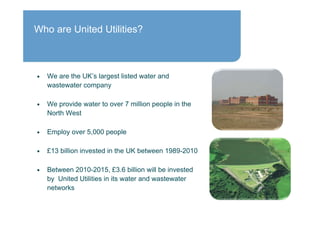
Who are United Utilities?
• We are the UK’s largest listed water and
wastewater company
• We provide water to over 7 million people in the
North West
• Employ over 5,000 people
• £13 billion invested in the UK between 1989-2010
• Between 2010-2015, £3.6 billion will be invested
by United Utilities in its water and wastewater
networks
Why UU uses Profibus
Unified Architecture
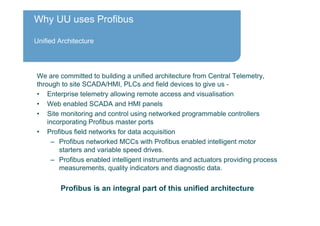
We are committed to building a unified architecture from Central Telemetry,
through to site SCADA/HMI, PLCs and field devices to give us -
• Enterprise telemetry allowing remote access and visualisation
• Web enabled SCADA and HMI panels
• Site monitoring and control using networked programmable controllers
incorporating Profibus master ports
• Profibus field networks for data acquisition
– Profibus networked MCCs with Profibus enabled intelligent motor
starters and variable speed drives.
– Profibus enabled intelligent instruments and actuators providing process
measurements, quality indicators and diagnostic data.
Profibus is an integral part of this unified architecture
First Topic
WIMES
My	thanks	go	to	Mr. Roger	Marlow,	Principal	Consultant	of	The	Pump	Centre,	ESR	Technology,	Warrington	for	his	kind	permission	to	
draw	the	material	in	this	topic	from	his	comprehensive	presentation	delivered	recently	at	the	Pump	Centre	Conference.
• WIMES is an acronym for Water Industry Mechanical and Electrical
Specifications
• The WIMES project is a Pump Centre collaborative project and has been in
existence since 1996.
• There are now almost 60 WIMES specification topics available, enabling
specification of a wide range of equipment, from relatively simple items such
as pumps and motors, to complicated pieces of package plant such as odour
treatment equipment.
• Of these 60 or so specification topics 12 are dedicated to electrical subjects.
WIMES - what?
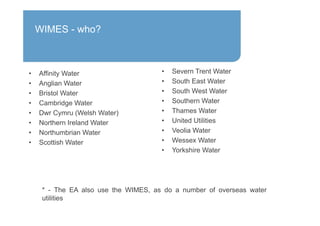
• Affinity Water
• Anglian Water
• Bristol Water
• Cambridge Water
• Dwr Cymru (Welsh Water)
• Northern Ireland Water
• Northumbrian Water
• Scottish Water
• Severn Trent Water
• South East Water
• South West Water
• Southern Water
• Thames Water
• United Utilities
• Veolia Water
• Wessex Water
• Yorkshire Water
* - The EA also use the WIMES, as do a number of overseas water
utilities
WIMES - who?
• Created to provide Water Companies with specifications that will allow them
to obtain equipment which is fit for purpose and gives the lowest Life Cycle
Costs at a competitive purchase price
• In achieving the above, the intention is therefore that the specifications
determine not only the initial purchase price but also the subsequent energy
and maintenance costs
• The intention is also that the specifications should be unambiguous and
allow individual suppliers to compete on an equal footing
WIMES - why?
• They avoid duplication of effort amongst Water companies
• They avoid restrictive and potentially expensive personal preferences, which
could otherwise arise ‘in isolation’
• They define a minimum acceptable standard for suppliers to work to and
they provide a powerful combined voice to suppliers to clearly indicate UK
Water Industry requirements
• The specifications and ultimately the products procured using them
concentrate on functionality and whole-life performance
WIMES - why?
• WIMES 3.02 covers general low voltage electrical installations
• WIMES 3.02(A) is dedicated to the design and installation of Profibus
Networks, but refers back to WIMES 3.02 for generic installation
requirements (cable management, segregation etc.)
• WIMES 3.02(C) is brand new (April 2013); this covers Lightning and LEMP
Protection for structures and incorporates a section for the protection of data
communications (i.e. Profibus) and other signal lines.
• Production of the Profibus content of these specifications draws on –
– Profibus International standards documentation and provides source
references to these.
– The experiences and needs of the participating water companies
– Input from Profibus experts external to the water companies.
WIMES – which
Ones are the Profibus specifications?
WIMES
Summary
• They provide a set of unified specification that suppliers to water companies
can use with confidence.
• They draw on current water industry engineering best practice.
• Familiarity with the WIMES specifications assists supplier response to
tenders and reduces the likelihood of potentially costly mistakes occurring
during procurement.
• They intend to be unambiguous and allow individual suppliers to compete on
an equal footing
• They avoid restrictive and potentially expensive personal preferences, which
could otherwise arise ‘in isolation’
• They define a minimum acceptable standard for suppliers to work to and
provide a powerful combined voice to suppliers clearly indicating UK Water
Industry requirements.
Second Topic
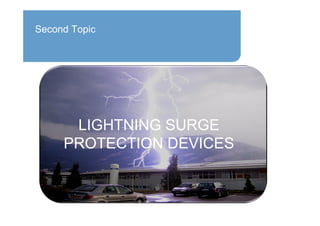
LIGHTNING SURGE
PROTECTION DEVICES
Surge Protection Devices (SPD)
Introduction
This presentation will only discuss SPDs as used on copper wire Profibus DP
networks but the principles are the same for copper wire Profibus PA
networks.
United Utilities are an end user of SPDs and we have to rely on the
manufacturer’s expertise and advice.
The SPD manufacturers have designed their SPDs so that the application
and installation of these on copper wire networks are straightforward and
just needs some attention to detail.
Lightning protection for buildings and structures is far more
complex than for Profibus networks and we won’t be discussing
this topic in this presentation.
Surge Protection Devices (SPD)
A few lightning facts
On average there are about 1.2 ground strikes/km2/year in the UK – some
regions get more and some get less – also more strikes on hills and less in
valleys.
SPDs are now required under BS7671 (aka the IET Regs) and this
became effective from 01/01/12
Thunder can be heard at any location in the UK between 10 and 20 days
per year.
An indirect strike within 100m of a building can induce surges of up to
1.25kA and 5kV.
Surge Protection Devices
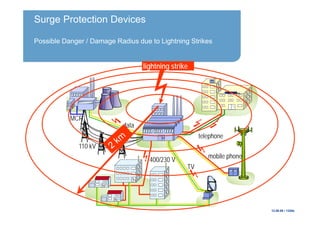
Possible Danger / Damage Radius due to Lightning Strikes
12.06.06 / 1320e
MCR
110 kV
data
TV
400/230 V
ABC Company
mobile phone
lightning strike
telephone
Surge Protection Devices (SPD)
Bird’s eye view of a waste water treatment site
Our sites tend to be isolated and on
open ground.
This site is about 550mx220m ≈12
hectares
Has 9 off installed PLCs, each fitted
with between 2 and 6 off Profibus
networks.
The networks have attached intelligent
MCC starters, instrumentation and
actuator devices located both inside
and outside the local area control
buildings.
To minimise plant failures and possible breach of regulations we
require the installation of SPDs on all external Profibus cabling on all
our sites.
Surge Protection Devices (SPD)
Why we use them
United Utilities uses Profibus as an I/O channel to and from our PLC control
systems, so Profibus is a critical part of our control system strategy.
A partial or catastrophic failure of a Profibus network-
• Can have severe and long lasting effects on the Safety, Health and
Environmental security of the public at large and on any of our
personnel or process plants.
• Exposes United Utilities to regulatory and environmental
prosecutions.
• Exposes United Utilities to civil and criminal prosecutions.
• Can damage United Utilities reputation.
We need to make our Profibus networks robust
Surge Protection Devices
What we install
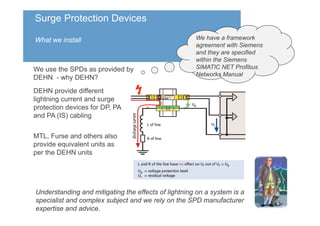
We use the SPDs as provided by
DEHN - why DEHN?
We have a framework
agreement with Siemens
and they are specified
within the Siemens
SIMATIC NET Profibus
Networks Manual
Understanding and mitigating the effects of lightning on a system is a
specialist and complex subject and we rely on the SPD manufacturer
expertise and advice.
MTL, Furse and others also
provide equivalent units as
per the DEHN units
DEHN provide different
lightning current and surge
protection devices for DP, PA
and PA (IS) cabling
Surge Protection Devices
Why they are important
• Most faults occur on our field networks
• We have unexplained failures of Profibus devices
If you have copper networks that run outdoors then fit SPDs
I suspect that on unprotected networks nearby ‘ground strikes’ raises the voltage
on the networks sufficient to overstress the Profibus device chips but not enough to
cause immediate failure.
Every strike will cause quicker device ‘aging’ or degradation that ultimately leads to
premature device failure
Similarly – large current switching transients (big motors starting/stopping) will
have the same effect over time. In this case follow the cable segregation rules
and keep Profibus copper cabling well away from power cables
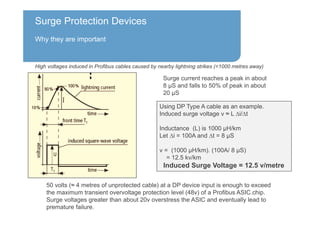
High voltages induced in Profibus cables caused by nearby lightning strikes (<1000 metres away)
Surge current reaches a peak in about
8 μS and falls to 50% of peak in about
20 μS
Using DP Type A cable as an example.
Induced surge voltage v ≈ L ∆i/∆t
Inductance (L) is 1000 μH/km
Let ∆i = 100A and ∆t = 8 μS
v = (1000 μH/km). (100A/ 8 μS)
= 12.5 kv/km
Induced Surge Voltage = 12.5 v/metre
50 volts (≈ 4 metres of unprotected cable) at a DP device input is enough to exceed
the maximum transient overvoltage protection level (48v) of a Profibus ASIC.chip.
Surge voltages greater than about 20v overstress the ASIC and eventually lead to
premature failure.
Surge Protection Devices
Why they are important
Surge Protection Devices
How they work
Suppressor Diodes – fast voltage clamping
but can only handle low surge currents
Gas Discharge Tubes – slow to start but
can handle very high surge currents
When a surge current occurs then voltage
rises rapidly
The suppressor diode quickly clamps the
voltage and diverts surge current to earth.
The GDT now fires and diverts large surge
currents to earth.
Can handle about 10kA peak discharge
current and will withstand many surge
currents of about 125 A
When the surge disappears then the SPD
automatically reverts to normal operation
Effectively acts as a momentary short
circuit to earth when the voltage gets too
high..
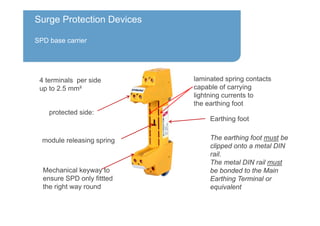
module releasing spring
protected side:
laminated spring contacts
capable of carrying
lightning currents to
the earthing foot
4 terminals per side
up to 2.5 mm²
Earthing foot
Mechanical keyway to
ensure SPD only fittted
the right way round
Surge Protection Devices
SPD base carrier
The earthing foot must be
clipped onto a metal DIN
rail.
The metal DIN rail must
be bonded to the Main
Earthing Terminal or
equivalent
Surge Protection Devices
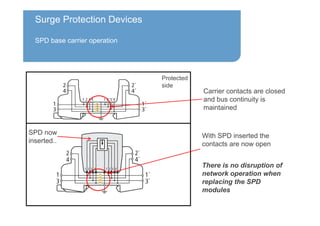
SPD base carrier operation
With SPD inserted the
contacts are now open
SPD now
inserted..
There is no disruption of
network operation when
replacing the SPD
modules
Carrier contacts are closed
and bus continuity is
maintained
Protected
side
Surge Protection Devices
Maintenance
Unfortunately you can’t tell if an SPD is ‘blown’ or has been overloaded by a
nearby lightning strike just by looking at it.
Limited to a periodic visual inspection of the installation i.e.-
• Installation corresponds with the technical documentation (no
modifications have been made)
• Check for signs of damage
• No loose connections.
• The SPD earth bonding conductors are intact and securely connected
at both ends.
Surge Protection Devices
Maintenance
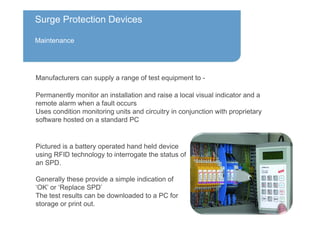
Pictured is a battery operated hand held device
using RFID technology to interrogate the status of
an SPD.
Generally these provide a simple indication of
‘OK’ or ‘Replace SPD’
The test results can be downloaded to a PC for
storage or print out.
Manufacturers can supply a range of test equipment to -
Permanently monitor an installation and raise a local visual indicator and a
remote alarm when a fault occurs
Uses condition monitoring units and circuitry in conjunction with proprietary
software hosted on a standard PC
Surge Protection Devices (SPD)
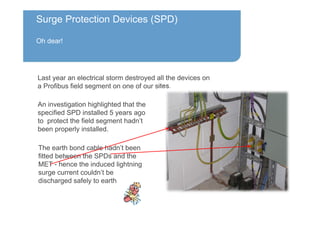
Oh dear!
An investigation highlighted that the
specified SPD installed 5 years ago
to protect the field segment hadn’t
been properly installed.
Last year an electrical storm destroyed all the devices on
a Profibus field segment on one of our sites.
The earth bond cable hadn’t been
fitted between the SPDs and the
MET - hence the induced lightning
surge current couldn’t be
discharged safely to earth
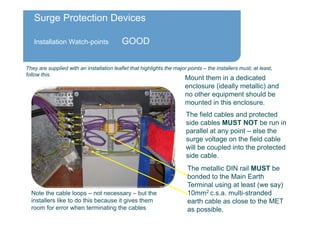
Surge Protection Devices
Installation Watch-points GOOD
The field cables and protected
side cables MUST NOT be run in
parallel at any point – else the
surge voltage on the field cable
will be coupled into the protected
side cable.
Mount them in a dedicated
enclosure (ideally metallic) and
no other equipment should be
mounted in this enclosure.
The metallic DIN rail MUST be
bonded to the Main Earth
Terminal using at least (we say)
10mm2 c.s.a. multi-stranded
earth cable as close to the MET
as possible.
Note the cable loops – not necessary – but the
installers like to do this because it gives them
room for error when terminating the cables
They are supplied with an installation leaflet that highlights the major points – the installers must, at least,
follow this.
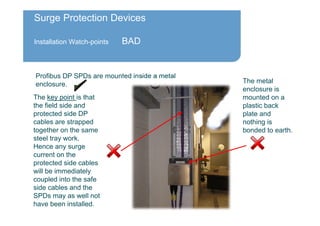
Surge Protection Devices
Installation Watch-points BAD
Profibus DP SPDs are mounted inside a metal
enclosure. The metal
enclosure is
mounted on a
plastic back
plate and
nothing is
bonded to earth.
The key point is that
the field side and
protected side DP
cables are strapped
together on the same
steel tray work.
Hence any surge
current on the
protected side cables
will be immediately
coupled into the safe
side cables and the
SPDs may as well not
have been installed.
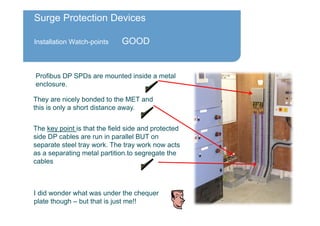
Surge Protection Devices
Installation Watch-points GOOD
Profibus DP SPDs are mounted inside a metal
enclosure.
The key point is that the field side and protected
side DP cables are run in parallel BUT on
separate steel tray work. The tray work now acts
as a separating metal partition.to segregate the
cables
They are nicely bonded to the MET and
this is only a short distance away.
I did wonder what was under the chequer
plate though – but that is just me!!
Surge Protection Devices
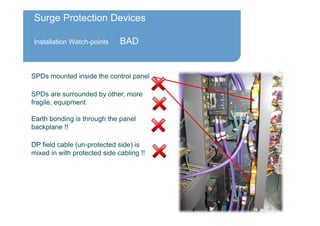
Installation Watch-points BAD
SPDs mounted inside the control panel
Earth bonding is through the panel
backplane !!
DP field cable (un-protected side) is
mixed in with protected side cabling !!
SPDs are surrounded by other, more
fragile, equipment
Surge Protection Devices
Summary
They may look small and insignificant but they can save you a lot of problems
and downtime.
If your Profibus copper cabling runs outside then fit surge protection devices
Further Reading
Dehn Lightning Protection Guide - www.dehn.co.uk/uk/service/downloads/lp_guide.shtml
MTL Surge Technologies Application Notes TAN1001 to TAN1007
www.mtl-inst.com/images/uploads/datasheets/tan/TAN1001.pdf
Ensure that they are located close and earth bonded to the MET and
installed correctly
QUESTIONS…….
David Bray
Senior MCA Engineer
United Utilities Plc
1st Floor Grasmere House
Lingley Mere Business Park
Great Sankey
Warrington
WA5 3LP
Tel Office: 01925 731082
Mobile: 07795 265101
mailto:david.bray@uuia.co.uk
Thank You…..

C5 wimes and spd, david bray

  • 1.
    Profibus UK 20thAnniversary Conference WIMES followed by Lightning Surge Protection June 2013
  • 2.
    Agenda  An overviewof United Utilities First Topic  WIMES – What, Who, Why, Which and Summary Second Topic  Profibus Copper Cables Lightning Surge Protection  Why we use them and what we install  Why they’re important  How they work  End user experience  Summary
  • 3.
    Who are UnitedUtilities? • We are the UK’s largest listed water and wastewater company • We provide water to over 7 million people in the North West • Employ over 5,000 people • £13 billion invested in the UK between 1989-2010 • Between 2010-2015, £3.6 billion will be invested by United Utilities in its water and wastewater networks
  • 4.
    Why UU usesProfibus Unified Architecture We are committed to building a unified architecture from Central Telemetry, through to site SCADA/HMI, PLCs and field devices to give us - • Enterprise telemetry allowing remote access and visualisation • Web enabled SCADA and HMI panels • Site monitoring and control using networked programmable controllers incorporating Profibus master ports • Profibus field networks for data acquisition – Profibus networked MCCs with Profibus enabled intelligent motor starters and variable speed drives. – Profibus enabled intelligent instruments and actuators providing process measurements, quality indicators and diagnostic data. Profibus is an integral part of this unified architecture
  • 5.
  • 6.
    • WIMES isan acronym for Water Industry Mechanical and Electrical Specifications • The WIMES project is a Pump Centre collaborative project and has been in existence since 1996. • There are now almost 60 WIMES specification topics available, enabling specification of a wide range of equipment, from relatively simple items such as pumps and motors, to complicated pieces of package plant such as odour treatment equipment. • Of these 60 or so specification topics 12 are dedicated to electrical subjects. WIMES - what?
  • 7.
    • Affinity Water •Anglian Water • Bristol Water • Cambridge Water • Dwr Cymru (Welsh Water) • Northern Ireland Water • Northumbrian Water • Scottish Water • Severn Trent Water • South East Water • South West Water • Southern Water • Thames Water • United Utilities • Veolia Water • Wessex Water • Yorkshire Water * - The EA also use the WIMES, as do a number of overseas water utilities WIMES - who?
  • 8.
    • Created toprovide Water Companies with specifications that will allow them to obtain equipment which is fit for purpose and gives the lowest Life Cycle Costs at a competitive purchase price • In achieving the above, the intention is therefore that the specifications determine not only the initial purchase price but also the subsequent energy and maintenance costs • The intention is also that the specifications should be unambiguous and allow individual suppliers to compete on an equal footing WIMES - why?
  • 9.
    • They avoidduplication of effort amongst Water companies • They avoid restrictive and potentially expensive personal preferences, which could otherwise arise ‘in isolation’ • They define a minimum acceptable standard for suppliers to work to and they provide a powerful combined voice to suppliers to clearly indicate UK Water Industry requirements • The specifications and ultimately the products procured using them concentrate on functionality and whole-life performance WIMES - why?
  • 10.
    • WIMES 3.02covers general low voltage electrical installations • WIMES 3.02(A) is dedicated to the design and installation of Profibus Networks, but refers back to WIMES 3.02 for generic installation requirements (cable management, segregation etc.) • WIMES 3.02(C) is brand new (April 2013); this covers Lightning and LEMP Protection for structures and incorporates a section for the protection of data communications (i.e. Profibus) and other signal lines. • Production of the Profibus content of these specifications draws on – – Profibus International standards documentation and provides source references to these. – The experiences and needs of the participating water companies – Input from Profibus experts external to the water companies. WIMES – which Ones are the Profibus specifications?
  • 11.
    WIMES Summary • They providea set of unified specification that suppliers to water companies can use with confidence. • They draw on current water industry engineering best practice. • Familiarity with the WIMES specifications assists supplier response to tenders and reduces the likelihood of potentially costly mistakes occurring during procurement. • They intend to be unambiguous and allow individual suppliers to compete on an equal footing • They avoid restrictive and potentially expensive personal preferences, which could otherwise arise ‘in isolation’ • They define a minimum acceptable standard for suppliers to work to and provide a powerful combined voice to suppliers clearly indicating UK Water Industry requirements.
  • 12.
  • 13.
    Surge Protection Devices(SPD) Introduction This presentation will only discuss SPDs as used on copper wire Profibus DP networks but the principles are the same for copper wire Profibus PA networks. United Utilities are an end user of SPDs and we have to rely on the manufacturer’s expertise and advice. The SPD manufacturers have designed their SPDs so that the application and installation of these on copper wire networks are straightforward and just needs some attention to detail. Lightning protection for buildings and structures is far more complex than for Profibus networks and we won’t be discussing this topic in this presentation.
  • 14.
    Surge Protection Devices(SPD) A few lightning facts On average there are about 1.2 ground strikes/km2/year in the UK – some regions get more and some get less – also more strikes on hills and less in valleys. SPDs are now required under BS7671 (aka the IET Regs) and this became effective from 01/01/12 Thunder can be heard at any location in the UK between 10 and 20 days per year. An indirect strike within 100m of a building can induce surges of up to 1.25kA and 5kV.
  • 15.
    Surge Protection Devices PossibleDanger / Damage Radius due to Lightning Strikes 12.06.06 / 1320e MCR 110 kV data TV 400/230 V ABC Company mobile phone lightning strike telephone
  • 16.
    Surge Protection Devices(SPD) Bird’s eye view of a waste water treatment site Our sites tend to be isolated and on open ground. This site is about 550mx220m ≈12 hectares Has 9 off installed PLCs, each fitted with between 2 and 6 off Profibus networks. The networks have attached intelligent MCC starters, instrumentation and actuator devices located both inside and outside the local area control buildings. To minimise plant failures and possible breach of regulations we require the installation of SPDs on all external Profibus cabling on all our sites.
  • 17.
    Surge Protection Devices(SPD) Why we use them United Utilities uses Profibus as an I/O channel to and from our PLC control systems, so Profibus is a critical part of our control system strategy. A partial or catastrophic failure of a Profibus network- • Can have severe and long lasting effects on the Safety, Health and Environmental security of the public at large and on any of our personnel or process plants. • Exposes United Utilities to regulatory and environmental prosecutions. • Exposes United Utilities to civil and criminal prosecutions. • Can damage United Utilities reputation. We need to make our Profibus networks robust
  • 18.
    Surge Protection Devices Whatwe install We use the SPDs as provided by DEHN - why DEHN? We have a framework agreement with Siemens and they are specified within the Siemens SIMATIC NET Profibus Networks Manual Understanding and mitigating the effects of lightning on a system is a specialist and complex subject and we rely on the SPD manufacturer expertise and advice. MTL, Furse and others also provide equivalent units as per the DEHN units DEHN provide different lightning current and surge protection devices for DP, PA and PA (IS) cabling
  • 19.
    Surge Protection Devices Whythey are important • Most faults occur on our field networks • We have unexplained failures of Profibus devices If you have copper networks that run outdoors then fit SPDs I suspect that on unprotected networks nearby ‘ground strikes’ raises the voltage on the networks sufficient to overstress the Profibus device chips but not enough to cause immediate failure. Every strike will cause quicker device ‘aging’ or degradation that ultimately leads to premature device failure Similarly – large current switching transients (big motors starting/stopping) will have the same effect over time. In this case follow the cable segregation rules and keep Profibus copper cabling well away from power cables
  • 20.
    High voltages inducedin Profibus cables caused by nearby lightning strikes (<1000 metres away) Surge current reaches a peak in about 8 μS and falls to 50% of peak in about 20 μS Using DP Type A cable as an example. Induced surge voltage v ≈ L ∆i/∆t Inductance (L) is 1000 μH/km Let ∆i = 100A and ∆t = 8 μS v = (1000 μH/km). (100A/ 8 μS) = 12.5 kv/km Induced Surge Voltage = 12.5 v/metre 50 volts (≈ 4 metres of unprotected cable) at a DP device input is enough to exceed the maximum transient overvoltage protection level (48v) of a Profibus ASIC.chip. Surge voltages greater than about 20v overstress the ASIC and eventually lead to premature failure. Surge Protection Devices Why they are important
  • 21.
    Surge Protection Devices Howthey work Suppressor Diodes – fast voltage clamping but can only handle low surge currents Gas Discharge Tubes – slow to start but can handle very high surge currents When a surge current occurs then voltage rises rapidly The suppressor diode quickly clamps the voltage and diverts surge current to earth. The GDT now fires and diverts large surge currents to earth. Can handle about 10kA peak discharge current and will withstand many surge currents of about 125 A When the surge disappears then the SPD automatically reverts to normal operation Effectively acts as a momentary short circuit to earth when the voltage gets too high..
  • 22.
    module releasing spring protectedside: laminated spring contacts capable of carrying lightning currents to the earthing foot 4 terminals per side up to 2.5 mm² Earthing foot Mechanical keyway to ensure SPD only fittted the right way round Surge Protection Devices SPD base carrier The earthing foot must be clipped onto a metal DIN rail. The metal DIN rail must be bonded to the Main Earthing Terminal or equivalent
  • 23.
    Surge Protection Devices SPDbase carrier operation With SPD inserted the contacts are now open SPD now inserted.. There is no disruption of network operation when replacing the SPD modules Carrier contacts are closed and bus continuity is maintained Protected side
  • 24.
    Surge Protection Devices Maintenance Unfortunatelyyou can’t tell if an SPD is ‘blown’ or has been overloaded by a nearby lightning strike just by looking at it. Limited to a periodic visual inspection of the installation i.e.- • Installation corresponds with the technical documentation (no modifications have been made) • Check for signs of damage • No loose connections. • The SPD earth bonding conductors are intact and securely connected at both ends.
  • 25.
    Surge Protection Devices Maintenance Picturedis a battery operated hand held device using RFID technology to interrogate the status of an SPD. Generally these provide a simple indication of ‘OK’ or ‘Replace SPD’ The test results can be downloaded to a PC for storage or print out. Manufacturers can supply a range of test equipment to - Permanently monitor an installation and raise a local visual indicator and a remote alarm when a fault occurs Uses condition monitoring units and circuitry in conjunction with proprietary software hosted on a standard PC
  • 26.
    Surge Protection Devices(SPD) Oh dear! An investigation highlighted that the specified SPD installed 5 years ago to protect the field segment hadn’t been properly installed. Last year an electrical storm destroyed all the devices on a Profibus field segment on one of our sites. The earth bond cable hadn’t been fitted between the SPDs and the MET - hence the induced lightning surge current couldn’t be discharged safely to earth
  • 27.
    Surge Protection Devices InstallationWatch-points GOOD The field cables and protected side cables MUST NOT be run in parallel at any point – else the surge voltage on the field cable will be coupled into the protected side cable. Mount them in a dedicated enclosure (ideally metallic) and no other equipment should be mounted in this enclosure. The metallic DIN rail MUST be bonded to the Main Earth Terminal using at least (we say) 10mm2 c.s.a. multi-stranded earth cable as close to the MET as possible. Note the cable loops – not necessary – but the installers like to do this because it gives them room for error when terminating the cables They are supplied with an installation leaflet that highlights the major points – the installers must, at least, follow this.
  • 28.
    Surge Protection Devices InstallationWatch-points BAD Profibus DP SPDs are mounted inside a metal enclosure. The metal enclosure is mounted on a plastic back plate and nothing is bonded to earth. The key point is that the field side and protected side DP cables are strapped together on the same steel tray work. Hence any surge current on the protected side cables will be immediately coupled into the safe side cables and the SPDs may as well not have been installed.
  • 29.
    Surge Protection Devices InstallationWatch-points GOOD Profibus DP SPDs are mounted inside a metal enclosure. The key point is that the field side and protected side DP cables are run in parallel BUT on separate steel tray work. The tray work now acts as a separating metal partition.to segregate the cables They are nicely bonded to the MET and this is only a short distance away. I did wonder what was under the chequer plate though – but that is just me!!
  • 30.
    Surge Protection Devices InstallationWatch-points BAD SPDs mounted inside the control panel Earth bonding is through the panel backplane !! DP field cable (un-protected side) is mixed in with protected side cabling !! SPDs are surrounded by other, more fragile, equipment
  • 31.
    Surge Protection Devices Summary Theymay look small and insignificant but they can save you a lot of problems and downtime. If your Profibus copper cabling runs outside then fit surge protection devices Further Reading Dehn Lightning Protection Guide - www.dehn.co.uk/uk/service/downloads/lp_guide.shtml MTL Surge Technologies Application Notes TAN1001 to TAN1007 www.mtl-inst.com/images/uploads/datasheets/tan/TAN1001.pdf Ensure that they are located close and earth bonded to the MET and installed correctly
  • 32.
    QUESTIONS……. David Bray Senior MCAEngineer United Utilities Plc 1st Floor Grasmere House Lingley Mere Business Park Great Sankey Warrington WA5 3LP Tel Office: 01925 731082 Mobile: 07795 265101 mailto:david.bray@uuia.co.uk Thank You…..