Wireless Communication
Networks and Systems
1st edition
Cory Beard, William Stallings
© 2016 Pearson Higher
Education, Inc.
The Wireless Channel 6-1
These slides are made available to faculty in PowerPoint form.
Slides can be freely added, modified, and deleted to suit student
needs. They represent substantial work on the part of the authors;
therefore, we request the following.
If these slides are used in a class setting or posted on an internal or
external www site, please mention the source textbook and note
our copyright of this material.
All material copyright 2016
Cory Beard and William Stallings, All Rights Reserved
CHAPTER 6
THE WIRELESS
CHANNEL
ANTENNAS
The Wireless Channel 6-2
• An antenna is an electrical conductor or
system of conductors
– Transmission - radiates electromagnetic energy
into space
– Reception - collects electromagnetic energy from
space
• In two-way communication, the same antenna
can be used for transmission and reception
RADIATION PATTERNS
The Wireless Channel 6-3
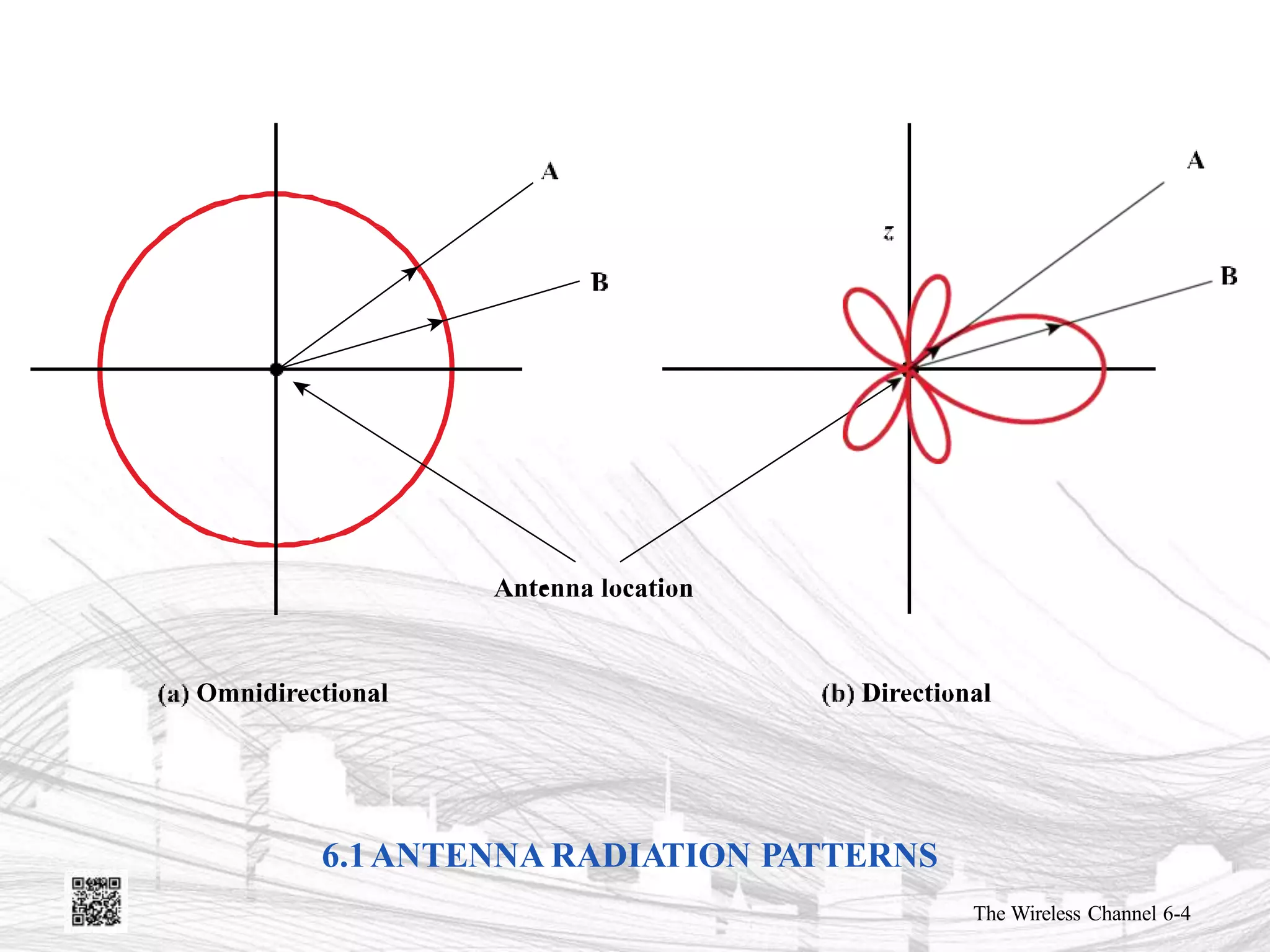
• Radiation pattern
– Graphical representation of radiation properties of an antenna
– Depicted as two-dimensional cross section
• Beam width (or half-power beam width)
– Measure of directivity of antenna
• Reception pattern
– Receiving antenna’s equivalent to radiation pattern
• Sidelobes
– Extra energy in directions outside the mainlobe
• Nulls
– Very low energy in between mainlobe and sidelobes
6.1ANTENNA RADIATION PATTERNS
The Wireless Channel 6-4
TYPES OF ANTENNAS
The Wireless Channel 6-5
• Isotropic antenna (idealized)
– Radiates power equally in all directions
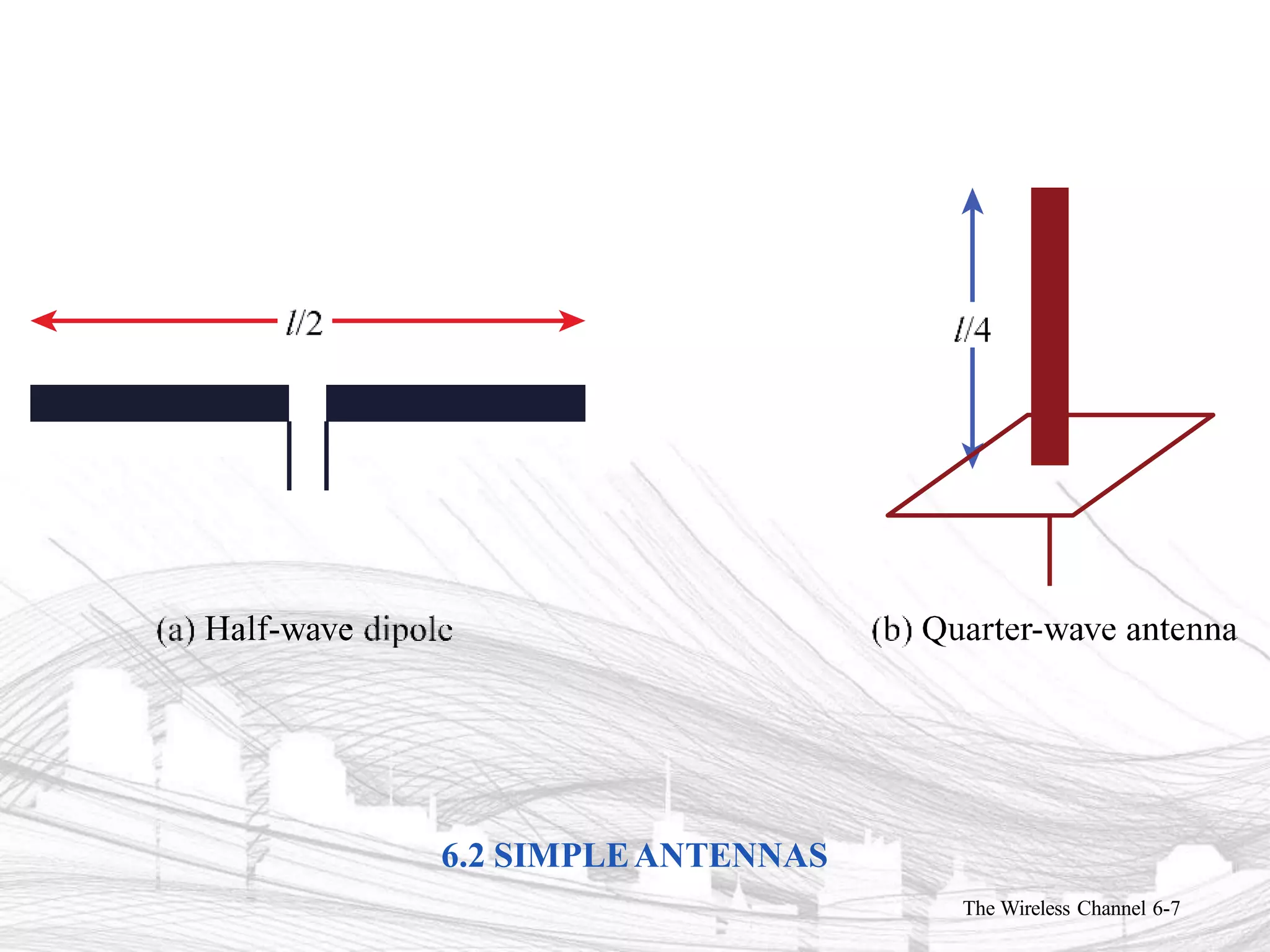
• Dipole antennas
– Half-wave dipole antenna (or Hertz antenna)
– Quarter-wave vertical antenna (or Marconi antenna)
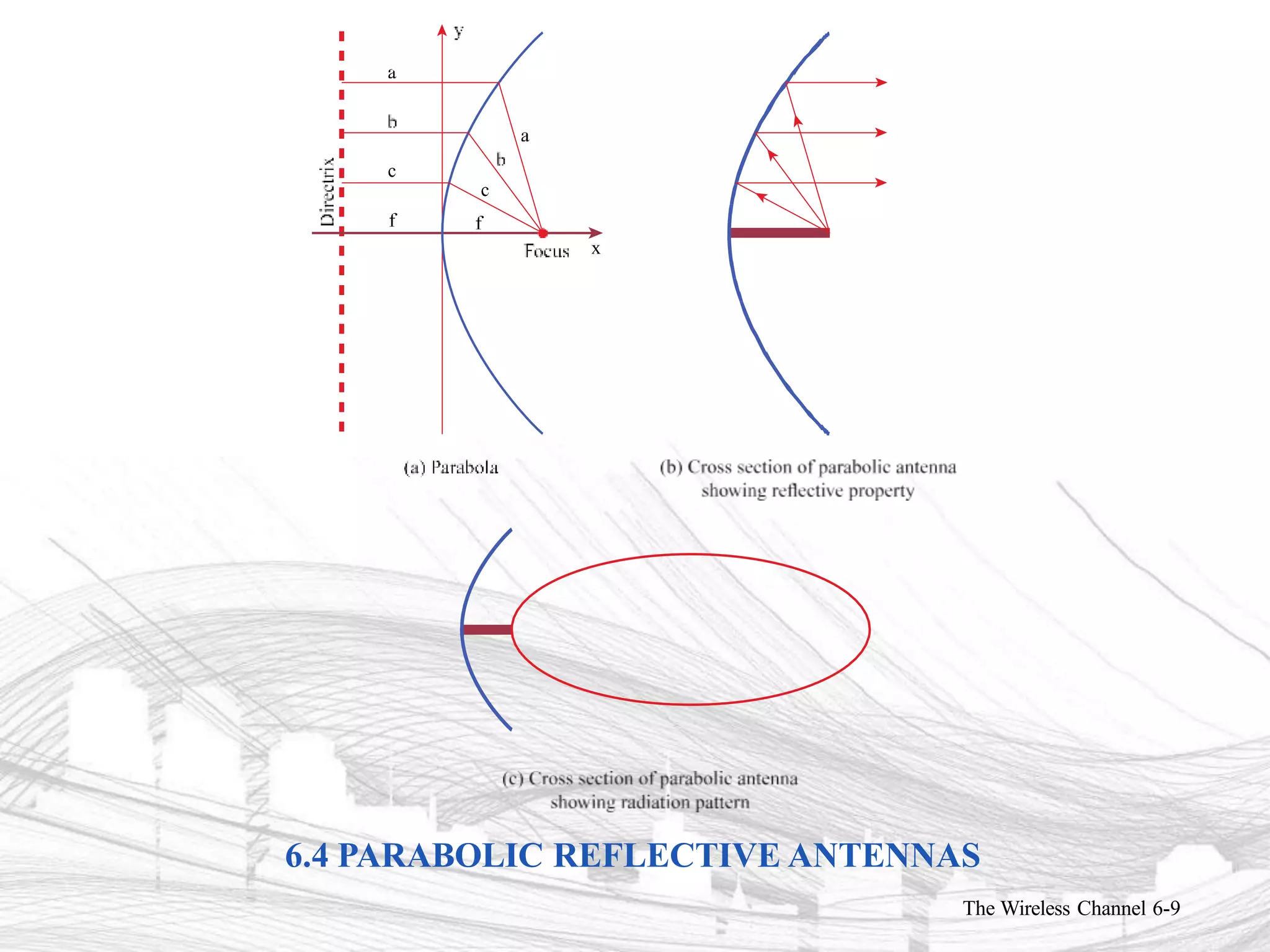
• Parabolic Reflective Antenna
• DirectionalAntennas
– Arrays of antennas
• In a linear array or other configuration
– Signal amplitudes and phases to each antenna are
adjusted to create a directional pattern
– Very useful in modern systems
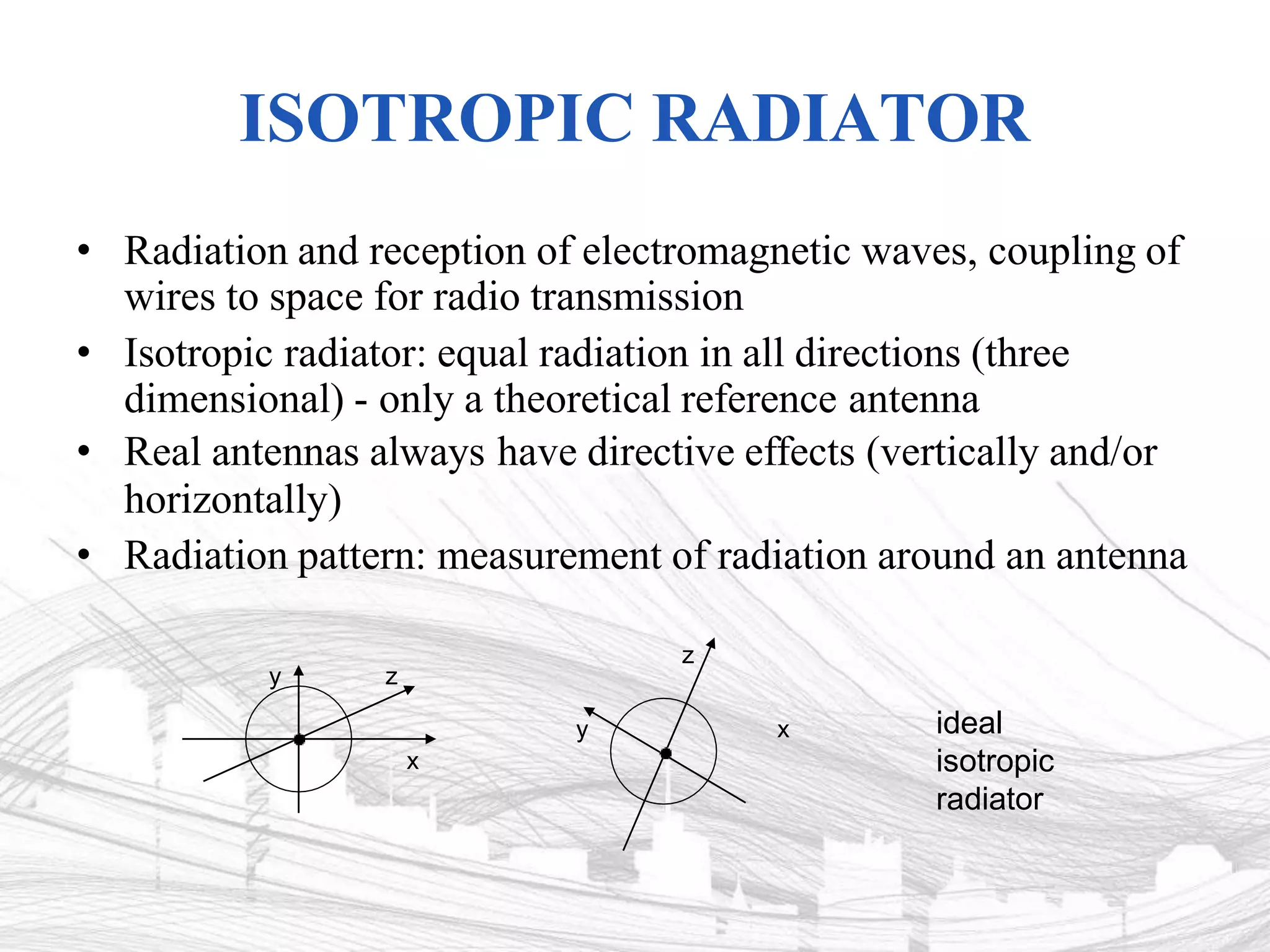
ISOTROPIC RADIATOR
• Radiation and reception of electromagnetic waves, coupling of
wires to space for radio transmission
• Isotropic radiator: equal radiation in all directions (three
dimensional) - only a theoretical reference antenna
• Real antennas always have directive effects (vertically and/or
horizontally)
• Radiation pattern: measurement of radiation around an antenna
z
y
x
z
y x ideal
isotropic
radiator
6.2 SIMPLEANTENNAS
The Wireless Channel 6-7
x
y
z
y
x
z
x
y y
z x
z
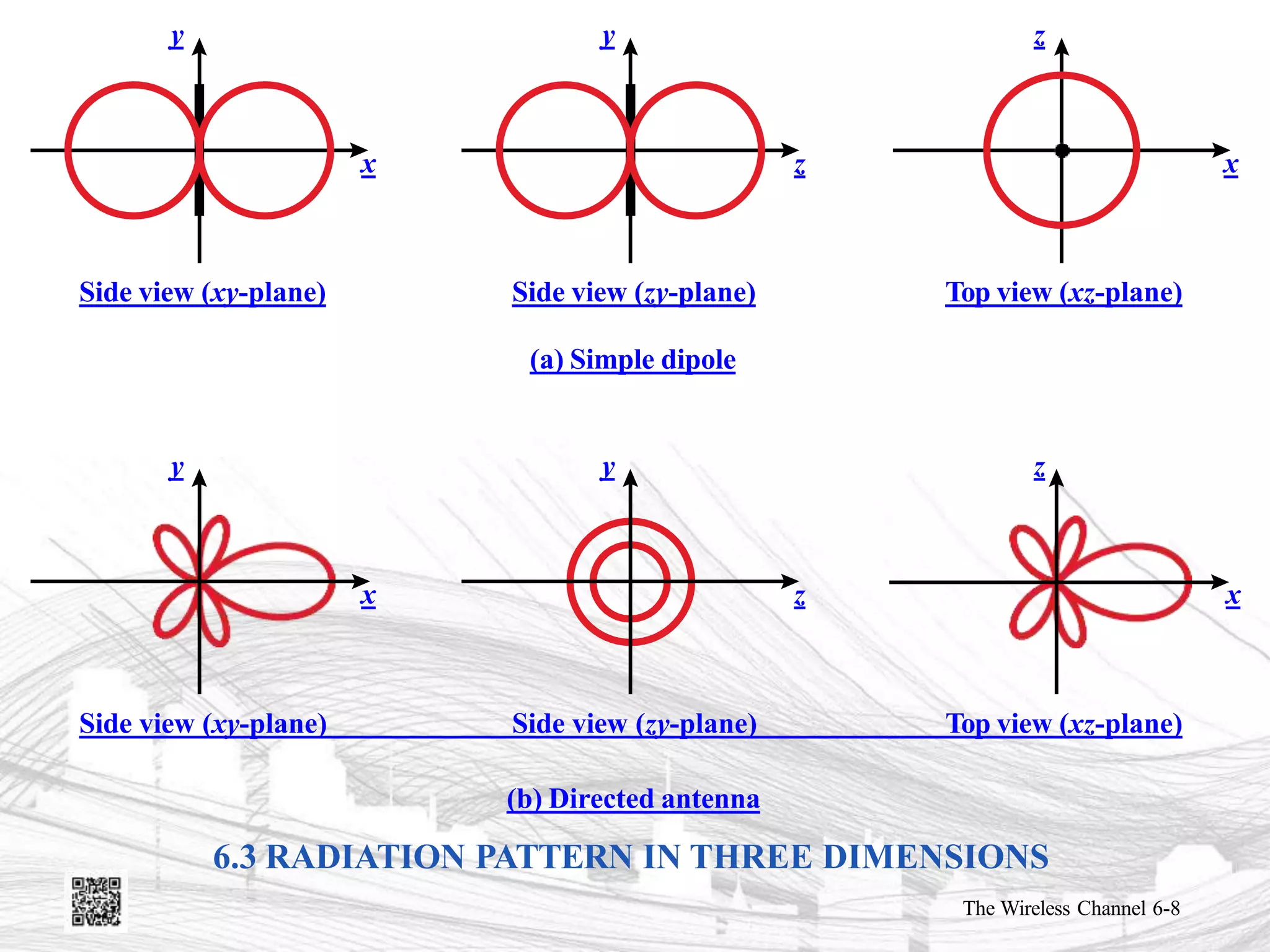
Side view (xy-plane) Side view (zy-plane) Top view (xz-plane)
(b) Directed antenna
6.3 RADIATION PATTERN IN THREE DIMENSIONS
Side view (zy-plane)
(a) Simple dipole
Top view (xz-plane)
Side view (xy-plane)
The Wireless Channel 6-8
6.4 PARABOLIC REFLECTIVE ANTENNAS
The Wireless Channel 6-9
ANTENNA GAIN
The Wireless Channel 6-10
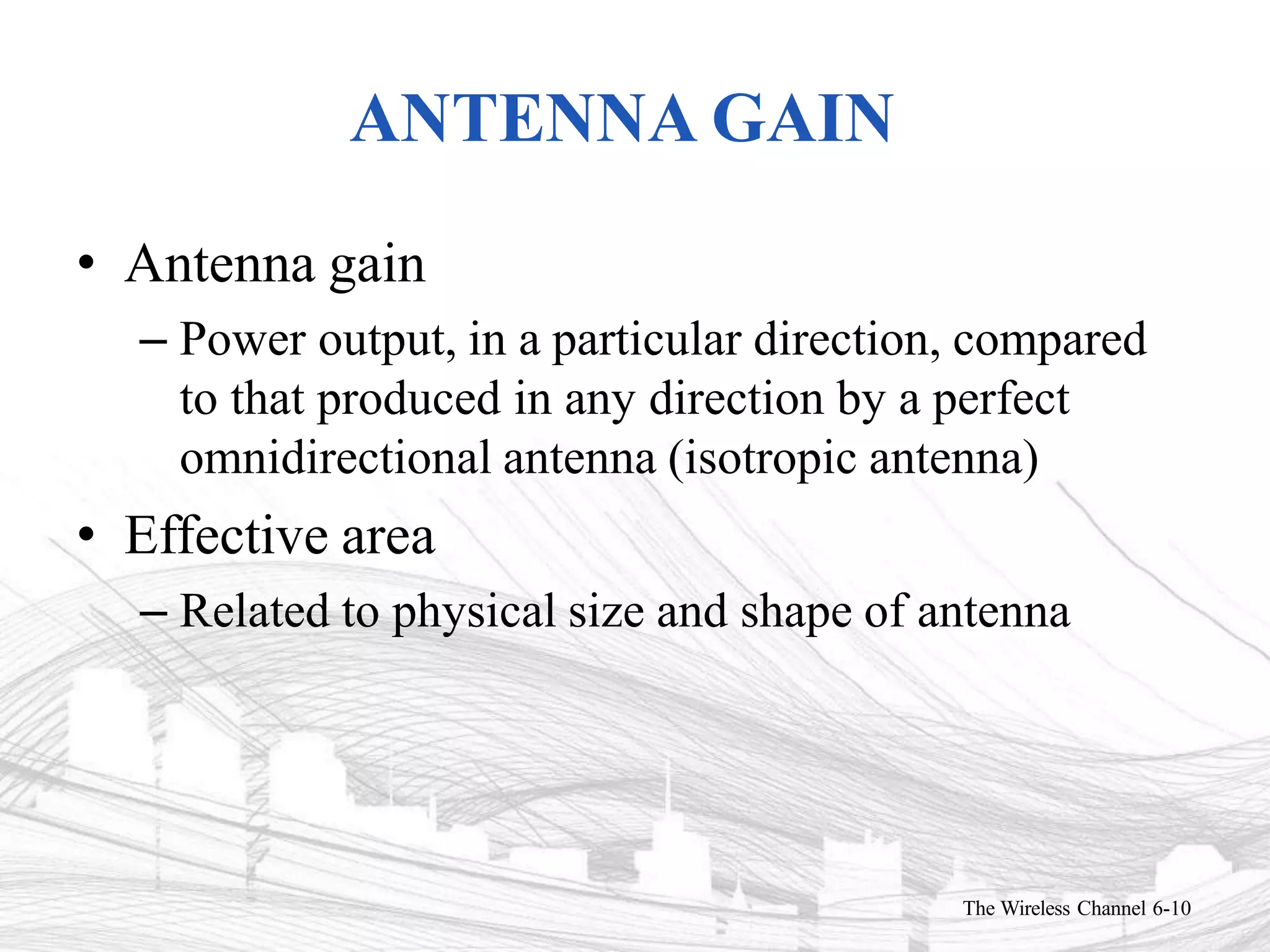
• Antenna gain
– Power output, in a particular direction, compared
to that produced in any direction by a perfect
omnidirectional antenna (isotropic antenna)
• Effective area
– Related to physical size and shape of antenna
ANTENNA GAIN
The Wireless Channel 6-11
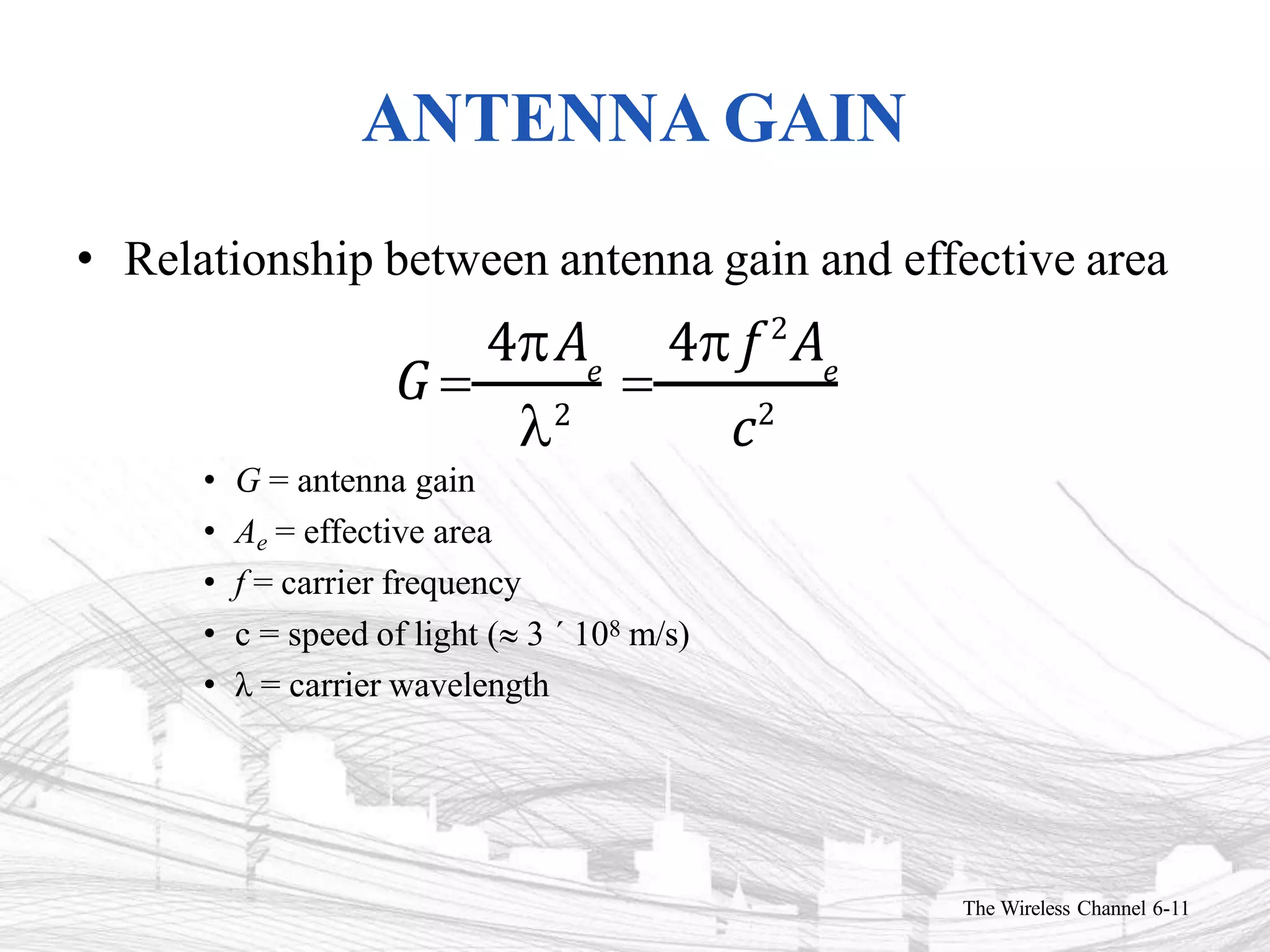
• Relationship between antenna gain and effective area
• G = antenna gain
• Ae = effective area
• f = carrier frequency
• c = speed of light  3 ´ 108 m/s)
• λ = carrier wavelength
2
4A 4 f 2
A
G  e
 e
c2
SPECTRUM CONSIDERATIONS
The Wireless Channel 6-12
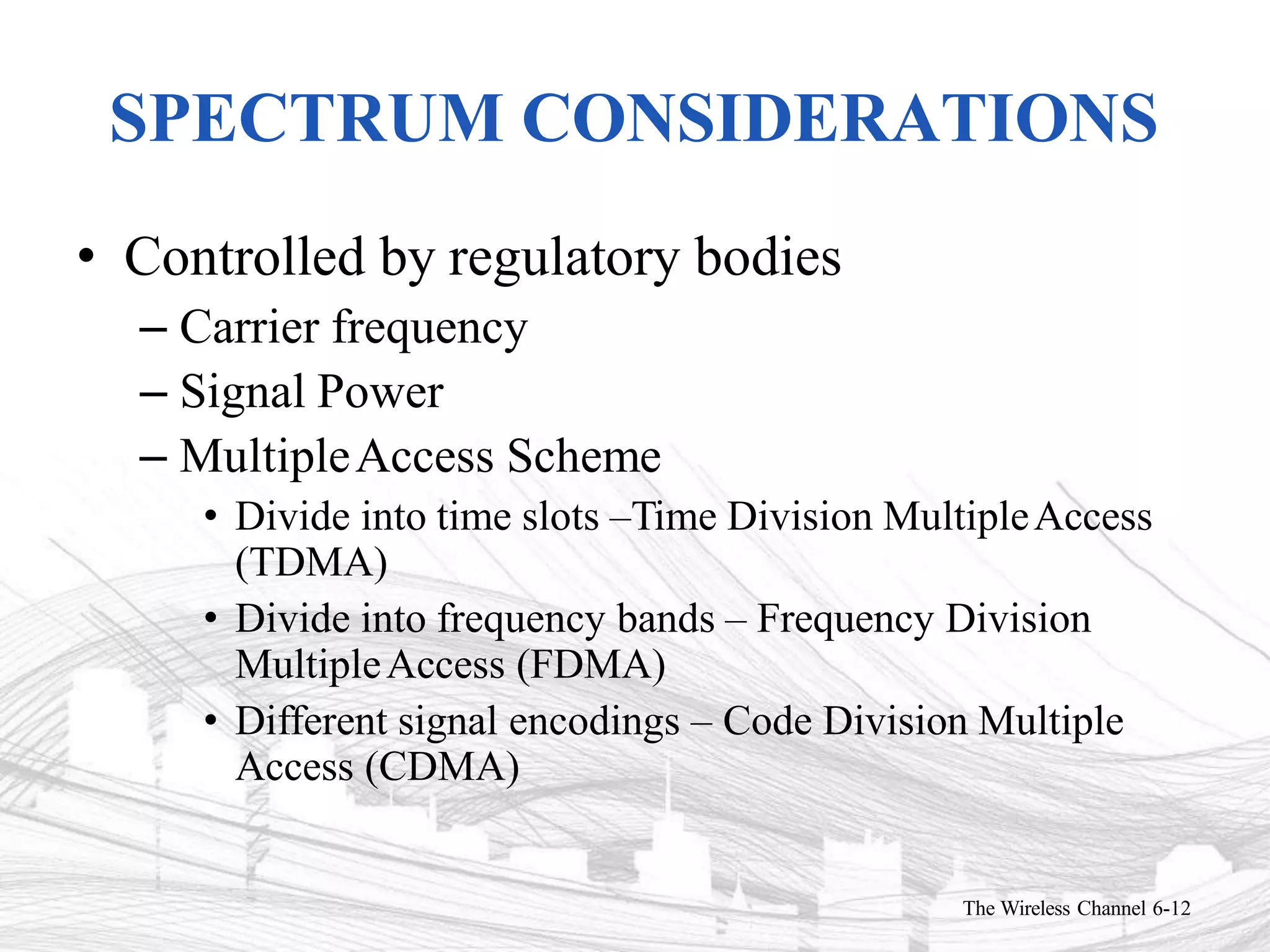
• Controlled by regulatory bodies
– Carrier frequency
– Signal Power
– MultipleAccess Scheme
• Divide into time slots –Time Division MultipleAccess
(TDMA)
• Divide into frequency bands – Frequency Division
MultipleAccess (FDMA)
• Different signal encodings – Code Division Multiple
Access (CDMA)
SPECTRUM CONSIDERATIONS
The Wireless Channel 6-13
• Industrial, Scientific, and Medical (ISM) bands
– Can be used without a license
– As long as power and spread spectrum regulations
are followed
• ISM bands are used for
– WLANs
– Wireless PersonalArea networks
– Internet of Things
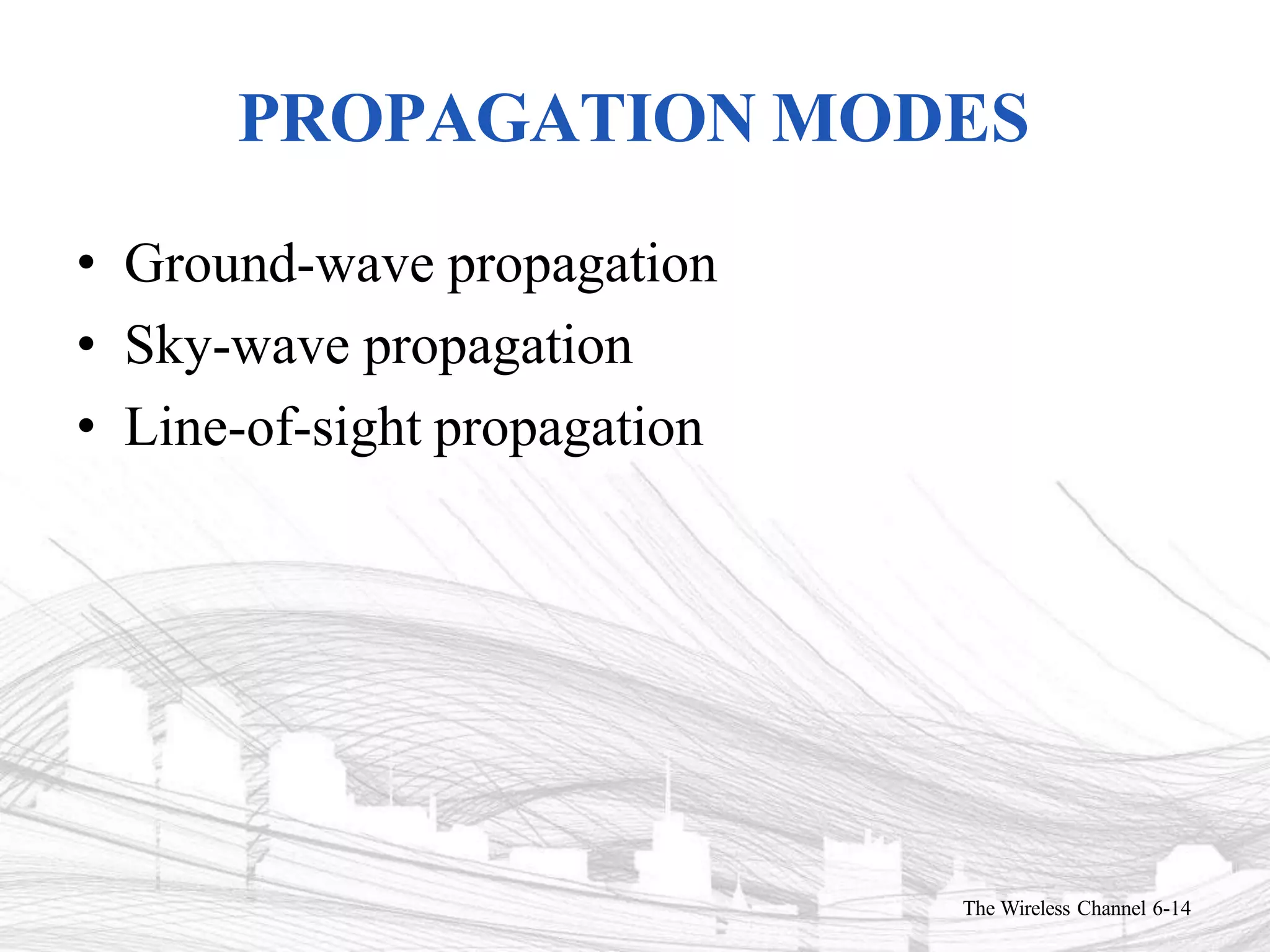
PROPAGATION MODES
The Wireless Channel 6-14
• Ground-wave propagation
• Sky-wave propagation
• Line-of-sight propagation
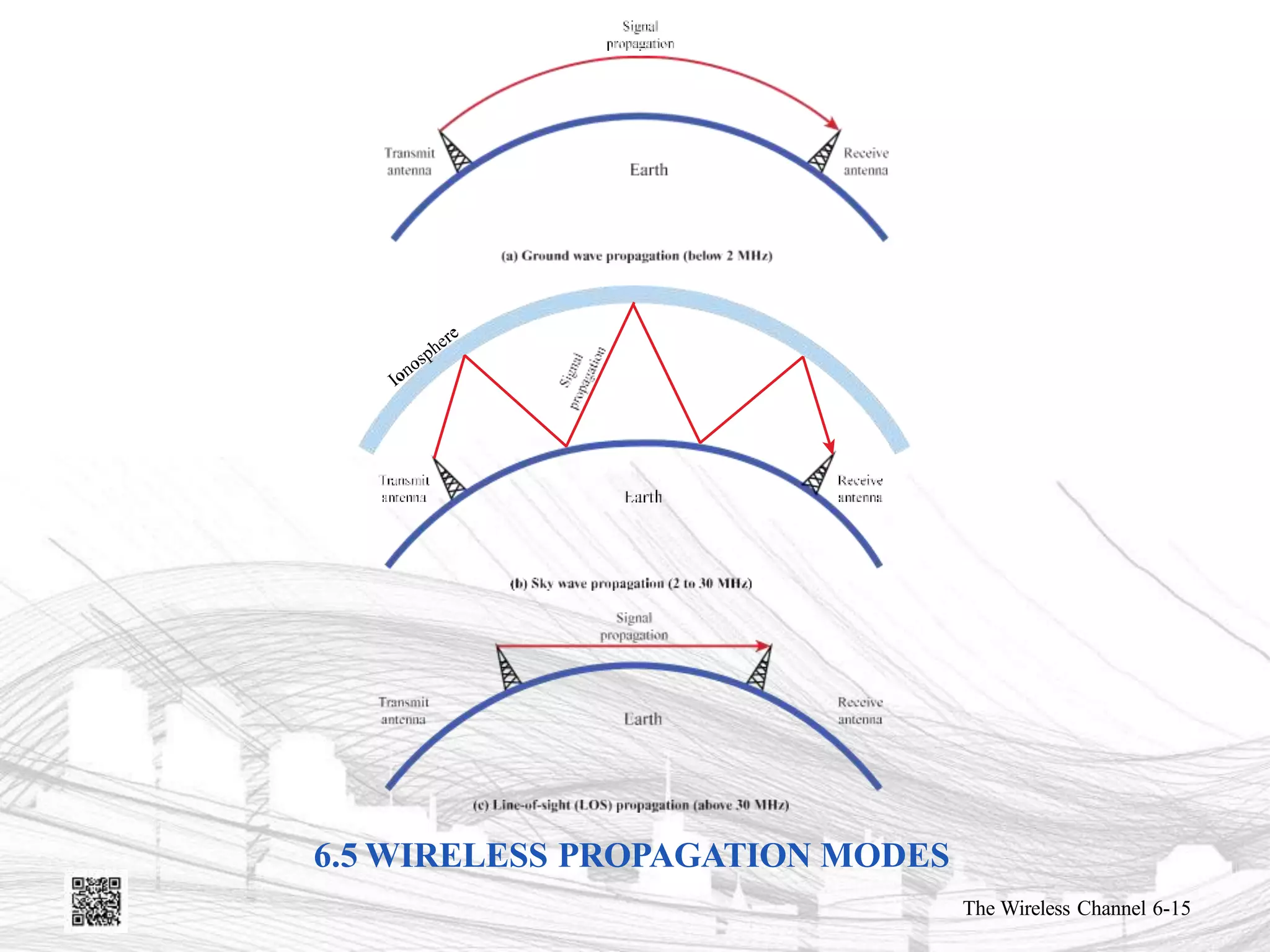
6.5 WIRELESS PROPAGATION MODES
The Wireless Channel 6-15
GROUND WAVE PROPAGATION
The Wireless Channel 6-16
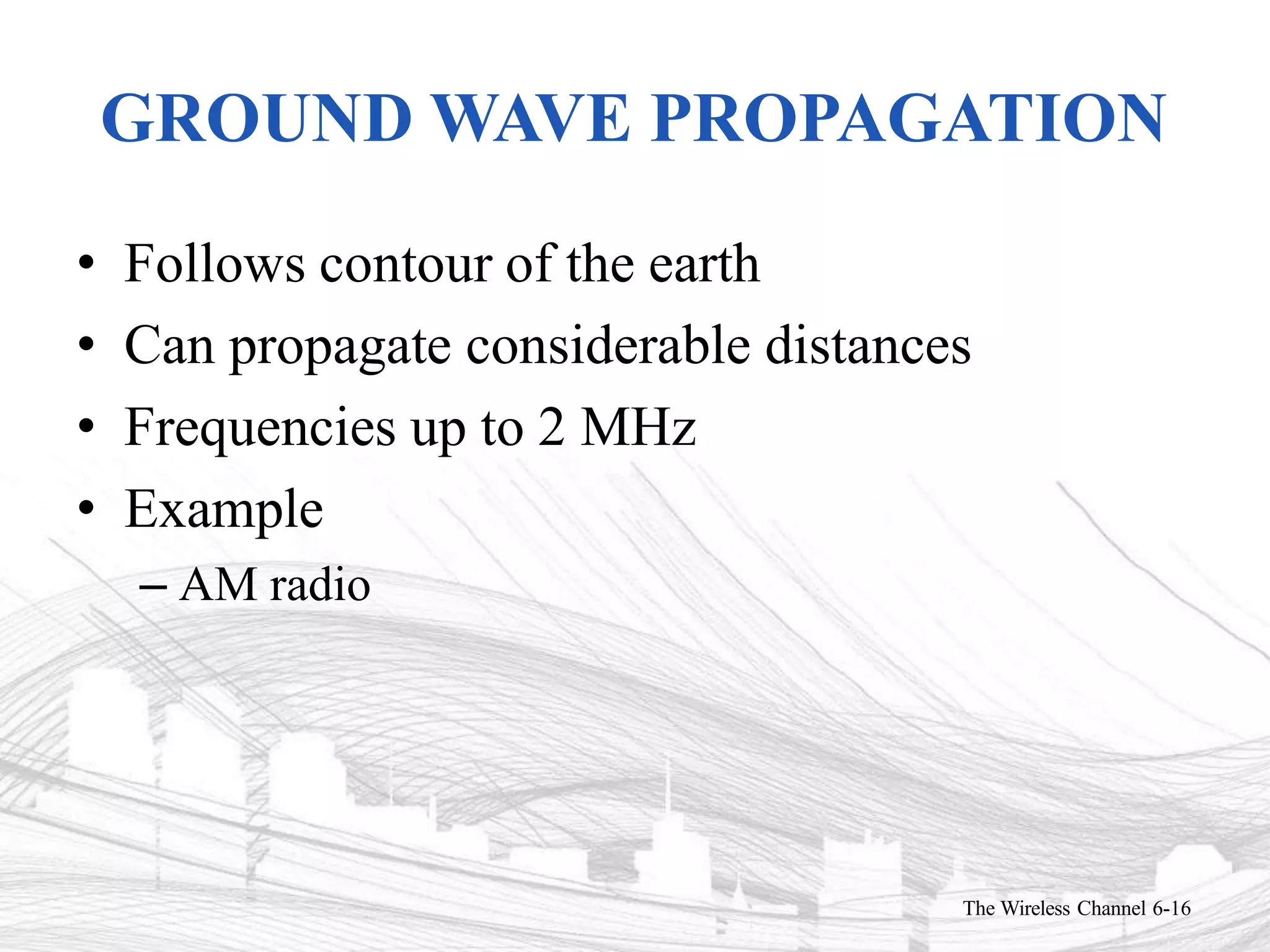
• Follows contour of the earth
• Can propagate considerable distances
• Frequencies up to 2 MHz
• Example
– AM radio
SKY WAVE PROPAGATION
The Wireless Channel 6-17
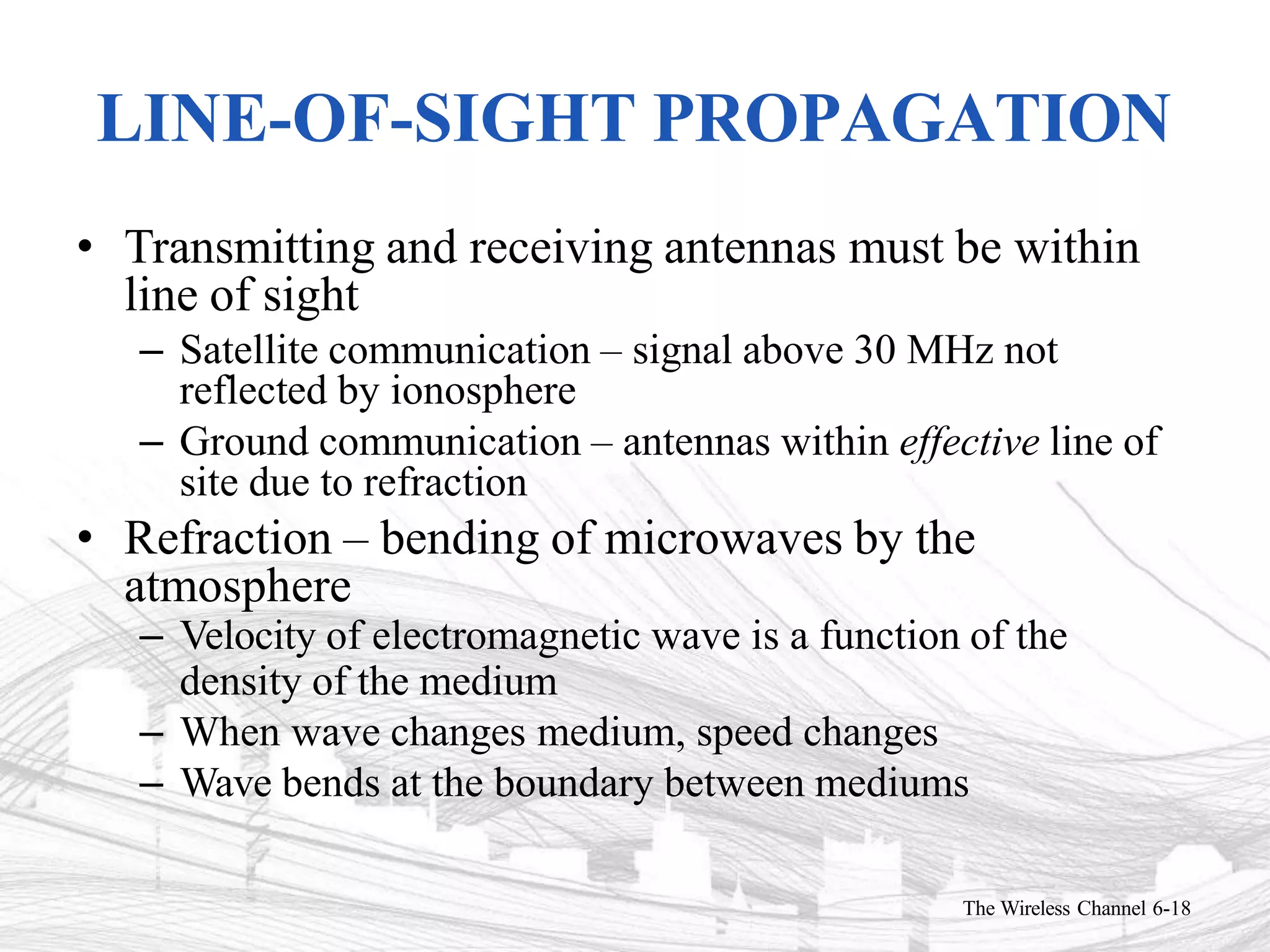
• Signal reflected from ionized layer of atmosphere
back down to earth
• Signal can travel a number of hops, back and forth
between ionosphere and earth’s surface
• Reflection effect caused by refraction
• Examples
– Amateur radio
– CB radio
LINE-OF-SIGHT PROPAGATION
The Wireless Channel 6-18
• Transmitting and receiving antennas must be within
line of sight
– Satellite communication – signal above 30 MHz not
reflected by ionosphere
– Ground communication – antennas within effective line of
site due to refraction
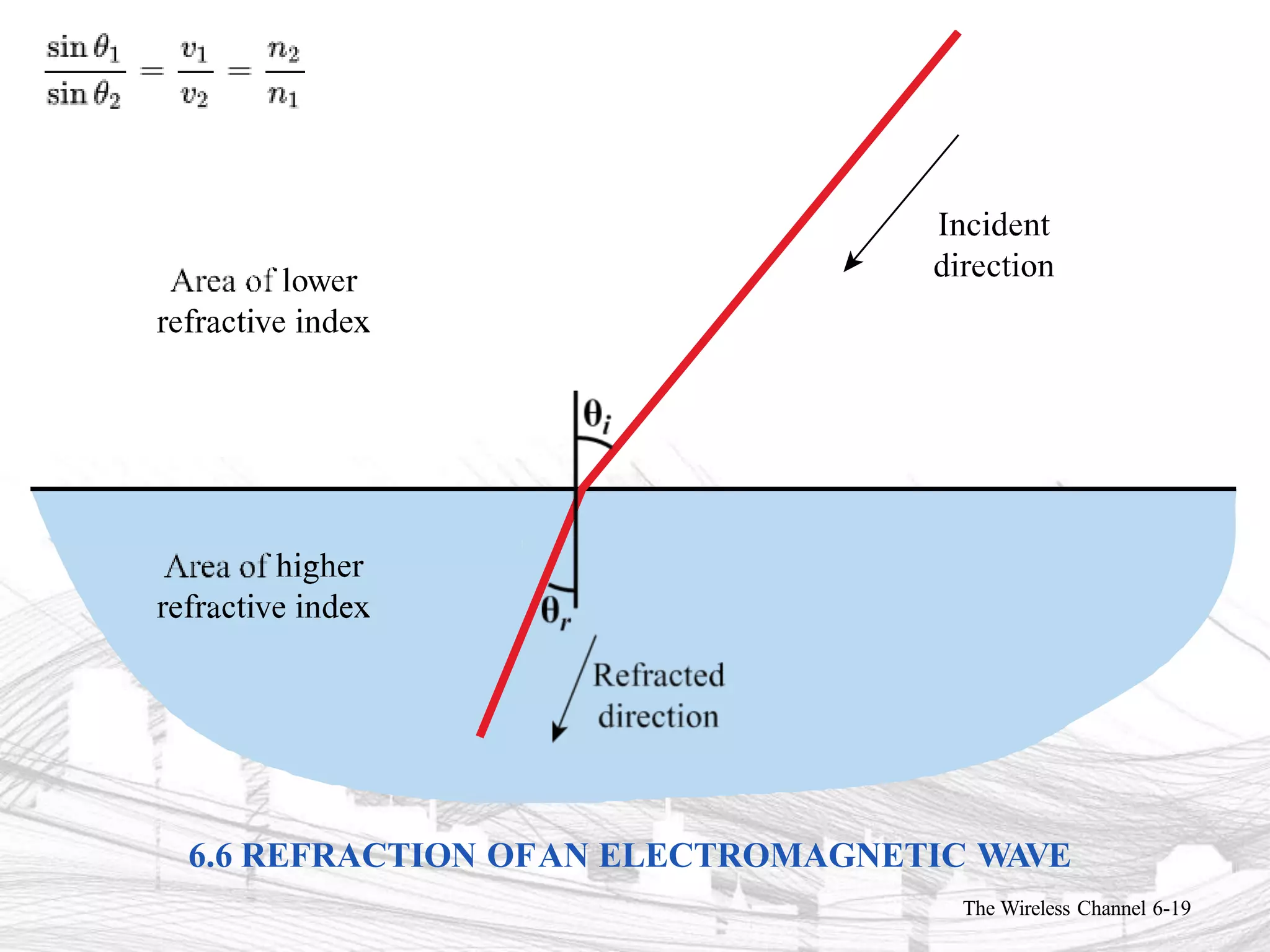
• Refraction – bending of microwaves by the
atmosphere
– Velocity of electromagnetic wave is a function of the
density of the medium
– When wave changes medium, speed changes
– Wave bends at the boundary between mediums
6.6 REFRACTION OFAN ELECTROMAGNETIC WAVE
The Wireless Channel 6-19
FIVE BASIC PROPAGATION
MECHANISMS
The Wireless Channel 6-20
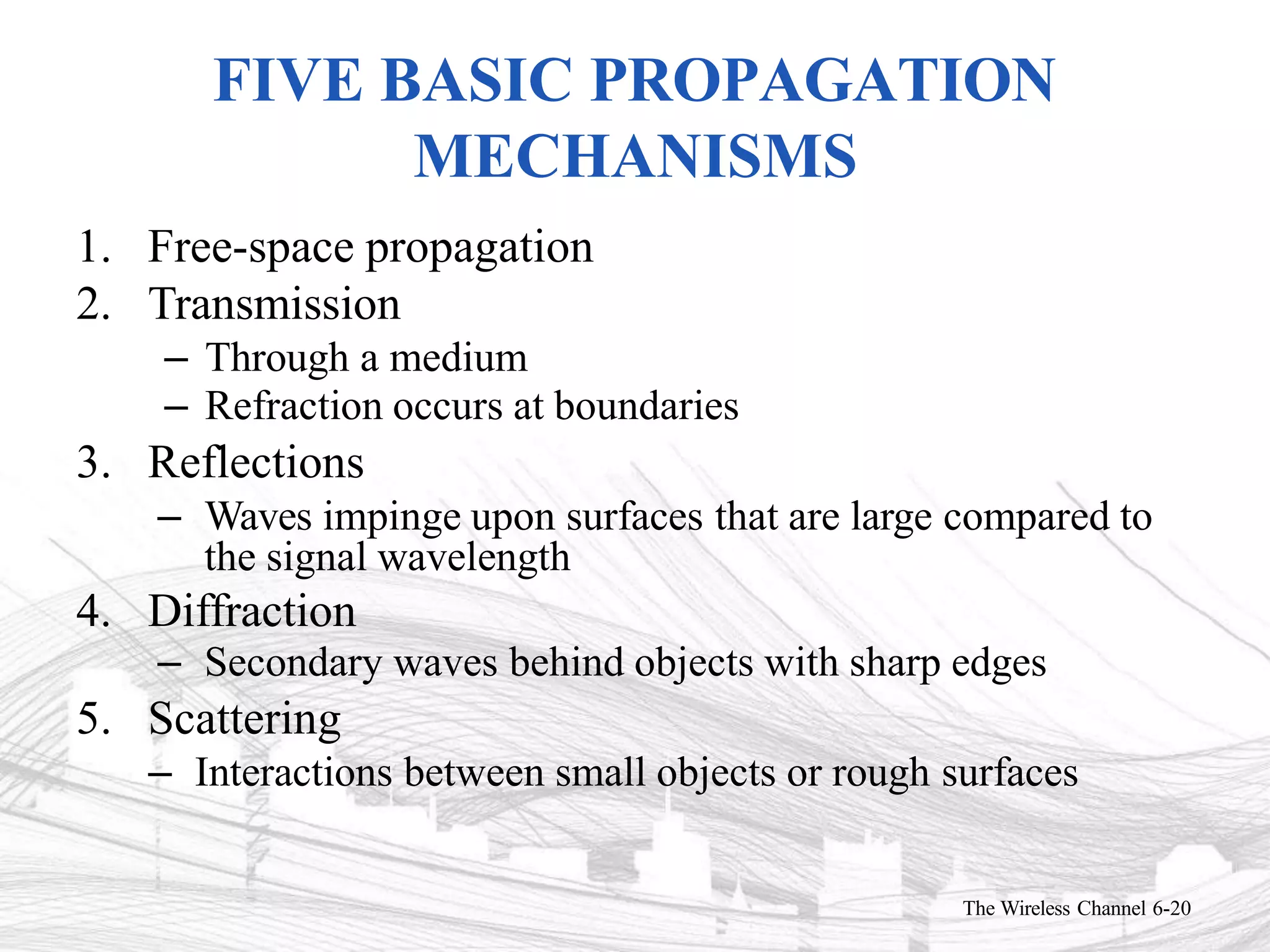
1. Free-space propagation
2. Transmission
– Through a medium
– Refraction occurs at boundaries
3. Reflections
– Waves impinge upon surfaces that are large compared to
the signal wavelength
4. Diffraction
– Secondary waves behind objects with sharp edges
5. Scattering
– Interactions between small objects or rough surfaces
LOS WIRELESS TRANSMISSION
IMPAIRMENTS
The Wireless Channel 6-21
• Attenuation and attenuation distortion
• Free space loss
• Noise
• Atmospheric absorption
• Multipath
• Refraction
• Thermal noise
ATTENUATION
The Wireless Channel 6-22
• Strength of signal falls off with distance over
transmission medium
• Attenuation factors for unguided media:
– Received signal must have sufficient strength so that
circuitry in the receiver can interpret the signal
– Signal must maintain a level sufficiently higher than noise
to be received without error
– Attenuation is greater at higher frequencies, causing
distortion
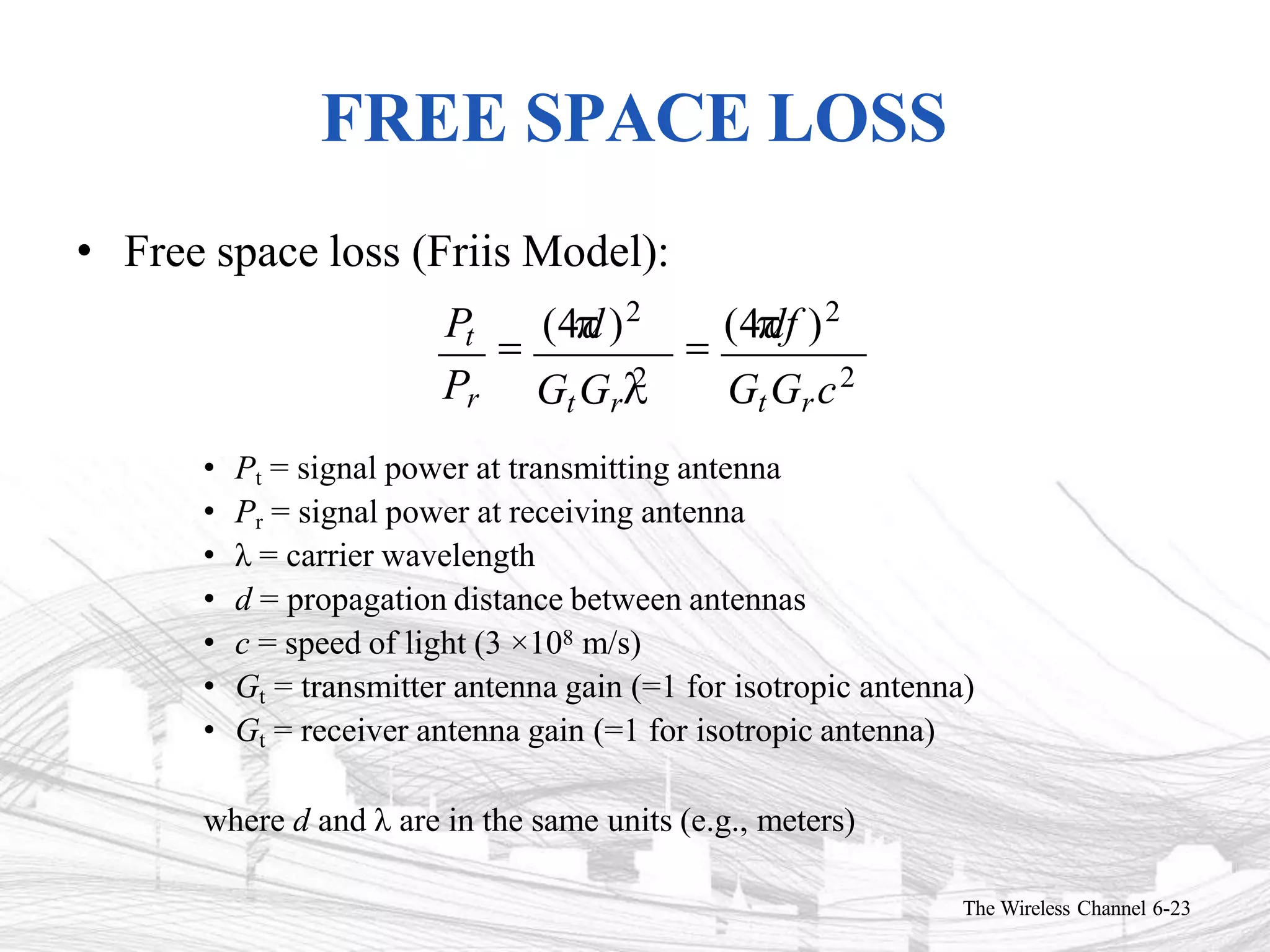
FREE SPACE LOSS
• Free space loss (Friis Model):
Pt 
(4
d)2

(4
df )2
• Pt = signal power at transmitting antenna
• Pr = signal power at receiving antenna
• λ = carrier wavelength
• d = propagation distance between antennas
• c = speed of light 3 ×10⁸ m/s)
• Gt = transmitter antenna gain (=1 for isotropic antenna)
• Gt = receiver antenna gain (=1 for isotropic antenna)
where d and λ are in the same units (e.g., meters)
GtGrc2
The Wireless Channel 6-23
GtGr
2
Pr
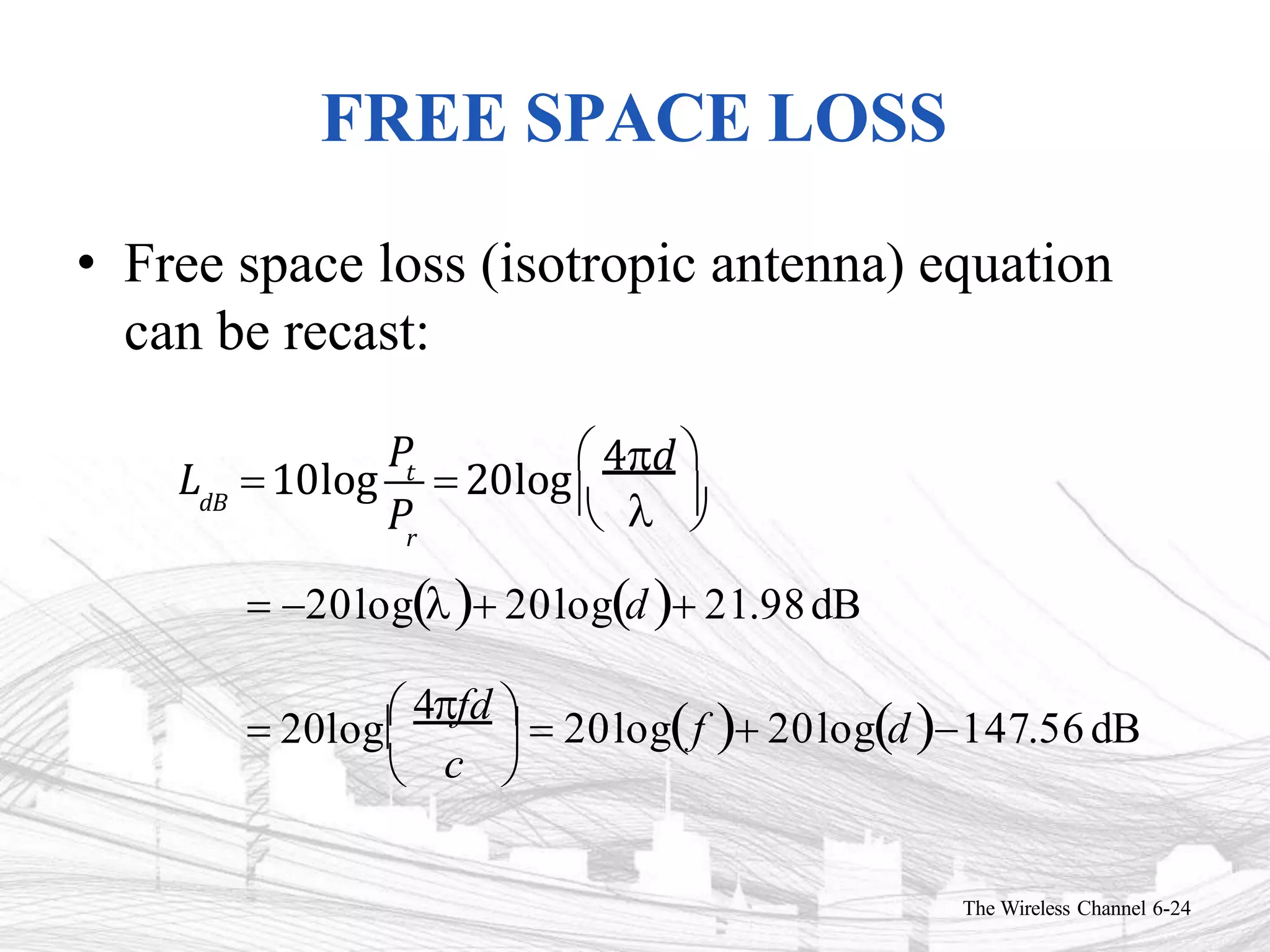
FREE SPACE LOSS
• Free space loss (isotropic antenna) equation
can be recast:
dB
Pr
L 10log
Pt
 20log
 4d 
The Wireless Channel 6-24
  
 20log 20logd 21.98dB



 20log
c
 4fd   20logf  20logd147.56dB
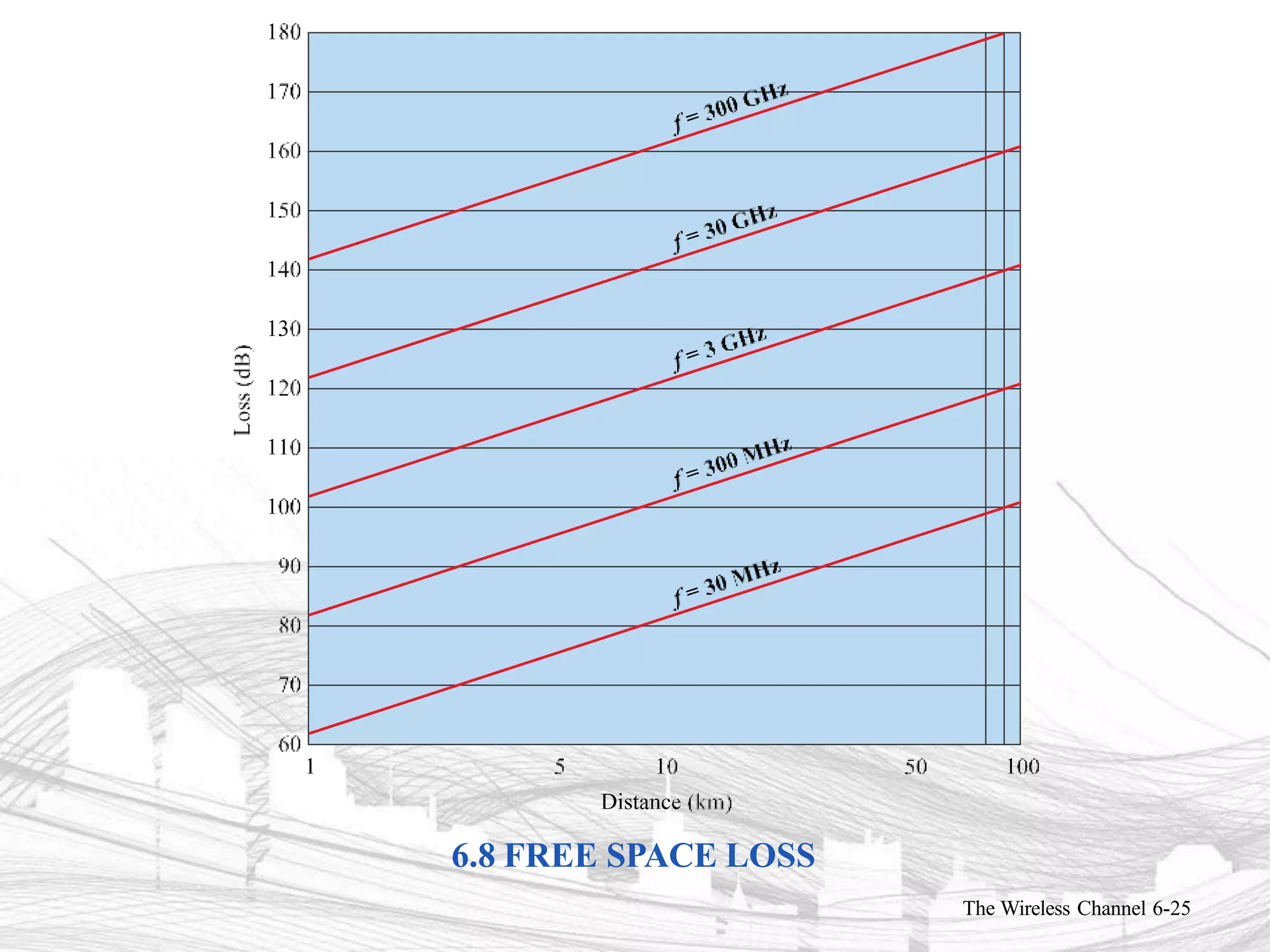
6.8 FREE SPACE LOSS
The Wireless Channel 6-25
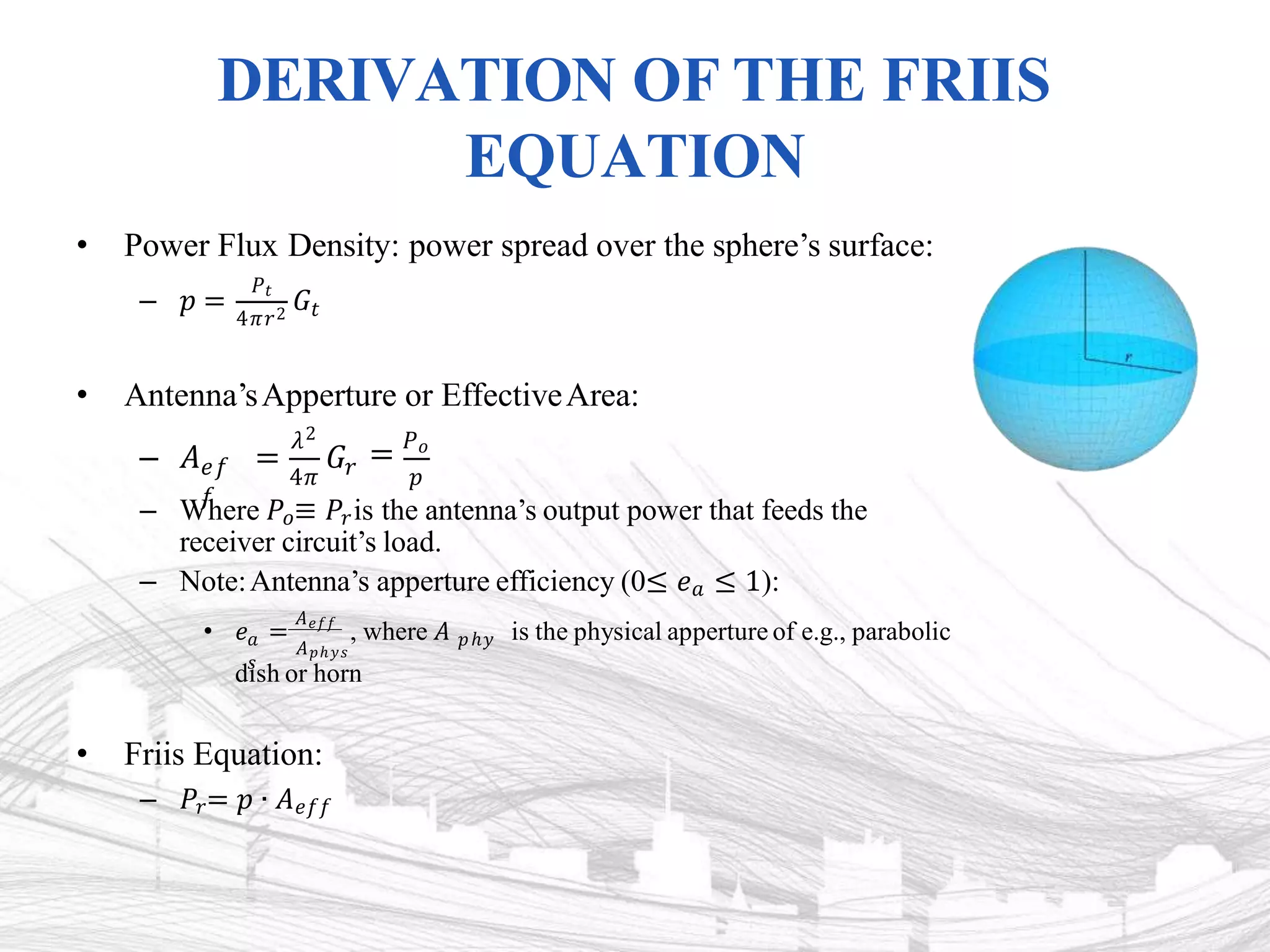
DERIVATION OF THE FRIIS
EQUATION
• Power Flux Density: power spread over the sphere’s surface:
– 𝑝 =
𝑃𝑡
4𝜋𝑟2
𝐺𝑡
• Antenna’sApperture or EffectiveArea:
𝑒𝑓
𝑓
𝜆2
𝐺𝑟 = 𝑃𝑜
4𝜋 𝑝
– 𝐴 =
– Where 𝑃𝑜≡ 𝑃𝑟is the antenna’s output power that feeds the
receiver circuit’s load.
– Note:Antenna’s apperture efficiency (0≤ 𝑒𝑎 ≤ 1):
𝐴𝑝ℎ𝑦𝑠
• 𝑒 =
𝐴𝑒𝑓𝑓
, where 𝐴
𝑎 𝑝ℎ𝑦
𝑠
is the physical apperture of e.g., parabolic
dish or horn
• Friis Equation:
– 𝑃𝑟= 𝑝 ∙ 𝐴𝑒𝑓𝑓
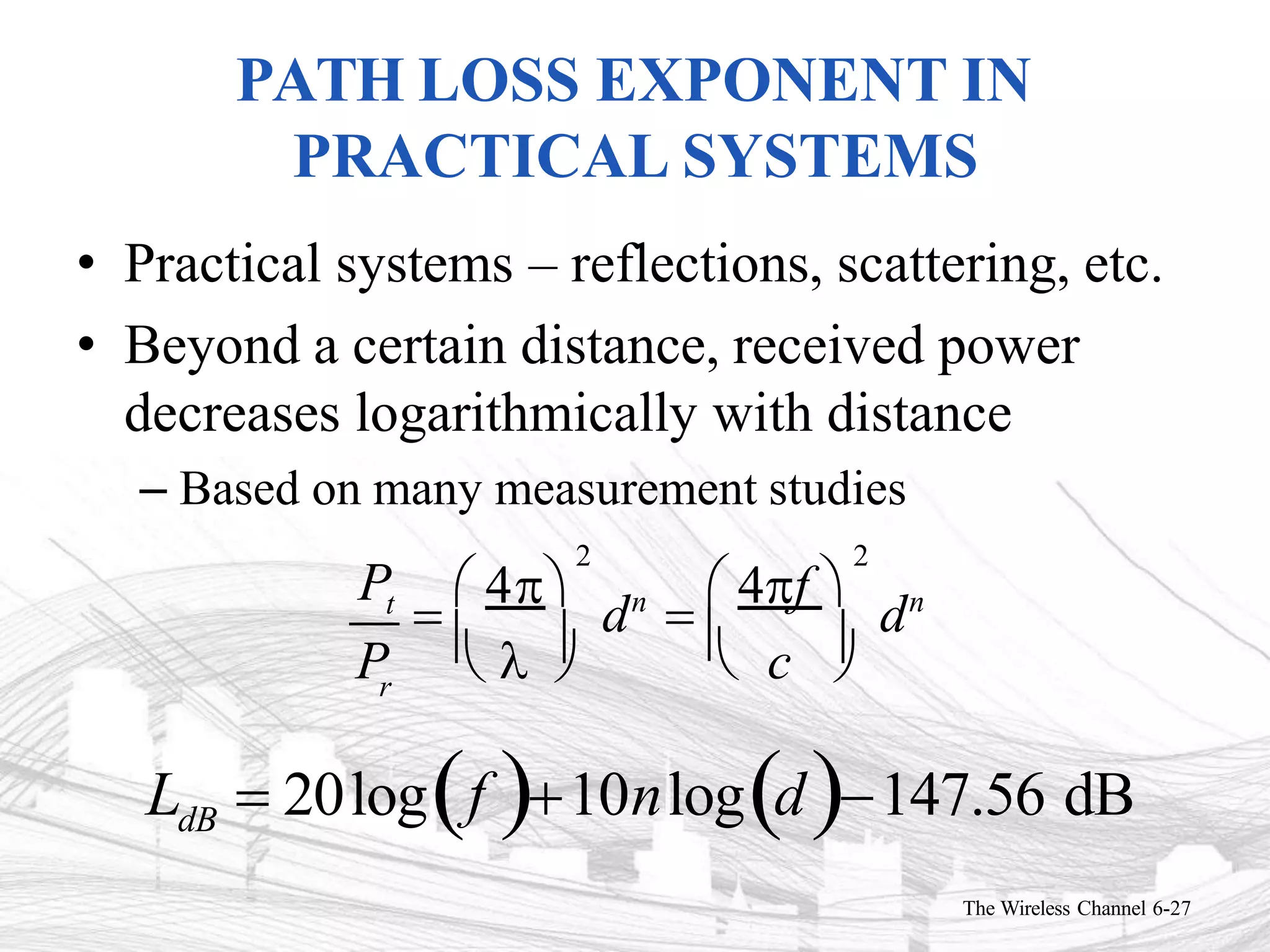
PATH LOSS EXPONENT IN
PRACTICAL SYSTEMS
• Practical systems – reflections, scattering, etc.
• Beyond a certain distance, received power
decreases logarithmically with distance
– Based on many measurement studies
Pt
r
P   
The Wireless Channel 6-27
 c 
2 2

 4
dn

 4f 
dn
LdB  20logf 10nlogd147.56 dB
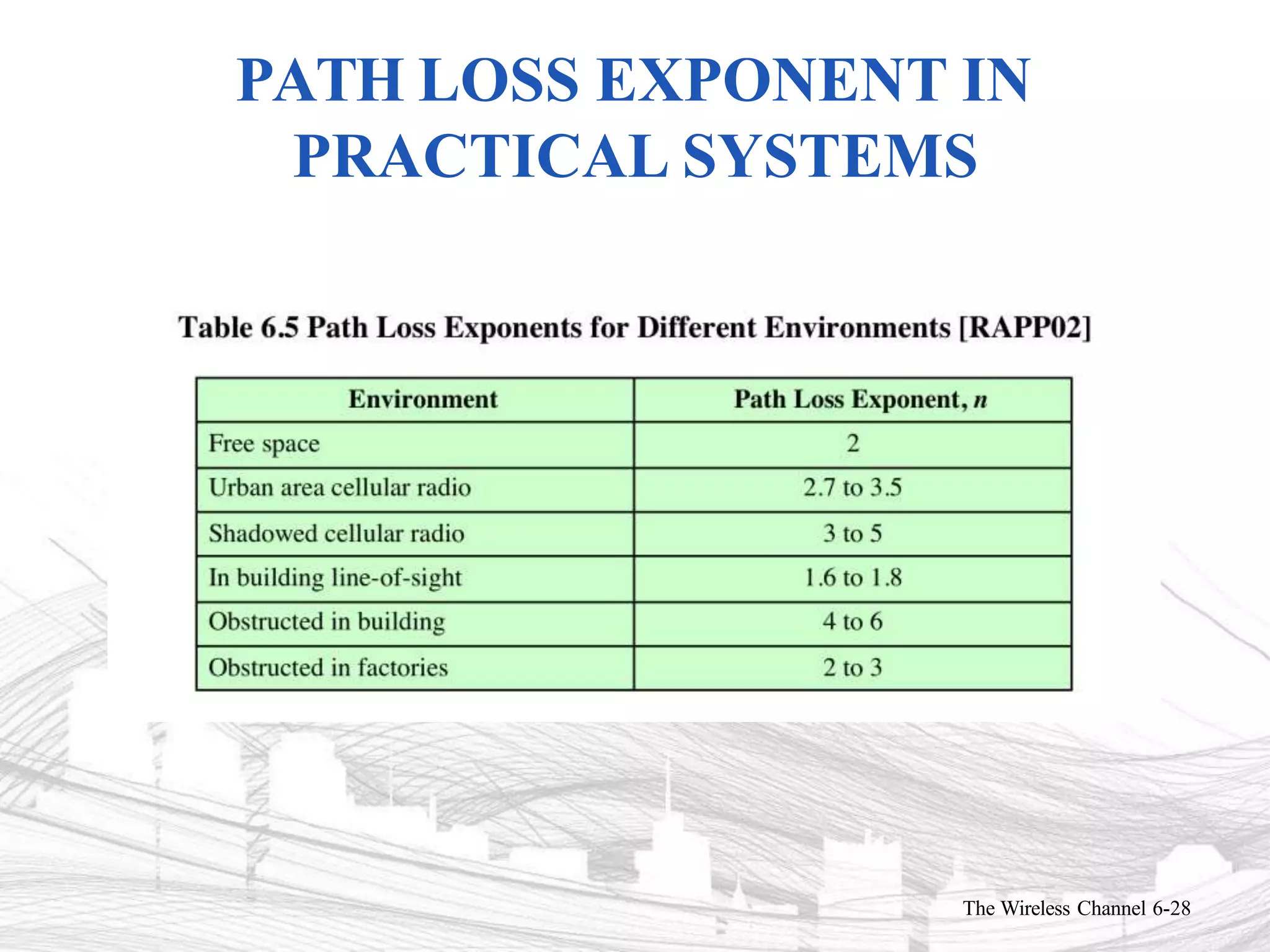
PATH LOSS EXPONENT IN
PRACTICAL SYSTEMS
The Wireless Channel 6-28
MODELS DERIVED FROM
EMPIRICAL MEASUREMENTS
The Wireless Channel 6-29
• Need to design systems based on empirical data applied to a
particular environment
– To determine power levels, tower heights, height of mobile
antennas
• Okumura developed a model, later refined by Hata
– Detailed measurement and analysis of the Tokyo area
– Among the best accuracy in a wide variety of situations
• Predicts path loss for typical environments
– Urban
– Small, medium sized city
– Large city
– Suburban
– Rural
CATEGORIES OF NOISE
The Wireless Channel 6-30
• Thermal Noise
• Intermodulation noise
• Crosstalk
• Impulse Noise
THERMAL NOISE
The Wireless Channel 6-31
• Thermal noise due to agitation of electrons
• Present in all electronic devices and
transmission media
• Cannot be eliminated
• Function of temperature
• Particularly significant for satellite
communication
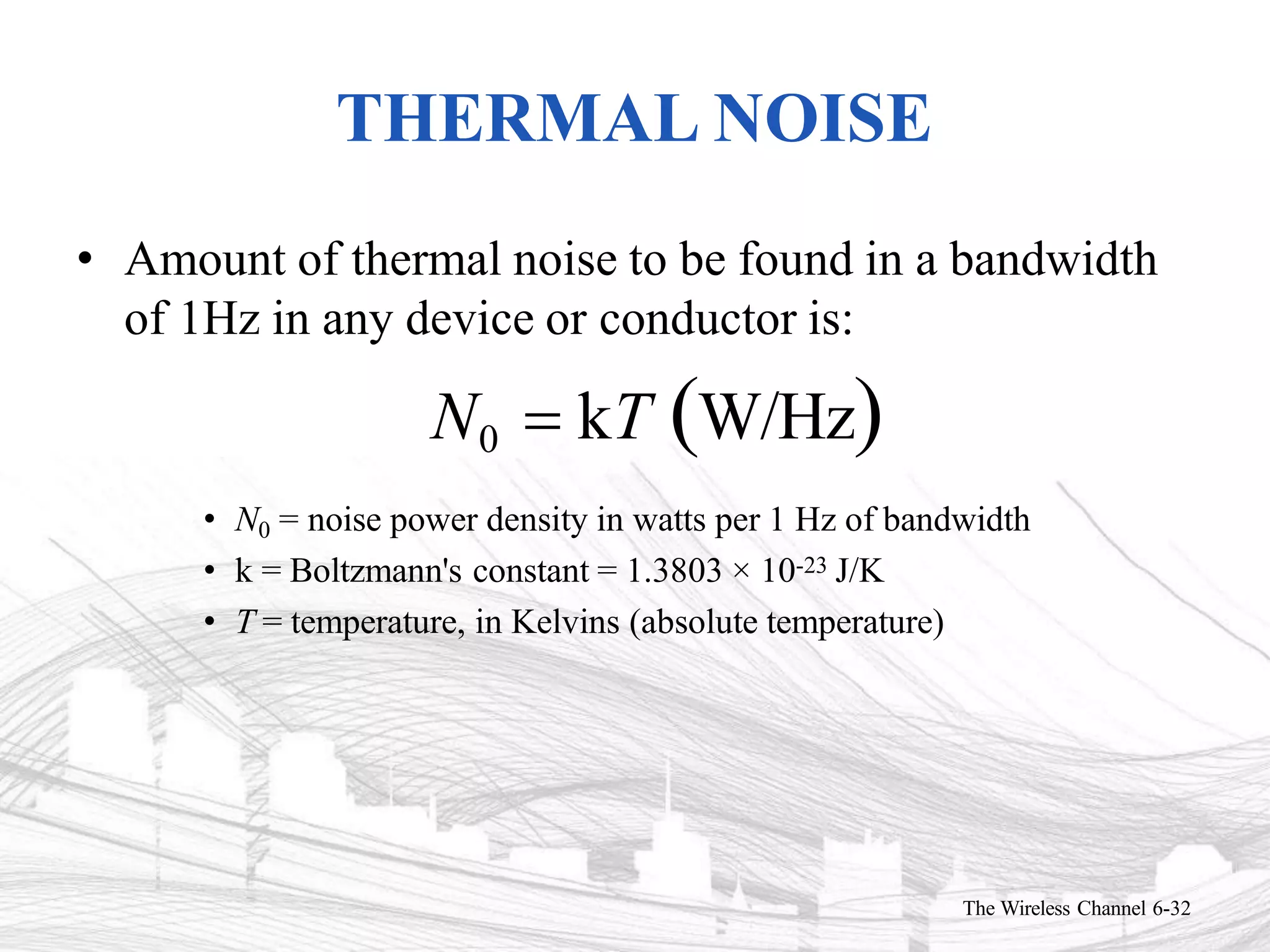
THERMAL NOISE
The Wireless Channel 6-32
• Amount of thermal noise to be found in a bandwidth
of 1Hz in any device or conductor is:
N0  kT W/Hz
• N0 = noise power density in watts per 1 Hz of bandwidth
• k = Boltzmann's constant = 1.3803 × 10⁻²³ J/K
• T = temperature, in Kelvins (absolute temperature)
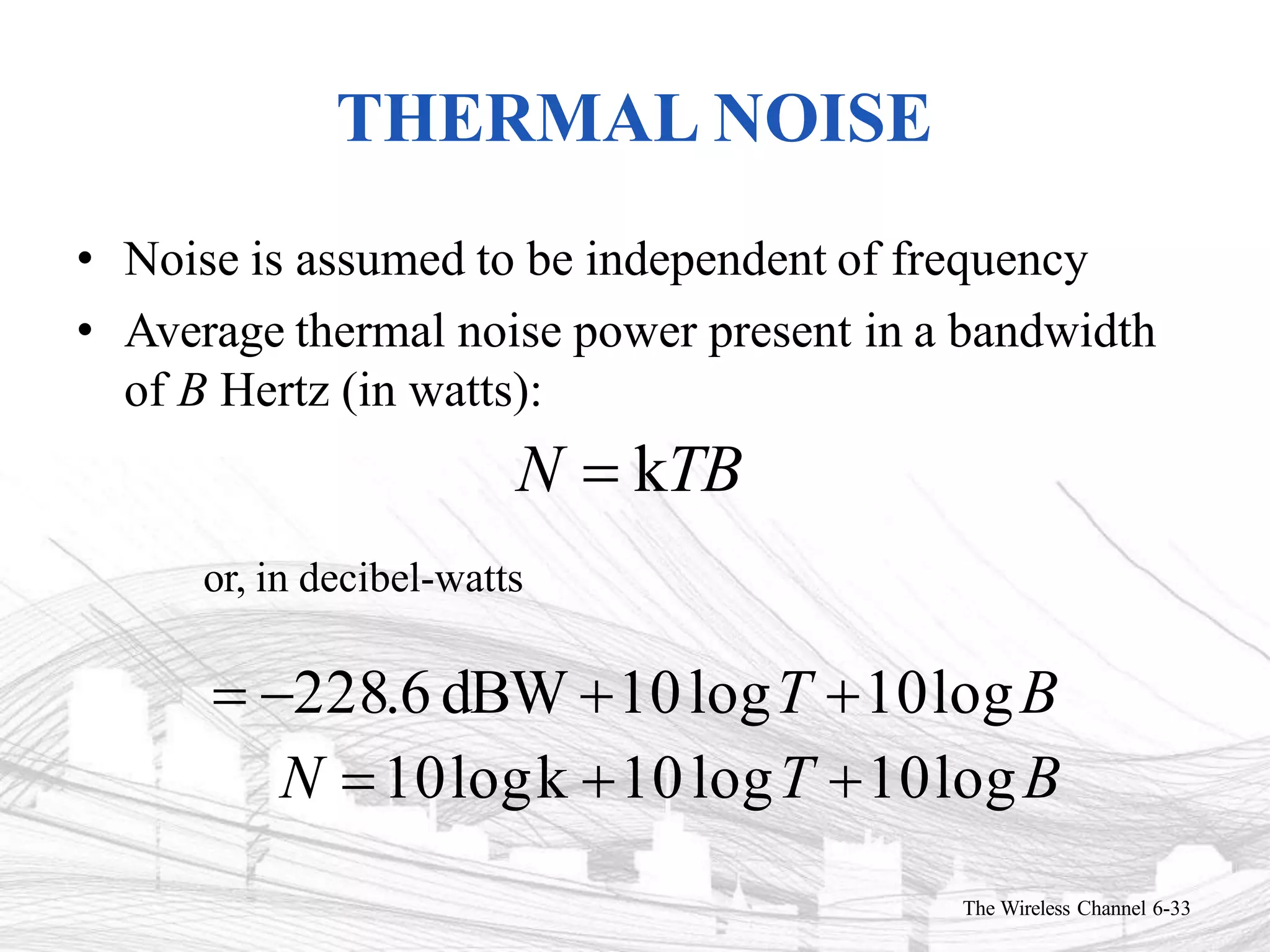
THERMAL NOISE
The Wireless Channel 6-33
• Noise is assumed to be independent of frequency
• Average thermal noise power present in a bandwidth
of B Hertz (in watts):
N  kTB
or, in decibel-watts
 228.6 dBW 10logT 10logB
N 10logk 10logT 10logB
NOISE TERMINOLOGY
The Wireless Channel 6-34
• Intermodulation noise – occurs if signals with
different frequencies share the same medium
– Interference caused by a signal produced at a frequency that
is the sum or difference of original frequencies
• Crosstalk – unwanted coupling between signal paths
• Impulse noise – irregular pulses or noise spikes
– Short duration and of relatively high amplitude
– Caused by external electromagnetic disturbances, or faults
and flaws in the communications system
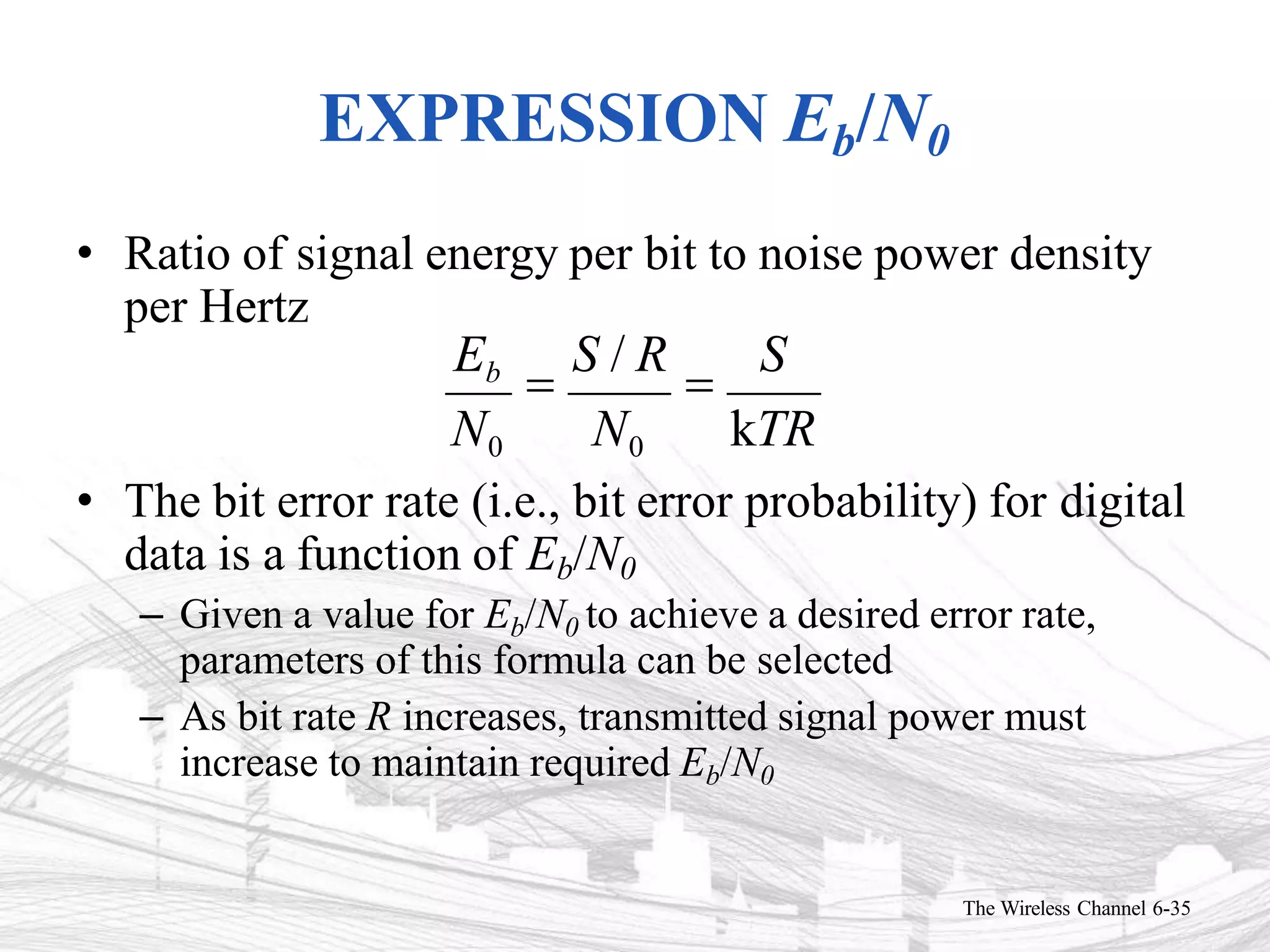
EXPRESSION Eb/N0
• Ratio of signal energy per bit to noise power density
per Hertz
Eb

S / R

S
N0 N0 kTR
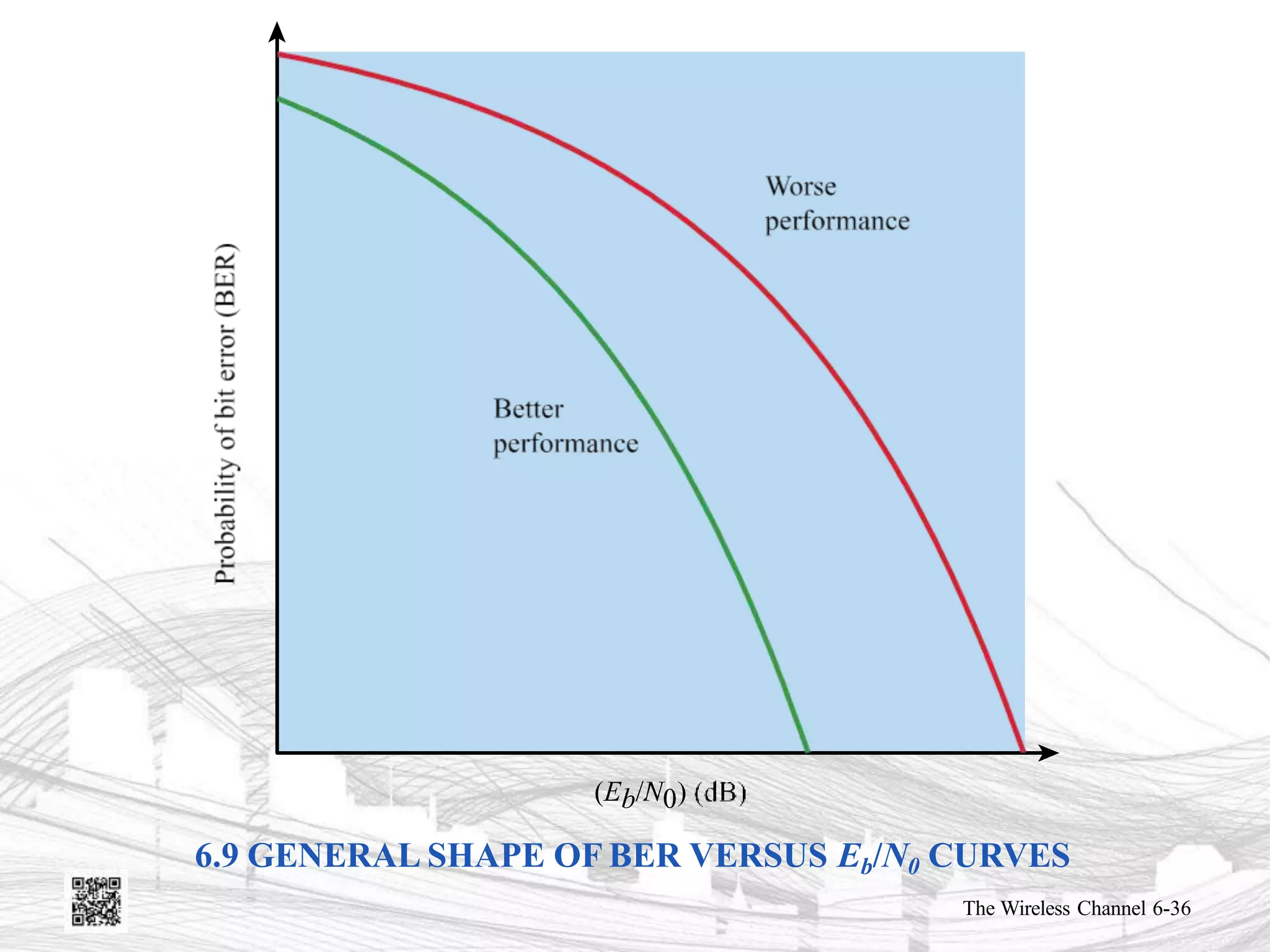
• The bit error rate (i.e., bit error probability) for digital
data is a function of Eb/N0
– Given a value for Eb/N0 to achieve a desired error rate,
parameters of this formula can be selected
– As bit rate R increases, transmitted signal power must
increase to maintain required Eb/N0
The Wireless Channel 6-35
6.9 GENERAL SHAPE OF BER VERSUS Eb/N0 CURVES
The Wireless Channel 6-36
OTHER IMPAIRMENTS
The Wireless Channel 6-37
• Atmospheric absorption – water vapor and
oxygen contribute to attenuation
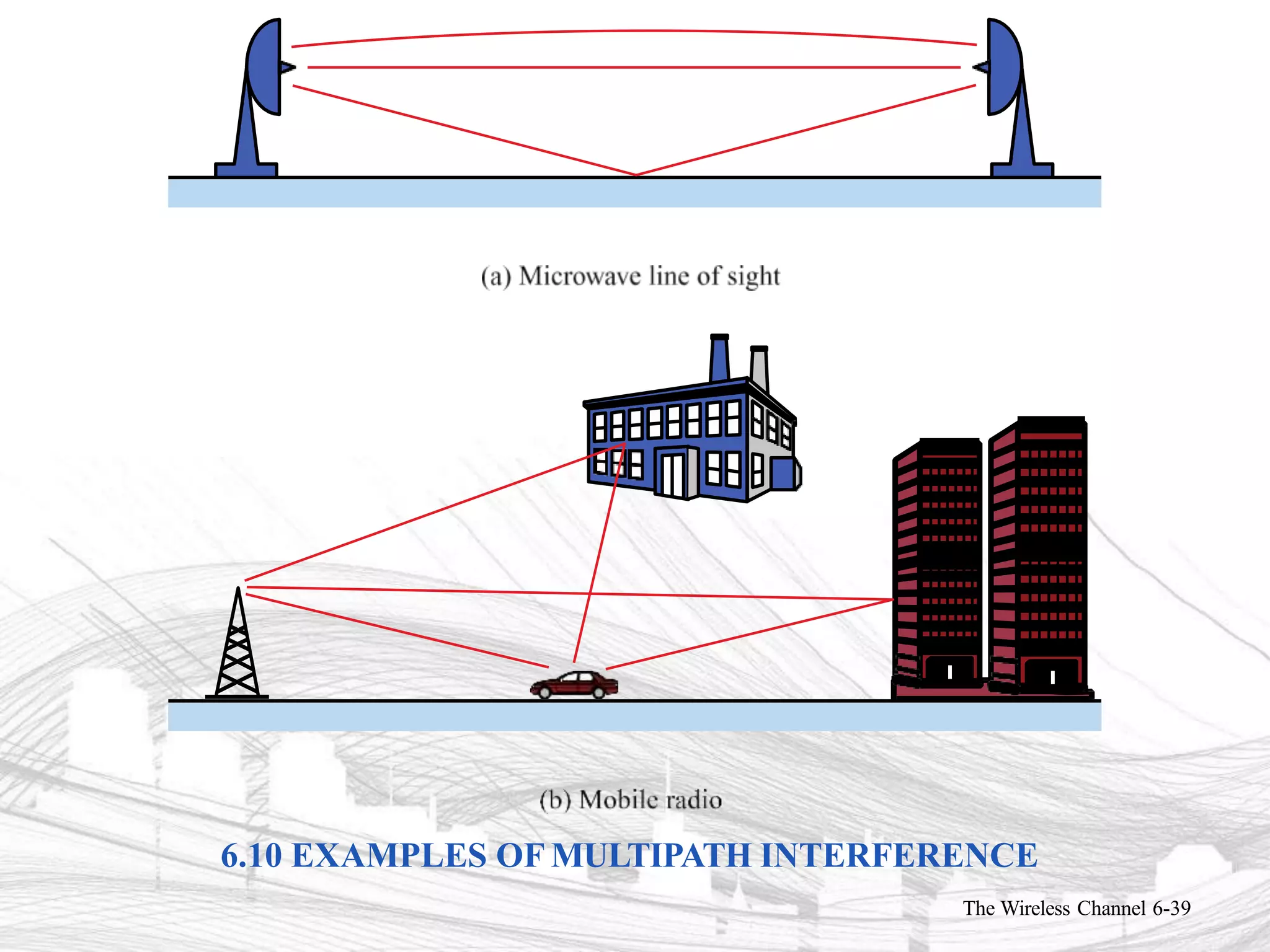
• Multipath – obstacles reflect signals so that
multiple copies with varying delays are
received
• Refraction – bending of radio waves as they
propagate through the atmosphere
THE EFFECTS OF MULTIPATH
PROPAGATION
The Wireless Channel 6-38
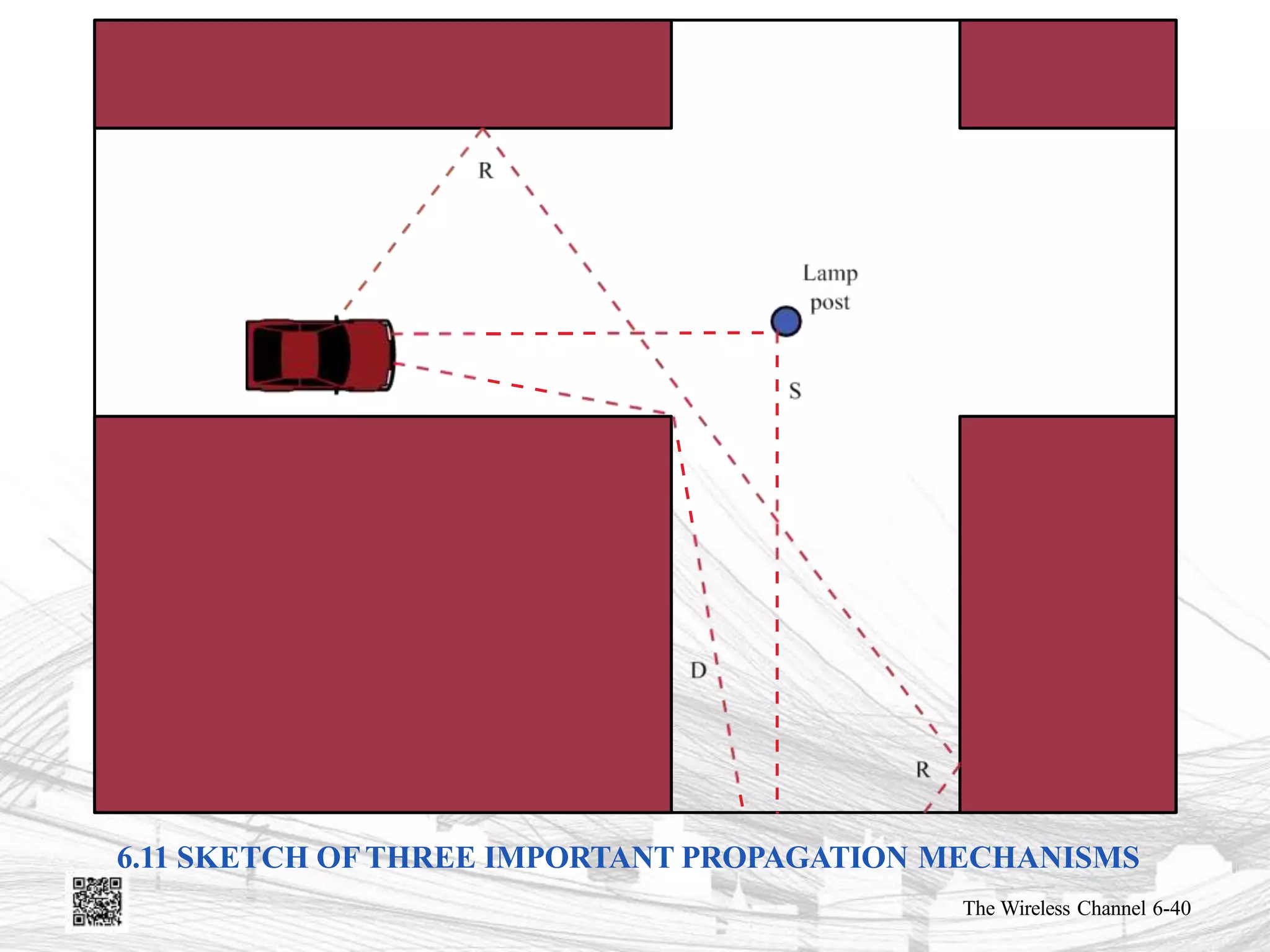
• Reflection, diffraction, and scattering
• Multiple copies of a signal may arrive at different
phases
– If phases add destructively, the signal level relative to
noise declines, making detection more difficult
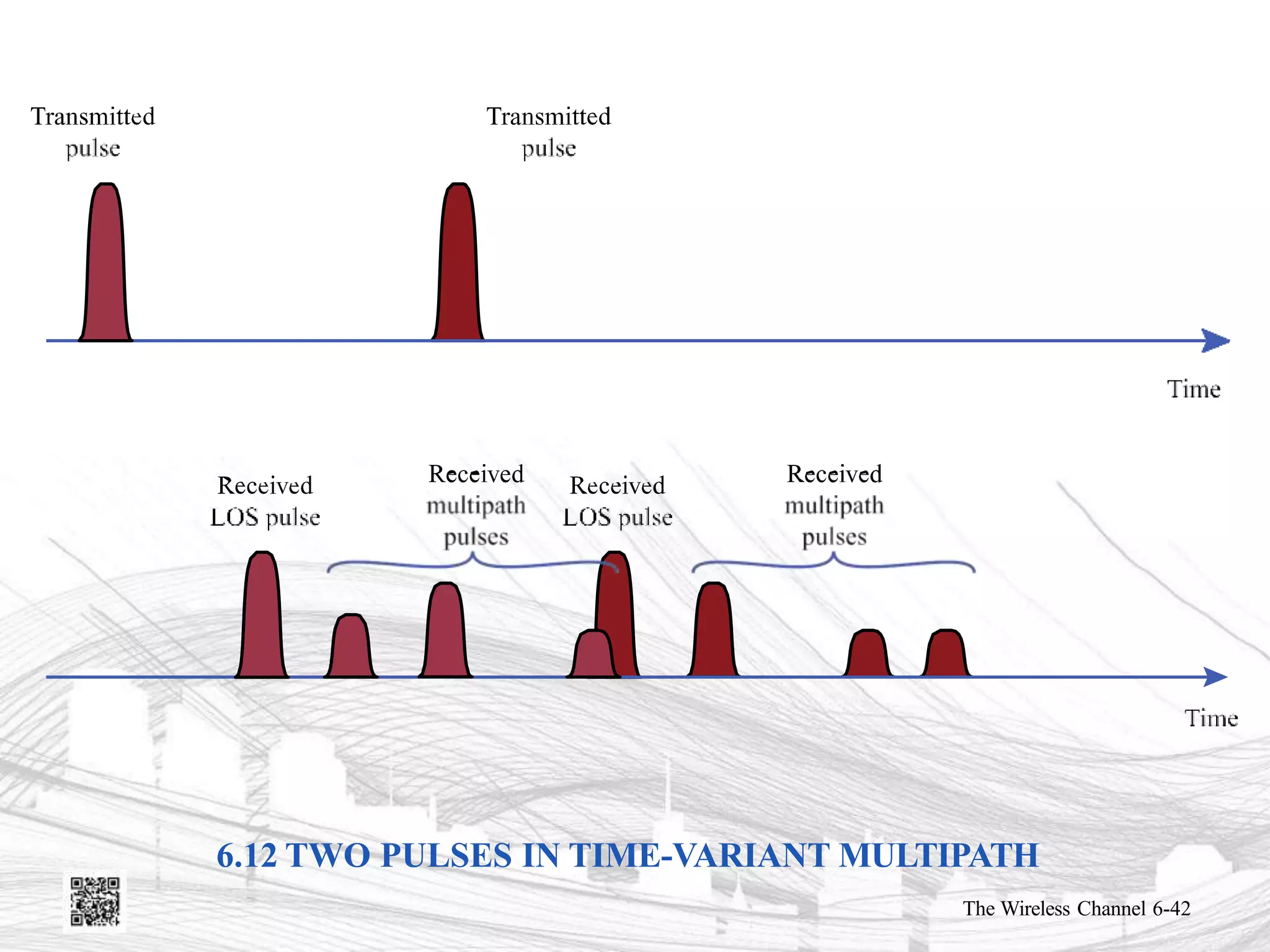
• Intersymbol interference (ISI)
– One or more delayed copies of a pulse may arrive at
the same time as the primary pulse for a subsequent bit
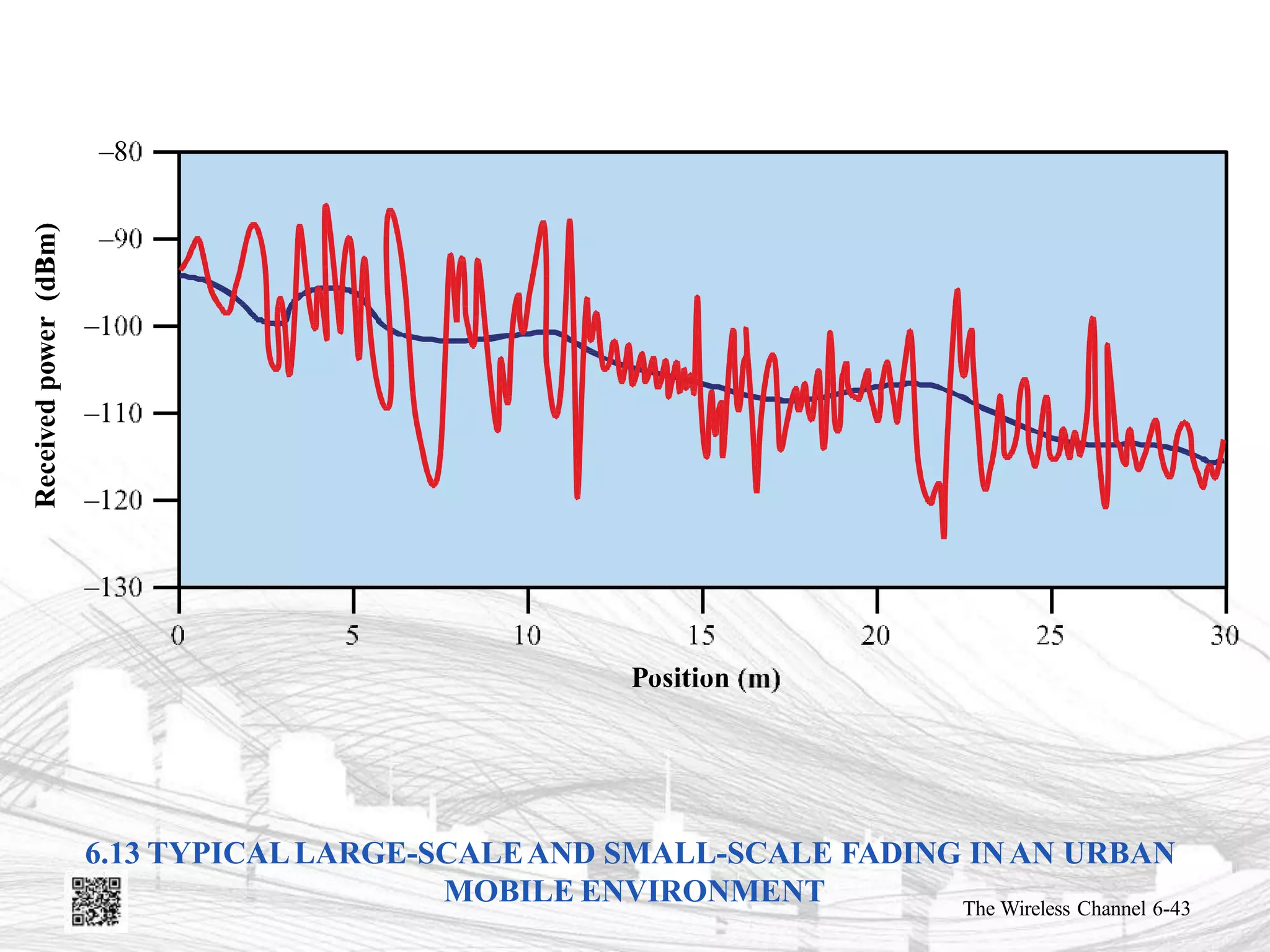
• Rapid signal fluctuations
– Over a few centimeters
6.10 EXAMPLES OF MULTIPATH INTERFERENCE
The Wireless Channel 6-39
6.11 SKETCH OFTHREE IMPORTANT PROPAGATION MECHANISMS
The Wireless Channel 6-40
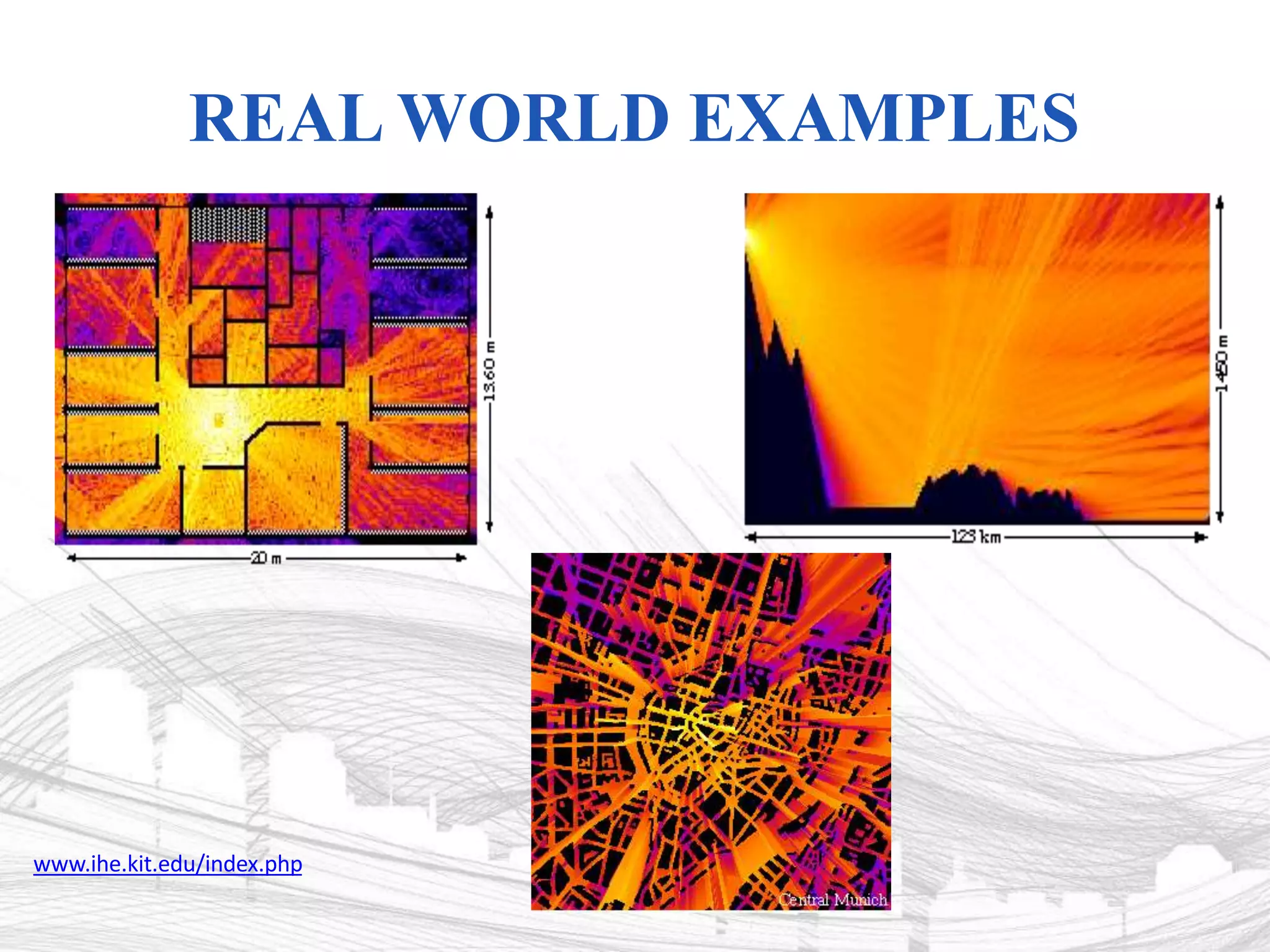
REAL WORLD EXAMPLES
www.ihe.kit.edu/index.php
6.12 TWO PULSES IN TIME-VARIANT MULTIPATH
The Wireless Channel 6-42
6.13 TYPICALLARGE-SCALEAND SMALL-SCALE FADING INAN URBAN
MOBILE ENVIRONMENT The Wireless Channel 6-43
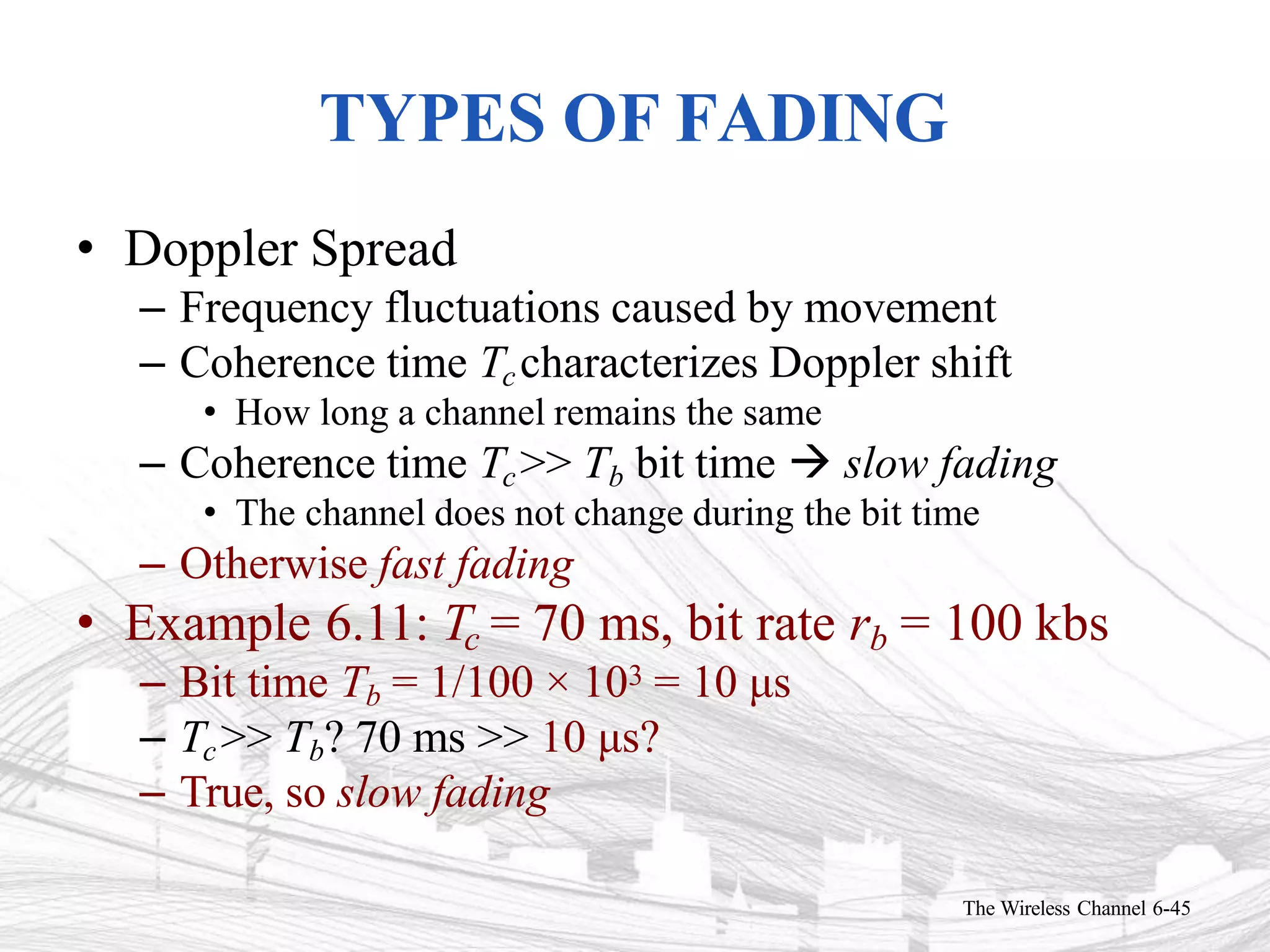
TYPES OF FADING
The Wireless Channel 6-44
• Large-scale fading
– Signal variations over large distances
– Path loss LdB as we have seen already
– Shadowing
• Statistical variations
– Rayleigh fading
– Ricean fading
TYPES OF FADING
The Wireless Channel 6-45
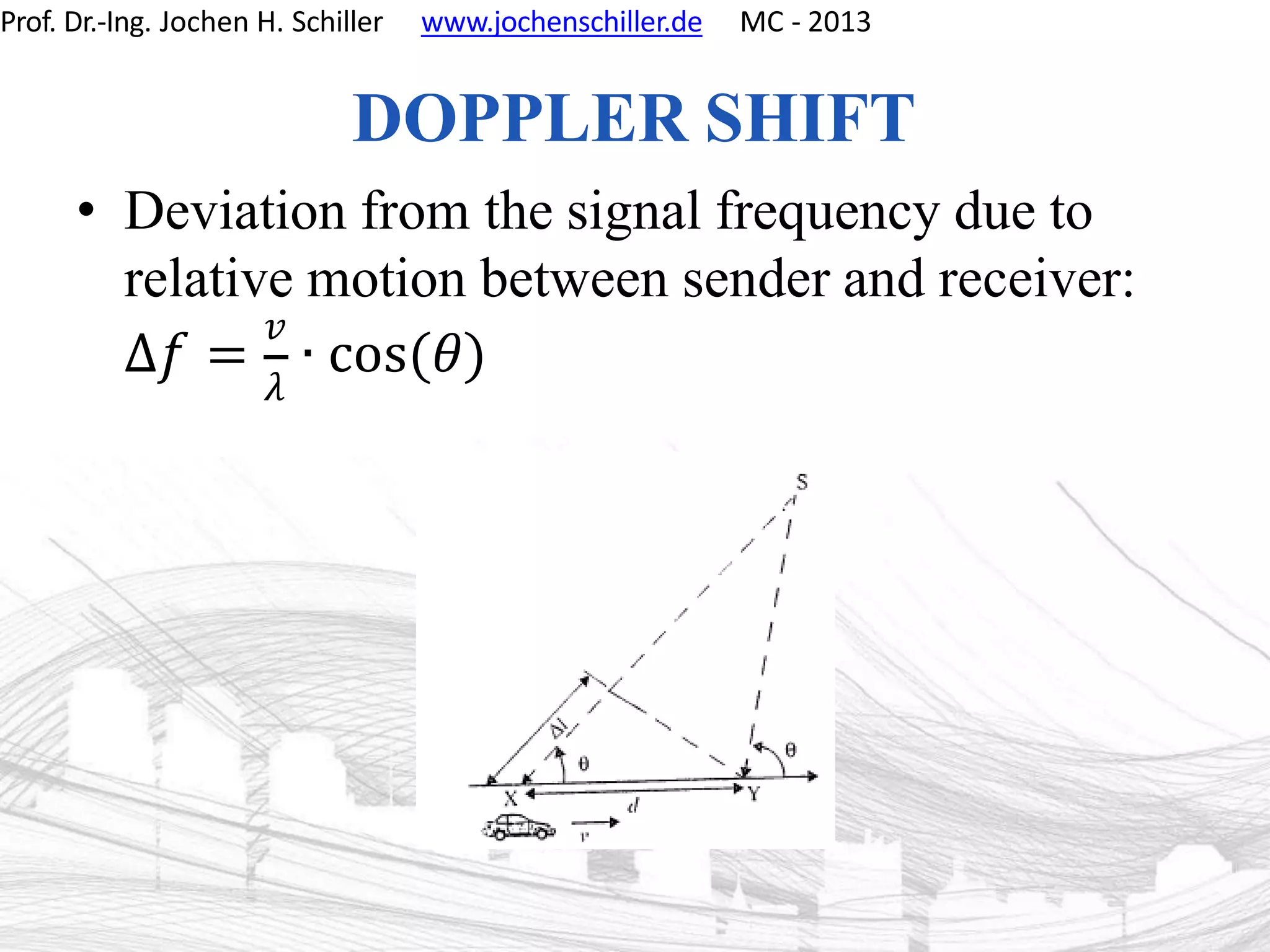
• Doppler Spread
– Frequency fluctuations caused by movement
– Coherence time Tccharacterizes Doppler shift
• How long a channel remains the same
– Coherence time Tc>> Tb bit time  slow fading
• The channel does not change during the bit time
– Otherwise fast fading
• Example 6.11: Tc = 70 ms, bit rate rb = 100 kbs
– Bit time Tb = 1/100 × 103 = 10 μs
– Tc>> Tb? 70 ms >> 10 μs?
– True, so slow fading
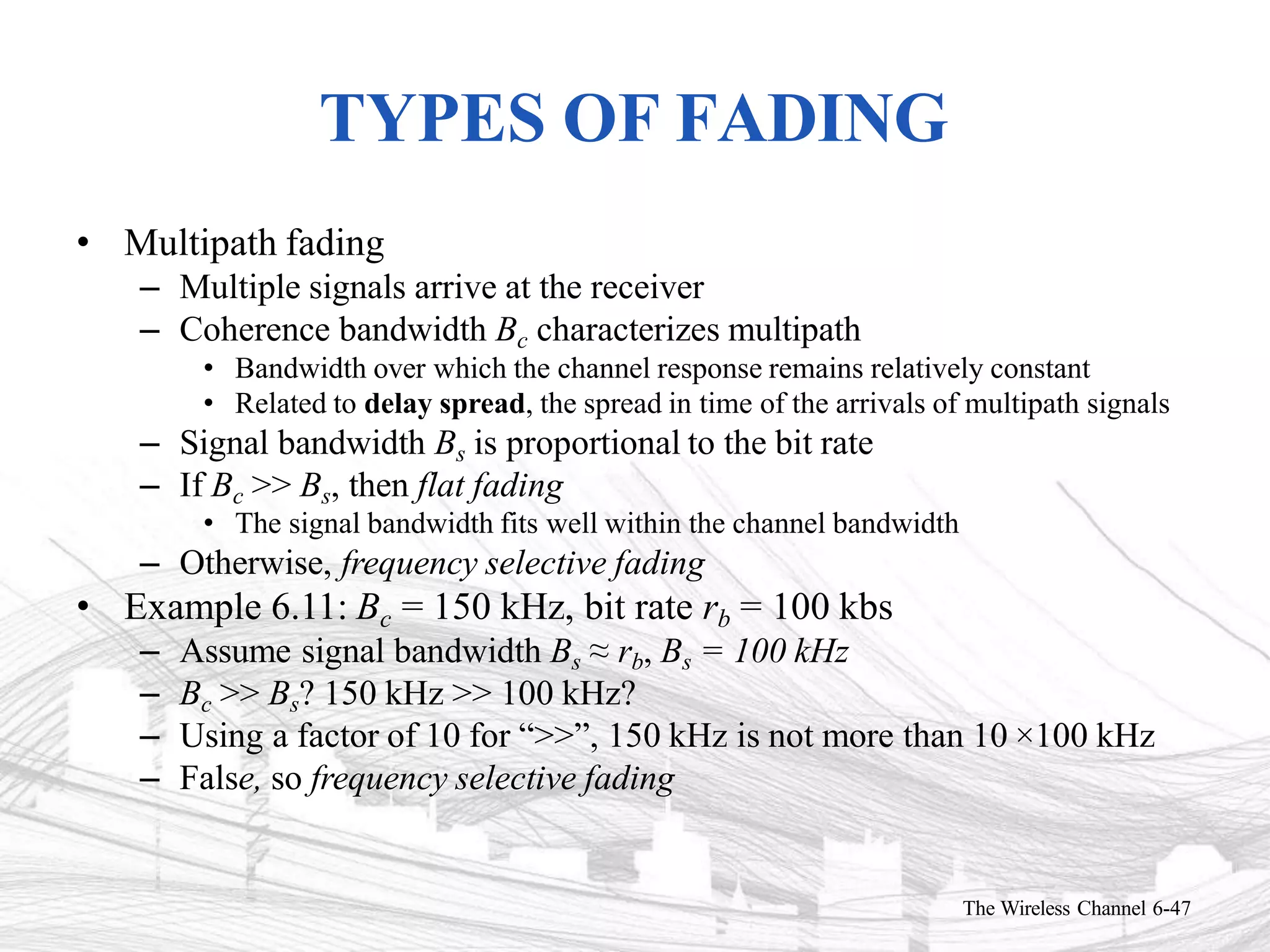
Prof. Dr.-Ing. Jochen H. Schiller www.jochenschiller.de MC - 2013
DOPPLER SHIFT
• Deviation from the signal frequency due to
relative motion between sender and receiver:
𝑣
𝜆
Δ𝑓 = ∙ cos(𝜃)
TYPES OF FADING
The Wireless Channel 6-47
• Multipath fading
– Multiple signals arrive at the receiver
– Coherence bandwidth Bc characterizes multipath
• Bandwidth over which the channel response remains relatively constant
• Related to delay spread, the spread in time of the arrivals of multipath signals
– Signal bandwidth Bs is proportional to the bit rate
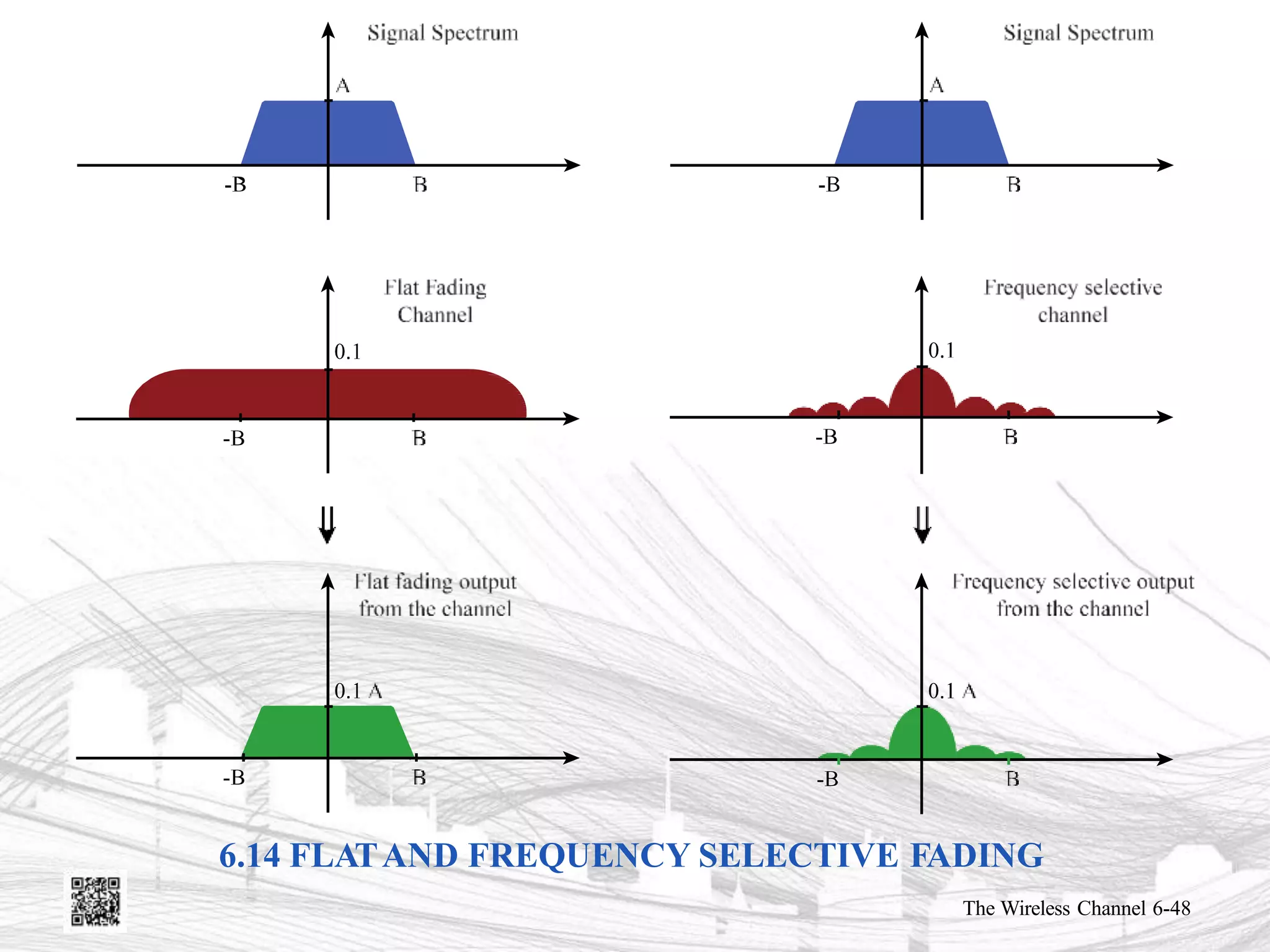
– If Bc >> Bs, then flat fading
• The signal bandwidth fits well within the channel bandwidth
– Otherwise, frequency selective fading
• Example 6.11: Bc = 150 kHz, bit rate rb = 100 kbs
– Assume signal bandwidth Bs ≈ rb, Bs = 100 kHz
– Bc >> Bs? 150 kHz >> 100 kHz?
– Using a factor of 10 for “>>”, 150 kHz is not more than 10 ×100 kHz
– False, so frequency selective fading
6.14 FLATAND FREQUENCY SELECTIVE FADING
The Wireless Channel 6-48
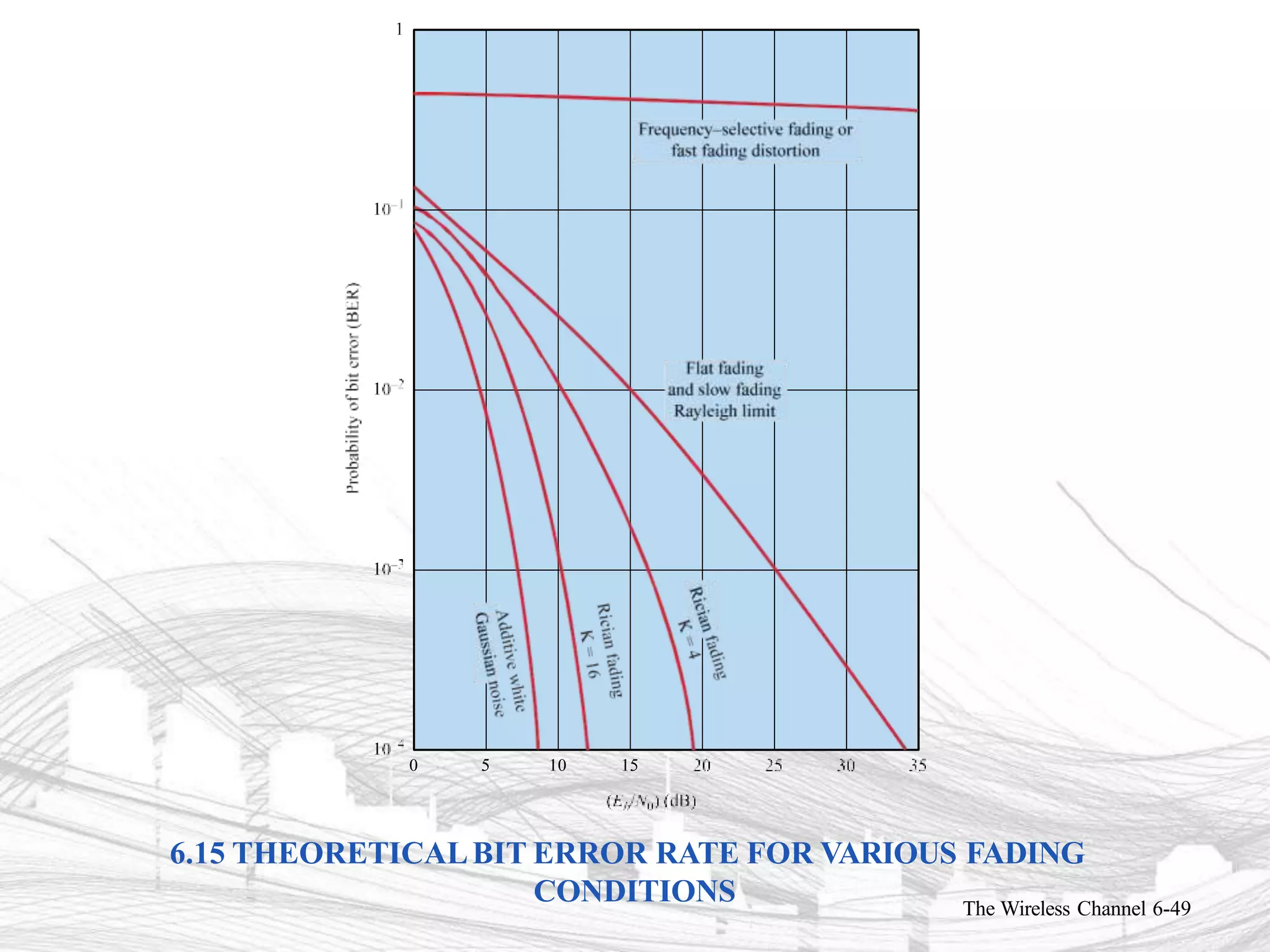
6.15 THEORETICALBIT ERROR RATE FOR VARIOUS FADING
CONDITIONS The Wireless Channel 6-49
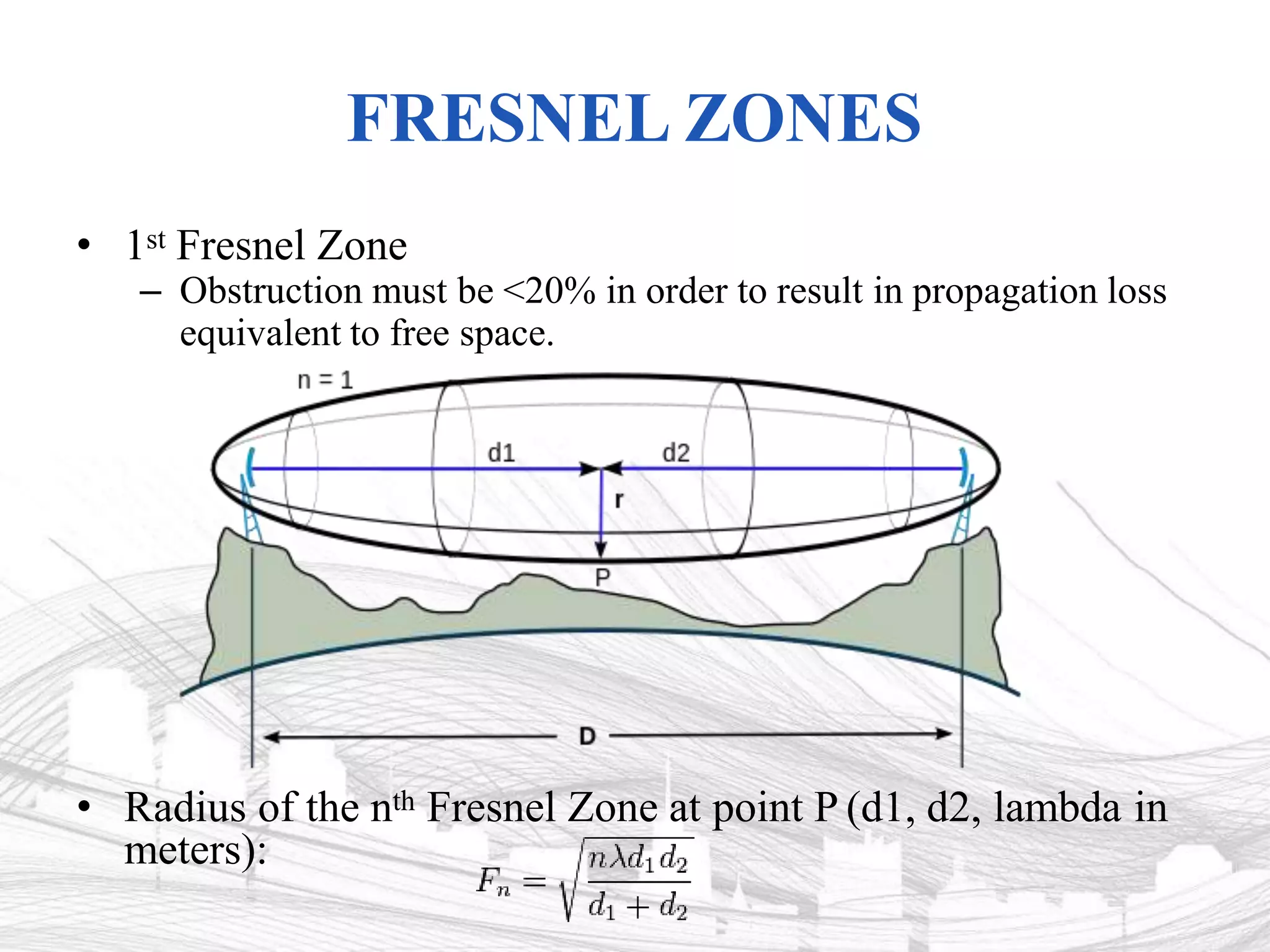
FRESNEL ZONES
• 1st Fresnel Zone
– Obstruction must be <20% in order to result in propagation loss
equivalent to free space.
• Radius of the nth Fresnel Zone at point P (d1, d2, lambda in
meters):
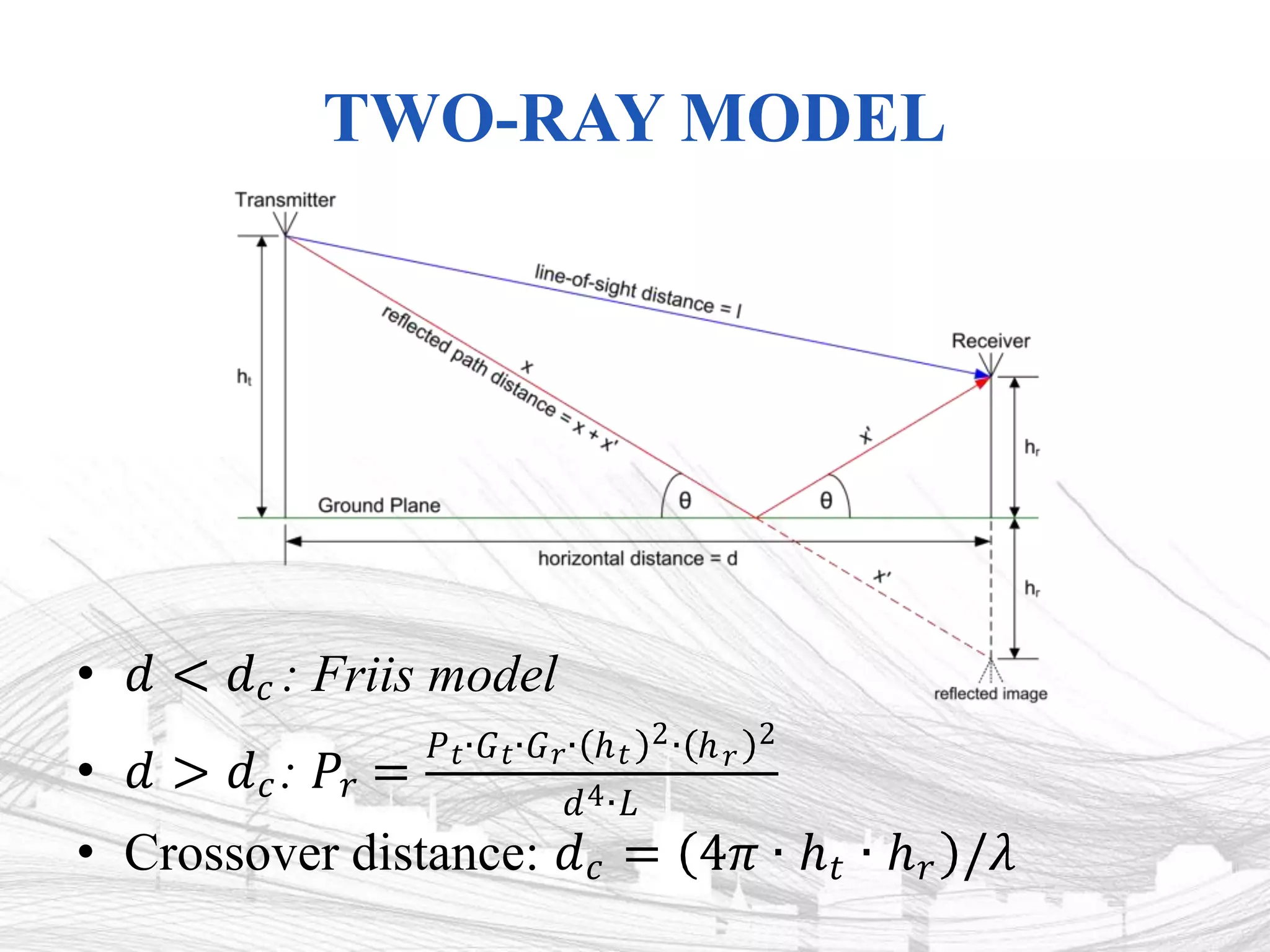
TWO-RAY MODEL
• 𝑑 < 𝑑𝑐 : Friis model
• 𝑑 > 𝑑𝑐: 𝑃𝑟 =
2
𝑃𝑡∙𝐺𝑡∙𝐺𝑟∙ ℎ𝑡 ∙ ℎ𝑟
2
𝑑4∙𝐿
• Crossover distance: 𝑑𝑐 = 4𝜋 ∙ ℎ𝑡 ∙ ℎ𝑟 /𝜆
PUTTING IT ALL TOGETHER IN A
MODEL
(EXTRA)
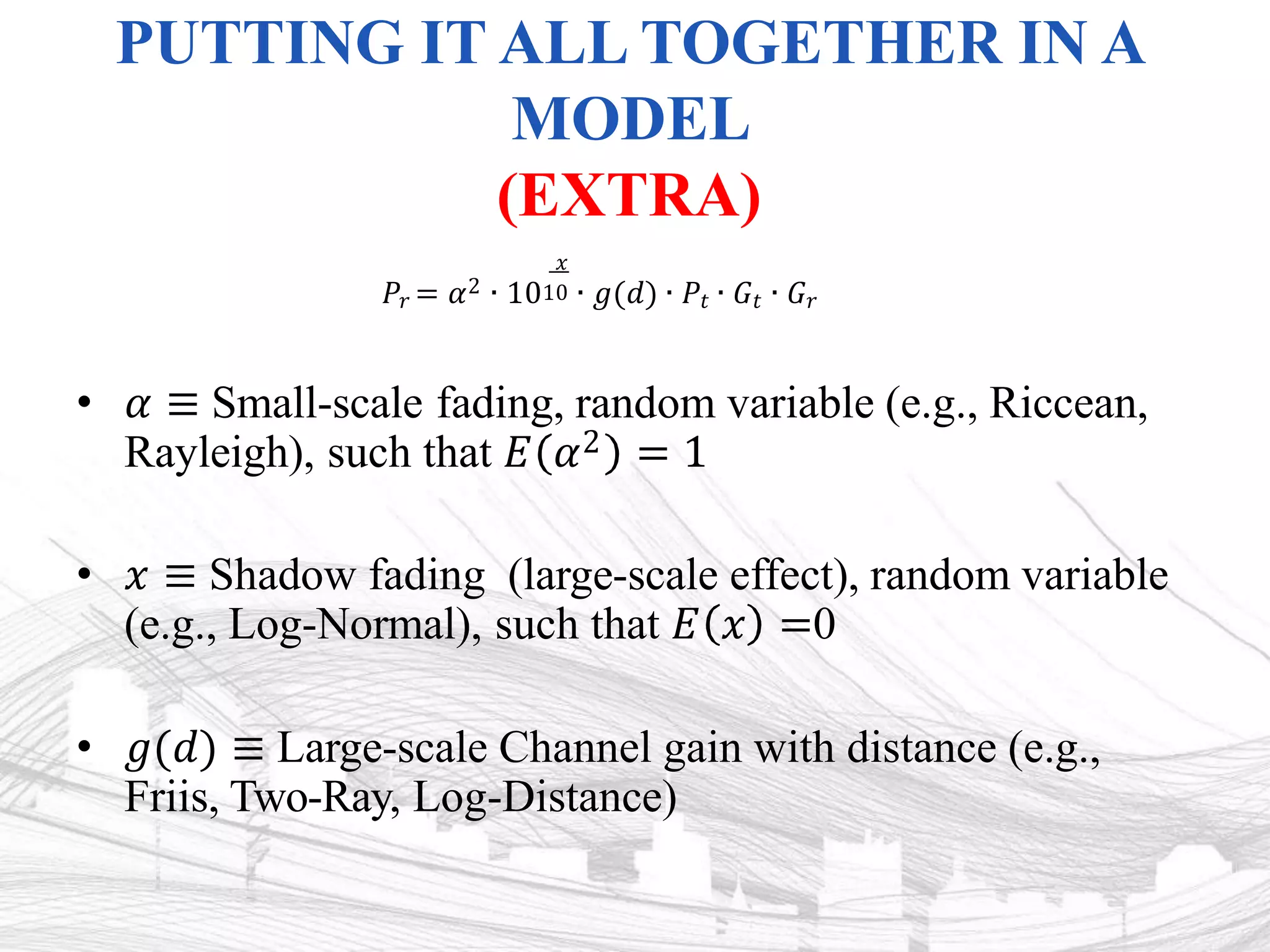
• 𝛼 ≡ Small-scale fading, random variable (e.g., Riccean,
Rayleigh), such that 𝐸 𝛼2 = 1
• 𝑥 ≡ Shadow fading (large-scale effect), random variable
(e.g., Log-Normal), such that 𝐸 𝑥 =0
• 𝑔(𝑑) ≡ Large-scale Channel gain with distance (e.g.,
Friis, Two-Ray, Log-Distance)
𝑥
𝑃𝑟 = 𝛼2 ∙ 1010 ∙ 𝑔(𝑑) ∙ 𝑃𝑡 ∙ 𝐺𝑡 ∙ 𝐺𝑟
CHANNEL CORRECTION
MECHANISMS
The Wireless Channel 6-53
• Forward error correction
• Adaptive equalization
• Adaptive modulation and coding
• Diversity techniques and MIMO
• OFDM
• Spread Spectrum (bandwidth expansion)
FORWARD ERROR CORRECTION
The Wireless Channel 6-54
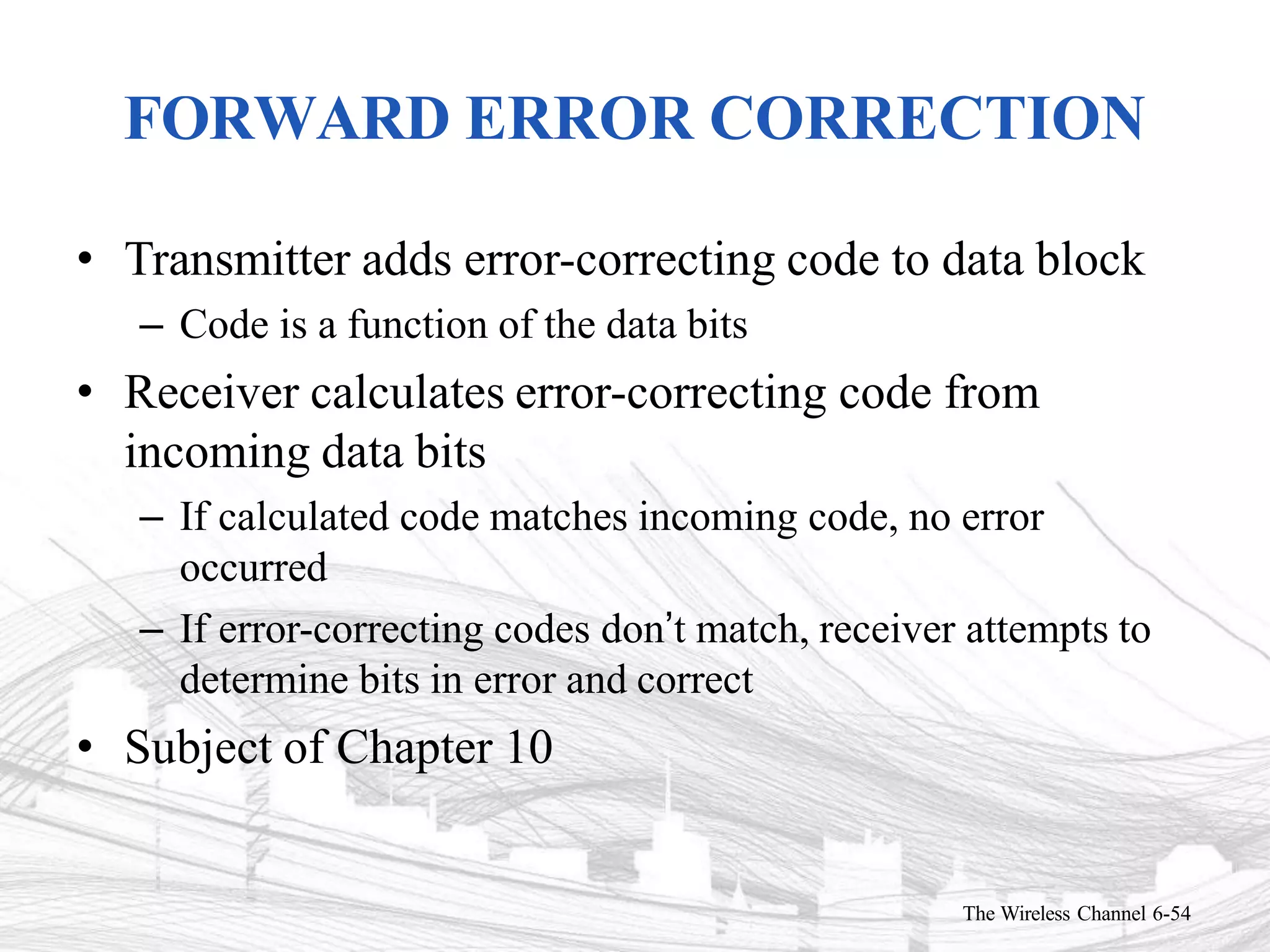
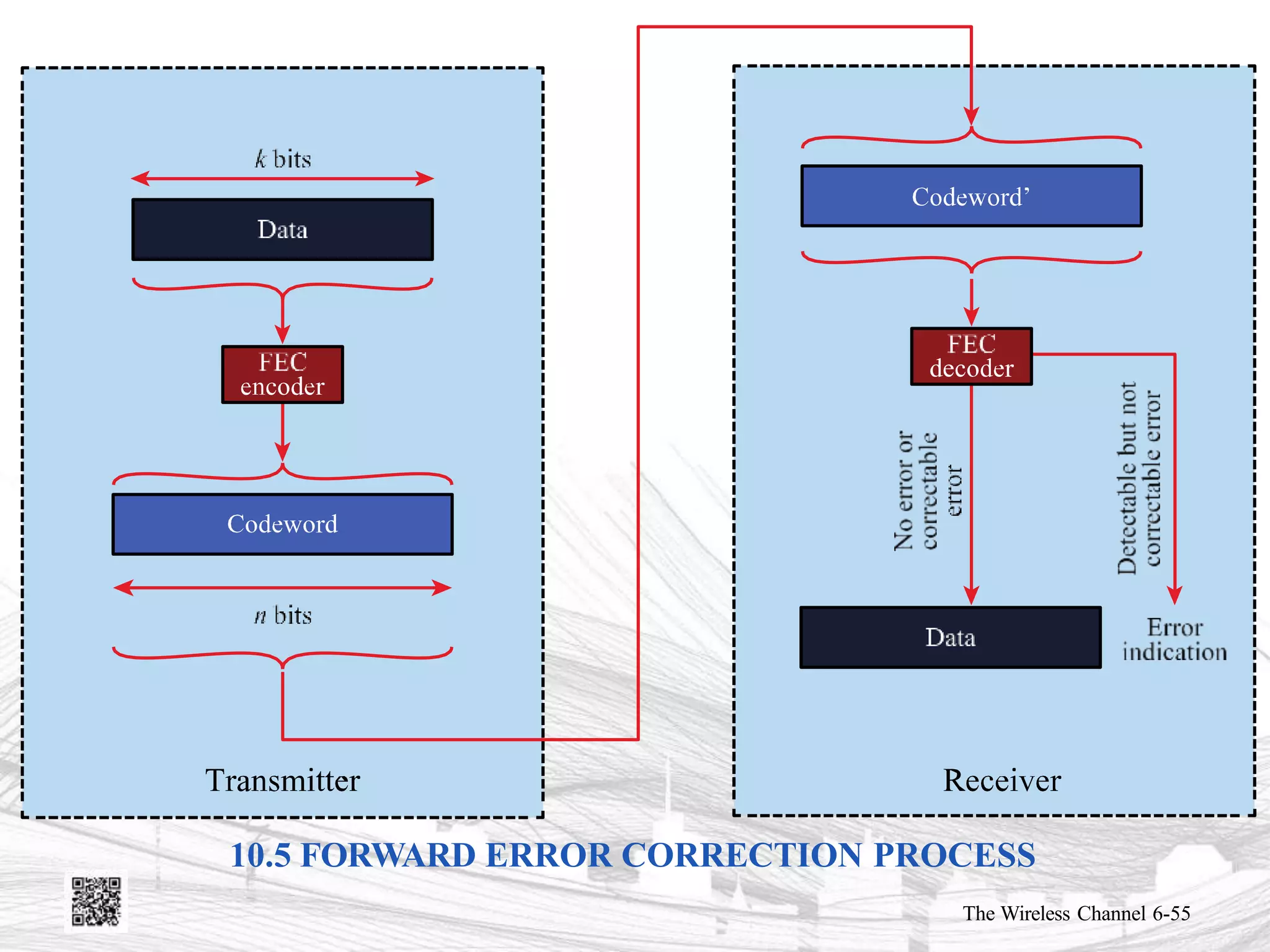
• Transmitter adds error-correcting code to data block
– Code is a function of the data bits
• Receiver calculates error-correcting code from
incoming data bits
– If calculated code matches incoming code, no error
occurred
– If error-correcting codes don’t match, receiver attempts to
determine bits in error and correct
• Subject of Chapter 10
10.5 FORWARD ERROR CORRECTION PROCESS
The Wireless Channel 6-55
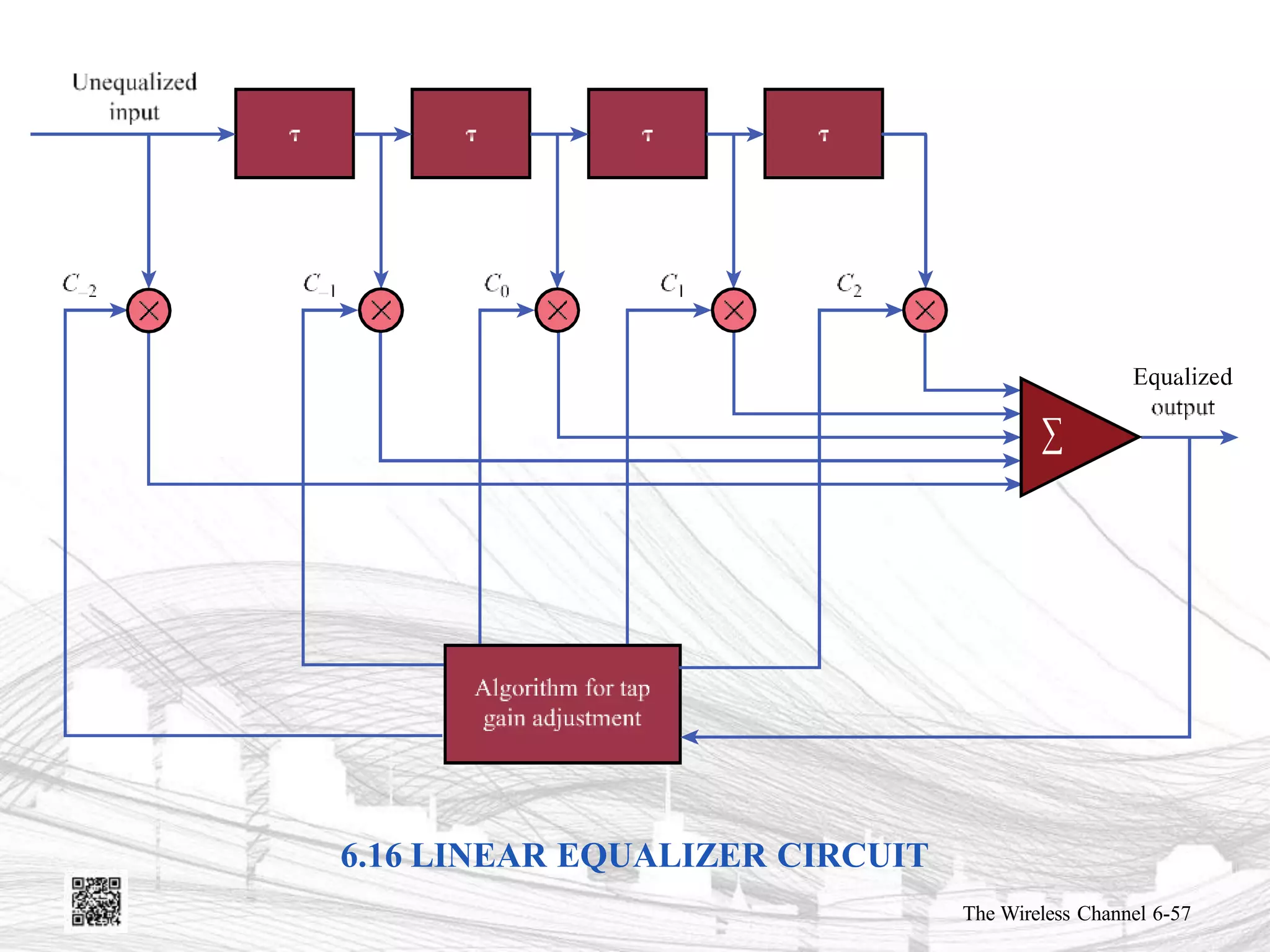
ADAPTIVE EQUALIZATION
The Wireless Channel 6-56
• Can be applied to transmissions that carry analog or
digital information
– Analog voice or video
– Digital data, digitized voice or video
• Used to combat intersymbol interference
• Involves gathering dispersed symbol energy back into
its original time interval
• Techniques
– Lumped analog circuits
– Sophisticated digital signal processing algorithms
6.16 LINEAR EQUALIZER CIRCUIT
The Wireless Channel 6-57
ADAPTIVE MODULATION AND
CODING (AMC)
The Wireless Channel 6-58
• The modulation process formats the signal to best
transmit bits
– To overcome noise
– To transmit as many bits as possible
• Coding detects and corrects errors
• AMC adapts to channel conditions
– 100’s of times per second
– Measures channel conditions
– Sends messages between transmitter and receiver to
coordinate changes
DIVERSITY TECHNIQUES
The Wireless Channel 6-59
• Diversity is based on the fact that individual channels
experience independent fading events
• Space diversity – techniques involving physical
transmission path, spacing antennas
• Frequency diversity – techniques where the signal is
spread out over a larger frequency bandwidth or
carried on multiple frequency carriers
• Time diversity – techniques aimed at spreading the
data out over time
• Use of diversity
– Selection diversity – select the best signal
– Combining diversity – combine the signals
MULTIPLE INPUT MULTIPLE
OUTPUT (MIMO) ANTENNAS
The Wireless Channel 6-60
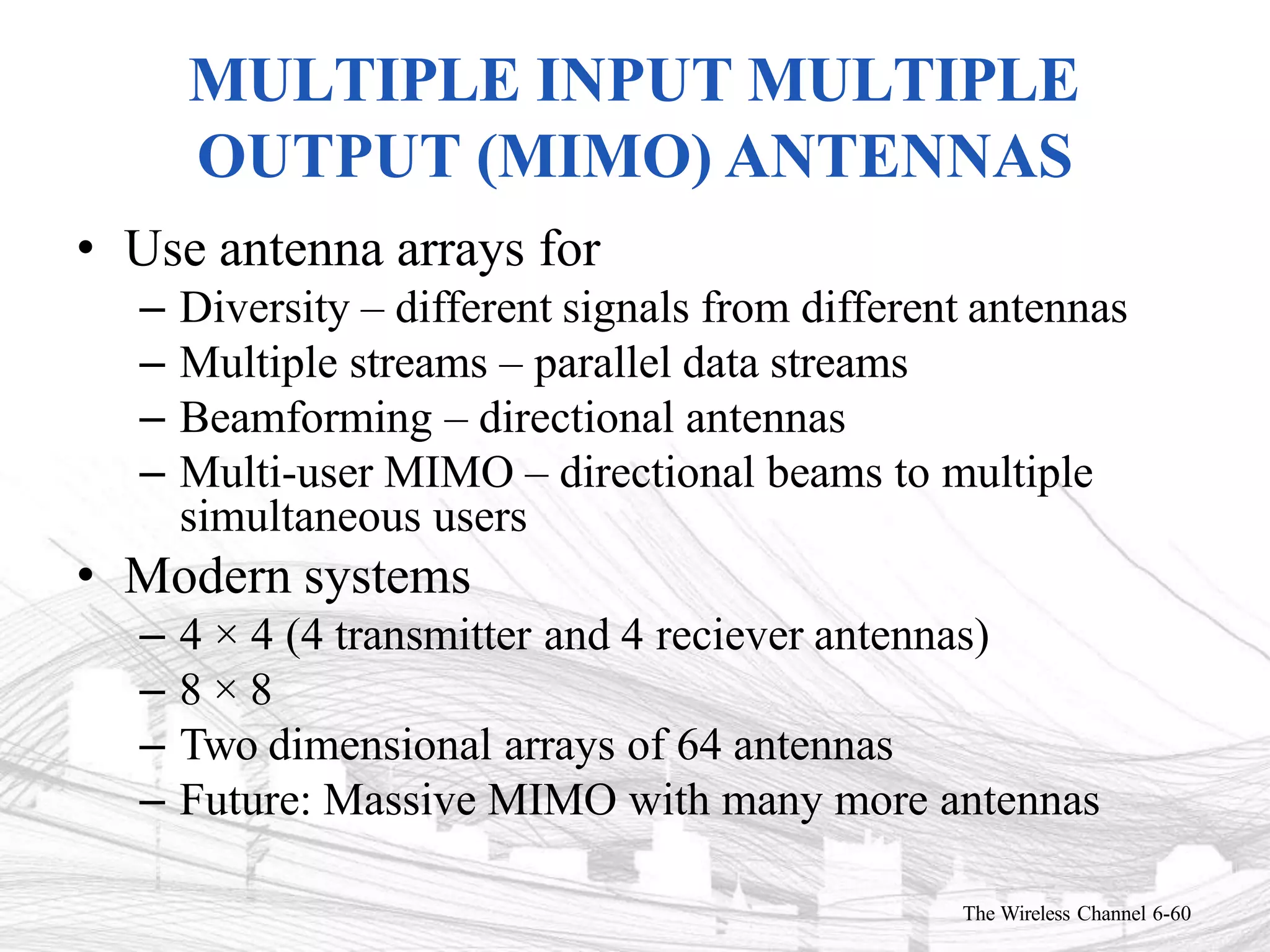
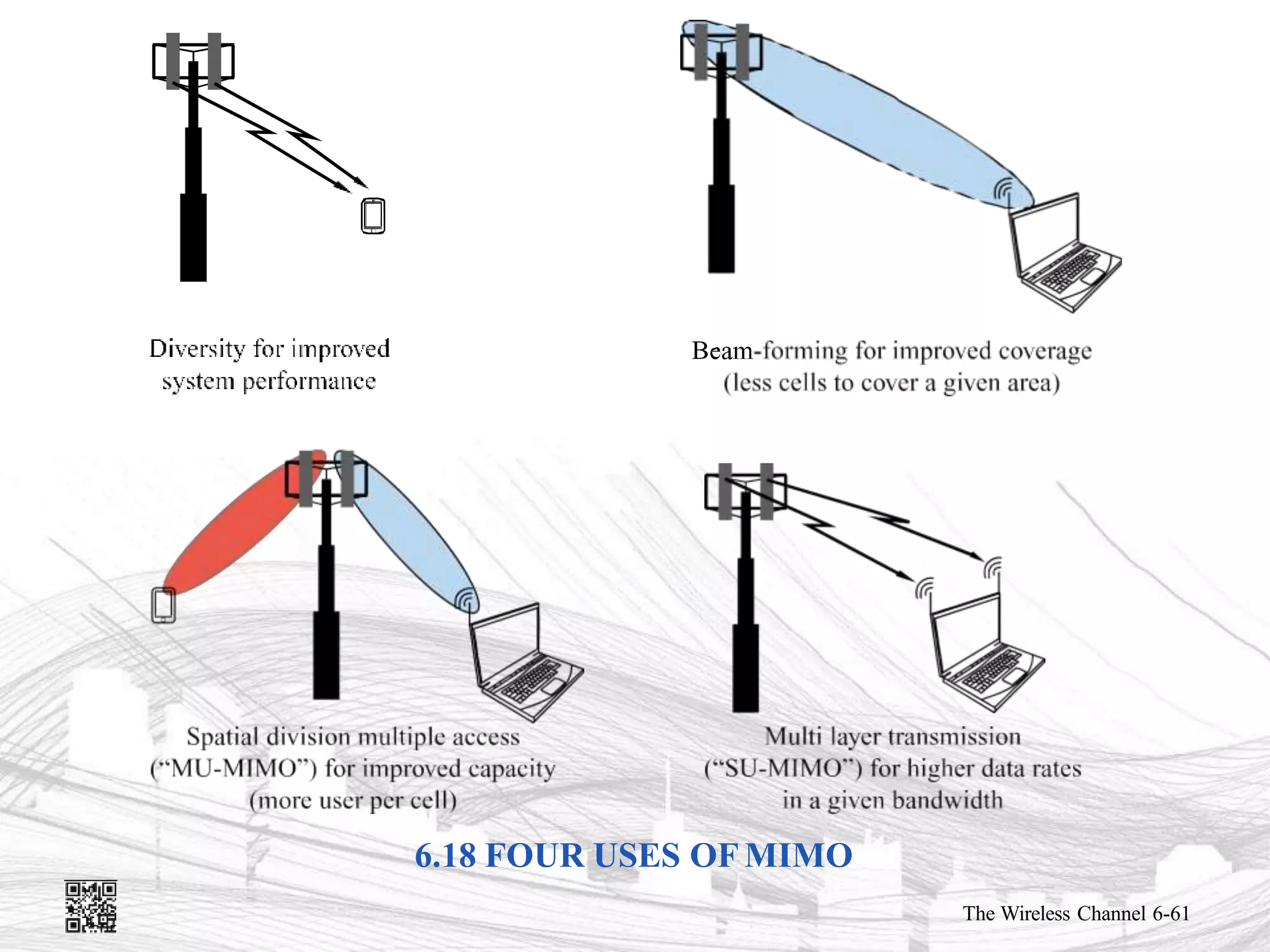
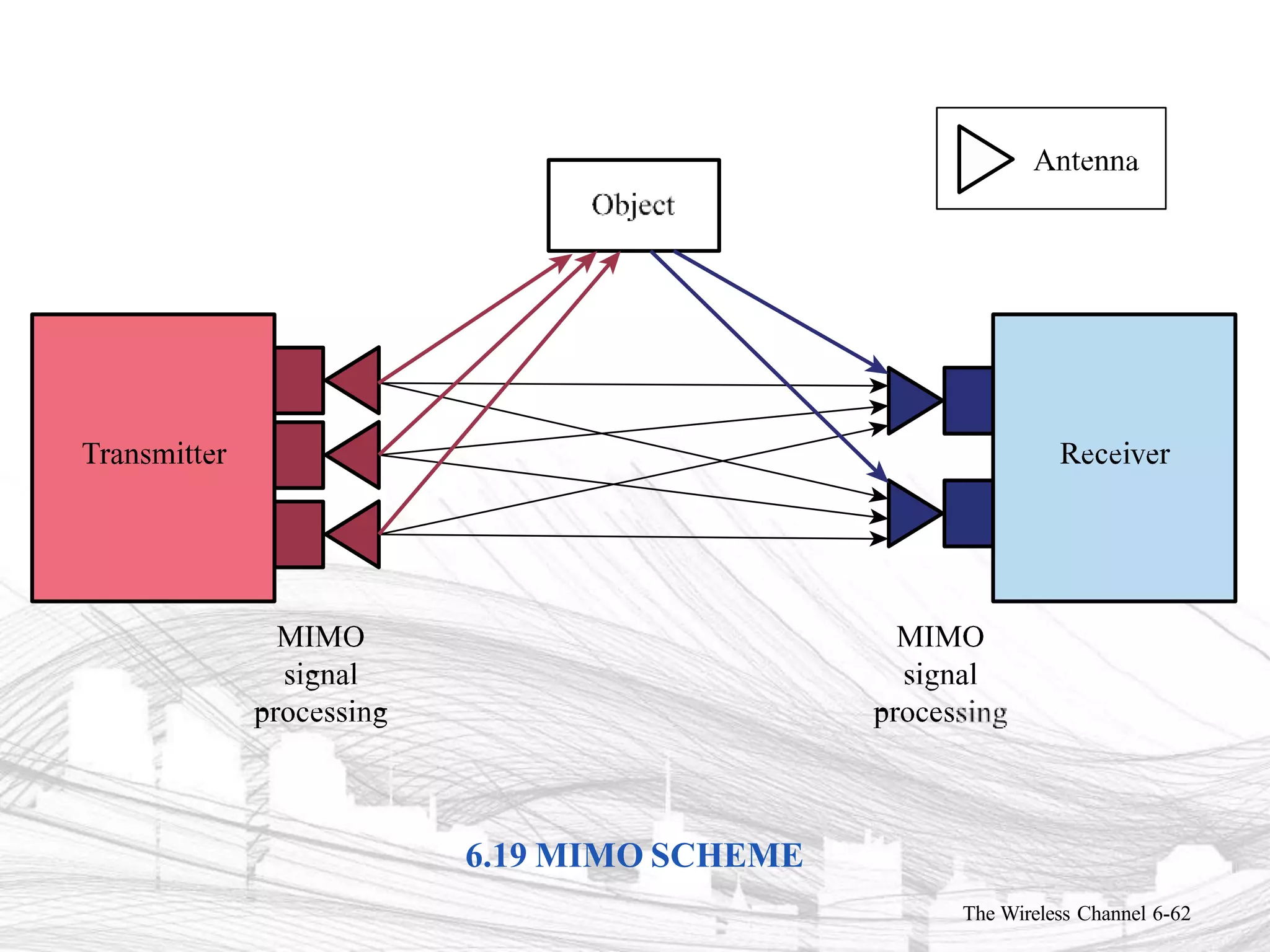
• Use antenna arrays for
– Diversity – different signals from different antennas
– Multiple streams – parallel data streams
– Beamforming – directional antennas
– Multi-user MIMO – directional beams to multiple
simultaneous users
• Modern systems
– 4 × 4 (4 transmitter and 4 reciever antennas)
– 8 × 8
– Two dimensional arrays of 64 antennas
– Future: Massive MIMO with many more antennas
6.18 FOUR USES OF MIMO
The Wireless Channel 6-61
6.19 MIMO SCHEME
The Wireless Channel 6-62
CHANNEL CORRECTION
MECHANISMS
The Wireless Channel 6-63
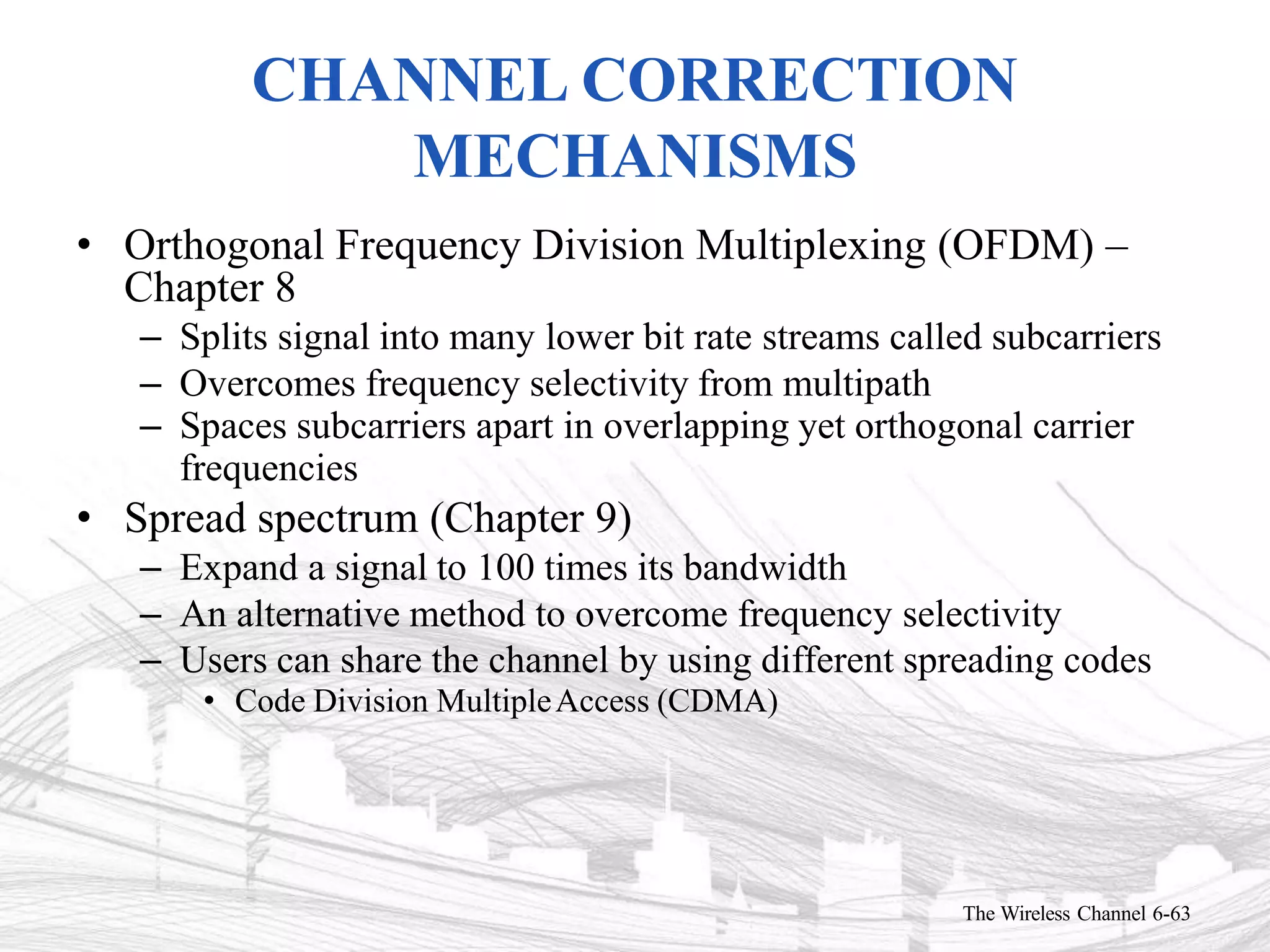
• Orthogonal Frequency Division Multiplexing (OFDM) –
Chapter 8
– Splits signal into many lower bit rate streams called subcarriers
– Overcomes frequency selectivity from multipath
– Spaces subcarriers apart in overlapping yet orthogonal carrier
frequencies
• Spread spectrum (Chapter 9)
– Expand a signal to 100 times its bandwidth
– An alternative method to overcome frequency selectivity
– Users can share the channel by using different spreading codes
• Code Division MultipleAccess (CDMA)
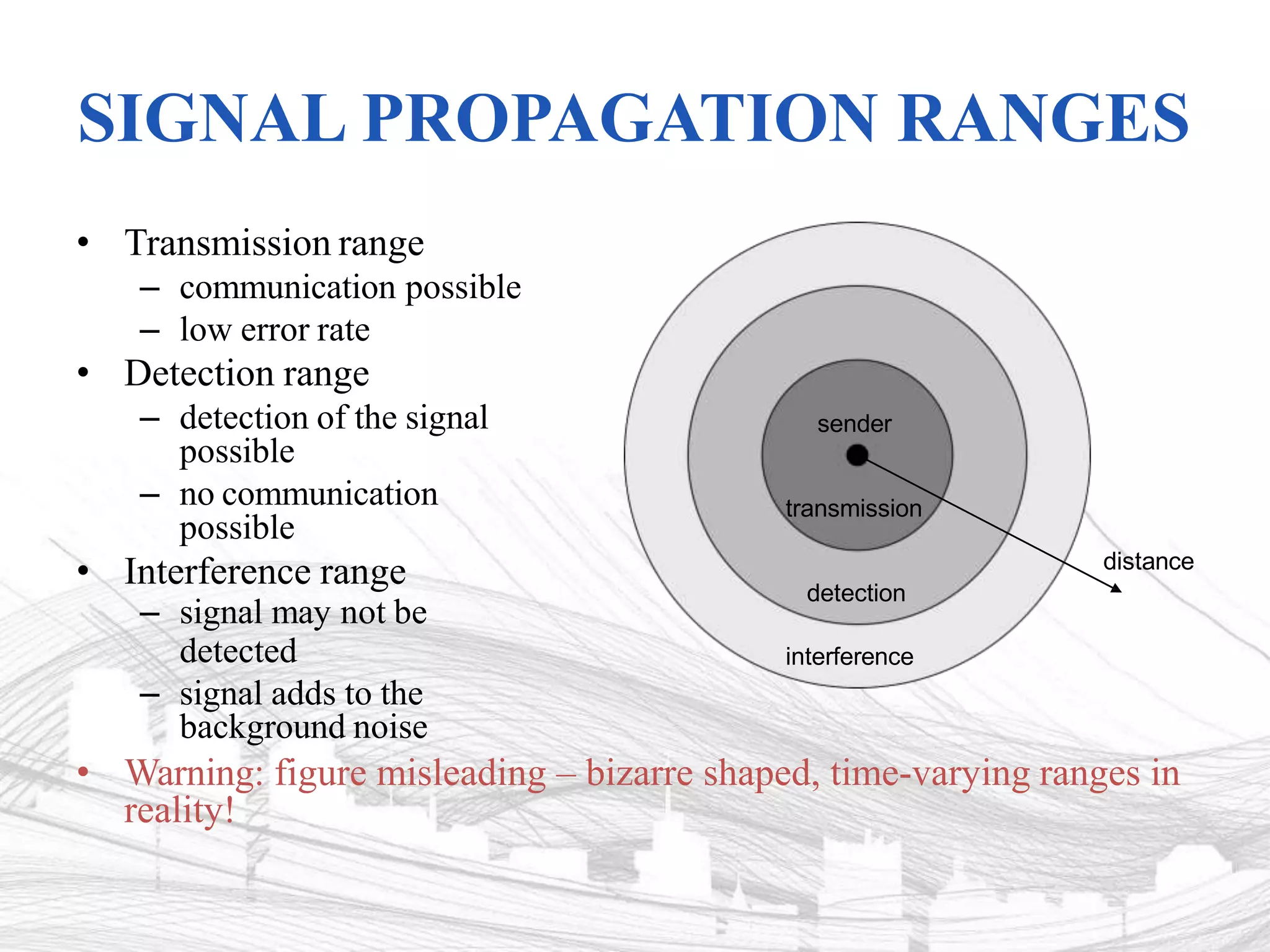
SIGNAL PROPAGATION RANGES
• Transmission range
– communication possible
– low error rate
• Detection range
– detection of the signal
possible
– no communication
possible
• Interference range
– signal may not be
detected
– signal adds to the
background noise
• Warning: figure misleading – bizarre shaped, time-varying ranges in
reality!
distance
sender
transmission
detection
interference

C06 - The Wireless Channel.pptx

  • 1.
    Wireless Communication Networks andSystems 1st edition Cory Beard, William Stallings © 2016 Pearson Higher Education, Inc. The Wireless Channel 6-1 These slides are made available to faculty in PowerPoint form. Slides can be freely added, modified, and deleted to suit student needs. They represent substantial work on the part of the authors; therefore, we request the following. If these slides are used in a class setting or posted on an internal or external www site, please mention the source textbook and note our copyright of this material. All material copyright 2016 Cory Beard and William Stallings, All Rights Reserved CHAPTER 6 THE WIRELESS CHANNEL
  • 2.
    ANTENNAS The Wireless Channel6-2 • An antenna is an electrical conductor or system of conductors – Transmission - radiates electromagnetic energy into space – Reception - collects electromagnetic energy from space • In two-way communication, the same antenna can be used for transmission and reception
  • 3.
    RADIATION PATTERNS The WirelessChannel 6-3 • Radiation pattern – Graphical representation of radiation properties of an antenna – Depicted as two-dimensional cross section • Beam width (or half-power beam width) – Measure of directivity of antenna • Reception pattern – Receiving antenna’s equivalent to radiation pattern • Sidelobes – Extra energy in directions outside the mainlobe • Nulls – Very low energy in between mainlobe and sidelobes
  • 4.
  • 5.
    TYPES OF ANTENNAS TheWireless Channel 6-5 • Isotropic antenna (idealized) – Radiates power equally in all directions • Dipole antennas – Half-wave dipole antenna (or Hertz antenna) – Quarter-wave vertical antenna (or Marconi antenna) • Parabolic Reflective Antenna • DirectionalAntennas – Arrays of antennas • In a linear array or other configuration – Signal amplitudes and phases to each antenna are adjusted to create a directional pattern – Very useful in modern systems
  • 6.
    ISOTROPIC RADIATOR • Radiationand reception of electromagnetic waves, coupling of wires to space for radio transmission • Isotropic radiator: equal radiation in all directions (three dimensional) - only a theoretical reference antenna • Real antennas always have directive effects (vertically and/or horizontally) • Radiation pattern: measurement of radiation around an antenna z y x z y x ideal isotropic radiator
  • 7.
  • 8.
    x y z y x z x y y z x z Sideview (xy-plane) Side view (zy-plane) Top view (xz-plane) (b) Directed antenna 6.3 RADIATION PATTERN IN THREE DIMENSIONS Side view (zy-plane) (a) Simple dipole Top view (xz-plane) Side view (xy-plane) The Wireless Channel 6-8
  • 9.
    6.4 PARABOLIC REFLECTIVEANTENNAS The Wireless Channel 6-9
  • 10.
    ANTENNA GAIN The WirelessChannel 6-10 • Antenna gain – Power output, in a particular direction, compared to that produced in any direction by a perfect omnidirectional antenna (isotropic antenna) • Effective area – Related to physical size and shape of antenna
  • 11.
    ANTENNA GAIN The WirelessChannel 6-11 • Relationship between antenna gain and effective area • G = antenna gain • Ae = effective area • f = carrier frequency • c = speed of light  3 ´ 108 m/s) • λ = carrier wavelength 2 4A 4 f 2 A G  e  e c2
  • 12.
    SPECTRUM CONSIDERATIONS The WirelessChannel 6-12 • Controlled by regulatory bodies – Carrier frequency – Signal Power – MultipleAccess Scheme • Divide into time slots –Time Division MultipleAccess (TDMA) • Divide into frequency bands – Frequency Division MultipleAccess (FDMA) • Different signal encodings – Code Division Multiple Access (CDMA)
  • 13.
    SPECTRUM CONSIDERATIONS The WirelessChannel 6-13 • Industrial, Scientific, and Medical (ISM) bands – Can be used without a license – As long as power and spread spectrum regulations are followed • ISM bands are used for – WLANs – Wireless PersonalArea networks – Internet of Things
  • 14.
    PROPAGATION MODES The WirelessChannel 6-14 • Ground-wave propagation • Sky-wave propagation • Line-of-sight propagation
  • 15.
    6.5 WIRELESS PROPAGATIONMODES The Wireless Channel 6-15
  • 16.
    GROUND WAVE PROPAGATION TheWireless Channel 6-16 • Follows contour of the earth • Can propagate considerable distances • Frequencies up to 2 MHz • Example – AM radio
  • 17.
    SKY WAVE PROPAGATION TheWireless Channel 6-17 • Signal reflected from ionized layer of atmosphere back down to earth • Signal can travel a number of hops, back and forth between ionosphere and earth’s surface • Reflection effect caused by refraction • Examples – Amateur radio – CB radio
  • 18.
    LINE-OF-SIGHT PROPAGATION The WirelessChannel 6-18 • Transmitting and receiving antennas must be within line of sight – Satellite communication – signal above 30 MHz not reflected by ionosphere – Ground communication – antennas within effective line of site due to refraction • Refraction – bending of microwaves by the atmosphere – Velocity of electromagnetic wave is a function of the density of the medium – When wave changes medium, speed changes – Wave bends at the boundary between mediums
  • 19.
    6.6 REFRACTION OFANELECTROMAGNETIC WAVE The Wireless Channel 6-19
  • 20.
    FIVE BASIC PROPAGATION MECHANISMS TheWireless Channel 6-20 1. Free-space propagation 2. Transmission – Through a medium – Refraction occurs at boundaries 3. Reflections – Waves impinge upon surfaces that are large compared to the signal wavelength 4. Diffraction – Secondary waves behind objects with sharp edges 5. Scattering – Interactions between small objects or rough surfaces
  • 21.
    LOS WIRELESS TRANSMISSION IMPAIRMENTS TheWireless Channel 6-21 • Attenuation and attenuation distortion • Free space loss • Noise • Atmospheric absorption • Multipath • Refraction • Thermal noise
  • 22.
    ATTENUATION The Wireless Channel6-22 • Strength of signal falls off with distance over transmission medium • Attenuation factors for unguided media: – Received signal must have sufficient strength so that circuitry in the receiver can interpret the signal – Signal must maintain a level sufficiently higher than noise to be received without error – Attenuation is greater at higher frequencies, causing distortion
  • 23.
    FREE SPACE LOSS •Free space loss (Friis Model): Pt  (4 d)2  (4 df )2 • Pt = signal power at transmitting antenna • Pr = signal power at receiving antenna • λ = carrier wavelength • d = propagation distance between antennas • c = speed of light 3 ×10⁸ m/s) • Gt = transmitter antenna gain (=1 for isotropic antenna) • Gt = receiver antenna gain (=1 for isotropic antenna) where d and λ are in the same units (e.g., meters) GtGrc2 The Wireless Channel 6-23 GtGr 2 Pr
  • 24.
    FREE SPACE LOSS •Free space loss (isotropic antenna) equation can be recast: dB Pr L 10log Pt  20log  4d  The Wireless Channel 6-24     20log 20logd 21.98dB     20log c  4fd   20logf  20logd147.56dB
  • 25.
    6.8 FREE SPACELOSS The Wireless Channel 6-25
  • 26.
    DERIVATION OF THEFRIIS EQUATION • Power Flux Density: power spread over the sphere’s surface: – 𝑝 = 𝑃𝑡 4𝜋𝑟2 𝐺𝑡 • Antenna’sApperture or EffectiveArea: 𝑒𝑓 𝑓 𝜆2 𝐺𝑟 = 𝑃𝑜 4𝜋 𝑝 – 𝐴 = – Where 𝑃𝑜≡ 𝑃𝑟is the antenna’s output power that feeds the receiver circuit’s load. – Note:Antenna’s apperture efficiency (0≤ 𝑒𝑎 ≤ 1): 𝐴𝑝ℎ𝑦𝑠 • 𝑒 = 𝐴𝑒𝑓𝑓 , where 𝐴 𝑎 𝑝ℎ𝑦 𝑠 is the physical apperture of e.g., parabolic dish or horn • Friis Equation: – 𝑃𝑟= 𝑝 ∙ 𝐴𝑒𝑓𝑓
  • 27.
    PATH LOSS EXPONENTIN PRACTICAL SYSTEMS • Practical systems – reflections, scattering, etc. • Beyond a certain distance, received power decreases logarithmically with distance – Based on many measurement studies Pt r P    The Wireless Channel 6-27  c  2 2   4 dn   4f  dn LdB  20logf 10nlogd147.56 dB
  • 28.
    PATH LOSS EXPONENTIN PRACTICAL SYSTEMS The Wireless Channel 6-28
  • 29.
    MODELS DERIVED FROM EMPIRICALMEASUREMENTS The Wireless Channel 6-29 • Need to design systems based on empirical data applied to a particular environment – To determine power levels, tower heights, height of mobile antennas • Okumura developed a model, later refined by Hata – Detailed measurement and analysis of the Tokyo area – Among the best accuracy in a wide variety of situations • Predicts path loss for typical environments – Urban – Small, medium sized city – Large city – Suburban – Rural
  • 30.
    CATEGORIES OF NOISE TheWireless Channel 6-30 • Thermal Noise • Intermodulation noise • Crosstalk • Impulse Noise
  • 31.
    THERMAL NOISE The WirelessChannel 6-31 • Thermal noise due to agitation of electrons • Present in all electronic devices and transmission media • Cannot be eliminated • Function of temperature • Particularly significant for satellite communication
  • 32.
    THERMAL NOISE The WirelessChannel 6-32 • Amount of thermal noise to be found in a bandwidth of 1Hz in any device or conductor is: N0  kT W/Hz • N0 = noise power density in watts per 1 Hz of bandwidth • k = Boltzmann's constant = 1.3803 × 10⁻²³ J/K • T = temperature, in Kelvins (absolute temperature)
  • 33.
    THERMAL NOISE The WirelessChannel 6-33 • Noise is assumed to be independent of frequency • Average thermal noise power present in a bandwidth of B Hertz (in watts): N  kTB or, in decibel-watts  228.6 dBW 10logT 10logB N 10logk 10logT 10logB
  • 34.
    NOISE TERMINOLOGY The WirelessChannel 6-34 • Intermodulation noise – occurs if signals with different frequencies share the same medium – Interference caused by a signal produced at a frequency that is the sum or difference of original frequencies • Crosstalk – unwanted coupling between signal paths • Impulse noise – irregular pulses or noise spikes – Short duration and of relatively high amplitude – Caused by external electromagnetic disturbances, or faults and flaws in the communications system
  • 35.
    EXPRESSION Eb/N0 • Ratioof signal energy per bit to noise power density per Hertz Eb  S / R  S N0 N0 kTR • The bit error rate (i.e., bit error probability) for digital data is a function of Eb/N0 – Given a value for Eb/N0 to achieve a desired error rate, parameters of this formula can be selected – As bit rate R increases, transmitted signal power must increase to maintain required Eb/N0 The Wireless Channel 6-35
  • 36.
    6.9 GENERAL SHAPEOF BER VERSUS Eb/N0 CURVES The Wireless Channel 6-36
  • 37.
    OTHER IMPAIRMENTS The WirelessChannel 6-37 • Atmospheric absorption – water vapor and oxygen contribute to attenuation • Multipath – obstacles reflect signals so that multiple copies with varying delays are received • Refraction – bending of radio waves as they propagate through the atmosphere
  • 38.
    THE EFFECTS OFMULTIPATH PROPAGATION The Wireless Channel 6-38 • Reflection, diffraction, and scattering • Multiple copies of a signal may arrive at different phases – If phases add destructively, the signal level relative to noise declines, making detection more difficult • Intersymbol interference (ISI) – One or more delayed copies of a pulse may arrive at the same time as the primary pulse for a subsequent bit • Rapid signal fluctuations – Over a few centimeters
  • 39.
    6.10 EXAMPLES OFMULTIPATH INTERFERENCE The Wireless Channel 6-39
  • 40.
    6.11 SKETCH OFTHREEIMPORTANT PROPAGATION MECHANISMS The Wireless Channel 6-40
  • 41.
  • 42.
    6.12 TWO PULSESIN TIME-VARIANT MULTIPATH The Wireless Channel 6-42
  • 43.
    6.13 TYPICALLARGE-SCALEAND SMALL-SCALEFADING INAN URBAN MOBILE ENVIRONMENT The Wireless Channel 6-43
  • 44.
    TYPES OF FADING TheWireless Channel 6-44 • Large-scale fading – Signal variations over large distances – Path loss LdB as we have seen already – Shadowing • Statistical variations – Rayleigh fading – Ricean fading
  • 45.
    TYPES OF FADING TheWireless Channel 6-45 • Doppler Spread – Frequency fluctuations caused by movement – Coherence time Tccharacterizes Doppler shift • How long a channel remains the same – Coherence time Tc>> Tb bit time  slow fading • The channel does not change during the bit time – Otherwise fast fading • Example 6.11: Tc = 70 ms, bit rate rb = 100 kbs – Bit time Tb = 1/100 × 103 = 10 μs – Tc>> Tb? 70 ms >> 10 μs? – True, so slow fading
  • 46.
    Prof. Dr.-Ing. JochenH. Schiller www.jochenschiller.de MC - 2013 DOPPLER SHIFT • Deviation from the signal frequency due to relative motion between sender and receiver: 𝑣 𝜆 Δ𝑓 = ∙ cos(𝜃)
  • 47.
    TYPES OF FADING TheWireless Channel 6-47 • Multipath fading – Multiple signals arrive at the receiver – Coherence bandwidth Bc characterizes multipath • Bandwidth over which the channel response remains relatively constant • Related to delay spread, the spread in time of the arrivals of multipath signals – Signal bandwidth Bs is proportional to the bit rate – If Bc >> Bs, then flat fading • The signal bandwidth fits well within the channel bandwidth – Otherwise, frequency selective fading • Example 6.11: Bc = 150 kHz, bit rate rb = 100 kbs – Assume signal bandwidth Bs ≈ rb, Bs = 100 kHz – Bc >> Bs? 150 kHz >> 100 kHz? – Using a factor of 10 for “>>”, 150 kHz is not more than 10 ×100 kHz – False, so frequency selective fading
  • 48.
    6.14 FLATAND FREQUENCYSELECTIVE FADING The Wireless Channel 6-48
  • 49.
    6.15 THEORETICALBIT ERRORRATE FOR VARIOUS FADING CONDITIONS The Wireless Channel 6-49
  • 50.
    FRESNEL ZONES • 1stFresnel Zone – Obstruction must be <20% in order to result in propagation loss equivalent to free space. • Radius of the nth Fresnel Zone at point P (d1, d2, lambda in meters):
  • 51.
    TWO-RAY MODEL • 𝑑< 𝑑𝑐 : Friis model • 𝑑 > 𝑑𝑐: 𝑃𝑟 = 2 𝑃𝑡∙𝐺𝑡∙𝐺𝑟∙ ℎ𝑡 ∙ ℎ𝑟 2 𝑑4∙𝐿 • Crossover distance: 𝑑𝑐 = 4𝜋 ∙ ℎ𝑡 ∙ ℎ𝑟 /𝜆
  • 52.
    PUTTING IT ALLTOGETHER IN A MODEL (EXTRA) • 𝛼 ≡ Small-scale fading, random variable (e.g., Riccean, Rayleigh), such that 𝐸 𝛼2 = 1 • 𝑥 ≡ Shadow fading (large-scale effect), random variable (e.g., Log-Normal), such that 𝐸 𝑥 =0 • 𝑔(𝑑) ≡ Large-scale Channel gain with distance (e.g., Friis, Two-Ray, Log-Distance) 𝑥 𝑃𝑟 = 𝛼2 ∙ 1010 ∙ 𝑔(𝑑) ∙ 𝑃𝑡 ∙ 𝐺𝑡 ∙ 𝐺𝑟
  • 53.
    CHANNEL CORRECTION MECHANISMS The WirelessChannel 6-53 • Forward error correction • Adaptive equalization • Adaptive modulation and coding • Diversity techniques and MIMO • OFDM • Spread Spectrum (bandwidth expansion)
  • 54.
    FORWARD ERROR CORRECTION TheWireless Channel 6-54 • Transmitter adds error-correcting code to data block – Code is a function of the data bits • Receiver calculates error-correcting code from incoming data bits – If calculated code matches incoming code, no error occurred – If error-correcting codes don’t match, receiver attempts to determine bits in error and correct • Subject of Chapter 10
  • 55.
    10.5 FORWARD ERRORCORRECTION PROCESS The Wireless Channel 6-55
  • 56.
    ADAPTIVE EQUALIZATION The WirelessChannel 6-56 • Can be applied to transmissions that carry analog or digital information – Analog voice or video – Digital data, digitized voice or video • Used to combat intersymbol interference • Involves gathering dispersed symbol energy back into its original time interval • Techniques – Lumped analog circuits – Sophisticated digital signal processing algorithms
  • 57.
    6.16 LINEAR EQUALIZERCIRCUIT The Wireless Channel 6-57
  • 58.
    ADAPTIVE MODULATION AND CODING(AMC) The Wireless Channel 6-58 • The modulation process formats the signal to best transmit bits – To overcome noise – To transmit as many bits as possible • Coding detects and corrects errors • AMC adapts to channel conditions – 100’s of times per second – Measures channel conditions – Sends messages between transmitter and receiver to coordinate changes
  • 59.
    DIVERSITY TECHNIQUES The WirelessChannel 6-59 • Diversity is based on the fact that individual channels experience independent fading events • Space diversity – techniques involving physical transmission path, spacing antennas • Frequency diversity – techniques where the signal is spread out over a larger frequency bandwidth or carried on multiple frequency carriers • Time diversity – techniques aimed at spreading the data out over time • Use of diversity – Selection diversity – select the best signal – Combining diversity – combine the signals
  • 60.
    MULTIPLE INPUT MULTIPLE OUTPUT(MIMO) ANTENNAS The Wireless Channel 6-60 • Use antenna arrays for – Diversity – different signals from different antennas – Multiple streams – parallel data streams – Beamforming – directional antennas – Multi-user MIMO – directional beams to multiple simultaneous users • Modern systems – 4 × 4 (4 transmitter and 4 reciever antennas) – 8 × 8 – Two dimensional arrays of 64 antennas – Future: Massive MIMO with many more antennas
  • 61.
    6.18 FOUR USESOF MIMO The Wireless Channel 6-61
  • 62.
    6.19 MIMO SCHEME TheWireless Channel 6-62
  • 63.
    CHANNEL CORRECTION MECHANISMS The WirelessChannel 6-63 • Orthogonal Frequency Division Multiplexing (OFDM) – Chapter 8 – Splits signal into many lower bit rate streams called subcarriers – Overcomes frequency selectivity from multipath – Spaces subcarriers apart in overlapping yet orthogonal carrier frequencies • Spread spectrum (Chapter 9) – Expand a signal to 100 times its bandwidth – An alternative method to overcome frequency selectivity – Users can share the channel by using different spreading codes • Code Division MultipleAccess (CDMA)
  • 64.
    SIGNAL PROPAGATION RANGES •Transmission range – communication possible – low error rate • Detection range – detection of the signal possible – no communication possible • Interference range – signal may not be detected – signal adds to the background noise • Warning: figure misleading – bizarre shaped, time-varying ranges in reality! distance sender transmission detection interference