ICS 243E -Ch.2 Wireless Transmission 2.2
Spectrum Allocation
VLF = Very Low Frequency UHF = Ultra High Frequency
LF = Low Frequency SHF = Super High Frequency
MF = Medium Frequency EHF = Extra High Frequency
HF = High Frequency UV = Ultraviolet Light
VHF = Very High Frequency
Relationship between frequency ‘f’ and wave length ‘’ :
= c/f
where c is the speed of light 3x10⁸
m/s
1 Mm
300 Hz
10 km
30 kHz
100 m
3 MHz
1 m
300 MHz
10 mm
30 GHz
100 m
3 THz
1 m
300 THz
visible light
VLF LF MF HF VHF UHF SHF EHF infrared UV
optical transmission
coax cable
twisted
pair
3.
ICS 243E -Ch.2 Wireless Transmission 2.3
Frequencies Allocated for Mobile Communication
VHF & UHF ranges for mobile radio
allows for simple, small antennas for cars
deterministic propagation characteristics
less subject to weather conditions –> more reliable connections
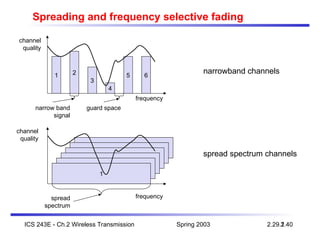
SHF and higher for directed radio links, satellite
communication
small antennas with directed transmission
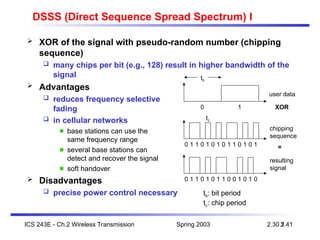
large bandwidths available
Wireless LANs use frequencies in UHF to SHF spectrum
some systems planned up to EHF
limitations due to absorption by water and oxygen molecules
weather dependent fading, signal loss caused by heavy rainfall, etc.
4.
ICS 243E -Ch.2 Wireless Transmission 2.4
Signals I
physical representation of data
function of time and location
signal parameters: parameters representing the value of
data
classification
continuous time/discrete time
continuous values/discrete values
analog signal = continuous time and continuous values
digital signal = discrete time and discrete values
signal parameters of periodic signals:
period T, frequency f=1/T, amplitude A, phase shift
sine wave as special periodic signal for a carrier:
s(t) = At sin(2 ft t + t)
5.
ICS 243E -Ch.2 Wireless Transmission 2.5
Fourier Representation of Periodic Signals
1
0
1
0
t t
ideal periodic signal real composition
(based on harmonics)
6.
ICS 243E -Ch.2 Wireless Transmission 2.6
Different representations of signals
amplitude (amplitude domain)
frequency spectrum (frequency domain)
phase state diagram (amplitude M and phase in polar
coordinates)
Composite signals mapped into frequency domain using
Fourier transformation
Digital signals need
infinite frequencies for perfect representation
modulation with a carrier frequency for transmission (->analog
signal!)
Signals II
f [Hz]
A [V]
I= M cos
Q = M sin
A [V]
t[s]
7.
ICS 243E -Ch.2 Wireless Transmission 2.7
Antennas are used to radiate and receive EM waves (energy)
Antennas link this energy between the ether and a device
such as a transmission line (e.g., coaxial cable)
Antennas consist of one or several radiating elements
through which an electric current circulates
Types of antennas:
omnidirectional
directional
phased arrays
adaptive
optimal
Principal characteristics used to characterize an antenna are:
radiation pattern
directivity
gain
efficiency
Antennas
8.
ICS 243E -Ch.2 Wireless Transmission 2.8
Isotropic Antennas
Isotropic radiator: equal radiation in all directions (three
dimensional) - only a theoretical reference antenna
Real antennas always have directive effects (vertical and/or
horizontal)
Radiation pattern: measurement of radiation around an
antenna
z
y
x
ideal
isotropic
radiator
9.
ICS 243E -Ch.2 Wireless Transmission 2.9
Omnidirectional Antennas: simple dipoles
Real antennas are not isotropic radiators but, e.g., dipoles
with lengths /4, or Hertzian dipole: /2 (2 dipoles)
shape/size of antenna proportional to wavelength
Example: Radiation pattern of a simple Hertzian dipole
Gain: ratio of the maximum power in the direction of the
main lobe to the power of an isotropic radiator (with the
same average power)
side view (xy-plane)
x
y
side view (yz-plane)
z
y
top view (xz-plane)
x
z
simple
dipole
/4 /2
10.
ICS 243E -Ch.2 Wireless Transmission 2.10
Directional Antennas
side view (xy-plane)
x
y
side view (yz-plane)
z
y
top view (xz-plane)
x
z
top view, 3 sector
x
z
top view, 6 sector
x
z
Often used for microwave connections (directed point to
point transmission) or base stations for mobile phones
(e.g., radio coverage of a valley or sectors for frequency
reuse)
directed
antenna
sectorized
antenna
11.
ICS 243E -Ch.2 Wireless Transmission 2.11
Array Antennas
Grouping of 2 or more antennas to obtain radiating
characteristics that cannot be obtained from a single
element
Antenna diversity
switched diversity, selection diversity
receiver chooses antenna with largest output
diversity combining
combine output power to produce gain
cophasing needed to avoid cancellation
ground plane
+
/4
/2
/4
/2 /2
/2
+
12.
ICS 243E -Ch.2 Wireless Transmission 2.12
Signal Propagation Ranges
distance
sender
transmission
detection
interference
Transmission range
communication possible
low error rate
Detection range
detection of the signal
possible
no communication
possible, high error rate
Interference range
signal may not be
detected
signal adds to the
background noise
13.
ICS 243E -Ch.2 Wireless Transmission 2.13
Signal Propagation I
Radio wave propagation is affected by the following
mechanisms:
reflection at large obstacles
scattering at small obstacles
diffraction at edges
reflection
scattering diffraction
14.
ICS 243E -Ch.2 Wireless Transmission 2.14
Signal Propagation II
The signal is also subject to degradation resulting from
propagation in the mobile radio environment. The principal
phenomena are:
pathloss due to distance covered by radio signal (frequency
dependent, less at low frequencies)
fading (frequency dependent, related to multipath
propagation)
shadowing induced by obstacles in the path between the
transmitted and the receiver
shadowing
15.
ICS 243E -Ch.2 Wireless Transmission 2.15
Signal Propagation III
Interference from other sources and noise will also impact signal
behavior:
co-channel (mobile users in adjacent cells using same frequency) and
adjacent (mobile users using frequencies adjacent to
transmission/reception frequency) channel interference
ambient noise from the radio transmitter components or other
electronic devices,
Propagation characteristics differ with the environment through
and over which radio waves travel. Several types of environments
can be identified (dense urban, urban, suburban and rural) and are
classified according to the following parameters:
terrain morphology
vegetation density
buildings: density and height
open areas
water surfaces
16.
Spring 2003
ICS 243E- Ch.2 Wireless Transmission 2.16
Pathloss I
Free-space pathloss:
To define free-space propagation, consider an isotropic source
consisting of a transmitter with a power Pt W. At a distance ‘d’ from
this source, the power transmitted is spread uniformly on the
surface of a sphere of radius ‘d’. The power density at the distance
‘d’ is then as follows:
Sr = Pt/4d2
The power received by an antenna at a distance ‘d’ from the
transmitter is then equal to:
Pr = PtAe/4d2
where A
e
is the effective area of the antenna.
17.
Spring 2003
ICS 243E- Ch.2 Wireless Transmission 2.17
Pathloss II
Noting that Ae = Gr/(4
where Gr is the gain of the receiver
And if we replace the isotropic source by a transmitting antenna
with a gain Gt the power received at a distance ‘d’ of the
transmitter by a receiving antenna of gain Gr becomes:
Pr = PtGrGt/[4d2
In decibels the propagation pathloss (PL) is given by:
PL(db) = -10log10(Pr/Pt) = -10log10(GrGt/[4d2
)
This is for the ideal case and can only be applied sensibly to
satellite systems and short range LOS propagation.
18.
Spring 2003
ICS 243E- Ch.2 Wireless Transmission 2.18
Signal can take many different paths between sender and
receiver due to reflection, scattering, diffraction
Positive effects of multipath:
enables communication even when transmitter and receiver
are not in LOS conditions - allows radio waves effectively to
go through obstacles by getting around them thereby
increasing the radio coverage area
Multipath Propagation I
signal at sender
signal at receiver
19.
Spring 2003
ICS 243E- Ch.2 Wireless Transmission 2.19
Multipath Propagation II
Negative effects of multipath:
Time dispersion or delay spread: signal is dispersed over time due
signals coming over different paths of different lengths
Causes interference with “neighboring” symbols, this is
referred to as Inter Symbol Interference (ISI)
multipath spread (in secs) = (longest1 – shortest2)/c
For a 5s symbol duration a 1s delay spread means about a 20%
intersymbol overlap.
The signal reaches a receiver directly and phase shifted (due to
reflections)
Distorted signal depending on the phases of the different
parts, this is referred to as Rayleigh fading, due to the distribution of the
fades. It creates fast fluctuations of the received signal (fast fading).
Random frequency modulation due to Doppler shifts on the different
paths. Doppler shift is caused by the relative velocity of the receiver to
the transmitter, leads to a frequency variation of the received signal.
20.
Spring 2003
ICS 243E- Ch.2 Wireless Transmission 2.20
Effects of Mobility
Channel characteristics change over time and location
signal paths change
different delay variations of different signal parts
different phases of signal parts
quick changes in the power received (short term fading)
Additional changes in
distance to sender
obstacles further away
slow changes in the average power
received (long term fading)
short term fading
long term
fading
t
power
21.
Spring 2003
ICS 243E- Ch.2 Wireless Transmission 2.21
Multiplexing Techniques
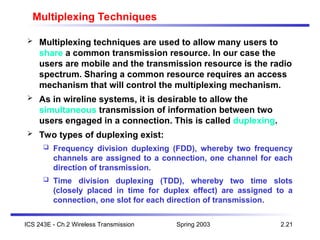
Multiplexing techniques are used to allow many users to
share a common transmission resource. In our case the
users are mobile and the transmission resource is the radio
spectrum. Sharing a common resource requires an access
mechanism that will control the multiplexing mechanism.
As in wireline systems, it is desirable to allow the
simultaneous transmission of information between two
users engaged in a connection. This is called duplexing.
Two types of duplexing exist:
Frequency division duplexing (FDD), whereby two frequency
channels are assigned to a connection, one channel for each
direction of transmission.
Time division duplexing (TDD), whereby two time slots
(closely placed in time for duplex effect) are assigned to a
connection, one slot for each direction of transmission.
22.
Spring 2003
ICS 243E- Ch.2 Wireless Transmission 2.22
Multiplexing in 3 dimensions
time (t) (TDM)
frequency (f) (FDM)
code (c) (CDM)
Goal: multiple use
of a shared medium
s2
s3
s1
Multiplexing
f
t
c
k2 k3 k4 k5 k6
k1
f
t
c
f
t
c
channels ki
23.
Spring 2003
ICS 243E- Ch.2 Wireless Transmission 2.23
Narrowband versus Wideband
These multiple access schemes can be grouped into two
categories:
Narrowband systems - the total spectrum is divided into a
large number of narrow radio bands that are shared.
Wideband systems - the total spectrum is used by each mobile
unit for both directions of transmission. Only applicable for
TDM and CDM.
24.
Spring 2003
ICS 243E- Ch.2 Wireless Transmission 2.24
Frequency Division Multiplexing (FDM)
Separation of the whole spectrum into smaller frequency bands
A channel gets a certain band of the spectrum for the whole time –
orthogonal system
Advantages:
no dynamic coordination
necessary, i.e., sync. and
framing
works also for analog signals
low bit rates – cheaper,
delay spread
Disadvantages:
waste of bandwidth
if the traffic is
distributed unevenly
inflexible
guard bands
narrow filters
k2 k3 k4 k5 k6
k1
f
t
c
25.
Spring 2003
ICS 243E- Ch.2 Wireless Transmission 2.25
f
t
c
k2 k3 k4 k5 k6
k1
Time Division Multiplexing (TDM)
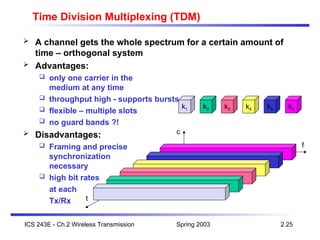
A channel gets the whole spectrum for a certain amount of
time – orthogonal system
Advantages:
only one carrier in the
medium at any time
throughput high - supports bursts
flexible – multiple slots
no guard bands ?!
Disadvantages:
Framing and precise
synchronization
necessary
high bit rates
at each
Tx/Rx
26.
Spring 2003
ICS 243E- Ch.2 Wireless Transmission 2.26
f
Hybrid TDM/FDM
Combination of both methods
A channel gets a certain frequency band for a certain
amount of time (slot).
Example: GSM, hops from one band to another each time
slot
Advantages:
better protection against
tapping (hopping among
frequencies)
protection against frequency
selective interference
Disadvantages:
Framing and
sync. required
t
c
k2 k3 k4 k5 k6
k1
27.
Spring 2003
ICS 243E- Ch.2 Wireless Transmission 2.27
Code Division Multiplexing (CDM)
Each channel has a unique code
(not necessarily orthogonal)
All channels use the same spectrum
at the same time
Advantages:
bandwidth efficient
no coordination and synchronization
necessary
good protection against interference
and tapping
Disadvantages:
lower user data rates due to high
gains required to reduce
interference
more complex signal regeneration
2.19.1
k2 k3 k4 k5 k6
k1
f
t
c
28.
Spring 2003
ICS 243E- Ch.2 Wireless Transmission 2.28
Issues with CDM
CDM has a soft capacity. The more users the more codes that are
used. However as more codes are used the signal to interference
(S/I) ratio will drop and the bit error rate (BER) will go up for all
users.
CDM requires tight power control as it suffers from far-near effect.
In other words, a user close to the base station transmitting with
the same power as a user farther away will drown the latter’s
signal. All signals must have more or less equal power at the
receiver.
Rake receivers can be used to improve signal reception. Time
delayed versions (a chip or more delayed) of the signal (multipath
signals) can be collected and used to make bit level decisions.
Soft handoffs can be used. Mobiles can switch base stations
without switching carriers. Two base stations receive the mobile
signal and the mobile is receiving from two base stations (one of
the rake receivers is used to listen to other signals).
Burst transmission - reduces interference
29.
Spring 2003
ICS 243E- Ch.2 Wireless Transmission 2.29
Types of CDM I
Two types exist:
Direct Sequence CDM (DS-CDM)
spreads the narrowband user signal (Rbps) over the full spectrum by
multiplying it by a very wide bandwidth signal (W). This is done by
taking every bit in the user stream and replacing it with a pseudonoise
(PN) code (a long bit sequence called the chip rate). The codes are
orthogonal (or approx.. orthogonal).
This results in a processing gain G = W/R (chips/bit). The higher G the
better the system performance as the lower the interference. G2
indicates the number of possible codes. Not all of the codes are
orthogonal.
30.
Spring 2003
ICS 243E- Ch.2 Wireless Transmission 2.30
Types of CDM II
Frequency hopping CDM (FH-CDM)
FH-CDM is based on a narrowband FDM system in which an individual
user’s transmission is spread out over a number of channels over time
(the channel choice is varied in a pseudorandom fashion). If the carrier
is changed every symbol then it is referred to as a fast FH system, if it
is changed every few symbols it is a slow FH system.
31.
ICS 243E -Ch.2 Wireless Transmission 2.31
Orthogonality and Codes
An m-bit PN generator generates N=2m
- 1 different codes.
Out of these codes only ‘m’ codes are orthogonal -> zero
cross correlation.
For example a 3 bit shift register circuit shown below
generates N=7 codes.
32.
ICS 243E -Ch.2 Wireless Transmission 2.32
Orthogonal Codes
A pair of codes is said to be orthogonal if the cross correlation is
zero: Rxy(0) = 0 .
For two m-bit codes: x1,x2,x3,...,xm and y1,y2,y3,...,ym:
For example: x = 0011 and y = 0110. Replace 0 with -1, 1 stays as is.
Then:
x = -1 -1 1 1
y = -1 1 1 -1
-----------------
Rxy(0) = 1 -1 +1 -1 = 0
33.
ICS 243E -Ch.2 Wireless Transmission 2.33
Example of an Orthogonal Code: Walsh Codes
In 1923 J.L. Walsh introduced a complete set of orthogonal
codes. To generate a Walsh code the following two steps
must be followed:
Step 1: represent a NxN matrix as four quadrants (start off with
2x2)
Step 2: make the first, second and third quadrants indentical
and invert the fourth
34.
ICS 243E -Ch.2 Wireless Transmission 2.34
Modulation
Digital modulation
digital data is translated into an analog signal (baseband)
ASK, FSK, PSK - main focus in this chapter
differences in spectral efficiency, power efficiency, robustness
Analog modulation
shifts center frequency of baseband signal up to the radio
carrier
Motivation
smaller antennas (e.g., /4)
Frequency Division Multiplexing
medium characteristics
Basic schemes
Amplitude Modulation (AM)
Frequency Modulation (FM)
Phase Modulation (PM)
35.
ICS 243E -Ch.2 Wireless Transmission 2.35
Modulation and Demodulation
synchronization
decision
digital
data
analog
demodulation
radio
carrier
analog
baseband
signal
101101001 radio receiver
digital
modulation
digital
data analog
modulation
radio
carrier
analog
baseband
signal
101101001 radio transmitter
36.
ICS 243E -Ch.2 Wireless Transmission 2.36
Digital Modulation
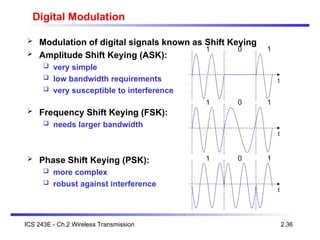
Modulation of digital signals known as Shift Keying
Amplitude Shift Keying (ASK):
very simple
low bandwidth requirements
very susceptible to interference
Frequency Shift Keying (FSK):
needs larger bandwidth
Phase Shift Keying (PSK):
more complex
robust against interference
1 0 1
t
1 0 1
t
1 0 1
t
37.
Spread spectrum technology
Spreadspectrum is a technique used in wireless
communication to transmit signals over a wider
bandwidth than the minimum required. This approach
offers several advantages in terms of security,
reliability, and resistance to interference.
38.
ICS 243E -Ch.2 Wireless Transmission 2.38
Spread spectrum technology: CDM
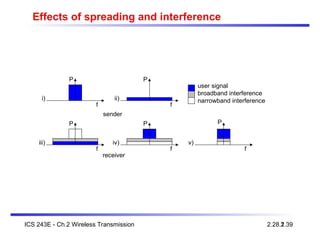
Problem of radio transmission: frequency dependent fading
can wipe out narrow band signals for duration of the
interference
Solution: spread the narrow band signal into a broad band
signal using a special code
protection against narrow band interference
protection against narrowband interference
Side effects:
coexistence of several signals without dynamic coordination
tap-proof
Alternatives: Direct Sequence, Frequency Hopping
detection at
receiver
interference spread
signal
signal
spread
interference
f f
power power
39.
ICS 243E -Ch.2 Wireless Transmission 2.39
Effects of spreading and interference
P
f
i)
P
f
ii)
sender
P
f
iii)
P
f
iv)
receiver
f
v)
user signal
broadband interference
narrowband interference
2.28.1
P
40.
Spring 2003
ICS 243E- Ch.2 Wireless Transmission 2.40
Spreading and frequency selective fading
frequency
channel
quality
1 2
3
4
5 6
narrow band
signal
guard space
2
2
2
2
2
frequency
channel
quality
1
spread
spectrum
2.29.1
narrowband channels
spread spectrum channels
41.
Spring 2003
ICS 243E- Ch.2 Wireless Transmission 2.41
2.30.1
DSSS (Direct Sequence Spread Spectrum) I
XOR of the signal with pseudo-random number (chipping
sequence)
many chips per bit (e.g., 128) result in higher bandwidth of the
signal
Advantages
reduces frequency selective
fading
in cellular networks
base stations can use the
same frequency range
several base stations can
detect and recover the signal
soft handover
Disadvantages
precise power control necessary
user data
chipping
sequence
resulting
signal
0 1
0 1 1 0 1 0 1 0
1 0 0 1 1
1
XOR
0 1 1 0 0 1 0 1
1 0 1 0 0
1
=
tb
tc
tb: bit period
tc: chip period
42.
Spring 2003
ICS 243E- Ch.2 Wireless Transmission 2.42
DSSS (Direct Sequence Spread Spectrum) II
X
user data
chipping
sequence
modulator
radio
carrier
spread
spectrum
signal
transmit
signal
transmitter
demodulator
received
signal
radio
carrier
X
chipping
sequence
lowpass
filtered
signal
receiver
integrator
products
decision
data
sampled
sums
correlator
2.31.1
43.
Spring 2003
ICS 243E- Ch.2 Wireless Transmission 2.43
2.32.1
FHSS (Frequency Hopping Spread Spectrum) I
The total available bandwidth is split into many
channels of smaller bandwidth plus guard spaces
between the channels.
Transmitter and receiver stay on one of these
channels for a certain time and then hop to another
channel.
This system implements FDM and TDM.
The pattern of channel usage is called the hopping
sequence, the time spend on a channel with a certain
frequency is called the dwell time.
44.
Spring 2003
ICS 243E- Ch.2 Wireless Transmission 2.44
2.32.1
FHSS (Frequency Hopping Spread Spectrum) I
Two versions
Fast Hopping:
several frequencies per user bit
Slow Hopping:
several user bits per frequency
Advantages
frequency selective fading and interference limited to short
period
simple implementation
uses only small portion of spectrum at any time
Disadvantages
not as robust as DSSS
simpler to detect
45.
Spring 2003
ICS 243E- Ch.2 Wireless Transmission 2.45
FHSS (Frequency Hopping Spread Spectrum) II
user data
slow
hopping
(3 bits/hop)
fast
hopping
(3 hops/bit)
0 1
tb
0 1 1 t
f
f1
f2
f3
t
td
f
f1
f2
f3
t
td
tb: bit period td: dwell time
2.33.1
46.
Spring 2003
ICS 243E- Ch.2 Wireless Transmission 2.46
FHSS (Frequency Hopping Spread Spectrum) III
modulator
user data
hopping
sequenc
e
modulator
narrowband
signal
spread
transmit
signal
transmitter
received
signal
receiver
demodulator
data
frequency
synthesizer
hopping
sequenc
e
demodulator
frequency
synthesizer
narrowband
signal
2.34.1
47.
Spring 2003
ICS 243E- Ch.2 Wireless Transmission 2.47
Concept of Cellular Communications
In the late 60’s it was proposed to alleviate the problem of
spectrum congestion by restructuring the coverage area of mobile
radio systems.
The cellular concept does not use broadcasting over large areas.
Instead smaller areas called cells are handled by less powerful
base stations that use less power for transmission. Now the
available spectrum can be re-used from one cell to another
thereby increasing the capacity of the system.
However this did give rise to a new problem, as a mobile unit
moved it could potentially leave the coverage area (cell) of a base
station in which it established the call. This required complex
controls that enabled the handing over of a connection (called
handoff) to the new cell that the mobile unit moved into.
48.
In summary, theessential elements of a cellular system are:
Low power transmitter and small coverage areas called cells
Spectrum (frequency) re-use
Handoff
49.
Dynamic ChannelAssignment (DCA)
Channels are assigned on demand based on traffic and
interference.
Efficient spectrum use
Requires complex algorithms
Hybrid Channel Assignment (HCA)
Combines fixed and dynamic approaches.
Balanced performance
More complex than FCA
Borrowing Channel Assignment (BCA)
Cells borrow channels from neighbors during high demand.
Reduces call blocking
May increase interference
ICS 243E - Ch.2 Wireless Transmission 2.49
50.
ICS 243E -Ch.2 Wireless Transmission 2.50
Cell structure
Implements space division multiplex: base station covers a
certain transmission area (cell)
Mobile stations communicate only via the base station
Advantages of cell structures:
higher capacity, higher number of users
less transmission power needed
more robust, decentralized
base station deals with interference, transmission area etc.
locally
Problems:
fixed network needed for the base stations
handover (changing from one cell to another) necessary
interference with other cells
Cell sizes from some 100 m in cities to, e.g., 35 km on the
country side (GSM) - even less for higher frequencies
2.35.1
51.
Cellular systemsrely on frequency management and channel assignment to
ensure efficient and interference-free communication. These two functions are
central to wireless network design, particularly in mobile cellular networks like
GSM, LTE, and 5G. Here's an overview of the concepts:
1. Frequency Management in Cellular Systems
Frequency management involves planning and controlling the allocation of the
limited radio spectrum to different cells and users to maximize efficiency and
minimize interference.
Key Concepts:
Frequency Spectrum: Limited and regulated resource allocated by national or
international regulatory bodies (e.g., FCC in the U.S., ITU globally).
Reuse: The same frequency band can be reused in non-adjacent cells to
increase capacity.
Frequency Reuse Factor (N): Number of unique frequency sets used in a
system before frequencies are reused. Smaller N means higher capacity but
more interference.
Spring 2003
ICS 243E - Ch.2 Wireless Transmission 2.51
52.
Types of Interference:
Co-channel Interference (CCI): Occurs when the same frequency is reused
too closely.
Adjacent Channel Interference (ACI): Arises from neighboring frequencies
bleeding into each other.
Goals of Frequency Management:
Maximize coverage
Maximize capacity
Minimize interference
Ensure Quality of Service (QoS)
ICS 243E - Ch.2 Wireless Transmission 2.52
53.
2. Channel AssignmentStrategies
Channel assignment deals with the method of assigning frequency
channels to base stations and users within cells.
Types of Channel Assignment:
a. Fixed Channel Assignment (FCA)
Each cell is assigned a predetermined set of frequencies.
Simple and easy to implement.
Inefficient in uneven traffic conditions.
b. Dynamic Channel Assignment (DCA)
Frequencies are assigned to cells dynamically as needed.
More complex but efficient in handling variable traffic.
Reduces co-channel interference by considering current usage.
c. Hybrid Channel Assignment
Combines FCA and DCA.
A portion of channels is fixed; the rest are dynamically assigned.
Offers a balance between complexity and performance.
2.53


![ICS 243E - Ch.2 Wireless Transmission 2.6
Different representations of signals
amplitude (amplitude domain)
frequency spectrum (frequency domain)
phase state diagram (amplitude M and phase in polar
coordinates)
Composite signals mapped into frequency domain using
Fourier transformation
Digital signals need
infinite frequencies for perfect representation
modulation with a carrier frequency for transmission (->analog
signal!)
Signals II
f [Hz]
A [V]
I= M cos
Q = M sin
A [V]
t[s]](https://image.slidesharecdn.com/unit-i-250916040655-e5951790/85/Mobile-Computing-wireless-networks-Unit-I-ppt-6-320.jpg)