Murach’s C# 2010, C22 © 2010, Mike Murach & Associates, Inc. Slide 1
Chapter 22
How to work with
XML files
Murach’s C# 2010, C22 © 2010, Mike Murach & Associates, Inc. Slide 2
Objectives
Applied
1. Use the XmlWriter class to write an XML document.
2. Use the XmlReader class to read an XML document.
3. Use Visual Studio’s XML Editor to create and edit an XML
document in a project.
Knowledge
1. Identify the following in an XML document: XML declarations,
start tags, end tags, root elements, parent elements, child
elements, attributes, element content, and comments.
Murach’s C# 2010, C22 © 2010, Mike Murach & Associates, Inc. Slide 3
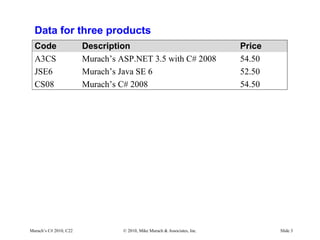
Data for three products
Code Description Price
A3CS Murach’s ASP.NET 3.5 with C# 2008 54.50
JSE6 Murach’s Java SE 6 52.50
CS08 Murach’s C# 2008 54.50
Murach’s C# 2010, C22 © 2010, Mike Murach & Associates, Inc. Slide 4
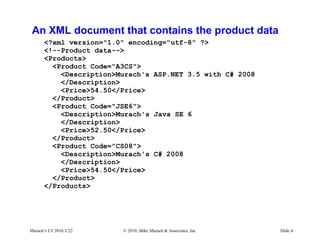
An XML document that contains the product data
<?xml version="1.0" encoding="utf-8" ?>
<!--Product data-->
<Products>
<Product Code="A3CS">
<Description>Murach's ASP.NET 3.5 with C# 2008
</Description>
<Price>54.50</Price>
</Product>
<Product Code="JSE6">
<Description>Murach's Java SE 6
</Description>
<Price>52.50</Price>
</Product>
<Product Code="CS08">
<Description>Murach's C# 2008
</Description>
<Price>54.50</Price>
</Product>
</Products>
Murach’s C# 2010, C22 © 2010, Mike Murach & Associates, Inc. Slide 5
An XML document
<?xml version="1.0" encoding="utf-8" ?>
<!--Product data-->
<Products>
<Product Code="CS08">
<Description>Murach's C# 2008</Description>
<Price>54.50</Price>
</Product>
</Products>
Product element
Description element
Price element
Murach’s C# 2010, C22 © 2010, Mike Murach & Associates, Inc. Slide 6
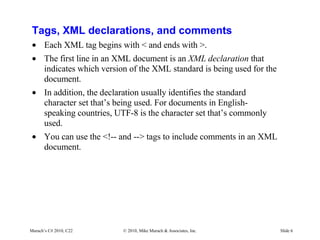
Tags, XML declarations, and comments
• Each XML tag begins with < and ends with >.
• The first line in an XML document is an XML declaration that
indicates which version of the XML standard is being used for the
document.
• In addition, the declaration usually identifies the standard
character set that’s being used. For documents in English-
speaking countries, UTF-8 is the character set that’s commonly
used.
• You can use the <!-- and --> tags to include comments in an XML
document.
Murach’s C# 2010, C22 © 2010, Mike Murach & Associates, Inc. Slide 7
Elements
• An element is a unit of XML data that begins with a start tag and
ends with an end tag.
• The start tag provides the name of the element and contains
any attributes assigned to the element.
• The end tag repeats the name, prefixed with a slash (/).
• The text between an element’s start and end tags is called the
element’s content.
• You can use any name you want for an XML element.
• Elements can contain other elements. An element that’s contained
within another is known as a child element. The element that
contains a child element is known as the child’s parent element.
• Child elements can repeat within a parent element.
• The highest-level parent element in an XML document is known
as the root element.
Murach’s C# 2010, C22 © 2010, Mike Murach & Associates, Inc. Slide 8
An XML document with a Code attribute
<?xml version="1.0" encoding="utf-8" ?>
<!--Product data-->
<Products>
<Product Code="CS08">
<Description>Murach's C# 2008</Description>
<Price>54.50</Price>
</Product>
</Products>
Attributes
• You can include one or more attributes in the start tag for an
element.
• An attribute consists of an attribute name, an equal sign, and a
string value in quotes.
• If an element has more than one attribute, the order in which the
attributes appear doesn’t matter, but the attributes must be
separated by one or more spaces.
Murach’s C# 2010, C22 © 2010, Mike Murach & Associates, Inc. Slide 9
When to use attributes instead of child elements
• When you design an XML document, you can use either a child
element or an attribute to represent a data item for an element. The
choice of one over the other is often a matter of preference.
• Two advantages of attributes are that they can appear in any order
and they are more concise because they do not require end tags.
• Two advantages of child elements are that they are easier for
people to read and they are more convenient for long string
values.
Murach’s C# 2010, C22 © 2010, Mike Murach & Associates, Inc. Slide 10
An XML document in the XML Editor
Murach’s C# 2010, C22 © 2010, Mike Murach & Associates, Inc. Slide 11
How to add a new XML file to a project
• Choose the ProjectAdd New Item command. In the Add New
Item dialog box, select the XML File template; type a name for
the XML file in the Name text box; and click Open.
• This adds an XML file to your project, adds the XML declaration
for the document, and opens the document in the XML Editor.
How to open an existing XML file
• To open an existing XML file that’s stored in the project, double-
click on the file.
• To open an existing XML file without adding the file to your
project, use the FileOpen command.
Murach’s C# 2010, C22 © 2010, Mike Murach & Associates, Inc. Slide 12
How to edit an XML file
• When you type a start tag, the XML Editor automatically adds an
end tag for the element and positions the insertion point between
the start and end tags so you can type the element’s content.
• When you type an attribute, the XML Editor automatically adds a
pair of quotation marks and positions the insertion point between
them so you can type the attribute value.
Murach’s C# 2010, C22 © 2010, Mike Murach & Associates, Inc. Slide 13
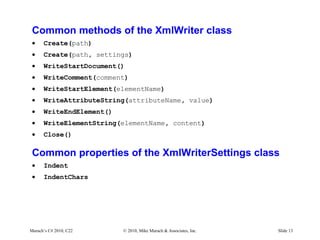
Common methods of the XmlWriter class
• Create(path)
• Create(path, settings)
• WriteStartDocument()
• WriteComment(comment)
• WriteStartElement(elementName)
• WriteAttributeString(attributeName, value)
• WriteEndElement()
• WriteElementString(elementName, content)
• Close()
Common properties of the XmlWriterSettings class
• Indent
• IndentChars
Murach’s C# 2010, C22 © 2010, Mike Murach & Associates, Inc. Slide 14
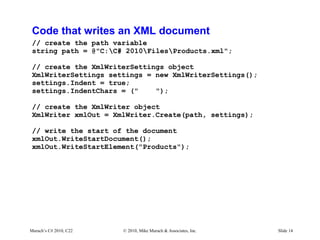
Code that writes an XML document
// create the path variable
string path = @"C:C# 2010FilesProducts.xml";
// create the XmlWriterSettings object
XmlWriterSettings settings = new XmlWriterSettings();
settings.Indent = true;
settings.IndentChars = (" ");
// create the XmlWriter object
XmlWriter xmlOut = XmlWriter.Create(path, settings);
// write the start of the document
xmlOut.WriteStartDocument();
xmlOut.WriteStartElement("Products");
Murach’s C# 2010, C22 © 2010, Mike Murach & Associates, Inc. Slide 15
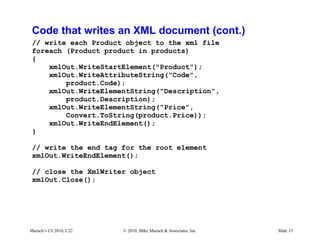
Code that writes an XML document (cont.)
// write each Product object to the xml file
foreach (Product product in products)
{
xmlOut.WriteStartElement("Product");
xmlOut.WriteAttributeString("Code",
product.Code);
xmlOut.WriteElementString("Description",
product.Description);
xmlOut.WriteElementString("Price",
Convert.ToString(product.Price));
xmlOut.WriteEndElement();
}
// write the end tag for the root element
xmlOut.WriteEndElement();
// close the XmlWriter object
xmlOut.Close();
Murach’s C# 2010, C22 © 2010, Mike Murach & Associates, Inc. Slide 16
Common indexer of the XmlReader class
• [name]
Common properties of the XmlReader class
• NodeType
• Name
• Value
• EOF
Murach’s C# 2010, C22 © 2010, Mike Murach & Associates, Inc. Slide 17
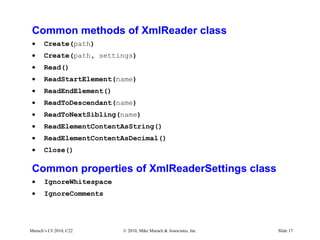
Common methods of XmlReader class
• Create(path)
• Create(path, settings)
• Read()
• ReadStartElement(name)
• ReadEndElement()
• ReadToDescendant(name)
• ReadToNextSibling(name)
• ReadElementContentAsString()
• ReadElementContentAsDecimal()
• Close()
Common properties of XmlReaderSettings class
• IgnoreWhitespace
• IgnoreComments
Murach’s C# 2010, C22 © 2010, Mike Murach & Associates, Inc. Slide 18
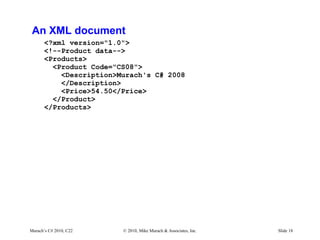
An XML document
<?xml version="1.0">
<!--Product data-->
<Products>
<Product Code="CS08">
<Description>Murach's C# 2008
</Description>
<Price>54.50</Price>
</Product>
</Products>
Murach’s C# 2010, C22 © 2010, Mike Murach & Associates, Inc. Slide 19
The XML nodes in the products document
NodeType Name Other properties
XmlDeclaration xml
Comment Value = “Product data”
Element Products
Element Product [“Code”] = “CS08”
Element Description
Text Value = “Murach’s C# 2008”
EndElement Description
Element Price
Text Value = “54.50”
EndElement Price
EndElement Product
EndElement Products
Murach’s C# 2010, C22 © 2010, Mike Murach & Associates, Inc. Slide 20
Code that reads an XML document
// create the list
List<Product> products = new List<Product>();
// create the path variable
string path = @"C:C# 2010FilesProducts.xml";
// create the XmlReaderSettings object
XmlReaderSettings settings = new XmlReaderSettings();
settings.IgnoreWhitespace = true;
settings.IgnoreComments = true;
// create the XmlReader object
XmlReader xmlIn = XmlReader.Create(path, settings);
Murach’s C# 2010, C22 © 2010, Mike Murach & Associates, Inc. Slide 21
Code that reads an XML document (cont.)
// read past all nodes to the first Product node
if {xmlIn.ReadToDescendant("Product"));
{
// create one Product object for each Product node
do
{
Product product = new Product();
product.Code = xmlIn["Code"];
xmlIn.ReadStartElement("Product");
product.Description =
xmlIn.ReadElementContentAsString();
product.Price =
xmlIn.ReadElementContentAsDecimal();
products.Add(product);
}
while(xmlIn.ReadToNextSibling("Product"));
}
// close the XmlReader object
xmlIn.Close();
Murach’s C# 2010, C22 © 2010, Mike Murach & Associates, Inc. Slide 22
A class that works with an XML document
using System;
using System.Xml;
using System.Collections.Generic;
namespace ProductMaintenance
{
public class ProductDB
{
private const string path =
@"C:C# 2010FilesProducts.xml";
public static List<Product> GetProducts()
{
// create the list
List<Product> products = new List<Product>();
// create the XmlReaderSettings object
XmlReaderSettings settings =
new XmlReaderSettings();
settings.IgnoreWhitespace = true;
settings.IgnoreComments = true;
Murach’s C# 2010, C22 © 2010, Mike Murach & Associates, Inc. Slide 23
A class that works with an XML document (cont.)
// create the XmlReader object
XmlReader xmlIn = XmlReader.Create(
path, settings);
// read past all nodes to first Product node
if {xmlIn.ReadToDescendant("Product"));
{
// create object for each Product node
do
{ Product product = new Product();
product.Code = xmlIn["Code"];
xmlIn.ReadStartElement("Product");
product.Description =
xmlIn.ReadElementContentAsString();
product.Price =
xmlIn.ReadElementContentAsDecimal();
products.Add(product);
}
while(xmlIn.ReadToNextSibling("Product"));
}
Murach’s C# 2010, C22 © 2010, Mike Murach & Associates, Inc. Slide 24
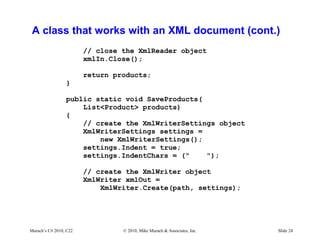
A class that works with an XML document (cont.)
// close the XmlReader object
xmlIn.Close();
return products;
}
public static void SaveProducts(
List<Product> products)
{
// create the XmlWriterSettings object
XmlWriterSettings settings =
new XmlWriterSettings();
settings.Indent = true;
settings.IndentChars = (" ");
// create the XmlWriter object
XmlWriter xmlOut =
XmlWriter.Create(path, settings);
Murach’s C# 2010, C22 © 2010, Mike Murach & Associates, Inc. Slide 25
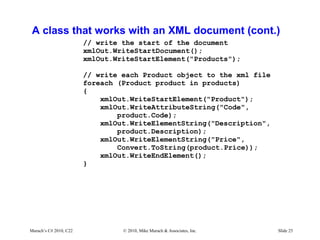
A class that works with an XML document (cont.)
// write the start of the document
xmlOut.WriteStartDocument();
xmlOut.WriteStartElement("Products");
// write each Product object to the xml file
foreach (Product product in products)
{
xmlOut.WriteStartElement("Product");
xmlOut.WriteAttributeString("Code",
product.Code);
xmlOut.WriteElementString("Description",
product.Description);
xmlOut.WriteElementString("Price",
Convert.ToString(product.Price));
xmlOut.WriteEndElement();
}
Murach’s C# 2010, C22 © 2010, Mike Murach & Associates, Inc. Slide 26
A class that works with an XML document (cont.)
// write the end tag for the root element
xmlOut.WriteEndElement();
// close the XmlWriter object
xmlOut.Close();
}
}
}

C# Tutorial MSM_Murach chapter-22-slides

  • 1.
    Murach’s C# 2010,C22 © 2010, Mike Murach & Associates, Inc. Slide 1 Chapter 22 How to work with XML files
  • 2.
    Murach’s C# 2010,C22 © 2010, Mike Murach & Associates, Inc. Slide 2 Objectives Applied 1. Use the XmlWriter class to write an XML document. 2. Use the XmlReader class to read an XML document. 3. Use Visual Studio’s XML Editor to create and edit an XML document in a project. Knowledge 1. Identify the following in an XML document: XML declarations, start tags, end tags, root elements, parent elements, child elements, attributes, element content, and comments.
  • 3.
    Murach’s C# 2010,C22 © 2010, Mike Murach & Associates, Inc. Slide 3 Data for three products Code Description Price A3CS Murach’s ASP.NET 3.5 with C# 2008 54.50 JSE6 Murach’s Java SE 6 52.50 CS08 Murach’s C# 2008 54.50
  • 4.
    Murach’s C# 2010,C22 © 2010, Mike Murach & Associates, Inc. Slide 4 An XML document that contains the product data <?xml version="1.0" encoding="utf-8" ?> <!--Product data--> <Products> <Product Code="A3CS"> <Description>Murach's ASP.NET 3.5 with C# 2008 </Description> <Price>54.50</Price> </Product> <Product Code="JSE6"> <Description>Murach's Java SE 6 </Description> <Price>52.50</Price> </Product> <Product Code="CS08"> <Description>Murach's C# 2008 </Description> <Price>54.50</Price> </Product> </Products>
  • 5.
    Murach’s C# 2010,C22 © 2010, Mike Murach & Associates, Inc. Slide 5 An XML document <?xml version="1.0" encoding="utf-8" ?> <!--Product data--> <Products> <Product Code="CS08"> <Description>Murach's C# 2008</Description> <Price>54.50</Price> </Product> </Products> Product element Description element Price element
  • 6.
    Murach’s C# 2010,C22 © 2010, Mike Murach & Associates, Inc. Slide 6 Tags, XML declarations, and comments • Each XML tag begins with < and ends with >. • The first line in an XML document is an XML declaration that indicates which version of the XML standard is being used for the document. • In addition, the declaration usually identifies the standard character set that’s being used. For documents in English- speaking countries, UTF-8 is the character set that’s commonly used. • You can use the <!-- and --> tags to include comments in an XML document.
  • 7.
    Murach’s C# 2010,C22 © 2010, Mike Murach & Associates, Inc. Slide 7 Elements • An element is a unit of XML data that begins with a start tag and ends with an end tag. • The start tag provides the name of the element and contains any attributes assigned to the element. • The end tag repeats the name, prefixed with a slash (/). • The text between an element’s start and end tags is called the element’s content. • You can use any name you want for an XML element. • Elements can contain other elements. An element that’s contained within another is known as a child element. The element that contains a child element is known as the child’s parent element. • Child elements can repeat within a parent element. • The highest-level parent element in an XML document is known as the root element.
  • 8.
    Murach’s C# 2010,C22 © 2010, Mike Murach & Associates, Inc. Slide 8 An XML document with a Code attribute <?xml version="1.0" encoding="utf-8" ?> <!--Product data--> <Products> <Product Code="CS08"> <Description>Murach's C# 2008</Description> <Price>54.50</Price> </Product> </Products> Attributes • You can include one or more attributes in the start tag for an element. • An attribute consists of an attribute name, an equal sign, and a string value in quotes. • If an element has more than one attribute, the order in which the attributes appear doesn’t matter, but the attributes must be separated by one or more spaces.
  • 9.
    Murach’s C# 2010,C22 © 2010, Mike Murach & Associates, Inc. Slide 9 When to use attributes instead of child elements • When you design an XML document, you can use either a child element or an attribute to represent a data item for an element. The choice of one over the other is often a matter of preference. • Two advantages of attributes are that they can appear in any order and they are more concise because they do not require end tags. • Two advantages of child elements are that they are easier for people to read and they are more convenient for long string values.
  • 10.
    Murach’s C# 2010,C22 © 2010, Mike Murach & Associates, Inc. Slide 10 An XML document in the XML Editor
  • 11.
    Murach’s C# 2010,C22 © 2010, Mike Murach & Associates, Inc. Slide 11 How to add a new XML file to a project • Choose the ProjectAdd New Item command. In the Add New Item dialog box, select the XML File template; type a name for the XML file in the Name text box; and click Open. • This adds an XML file to your project, adds the XML declaration for the document, and opens the document in the XML Editor. How to open an existing XML file • To open an existing XML file that’s stored in the project, double- click on the file. • To open an existing XML file without adding the file to your project, use the FileOpen command.
  • 12.
    Murach’s C# 2010,C22 © 2010, Mike Murach & Associates, Inc. Slide 12 How to edit an XML file • When you type a start tag, the XML Editor automatically adds an end tag for the element and positions the insertion point between the start and end tags so you can type the element’s content. • When you type an attribute, the XML Editor automatically adds a pair of quotation marks and positions the insertion point between them so you can type the attribute value.
  • 13.
    Murach’s C# 2010,C22 © 2010, Mike Murach & Associates, Inc. Slide 13 Common methods of the XmlWriter class • Create(path) • Create(path, settings) • WriteStartDocument() • WriteComment(comment) • WriteStartElement(elementName) • WriteAttributeString(attributeName, value) • WriteEndElement() • WriteElementString(elementName, content) • Close() Common properties of the XmlWriterSettings class • Indent • IndentChars
  • 14.
    Murach’s C# 2010,C22 © 2010, Mike Murach & Associates, Inc. Slide 14 Code that writes an XML document // create the path variable string path = @"C:C# 2010FilesProducts.xml"; // create the XmlWriterSettings object XmlWriterSettings settings = new XmlWriterSettings(); settings.Indent = true; settings.IndentChars = (" "); // create the XmlWriter object XmlWriter xmlOut = XmlWriter.Create(path, settings); // write the start of the document xmlOut.WriteStartDocument(); xmlOut.WriteStartElement("Products");
  • 15.
    Murach’s C# 2010,C22 © 2010, Mike Murach & Associates, Inc. Slide 15 Code that writes an XML document (cont.) // write each Product object to the xml file foreach (Product product in products) { xmlOut.WriteStartElement("Product"); xmlOut.WriteAttributeString("Code", product.Code); xmlOut.WriteElementString("Description", product.Description); xmlOut.WriteElementString("Price", Convert.ToString(product.Price)); xmlOut.WriteEndElement(); } // write the end tag for the root element xmlOut.WriteEndElement(); // close the XmlWriter object xmlOut.Close();
  • 16.
    Murach’s C# 2010,C22 © 2010, Mike Murach & Associates, Inc. Slide 16 Common indexer of the XmlReader class • [name] Common properties of the XmlReader class • NodeType • Name • Value • EOF
  • 17.
    Murach’s C# 2010,C22 © 2010, Mike Murach & Associates, Inc. Slide 17 Common methods of XmlReader class • Create(path) • Create(path, settings) • Read() • ReadStartElement(name) • ReadEndElement() • ReadToDescendant(name) • ReadToNextSibling(name) • ReadElementContentAsString() • ReadElementContentAsDecimal() • Close() Common properties of XmlReaderSettings class • IgnoreWhitespace • IgnoreComments
  • 18.
    Murach’s C# 2010,C22 © 2010, Mike Murach & Associates, Inc. Slide 18 An XML document <?xml version="1.0"> <!--Product data--> <Products> <Product Code="CS08"> <Description>Murach's C# 2008 </Description> <Price>54.50</Price> </Product> </Products>
  • 19.
    Murach’s C# 2010,C22 © 2010, Mike Murach & Associates, Inc. Slide 19 The XML nodes in the products document NodeType Name Other properties XmlDeclaration xml Comment Value = “Product data” Element Products Element Product [“Code”] = “CS08” Element Description Text Value = “Murach’s C# 2008” EndElement Description Element Price Text Value = “54.50” EndElement Price EndElement Product EndElement Products
  • 20.
    Murach’s C# 2010,C22 © 2010, Mike Murach & Associates, Inc. Slide 20 Code that reads an XML document // create the list List<Product> products = new List<Product>(); // create the path variable string path = @"C:C# 2010FilesProducts.xml"; // create the XmlReaderSettings object XmlReaderSettings settings = new XmlReaderSettings(); settings.IgnoreWhitespace = true; settings.IgnoreComments = true; // create the XmlReader object XmlReader xmlIn = XmlReader.Create(path, settings);
  • 21.
    Murach’s C# 2010,C22 © 2010, Mike Murach & Associates, Inc. Slide 21 Code that reads an XML document (cont.) // read past all nodes to the first Product node if {xmlIn.ReadToDescendant("Product")); { // create one Product object for each Product node do { Product product = new Product(); product.Code = xmlIn["Code"]; xmlIn.ReadStartElement("Product"); product.Description = xmlIn.ReadElementContentAsString(); product.Price = xmlIn.ReadElementContentAsDecimal(); products.Add(product); } while(xmlIn.ReadToNextSibling("Product")); } // close the XmlReader object xmlIn.Close();
  • 22.
    Murach’s C# 2010,C22 © 2010, Mike Murach & Associates, Inc. Slide 22 A class that works with an XML document using System; using System.Xml; using System.Collections.Generic; namespace ProductMaintenance { public class ProductDB { private const string path = @"C:C# 2010FilesProducts.xml"; public static List<Product> GetProducts() { // create the list List<Product> products = new List<Product>(); // create the XmlReaderSettings object XmlReaderSettings settings = new XmlReaderSettings(); settings.IgnoreWhitespace = true; settings.IgnoreComments = true;
  • 23.
    Murach’s C# 2010,C22 © 2010, Mike Murach & Associates, Inc. Slide 23 A class that works with an XML document (cont.) // create the XmlReader object XmlReader xmlIn = XmlReader.Create( path, settings); // read past all nodes to first Product node if {xmlIn.ReadToDescendant("Product")); { // create object for each Product node do { Product product = new Product(); product.Code = xmlIn["Code"]; xmlIn.ReadStartElement("Product"); product.Description = xmlIn.ReadElementContentAsString(); product.Price = xmlIn.ReadElementContentAsDecimal(); products.Add(product); } while(xmlIn.ReadToNextSibling("Product")); }
  • 24.
    Murach’s C# 2010,C22 © 2010, Mike Murach & Associates, Inc. Slide 24 A class that works with an XML document (cont.) // close the XmlReader object xmlIn.Close(); return products; } public static void SaveProducts( List<Product> products) { // create the XmlWriterSettings object XmlWriterSettings settings = new XmlWriterSettings(); settings.Indent = true; settings.IndentChars = (" "); // create the XmlWriter object XmlWriter xmlOut = XmlWriter.Create(path, settings);
  • 25.
    Murach’s C# 2010,C22 © 2010, Mike Murach & Associates, Inc. Slide 25 A class that works with an XML document (cont.) // write the start of the document xmlOut.WriteStartDocument(); xmlOut.WriteStartElement("Products"); // write each Product object to the xml file foreach (Product product in products) { xmlOut.WriteStartElement("Product"); xmlOut.WriteAttributeString("Code", product.Code); xmlOut.WriteElementString("Description", product.Description); xmlOut.WriteElementString("Price", Convert.ToString(product.Price)); xmlOut.WriteEndElement(); }
  • 26.
    Murach’s C# 2010,C22 © 2010, Mike Murach & Associates, Inc. Slide 26 A class that works with an XML document (cont.) // write the end tag for the root element xmlOut.WriteEndElement(); // close the XmlWriter object xmlOut.Close(); } } }