SQLite usage
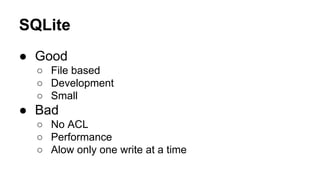
SQLite
● Good
○ File based
○ Development
○ Small
● Bad
○ No ACL
○ Performance
○ Alow only one write at a time
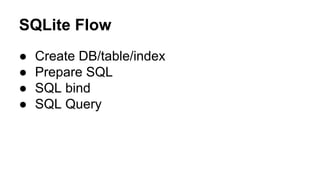
SQLite Flow
● Create DB/table/index
● Prepare SQL
● SQL bind
● SQL Query
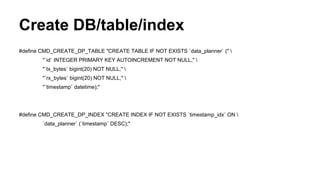
Create DB/table/index
#define CMD_CREATE_DP_TABLE "CREATE TABLE IF NOT EXISTS `data_planner` (" 
"`id` INTEGER PRIMARY KEY AUTOINCREMENT NOT NULL," 
"`tx_bytes` bigint(20) NOT NULL," 
"`rx_bytes` bigint(20) NOT NULL," 
"`timestamp` datetime);"
#define CMD_CREATE_DP_INDEX "CREATE INDEX IF NOT EXISTS `timestamp_idx` ON 
`data_planner` (`timestamp` DESC);"
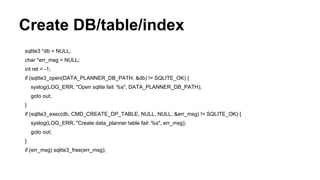
Create DB/table/index
sqlite3 *db = NULL;
char *err_msg = NULL;
int ret = -1;
if (sqlite3_open(DATA_PLANNER_DB_PATH, &db) != SQLITE_OK) {
syslog(LOG_ERR, "Open sqlite fail: %s", DATA_PLANNER_DB_PATH);
goto out;
}
if (sqlite3_exec(db, CMD_CREATE_DP_TABLE, NULL, NULL, &err_msg) != SQLITE_OK) {
syslog(LOG_ERR, "Create data_planner table fail: %s", err_msg);
goto out;
}
if (err_msg) sqlite3_free(err_msg);
Create DB/table/index
if (sqlite3_exec(db, CMD_CREATE_DP_INDEX, NULL, NULL, &err_msg) != SQLITE_OK) {
syslog(LOG_ERR, "Create data_planner index fail: %s", err_msg);
goto out;
}
ret = 0;
out:
if (err_msg) sqlite3_free(err_msg);
if (db) sqlite3_close(db);
return ret;
Create DB/table/index
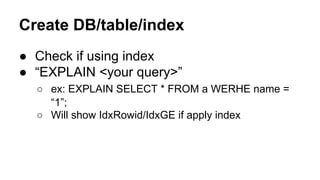
● Check if using index
● “EXPLAIN <your query>”
○ ex: EXPLAIN SELECT * FROM a WERHE name =
“1”;
○ Will show IdxRowid/IdxGE if apply index
Create DB/table/index
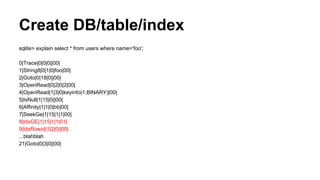
sqlite> explain select * from users where name='foo';
0|Trace|0|0|0||00|
1|String8|0|1|0|foo|00|
2|Goto|0|18|0||00|
3|OpenRead|0|2|0|2|00|
4|OpenRead|1|3|0|keyinfo(1,BINARY)|00|
5|IsNull|1|15|0||00|
6|Affinity|1|1|0|bb|00|
7|SeekGe|1|15|1|1|00|
8|IdxGE|1|15|1|1|01|
9|IdxRowid|1|2|0||00|
...blahblah
21|Goto|0|3|0||00|
Create DB/table/index
● When to create?
○ System startup
○ Program startup
○ In every query
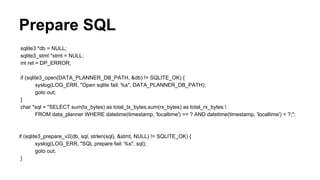
Prepare SQL
sqlite3 *db = NULL;
sqlite3_stmt *stmt = NULL;
int ret = DP_ERROR;
if (sqlite3_open(DATA_PLANNER_DB_PATH, &db) != SQLITE_OK) {
syslog(LOG_ERR, "Open sqlite fail: %s", DATA_PLANNER_DB_PATH);
goto out;
}
char *sql = "SELECT sum(tx_bytes) as total_tx_bytes,sum(rx_bytes) as total_rx_bytes 
FROM data_planner WHERE datetime(timestamp, 'localtime') >= ? AND datetime(timestamp, 'localtime') < ?;";
if (sqlite3_prepare_v2(db, sql, strlen(sql), &stmt, NULL) != SQLITE_OK) {
syslog(LOG_ERR, "SQL prepare fail: %s", sql);
goto out;
}
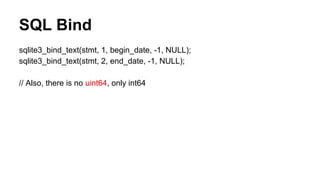
SQL Bind
sqlite3_bind_text(stmt, 1, begin_date, -1, NULL);
sqlite3_bind_text(stmt, 2, end_date, -1, NULL);
// Also, there is no uint64, only int64
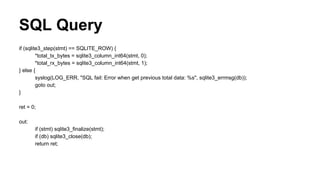
SQL Query
if (sqlite3_step(stmt) == SQLITE_ROW) {
*total_tx_bytes = sqlite3_column_int64(stmt, 0);
*total_rx_bytes = sqlite3_column_int64(stmt, 1);
} else {
syslog(LOG_ERR, "SQL fail: Error when get previous total data: %s", sqlite3_errmsg(db));
goto out;
}
ret = 0;
out:
if (stmt) sqlite3_finalize(stmt);
if (db) sqlite3_close(db);
return ret;
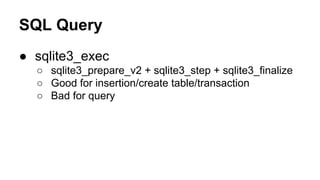
SQL Query
● sqlite3_exec
○ sqlite3_prepare_v2 + sqlite3_step + sqlite3_finalize
○ Good for insertion/create table/transaction
○ Bad for query
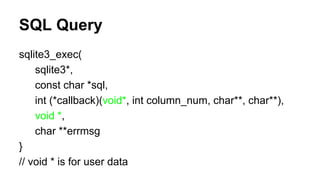
SQL Query
sqlite3_exec(
sqlite3*,
const char *sql,
int (*callback)(void*, int column_num, char**, char**),
void *,
char **errmsg
}
// void * is for user data
Timezone issue
● Use UTC
● In C
○ Use gmtime_r instead of localtime_r
● In SQLite3
○ Insert using datetime(?, 'unixepoch')
■ ? is time_t
○ Query using datetime(timestamp, 'localtime')
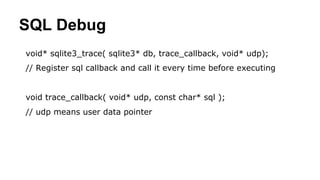
SQL Debug
void* sqlite3_trace( sqlite3* db, trace_callback, void* udp);
// Register sql callback and call it every time before executing
void trace_callback( void* udp, const char* sql );
// udp means user data pointer
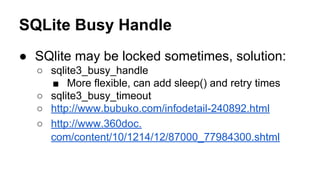
SQLite Busy Handle
● SQlite may be locked sometimes, solution:
○ sqlite3_busy_handle
■ More flexible, can add sleep() and retry times
○ sqlite3_busy_timeout
○ http://www.bubuko.com/infodetail-240892.html
○ http://www.360doc.
com/content/10/1214/12/87000_77984300.shtml
Relational Database
● MariaDB/MySQL/Percona
○ Multiple engines
■ MyISAM
● Table lock
■ InnoDB
● Row lock
● Transaction
● PostgreSQL
● SQLite
Relational Database
● Replication
○ For read
○ Master/Slave
● Sharding
○ For read/write
○ Do not rely on auto sharding
Reference
● http://stackoverflow.com/questions/1454188/how-can-i-analyse-a-sqlite-query-execution
● https://www.sqlite.org/docs.html
● http://www.cnblogs.com/likebeta/archive/2012/06/17/2552757.html

C SQLite usage

  • 1.
  • 2.
    SQLite ● Good ○ Filebased ○ Development ○ Small ● Bad ○ No ACL ○ Performance ○ Alow only one write at a time
  • 3.
    SQLite Flow ● CreateDB/table/index ● Prepare SQL ● SQL bind ● SQL Query
  • 4.
    Create DB/table/index #define CMD_CREATE_DP_TABLE"CREATE TABLE IF NOT EXISTS `data_planner` (" "`id` INTEGER PRIMARY KEY AUTOINCREMENT NOT NULL," "`tx_bytes` bigint(20) NOT NULL," "`rx_bytes` bigint(20) NOT NULL," "`timestamp` datetime);" #define CMD_CREATE_DP_INDEX "CREATE INDEX IF NOT EXISTS `timestamp_idx` ON `data_planner` (`timestamp` DESC);"
  • 5.
    Create DB/table/index sqlite3 *db= NULL; char *err_msg = NULL; int ret = -1; if (sqlite3_open(DATA_PLANNER_DB_PATH, &db) != SQLITE_OK) { syslog(LOG_ERR, "Open sqlite fail: %s", DATA_PLANNER_DB_PATH); goto out; } if (sqlite3_exec(db, CMD_CREATE_DP_TABLE, NULL, NULL, &err_msg) != SQLITE_OK) { syslog(LOG_ERR, "Create data_planner table fail: %s", err_msg); goto out; } if (err_msg) sqlite3_free(err_msg);
  • 6.
    Create DB/table/index if (sqlite3_exec(db,CMD_CREATE_DP_INDEX, NULL, NULL, &err_msg) != SQLITE_OK) { syslog(LOG_ERR, "Create data_planner index fail: %s", err_msg); goto out; } ret = 0; out: if (err_msg) sqlite3_free(err_msg); if (db) sqlite3_close(db); return ret;
  • 7.
    Create DB/table/index ● Checkif using index ● “EXPLAIN <your query>” ○ ex: EXPLAIN SELECT * FROM a WERHE name = “1”; ○ Will show IdxRowid/IdxGE if apply index
  • 8.
    Create DB/table/index sqlite> explainselect * from users where name='foo'; 0|Trace|0|0|0||00| 1|String8|0|1|0|foo|00| 2|Goto|0|18|0||00| 3|OpenRead|0|2|0|2|00| 4|OpenRead|1|3|0|keyinfo(1,BINARY)|00| 5|IsNull|1|15|0||00| 6|Affinity|1|1|0|bb|00| 7|SeekGe|1|15|1|1|00| 8|IdxGE|1|15|1|1|01| 9|IdxRowid|1|2|0||00| ...blahblah 21|Goto|0|3|0||00|
  • 9.
    Create DB/table/index ● Whento create? ○ System startup ○ Program startup ○ In every query
  • 10.
    Prepare SQL sqlite3 *db= NULL; sqlite3_stmt *stmt = NULL; int ret = DP_ERROR; if (sqlite3_open(DATA_PLANNER_DB_PATH, &db) != SQLITE_OK) { syslog(LOG_ERR, "Open sqlite fail: %s", DATA_PLANNER_DB_PATH); goto out; } char *sql = "SELECT sum(tx_bytes) as total_tx_bytes,sum(rx_bytes) as total_rx_bytes FROM data_planner WHERE datetime(timestamp, 'localtime') >= ? AND datetime(timestamp, 'localtime') < ?;"; if (sqlite3_prepare_v2(db, sql, strlen(sql), &stmt, NULL) != SQLITE_OK) { syslog(LOG_ERR, "SQL prepare fail: %s", sql); goto out; }
  • 11.
    SQL Bind sqlite3_bind_text(stmt, 1,begin_date, -1, NULL); sqlite3_bind_text(stmt, 2, end_date, -1, NULL); // Also, there is no uint64, only int64
  • 12.
    SQL Query if (sqlite3_step(stmt)== SQLITE_ROW) { *total_tx_bytes = sqlite3_column_int64(stmt, 0); *total_rx_bytes = sqlite3_column_int64(stmt, 1); } else { syslog(LOG_ERR, "SQL fail: Error when get previous total data: %s", sqlite3_errmsg(db)); goto out; } ret = 0; out: if (stmt) sqlite3_finalize(stmt); if (db) sqlite3_close(db); return ret;
  • 13.
    SQL Query ● sqlite3_exec ○sqlite3_prepare_v2 + sqlite3_step + sqlite3_finalize ○ Good for insertion/create table/transaction ○ Bad for query
  • 14.
    SQL Query sqlite3_exec( sqlite3*, const char*sql, int (*callback)(void*, int column_num, char**, char**), void *, char **errmsg } // void * is for user data
  • 15.
    Timezone issue ● UseUTC ● In C ○ Use gmtime_r instead of localtime_r ● In SQLite3 ○ Insert using datetime(?, 'unixepoch') ■ ? is time_t ○ Query using datetime(timestamp, 'localtime')
  • 16.
    SQL Debug void* sqlite3_trace(sqlite3* db, trace_callback, void* udp); // Register sql callback and call it every time before executing void trace_callback( void* udp, const char* sql ); // udp means user data pointer
  • 17.
    SQLite Busy Handle ●SQlite may be locked sometimes, solution: ○ sqlite3_busy_handle ■ More flexible, can add sleep() and retry times ○ sqlite3_busy_timeout ○ http://www.bubuko.com/infodetail-240892.html ○ http://www.360doc. com/content/10/1214/12/87000_77984300.shtml
  • 18.
    Relational Database ● MariaDB/MySQL/Percona ○Multiple engines ■ MyISAM ● Table lock ■ InnoDB ● Row lock ● Transaction ● PostgreSQL ● SQLite
  • 19.
    Relational Database ● Replication ○For read ○ Master/Slave ● Sharding ○ For read/write ○ Do not rely on auto sharding
  • 20.