Documentary conventions:
What is a documentary?
-Documentary is usually described as non-fictional representation of reality, it has a clear narrative structure and makes
use of a variety of plans to transfer the meaning to an audience. A documentary usually concentrates on a single issue or
story and may present alternative view or a single vision.
What are the conventions of a documentary?
• Exposition  It occurs at the beginning as well as introducing the important subjects of the film. It’s important to
include exposition in documentaries because it creates the viewers first impression and introduces the viewer to the
content.
• Voice-over  Is commentary by the filmmaker, it is spoken while filming or added to the soundtrack during the
production. This is done so the filmmaker can speak directly to the viewer, this offers information, explanation and
opinions
• interviews Are common documentary technique. It helps people being filmed to speak about events, provoked
by the questions asked by the filmmaker. There are two type of interviews. 1. On screen, where we see the
filmmaker asking questions as well the person answering. 2. Off screen, where we see the person answering the
questions but not the filmmaker asking.
• Archival footage  Is a primary research, is a factual taken from a film library or stored and put into a documentary
to show historical events or add details without the need for extra filming.
• Visual coding  this associations with the idea of Mise-en-scene for example a news reader wearing smart clothe
like a suit and hitting behind a big table and having camera’s being pointed at will make it more realistic and reliable
to the viewer.
• Titles and text  It’s a speedy way of conveying information .
• Reconstruction  Its an artificial scenes of an event which has been recreated and acted out on a film based on
information of the event. Reconstruction provides factual information and gives the viewer sense of realism.
• Montage  is a sequence of ideas that is put in specific order in the film.
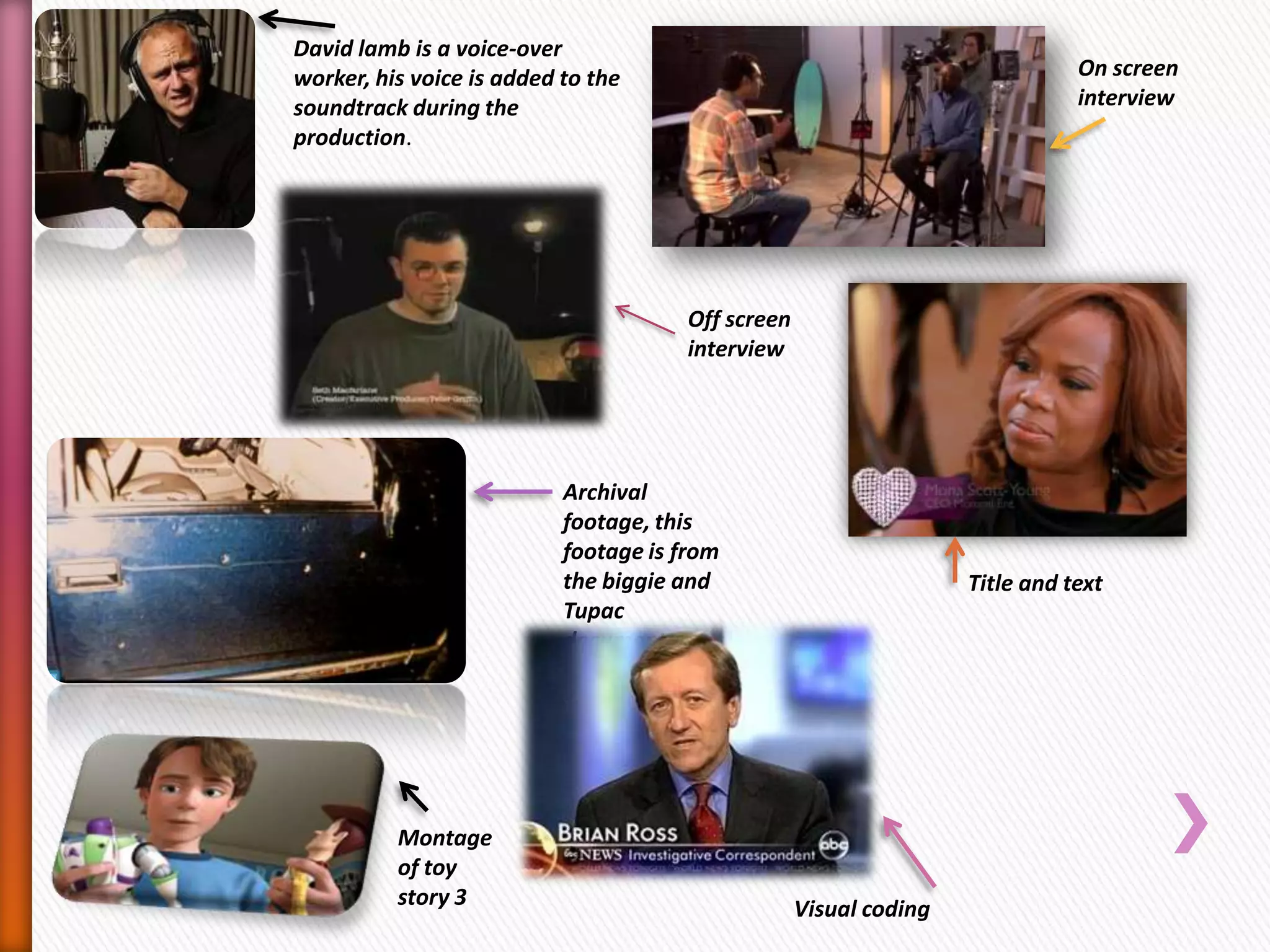
David lamb is a voice-over
worker, his voice is added to the
soundtrack during the
production.
On screen
interview
Off screen
interview
Archival
footage, this
footage is from
the biggie and
Tupac
documentary
Title and text
Visual coding
Montage
of toy
story 3
At the beginning of the documentary it starts off with archival footage at the beginning of
the crime scene. They used this to drag the audience attention and give them a sense of
what it was like and what really happened. This is a primary source which makes it very
reliable as they were taken at the time of the incident. Furthermore, while showing the
archives they voice over police sirens and police calls, this helps to make it look more
realistic. In the documentary, the exposition occurs at the beginning and introduces the
important themes of the film, this is key because it creates the audience’s first impression
and introduces the viewer to the content.
As the documentary continues we hear voice over of the presenter’s voice and
throughout it we see him interviewing people. These two techniques are useful, for
example the voice over is beneficial because instead of having to watch and listen to him
and then showing next scene, we can just to him and view other scenes at the same
time.
Interviewing people is good method, this is used so we can hear other sides of stories
and coming from a different point of view therefore making it non biased. When the
interviews are being done, there are titles and texts shown. This is done so the audience
known who the person is and what they do and how they’re related to the situation.

Documentary convision

  • 1.
    Documentary conventions: What isa documentary? -Documentary is usually described as non-fictional representation of reality, it has a clear narrative structure and makes use of a variety of plans to transfer the meaning to an audience. A documentary usually concentrates on a single issue or story and may present alternative view or a single vision. What are the conventions of a documentary? • Exposition  It occurs at the beginning as well as introducing the important subjects of the film. It’s important to include exposition in documentaries because it creates the viewers first impression and introduces the viewer to the content. • Voice-over  Is commentary by the filmmaker, it is spoken while filming or added to the soundtrack during the production. This is done so the filmmaker can speak directly to the viewer, this offers information, explanation and opinions • interviews Are common documentary technique. It helps people being filmed to speak about events, provoked by the questions asked by the filmmaker. There are two type of interviews. 1. On screen, where we see the filmmaker asking questions as well the person answering. 2. Off screen, where we see the person answering the questions but not the filmmaker asking. • Archival footage  Is a primary research, is a factual taken from a film library or stored and put into a documentary to show historical events or add details without the need for extra filming. • Visual coding  this associations with the idea of Mise-en-scene for example a news reader wearing smart clothe like a suit and hitting behind a big table and having camera’s being pointed at will make it more realistic and reliable to the viewer. • Titles and text  It’s a speedy way of conveying information . • Reconstruction  Its an artificial scenes of an event which has been recreated and acted out on a film based on information of the event. Reconstruction provides factual information and gives the viewer sense of realism. • Montage  is a sequence of ideas that is put in specific order in the film.
  • 2.
    David lamb isa voice-over worker, his voice is added to the soundtrack during the production. On screen interview Off screen interview Archival footage, this footage is from the biggie and Tupac documentary Title and text Visual coding Montage of toy story 3
  • 3.
    At the beginningof the documentary it starts off with archival footage at the beginning of the crime scene. They used this to drag the audience attention and give them a sense of what it was like and what really happened. This is a primary source which makes it very reliable as they were taken at the time of the incident. Furthermore, while showing the archives they voice over police sirens and police calls, this helps to make it look more realistic. In the documentary, the exposition occurs at the beginning and introduces the important themes of the film, this is key because it creates the audience’s first impression and introduces the viewer to the content. As the documentary continues we hear voice over of the presenter’s voice and throughout it we see him interviewing people. These two techniques are useful, for example the voice over is beneficial because instead of having to watch and listen to him and then showing next scene, we can just to him and view other scenes at the same time. Interviewing people is good method, this is used so we can hear other sides of stories and coming from a different point of view therefore making it non biased. When the interviews are being done, there are titles and texts shown. This is done so the audience known who the person is and what they do and how they’re related to the situation.