1
Exception Handling
2
Introduction
• Exceptions
– Indicate problems that occur during a program’s execution
– Occur infrequently
• Exception handling
– Can resolve exceptions
• Allow a program to continue executing or
• Notify the user of the problem and
• Terminate the program in a controlled manner
– Makes programs robust and fault-tolerant
3
Exception-Handling Overview
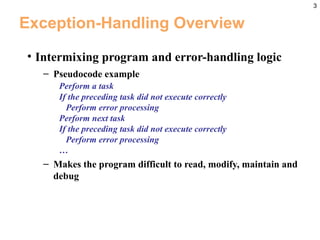
• Intermixing program and error-handling logic
– Pseudocode example
Perform a task
If the preceding task did not execute correctly
Perform error processing
Perform next task
If the preceding task did not execute correctly
Perform error processing
…
– Makes the program difficult to read, modify, maintain and
debug
4
Example: Handling an Attempt to Divide
by Zero
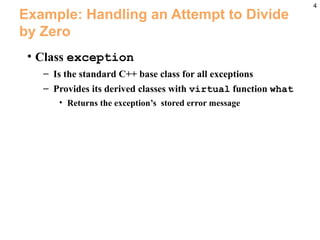
• Class exception
– Is the standard C++ base class for all exceptions
– Provides its derived classes with virtual function what
• Returns the exception’s stored error message
51
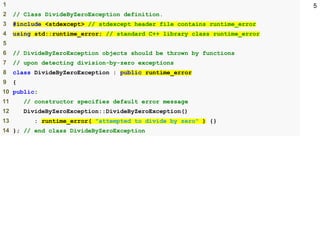
2 // Class DivideByZeroException definition.
3 #include <stdexcept> // stdexcept header file contains runtime_error
4 using std::runtime_error; // standard C++ library class runtime_error
5
6 // DivideByZeroException objects should be thrown by functions
7 // upon detecting division-by-zero exceptions
8 class DivideByZeroException : public runtime_error
9 {
10 public:
11 // constructor specifies default error message
12 DivideByZeroException::DivideByZeroException()
13 : runtime_error( "attempted to divide by zero" ) {}
14 }; // end class DivideByZeroException
61
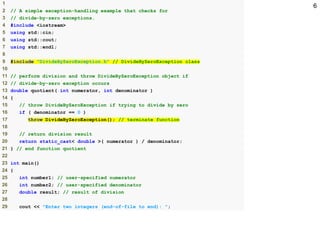
2 // A simple exception-handling example that checks for
3 // divide-by-zero exceptions.
4 #include <iostream>
5 using std::cin;
6 using std::cout;
7 using std::endl;
8
9 #include "DivideByZeroException.h" // DivideByZeroException class
10
11 // perform division and throw DivideByZeroException object if
12 // divide-by-zero exception occurs
13 double quotient( int numerator, int denominator )
14 {
15 // throw DivideByZeroException if trying to divide by zero
16 if ( denominator == 0 )
17 throw DivideByZeroException(); // terminate function
18
19 // return division result
20 return static_cast< double >( numerator ) / denominator;
21 } // end function quotient
22
23 int main()
24 {
25 int number1; // user-specified numerator
26 int number2; // user-specified denominator
27 double result; // result of division
28
29 cout << "Enter two integers (end-of-file to end): ";
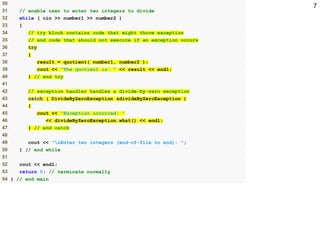
730
31 // enable user to enter two integers to divide
32 while ( cin >> number1 >> number2 )
33 {
34 // try block contains code that might throw exception
35 // and code that should not execute if an exception occurs
36 try
37 {
38 result = quotient( number1, number2 );
39 cout << "The quotient is: " << result << endl;
40 } // end try
41
42 // exception handler handles a divide-by-zero exception
43 catch ( DivideByZeroException &divideByZeroException )
44 {
45 cout << "Exception occurred: "
46 << divideByZeroException.what() << endl;
47 } // end catch
48
49 cout << "nEnter two integers (end-of-file to end): ";
50 } // end while
51
52 cout << endl;
53 return 0; // terminate normally
54 } // end main
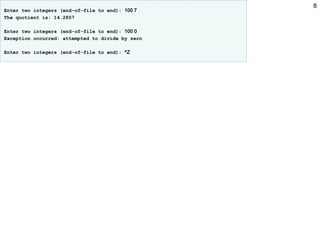
8
Enter two integers (end-of-file to end): 100 7
The quotient is: 14.2857
Enter two integers (end-of-file to end): 100 0
Exception occurred: attempted to divide by zero
Enter two integers (end-of-file to end): ^Z
9
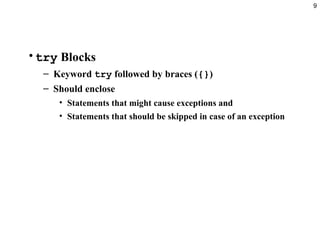
•try Blocks
– Keyword try followed by braces ({})
– Should enclose
• Statements that might cause exceptions and
• Statements that should be skipped in case of an exception
10
•catch handlers
– Immediately follow a try block
• One or more catch handlers for each try block
– Keyword catch
– Exception parameter enclosed in parentheses
• Represents the type of exception to process
• Can provide an optional parameter name to interact with the
caught exception object
– Executes if exception parameter type matches the
exception thrown in the try block
• Could be a base class of the thrown exception’s class
11
Each catch handler can have only a single
parameter—specifying a comma-separated
list of exception parameters is a syntax error.
It is a logic error to catch the same type in two
different catch handlers following a single try
block.
12
• Termination model of exception handling
– try block expires when an exception occurs
• Local variables in try block go out of scope
– The code within the matching catch handler executes
– Control resumes with the first statement after the last
catch handler following the try block
• Control does not return to throw point
• Stack unwinding
– Occurs if no matching catch handler is found
– Program attempts to locate another enclosing try block in
the calling function
13
• Throwing an exception
– Use keyword throw followed by an operand representing
the type of exception
• The throw operand can be of any type
– If the throw operand is an object, it is called an
exception object
– The throw operand initializes the exception parameter in
the matching catch handler, if one is found
14
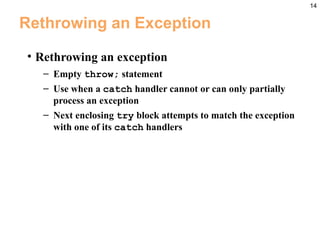
Rethrowing an Exception
• Rethrowing an exception
– Empty throw; statement
– Use when a catch handler cannot or can only partially
process an exception
– Next enclosing try block attempts to match the exception
with one of its catch handlers
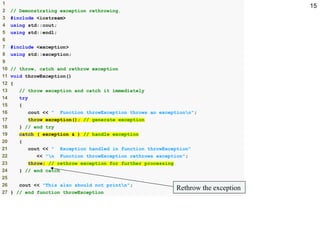
151
2 // Demonstrating exception rethrowing.
3 #include <iostream>
4 using std::cout;
5 using std::endl;
6
7 #include <exception>
8 using std::exception;
9
10 // throw, catch and rethrow exception
11 void throwException()
12 {
13 // throw exception and catch it immediately
14 try
15 {
16 cout << " Function throwException throws an exceptionn";
17 throw exception(); // generate exception
18 } // end try
19 catch ( exception & ) // handle exception
20 {
21 cout << " Exception handled in function throwException"
22 << "n Function throwException rethrows exception";
23 throw; // rethrow exception for further processing
24 } // end catch
25
26 cout << "This also should not printn";
27 } // end function throwException
Rethrow the exception
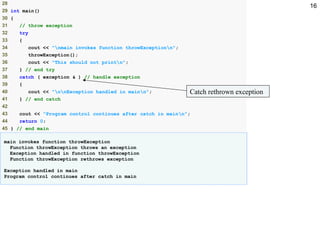
1628
29 int main()
30 {
31 // throw exception
32 try
33 {
34 cout << "nmain invokes function throwExceptionn";
35 throwException();
36 cout << "This should not printn";
37 } // end try
38 catch ( exception & ) // handle exception
39 {
40 cout << "nnException handled in mainn";
41 } // end catch
42
43 cout << "Program control continues after catch in mainn";
44 return 0;
45 } // end main
main invokes function throwException
Function throwException throws an exception
Exception handled in function throwException
Function throwException rethrows exception
Exception handled in main
Program control continues after catch in main
Catch rethrown exception
17
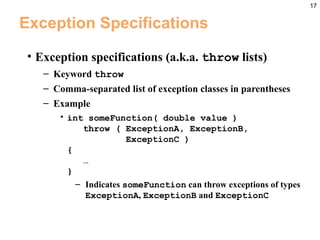
Exception Specifications
• Exception specifications (a.k.a. throw lists)
– Keyword throw
– Comma-separated list of exception classes in parentheses
– Example
• int someFunction( double value )
throw ( ExceptionA, ExceptionB,
ExceptionC )
{
…
}
– Indicates someFunction can throw exceptions of types
ExceptionA, ExceptionB and ExceptionC
18
• Exception specifications (Cont.)
– A function can throw only exceptions of types in its
specification or types derived from those types
• If a function throws a non-specification exception, function
unexpected is called
– This normally terminates the program
– No exception specification indicates the function can
throw any exception
– An empty exception specification, throw(), indicates the
function can not throw any exceptions
19
Processing Unexpected Exceptions
• Function unexpected
– Called when a function throws an exception not in its
exception specification
– Calls the function registered with function
set_unexpected
– Function terminate is called by default
• Function set_unexpected of <exception>
– Takes as argument a pointer to a function with no
arguments and a void return type
– Returns a pointer to the last function called by
unexpected
• Returns 0 the first time
20
• Function terminate
– Called when
• No matching catch is found for a thrown exception
• A destructor attempts to throw an exception during stack
unwinding
• Attempting to rethrow an exception when no exception is
being handled
• Calling function unexpected before registering a function
with function set_unexpected
– Calls the function registered with function
set_terminate
– Function abort is called by default
21
• Function set_terminate
– Takes as argument a pointer to a function with no
arguments and a void return type
– Returns a pointer to the last function called by
terminate
• Returns 0 the first time
• Function abort
– Terminates the program without calling destructors for
automatic or static storage class objects
• Could lead to resource leaks
22
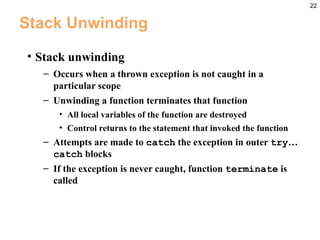
Stack Unwinding
• Stack unwinding
– Occurs when a thrown exception is not caught in a
particular scope
– Unwinding a function terminates that function
• All local variables of the function are destroyed
• Control returns to the statement that invoked the function
– Attempts are made to catch the exception in outer try…
catch blocks
– If the exception is never caught, function terminate is
called
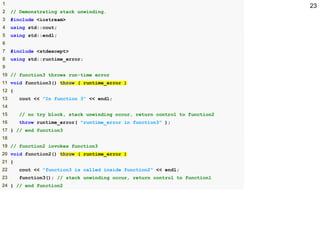
231
2 // Demonstrating stack unwinding.
3 #include <iostream>
4 using std::cout;
5 using std::endl;
6
7 #include <stdexcept>
8 using std::runtime_error;
9
10 // function3 throws run-time error
11 void function3() throw ( runtime_error )
12 {
13 cout << "In function 3" << endl;
14
15 // no try block, stack unwinding occur, return control to function2
16 throw runtime_error( "runtime_error in function3" );
17 } // end function3
18
19 // function2 invokes function3
20 void function2() throw ( runtime_error )
21 {
22 cout << "function3 is called inside function2" << endl;
23 function3(); // stack unwinding occur, return control to function1
24 } // end function2
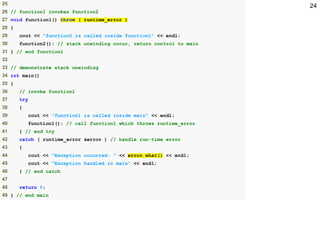
2425
26 // function1 invokes function2
27 void function1() throw ( runtime_error )
28 {
29 cout << "function2 is called inside function1" << endl;
30 function2(); // stack unwinding occur, return control to main
31 } // end function1
32
33 // demonstrate stack unwinding
34 int main()
35 {
36 // invoke function1
37 try
38 {
39 cout << "function1 is called inside main" << endl;
40 function1(); // call function1 which throws runtime_error
41 } // end try
42 catch ( runtime_error &error ) // handle run-time error
43 {
44 cout << "Exception occurred: " << error.what() << endl;
45 cout << "Exception handled in main" << endl;
46 } // end catch
47
48 return 0;
49 } // end main
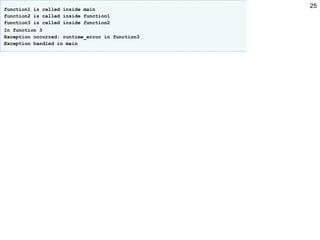
25function1 is called inside main
function2 is called inside function1
function3 is called inside function2
In function 3
Exception occurred: runtime_error in function3
Exception handled in main

Handling

  • 1.
  • 2.
    2 Introduction • Exceptions – Indicateproblems that occur during a program’s execution – Occur infrequently • Exception handling – Can resolve exceptions • Allow a program to continue executing or • Notify the user of the problem and • Terminate the program in a controlled manner – Makes programs robust and fault-tolerant
  • 3.
    3 Exception-Handling Overview • Intermixingprogram and error-handling logic – Pseudocode example Perform a task If the preceding task did not execute correctly Perform error processing Perform next task If the preceding task did not execute correctly Perform error processing … – Makes the program difficult to read, modify, maintain and debug
  • 4.
    4 Example: Handling anAttempt to Divide by Zero • Class exception – Is the standard C++ base class for all exceptions – Provides its derived classes with virtual function what • Returns the exception’s stored error message
  • 5.
    51 2 // ClassDivideByZeroException definition. 3 #include <stdexcept> // stdexcept header file contains runtime_error 4 using std::runtime_error; // standard C++ library class runtime_error 5 6 // DivideByZeroException objects should be thrown by functions 7 // upon detecting division-by-zero exceptions 8 class DivideByZeroException : public runtime_error 9 { 10 public: 11 // constructor specifies default error message 12 DivideByZeroException::DivideByZeroException() 13 : runtime_error( "attempted to divide by zero" ) {} 14 }; // end class DivideByZeroException
  • 6.
    61 2 // Asimple exception-handling example that checks for 3 // divide-by-zero exceptions. 4 #include <iostream> 5 using std::cin; 6 using std::cout; 7 using std::endl; 8 9 #include "DivideByZeroException.h" // DivideByZeroException class 10 11 // perform division and throw DivideByZeroException object if 12 // divide-by-zero exception occurs 13 double quotient( int numerator, int denominator ) 14 { 15 // throw DivideByZeroException if trying to divide by zero 16 if ( denominator == 0 ) 17 throw DivideByZeroException(); // terminate function 18 19 // return division result 20 return static_cast< double >( numerator ) / denominator; 21 } // end function quotient 22 23 int main() 24 { 25 int number1; // user-specified numerator 26 int number2; // user-specified denominator 27 double result; // result of division 28 29 cout << "Enter two integers (end-of-file to end): ";
  • 7.
    730 31 // enableuser to enter two integers to divide 32 while ( cin >> number1 >> number2 ) 33 { 34 // try block contains code that might throw exception 35 // and code that should not execute if an exception occurs 36 try 37 { 38 result = quotient( number1, number2 ); 39 cout << "The quotient is: " << result << endl; 40 } // end try 41 42 // exception handler handles a divide-by-zero exception 43 catch ( DivideByZeroException &divideByZeroException ) 44 { 45 cout << "Exception occurred: " 46 << divideByZeroException.what() << endl; 47 } // end catch 48 49 cout << "nEnter two integers (end-of-file to end): "; 50 } // end while 51 52 cout << endl; 53 return 0; // terminate normally 54 } // end main
  • 8.
    8 Enter two integers(end-of-file to end): 100 7 The quotient is: 14.2857 Enter two integers (end-of-file to end): 100 0 Exception occurred: attempted to divide by zero Enter two integers (end-of-file to end): ^Z
  • 9.
    9 •try Blocks – Keywordtry followed by braces ({}) – Should enclose • Statements that might cause exceptions and • Statements that should be skipped in case of an exception
  • 10.
    10 •catch handlers – Immediatelyfollow a try block • One or more catch handlers for each try block – Keyword catch – Exception parameter enclosed in parentheses • Represents the type of exception to process • Can provide an optional parameter name to interact with the caught exception object – Executes if exception parameter type matches the exception thrown in the try block • Could be a base class of the thrown exception’s class
  • 11.
    11 Each catch handlercan have only a single parameter—specifying a comma-separated list of exception parameters is a syntax error. It is a logic error to catch the same type in two different catch handlers following a single try block.
  • 12.
    12 • Termination modelof exception handling – try block expires when an exception occurs • Local variables in try block go out of scope – The code within the matching catch handler executes – Control resumes with the first statement after the last catch handler following the try block • Control does not return to throw point • Stack unwinding – Occurs if no matching catch handler is found – Program attempts to locate another enclosing try block in the calling function
  • 13.
    13 • Throwing anexception – Use keyword throw followed by an operand representing the type of exception • The throw operand can be of any type – If the throw operand is an object, it is called an exception object – The throw operand initializes the exception parameter in the matching catch handler, if one is found
  • 14.
    14 Rethrowing an Exception •Rethrowing an exception – Empty throw; statement – Use when a catch handler cannot or can only partially process an exception – Next enclosing try block attempts to match the exception with one of its catch handlers
  • 15.
    151 2 // Demonstratingexception rethrowing. 3 #include <iostream> 4 using std::cout; 5 using std::endl; 6 7 #include <exception> 8 using std::exception; 9 10 // throw, catch and rethrow exception 11 void throwException() 12 { 13 // throw exception and catch it immediately 14 try 15 { 16 cout << " Function throwException throws an exceptionn"; 17 throw exception(); // generate exception 18 } // end try 19 catch ( exception & ) // handle exception 20 { 21 cout << " Exception handled in function throwException" 22 << "n Function throwException rethrows exception"; 23 throw; // rethrow exception for further processing 24 } // end catch 25 26 cout << "This also should not printn"; 27 } // end function throwException Rethrow the exception
  • 16.
    1628 29 int main() 30{ 31 // throw exception 32 try 33 { 34 cout << "nmain invokes function throwExceptionn"; 35 throwException(); 36 cout << "This should not printn"; 37 } // end try 38 catch ( exception & ) // handle exception 39 { 40 cout << "nnException handled in mainn"; 41 } // end catch 42 43 cout << "Program control continues after catch in mainn"; 44 return 0; 45 } // end main main invokes function throwException Function throwException throws an exception Exception handled in function throwException Function throwException rethrows exception Exception handled in main Program control continues after catch in main Catch rethrown exception
  • 17.
    17 Exception Specifications • Exceptionspecifications (a.k.a. throw lists) – Keyword throw – Comma-separated list of exception classes in parentheses – Example • int someFunction( double value ) throw ( ExceptionA, ExceptionB, ExceptionC ) { … } – Indicates someFunction can throw exceptions of types ExceptionA, ExceptionB and ExceptionC
  • 18.
    18 • Exception specifications(Cont.) – A function can throw only exceptions of types in its specification or types derived from those types • If a function throws a non-specification exception, function unexpected is called – This normally terminates the program – No exception specification indicates the function can throw any exception – An empty exception specification, throw(), indicates the function can not throw any exceptions
  • 19.
    19 Processing Unexpected Exceptions •Function unexpected – Called when a function throws an exception not in its exception specification – Calls the function registered with function set_unexpected – Function terminate is called by default • Function set_unexpected of <exception> – Takes as argument a pointer to a function with no arguments and a void return type – Returns a pointer to the last function called by unexpected • Returns 0 the first time
  • 20.
    20 • Function terminate –Called when • No matching catch is found for a thrown exception • A destructor attempts to throw an exception during stack unwinding • Attempting to rethrow an exception when no exception is being handled • Calling function unexpected before registering a function with function set_unexpected – Calls the function registered with function set_terminate – Function abort is called by default
  • 21.
    21 • Function set_terminate –Takes as argument a pointer to a function with no arguments and a void return type – Returns a pointer to the last function called by terminate • Returns 0 the first time • Function abort – Terminates the program without calling destructors for automatic or static storage class objects • Could lead to resource leaks
  • 22.
    22 Stack Unwinding • Stackunwinding – Occurs when a thrown exception is not caught in a particular scope – Unwinding a function terminates that function • All local variables of the function are destroyed • Control returns to the statement that invoked the function – Attempts are made to catch the exception in outer try… catch blocks – If the exception is never caught, function terminate is called
  • 23.
    231 2 // Demonstratingstack unwinding. 3 #include <iostream> 4 using std::cout; 5 using std::endl; 6 7 #include <stdexcept> 8 using std::runtime_error; 9 10 // function3 throws run-time error 11 void function3() throw ( runtime_error ) 12 { 13 cout << "In function 3" << endl; 14 15 // no try block, stack unwinding occur, return control to function2 16 throw runtime_error( "runtime_error in function3" ); 17 } // end function3 18 19 // function2 invokes function3 20 void function2() throw ( runtime_error ) 21 { 22 cout << "function3 is called inside function2" << endl; 23 function3(); // stack unwinding occur, return control to function1 24 } // end function2
  • 24.
    2425 26 // function1invokes function2 27 void function1() throw ( runtime_error ) 28 { 29 cout << "function2 is called inside function1" << endl; 30 function2(); // stack unwinding occur, return control to main 31 } // end function1 32 33 // demonstrate stack unwinding 34 int main() 35 { 36 // invoke function1 37 try 38 { 39 cout << "function1 is called inside main" << endl; 40 function1(); // call function1 which throws runtime_error 41 } // end try 42 catch ( runtime_error &error ) // handle run-time error 43 { 44 cout << "Exception occurred: " << error.what() << endl; 45 cout << "Exception handled in main" << endl; 46 } // end catch 47 48 return 0; 49 } // end main
  • 25.
    25function1 is calledinside main function2 is called inside function1 function3 is called inside function2 In function 3 Exception occurred: runtime_error in function3 Exception handled in main