Business Support Agencies in
Nepal
Chapter- 9
Nepal Chamber of Commerce (NCC)
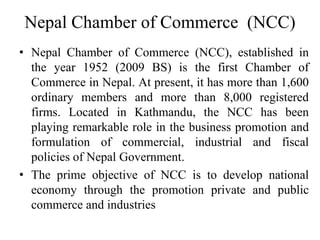
• Nepal Chamber of Commerce (NCC), established in
the year 1952 (2009 BS) is the first Chamber of
Commerce in Nepal. At present, it has more than 1,600
ordinary members and more than 8,000 registered
firms. Located in Kathmandu, the NCC has been
playing remarkable role in the business promotion and
formulation of commercial, industrial and fiscal
policies of Nepal Government.
• The prime objective of NCC is to develop national
economy through the promotion private and public
commerce and industries
Formation of NCC
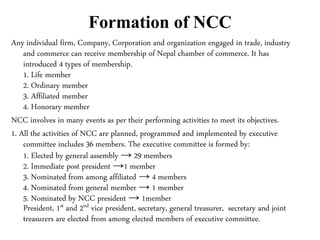
Any individual firm, Company, Corporation and organization engaged in trade, industry
and commerce can receive membership of Nepal chamber of commerce. It has
introduced 4 types of membership.
1. Life member
2. Ordinary member
3. Affiliated member
4. Honorary member
NCC involves in many events as per their performing activities to meet its objectives.
1. All the activities of NCC are planned, programmed and implemented by executive
committee includes 36 members. The executive committee is formed by:
1. Elected by general assembly → 29 members
2. Immediate post president →1 member
3. Nominated from among affiliated → 4 members
4. Nominated from general member → 1 member
5. Nominated by NCC president → 1member
President, 1st and 2nd vice president, secretary, general treasurer, secretary and joint
treasurers are elected from among elected members of executive committee.
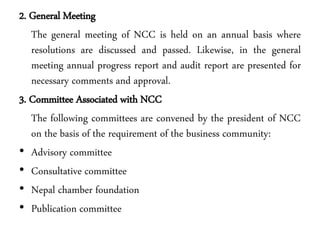
2. General Meeting
The general meeting of NCC is held on an annual basis where
resolutions are discussed and passed. Likewise, in the general
meeting annual progress report and audit report are presented for
necessary comments and approval.
3. Committee Associated with NCC
The following committees are convened by the president of NCC
on the basis of the requirement of the business community:
• Advisory committee
• Consultative committee
• Nepal chamber foundation
• Publication committee
Functions of NCC
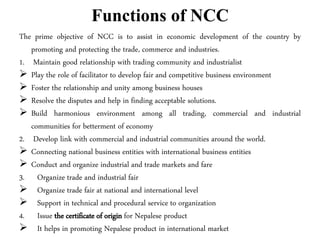
The prime objective of NCC is to assist in economic development of the country by
promoting and protecting the trade, commerce and industries.
1. Maintain good relationship with trading community and industrialist
 Play the role of facilitator to develop fair and competitive business environment
 Foster the relationship and unity among business houses
 Resolve the disputes and help in finding acceptable solutions.
 Build harmonious environment among all trading, commercial and industrial
communities for betterment of economy
2. Develop link with commercial and industrial communities around the world.
 Connecting national business entities with international business entities
 Conduct and organize industrial and trade markets and fare
3. Organize trade and industrial fair
 Organize trade fair at national and international level
 Support in technical and procedural service to organization
4. Issue the certificate of origin for Nepalese product
 It helps in promoting Nepalese product in international market
5. Establish academic institution regarding trade, commerce and industries
 Provide training for technical management, provide workshops, seminars,
training and research programs for corporate houses
 Support in searching for new business ventures and encourage
entrepreneurs to invest in such business.
6. Conduct social welfare activities
 It is actively indulged in charitable activities
 It provides financial and technical support to the institutions involved in
serving the society. For instance, it has provided free ambulance and corpse
service in Kathmandu valley.
7. Economic Development
 By directing supporting business
 Provide technical, financial, managerial and logistic support to individuals
who wants to involve in industries, commerce and service sector business.
 Create environment of fair competition among business organization
Federation of Nepal Chamber of Commerce and
Industries (FNCCI )
The Federation of Nepalese Chambers of Commerce and Industry
(FNCCI) is the nationally and internationally recognized umbrella
organization of business in Nepal, established in 1965. It is a
representative body of business organizations in the country, it
represents the interests of the private sector and is involved in
promotion of socio economic development of Nepal through
private sector led economic growth. It was established for
promoting, protecting right and interest of business communities
and to provide information advice, consultation and promotional
services to business.
Formation of FNCCI
Membership Structure
Under the National Directives Act 1961 (Rastriya Nirdeshan Ain 2018), the FNCCI
Membership, at present, is comprised of:
•112 District / Municipality Level Chambers
•103 Commodity / Sectoral Associations
•961 Leading public and private sector undertakings
•20 Bi-national Chambers
The FNCCI is represented in almost all national councils / boards / committees / policy
advisory bodies concerned with business and industry. And involve in other activities:
1. General Assembly and Executive Committee
It’s all activities, functions, plans policy are managed and controlled by executive
committee. Its executive committee consists of 74 members. It membership is formed
in following way:
1. Ordinary member 2. Associate member 3. Specific member 4.
Foreign member 5. Honorary member
Executive committee Member structure
• The general assembly from ordinary member and associate members - 1
president
• Immediate post president - 1 member
• From various groups - 5 vice presidents
• From various sector of commerce and industry associating representing each
region – 14
• From commerce and industry association - 4 members
• From bi national - 11 members
• From commodity associate – 12 members
• From among associate - 16 members
• Nominated by president - 5 members
• Elected chairperson of regional commerce and industry associate - 5 members
2. Councils
Three councils as per the interest of its members:
•District / Municipality Council
• Commodity Council
•Employers Council (Permanent organ of FNCCI)
It establish link between employers, employees and government through regular
contacts. Present unified opinions on labor related issues
3. Membership Committee
It scrutinizes the applications for memberships and submit recommendation to the
executive committee for the decision to grand membership of FNCCI
4. Secretariat
• For day to day operation, business library, training unit, HRD centre
Database centre and other administrative wings supported by professional staffs
Vision of FNCCI
"Leading the Nation's Economic Progress"
Mission of FNCCI
"Facilitating Nepalese Businesses Become Globally Competitive"
Objectives of FNCCI
•Promote the economic and social development of Nepal while protecting
and defending the rights and interests of the business persons of the entire
country.
•Make effective and significant contribution to the development of open
market economy while recognizing the changes taking place in the global
arena.
•Act as a supreme representative body of the trade and industry of the
country while supporting the national goals of self reliant and independent
national economy.
•Foster cooperation with related national and foreign organizations
Functions of FNCCI
• Represents Business Communities in National and International Level
 Formal institution to bring voice of business communities to national level
 Provide advisory services to government, lobby as and when required in formulation and
execution of business and industry related policies, plans, acts and programs regarding
industry and commerce.
• Promotes Export and Investment
 Support in necessary documentation and prepare recommendation to promote export
• Promote Joint Venture
 It fosters cooperation with related national and foreign organizations to encourage
foreign investment
 Initiate new technology in production and distribution and facilitate in huge investment
• Provide Expertise Service
 It provides expertise service for exporter, importer as well as investor
• Facilitating Trade Fairs and Exhibitions
 It facilitates participation in national and international trade and seminars
• Promoting Better Industrial Relations
 Resolve disputes, promote fair and competitive industrial relations among business entrepreneurs
 Establish sound industrial relationship in the country
• Provide Business Information and Research Service
 It provides business information to inside and outside members regarding scopes, procedures, difficulty in
area of business.
 It provides up to date and information services to business and government.
• Strengthening Local Chambers
 Policy of decentralization and delegate the authority
• Promoting entrepreneurship
 It plays a catalytic role in the business and industrial development
 Provide logistic, technical and even financial support in basis of skills, knowledge and experience
 It organizes training, workshop, seminar and research programs.
• Provides Business Welfare Service
 It reinforces business community’s commitment for the society
 It creates awareness and support for business and industry effort on issues affecting business like social
responsibility, Corporate governance, campaigns against HIV/AIDS, child labour, environment etc.
Trade and Export Promotion Centre (TEPC)
Trade and export promotion center is a national trade promotion
organization of Nepal. It was established in 2006 by the government of
Nepal by merging three organizations.
• Trade promotion center
• Export promotion center
• Carpet and wool development board.
Its main aim is to prevent import and promote and increase country’s
export capacity. At initial stage it was limited with few countries.
However due to globalization, it is helping in developing new market.
It also helps in establishment of relationship between exporter and
importer. It tries to maintain positive result and it links Nepalese
product in international market.
Function of TEPC
• It provides advice to the government of Nepal in formulation of
policies for the development and expansion of trade and export
• It helps in expansion of export business and increases national
economy
• It tries to reduce poverty through developing rural economy by
enhancing internal and external market for agro based and other
products
• It conducts programs for increasing the products of exportable
products
• It assists to diversify trade by identifying potential market for
exportable products
• It cooperates in operating institutions for export promotion and
diversified trade and extend support to such institutions
• It pleads for technical assistance with national and international
organizations for improving quality and standard of exportable
products
• It organizes buyer and seller meet and conduct training seminar and
workshop
• It assists in market test of exportable products
• It studies and identifies the problems of foreign trade and advises the
government of Nepal with appropriate measures to solve those
problems
• It provide trade relation information to all the agencies
• It provide support to the exporters by promoting their product , by
organizing buyers sellers meet, through training, seminars and
workshops
• It helps in simplifying the trade related procedure such as insurance,
quality control, transportation etc.

Business support agencies

  • 1.
    Business Support Agenciesin Nepal Chapter- 9
  • 2.
    Nepal Chamber ofCommerce (NCC) • Nepal Chamber of Commerce (NCC), established in the year 1952 (2009 BS) is the first Chamber of Commerce in Nepal. At present, it has more than 1,600 ordinary members and more than 8,000 registered firms. Located in Kathmandu, the NCC has been playing remarkable role in the business promotion and formulation of commercial, industrial and fiscal policies of Nepal Government. • The prime objective of NCC is to develop national economy through the promotion private and public commerce and industries
  • 3.
    Formation of NCC Anyindividual firm, Company, Corporation and organization engaged in trade, industry and commerce can receive membership of Nepal chamber of commerce. It has introduced 4 types of membership. 1. Life member 2. Ordinary member 3. Affiliated member 4. Honorary member NCC involves in many events as per their performing activities to meet its objectives. 1. All the activities of NCC are planned, programmed and implemented by executive committee includes 36 members. The executive committee is formed by: 1. Elected by general assembly → 29 members 2. Immediate post president →1 member 3. Nominated from among affiliated → 4 members 4. Nominated from general member → 1 member 5. Nominated by NCC president → 1member President, 1st and 2nd vice president, secretary, general treasurer, secretary and joint treasurers are elected from among elected members of executive committee.
  • 4.
    2. General Meeting Thegeneral meeting of NCC is held on an annual basis where resolutions are discussed and passed. Likewise, in the general meeting annual progress report and audit report are presented for necessary comments and approval. 3. Committee Associated with NCC The following committees are convened by the president of NCC on the basis of the requirement of the business community: • Advisory committee • Consultative committee • Nepal chamber foundation • Publication committee
  • 5.
    Functions of NCC Theprime objective of NCC is to assist in economic development of the country by promoting and protecting the trade, commerce and industries. 1. Maintain good relationship with trading community and industrialist  Play the role of facilitator to develop fair and competitive business environment  Foster the relationship and unity among business houses  Resolve the disputes and help in finding acceptable solutions.  Build harmonious environment among all trading, commercial and industrial communities for betterment of economy 2. Develop link with commercial and industrial communities around the world.  Connecting national business entities with international business entities  Conduct and organize industrial and trade markets and fare 3. Organize trade and industrial fair  Organize trade fair at national and international level  Support in technical and procedural service to organization 4. Issue the certificate of origin for Nepalese product  It helps in promoting Nepalese product in international market
  • 6.
    5. Establish academicinstitution regarding trade, commerce and industries  Provide training for technical management, provide workshops, seminars, training and research programs for corporate houses  Support in searching for new business ventures and encourage entrepreneurs to invest in such business. 6. Conduct social welfare activities  It is actively indulged in charitable activities  It provides financial and technical support to the institutions involved in serving the society. For instance, it has provided free ambulance and corpse service in Kathmandu valley. 7. Economic Development  By directing supporting business  Provide technical, financial, managerial and logistic support to individuals who wants to involve in industries, commerce and service sector business.  Create environment of fair competition among business organization
  • 7.
    Federation of NepalChamber of Commerce and Industries (FNCCI ) The Federation of Nepalese Chambers of Commerce and Industry (FNCCI) is the nationally and internationally recognized umbrella organization of business in Nepal, established in 1965. It is a representative body of business organizations in the country, it represents the interests of the private sector and is involved in promotion of socio economic development of Nepal through private sector led economic growth. It was established for promoting, protecting right and interest of business communities and to provide information advice, consultation and promotional services to business.
  • 8.
    Formation of FNCCI MembershipStructure Under the National Directives Act 1961 (Rastriya Nirdeshan Ain 2018), the FNCCI Membership, at present, is comprised of: •112 District / Municipality Level Chambers •103 Commodity / Sectoral Associations •961 Leading public and private sector undertakings •20 Bi-national Chambers The FNCCI is represented in almost all national councils / boards / committees / policy advisory bodies concerned with business and industry. And involve in other activities: 1. General Assembly and Executive Committee It’s all activities, functions, plans policy are managed and controlled by executive committee. Its executive committee consists of 74 members. It membership is formed in following way: 1. Ordinary member 2. Associate member 3. Specific member 4. Foreign member 5. Honorary member
  • 9.
    Executive committee Memberstructure • The general assembly from ordinary member and associate members - 1 president • Immediate post president - 1 member • From various groups - 5 vice presidents • From various sector of commerce and industry associating representing each region – 14 • From commerce and industry association - 4 members • From bi national - 11 members • From commodity associate – 12 members • From among associate - 16 members • Nominated by president - 5 members • Elected chairperson of regional commerce and industry associate - 5 members
  • 10.
    2. Councils Three councilsas per the interest of its members: •District / Municipality Council • Commodity Council •Employers Council (Permanent organ of FNCCI) It establish link between employers, employees and government through regular contacts. Present unified opinions on labor related issues 3. Membership Committee It scrutinizes the applications for memberships and submit recommendation to the executive committee for the decision to grand membership of FNCCI 4. Secretariat • For day to day operation, business library, training unit, HRD centre Database centre and other administrative wings supported by professional staffs
  • 11.
    Vision of FNCCI "Leadingthe Nation's Economic Progress" Mission of FNCCI "Facilitating Nepalese Businesses Become Globally Competitive" Objectives of FNCCI •Promote the economic and social development of Nepal while protecting and defending the rights and interests of the business persons of the entire country. •Make effective and significant contribution to the development of open market economy while recognizing the changes taking place in the global arena. •Act as a supreme representative body of the trade and industry of the country while supporting the national goals of self reliant and independent national economy. •Foster cooperation with related national and foreign organizations
  • 12.
    Functions of FNCCI •Represents Business Communities in National and International Level  Formal institution to bring voice of business communities to national level  Provide advisory services to government, lobby as and when required in formulation and execution of business and industry related policies, plans, acts and programs regarding industry and commerce. • Promotes Export and Investment  Support in necessary documentation and prepare recommendation to promote export • Promote Joint Venture  It fosters cooperation with related national and foreign organizations to encourage foreign investment  Initiate new technology in production and distribution and facilitate in huge investment • Provide Expertise Service  It provides expertise service for exporter, importer as well as investor
  • 13.
    • Facilitating TradeFairs and Exhibitions  It facilitates participation in national and international trade and seminars • Promoting Better Industrial Relations  Resolve disputes, promote fair and competitive industrial relations among business entrepreneurs  Establish sound industrial relationship in the country • Provide Business Information and Research Service  It provides business information to inside and outside members regarding scopes, procedures, difficulty in area of business.  It provides up to date and information services to business and government. • Strengthening Local Chambers  Policy of decentralization and delegate the authority • Promoting entrepreneurship  It plays a catalytic role in the business and industrial development  Provide logistic, technical and even financial support in basis of skills, knowledge and experience  It organizes training, workshop, seminar and research programs. • Provides Business Welfare Service  It reinforces business community’s commitment for the society  It creates awareness and support for business and industry effort on issues affecting business like social responsibility, Corporate governance, campaigns against HIV/AIDS, child labour, environment etc.
  • 14.
    Trade and ExportPromotion Centre (TEPC) Trade and export promotion center is a national trade promotion organization of Nepal. It was established in 2006 by the government of Nepal by merging three organizations. • Trade promotion center • Export promotion center • Carpet and wool development board. Its main aim is to prevent import and promote and increase country’s export capacity. At initial stage it was limited with few countries. However due to globalization, it is helping in developing new market. It also helps in establishment of relationship between exporter and importer. It tries to maintain positive result and it links Nepalese product in international market.
  • 15.
    Function of TEPC •It provides advice to the government of Nepal in formulation of policies for the development and expansion of trade and export • It helps in expansion of export business and increases national economy • It tries to reduce poverty through developing rural economy by enhancing internal and external market for agro based and other products • It conducts programs for increasing the products of exportable products • It assists to diversify trade by identifying potential market for exportable products • It cooperates in operating institutions for export promotion and diversified trade and extend support to such institutions
  • 16.
    • It pleadsfor technical assistance with national and international organizations for improving quality and standard of exportable products • It organizes buyer and seller meet and conduct training seminar and workshop • It assists in market test of exportable products • It studies and identifies the problems of foreign trade and advises the government of Nepal with appropriate measures to solve those problems • It provide trade relation information to all the agencies • It provide support to the exporters by promoting their product , by organizing buyers sellers meet, through training, seminars and workshops • It helps in simplifying the trade related procedure such as insurance, quality control, transportation etc.