Introduction to Strategic Management &
Strategic Management as a Process
2
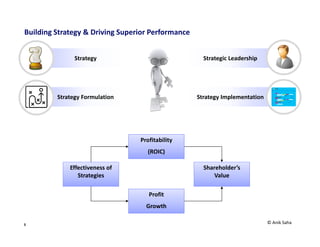
Building Strategy & Driving Superior Performance
Profitability
(ROIC)
Profit
Growth
Effectiveness of
Strategies
Shareholder’s
Value
Strategy Strategic Leadership
Strategy Formulation Strategy Implementation
© Anik Saha
3
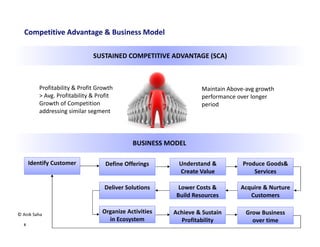
Competitive Advantage & Business Model
SUSTAINED COMPETITIVE ADVANTAGE (SCA)
BUSINESS MODEL
Identify Customer Define Offerings
Create Value
Understand &
Create Value Services
Produce Goods&
Services
in Ecosystem
Organize Activities
in Ecosystem
Deliver Solutions Lower Costs &
Build Resources
Acquire & Nurture
Customers
Profitability
Achieve & Sustain
Profitability over time
Grow Business
over time
Profitability & Profit Growth
> Avg. Profitability & Profit
Growth of Competition
addressing similar segment
Maintain Above-avg growth
performance over longer
period
© Anik Saha
4
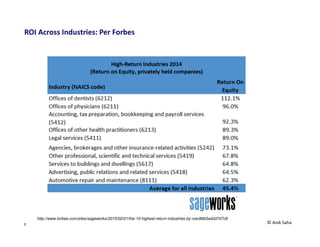
ROI Across Industries: Per Forbes
http://www.forbes.com/sites/sageworks/2015/02/01/the-10-highest-return-industries-by-roe/#6b5a42d7d7c8
© Anik Saha
5
ROI Across Industries: Per Forbes
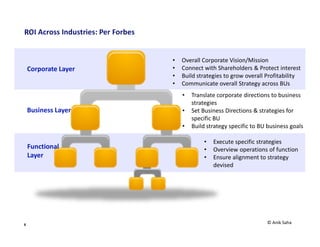
Corporate Layer
Business Layer
Functional
Layer
• Translate corporate directions to business
strategies
• Set Business Directions & strategies for
specific BU
• Build strategy specific to BU business goals
• Overall Corporate Vision/Mission
• Connect with Shareholders & Protect interest
• Build strategies to grow overall Profitability
• Communicate overall Strategy across BUs
• Execute specific strategies
• Overview operations of function
• Ensure alignment to strategy
devised
© Anik Saha
6
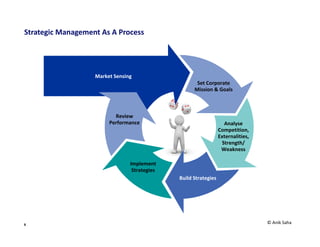
Strategic Management As A Process
Market Sensing
Set Corporate
Mission & Goals
Analyse
Competition,
Externalities,
Strength/
Weakness
Build Strategies
Implement
Strategies
Review
Performance
© Anik Saha
7
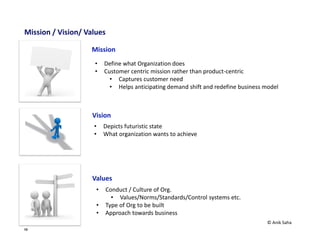
Mission / Vision/ Values
Mission
Vision
Values
• Define what Organization does
• Customer centric mission rather than product-centric
• Captures customer need
• Helps anticipating demand shift and redefine business model
• Depicts futuristic state
• What organization wants to achieve
• Conduct / Culture of Org.
• Values/Norms/Standards/Control systems etc.
• Type of Org to be built
• Approach towards business
© Anik Saha
8
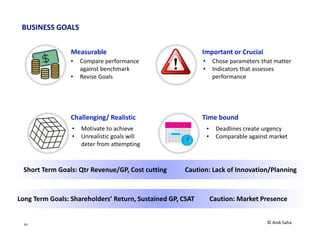
BUSINESS GOALS
Measurable
Challenging/ Realistic
Important or Crucial
Time bound
• Compare performance
against benchmark
• Revise Goals
• Motivate to achieve
• Unrealistic goals will
deter from attempting
• Deadlines create urgency
• Comparable against market
• Chose parameters that matter
• Indicators that assesses
performance
Short Term Goals: Qtr Revenue/GP, Cost cutting Caution: Lack of Innovation/Planning
Long Term Goals: Shareholders’ Return, Sustained GP, CSAT Caution: Market Presence
© Anik Saha
9
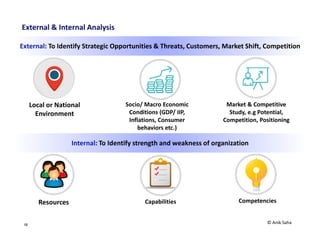
External & Internal Analysis
External: To Identify Strategic Opportunities & Threats, Customers, Market Shift, Competition
Internal: To Identify strength and weakness of organization
Local or National
Environment
Socio/ Macro Economic
Conditions (GDP/ IIP,
Inflations, Consumer
behaviors etc.)
Market & Competitive
Study, e.g Potential,
Competition, Positioning
Resources Capabilities Competencies
© Anik Saha
10
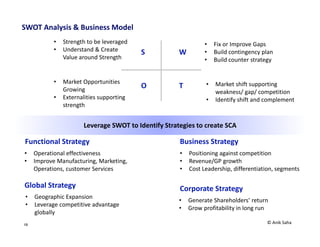
SWOT Analysis & Business Model
S W
O T
• Strength to be leveraged
• Understand & Create
Value around Strength
• Fix or Improve Gaps
• Build contingency plan
• Build counter strategy
• Market Opportunities
Growing
• Externalities supporting
strength
• Market shift supporting
weakness/ gap/ competition
• Identify shift and complement
Leverage SWOT to Identify Strategies to create SCA
Functional Strategy
• Operational effectiveness
• Improve Manufacturing, Marketing,
Operations, customer Services
Business Strategy
• Positioning against competition
• Revenue/GP growth
• Cost Leadership, differentiation, segments
• Geographic Expansion
• Leverage competitive advantage
globally
Corporate Strategy
• Generate Shareholders’ return
• Grow profitability in long run
Global Strategy
© Anik Saha
11
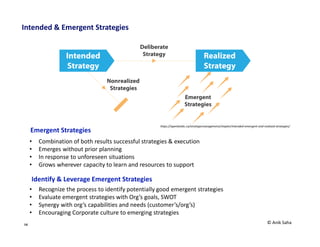
Intended & Emergent Strategies
• Recognize the process to identify potentially good emergent strategies
• Evaluate emergent strategies with Org’s goals, SWOT
• Synergy with org’s capabilities and needs (customer’s/org’s)
• Encouraging Corporate culture to emerging strategies
• Combination of both results successful strategies & execution
• Emerges without prior planning
• In response to unforeseen situations
• Grows wherever capacity to learn and resources to support
Emergent Strategies
Identify & Leverage Emergent Strategies
https://opentextbc.ca/strategicmanagement/chapter/intended-emergent-and-realized-strategies/
© Anik Saha
12
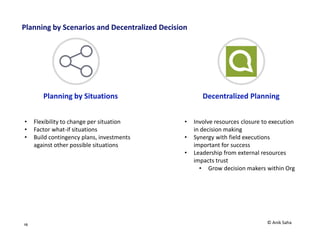
Planning by Scenarios and Decentralized Decision
Planning by Situations Decentralized Planning
• Flexibility to change per situation
• Factor what-if situations
• Build contingency plans, investments
against other possible situations
• Involve resources closure to execution
in decision making
• Synergy with field executions
important for success
• Leadership from external resources
impacts trust
• Grow decision makers within Org
© Anik Saha
13
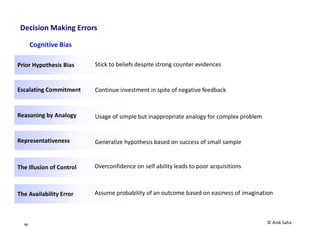
Decision Making Errors
Prior Hypothesis Bias
Cognitive Bias
Escalating Commitment
Reasoning by Analogy
Representativeness
The Illusion of Control
Stick to beliefs despite strong counter evidences
Continue investment in spite of negative feedback
Usage of simple but inappropriate analogy for complex problem
Generalize hypothesis based on success of small sample
Overconfidence on self ability leads to poor acquisitions
The Availability Error Assume probability of an outcome based on easiness of imagination
© Anik Saha
14
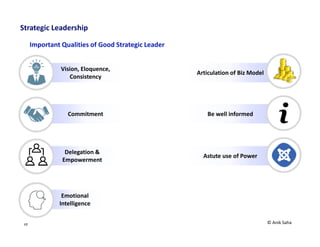
Strategic Leadership
Important Qualities of Good Strategic Leader
Vision, Eloquence,
Consistency
Articulation of Biz Model
Commitment Be well informed
Delegation &
Empowerment
Astute use of Power
Emotional
Intelligence
© Anik Saha
15
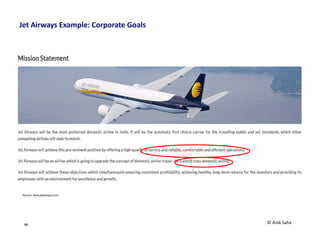
Jet Airways Example: Corporate Goals
Source: www.jetairways.com
© Anik Saha
16
Source: http://wap.business-standard.com/article/companies/jet-airways-trying-new-strategies-yet-to-deliver-114100100393_1.html
Jet Airways Example: Business Strategy
© Anik Saha
Jet Airways Example: Marketing Strategy
1. Positioning As Hospitality with a class/aristocracy or Privileged
2. Corporate Tie ups, Branding as International carrier with flights to US/Europe etc.
3. Skimmed Pricing Strategy to not getting classified as 'Low Cost' Airlines; Attempt to come out of the clutter of
other airlines
4. Special Hospitality Care with 'Jet Privileged' members like Premier Lounge, Free Snacks, Priority Check-in counters
etc.
5. Business Class segment focus and hence the team on field also has professional looks/outfits
© Anik Saha
18
Acknowledgement
Strategic Management by Charles W. L. Hill/ Gareth R.
Jones, Published by CENGAGE Learning
© Anik Saha

Business strategy session 1

  • 1.
    Introduction to StrategicManagement & Strategic Management as a Process
  • 2.
    2 Building Strategy &Driving Superior Performance Profitability (ROIC) Profit Growth Effectiveness of Strategies Shareholder’s Value Strategy Strategic Leadership Strategy Formulation Strategy Implementation © Anik Saha
  • 3.
    3 Competitive Advantage &Business Model SUSTAINED COMPETITIVE ADVANTAGE (SCA) BUSINESS MODEL Identify Customer Define Offerings Create Value Understand & Create Value Services Produce Goods& Services in Ecosystem Organize Activities in Ecosystem Deliver Solutions Lower Costs & Build Resources Acquire & Nurture Customers Profitability Achieve & Sustain Profitability over time Grow Business over time Profitability & Profit Growth > Avg. Profitability & Profit Growth of Competition addressing similar segment Maintain Above-avg growth performance over longer period © Anik Saha
  • 4.
    4 ROI Across Industries:Per Forbes http://www.forbes.com/sites/sageworks/2015/02/01/the-10-highest-return-industries-by-roe/#6b5a42d7d7c8 © Anik Saha
  • 5.
    5 ROI Across Industries:Per Forbes Corporate Layer Business Layer Functional Layer • Translate corporate directions to business strategies • Set Business Directions & strategies for specific BU • Build strategy specific to BU business goals • Overall Corporate Vision/Mission • Connect with Shareholders & Protect interest • Build strategies to grow overall Profitability • Communicate overall Strategy across BUs • Execute specific strategies • Overview operations of function • Ensure alignment to strategy devised © Anik Saha
  • 6.
    6 Strategic Management AsA Process Market Sensing Set Corporate Mission & Goals Analyse Competition, Externalities, Strength/ Weakness Build Strategies Implement Strategies Review Performance © Anik Saha
  • 7.
    7 Mission / Vision/Values Mission Vision Values • Define what Organization does • Customer centric mission rather than product-centric • Captures customer need • Helps anticipating demand shift and redefine business model • Depicts futuristic state • What organization wants to achieve • Conduct / Culture of Org. • Values/Norms/Standards/Control systems etc. • Type of Org to be built • Approach towards business © Anik Saha
  • 8.
    8 BUSINESS GOALS Measurable Challenging/ Realistic Importantor Crucial Time bound • Compare performance against benchmark • Revise Goals • Motivate to achieve • Unrealistic goals will deter from attempting • Deadlines create urgency • Comparable against market • Chose parameters that matter • Indicators that assesses performance Short Term Goals: Qtr Revenue/GP, Cost cutting Caution: Lack of Innovation/Planning Long Term Goals: Shareholders’ Return, Sustained GP, CSAT Caution: Market Presence © Anik Saha
  • 9.
    9 External & InternalAnalysis External: To Identify Strategic Opportunities & Threats, Customers, Market Shift, Competition Internal: To Identify strength and weakness of organization Local or National Environment Socio/ Macro Economic Conditions (GDP/ IIP, Inflations, Consumer behaviors etc.) Market & Competitive Study, e.g Potential, Competition, Positioning Resources Capabilities Competencies © Anik Saha
  • 10.
    10 SWOT Analysis &Business Model S W O T • Strength to be leveraged • Understand & Create Value around Strength • Fix or Improve Gaps • Build contingency plan • Build counter strategy • Market Opportunities Growing • Externalities supporting strength • Market shift supporting weakness/ gap/ competition • Identify shift and complement Leverage SWOT to Identify Strategies to create SCA Functional Strategy • Operational effectiveness • Improve Manufacturing, Marketing, Operations, customer Services Business Strategy • Positioning against competition • Revenue/GP growth • Cost Leadership, differentiation, segments • Geographic Expansion • Leverage competitive advantage globally Corporate Strategy • Generate Shareholders’ return • Grow profitability in long run Global Strategy © Anik Saha
  • 11.
    11 Intended & EmergentStrategies • Recognize the process to identify potentially good emergent strategies • Evaluate emergent strategies with Org’s goals, SWOT • Synergy with org’s capabilities and needs (customer’s/org’s) • Encouraging Corporate culture to emerging strategies • Combination of both results successful strategies & execution • Emerges without prior planning • In response to unforeseen situations • Grows wherever capacity to learn and resources to support Emergent Strategies Identify & Leverage Emergent Strategies https://opentextbc.ca/strategicmanagement/chapter/intended-emergent-and-realized-strategies/ © Anik Saha
  • 12.
    12 Planning by Scenariosand Decentralized Decision Planning by Situations Decentralized Planning • Flexibility to change per situation • Factor what-if situations • Build contingency plans, investments against other possible situations • Involve resources closure to execution in decision making • Synergy with field executions important for success • Leadership from external resources impacts trust • Grow decision makers within Org © Anik Saha
  • 13.
    13 Decision Making Errors PriorHypothesis Bias Cognitive Bias Escalating Commitment Reasoning by Analogy Representativeness The Illusion of Control Stick to beliefs despite strong counter evidences Continue investment in spite of negative feedback Usage of simple but inappropriate analogy for complex problem Generalize hypothesis based on success of small sample Overconfidence on self ability leads to poor acquisitions The Availability Error Assume probability of an outcome based on easiness of imagination © Anik Saha
  • 14.
    14 Strategic Leadership Important Qualitiesof Good Strategic Leader Vision, Eloquence, Consistency Articulation of Biz Model Commitment Be well informed Delegation & Empowerment Astute use of Power Emotional Intelligence © Anik Saha
  • 15.
    15 Jet Airways Example:Corporate Goals Source: www.jetairways.com © Anik Saha
  • 16.
  • 17.
    Jet Airways Example:Marketing Strategy 1. Positioning As Hospitality with a class/aristocracy or Privileged 2. Corporate Tie ups, Branding as International carrier with flights to US/Europe etc. 3. Skimmed Pricing Strategy to not getting classified as 'Low Cost' Airlines; Attempt to come out of the clutter of other airlines 4. Special Hospitality Care with 'Jet Privileged' members like Premier Lounge, Free Snacks, Priority Check-in counters etc. 5. Business Class segment focus and hence the team on field also has professional looks/outfits © Anik Saha
  • 18.
    18 Acknowledgement Strategic Management byCharles W. L. Hill/ Gareth R. Jones, Published by CENGAGE Learning © Anik Saha