BUSINESS RESEARCH METHODS (UCM20502J)
UNIT III
DATA – MEANING
Data refers to factual information that is collected, stored, and analyzed for various
purposes, including decision-making and knowledge discovery in different fields such as
business, science, and technology.
The term "data" refers to factual information used as a basis for reasoning, discussion, or
calculation. It can be raw, unorganized facts or processed information that is meaningful and
useful for decision-making. In the context of computing and technology, data often refers to
digital information that is stored, processed, and transmitted by computers.
CLASSIFICATION OF DATA
Data can be classified into different types based on various criteria such as its nature, source,
format, and usage. Here are some common classifications of data:
1. Based on Nature:
o Qualitative Data: Descriptive data that is subjective and categorical.
o Quantitative Data: Numerical data that is objective and measurable.
2. Based on Source:
o Primary Data: Data collected firsthand through surveys, experiments, or direct
observation.
o Secondary Data: Data obtained from existing sources such as books, articles, or
databases.
3. Based on Format:
o Structured Data: Data organized into a predefined format, such as tables or
databases.
o Unstructured Data: Data that does not have a predefined format, such as text
documents, images, or videos.
4. Based on Usage:
1
o Transactional Data: Data generated by day-to-day transactions in business
operations.
o Analytical Data: Data used for analysis and decision-making, often aggregated or
summarized.
5. Based on Sensitivity:
o Sensitive Data: Data that requires special precautions due to privacy, security, or
regulatory concerns (e.g., personal information, financial data).
o Non-sensitive Data: Data that does not pose significant risks if exposed or
accessed (e.g., publicly available information).
These classifications help in understanding the characteristics and appropriate handling of
different types of data in various contexts and applications.
PRIMARY DATA – INTRODUCTION
Primary data refers to data that is collected firsthand by the researcher or investigator
specifically for the purpose of addressing the research problem or objective at hand. This type of
data is original and has not been previously published or analyzed. It is gathered through
methods such as surveys, experiments, observations, or interviews directly from the source or
subjects involved.
Key characteristics of primary data include:
1. Originality: It is collected directly from the source for the first time.
2. Relevance: It is specific to the research question or objective.
3. Control: Researchers have control over the data collection methods and procedures.
4. Accuracy: Researchers can ensure data accuracy through careful design and execution of
data collection methods.
2
TYPES OF PRIMARY DATA
1. Surveys
 Description: A systematic method of collecting data from a predefined group of
respondents to gain information and insights into various topics of interest.
 Types:
o Questionnaires: Structured with closed or open-ended questions.
o Online Surveys: Conducted via internet platforms.
o Telephone Surveys: Conducted over the phone.
o Face-to-Face Surveys: Conducted in person.
2. Interviews
 Description: A direct method of gathering detailed information from individuals through
structured, semi-structured, or unstructured conversations.
 Types:
o Structured Interviews: Pre-determined questions.
o Semi-Structured Interviews: Mix of pre-determined and open-ended questions.
o Unstructured Interviews: Open-ended, conversational approach.
3. Focus Groups
 Description: Guided group discussions led by a moderator to collect opinions, beliefs,
and attitudes about a specific topic.
 Usage: Useful for obtaining diverse perspectives in a social context.
4. Observations
 Description: Systematic recording of behavioral patterns of people, objects, and
occurrences without direct interaction.
 Types:
o Participant Observation: Researcher actively engages in the context.
3
o Non-Participant Observation: Researcher observes without involvement.
5. Experiments
 Description: Controlled study where variables are manipulated to observe the effects on
other variables.
 Usage: Commonly used in natural sciences, psychology, and social sciences to establish
causality.
6. Diaries and Journals
 Description: Participants record their activities, thoughts, and experiences over a period
of time.
 Usage: Useful in longitudinal studies to track changes over time.
7. Case Studies
 Description: In-depth exploration of a single case or small number of cases within their
real-life context.
 Usage: Ideal for studying complex phenomena and generating insights into unique
situations.
8. Ethnographic Research
 Description: Immersive research method where the researcher spends extended time
within a community to understand their culture, behaviors, and interactions.
 Usage: Widely used in anthropology and sociology.
Each method has its own strengths and weaknesses, and the choice of method depends on the
research question, objectives, and available resources.
QUESTIONNAIRE – MEANING & IMPORTANCE
Meaning of Questionnaire
4
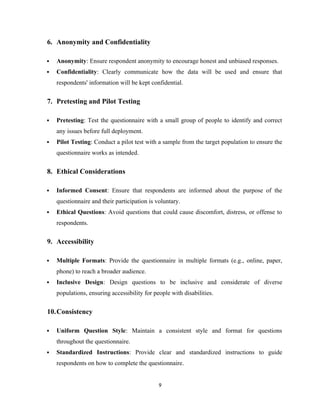
A questionnaire is a research instrument consisting of a series of questions designed to gather
information from respondents. Questionnaires can be administered in various ways, including
online, by mail, in person, or over the phone. They can include different types of questions, such
as:
 Closed-ended questions: Respondents choose from provided options (e.g., multiple-
choice, yes/no).
 Open-ended questions: Respondents provide answers in their own words.
 Scaled questions: Respondents rate something on a scale (e.g., Likert scale).
Importance of Questionnaires
1. Efficient Data Collection: Questionnaires allow researchers to collect data from a large
number of respondents quickly and efficiently, especially when administered online or
via mail.
2. Standardization: The same set of questions is presented to all respondents, ensuring
consistency and reliability in the data collected.
3. Quantitative and Qualitative Insights: Depending on the question types, questionnaires
can provide both quantitative data (e.g., numerical ratings) and qualitative insights (e.g.,
open-ended responses).
4. Cost-Effective: Compared to other methods like interviews or focus groups,
questionnaires can be more economical in terms of time and resources, especially for
large-scale surveys.
5. Anonymity and Privacy: Respondents may feel more comfortable providing honest
answers when they can complete a questionnaire anonymously, reducing the potential for
social desirability bias.
6. Flexibility: Questionnaires can be adapted to suit different research objectives, target
audiences, and contexts. They can cover a wide range of topics and be customized for
specific studies.
7. Ease of Analysis: Data from closed-ended questions can be easily quantified and
analyzed using statistical tools, making it straightforward to identify trends, patterns, and
correlations.
5
8. Accessibility: Online questionnaires can reach a geographically diverse audience,
allowing researchers to gather data from respondents across different regions and
demographics.
TYPES OF QUESTIONNAIRE
Questionnaires can be classified based on their structure, delivery method, and the nature
of the questions. Here are the main types of questionnaires:
Based on Structure
1. Structured Questionnaires: These have pre-determined questions with specific answer
options. They are easy to administer and analyze.
o Closed-Ended Questions: Respondents choose from provided options (e.g.,
multiple choice, yes/no).
o Scaled Questions: Respondents rate items on a scale (e.g., Likert scale).
2. Unstructured Questionnaires: These have open-ended questions that allow respondents
to answer in their own words, providing richer, more detailed responses.
o Open-Ended Questions: Respondents provide answers without restrictions,
offering deeper insights.
3. Semi-Structured Questionnaires: A combination of both structured and unstructured
elements. They include both closed-ended and open-ended questions, offering a balance
between quantitative and qualitative data.
Based on Delivery Method
1. Online Questionnaires: Administered via the internet using survey platforms or email.
They are convenient, cost-effective, and can reach a large audience quickly.
2. Paper Questionnaires: Distributed physically, often used in settings where internet
access is limited or where a personal touch is needed.
3. Telephone Questionnaires: Conducted over the phone, useful for reaching respondents
who may not have internet access or prefer verbal communication.
6
4. Face-to-Face Questionnaires: Administered in person, allowing for clarification of
questions and more personal interaction.
Based on Purpose or Content
1. Descriptive Questionnaires: Aim to describe the characteristics of a population or
phenomenon, such as demographic surveys.
2. Analytical Questionnaires: Designed to explore relationships between variables, often
used in research studies to test hypotheses.
3. Behavioral Questionnaires: Focus on respondents' actions and behaviors, often used in
market research and psychology.
4. Attitudinal Questionnaires: Measure attitudes, opinions, and perceptions about specific
topics or issues.
5. Factual Questionnaires: Collect factual information, such as personal or demographic
data.
Examples of Specific Types
1. Customer Satisfaction Questionnaires: Assess customer satisfaction with products or
services, typically including both rating scales and open-ended questions.
2. Employee Feedback Questionnaires: Gather feedback from employees about their work
environment, job satisfaction, and organizational culture.
3. Market Research Questionnaires: Explore consumer preferences, buying habits, and
market trends.
4. Health Assessment Questionnaires: Collect information on health behaviors,
conditions, and experiences, often used in medical and public health research.
5. Educational Evaluation Questionnaires: Assess educational experiences, teaching
effectiveness, and learning outcomes from students or educators.
Each type of questionnaire serves different research purposes and is chosen based on the specific
objectives of the study, the target audience, and the nature of the information being sought.
FEATURES OF QUESTIONNAIRE
7
1. Clarity and Simplicity
 Clear and Understandable Questions: Questions should be easy to understand and free
from ambiguity.
 Simple Language: Use straightforward language that is appropriate for the target
audience, avoiding jargon and complex terms.
2. Relevance
 Focused Content: Questions should be directly related to the research objectives and
should not include irrelevant information.
 Concise Questions: Keep questions short and to the point to maintain the respondent's
interest and avoid confusion.
3. Logical Flow and Structure
 Logical Sequencing: Arrange questions in a logical order, starting with general questions
and moving to more specific ones.
 Sectioning: Group related questions into sections to make the questionnaire more
organized and easier to navigate.
4. Types of Questions
 Balanced Mix: Include a mix of closed-ended and open-ended questions to gather both
quantitative and qualitative data.
 Appropriate Question Types: Use different types of questions (e.g., multiple choice,
Likert scale, ranking) based on the information needed.
5. Scalability
 Rating Scales: Use rating scales (e.g., Likert scale) for respondents to express degrees of
opinion or behavior.
 Binary Questions: Include yes/no or true/false questions for straightforward responses.
8
6. Anonymity and Confidentiality
 Anonymity: Ensure respondent anonymity to encourage honest and unbiased responses.
 Confidentiality: Clearly communicate how the data will be used and ensure that
respondents' information will be kept confidential.
7. Pretesting and Pilot Testing
 Pretesting: Test the questionnaire with a small group of people to identify and correct
any issues before full deployment.
 Pilot Testing: Conduct a pilot test with a sample from the target population to ensure the
questionnaire works as intended.
8. Ethical Considerations
 Informed Consent: Ensure that respondents are informed about the purpose of the
questionnaire and their participation is voluntary.
 Ethical Questions: Avoid questions that could cause discomfort, distress, or offense to
respondents.
9. Accessibility
 Multiple Formats: Provide the questionnaire in multiple formats (e.g., online, paper,
phone) to reach a broader audience.
 Inclusive Design: Design questions to be inclusive and considerate of diverse
populations, ensuring accessibility for people with disabilities.
10.Consistency
 Uniform Question Style: Maintain a consistent style and format for questions
throughout the questionnaire.
 Standardized Instructions: Provide clear and standardized instructions to guide
respondents on how to complete the questionnaire.
9
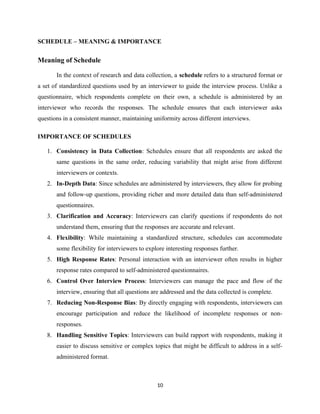
SCHEDULE – MEANING & IMPORTANCE
Meaning of Schedule
In the context of research and data collection, a schedule refers to a structured format or
a set of standardized questions used by an interviewer to guide the interview process. Unlike a
questionnaire, which respondents complete on their own, a schedule is administered by an
interviewer who records the responses. The schedule ensures that each interviewer asks
questions in a consistent manner, maintaining uniformity across different interviews.
IMPORTANCE OF SCHEDULES
1. Consistency in Data Collection: Schedules ensure that all respondents are asked the
same questions in the same order, reducing variability that might arise from different
interviewers or contexts.
2. In-Depth Data: Since schedules are administered by interviewers, they allow for probing
and follow-up questions, providing richer and more detailed data than self-administered
questionnaires.
3. Clarification and Accuracy: Interviewers can clarify questions if respondents do not
understand them, ensuring that the responses are accurate and relevant.
4. Flexibility: While maintaining a standardized structure, schedules can accommodate
some flexibility for interviewers to explore interesting responses further.
5. High Response Rates: Personal interaction with an interviewer often results in higher
response rates compared to self-administered questionnaires.
6. Control Over Interview Process: Interviewers can manage the pace and flow of the
interview, ensuring that all questions are addressed and the data collected is complete.
7. Reducing Non-Response Bias: By directly engaging with respondents, interviewers can
encourage participation and reduce the likelihood of incomplete responses or non-
responses.
8. Handling Sensitive Topics: Interviewers can build rapport with respondents, making it
easier to discuss sensitive or complex topics that might be difficult to address in a self-
administered format.
10
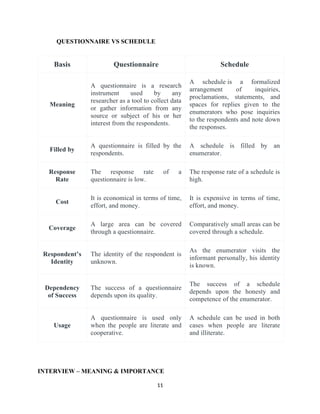
QUESTIONNAIRE VS SCHEDULE
Basis Questionnaire Schedule
Meaning
A questionnaire is a research
instrument used by any
researcher as a tool to collect data
or gather information from any
source or subject of his or her
interest from the respondents.
A schedule is a formalized
arrangement of inquiries,
proclamations, statements, and
spaces for replies given to the
enumerators who pose inquiries
to the respondents and note down
the responses.
Filled by
A questionnaire is filled by the
respondents.
A schedule is filled by an
enumerator.
Response
Rate
The response rate of a
questionnaire is low.
The response rate of a schedule is
high.
Cost
It is economical in terms of time,
effort, and money.
It is expensive in terms of time,
effort, and money.
Coverage
A large area can be covered
through a questionnaire.
Comparatively small areas can be
covered through a schedule.
Respondent’s
Identity
The identity of the respondent is
unknown.
As the enumerator visits the
informant personally, his identity
is known.
Dependency
of Success
The success of a questionnaire
depends upon its quality.
The success of a schedule
depends upon the honesty and
competence of the enumerator.
Usage
A questionnaire is used only
when the people are literate and
cooperative.
A schedule can be used in both
cases when people are literate
and illiterate.
INTERVIEW – MEANING & IMPORTANCE
11
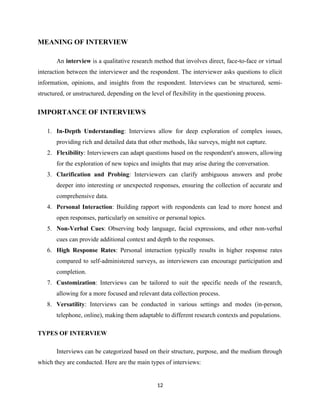
MEANING OF INTERVIEW
An interview is a qualitative research method that involves direct, face-to-face or virtual
interaction between the interviewer and the respondent. The interviewer asks questions to elicit
information, opinions, and insights from the respondent. Interviews can be structured, semi-
structured, or unstructured, depending on the level of flexibility in the questioning process.
IMPORTANCE OF INTERVIEWS
1. In-Depth Understanding: Interviews allow for deep exploration of complex issues,
providing rich and detailed data that other methods, like surveys, might not capture.
2. Flexibility: Interviewers can adapt questions based on the respondent's answers, allowing
for the exploration of new topics and insights that may arise during the conversation.
3. Clarification and Probing: Interviewers can clarify ambiguous answers and probe
deeper into interesting or unexpected responses, ensuring the collection of accurate and
comprehensive data.
4. Personal Interaction: Building rapport with respondents can lead to more honest and
open responses, particularly on sensitive or personal topics.
5. Non-Verbal Cues: Observing body language, facial expressions, and other non-verbal
cues can provide additional context and depth to the responses.
6. High Response Rates: Personal interaction typically results in higher response rates
compared to self-administered surveys, as interviewers can encourage participation and
completion.
7. Customization: Interviews can be tailored to suit the specific needs of the research,
allowing for a more focused and relevant data collection process.
8. Versatility: Interviews can be conducted in various settings and modes (in-person,
telephone, online), making them adaptable to different research contexts and populations.
TYPES OF INTERVIEW
Interviews can be categorized based on their structure, purpose, and the medium through
which they are conducted. Here are the main types of interviews:
12
Based on Structure
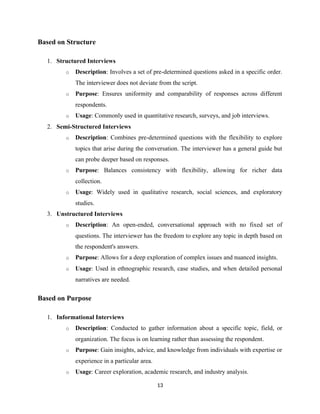
1. Structured Interviews
o Description: Involves a set of pre-determined questions asked in a specific order.
The interviewer does not deviate from the script.
o Purpose: Ensures uniformity and comparability of responses across different
respondents.
o Usage: Commonly used in quantitative research, surveys, and job interviews.
2. Semi-Structured Interviews
o Description: Combines pre-determined questions with the flexibility to explore
topics that arise during the conversation. The interviewer has a general guide but
can probe deeper based on responses.
o Purpose: Balances consistency with flexibility, allowing for richer data
collection.
o Usage: Widely used in qualitative research, social sciences, and exploratory
studies.
3. Unstructured Interviews
o Description: An open-ended, conversational approach with no fixed set of
questions. The interviewer has the freedom to explore any topic in depth based on
the respondent's answers.
o Purpose: Allows for a deep exploration of complex issues and nuanced insights.
o Usage: Used in ethnographic research, case studies, and when detailed personal
narratives are needed.
Based on Purpose
1. Informational Interviews
o Description: Conducted to gather information about a specific topic, field, or
organization. The focus is on learning rather than assessing the respondent.
o Purpose: Gain insights, advice, and knowledge from individuals with expertise or
experience in a particular area.
o Usage: Career exploration, academic research, and industry analysis.
13
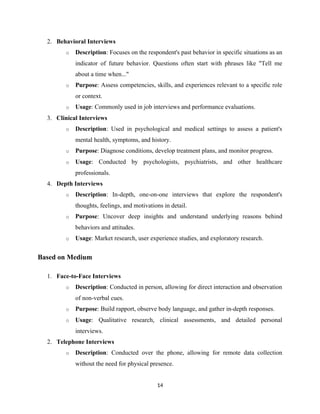
2. Behavioral Interviews
o Description: Focuses on the respondent's past behavior in specific situations as an
indicator of future behavior. Questions often start with phrases like "Tell me
about a time when..."
o Purpose: Assess competencies, skills, and experiences relevant to a specific role
or context.
o Usage: Commonly used in job interviews and performance evaluations.
3. Clinical Interviews
o Description: Used in psychological and medical settings to assess a patient's
mental health, symptoms, and history.
o Purpose: Diagnose conditions, develop treatment plans, and monitor progress.
o Usage: Conducted by psychologists, psychiatrists, and other healthcare
professionals.
4. Depth Interviews
o Description: In-depth, one-on-one interviews that explore the respondent's
thoughts, feelings, and motivations in detail.
o Purpose: Uncover deep insights and understand underlying reasons behind
behaviors and attitudes.
o Usage: Market research, user experience studies, and exploratory research.
Based on Medium
1. Face-to-Face Interviews
o Description: Conducted in person, allowing for direct interaction and observation
of non-verbal cues.
o Purpose: Build rapport, observe body language, and gather in-depth responses.
o Usage: Qualitative research, clinical assessments, and detailed personal
interviews.
2. Telephone Interviews
o Description: Conducted over the phone, allowing for remote data collection
without the need for physical presence.
14
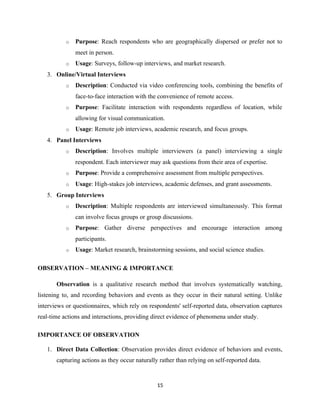
o Purpose: Reach respondents who are geographically dispersed or prefer not to
meet in person.
o Usage: Surveys, follow-up interviews, and market research.
3. Online/Virtual Interviews
o Description: Conducted via video conferencing tools, combining the benefits of
face-to-face interaction with the convenience of remote access.
o Purpose: Facilitate interaction with respondents regardless of location, while
allowing for visual communication.
o Usage: Remote job interviews, academic research, and focus groups.
4. Panel Interviews
o Description: Involves multiple interviewers (a panel) interviewing a single
respondent. Each interviewer may ask questions from their area of expertise.
o Purpose: Provide a comprehensive assessment from multiple perspectives.
o Usage: High-stakes job interviews, academic defenses, and grant assessments.
5. Group Interviews
o Description: Multiple respondents are interviewed simultaneously. This format
can involve focus groups or group discussions.
o Purpose: Gather diverse perspectives and encourage interaction among
participants.
o Usage: Market research, brainstorming sessions, and social science studies.
OBSERVATION – MEANING & IMPORTANCE
Observation is a qualitative research method that involves systematically watching,
listening to, and recording behaviors and events as they occur in their natural setting. Unlike
interviews or questionnaires, which rely on respondents' self-reported data, observation captures
real-time actions and interactions, providing direct evidence of phenomena under study.
IMPORTANCE OF OBSERVATION
1. Direct Data Collection: Observation provides direct evidence of behaviors and events,
capturing actions as they occur naturally rather than relying on self-reported data.
15
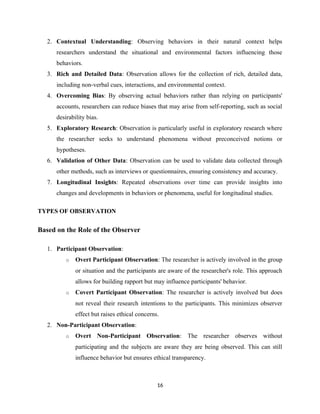
2. Contextual Understanding: Observing behaviors in their natural context helps
researchers understand the situational and environmental factors influencing those
behaviors.
3. Rich and Detailed Data: Observation allows for the collection of rich, detailed data,
including non-verbal cues, interactions, and environmental context.
4. Overcoming Bias: By observing actual behaviors rather than relying on participants'
accounts, researchers can reduce biases that may arise from self-reporting, such as social
desirability bias.
5. Exploratory Research: Observation is particularly useful in exploratory research where
the researcher seeks to understand phenomena without preconceived notions or
hypotheses.
6. Validation of Other Data: Observation can be used to validate data collected through
other methods, such as interviews or questionnaires, ensuring consistency and accuracy.
7. Longitudinal Insights: Repeated observations over time can provide insights into
changes and developments in behaviors or phenomena, useful for longitudinal studies.
TYPES OF OBSERVATION
Based on the Role of the Observer
1. Participant Observation:
o Overt Participant Observation: The researcher is actively involved in the group
or situation and the participants are aware of the researcher's role. This approach
allows for building rapport but may influence participants' behavior.
o Covert Participant Observation: The researcher is actively involved but does
not reveal their research intentions to the participants. This minimizes observer
effect but raises ethical concerns.
2. Non-Participant Observation:
o Overt Non-Participant Observation: The researcher observes without
participating and the subjects are aware they are being observed. This can still
influence behavior but ensures ethical transparency.
16
o Covert Non-Participant Observation: The researcher observes without
participating and without the subjects' knowledge. This minimizes observer effect
but also raises ethical issues.
Based on the Environment
1. Naturalistic Observation:
o Observations are conducted in the natural environment where the behavior or
event occurs without any interference from the researcher. This method captures
genuine behaviors but lacks control over variables.
2. Controlled Observation:
o Observations are made in a controlled setting where some variables are
manipulated by the researcher. This method provides control and allows for the
testing of specific hypotheses, but it may lack ecological validity.
Based on Structure
1. Structured Observation:
o The researcher uses a predefined framework or checklist to systematically observe
and record behaviors. This method is often quantitative and allows for easy
comparison and analysis of data.
2. Unstructured Observation:
o The researcher records all relevant behaviors and events without predefined
categories, allowing for flexibility and a comprehensive data collection. This
method is qualitative and can provide deep insights but is harder to analyze
systematically.
Based on the Level of Interaction
1. Direct Observation:
o The researcher directly observes the subjects and records their behaviors and
interactions. This can be done overtly or covertly and allows for capturing real-
time data.
17
2. Indirect Observation:
o The researcher observes the results of behaviors rather than the behaviors
themselves. For example, analyzing traces left by activities such as footprints,
wear and tear on objects, or digital traces.
Based on Duration
1. Continuous Observation:
o The researcher observes subjects continuously over a period of time, capturing all
behaviors and events as they occur. This provides comprehensive data but can be
resource-intensive.
2. Time-Interval Observation:
o Observations are made at specific intervals (e.g., every 5 minutes) rather than
continuously. This method is more manageable and can reduce the burden on the
observer while still capturing representative data.
Based on Purpose
1. Descriptive Observation:
o Aims to describe behaviors and events in detail without any preconceived notions
or hypotheses. This method is exploratory and useful for generating hypotheses.
2. Analytical Observation:
o Focuses on testing specific hypotheses and analyzing relationships between
variables. This method often involves structured observation and is used in
hypothesis-driven research.
SECONDARY DATA – INTRODUCTION
Secondary data refers to data that has been previously collected, processed, and
published by others for purposes other than the current research. This data is used as a secondary
source in research, analysis, or decision-making. Secondary data can come from a variety of
sources and can be used to complement primary data or as a standalone resource for research.
18
SOURCES OF SECONDARY DATA
1. Government Publications
 Census Data: Provides demographic information, population statistics, and socio-
economic data.
 Economic Reports: Includes data on economic performance, inflation, employment, and
trade.
 Health Statistics: Data on public health, disease prevalence, and healthcare services.
 Educational Statistics: Information on school enrollment, literacy rates, and educational
attainment.
2. Academic and Research Institutions
 Academic Journals: Peer-reviewed articles and studies in various disciplines.
 Research Papers: Theses, dissertations, and research reports produced by scholars.
 University Databases: Institutional repositories containing research outputs and datasets.
3. Commercial Data Providers
 Market Research Reports: Industry analyses, consumer behavior studies, and market
trends from firms like Nielsen, Gartner, and Statista.
 Industry Reports: Data on specific sectors, market conditions, and forecasts from
industry associations and consultancy firms.
 Financial Databases: Stock market data, financial performance reports, and economic
indicators from providers like Bloomberg, Reuters, and Moody’s.
4. Historical Records
 Archival Documents: Historical manuscripts, records, and documents preserved in
archives and libraries.
 Historical Newspapers: Old newspaper articles and periodicals that provide historical
context and events.
19
 Historical Economic Data: Data on past economic conditions, trends, and events.
5. Organizational Reports
 Annual Reports: Detailed reports published by companies on their financial
performance, operations, and strategic direction.
 Financial Statements: Balance sheets, income statements, and cash flow statements of
businesses.
 Internal Audits: Reports and findings from internal evaluations and assessments within
organizations.
6. Online Databases and Repositories
 Digital Libraries: Online collections of books, journals, and historical documents (e.g.,
Google Books, Project MUSE).
 Open Data Portals: Publicly available datasets from government and non-governmental
organizations (e.g., data.gov, World Bank Open Data).
 Academic Repositories: Platforms for sharing academic research and data (e.g.,
ResearchGate, arXiv).
7. Commercial Publications
 Books: Books authored by experts and practitioners in various fields, often including
empirical research and case studies.
 Magazines and Trade Publications: Industry-specific magazines and publications
providing current trends, news, and insights.
8. Media Sources
 Newspapers: Articles, reports, and opinion pieces covering current events and historical
contexts.
 Television and Radio Broadcasts: News reports, documentaries, and interviews
providing information on various topics.
20
9. Non-Governmental Organizations (NGOs) and International Organizations
 NGO Reports: Publications from NGOs on social issues, development projects, and
humanitarian efforts.
 International Organizations: Data and reports from organizations such as the United
Nations, World Health Organization, and World Bank.
10. Social Media and Online Platforms
 Social Media Posts: Publicly available data from platforms like Twitter, Facebook, and
Instagram, providing insights into public opinions and trends.
 Blogs and Forums: User-generated content and discussions on various topics.
11. Trade Associations and Professional Bodies
 Industry Surveys: Reports and data from surveys conducted by trade associations and
professional organizations.
 Standards and Guidelines: Publications related to industry standards, best practices, and
professional guidelines.
12. Libraries and Archives
 Library Catalogs: Access to a wide range of books, journals, and other publications.
 Archives: Historical records, manuscripts, and special collections available in public and
private archives.
SAMPLING – MEANING
Sampling is the process of selecting a subset of individuals, items, or observations from a
larger population to make inferences or generalizations about that population. It is a crucial step
in research and data collection, as it allows researchers to study and analyze a manageable
portion of the population rather than the entire group.
Merits of Sampling
21
1. Cost-Effectiveness:
o Description: Sampling reduces the costs associated with data collection
compared to surveying an entire population.
o Example: A company might sample a few customers instead of surveying all its
customers to gauge satisfaction.
2. Time Efficiency:
o Description: Data collection and analysis are quicker when working with a
sample rather than the entire population.
o Example: Researchers can conduct a study on a small sample in weeks instead of
months or years needed for a full population survey.
3. Manageability:
o Description: Smaller datasets are easier to manage, analyze, and interpret.
o Example: A medical study may focus on a sample of patients, making it feasible
to track their health outcomes without dealing with thousands of cases.
4. Feasibility:
o Description: It is often impractical to study an entire population due to logistical,
financial, or time constraints. Sampling makes research feasible in such cases.
o Example: National surveys use samples to estimate population-wide statistics like
income levels or public opinion.
5. Data Quality:
o Description: With proper sampling techniques, the quality of data can be high,
providing accurate insights into the population.
o Example: Well-designed samples can provide reliable data for policy-making or
scientific research.
6. Flexibility:
o Description: Sampling allows researchers to tailor their data collection methods
and focus on specific subgroups or variables of interest.
o Example: Researchers can use stratified sampling to ensure that various
demographic groups are represented in the study.
Demerits of Sampling
22
1. Sampling Bias:
o Description: If the sample is not representative of the population, it can lead to
biased results.
o Example: If a survey on educational attainment only includes responses from
urban areas, it may not accurately reflect rural education levels.
2. Sampling Error:
o Description: There is always a margin of error associated with sampling. The
sample may not perfectly reflect the population characteristics.
o Example: A sample might estimate the average income slightly higher or lower
than the true population average.
3. Limited Generalizability:
o Description: Findings from a sample may not always generalize to the entire
population, especially if the sample is not well-chosen.
o Example: Results from a sample of college students may not apply to the general
population.
4. Complexity in Sampling Design:
o Description: Designing a sampling method that ensures representativeness can be
complex and requires careful planning.
o Example: Stratified sampling requires detailed knowledge of population strata
and careful selection within each stratum.
5. Dependence on Sampling Frame:
o Description: The accuracy of the sample depends on the quality of the sampling
frame (the list or database from which the sample is drawn). An incomplete or
outdated frame can lead to errors.
o Example: If a sampling frame of voters is outdated, the sample may not include
recent voters or exclude certain groups.
6. Ethical Considerations:
o Description: Ensuring that the sample is ethically chosen and that all participants
are treated fairly can be challenging.
o Example: Ensuring that all groups within a population have an equal chance of
being included in the sample.
23
Laws of Sampling
1. Law of Statistical Regularity:
o Description: This law states that if a sample is selected randomly, the
characteristics of the sample will tend to approximate the characteristics of the
population, given a sufficiently large sample size.
o Implication: Ensures that random sampling provides a representative snapshot of
the population, leading to valid inferences.
2. Law of Inertia of Large Numbers:
o Description: As the sample size increases, the sample mean tends to approach the
population mean, and the variability of the sample mean decreases.
o Implication: Larger samples generally provide more accurate estimates of
population parameters and reduce the impact of sampling error.
3. Law of Sampling Distribution:
o Description: This law states that the distribution of sample statistics (like the
mean) will approximate a normal distribution as the sample size becomes larger,
according to the Central Limit Theorem.
o Implication: Allows researchers to use statistical inference techniques and
hypothesis testing based on the normality of sampling distributions.
Essentials of Sampling
1. Define the Population:
o Description: Clearly specify the group of individuals or items that are the subject
of the research. This includes defining the boundaries and characteristics of the
population.
o Example: A study on college students' health might define the population as all
full-time undergraduate students enrolled in a specific academic year.
2. Develop a Sampling Frame:
o Description: Create a comprehensive list or database from which the sample will
be drawn. The sampling frame should include all members of the population to
ensure representativeness.
24
o Example: A sampling frame for a survey on employee satisfaction might be an
up-to-date list of all employees in the company.
3. Choose a Sampling Method:
o Description: Select an appropriate sampling method based on the research
objectives, the nature of the population, and practical considerations. Methods
include random sampling, stratified sampling, and cluster sampling.
o Example: For a nationwide health survey, stratified sampling might be used to
ensure representation from different geographic regions.
4. Determine Sample Size:
o Description: Calculate the appropriate sample size needed to achieve reliable and
valid results. This involves considering factors such as the population size, margin
of error, and confidence level.
o Example: A researcher might use statistical formulas or software to determine
that a sample size of 500 is needed for a 95% confidence level with a 5% margin
of error.
5. Conduct the Sampling:
o Description: Implement the sampling method to select the sample from the
sampling frame. This should be done systematically and consistently to avoid
biases.
o Example: For a simple random sample, names might be drawn from a list using a
random number generator.
6. Collect and Analyze Data:
o Description: Gather data from the selected sample and analyze it to draw
conclusions about the population. Ensure data collection methods are standardized
and reliable.
o Example: Administering a survey to the sample and analyzing the responses to
determine trends or patterns.
7. Address Sampling Bias:
o Description: Identify and minimize any potential biases in the sampling process
that could affect the validity of the results. Bias can occur due to non-random
selection, incomplete sampling frame, or other factors.
25
o Example: Ensuring that the sample is not skewed by over-representing or under-
representing certain groups.
8. Validate Findings:
o Description: Verify the accuracy and generalizability of the findings by
comparing them with other data sources or conducting follow-up studies.
o Example: Cross-checking survey results with other research or conducting a pilot
study to confirm findings.
9. Document and Report:
o Description: Clearly document the sampling process, including the methods used,
the sample size, and any limitations. Report the findings transparently to ensure
the research is credible and replicable.
o Example: Providing detailed information in a research report about how the
sample was selected and how it represents the population.
DETERMINING SAMPLE SIZE
Determining sample size is a critical step in research design that influences the accuracy
and reliability of study results. An appropriately chosen sample size ensures that the findings are
statistically valid and can be generalized to the larger population.
TYPES OF SAMPLING
Sampling is a crucial aspect of research and statistics, and it involves selecting a subset
from a larger population to make inferences about the entire group. The choice of sampling
method impacts the quality and reliability of the research findings. Sampling methods are
generally categorized into two main types: probability sampling and non-probability
sampling. Here’s a detailed overview of each type and its various methods:
1. Probability Sampling
In probability sampling, every member of the population has a known and non-zero
chance of being selected. This type of sampling allows for the generalization of results to the
larger population and supports statistical inference.
26
a. Simple Random Sampling
 Description: Each member of the population has an equal chance of being selected.
Random selection methods ensure that every possible sample has an equal probability of
being chosen.
 Methods:
o Random Number Generator: Use of algorithms or software to randomly select
individuals.
o Drawing Lots: Manual selection using physical randomization techniques.
 Advantages: Minimizes bias, easy to understand and implement.
 Disadvantages: Requires a complete sampling frame, may not be practical for large
populations.
b. Systematic Sampling
 Description: Members are selected at regular intervals from a list or population. The
starting point is usually randomly chosen.
 Steps:
1. Determine the sampling interval (k), where k=Nnk = frac{N}{n}k=nN (N =
population size, n = desired sample size).
2. Select a random starting point and then select every k-th member.
 Advantages: Simple to implement, ensures even coverage.
 Disadvantages: Can introduce bias if there is a hidden pattern in the list.
c. Stratified Sampling
 Description: The population is divided into distinct subgroups (strata) based on a specific
characteristic. Samples are then drawn from each stratum.
 Steps:
1. Identify strata (e.g., age, income, education).
2. Perform random sampling within each stratum.
 Advantages: Ensures representation of all subgroups, increases precision.
27
 Disadvantages: Requires detailed knowledge of the population structure, more complex
to administer.
d. Cluster Sampling
 Description: The population is divided into clusters (e.g., geographical areas,
institutions), and entire clusters are randomly selected. All members within selected
clusters are then included in the sample.
 Steps:
1. Divide the population into clusters.
2. Randomly select clusters.
3. Sample all members within the selected clusters.
 Advantages: Cost-effective and practical for large populations.
 Disadvantages: Clusters may not be representative of the population, potential for
increased sampling error.
2. Non-Probability Sampling
In non-probability sampling, not all members of the population have a known or equal
chance of being selected. This type of sampling is often used when probability sampling is not
feasible but has limitations in generalizability.
a. Convenience Sampling
 Description: Sampling is done based on ease of access or availability. Participants are
chosen based on their convenience to the researcher.
 Methods:
o Voluntary Response: Participants self-select to be part of the study.
o Opportunistic Sampling: Selecting individuals who are readily available.
 Advantages: Quick, inexpensive, and easy to implement.
 Disadvantages: High risk of bias, limited generalizability.
28
b. Judgmental (Purposive) Sampling
 Description: The researcher selects specific individuals based on their expertise or
characteristics relevant to the study.
 Methods:
o Expert Selection: Choosing individuals who are considered experts or have
specific knowledge.
o Key Informant Sampling: Selecting key individuals who provide valuable
insights.
 Advantages: Useful for obtaining detailed information from knowledgeable sources.
 Disadvantages: Potential for bias, not representative of the broader population.
c. Snowball Sampling
 Description: Existing subjects recruit new participants from their acquaintances. This
method is useful for hard-to-reach or specialized populations.
 Steps:
1. Start with an initial participant.
2. Ask the participant to refer others.
3. Continue the process until the sample size is achieved.
 Advantages: Effective for accessing hidden or difficult-to-reach populations.
 Disadvantages: Can lead to sample bias, as participants may have similar characteristics.
d. Quota Sampling
 Description: The population is segmented into groups (quotas), and samples are selected
to meet predefined quotas based on specific characteristics.
 Steps:
1. Identify relevant quotas (e.g., gender, age groups).
2. Select participants to fulfill each quota.
 Advantages: Ensures representation of specific groups.
 Disadvantages: Can introduce bias if quotas are not set properly, less statistically
rigorous.
29
ERRORS MEANING
Errors in research and statistics refer to deviations from the true values or outcomes due
to various factors during data collection, analysis, and interpretation. Understanding these errors
is crucial for improving the accuracy and reliability of research findings. Errors can be broadly
categorized into sampling errors and non-sampling errors. Here’s an overview of each type:
1. Sampling Errors
Sampling errors occur because a sample, rather than the entire population, is used to make
inferences. These errors are natural and expected in any sampling process.
a. Sampling Error
 Meaning: The difference between the sample estimate and the true population parameter.
Sampling error arises because the sample may not perfectly represent the population.
 Examples:
o A survey of 100 people estimating the average income of a city may differ from the
actual average income of the entire city.
 Mitigation:
o Use larger sample sizes.
o Employ probability sampling methods to ensure representativeness.
b. Margin of Error
 Meaning: A measure of the range within which the true population parameter is expected to lie,
given the sample estimate. It is often reported along with confidence intervals.
 Example: A poll result showing that 60% of voters support a candidate with a margin of error of
±3% means the true support level is likely between 57% and 63%.
 Mitigation:
o Increase the sample size to reduce the margin of error.
2. Non-Sampling Errors
30
Non-sampling errors are not related to the act of sampling but to other aspects of the research
process, including data collection, measurement, and processing.
a. Measurement Error
 Meaning: Errors that occur during data collection due to inaccuracies in measurement
instruments or procedures.
 Types:
o Systematic Error: Consistent and repeatable errors, often due to flawed measurement
tools.
o Random Error: Occasional, unpredictable errors that vary in magnitude.
 Examples:
o A faulty scale that consistently measures weight inaccurately.
 Mitigation:
o Use calibrated and validated measurement instruments.
o Standardize data collection procedures.
b. Response Error
 Meaning: Errors that occur when respondents provide inaccurate or incomplete information.
 Types:
o Social Desirability Bias: When respondents provide answers they believe are more
socially acceptable.
o Recall Bias: When respondents have difficulty remembering past events or experiences
accurately.
 Examples:
o Participants exaggerating their exercise frequency in a health survey.
 Mitigation:
o Ensure anonymity and confidentiality.
o Use clear and unbiased questions.
c. Non-Response Error
 Meaning: Errors arising when individuals selected for the sample do not respond or participate,
potentially leading to a non-representative sample.
31
 Types:
o Unit Non-Response: When selected participants do not respond at all.
o Item Non-Response: When participants respond to some questions but omit others.
 Examples:
o A survey where only 50% of the selected respondents participate.
 Mitigation:
o Employ follow-up strategies to increase response rates.
o Use techniques to handle missing data, such as imputation.
d. Processing Error
 Meaning: Errors that occur during data entry, coding, or analysis processes.
 Types:
o Data Entry Error: Mistakes made while entering data into a database or system.
o Data Coding Error: Incorrect categorization or coding of responses.
 Examples:
o Typographical errors when entering survey data into a spreadsheet.
 Mitigation:
o Implement double-check procedures and validation checks.
e. Selection Bias
 Meaning: Errors that occur when certain groups are systematically excluded or overrepresented
in the sample, leading to biased results.
 Types:
o Sampling Bias: When the sampling method leads to a non-representative sample.
o Survivorship Bias: When only successful cases are considered, ignoring unsuccessful
ones.
 Examples:
o Surveying only customers who visit a store during business hours, excluding those who
shop online.
 Mitigation:
o Use random sampling techniques and ensure a comprehensive sampling frame.
32

BUSINESS RESEARCH METHODS FULLNOTES.docx

  • 1.
    BUSINESS RESEARCH METHODS(UCM20502J) UNIT III DATA – MEANING Data refers to factual information that is collected, stored, and analyzed for various purposes, including decision-making and knowledge discovery in different fields such as business, science, and technology. The term "data" refers to factual information used as a basis for reasoning, discussion, or calculation. It can be raw, unorganized facts or processed information that is meaningful and useful for decision-making. In the context of computing and technology, data often refers to digital information that is stored, processed, and transmitted by computers. CLASSIFICATION OF DATA Data can be classified into different types based on various criteria such as its nature, source, format, and usage. Here are some common classifications of data: 1. Based on Nature: o Qualitative Data: Descriptive data that is subjective and categorical. o Quantitative Data: Numerical data that is objective and measurable. 2. Based on Source: o Primary Data: Data collected firsthand through surveys, experiments, or direct observation. o Secondary Data: Data obtained from existing sources such as books, articles, or databases. 3. Based on Format: o Structured Data: Data organized into a predefined format, such as tables or databases. o Unstructured Data: Data that does not have a predefined format, such as text documents, images, or videos. 4. Based on Usage: 1
  • 2.
    o Transactional Data:Data generated by day-to-day transactions in business operations. o Analytical Data: Data used for analysis and decision-making, often aggregated or summarized. 5. Based on Sensitivity: o Sensitive Data: Data that requires special precautions due to privacy, security, or regulatory concerns (e.g., personal information, financial data). o Non-sensitive Data: Data that does not pose significant risks if exposed or accessed (e.g., publicly available information). These classifications help in understanding the characteristics and appropriate handling of different types of data in various contexts and applications. PRIMARY DATA – INTRODUCTION Primary data refers to data that is collected firsthand by the researcher or investigator specifically for the purpose of addressing the research problem or objective at hand. This type of data is original and has not been previously published or analyzed. It is gathered through methods such as surveys, experiments, observations, or interviews directly from the source or subjects involved. Key characteristics of primary data include: 1. Originality: It is collected directly from the source for the first time. 2. Relevance: It is specific to the research question or objective. 3. Control: Researchers have control over the data collection methods and procedures. 4. Accuracy: Researchers can ensure data accuracy through careful design and execution of data collection methods. 2
  • 3.
    TYPES OF PRIMARYDATA 1. Surveys  Description: A systematic method of collecting data from a predefined group of respondents to gain information and insights into various topics of interest.  Types: o Questionnaires: Structured with closed or open-ended questions. o Online Surveys: Conducted via internet platforms. o Telephone Surveys: Conducted over the phone. o Face-to-Face Surveys: Conducted in person. 2. Interviews  Description: A direct method of gathering detailed information from individuals through structured, semi-structured, or unstructured conversations.  Types: o Structured Interviews: Pre-determined questions. o Semi-Structured Interviews: Mix of pre-determined and open-ended questions. o Unstructured Interviews: Open-ended, conversational approach. 3. Focus Groups  Description: Guided group discussions led by a moderator to collect opinions, beliefs, and attitudes about a specific topic.  Usage: Useful for obtaining diverse perspectives in a social context. 4. Observations  Description: Systematic recording of behavioral patterns of people, objects, and occurrences without direct interaction.  Types: o Participant Observation: Researcher actively engages in the context. 3
  • 4.
    o Non-Participant Observation:Researcher observes without involvement. 5. Experiments  Description: Controlled study where variables are manipulated to observe the effects on other variables.  Usage: Commonly used in natural sciences, psychology, and social sciences to establish causality. 6. Diaries and Journals  Description: Participants record their activities, thoughts, and experiences over a period of time.  Usage: Useful in longitudinal studies to track changes over time. 7. Case Studies  Description: In-depth exploration of a single case or small number of cases within their real-life context.  Usage: Ideal for studying complex phenomena and generating insights into unique situations. 8. Ethnographic Research  Description: Immersive research method where the researcher spends extended time within a community to understand their culture, behaviors, and interactions.  Usage: Widely used in anthropology and sociology. Each method has its own strengths and weaknesses, and the choice of method depends on the research question, objectives, and available resources. QUESTIONNAIRE – MEANING & IMPORTANCE Meaning of Questionnaire 4
  • 5.
    A questionnaire isa research instrument consisting of a series of questions designed to gather information from respondents. Questionnaires can be administered in various ways, including online, by mail, in person, or over the phone. They can include different types of questions, such as:  Closed-ended questions: Respondents choose from provided options (e.g., multiple- choice, yes/no).  Open-ended questions: Respondents provide answers in their own words.  Scaled questions: Respondents rate something on a scale (e.g., Likert scale). Importance of Questionnaires 1. Efficient Data Collection: Questionnaires allow researchers to collect data from a large number of respondents quickly and efficiently, especially when administered online or via mail. 2. Standardization: The same set of questions is presented to all respondents, ensuring consistency and reliability in the data collected. 3. Quantitative and Qualitative Insights: Depending on the question types, questionnaires can provide both quantitative data (e.g., numerical ratings) and qualitative insights (e.g., open-ended responses). 4. Cost-Effective: Compared to other methods like interviews or focus groups, questionnaires can be more economical in terms of time and resources, especially for large-scale surveys. 5. Anonymity and Privacy: Respondents may feel more comfortable providing honest answers when they can complete a questionnaire anonymously, reducing the potential for social desirability bias. 6. Flexibility: Questionnaires can be adapted to suit different research objectives, target audiences, and contexts. They can cover a wide range of topics and be customized for specific studies. 7. Ease of Analysis: Data from closed-ended questions can be easily quantified and analyzed using statistical tools, making it straightforward to identify trends, patterns, and correlations. 5
  • 6.
    8. Accessibility: Onlinequestionnaires can reach a geographically diverse audience, allowing researchers to gather data from respondents across different regions and demographics. TYPES OF QUESTIONNAIRE Questionnaires can be classified based on their structure, delivery method, and the nature of the questions. Here are the main types of questionnaires: Based on Structure 1. Structured Questionnaires: These have pre-determined questions with specific answer options. They are easy to administer and analyze. o Closed-Ended Questions: Respondents choose from provided options (e.g., multiple choice, yes/no). o Scaled Questions: Respondents rate items on a scale (e.g., Likert scale). 2. Unstructured Questionnaires: These have open-ended questions that allow respondents to answer in their own words, providing richer, more detailed responses. o Open-Ended Questions: Respondents provide answers without restrictions, offering deeper insights. 3. Semi-Structured Questionnaires: A combination of both structured and unstructured elements. They include both closed-ended and open-ended questions, offering a balance between quantitative and qualitative data. Based on Delivery Method 1. Online Questionnaires: Administered via the internet using survey platforms or email. They are convenient, cost-effective, and can reach a large audience quickly. 2. Paper Questionnaires: Distributed physically, often used in settings where internet access is limited or where a personal touch is needed. 3. Telephone Questionnaires: Conducted over the phone, useful for reaching respondents who may not have internet access or prefer verbal communication. 6
  • 7.
    4. Face-to-Face Questionnaires:Administered in person, allowing for clarification of questions and more personal interaction. Based on Purpose or Content 1. Descriptive Questionnaires: Aim to describe the characteristics of a population or phenomenon, such as demographic surveys. 2. Analytical Questionnaires: Designed to explore relationships between variables, often used in research studies to test hypotheses. 3. Behavioral Questionnaires: Focus on respondents' actions and behaviors, often used in market research and psychology. 4. Attitudinal Questionnaires: Measure attitudes, opinions, and perceptions about specific topics or issues. 5. Factual Questionnaires: Collect factual information, such as personal or demographic data. Examples of Specific Types 1. Customer Satisfaction Questionnaires: Assess customer satisfaction with products or services, typically including both rating scales and open-ended questions. 2. Employee Feedback Questionnaires: Gather feedback from employees about their work environment, job satisfaction, and organizational culture. 3. Market Research Questionnaires: Explore consumer preferences, buying habits, and market trends. 4. Health Assessment Questionnaires: Collect information on health behaviors, conditions, and experiences, often used in medical and public health research. 5. Educational Evaluation Questionnaires: Assess educational experiences, teaching effectiveness, and learning outcomes from students or educators. Each type of questionnaire serves different research purposes and is chosen based on the specific objectives of the study, the target audience, and the nature of the information being sought. FEATURES OF QUESTIONNAIRE 7
  • 8.
    1. Clarity andSimplicity  Clear and Understandable Questions: Questions should be easy to understand and free from ambiguity.  Simple Language: Use straightforward language that is appropriate for the target audience, avoiding jargon and complex terms. 2. Relevance  Focused Content: Questions should be directly related to the research objectives and should not include irrelevant information.  Concise Questions: Keep questions short and to the point to maintain the respondent's interest and avoid confusion. 3. Logical Flow and Structure  Logical Sequencing: Arrange questions in a logical order, starting with general questions and moving to more specific ones.  Sectioning: Group related questions into sections to make the questionnaire more organized and easier to navigate. 4. Types of Questions  Balanced Mix: Include a mix of closed-ended and open-ended questions to gather both quantitative and qualitative data.  Appropriate Question Types: Use different types of questions (e.g., multiple choice, Likert scale, ranking) based on the information needed. 5. Scalability  Rating Scales: Use rating scales (e.g., Likert scale) for respondents to express degrees of opinion or behavior.  Binary Questions: Include yes/no or true/false questions for straightforward responses. 8
  • 9.
    6. Anonymity andConfidentiality  Anonymity: Ensure respondent anonymity to encourage honest and unbiased responses.  Confidentiality: Clearly communicate how the data will be used and ensure that respondents' information will be kept confidential. 7. Pretesting and Pilot Testing  Pretesting: Test the questionnaire with a small group of people to identify and correct any issues before full deployment.  Pilot Testing: Conduct a pilot test with a sample from the target population to ensure the questionnaire works as intended. 8. Ethical Considerations  Informed Consent: Ensure that respondents are informed about the purpose of the questionnaire and their participation is voluntary.  Ethical Questions: Avoid questions that could cause discomfort, distress, or offense to respondents. 9. Accessibility  Multiple Formats: Provide the questionnaire in multiple formats (e.g., online, paper, phone) to reach a broader audience.  Inclusive Design: Design questions to be inclusive and considerate of diverse populations, ensuring accessibility for people with disabilities. 10.Consistency  Uniform Question Style: Maintain a consistent style and format for questions throughout the questionnaire.  Standardized Instructions: Provide clear and standardized instructions to guide respondents on how to complete the questionnaire. 9
  • 10.
    SCHEDULE – MEANING& IMPORTANCE Meaning of Schedule In the context of research and data collection, a schedule refers to a structured format or a set of standardized questions used by an interviewer to guide the interview process. Unlike a questionnaire, which respondents complete on their own, a schedule is administered by an interviewer who records the responses. The schedule ensures that each interviewer asks questions in a consistent manner, maintaining uniformity across different interviews. IMPORTANCE OF SCHEDULES 1. Consistency in Data Collection: Schedules ensure that all respondents are asked the same questions in the same order, reducing variability that might arise from different interviewers or contexts. 2. In-Depth Data: Since schedules are administered by interviewers, they allow for probing and follow-up questions, providing richer and more detailed data than self-administered questionnaires. 3. Clarification and Accuracy: Interviewers can clarify questions if respondents do not understand them, ensuring that the responses are accurate and relevant. 4. Flexibility: While maintaining a standardized structure, schedules can accommodate some flexibility for interviewers to explore interesting responses further. 5. High Response Rates: Personal interaction with an interviewer often results in higher response rates compared to self-administered questionnaires. 6. Control Over Interview Process: Interviewers can manage the pace and flow of the interview, ensuring that all questions are addressed and the data collected is complete. 7. Reducing Non-Response Bias: By directly engaging with respondents, interviewers can encourage participation and reduce the likelihood of incomplete responses or non- responses. 8. Handling Sensitive Topics: Interviewers can build rapport with respondents, making it easier to discuss sensitive or complex topics that might be difficult to address in a self- administered format. 10
  • 11.
    QUESTIONNAIRE VS SCHEDULE BasisQuestionnaire Schedule Meaning A questionnaire is a research instrument used by any researcher as a tool to collect data or gather information from any source or subject of his or her interest from the respondents. A schedule is a formalized arrangement of inquiries, proclamations, statements, and spaces for replies given to the enumerators who pose inquiries to the respondents and note down the responses. Filled by A questionnaire is filled by the respondents. A schedule is filled by an enumerator. Response Rate The response rate of a questionnaire is low. The response rate of a schedule is high. Cost It is economical in terms of time, effort, and money. It is expensive in terms of time, effort, and money. Coverage A large area can be covered through a questionnaire. Comparatively small areas can be covered through a schedule. Respondent’s Identity The identity of the respondent is unknown. As the enumerator visits the informant personally, his identity is known. Dependency of Success The success of a questionnaire depends upon its quality. The success of a schedule depends upon the honesty and competence of the enumerator. Usage A questionnaire is used only when the people are literate and cooperative. A schedule can be used in both cases when people are literate and illiterate. INTERVIEW – MEANING & IMPORTANCE 11
  • 12.
    MEANING OF INTERVIEW Aninterview is a qualitative research method that involves direct, face-to-face or virtual interaction between the interviewer and the respondent. The interviewer asks questions to elicit information, opinions, and insights from the respondent. Interviews can be structured, semi- structured, or unstructured, depending on the level of flexibility in the questioning process. IMPORTANCE OF INTERVIEWS 1. In-Depth Understanding: Interviews allow for deep exploration of complex issues, providing rich and detailed data that other methods, like surveys, might not capture. 2. Flexibility: Interviewers can adapt questions based on the respondent's answers, allowing for the exploration of new topics and insights that may arise during the conversation. 3. Clarification and Probing: Interviewers can clarify ambiguous answers and probe deeper into interesting or unexpected responses, ensuring the collection of accurate and comprehensive data. 4. Personal Interaction: Building rapport with respondents can lead to more honest and open responses, particularly on sensitive or personal topics. 5. Non-Verbal Cues: Observing body language, facial expressions, and other non-verbal cues can provide additional context and depth to the responses. 6. High Response Rates: Personal interaction typically results in higher response rates compared to self-administered surveys, as interviewers can encourage participation and completion. 7. Customization: Interviews can be tailored to suit the specific needs of the research, allowing for a more focused and relevant data collection process. 8. Versatility: Interviews can be conducted in various settings and modes (in-person, telephone, online), making them adaptable to different research contexts and populations. TYPES OF INTERVIEW Interviews can be categorized based on their structure, purpose, and the medium through which they are conducted. Here are the main types of interviews: 12
  • 13.
    Based on Structure 1.Structured Interviews o Description: Involves a set of pre-determined questions asked in a specific order. The interviewer does not deviate from the script. o Purpose: Ensures uniformity and comparability of responses across different respondents. o Usage: Commonly used in quantitative research, surveys, and job interviews. 2. Semi-Structured Interviews o Description: Combines pre-determined questions with the flexibility to explore topics that arise during the conversation. The interviewer has a general guide but can probe deeper based on responses. o Purpose: Balances consistency with flexibility, allowing for richer data collection. o Usage: Widely used in qualitative research, social sciences, and exploratory studies. 3. Unstructured Interviews o Description: An open-ended, conversational approach with no fixed set of questions. The interviewer has the freedom to explore any topic in depth based on the respondent's answers. o Purpose: Allows for a deep exploration of complex issues and nuanced insights. o Usage: Used in ethnographic research, case studies, and when detailed personal narratives are needed. Based on Purpose 1. Informational Interviews o Description: Conducted to gather information about a specific topic, field, or organization. The focus is on learning rather than assessing the respondent. o Purpose: Gain insights, advice, and knowledge from individuals with expertise or experience in a particular area. o Usage: Career exploration, academic research, and industry analysis. 13
  • 14.
    2. Behavioral Interviews oDescription: Focuses on the respondent's past behavior in specific situations as an indicator of future behavior. Questions often start with phrases like "Tell me about a time when..." o Purpose: Assess competencies, skills, and experiences relevant to a specific role or context. o Usage: Commonly used in job interviews and performance evaluations. 3. Clinical Interviews o Description: Used in psychological and medical settings to assess a patient's mental health, symptoms, and history. o Purpose: Diagnose conditions, develop treatment plans, and monitor progress. o Usage: Conducted by psychologists, psychiatrists, and other healthcare professionals. 4. Depth Interviews o Description: In-depth, one-on-one interviews that explore the respondent's thoughts, feelings, and motivations in detail. o Purpose: Uncover deep insights and understand underlying reasons behind behaviors and attitudes. o Usage: Market research, user experience studies, and exploratory research. Based on Medium 1. Face-to-Face Interviews o Description: Conducted in person, allowing for direct interaction and observation of non-verbal cues. o Purpose: Build rapport, observe body language, and gather in-depth responses. o Usage: Qualitative research, clinical assessments, and detailed personal interviews. 2. Telephone Interviews o Description: Conducted over the phone, allowing for remote data collection without the need for physical presence. 14
  • 15.
    o Purpose: Reachrespondents who are geographically dispersed or prefer not to meet in person. o Usage: Surveys, follow-up interviews, and market research. 3. Online/Virtual Interviews o Description: Conducted via video conferencing tools, combining the benefits of face-to-face interaction with the convenience of remote access. o Purpose: Facilitate interaction with respondents regardless of location, while allowing for visual communication. o Usage: Remote job interviews, academic research, and focus groups. 4. Panel Interviews o Description: Involves multiple interviewers (a panel) interviewing a single respondent. Each interviewer may ask questions from their area of expertise. o Purpose: Provide a comprehensive assessment from multiple perspectives. o Usage: High-stakes job interviews, academic defenses, and grant assessments. 5. Group Interviews o Description: Multiple respondents are interviewed simultaneously. This format can involve focus groups or group discussions. o Purpose: Gather diverse perspectives and encourage interaction among participants. o Usage: Market research, brainstorming sessions, and social science studies. OBSERVATION – MEANING & IMPORTANCE Observation is a qualitative research method that involves systematically watching, listening to, and recording behaviors and events as they occur in their natural setting. Unlike interviews or questionnaires, which rely on respondents' self-reported data, observation captures real-time actions and interactions, providing direct evidence of phenomena under study. IMPORTANCE OF OBSERVATION 1. Direct Data Collection: Observation provides direct evidence of behaviors and events, capturing actions as they occur naturally rather than relying on self-reported data. 15
  • 16.
    2. Contextual Understanding:Observing behaviors in their natural context helps researchers understand the situational and environmental factors influencing those behaviors. 3. Rich and Detailed Data: Observation allows for the collection of rich, detailed data, including non-verbal cues, interactions, and environmental context. 4. Overcoming Bias: By observing actual behaviors rather than relying on participants' accounts, researchers can reduce biases that may arise from self-reporting, such as social desirability bias. 5. Exploratory Research: Observation is particularly useful in exploratory research where the researcher seeks to understand phenomena without preconceived notions or hypotheses. 6. Validation of Other Data: Observation can be used to validate data collected through other methods, such as interviews or questionnaires, ensuring consistency and accuracy. 7. Longitudinal Insights: Repeated observations over time can provide insights into changes and developments in behaviors or phenomena, useful for longitudinal studies. TYPES OF OBSERVATION Based on the Role of the Observer 1. Participant Observation: o Overt Participant Observation: The researcher is actively involved in the group or situation and the participants are aware of the researcher's role. This approach allows for building rapport but may influence participants' behavior. o Covert Participant Observation: The researcher is actively involved but does not reveal their research intentions to the participants. This minimizes observer effect but raises ethical concerns. 2. Non-Participant Observation: o Overt Non-Participant Observation: The researcher observes without participating and the subjects are aware they are being observed. This can still influence behavior but ensures ethical transparency. 16
  • 17.
    o Covert Non-ParticipantObservation: The researcher observes without participating and without the subjects' knowledge. This minimizes observer effect but also raises ethical issues. Based on the Environment 1. Naturalistic Observation: o Observations are conducted in the natural environment where the behavior or event occurs without any interference from the researcher. This method captures genuine behaviors but lacks control over variables. 2. Controlled Observation: o Observations are made in a controlled setting where some variables are manipulated by the researcher. This method provides control and allows for the testing of specific hypotheses, but it may lack ecological validity. Based on Structure 1. Structured Observation: o The researcher uses a predefined framework or checklist to systematically observe and record behaviors. This method is often quantitative and allows for easy comparison and analysis of data. 2. Unstructured Observation: o The researcher records all relevant behaviors and events without predefined categories, allowing for flexibility and a comprehensive data collection. This method is qualitative and can provide deep insights but is harder to analyze systematically. Based on the Level of Interaction 1. Direct Observation: o The researcher directly observes the subjects and records their behaviors and interactions. This can be done overtly or covertly and allows for capturing real- time data. 17
  • 18.
    2. Indirect Observation: oThe researcher observes the results of behaviors rather than the behaviors themselves. For example, analyzing traces left by activities such as footprints, wear and tear on objects, or digital traces. Based on Duration 1. Continuous Observation: o The researcher observes subjects continuously over a period of time, capturing all behaviors and events as they occur. This provides comprehensive data but can be resource-intensive. 2. Time-Interval Observation: o Observations are made at specific intervals (e.g., every 5 minutes) rather than continuously. This method is more manageable and can reduce the burden on the observer while still capturing representative data. Based on Purpose 1. Descriptive Observation: o Aims to describe behaviors and events in detail without any preconceived notions or hypotheses. This method is exploratory and useful for generating hypotheses. 2. Analytical Observation: o Focuses on testing specific hypotheses and analyzing relationships between variables. This method often involves structured observation and is used in hypothesis-driven research. SECONDARY DATA – INTRODUCTION Secondary data refers to data that has been previously collected, processed, and published by others for purposes other than the current research. This data is used as a secondary source in research, analysis, or decision-making. Secondary data can come from a variety of sources and can be used to complement primary data or as a standalone resource for research. 18
  • 19.
    SOURCES OF SECONDARYDATA 1. Government Publications  Census Data: Provides demographic information, population statistics, and socio- economic data.  Economic Reports: Includes data on economic performance, inflation, employment, and trade.  Health Statistics: Data on public health, disease prevalence, and healthcare services.  Educational Statistics: Information on school enrollment, literacy rates, and educational attainment. 2. Academic and Research Institutions  Academic Journals: Peer-reviewed articles and studies in various disciplines.  Research Papers: Theses, dissertations, and research reports produced by scholars.  University Databases: Institutional repositories containing research outputs and datasets. 3. Commercial Data Providers  Market Research Reports: Industry analyses, consumer behavior studies, and market trends from firms like Nielsen, Gartner, and Statista.  Industry Reports: Data on specific sectors, market conditions, and forecasts from industry associations and consultancy firms.  Financial Databases: Stock market data, financial performance reports, and economic indicators from providers like Bloomberg, Reuters, and Moody’s. 4. Historical Records  Archival Documents: Historical manuscripts, records, and documents preserved in archives and libraries.  Historical Newspapers: Old newspaper articles and periodicals that provide historical context and events. 19
  • 20.
     Historical EconomicData: Data on past economic conditions, trends, and events. 5. Organizational Reports  Annual Reports: Detailed reports published by companies on their financial performance, operations, and strategic direction.  Financial Statements: Balance sheets, income statements, and cash flow statements of businesses.  Internal Audits: Reports and findings from internal evaluations and assessments within organizations. 6. Online Databases and Repositories  Digital Libraries: Online collections of books, journals, and historical documents (e.g., Google Books, Project MUSE).  Open Data Portals: Publicly available datasets from government and non-governmental organizations (e.g., data.gov, World Bank Open Data).  Academic Repositories: Platforms for sharing academic research and data (e.g., ResearchGate, arXiv). 7. Commercial Publications  Books: Books authored by experts and practitioners in various fields, often including empirical research and case studies.  Magazines and Trade Publications: Industry-specific magazines and publications providing current trends, news, and insights. 8. Media Sources  Newspapers: Articles, reports, and opinion pieces covering current events and historical contexts.  Television and Radio Broadcasts: News reports, documentaries, and interviews providing information on various topics. 20
  • 21.
    9. Non-Governmental Organizations(NGOs) and International Organizations  NGO Reports: Publications from NGOs on social issues, development projects, and humanitarian efforts.  International Organizations: Data and reports from organizations such as the United Nations, World Health Organization, and World Bank. 10. Social Media and Online Platforms  Social Media Posts: Publicly available data from platforms like Twitter, Facebook, and Instagram, providing insights into public opinions and trends.  Blogs and Forums: User-generated content and discussions on various topics. 11. Trade Associations and Professional Bodies  Industry Surveys: Reports and data from surveys conducted by trade associations and professional organizations.  Standards and Guidelines: Publications related to industry standards, best practices, and professional guidelines. 12. Libraries and Archives  Library Catalogs: Access to a wide range of books, journals, and other publications.  Archives: Historical records, manuscripts, and special collections available in public and private archives. SAMPLING – MEANING Sampling is the process of selecting a subset of individuals, items, or observations from a larger population to make inferences or generalizations about that population. It is a crucial step in research and data collection, as it allows researchers to study and analyze a manageable portion of the population rather than the entire group. Merits of Sampling 21
  • 22.
    1. Cost-Effectiveness: o Description:Sampling reduces the costs associated with data collection compared to surveying an entire population. o Example: A company might sample a few customers instead of surveying all its customers to gauge satisfaction. 2. Time Efficiency: o Description: Data collection and analysis are quicker when working with a sample rather than the entire population. o Example: Researchers can conduct a study on a small sample in weeks instead of months or years needed for a full population survey. 3. Manageability: o Description: Smaller datasets are easier to manage, analyze, and interpret. o Example: A medical study may focus on a sample of patients, making it feasible to track their health outcomes without dealing with thousands of cases. 4. Feasibility: o Description: It is often impractical to study an entire population due to logistical, financial, or time constraints. Sampling makes research feasible in such cases. o Example: National surveys use samples to estimate population-wide statistics like income levels or public opinion. 5. Data Quality: o Description: With proper sampling techniques, the quality of data can be high, providing accurate insights into the population. o Example: Well-designed samples can provide reliable data for policy-making or scientific research. 6. Flexibility: o Description: Sampling allows researchers to tailor their data collection methods and focus on specific subgroups or variables of interest. o Example: Researchers can use stratified sampling to ensure that various demographic groups are represented in the study. Demerits of Sampling 22
  • 23.
    1. Sampling Bias: oDescription: If the sample is not representative of the population, it can lead to biased results. o Example: If a survey on educational attainment only includes responses from urban areas, it may not accurately reflect rural education levels. 2. Sampling Error: o Description: There is always a margin of error associated with sampling. The sample may not perfectly reflect the population characteristics. o Example: A sample might estimate the average income slightly higher or lower than the true population average. 3. Limited Generalizability: o Description: Findings from a sample may not always generalize to the entire population, especially if the sample is not well-chosen. o Example: Results from a sample of college students may not apply to the general population. 4. Complexity in Sampling Design: o Description: Designing a sampling method that ensures representativeness can be complex and requires careful planning. o Example: Stratified sampling requires detailed knowledge of population strata and careful selection within each stratum. 5. Dependence on Sampling Frame: o Description: The accuracy of the sample depends on the quality of the sampling frame (the list or database from which the sample is drawn). An incomplete or outdated frame can lead to errors. o Example: If a sampling frame of voters is outdated, the sample may not include recent voters or exclude certain groups. 6. Ethical Considerations: o Description: Ensuring that the sample is ethically chosen and that all participants are treated fairly can be challenging. o Example: Ensuring that all groups within a population have an equal chance of being included in the sample. 23
  • 24.
    Laws of Sampling 1.Law of Statistical Regularity: o Description: This law states that if a sample is selected randomly, the characteristics of the sample will tend to approximate the characteristics of the population, given a sufficiently large sample size. o Implication: Ensures that random sampling provides a representative snapshot of the population, leading to valid inferences. 2. Law of Inertia of Large Numbers: o Description: As the sample size increases, the sample mean tends to approach the population mean, and the variability of the sample mean decreases. o Implication: Larger samples generally provide more accurate estimates of population parameters and reduce the impact of sampling error. 3. Law of Sampling Distribution: o Description: This law states that the distribution of sample statistics (like the mean) will approximate a normal distribution as the sample size becomes larger, according to the Central Limit Theorem. o Implication: Allows researchers to use statistical inference techniques and hypothesis testing based on the normality of sampling distributions. Essentials of Sampling 1. Define the Population: o Description: Clearly specify the group of individuals or items that are the subject of the research. This includes defining the boundaries and characteristics of the population. o Example: A study on college students' health might define the population as all full-time undergraduate students enrolled in a specific academic year. 2. Develop a Sampling Frame: o Description: Create a comprehensive list or database from which the sample will be drawn. The sampling frame should include all members of the population to ensure representativeness. 24
  • 25.
    o Example: Asampling frame for a survey on employee satisfaction might be an up-to-date list of all employees in the company. 3. Choose a Sampling Method: o Description: Select an appropriate sampling method based on the research objectives, the nature of the population, and practical considerations. Methods include random sampling, stratified sampling, and cluster sampling. o Example: For a nationwide health survey, stratified sampling might be used to ensure representation from different geographic regions. 4. Determine Sample Size: o Description: Calculate the appropriate sample size needed to achieve reliable and valid results. This involves considering factors such as the population size, margin of error, and confidence level. o Example: A researcher might use statistical formulas or software to determine that a sample size of 500 is needed for a 95% confidence level with a 5% margin of error. 5. Conduct the Sampling: o Description: Implement the sampling method to select the sample from the sampling frame. This should be done systematically and consistently to avoid biases. o Example: For a simple random sample, names might be drawn from a list using a random number generator. 6. Collect and Analyze Data: o Description: Gather data from the selected sample and analyze it to draw conclusions about the population. Ensure data collection methods are standardized and reliable. o Example: Administering a survey to the sample and analyzing the responses to determine trends or patterns. 7. Address Sampling Bias: o Description: Identify and minimize any potential biases in the sampling process that could affect the validity of the results. Bias can occur due to non-random selection, incomplete sampling frame, or other factors. 25
  • 26.
    o Example: Ensuringthat the sample is not skewed by over-representing or under- representing certain groups. 8. Validate Findings: o Description: Verify the accuracy and generalizability of the findings by comparing them with other data sources or conducting follow-up studies. o Example: Cross-checking survey results with other research or conducting a pilot study to confirm findings. 9. Document and Report: o Description: Clearly document the sampling process, including the methods used, the sample size, and any limitations. Report the findings transparently to ensure the research is credible and replicable. o Example: Providing detailed information in a research report about how the sample was selected and how it represents the population. DETERMINING SAMPLE SIZE Determining sample size is a critical step in research design that influences the accuracy and reliability of study results. An appropriately chosen sample size ensures that the findings are statistically valid and can be generalized to the larger population. TYPES OF SAMPLING Sampling is a crucial aspect of research and statistics, and it involves selecting a subset from a larger population to make inferences about the entire group. The choice of sampling method impacts the quality and reliability of the research findings. Sampling methods are generally categorized into two main types: probability sampling and non-probability sampling. Here’s a detailed overview of each type and its various methods: 1. Probability Sampling In probability sampling, every member of the population has a known and non-zero chance of being selected. This type of sampling allows for the generalization of results to the larger population and supports statistical inference. 26
  • 27.
    a. Simple RandomSampling  Description: Each member of the population has an equal chance of being selected. Random selection methods ensure that every possible sample has an equal probability of being chosen.  Methods: o Random Number Generator: Use of algorithms or software to randomly select individuals. o Drawing Lots: Manual selection using physical randomization techniques.  Advantages: Minimizes bias, easy to understand and implement.  Disadvantages: Requires a complete sampling frame, may not be practical for large populations. b. Systematic Sampling  Description: Members are selected at regular intervals from a list or population. The starting point is usually randomly chosen.  Steps: 1. Determine the sampling interval (k), where k=Nnk = frac{N}{n}k=nN (N = population size, n = desired sample size). 2. Select a random starting point and then select every k-th member.  Advantages: Simple to implement, ensures even coverage.  Disadvantages: Can introduce bias if there is a hidden pattern in the list. c. Stratified Sampling  Description: The population is divided into distinct subgroups (strata) based on a specific characteristic. Samples are then drawn from each stratum.  Steps: 1. Identify strata (e.g., age, income, education). 2. Perform random sampling within each stratum.  Advantages: Ensures representation of all subgroups, increases precision. 27
  • 28.
     Disadvantages: Requiresdetailed knowledge of the population structure, more complex to administer. d. Cluster Sampling  Description: The population is divided into clusters (e.g., geographical areas, institutions), and entire clusters are randomly selected. All members within selected clusters are then included in the sample.  Steps: 1. Divide the population into clusters. 2. Randomly select clusters. 3. Sample all members within the selected clusters.  Advantages: Cost-effective and practical for large populations.  Disadvantages: Clusters may not be representative of the population, potential for increased sampling error. 2. Non-Probability Sampling In non-probability sampling, not all members of the population have a known or equal chance of being selected. This type of sampling is often used when probability sampling is not feasible but has limitations in generalizability. a. Convenience Sampling  Description: Sampling is done based on ease of access or availability. Participants are chosen based on their convenience to the researcher.  Methods: o Voluntary Response: Participants self-select to be part of the study. o Opportunistic Sampling: Selecting individuals who are readily available.  Advantages: Quick, inexpensive, and easy to implement.  Disadvantages: High risk of bias, limited generalizability. 28
  • 29.
    b. Judgmental (Purposive)Sampling  Description: The researcher selects specific individuals based on their expertise or characteristics relevant to the study.  Methods: o Expert Selection: Choosing individuals who are considered experts or have specific knowledge. o Key Informant Sampling: Selecting key individuals who provide valuable insights.  Advantages: Useful for obtaining detailed information from knowledgeable sources.  Disadvantages: Potential for bias, not representative of the broader population. c. Snowball Sampling  Description: Existing subjects recruit new participants from their acquaintances. This method is useful for hard-to-reach or specialized populations.  Steps: 1. Start with an initial participant. 2. Ask the participant to refer others. 3. Continue the process until the sample size is achieved.  Advantages: Effective for accessing hidden or difficult-to-reach populations.  Disadvantages: Can lead to sample bias, as participants may have similar characteristics. d. Quota Sampling  Description: The population is segmented into groups (quotas), and samples are selected to meet predefined quotas based on specific characteristics.  Steps: 1. Identify relevant quotas (e.g., gender, age groups). 2. Select participants to fulfill each quota.  Advantages: Ensures representation of specific groups.  Disadvantages: Can introduce bias if quotas are not set properly, less statistically rigorous. 29
  • 30.
    ERRORS MEANING Errors inresearch and statistics refer to deviations from the true values or outcomes due to various factors during data collection, analysis, and interpretation. Understanding these errors is crucial for improving the accuracy and reliability of research findings. Errors can be broadly categorized into sampling errors and non-sampling errors. Here’s an overview of each type: 1. Sampling Errors Sampling errors occur because a sample, rather than the entire population, is used to make inferences. These errors are natural and expected in any sampling process. a. Sampling Error  Meaning: The difference between the sample estimate and the true population parameter. Sampling error arises because the sample may not perfectly represent the population.  Examples: o A survey of 100 people estimating the average income of a city may differ from the actual average income of the entire city.  Mitigation: o Use larger sample sizes. o Employ probability sampling methods to ensure representativeness. b. Margin of Error  Meaning: A measure of the range within which the true population parameter is expected to lie, given the sample estimate. It is often reported along with confidence intervals.  Example: A poll result showing that 60% of voters support a candidate with a margin of error of ±3% means the true support level is likely between 57% and 63%.  Mitigation: o Increase the sample size to reduce the margin of error. 2. Non-Sampling Errors 30
  • 31.
    Non-sampling errors arenot related to the act of sampling but to other aspects of the research process, including data collection, measurement, and processing. a. Measurement Error  Meaning: Errors that occur during data collection due to inaccuracies in measurement instruments or procedures.  Types: o Systematic Error: Consistent and repeatable errors, often due to flawed measurement tools. o Random Error: Occasional, unpredictable errors that vary in magnitude.  Examples: o A faulty scale that consistently measures weight inaccurately.  Mitigation: o Use calibrated and validated measurement instruments. o Standardize data collection procedures. b. Response Error  Meaning: Errors that occur when respondents provide inaccurate or incomplete information.  Types: o Social Desirability Bias: When respondents provide answers they believe are more socially acceptable. o Recall Bias: When respondents have difficulty remembering past events or experiences accurately.  Examples: o Participants exaggerating their exercise frequency in a health survey.  Mitigation: o Ensure anonymity and confidentiality. o Use clear and unbiased questions. c. Non-Response Error  Meaning: Errors arising when individuals selected for the sample do not respond or participate, potentially leading to a non-representative sample. 31
  • 32.
     Types: o UnitNon-Response: When selected participants do not respond at all. o Item Non-Response: When participants respond to some questions but omit others.  Examples: o A survey where only 50% of the selected respondents participate.  Mitigation: o Employ follow-up strategies to increase response rates. o Use techniques to handle missing data, such as imputation. d. Processing Error  Meaning: Errors that occur during data entry, coding, or analysis processes.  Types: o Data Entry Error: Mistakes made while entering data into a database or system. o Data Coding Error: Incorrect categorization or coding of responses.  Examples: o Typographical errors when entering survey data into a spreadsheet.  Mitigation: o Implement double-check procedures and validation checks. e. Selection Bias  Meaning: Errors that occur when certain groups are systematically excluded or overrepresented in the sample, leading to biased results.  Types: o Sampling Bias: When the sampling method leads to a non-representative sample. o Survivorship Bias: When only successful cases are considered, ignoring unsuccessful ones.  Examples: o Surveying only customers who visit a store during business hours, excluding those who shop online.  Mitigation: o Use random sampling techniques and ensure a comprehensive sampling frame. 32