



James Taylor,
CEO

The Decision
Management
Manifesto
Explained
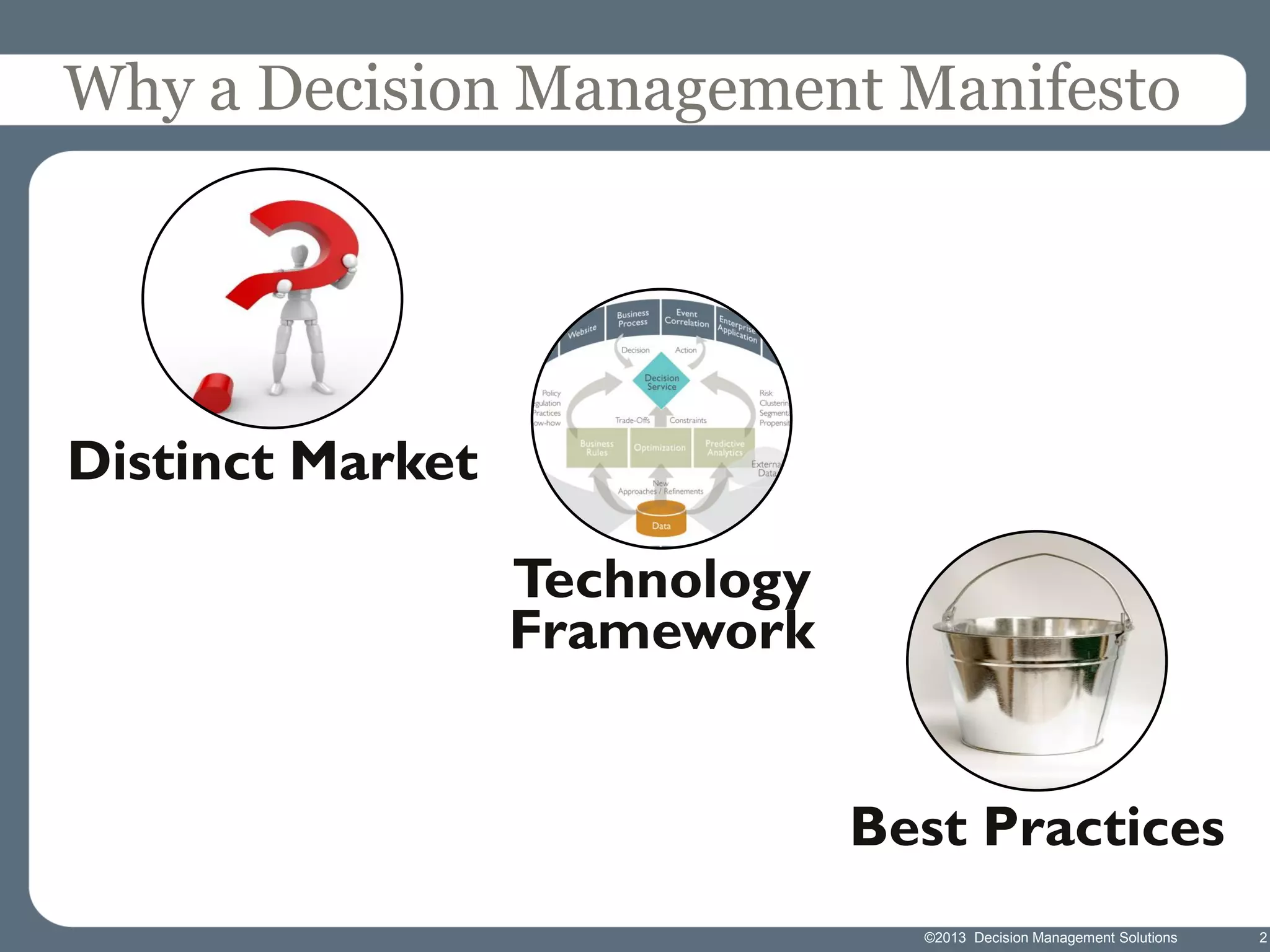
Why a Decision Management Manifesto

Distinct Market
Technology
Framework
Best Practices
©2013 Decision Management Solutions

2
Your Presenter – James Taylor
CEO of Decision Management Solutions

We help clients to improve their
business by applying business rules and
analytic technology to automate and
improve decisions
I have spent the 11 years championing
Decision Management and developing
Decision Management Systems

©2013 Decision Management Solutions

3
Decision Management
A business discipline and a technology stack
Builds on existing IT infrastructure
Enhances business processes
Leverages analytics to manage uncertainty
Increases transparency and business control

Effectively implements
Business Rules
Predictive Analytics

©2013 Decision Management Solutions

4
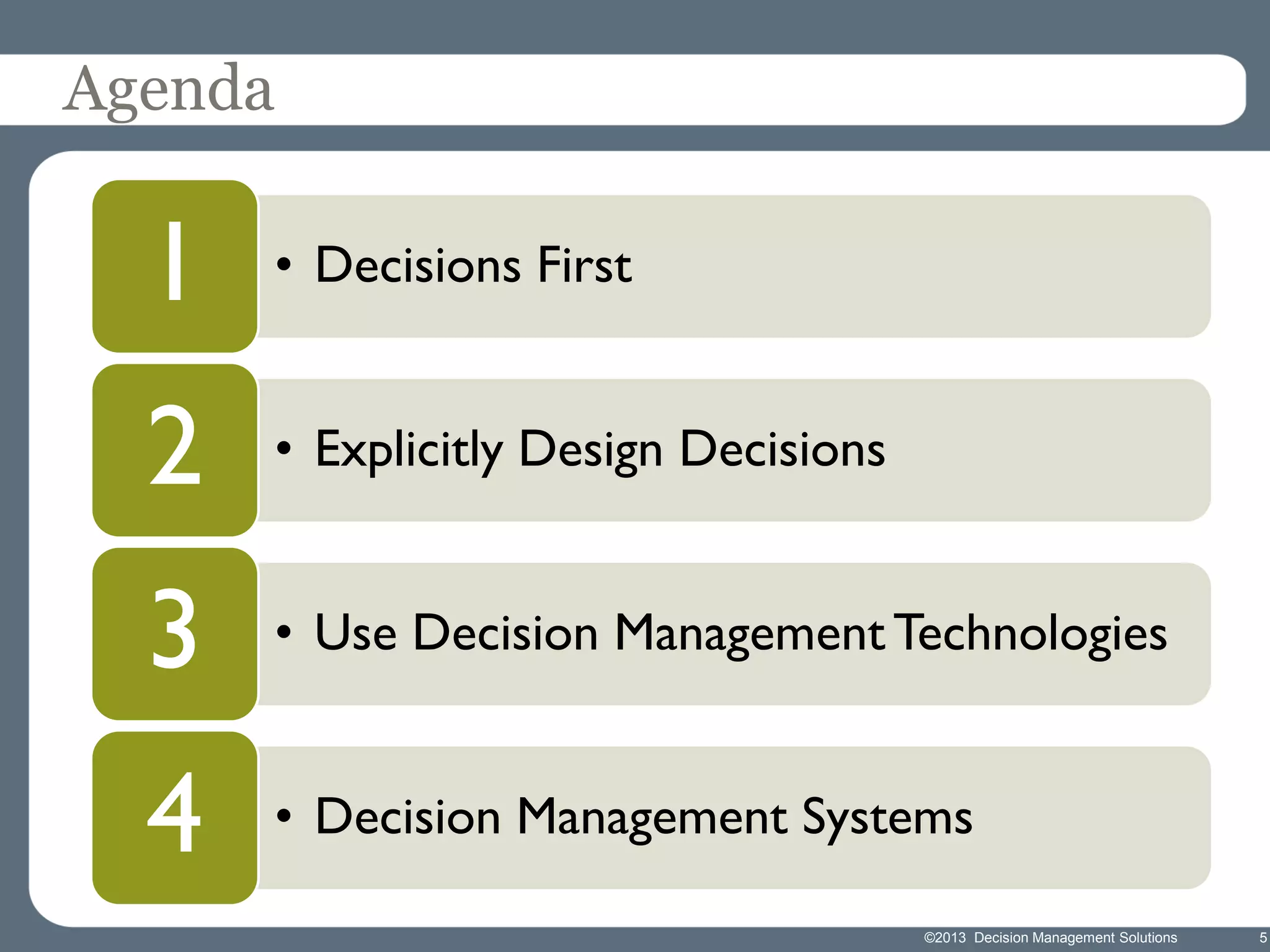
Agenda

1

• Decisions First

2

• Explicitly Design Decisions

3

• Use Decision Management Technologies

4

• Decision Management Systems
©2013 Decision Management Solutions

5
Decisions First
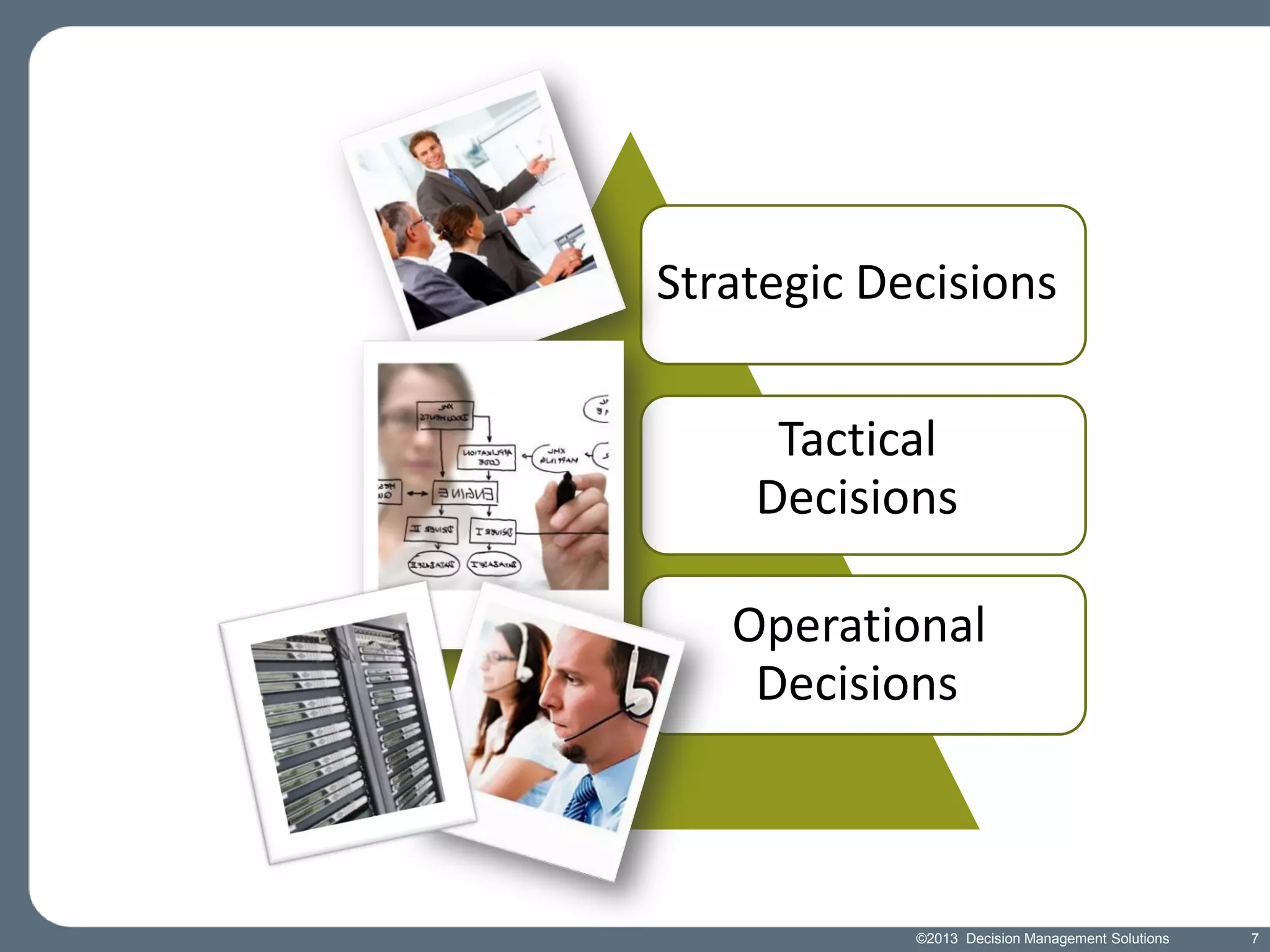
Strategic Decisions
Tactical
Decisions
Operational
Decisions

©2013 Decision Management Solutions

7
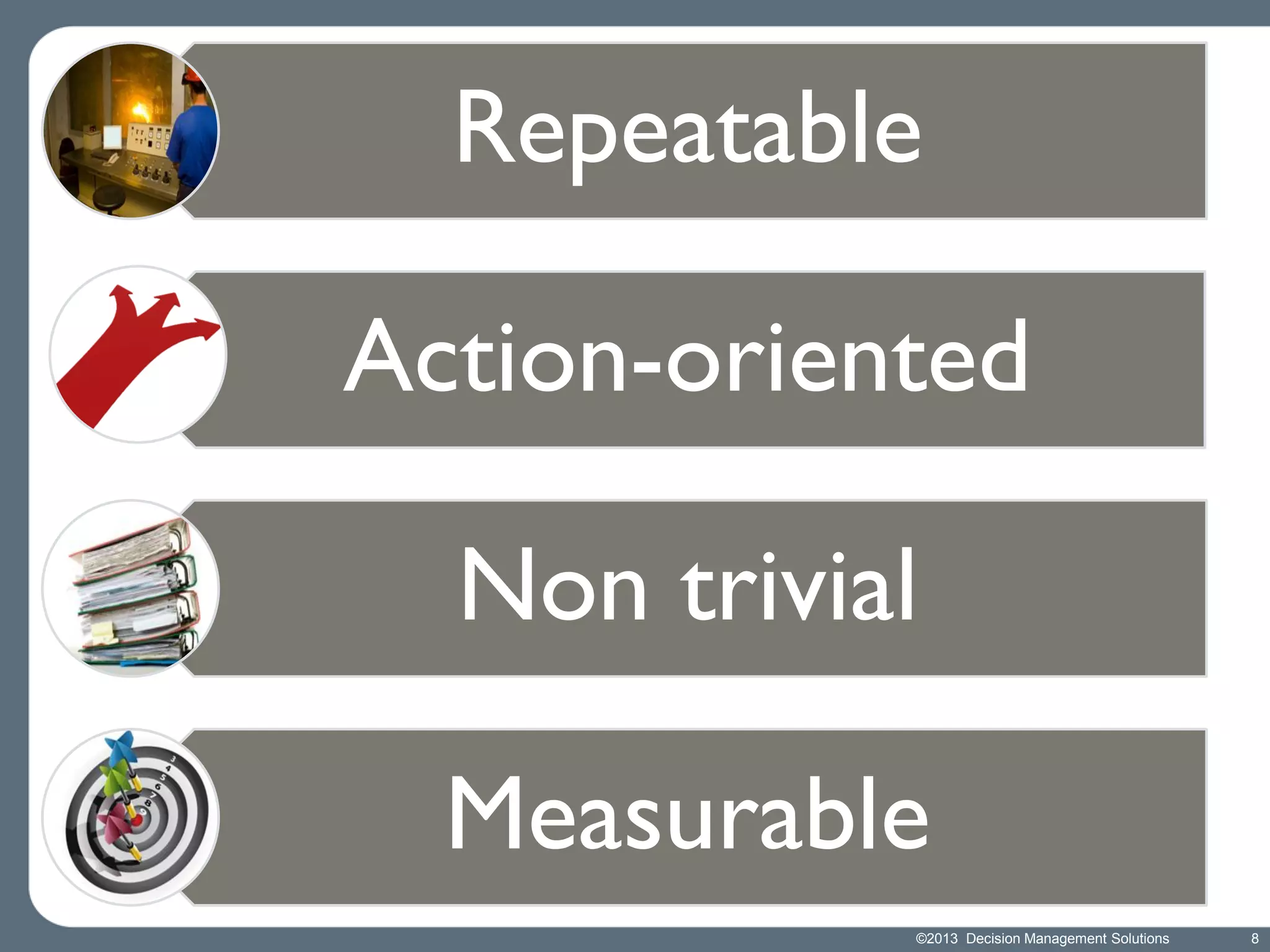
Repeatable

Action-oriented
Non trivial

Measurable
©2013 Decision Management Solutions

8
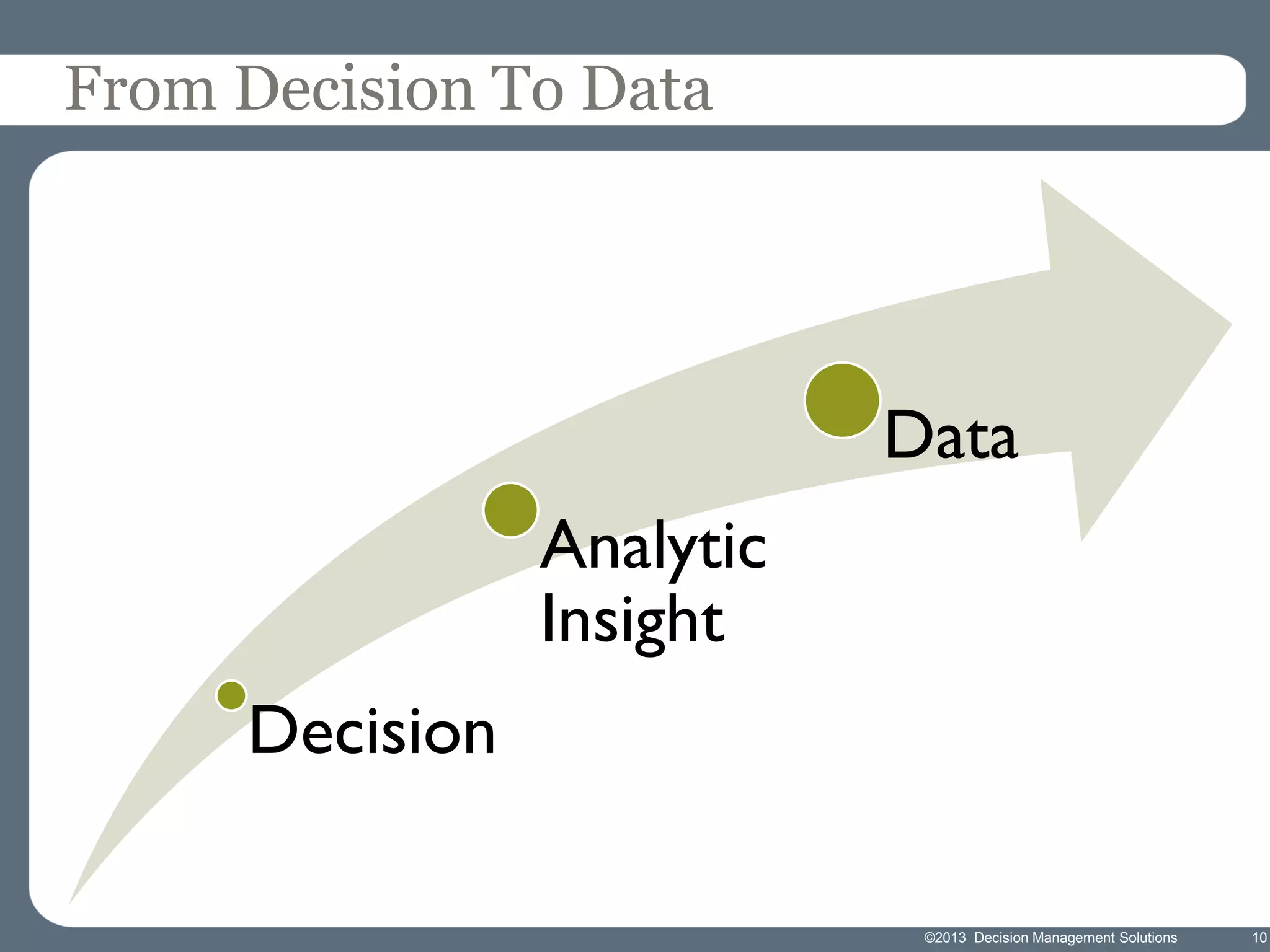
From Decision To Data

Data
Analytic
Insight
Decision
©2013 Decision Management Solutions

10
Decisions First
1.

Decisions First
1.

2.

3.
4.

5.

Decisions, especially operational decisions, link an
organization’s metrics and objectives to its operational
systems.
Decisions are first class objects just like business processes or
data and should be identified, described, modeled, reviewed and
managed in business terms as part of a business architecture.
Decisions should be modeled first before considering how
business rules and or analytics will be used.
Decisions support business processes and help organizations
respond to events but they are not subsumed by either
processes or events, simplifying their expression and
management.
Business, IT, and analytic professionals all have a role in
identifying, describing, modeling, reviewing and managing
decisions.
©2013 Decision Management Solutions

12
Explicitly Design Decisions
Describe Decisions
Define Decisions with
A question
Possible answers

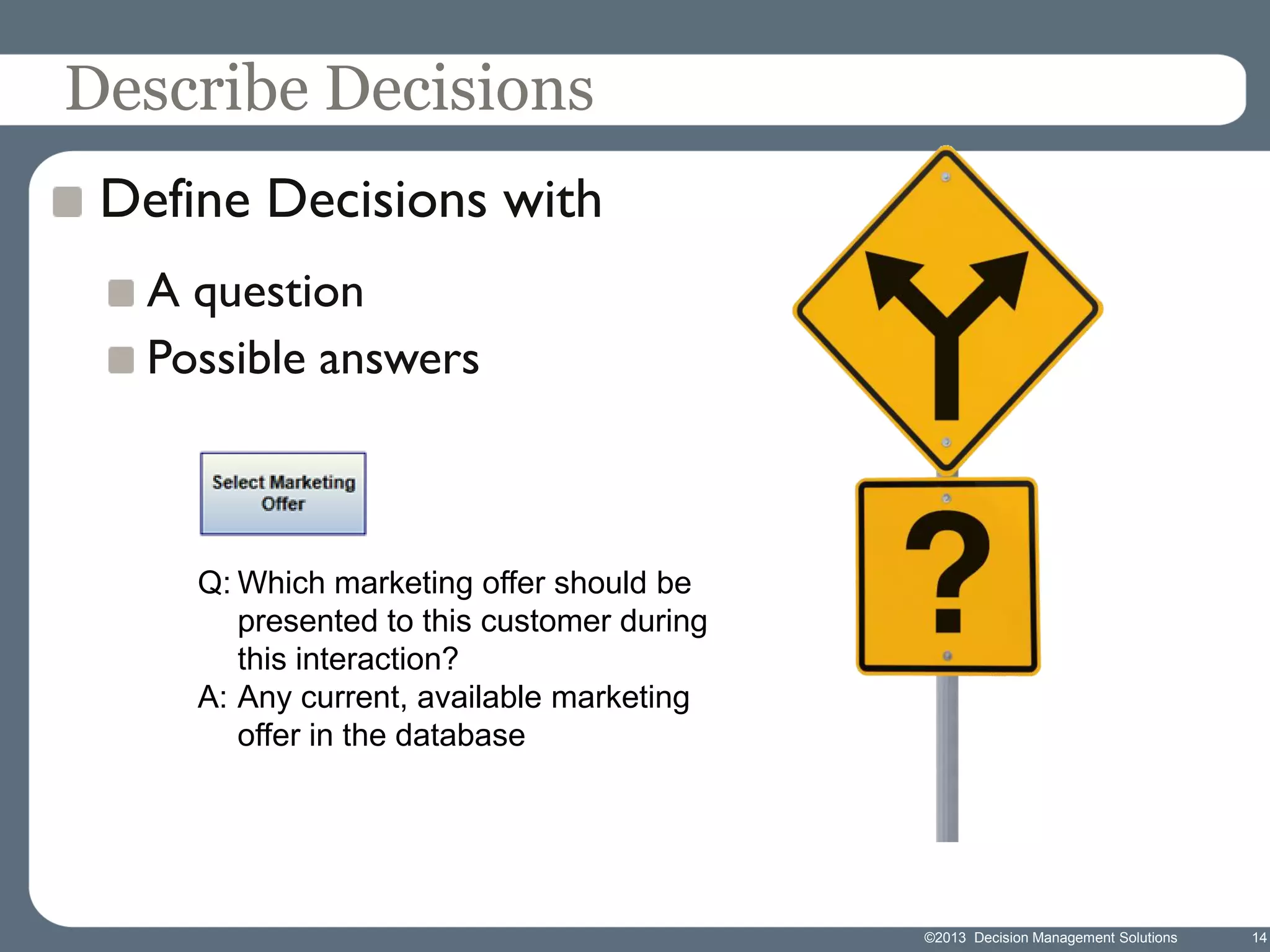
Q: Which marketing offer should be
presented to this customer during
this interaction?
A: Any current, available marketing
offer in the database

©2013 Decision Management Solutions

14
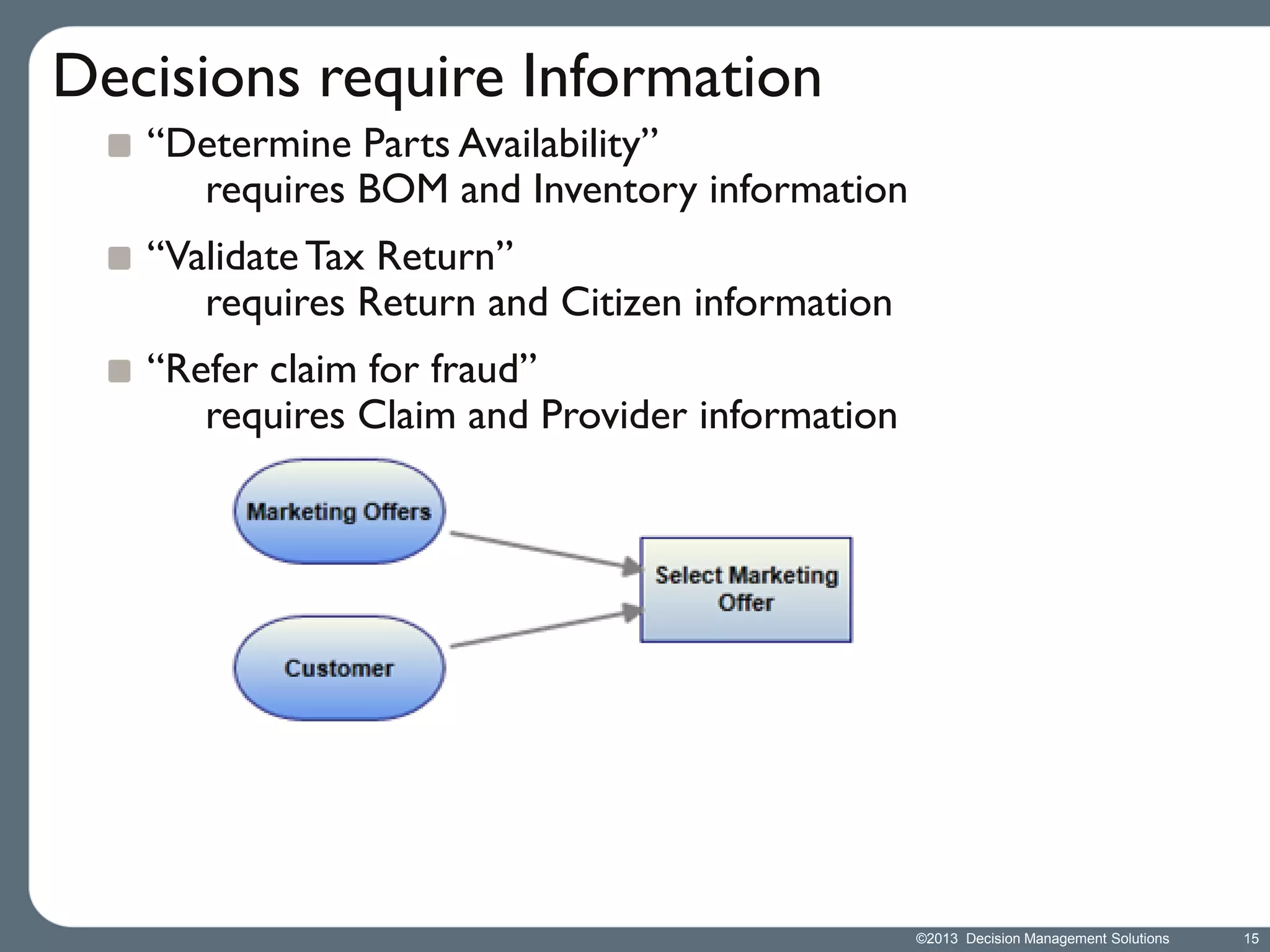
Decisions require Information
“Determine Parts Availability”
requires BOM and Inventory information
“Validate Tax Return”
requires Return and Citizen information
“Refer claim for fraud”
requires Claim and Provider information

©2013 Decision Management Solutions

15
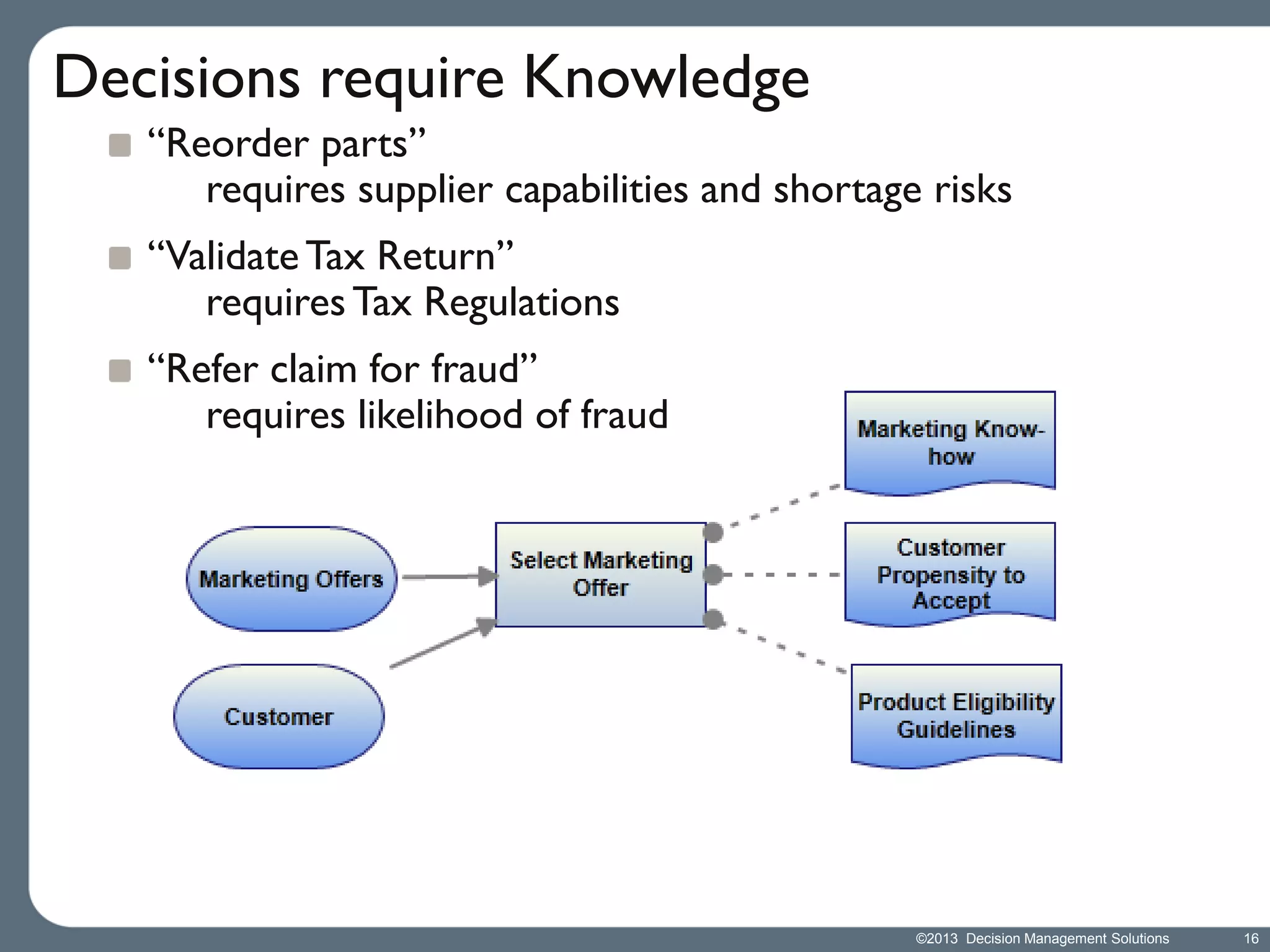
Decisions require Knowledge
“Reorder parts”
requires supplier capabilities and shortage risks
“Validate Tax Return”
requires Tax Regulations
“Refer claim for fraud”
requires likelihood of fraud

©2013 Decision Management Solutions

16
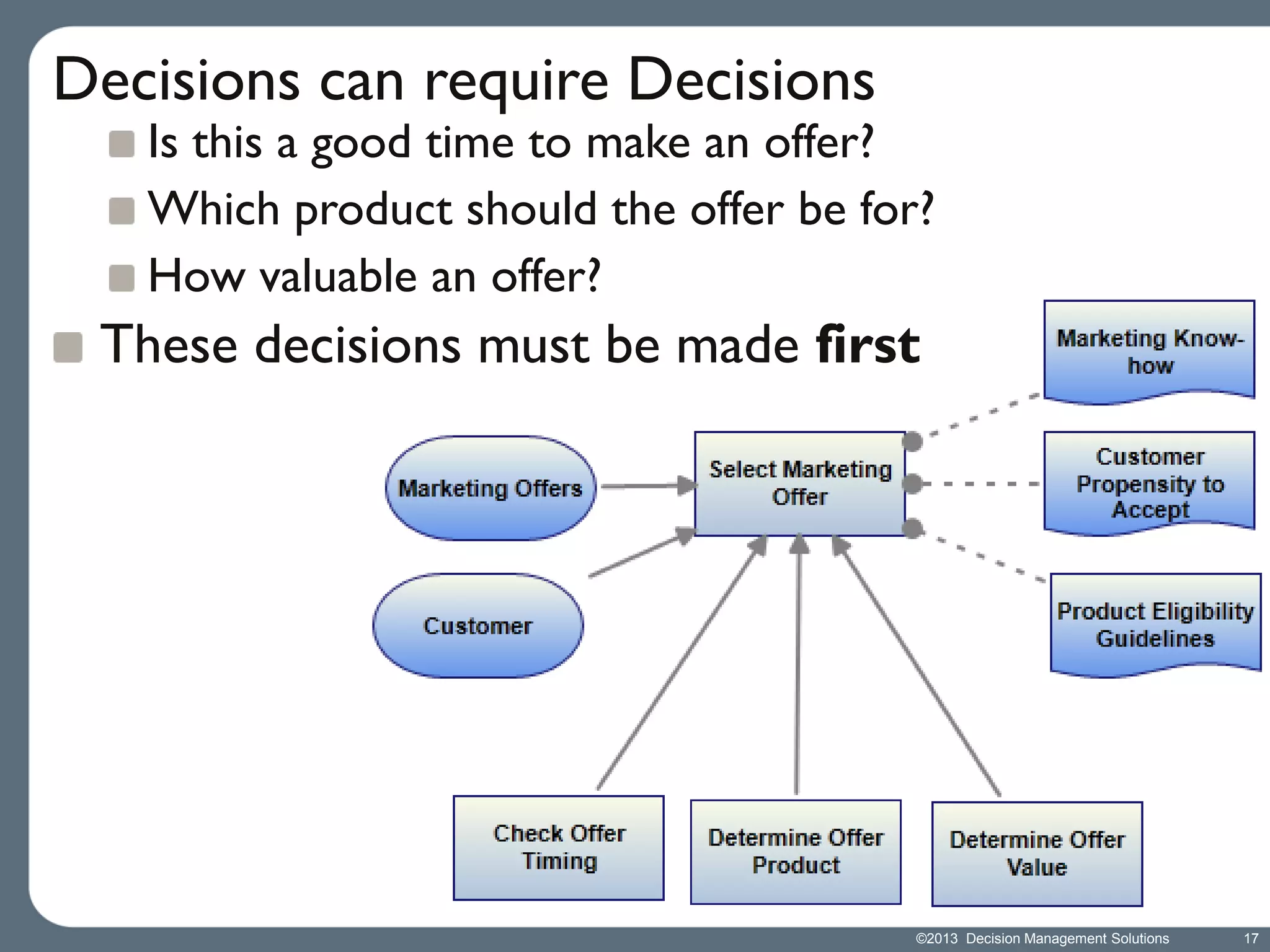
Decisions can require Decisions

Is this a good time to make an offer?
Which product should the offer be for?
How valuable an offer?

These decisions must be made first

©2013 Decision Management Solutions

17
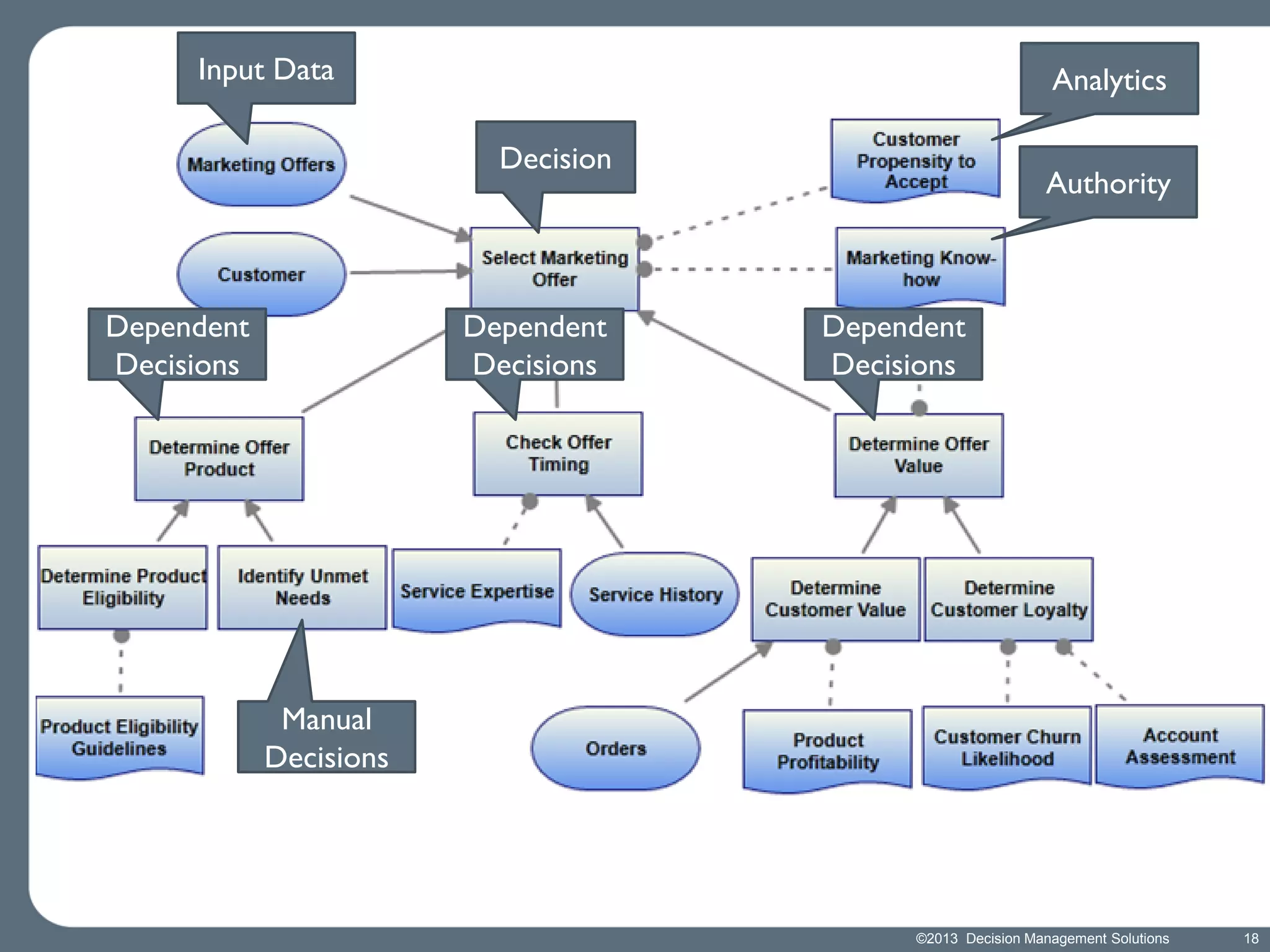
Input Data

Analytics
Decision

Dependent
Decisions

Dependent
Decisions

Authority

Dependent
Decisions

Manual
Decisions

©2013 Decision Management Solutions

18
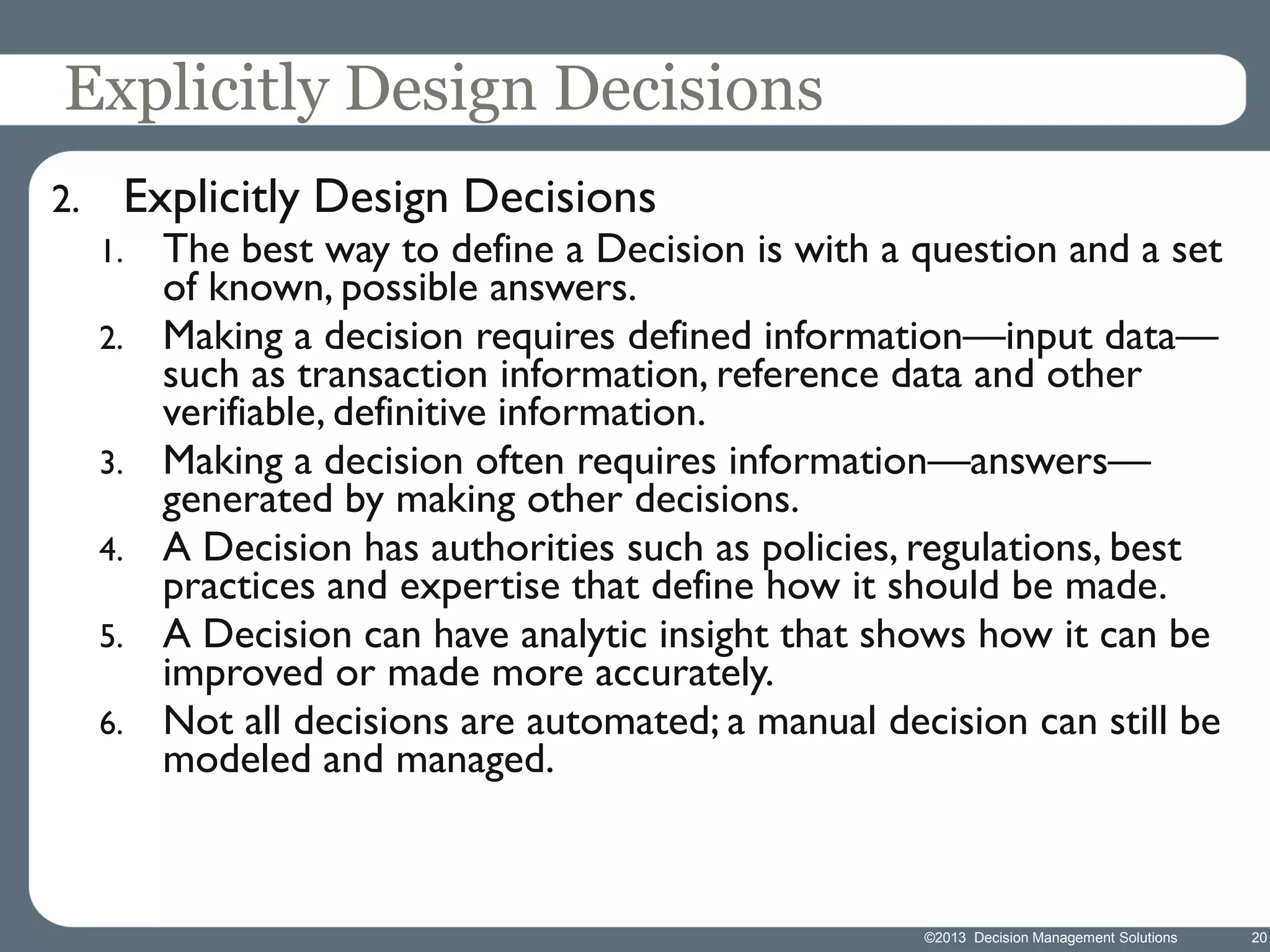
Explicitly Design Decisions
2.

Explicitly Design Decisions

The best way to define a Decision is with a question and a set
of known, possible answers.
2. Making a decision requires defined information—input data—
such as transaction information, reference data and other
verifiable, definitive information.
3. Making a decision often requires information—answers—
generated by making other decisions.
4. A Decision has authorities such as policies, regulations, best
practices and expertise that define how it should be made.
5. A Decision can have analytic insight that shows how it can be
improved or made more accurately.
6. Not all decisions are automated; a manual decision can still be
modeled and managed.
1.

©2013 Decision Management Solutions

20
Use Decision Management
Technologies
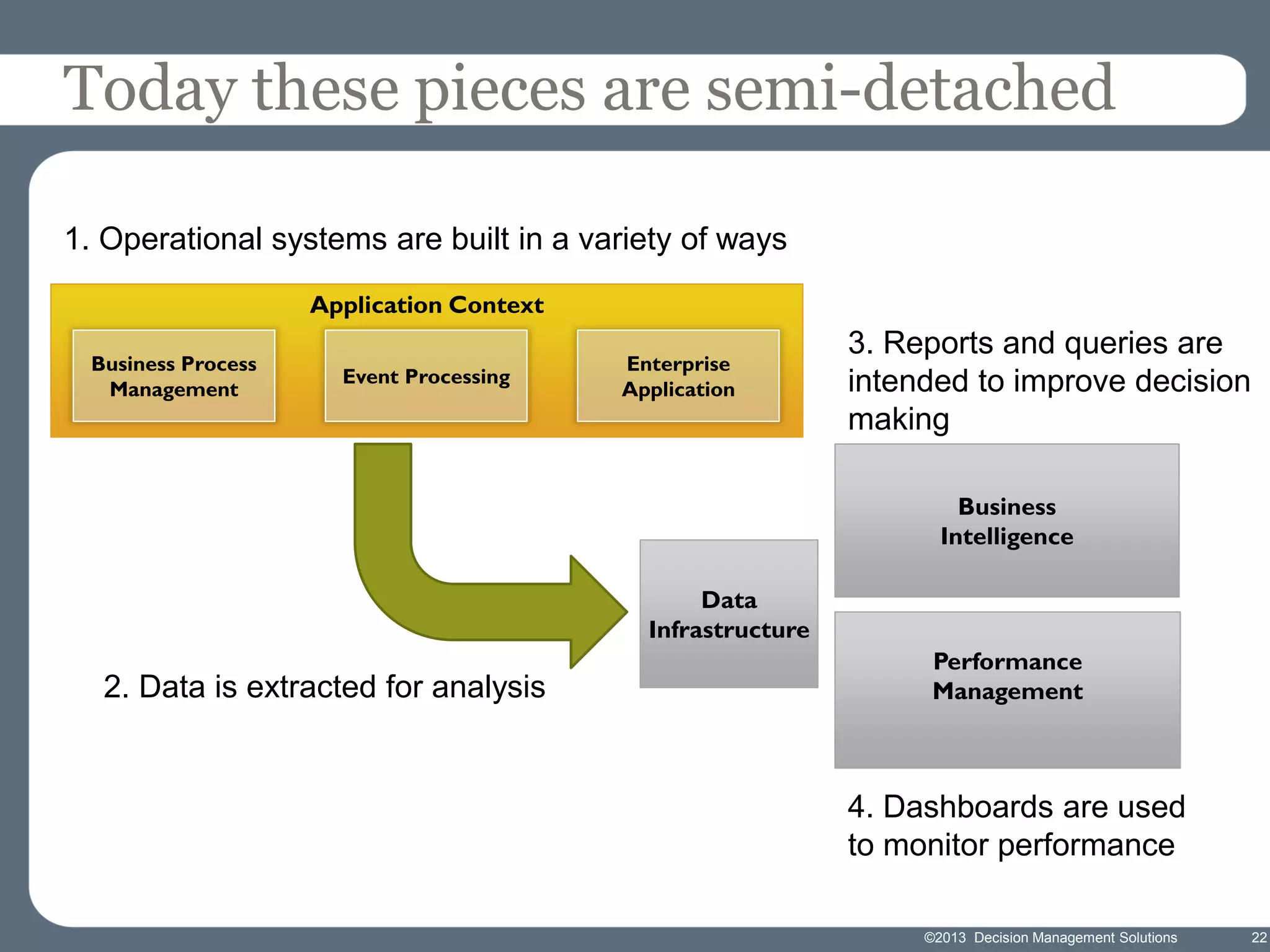
Today these pieces are semi-detached
1. Operational systems are built in a variety of ways
Application Context
Business Process
Management

Event Processing

Enterprise
Application

3. Reports and queries are
intended to improve decision
making
Business
Intelligence

Data
Infrastructure

2. Data is extracted for analysis

Performance
Management

4. Dashboards are used
to monitor performance
©2013 Decision Management Solutions

22
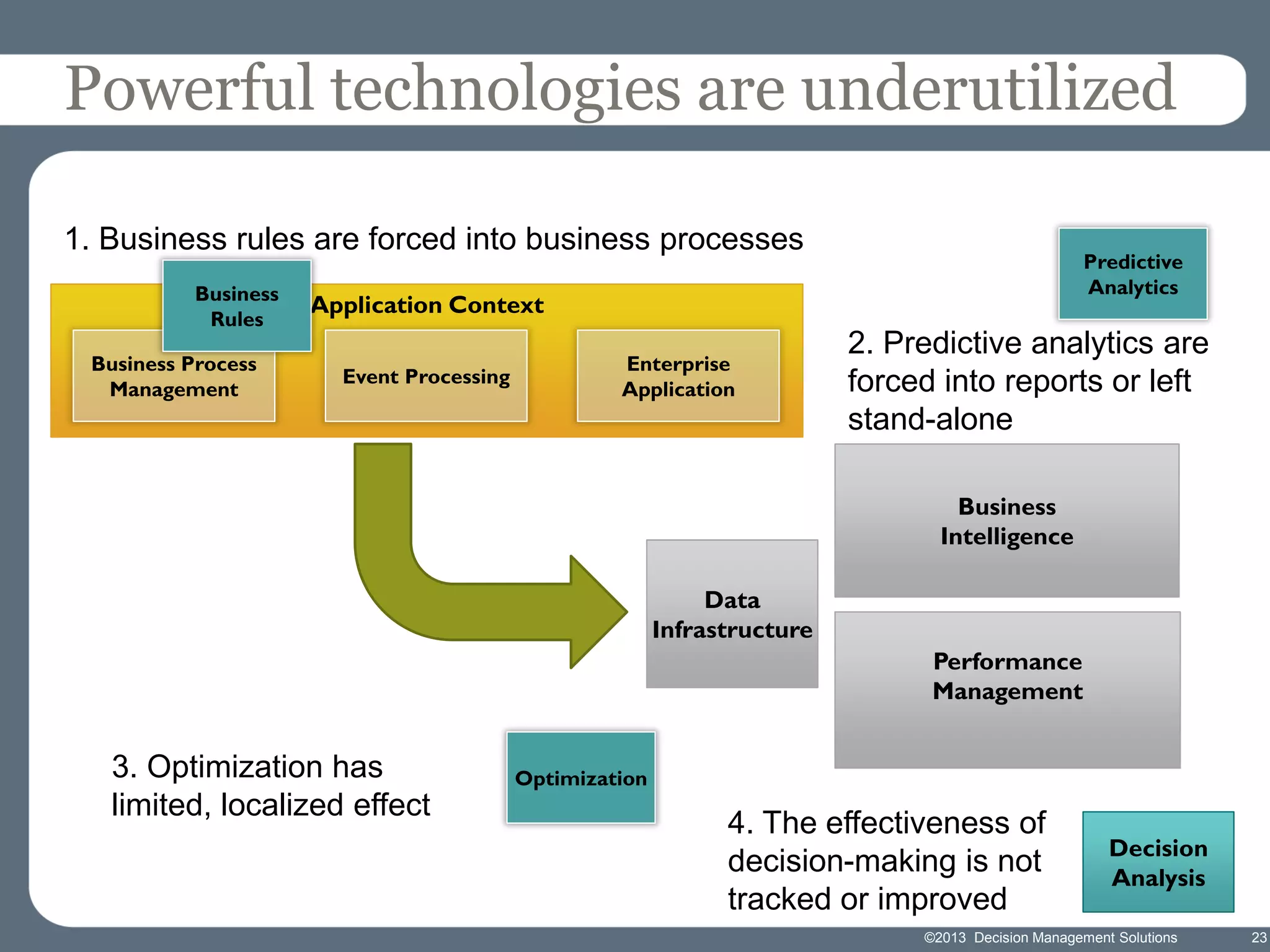
Powerful technologies are underutilized
1. Business rules are forced into business processes
Business
Rules
Business Process
Management

Predictive
Analytics

Application Context
Event Processing

Enterprise
Application

2. Predictive analytics are
forced into reports or left
stand-alone
Business
Intelligence

Data
Infrastructure
Performance
Management

3. Optimization has
limited, localized effect

Optimization

4. The effectiveness of
decision-making is not
tracked or improved

Decision
Analysis

©2013 Decision Management Solutions

23
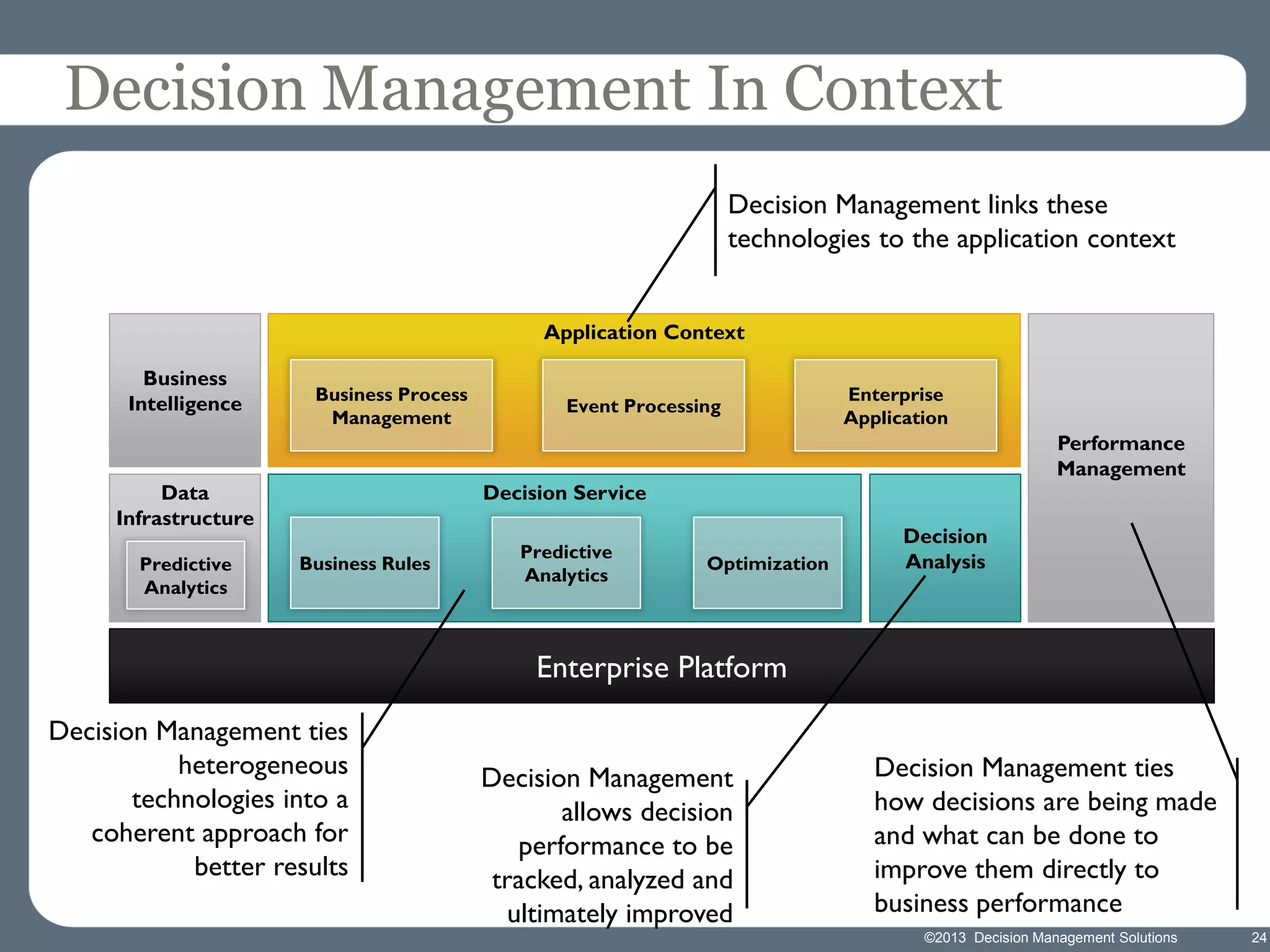
Decision Management In Context
Decision Management links these
technologies to the application context
Application Context
Business
Intelligence

Business Process
Management

Data
Infrastructure
Predictive
Analytics

Event Processing

Enterprise
Application

Performance
Management

Decision Service
Business Rules

Predictive
Analytics

Optimization

Decision
Analysis

Enterprise Platform
Decision Management ties
heterogeneous
technologies into a
coherent approach for
better results

Decision Management
allows decision
performance to be
tracked, analyzed and
ultimately improved

Decision Management ties
how decisions are being made
and what can be done to
improve them directly to
business performance
©2013 Decision Management Solutions

24
©2013 Decision Management Solutions

25
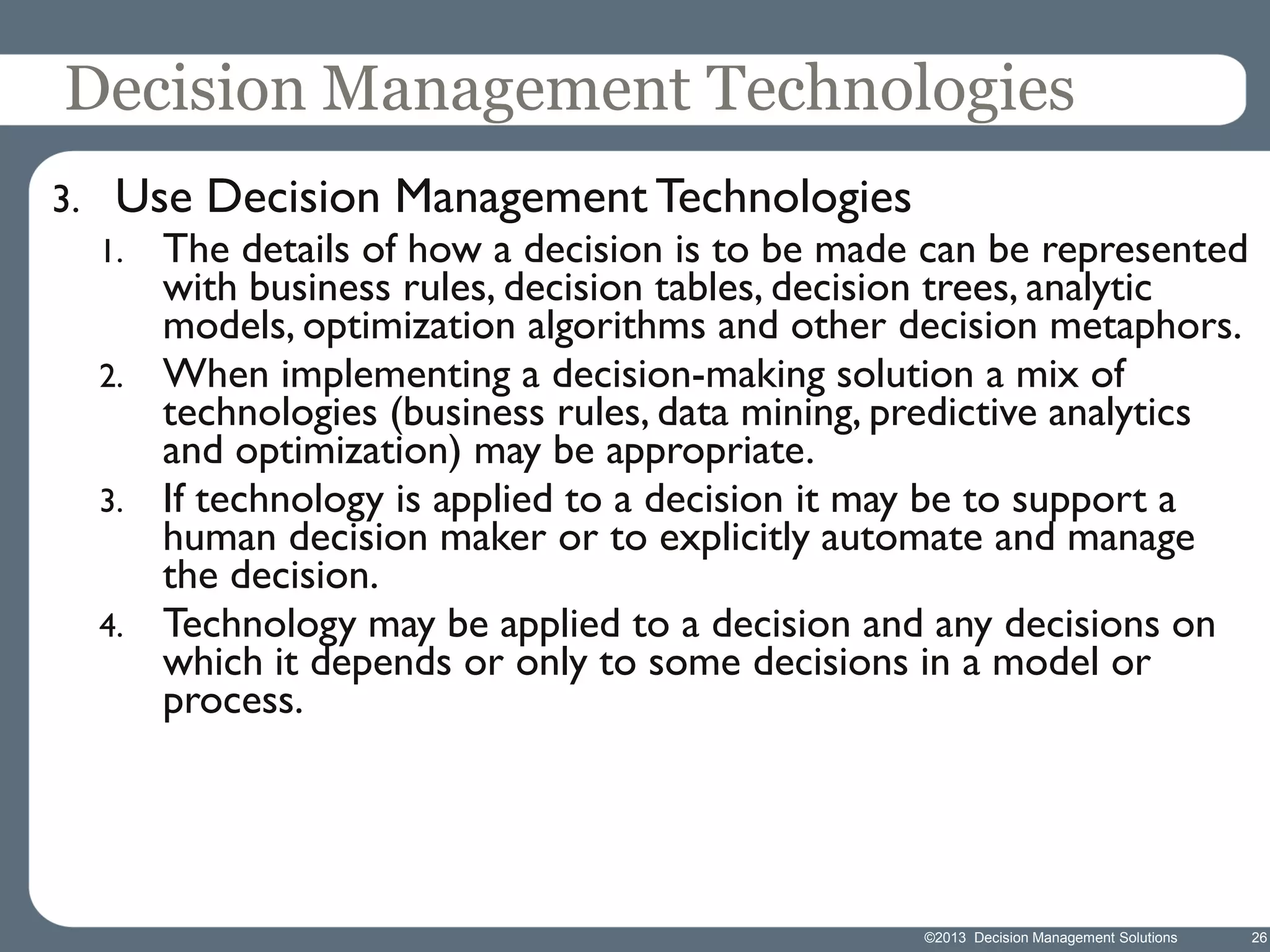
Decision Management Technologies
3.

Use Decision Management Technologies

The details of how a decision is to be made can be represented
with business rules, decision tables, decision trees, analytic
models, optimization algorithms and other decision metaphors.
2. When implementing a decision-making solution a mix of
technologies (business rules, data mining, predictive analytics
and optimization) may be appropriate.
3. If technology is applied to a decision it may be to support a
human decision maker or to explicitly automate and manage
the decision.
4. Technology may be applied to a decision and any decisions on
which it depends or only to some decisions in a model or
process.
1.

©2013 Decision Management Solutions

26
Decision Management
Systems
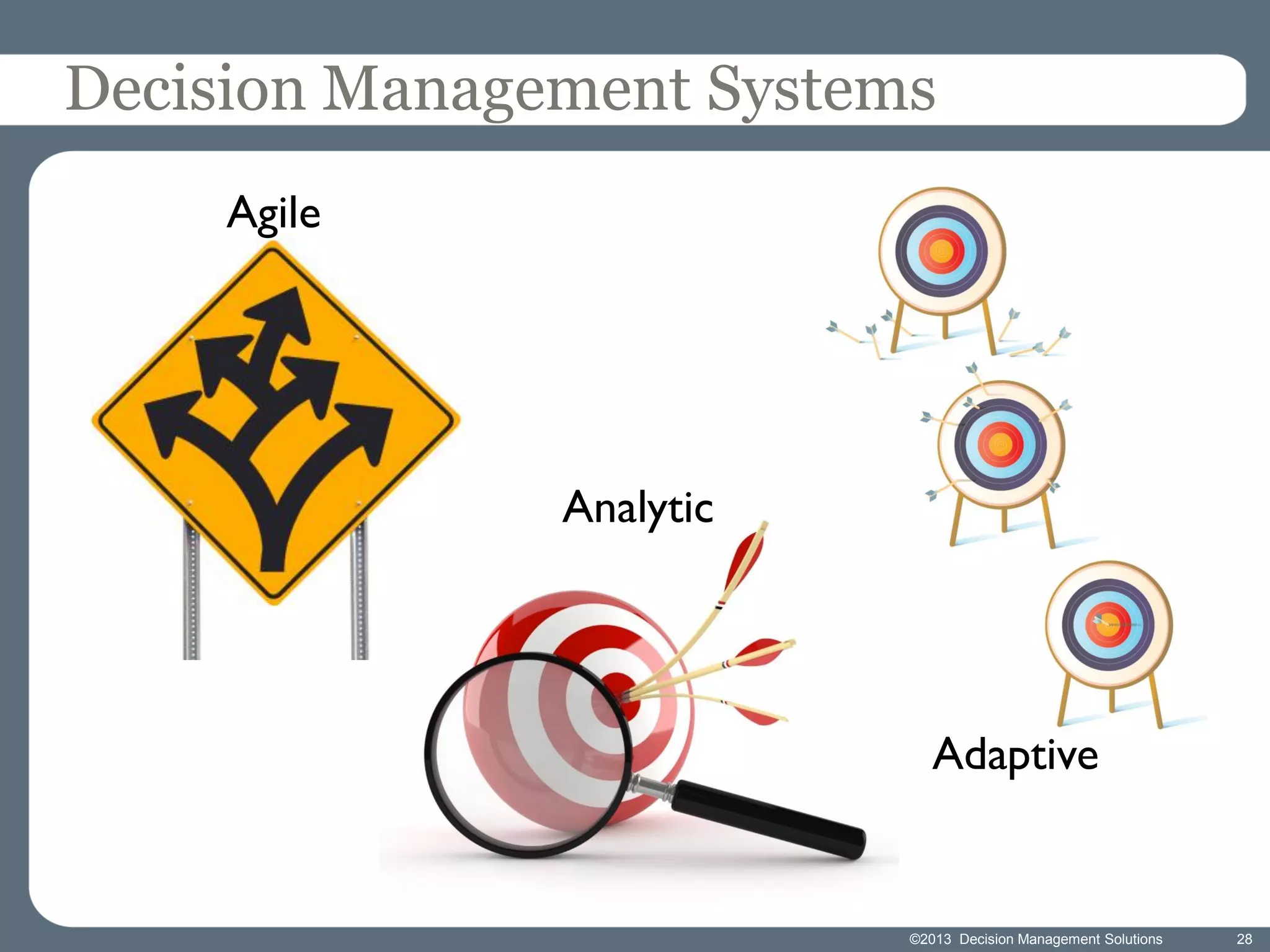
Decision Management Systems
Agile

Analytic

Adaptive

©2013 Decision Management Solutions

28
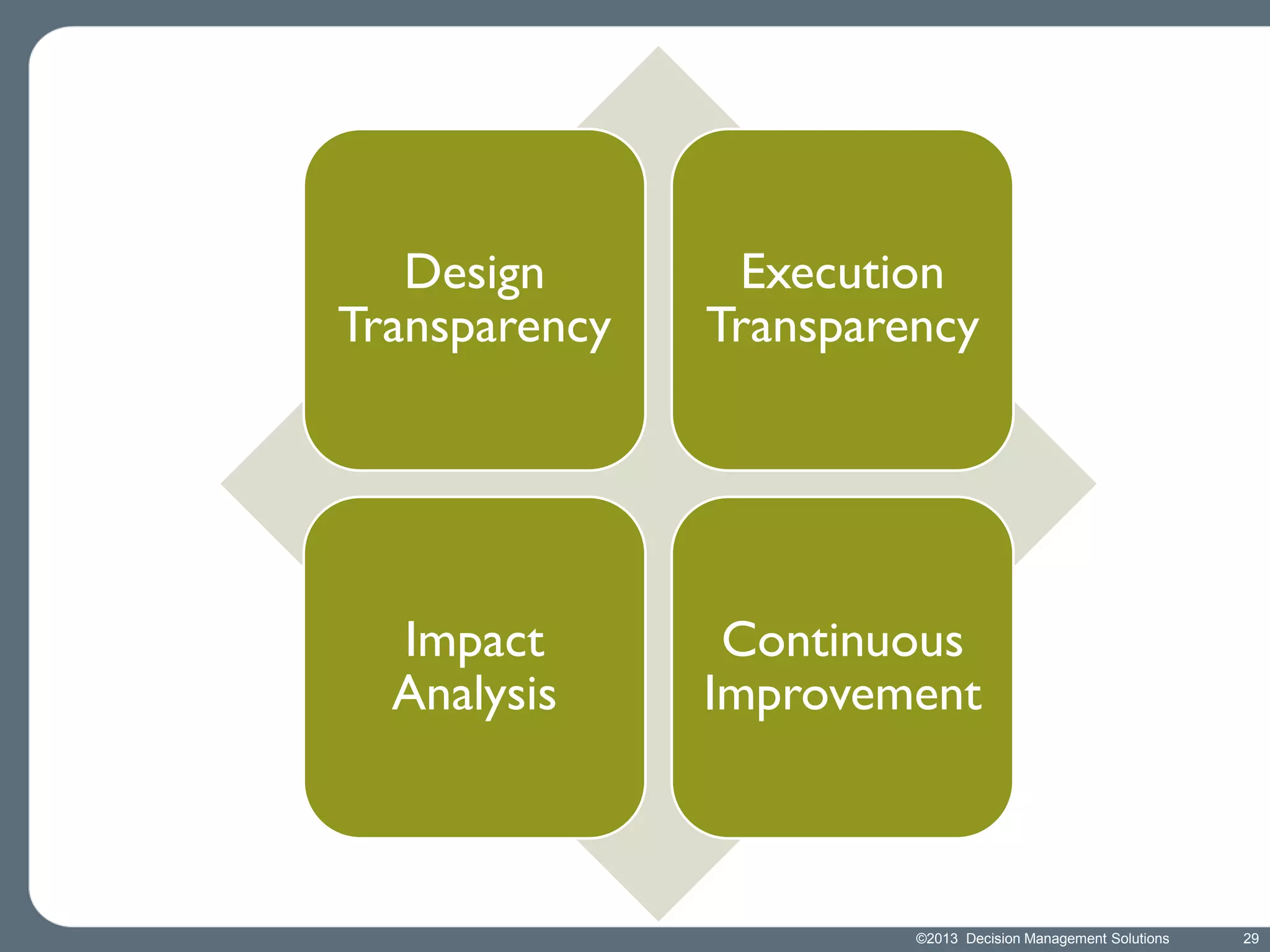
Design
Transparency

Execution
Transparency

Impact
Analysis

Continuous
Improvement

©2013 Decision Management Solutions

29
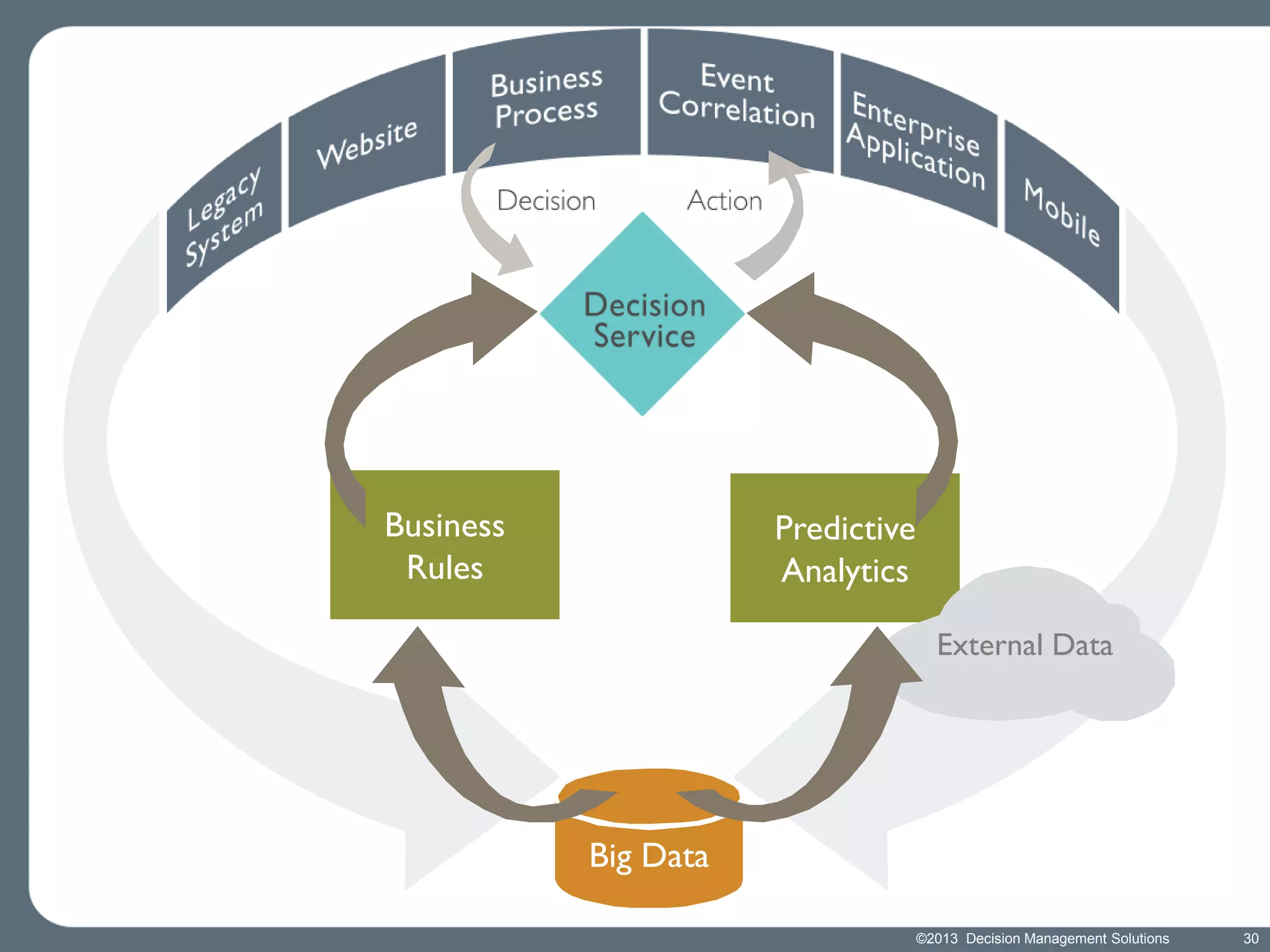
Business
Rules

Predictive
Analytics
External Data

Big Data
©2013 Decision Management Solutions

30
©2013 Decision Management Solutions

31
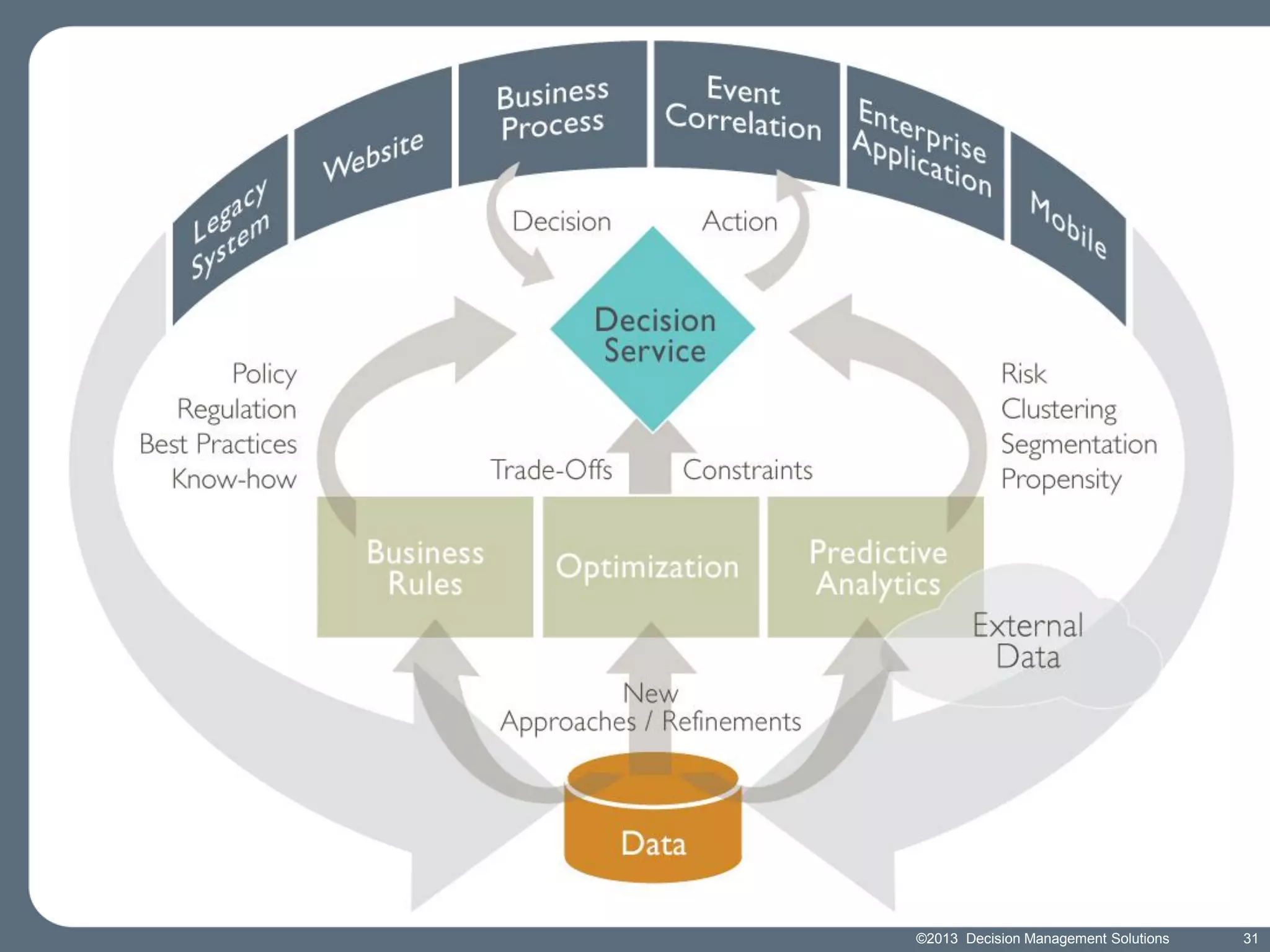
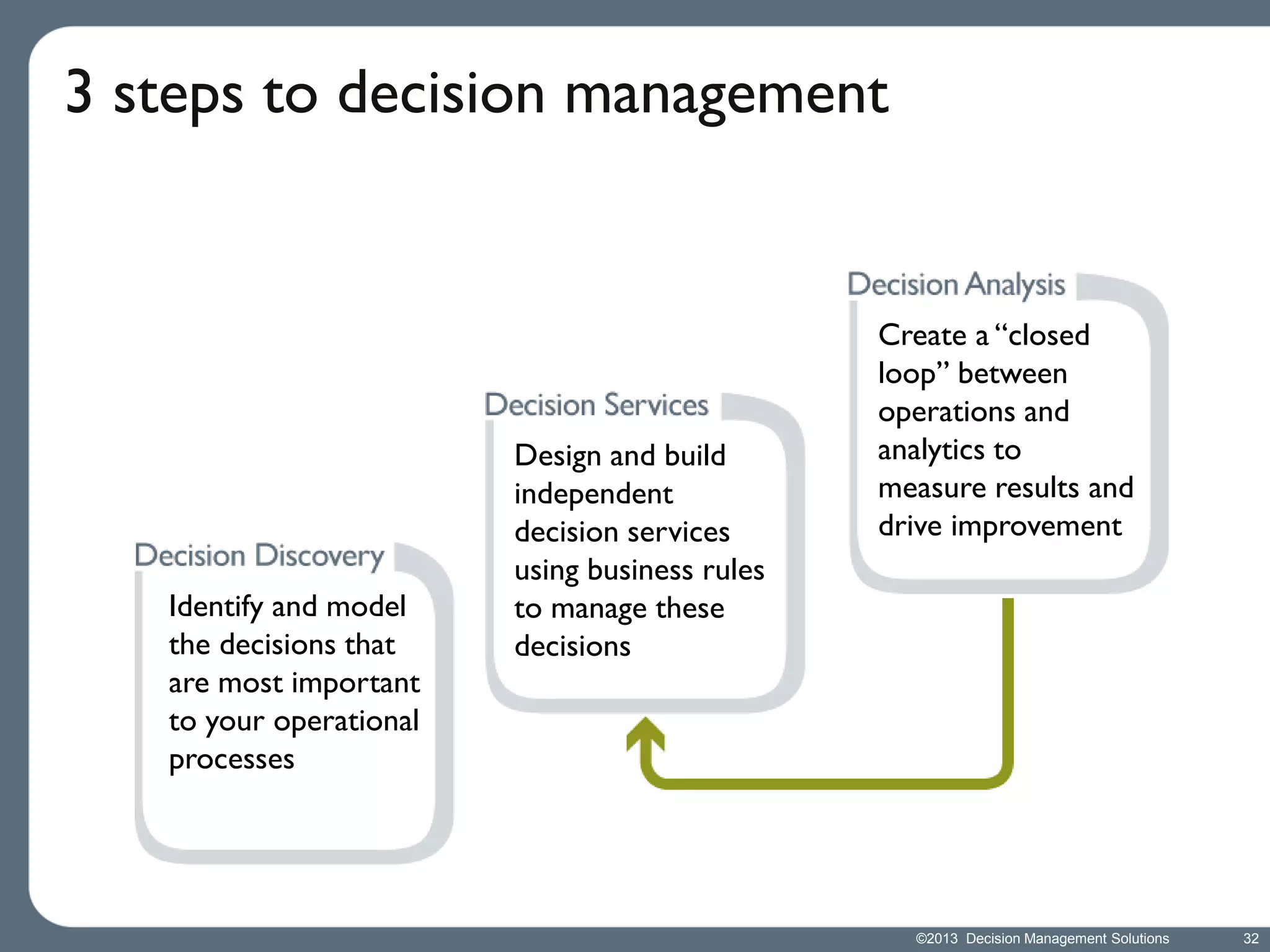
3 steps to decision management

Identify and model
the decisions that
are most important
to your operational
processes

Design and build
independent
decision services
using business rules
to manage these
decisions

Create a “closed
loop” between
operations and
analytics to
measure results and
drive improvement

©2013 Decision Management Solutions

32
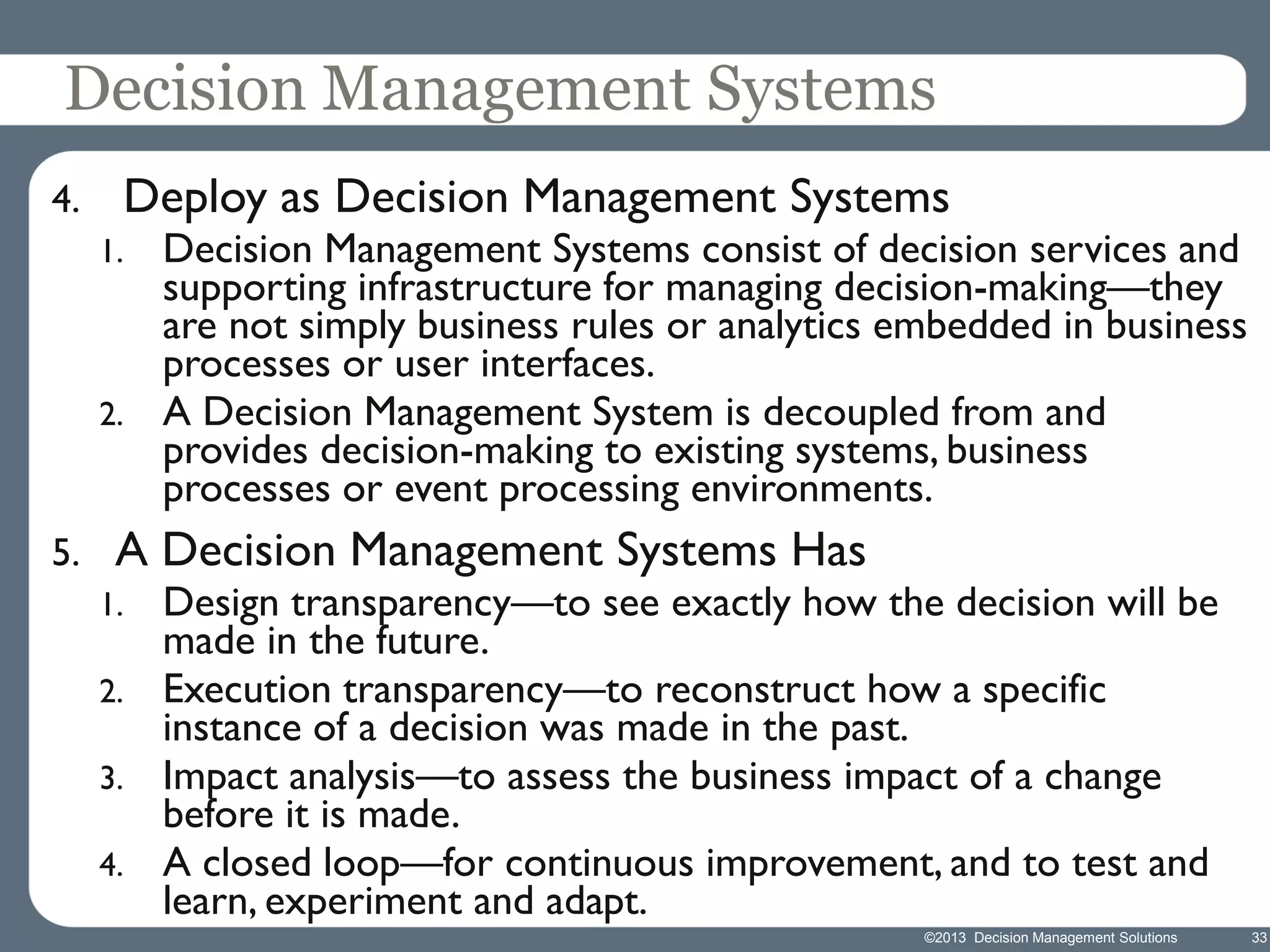
Decision Management Systems
4.

Deploy as Decision Management Systems
1.

2.

5.

Decision Management Systems consist of decision services and
supporting infrastructure for managing decision-making—they
are not simply business rules or analytics embedded in business
processes or user interfaces.
A Decision Management System is decoupled from and
provides decision-making to existing systems, business
processes or event processing environments.

A Decision Management Systems Has
1.
2.
3.
4.

Design transparency—to see exactly how the decision will be
made in the future.
Execution transparency—to reconstruct how a specific
instance of a decision was made in the past.
Impact analysis—to assess the business impact of a change
before it is made.
A closed loop—for continuous improvement, and to test and
learn, experiment and adapt.
©2013 Decision Management Solutions

33
Questions?
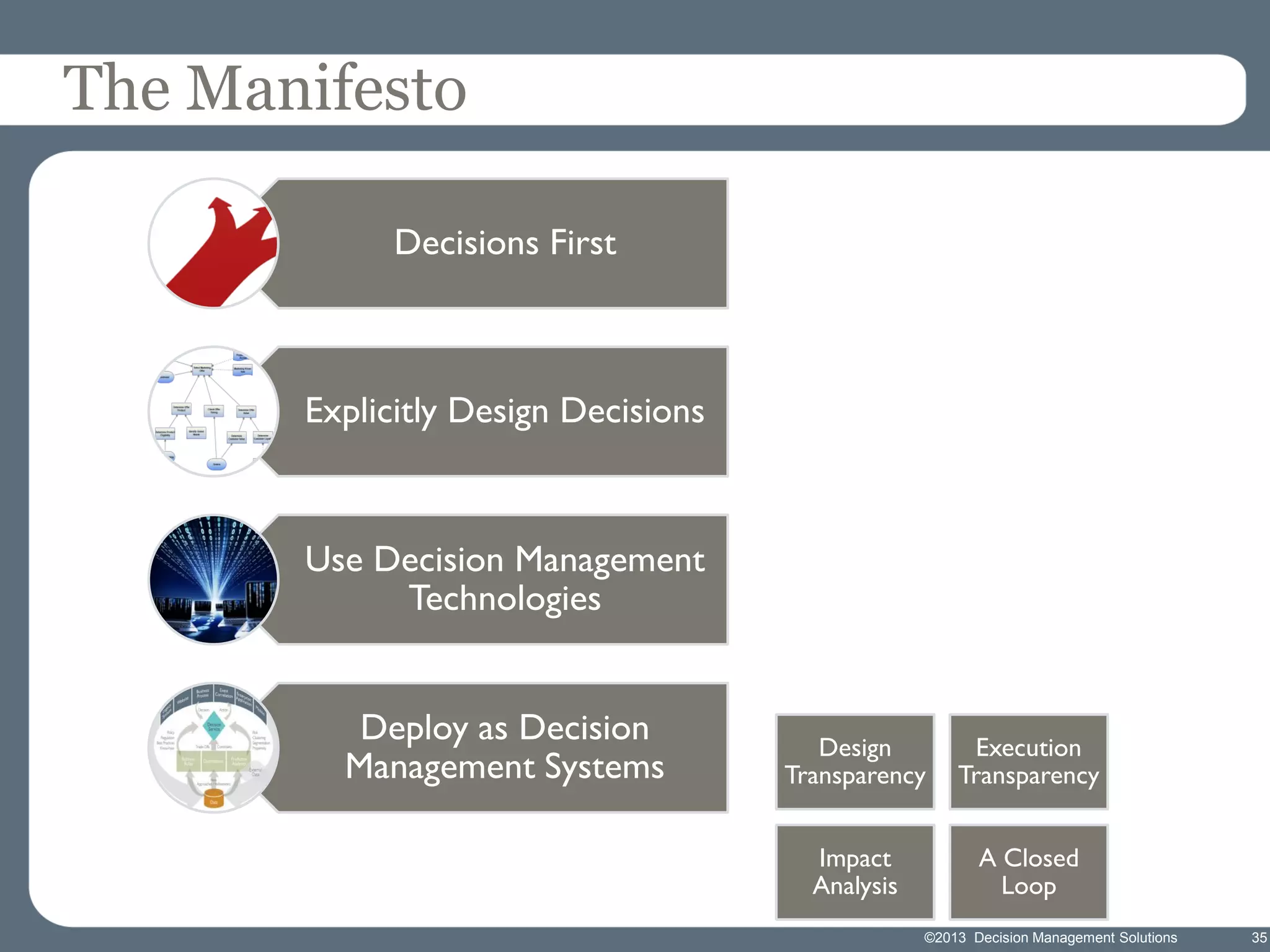
The Manifesto
Decisions First

Explicitly Design Decisions

Use Decision Management
Technologies
Deploy as Decision
Management Systems

Design
Transparency

Execution
Transparency

Impact
Analysis

A Closed
Loop
©2013 Decision Management Solutions

35
Find Out More
Decision Management Manifesto & White Paper

decisionmanagementsolutions.com/decision-management-manifesto

Decision Modeling

decisionmanagementsolutions.com/services/decision-modeling

DecisionsFirst Modeler

decisionmanagementsolutions.com/decisionsfirst-modeler

Decision Management Technology

decisionmanagementsolutions.com/decision-management-technology

©2013 Decision Management Solutions

36
Thank You
James Taylor, CEO
james@decisionmanagementsolutions.com

More on Decision Management at
decisionmangementsolutions.com

The Decision Management Manifesto Explained

  • 1.
  • 2.
    Why a DecisionManagement Manifesto Distinct Market Technology Framework Best Practices ©2013 Decision Management Solutions 2
  • 3.
    Your Presenter –James Taylor CEO of Decision Management Solutions We help clients to improve their business by applying business rules and analytic technology to automate and improve decisions I have spent the 11 years championing Decision Management and developing Decision Management Systems ©2013 Decision Management Solutions 3
  • 4.
    Decision Management A businessdiscipline and a technology stack Builds on existing IT infrastructure Enhances business processes Leverages analytics to manage uncertainty Increases transparency and business control Effectively implements Business Rules Predictive Analytics ©2013 Decision Management Solutions 4
  • 5.
    Agenda 1 • Decisions First 2 •Explicitly Design Decisions 3 • Use Decision Management Technologies 4 • Decision Management Systems ©2013 Decision Management Solutions 5
  • 6.
  • 7.
  • 8.
  • 10.
    From Decision ToData Data Analytic Insight Decision ©2013 Decision Management Solutions 10
  • 12.
    Decisions First 1. Decisions First 1. 2. 3. 4. 5. Decisions,especially operational decisions, link an organization’s metrics and objectives to its operational systems. Decisions are first class objects just like business processes or data and should be identified, described, modeled, reviewed and managed in business terms as part of a business architecture. Decisions should be modeled first before considering how business rules and or analytics will be used. Decisions support business processes and help organizations respond to events but they are not subsumed by either processes or events, simplifying their expression and management. Business, IT, and analytic professionals all have a role in identifying, describing, modeling, reviewing and managing decisions. ©2013 Decision Management Solutions 12
  • 13.
  • 14.
    Describe Decisions Define Decisionswith A question Possible answers Q: Which marketing offer should be presented to this customer during this interaction? A: Any current, available marketing offer in the database ©2013 Decision Management Solutions 14
  • 15.
    Decisions require Information “DetermineParts Availability” requires BOM and Inventory information “Validate Tax Return” requires Return and Citizen information “Refer claim for fraud” requires Claim and Provider information ©2013 Decision Management Solutions 15
  • 16.
    Decisions require Knowledge “Reorderparts” requires supplier capabilities and shortage risks “Validate Tax Return” requires Tax Regulations “Refer claim for fraud” requires likelihood of fraud ©2013 Decision Management Solutions 16
  • 17.
    Decisions can requireDecisions Is this a good time to make an offer? Which product should the offer be for? How valuable an offer? These decisions must be made first ©2013 Decision Management Solutions 17
  • 18.
  • 20.
    Explicitly Design Decisions 2. ExplicitlyDesign Decisions The best way to define a Decision is with a question and a set of known, possible answers. 2. Making a decision requires defined information—input data— such as transaction information, reference data and other verifiable, definitive information. 3. Making a decision often requires information—answers— generated by making other decisions. 4. A Decision has authorities such as policies, regulations, best practices and expertise that define how it should be made. 5. A Decision can have analytic insight that shows how it can be improved or made more accurately. 6. Not all decisions are automated; a manual decision can still be modeled and managed. 1. ©2013 Decision Management Solutions 20
  • 21.
  • 22.
    Today these piecesare semi-detached 1. Operational systems are built in a variety of ways Application Context Business Process Management Event Processing Enterprise Application 3. Reports and queries are intended to improve decision making Business Intelligence Data Infrastructure 2. Data is extracted for analysis Performance Management 4. Dashboards are used to monitor performance ©2013 Decision Management Solutions 22
  • 23.
    Powerful technologies areunderutilized 1. Business rules are forced into business processes Business Rules Business Process Management Predictive Analytics Application Context Event Processing Enterprise Application 2. Predictive analytics are forced into reports or left stand-alone Business Intelligence Data Infrastructure Performance Management 3. Optimization has limited, localized effect Optimization 4. The effectiveness of decision-making is not tracked or improved Decision Analysis ©2013 Decision Management Solutions 23
  • 24.
    Decision Management InContext Decision Management links these technologies to the application context Application Context Business Intelligence Business Process Management Data Infrastructure Predictive Analytics Event Processing Enterprise Application Performance Management Decision Service Business Rules Predictive Analytics Optimization Decision Analysis Enterprise Platform Decision Management ties heterogeneous technologies into a coherent approach for better results Decision Management allows decision performance to be tracked, analyzed and ultimately improved Decision Management ties how decisions are being made and what can be done to improve them directly to business performance ©2013 Decision Management Solutions 24
  • 25.
  • 26.
    Decision Management Technologies 3. UseDecision Management Technologies The details of how a decision is to be made can be represented with business rules, decision tables, decision trees, analytic models, optimization algorithms and other decision metaphors. 2. When implementing a decision-making solution a mix of technologies (business rules, data mining, predictive analytics and optimization) may be appropriate. 3. If technology is applied to a decision it may be to support a human decision maker or to explicitly automate and manage the decision. 4. Technology may be applied to a decision and any decisions on which it depends or only to some decisions in a model or process. 1. ©2013 Decision Management Solutions 26
  • 27.
  • 28.
  • 29.
  • 30.
  • 31.
  • 32.
    3 steps todecision management Identify and model the decisions that are most important to your operational processes Design and build independent decision services using business rules to manage these decisions Create a “closed loop” between operations and analytics to measure results and drive improvement ©2013 Decision Management Solutions 32
  • 33.
    Decision Management Systems 4. Deployas Decision Management Systems 1. 2. 5. Decision Management Systems consist of decision services and supporting infrastructure for managing decision-making—they are not simply business rules or analytics embedded in business processes or user interfaces. A Decision Management System is decoupled from and provides decision-making to existing systems, business processes or event processing environments. A Decision Management Systems Has 1. 2. 3. 4. Design transparency—to see exactly how the decision will be made in the future. Execution transparency—to reconstruct how a specific instance of a decision was made in the past. Impact analysis—to assess the business impact of a change before it is made. A closed loop—for continuous improvement, and to test and learn, experiment and adapt. ©2013 Decision Management Solutions 33
  • 34.
  • 35.
    The Manifesto Decisions First ExplicitlyDesign Decisions Use Decision Management Technologies Deploy as Decision Management Systems Design Transparency Execution Transparency Impact Analysis A Closed Loop ©2013 Decision Management Solutions 35
  • 36.
    Find Out More DecisionManagement Manifesto & White Paper decisionmanagementsolutions.com/decision-management-manifesto Decision Modeling decisionmanagementsolutions.com/services/decision-modeling DecisionsFirst Modeler decisionmanagementsolutions.com/decisionsfirst-modeler Decision Management Technology decisionmanagementsolutions.com/decision-management-technology ©2013 Decision Management Solutions 36
  • 37.
    Thank You James Taylor,CEO james@decisionmanagementsolutions.com More on Decision Management at decisionmangementsolutions.com