BUSINESS
CONTINUITY
GUIDE
PLANNING
AGENDA
• Introduction
• Objectives of BCP
• Approaches to BCP
• Dimensions of Scope
• Entry Points
2
• Q&A
INTRODUCTION
So…you’ve decided to embark on a business continuity
planning (BCP) project
…but where do you start?
• Define the objectives
• Determine the dimensions of scope
• Select an appropriate approach
• Proceed from an entry point
3
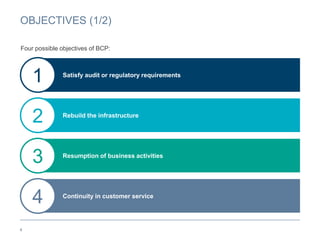
OBJECTIVES (1/2)
Satisfy audit or regulatory requirements
1
Rebuild the infrastructure
2
Resumption of business activities
3
Continuity in customer service
4
Four possible objectives of BCP:
4
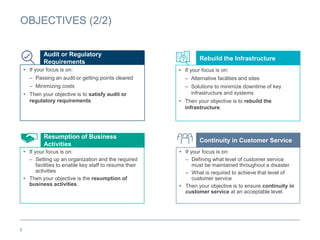
OBJECTIVES (2/2)
5
Audit or Regulatory
Requirements
• If your focus is on:
– Passing an audit or getting points cleared
– Minimizing costs
• Then your objective is to satisfy audit or
regulatory requirements.
Rebuild the Infrastructure
• If your focus is on:
– Alternative facilities and sites
– Solutions to minimize downtime of key
infrastructure and systems
• Then your objective is to rebuild the
infrastructure.
Resumption of Business
Activities
• If your focus is on:
– Setting up an organization and the required
facilities to enable key staff to resume their
activities
• Then your objective is the resumption of
business activities.
Continuity in Customer Service
• If your focus is on:
– Defining what level of customer service
must be maintained throughout a disaster
– What is required to achieve that level of
customer service
• Then your objective is to ensure continuity in
customer service at an acceptable level.
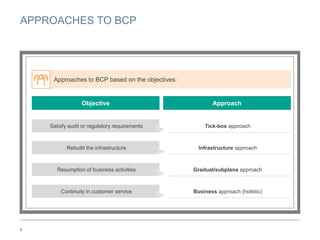
APPROACHES TO BCP
6
Approaches to BCP based on the objectives:
Objective Approach
Satisfy audit or regulatory requirements Tick-box approach
Rebuild the infrastructure Infrastructure approach
Resumption of business activities Gradual/subplans approach
Continuity in customer service Business approach (holistic)
SCOPE
7
• Event Interrupting Operations
– Asset protection
Protection of assets (e.g., people, building, etc.)
– BCP
Preparation of critical elements for business continuity
• Enterprise-wide versus IT…
...be clear on the scope of your BCP project
8
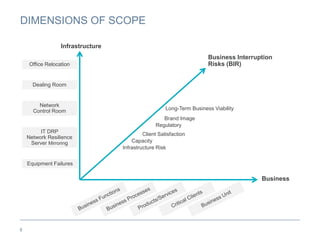
DIMENSIONS OF SCOPE
Business
Network
Control Room
IT DRP
Network Resilience
Server Mirroring
Dealing Room
Office Relocation
Equipment Failures
Infrastructure
Business Interruption
Risks (BIR)
Infrastructure Risk
Long-Term Business Viability
Brand Image
Client Satisfaction
Capacity
Regulatory
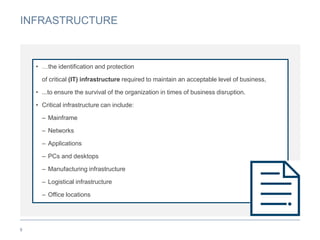
INFRASTRUCTURE
9
• …the identification and protection
of critical (IT) infrastructure required to maintain an acceptable level of business,
• ...to ensure the survival of the organization in times of business disruption.
• Critical infrastructure can include:
– Mainframe
– Networks
– Applications
– PCs and desktops
– Manufacturing infrastructure
– Logistical infrastructure
– Office locations
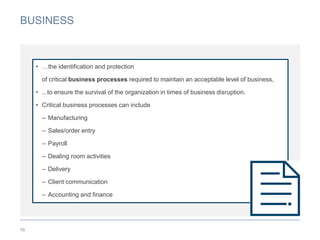
BUSINESS
10
• …the identification and protection
of critical business processes required to maintain an acceptable level of business,
• ...to ensure the survival of the organization in times of business disruption.
• Critical business processes can include
– Manufacturing
– Sales/order entry
– Payroll
– Dealing room activities
– Delivery
– Client communication
– Accounting and finance
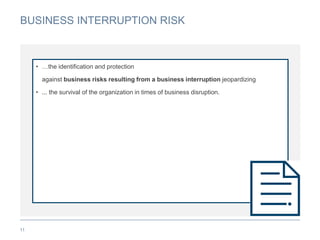
BUSINESS INTERRUPTION RISK
11
• …the identification and protection
against business risks resulting from a business interruption jeopardizing
• ... the survival of the organization in times of business disruption.
ENTRY POINTS
12
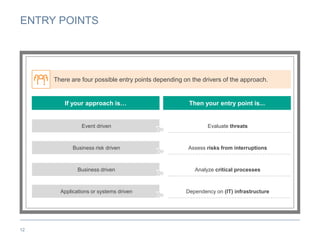
There are four possible entry points depending on the drivers of the approach.
If your approach is… Then your entry point is...
Event driven Evaluate threats
Business risk driven Assess risks from interruptions
Business driven Analyze critical processes
Applications or systems driven Dependency on (IT) infrastructure
THREATS
13
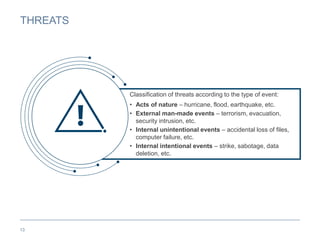
Classification of threats according to the type of event:
• Acts of nature – hurricane, flood, earthquake, etc.
• External man-made events – terrorism, evacuation,
security intrusion, etc.
• Internal unintentional events – accidental loss of files,
computer failure, etc.
• Internal intentional events – strike, sabotage, data
deletion, etc.
RISKS
14
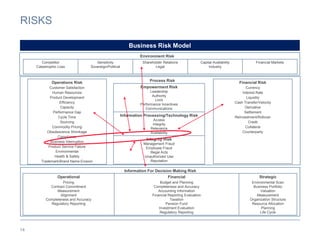
Competitor
Catastrophic Loss
Sensitivity
Sovereign/Political
Shareholder Relations
Legal
Capital Availability
Industry
Financial Markets
Information For Decision Making Risk
Operational
Pricing
Contract Commitment
Measurement
Alignment
Completeness and Accuracy
Regulatory Reporting
Financial
Budget and Planning
Completeness and Accuracy
Accounting Information
Financial Reporting Evaluation
Taxation
Pension Fund
Investment Evaluation
Regulatory Reporting
Strategic
Environmental Scan
Business Portfolio
Valuation
Measurement
Organization Structure
Resource Allocation
Planning
Life Cycle
Operations Risk
Customer Satisfaction
Human Resources
Product Development
Efficiency
Capacity
Performance Gap
Cycle Time
Sourcing
Commodity Pricing
Obsolescence Shrinkage
Compliance
Business Interruption
Product Service Failure
Environmental
Health & Safety
Trademark/Brand Name Erosion
Empowerment Risk
Leadership
Authority
Limit
Performance Incentives
Communications
Information Processing/Technology Risk
Access
Integrity
Relevance
Availability
Integrity Risk
Management Fraud
Employee Fraud
Illegal Acts
Unauthorized Use
Reputation
Financial Risk
Currency
Interest Rate
Liquidity
Cash Transfer/Velocity
Derivative
Settlement
Reinvestment/Rollover
Credit
Collateral
Counterparty
Process Risk
Environment Risk
Business Risk Model
15
ENTRY POINT: INFRASTRUCTURE
Business
Network
Control Room
IT DRP
Network Resilience
Server Mirroring
Dealing Room
Office Relocation
Equipment Failures
Infrastructure
Business
Interruption Risks
(BIR)
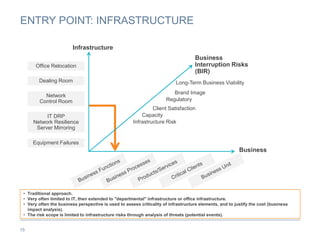
• Traditional approach.
• Very often limited to IT, then extended to "departmental" infrastructure or office infrastructure.
• Very often the business perspective is used to assess criticality of infrastructure elements, and to justify the cost (business
impact analysis).
• The risk scope is limited to infrastructure risks through analysis of threats (potential events).
Infrastructure Risk
Long-Term Business Viability
Brand Image
Client Satisfaction
Capacity
Regulatory
16
ENTRY POINT: BUSINESS
Business
Infrastructure
Business
Interruption Risks
(BIR)
Network
Control Room
IT DRP
Network Resilience
Server Mirroring
Dealing Room
Office Relocation
Equipment Failures
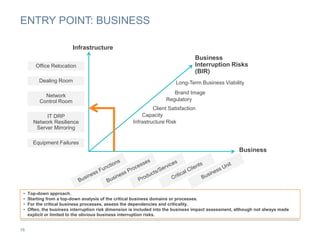
• Top-down approach.
• Starting from a top-down analysis of the critical business domains or processes.
• For the critical business processes, assess the dependencies and criticality.
• Often, the business interruption risk dimension is included into the business impact assessment, although not always made
explicit or limited to the obvious business interruption risks.
Infrastructure Risk
Long-Term Business Viability
Brand Image
Client Satisfaction
Capacity
Regulatory
17
ENTRY POINT: BUSINESS RISKS
Business
Infrastructure
Business
Interruption Risks
(BIR)
1.
2.
Network
Control Room
IT DRP
Network Resilience
Server Mirroring
Dealing Room
Office Relocation
Equipment Failures
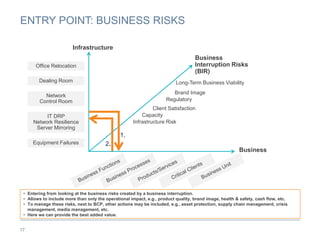
• Entering from looking at the business risks created by a business interruption.
• Allows to include more than only the operational impact, e.g., product quality, brand image, health & safety, cash flow, etc.
• To manage these risks, next to BCP, other actions may be included, e.g., asset protection, supply chain management, crisis
management, media management, etc.
• Here we can provide the best added value.
Infrastructure Risk
Long-Term Business Viability
Brand Image
Client Satisfaction
Capacity
Regulatory
RISKS
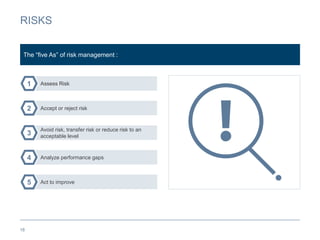
The “five As” of risk management :
Assess Risk
1
Accept or reject risk
2
Avoid risk, transfer risk or reduce risk to an
acceptable level
3
Analyze performance gaps
4
Act to improve
5
18
Business Processes
Information Flows
Infrastructure & Resources
19
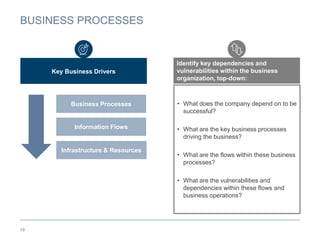
Identify key dependencies and
vulnerabilities within the business
organization, top-down:
• What does the company depend on to be
successful?
• What are the key business processes
driving the business?
• What are the flows within these business
processes?
• What are the vulnerabilities and
dependencies within these flows and
business operations?
BUSINESS PROCESSES
Key Business Drivers
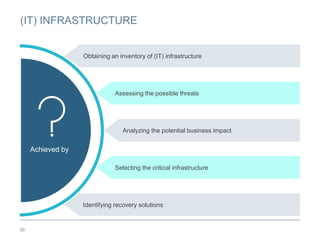
(IT) INFRASTRUCTURE
20
Identifying recovery solutions
Assessing the possible threats
Selecting the critical infrastructure
Analyzing the potential business impact
Obtaining an inventory of (IT) infrastructure
Achieved by
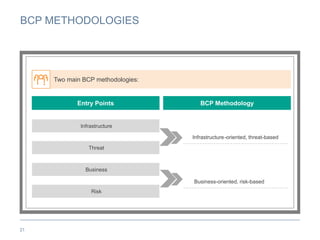
BCP METHODOLOGIES
21
Two main BCP methodologies:
Entry Points BCP Methodology
Infrastructure
Infrastructure-oriented, threat-based
Threat
Business
Business-oriented, risk-based
Risk

Business continuity planning guide

  • 1.
  • 2.
    AGENDA • Introduction • Objectivesof BCP • Approaches to BCP • Dimensions of Scope • Entry Points 2 • Q&A
  • 3.
    INTRODUCTION So…you’ve decided toembark on a business continuity planning (BCP) project …but where do you start? • Define the objectives • Determine the dimensions of scope • Select an appropriate approach • Proceed from an entry point 3
  • 4.
    OBJECTIVES (1/2) Satisfy auditor regulatory requirements 1 Rebuild the infrastructure 2 Resumption of business activities 3 Continuity in customer service 4 Four possible objectives of BCP: 4
  • 5.
    OBJECTIVES (2/2) 5 Audit orRegulatory Requirements • If your focus is on: – Passing an audit or getting points cleared – Minimizing costs • Then your objective is to satisfy audit or regulatory requirements. Rebuild the Infrastructure • If your focus is on: – Alternative facilities and sites – Solutions to minimize downtime of key infrastructure and systems • Then your objective is to rebuild the infrastructure. Resumption of Business Activities • If your focus is on: – Setting up an organization and the required facilities to enable key staff to resume their activities • Then your objective is the resumption of business activities. Continuity in Customer Service • If your focus is on: – Defining what level of customer service must be maintained throughout a disaster – What is required to achieve that level of customer service • Then your objective is to ensure continuity in customer service at an acceptable level.
  • 6.
    APPROACHES TO BCP 6 Approachesto BCP based on the objectives: Objective Approach Satisfy audit or regulatory requirements Tick-box approach Rebuild the infrastructure Infrastructure approach Resumption of business activities Gradual/subplans approach Continuity in customer service Business approach (holistic)
  • 7.
    SCOPE 7 • Event InterruptingOperations – Asset protection Protection of assets (e.g., people, building, etc.) – BCP Preparation of critical elements for business continuity • Enterprise-wide versus IT… ...be clear on the scope of your BCP project
  • 8.
    8 DIMENSIONS OF SCOPE Business Network ControlRoom IT DRP Network Resilience Server Mirroring Dealing Room Office Relocation Equipment Failures Infrastructure Business Interruption Risks (BIR) Infrastructure Risk Long-Term Business Viability Brand Image Client Satisfaction Capacity Regulatory
  • 9.
    INFRASTRUCTURE 9 • …the identificationand protection of critical (IT) infrastructure required to maintain an acceptable level of business, • ...to ensure the survival of the organization in times of business disruption. • Critical infrastructure can include: – Mainframe – Networks – Applications – PCs and desktops – Manufacturing infrastructure – Logistical infrastructure – Office locations
  • 10.
    BUSINESS 10 • …the identificationand protection of critical business processes required to maintain an acceptable level of business, • ...to ensure the survival of the organization in times of business disruption. • Critical business processes can include – Manufacturing – Sales/order entry – Payroll – Dealing room activities – Delivery – Client communication – Accounting and finance
  • 11.
    BUSINESS INTERRUPTION RISK 11 •…the identification and protection against business risks resulting from a business interruption jeopardizing • ... the survival of the organization in times of business disruption.
  • 12.
    ENTRY POINTS 12 There arefour possible entry points depending on the drivers of the approach. If your approach is… Then your entry point is... Event driven Evaluate threats Business risk driven Assess risks from interruptions Business driven Analyze critical processes Applications or systems driven Dependency on (IT) infrastructure
  • 13.
    THREATS 13 Classification of threatsaccording to the type of event: • Acts of nature – hurricane, flood, earthquake, etc. • External man-made events – terrorism, evacuation, security intrusion, etc. • Internal unintentional events – accidental loss of files, computer failure, etc. • Internal intentional events – strike, sabotage, data deletion, etc.
  • 14.
    RISKS 14 Competitor Catastrophic Loss Sensitivity Sovereign/Political Shareholder Relations Legal CapitalAvailability Industry Financial Markets Information For Decision Making Risk Operational Pricing Contract Commitment Measurement Alignment Completeness and Accuracy Regulatory Reporting Financial Budget and Planning Completeness and Accuracy Accounting Information Financial Reporting Evaluation Taxation Pension Fund Investment Evaluation Regulatory Reporting Strategic Environmental Scan Business Portfolio Valuation Measurement Organization Structure Resource Allocation Planning Life Cycle Operations Risk Customer Satisfaction Human Resources Product Development Efficiency Capacity Performance Gap Cycle Time Sourcing Commodity Pricing Obsolescence Shrinkage Compliance Business Interruption Product Service Failure Environmental Health & Safety Trademark/Brand Name Erosion Empowerment Risk Leadership Authority Limit Performance Incentives Communications Information Processing/Technology Risk Access Integrity Relevance Availability Integrity Risk Management Fraud Employee Fraud Illegal Acts Unauthorized Use Reputation Financial Risk Currency Interest Rate Liquidity Cash Transfer/Velocity Derivative Settlement Reinvestment/Rollover Credit Collateral Counterparty Process Risk Environment Risk Business Risk Model
  • 15.
    15 ENTRY POINT: INFRASTRUCTURE Business Network ControlRoom IT DRP Network Resilience Server Mirroring Dealing Room Office Relocation Equipment Failures Infrastructure Business Interruption Risks (BIR) • Traditional approach. • Very often limited to IT, then extended to "departmental" infrastructure or office infrastructure. • Very often the business perspective is used to assess criticality of infrastructure elements, and to justify the cost (business impact analysis). • The risk scope is limited to infrastructure risks through analysis of threats (potential events). Infrastructure Risk Long-Term Business Viability Brand Image Client Satisfaction Capacity Regulatory
  • 16.
    16 ENTRY POINT: BUSINESS Business Infrastructure Business InterruptionRisks (BIR) Network Control Room IT DRP Network Resilience Server Mirroring Dealing Room Office Relocation Equipment Failures • Top-down approach. • Starting from a top-down analysis of the critical business domains or processes. • For the critical business processes, assess the dependencies and criticality. • Often, the business interruption risk dimension is included into the business impact assessment, although not always made explicit or limited to the obvious business interruption risks. Infrastructure Risk Long-Term Business Viability Brand Image Client Satisfaction Capacity Regulatory
  • 17.
    17 ENTRY POINT: BUSINESSRISKS Business Infrastructure Business Interruption Risks (BIR) 1. 2. Network Control Room IT DRP Network Resilience Server Mirroring Dealing Room Office Relocation Equipment Failures • Entering from looking at the business risks created by a business interruption. • Allows to include more than only the operational impact, e.g., product quality, brand image, health & safety, cash flow, etc. • To manage these risks, next to BCP, other actions may be included, e.g., asset protection, supply chain management, crisis management, media management, etc. • Here we can provide the best added value. Infrastructure Risk Long-Term Business Viability Brand Image Client Satisfaction Capacity Regulatory
  • 18.
    RISKS The “five As”of risk management : Assess Risk 1 Accept or reject risk 2 Avoid risk, transfer risk or reduce risk to an acceptable level 3 Analyze performance gaps 4 Act to improve 5 18
  • 19.
    Business Processes Information Flows Infrastructure& Resources 19 Identify key dependencies and vulnerabilities within the business organization, top-down: • What does the company depend on to be successful? • What are the key business processes driving the business? • What are the flows within these business processes? • What are the vulnerabilities and dependencies within these flows and business operations? BUSINESS PROCESSES Key Business Drivers
  • 20.
    (IT) INFRASTRUCTURE 20 Identifying recoverysolutions Assessing the possible threats Selecting the critical infrastructure Analyzing the potential business impact Obtaining an inventory of (IT) infrastructure Achieved by
  • 21.
    BCP METHODOLOGIES 21 Two mainBCP methodologies: Entry Points BCP Methodology Infrastructure Infrastructure-oriented, threat-based Threat Business Business-oriented, risk-based Risk