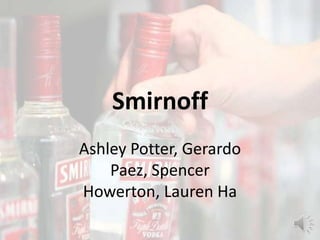
Smirnoff
Ashley Potter, Gerardo
Paez, Spencer
Howerton, Lauren Ha
Product
The need-satisfying offering of a firm
Goods
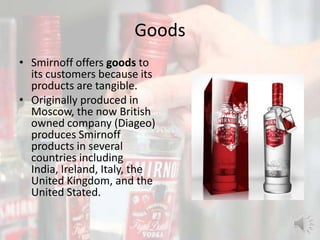
• Smirnoff offers goods to
its customers because its
products are tangible.
• Originally produced in
Moscow, the now British
owned company (Diageo)
produces Smirnoff
products in several
countries including
India, Ireland, Italy, the
United Kingdom, and the
United Stated.
Product Assortment
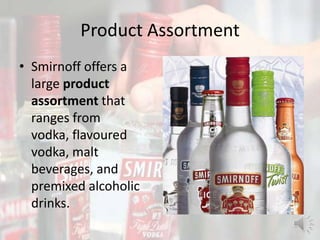
• Smirnoff offers a
large product
assortment that
ranges from
vodka, flavoured
vodka, malt
beverages, and
premixed alcoholic
drinks.
Product Assortment
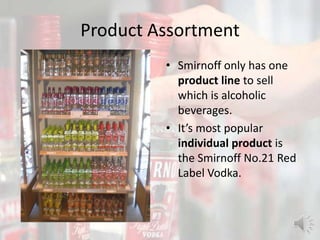
• Smirnoff only has one
product line to sell
which is alcoholic
beverages.
• It’s most popular
individual product is
the Smirnoff No.21 Red
Label Vodka.
Branding
• Brand Name:
Smirnoff
• Trademark:
Branding
• Smirnoff has successful
branding because: it’s
product is easy to identify, it
still maintains a lower price
than most competitors
without losing quality, it is
widespread throughout
over 130 countries, demand
for vodka will always be
strong as long as higher
education exists, and it
takes up a good chunk of
the alcohol aisle with its
various product
assortments.
Brand Familiarity
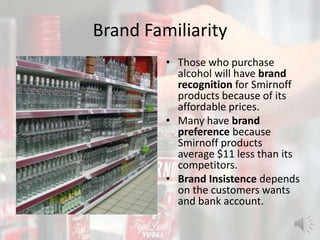
• Those who purchase
alcohol will have brand
recognition for Smirnoff
products because of its
affordable prices.
• Many have brand
preference because
Smirnoff products
average $11 less than its
competitors.
• Brand Insistence depends
on the customers wants
and bank account.
Branding
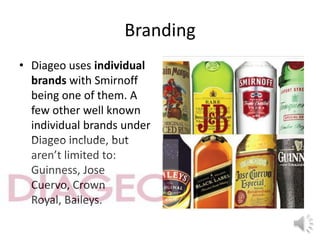
• Diageo uses individual
brands with Smirnoff
being one of them. A
few other well known
individual brands under
Diageo include, but
aren’t limited to:
Guinness, Jose
Cuervo, Crown
Royal, Baileys.
Consumer Product Classes
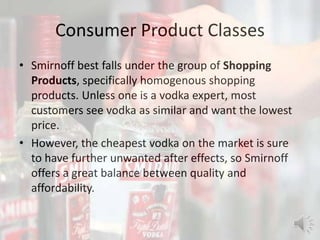
• Smirnoff best falls under the group of Shopping
Products, specifically homogenous shopping
products. Unless one is a vodka expert, most
customers see vodka as similar and want the lowest
price.
• However, the cheapest vodka on the market is sure
to have further unwanted after effects, so Smirnoff
offers a great balance between quality and
affordability.
Product Life Cycle
Market Introduction (1860)
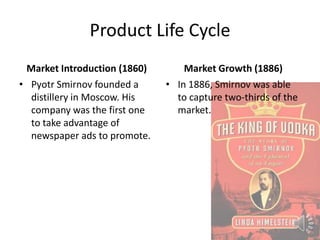
• Pyotr Smirnov founded a
distillery in Moscow. His
company was the first one
to take advantage of
newspaper ads to promote.
Market Growth (1886)
• In 1886, Smirnov was able
to capture two-thirds of the
market.
Product Life Cycles
Market Maturity( 1930-Today)
• By the 1930, Smirnoff was
exported to most European
countries and production
began in North
America, though not as
successful as hoped in
America.
• By the 1990, the fall of Berlin
Wall marked a pivotal moment
in the companies dynasty.
Troops turned to the vodka
and it’s popularity grew.
Sales Decline (TBA)
• Today, Smirnoff is still
thriving as competition gets
tougher, so they have not
seen the sales decline stage
yet.
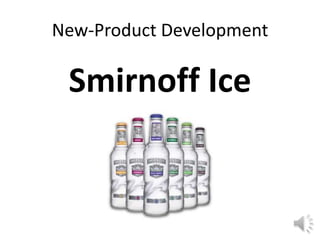
New-Product Development
Smirnoff Ice
New-Product Process
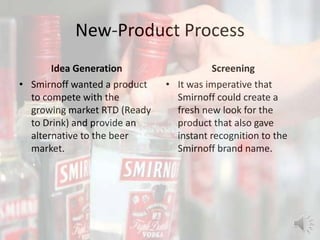
Idea Generation
• Smirnoff wanted a product
to compete with the
growing market RTD (Ready
to Drink) and provide an
alternative to the beer
market.
Screening
• It was imperative that
Smirnoff could create a
fresh new look for the
product that also gave
instant recognition to the
Smirnoff brand name.
New-Product Process
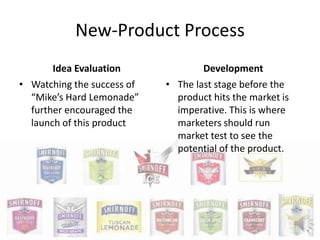
Idea Evaluation
• Watching the success of
“Mike’s Hard Lemonade”
further encouraged the
launch of this product
Development
• The last stage before the
product hits the market is
imperative. This is where
marketers should run
market test to see the
potential of the product.
New-Product Process
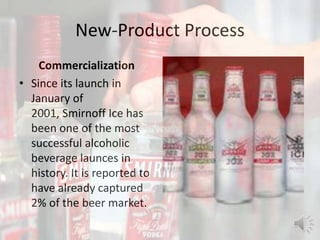
Commercialization
• Since its launch in
January of
2001, Smirnoff Ice has
been one of the most
successful alcoholic
beverage launces in
history. It is reported to
have already captured
2% of the beer market.
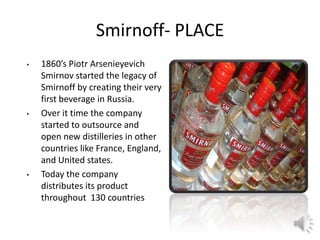
Smirnoff- PLACE
• 1860’s Piotr Arsenieyevich
Smirnov started the legacy of
Smirnoff by creating their very
first beverage in Russia.
• Over it time the company
started to outsource and
open new distilleries in other
countries like France, England,
and United states.
• Today the company
distributes its product
throughout 130 countries
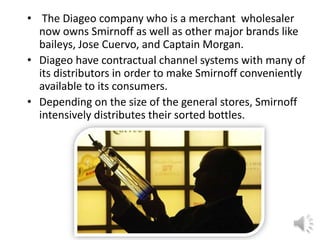
• The Diageo company who is a merchant wholesaler
now owns Smirnoff as well as other major brands like
baileys, Jose Cuervo, and Captain Morgan.
• Diageo have contractual channel systems with many of
its distributors in order to make Smirnoff conveniently
available to its consumers.
• Depending on the size of the general stores, Smirnoff
intensively distributes their sorted bottles.
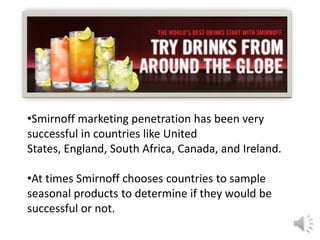
•Smirnoff marketing penetration has been very
successful in countries like United
States, England, South Africa, Canada, and Ireland.
•At times Smirnoff chooses countries to sample
seasonal products to determine if they would be
successful or not.
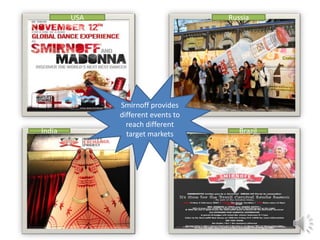
Smirnoff provides
different events to
reach different
target markets
USA Russia
India Brazil
Price
Smirnoff
Average List Price
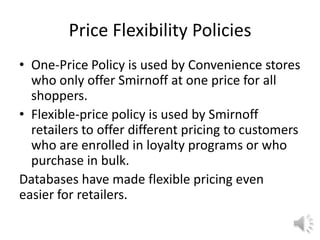
• Smirnoff Vodka 375ml $10
• Smirnoff vodka 750ml $14
• Smirnoff vodka 1.75L $20
• Smirnoff Ice malt beverage six-pack $8
Price Flexibility Policies
• One-Price Policy is used by Convenience stores
who only offer Smirnoff at one price for all
shoppers.
• Flexible-price policy is used by Smirnoff
retailers to offer different pricing to customers
who are enrolled in loyalty programs or who
purchase in bulk.
Databases have made flexible pricing even
easier for retailers.
Discounts
• Club card members are offered extra saving as part
of a supermarket loyalty program
• Non-cumulative quantity discounts are offered by
retailers to allow customers a one time price break
for purchasing a certain quantity
• Coupons are used by consumers to receive an extra
discount off the list price of Smirnoff
• Sale prices are used to advertise Smirnoff at a
temporary discount to encourage purchasing of the
product
Allowances
• Damaged bottles are credited back to the retailers
for accepting less sellable product that was damaged
during the shipment of Smirnoff
• Smirnoff can offer retailers stocking allowances to
get attention and space for their new products
• Push money is sometimes used by Smirnoff to
encourage sales teams and retailers to sell their
newer products aggressively
Profit Maximization
• Lower prices expands the market size and
exceeds customers reference price
• This leads to greater sales and profits
• Manufacturers and retailers are able to
receive a rapid return on investment
Demand Approach to Setting Prices
• Smirnoff offers customers a product that exceeds their
reference price with its high quality taste at a low price
• Odd-even pricing is used by retailers who sell Smirnoff to
influence their customers psychological process of
purchasing
• Prestige Pricing-Diageo uses prestige pricing to separate
its ultra premium vodkas. Smirnoff’s price is set lower to
help place a higher status on Diageo’s ultra-premium
vodkas
Smirnoff
Promotion
Personal Selling
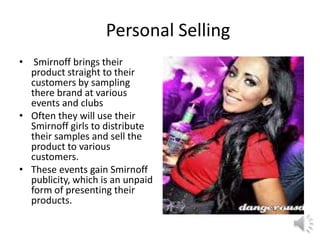
• Smirnoff brings their
product straight to their
customers by sampling
there brand at various
events and clubs
• Often they will use their
Smirnoff girls to distribute
their samples and sell the
product to various
customers.
• These events gain Smirnoff
publicity, which is an unpaid
form of presenting their
products.
Mass Selling
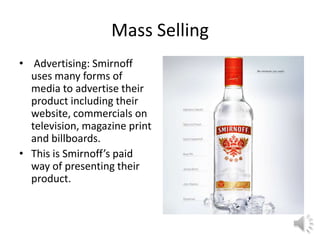
• Advertising: Smirnoff
uses many forms of
media to advertise their
product including their
website, commercials on
television, magazine print
and billboards.
• This is Smirnoff’s paid
way of presenting their
product.
Mass selling cont.
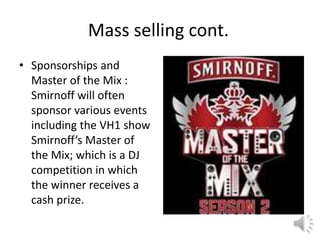
• Sponsorships and
Master of the Mix :
Smirnoff will often
sponsor various events
including the VH1 show
Smirnoff’s Master of
the Mix; which is a DJ
competition in which
the winner receives a
cash prize.
Integrated Marketing communications
• Smirnoff’s coordination of all of their promotion
methods seeks to convey the same consistent
message.
• Their message is that they have the most popular
premium spirits with a wide variety of unique
flavors
• These promotion methods follow the AIDA
model, which is to get attention, hold interest,
arouse desire, to obtain action or to buy the
product.
Product Demand
• Vodka and other spirits
are typically a product
with a primary
demand, customers want
the product but not a
specific brand
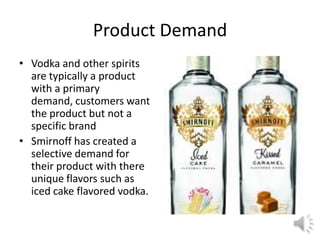
• Smirnoff has created a
selective demand for
their product with there
unique flavors such as
iced cake flavored vodka.
Yours for the making campaign
• Smirnoff is the number
one selling vodka by
volume in the world
• They focus on reminder
advertising with their
original vodka, which is
an already established
product.
• With their flavored
vodkas, Smirnoff uses a
more competitive
advertising
• They seek to push their
new and unique vodka
flavors.
Yours for the making cont.
• Smirnoff’s latest ad campaign, yours for the
making, focuses on the unique and wide
variety of drinks you can create with the
flavored spirits
• They have many different recipes accessible
on their website for free.

Bus 360 smirnoff

  • 1.
    Smirnoff Ashley Potter, Gerardo Paez,Spencer Howerton, Lauren Ha
  • 2.
  • 3.
    Goods • Smirnoff offersgoods to its customers because its products are tangible. • Originally produced in Moscow, the now British owned company (Diageo) produces Smirnoff products in several countries including India, Ireland, Italy, the United Kingdom, and the United Stated.
  • 4.
    Product Assortment • Smirnoffoffers a large product assortment that ranges from vodka, flavoured vodka, malt beverages, and premixed alcoholic drinks.
  • 5.
    Product Assortment • Smirnoffonly has one product line to sell which is alcoholic beverages. • It’s most popular individual product is the Smirnoff No.21 Red Label Vodka.
  • 6.
  • 7.
    Branding • Smirnoff hassuccessful branding because: it’s product is easy to identify, it still maintains a lower price than most competitors without losing quality, it is widespread throughout over 130 countries, demand for vodka will always be strong as long as higher education exists, and it takes up a good chunk of the alcohol aisle with its various product assortments.
  • 8.
    Brand Familiarity • Thosewho purchase alcohol will have brand recognition for Smirnoff products because of its affordable prices. • Many have brand preference because Smirnoff products average $11 less than its competitors. • Brand Insistence depends on the customers wants and bank account.
  • 9.
    Branding • Diageo usesindividual brands with Smirnoff being one of them. A few other well known individual brands under Diageo include, but aren’t limited to: Guinness, Jose Cuervo, Crown Royal, Baileys.
  • 10.
    Consumer Product Classes •Smirnoff best falls under the group of Shopping Products, specifically homogenous shopping products. Unless one is a vodka expert, most customers see vodka as similar and want the lowest price. • However, the cheapest vodka on the market is sure to have further unwanted after effects, so Smirnoff offers a great balance between quality and affordability.
  • 11.
    Product Life Cycle MarketIntroduction (1860) • Pyotr Smirnov founded a distillery in Moscow. His company was the first one to take advantage of newspaper ads to promote. Market Growth (1886) • In 1886, Smirnov was able to capture two-thirds of the market.
  • 12.
    Product Life Cycles MarketMaturity( 1930-Today) • By the 1930, Smirnoff was exported to most European countries and production began in North America, though not as successful as hoped in America. • By the 1990, the fall of Berlin Wall marked a pivotal moment in the companies dynasty. Troops turned to the vodka and it’s popularity grew. Sales Decline (TBA) • Today, Smirnoff is still thriving as competition gets tougher, so they have not seen the sales decline stage yet.
  • 13.
  • 14.
    New-Product Process Idea Generation •Smirnoff wanted a product to compete with the growing market RTD (Ready to Drink) and provide an alternative to the beer market. Screening • It was imperative that Smirnoff could create a fresh new look for the product that also gave instant recognition to the Smirnoff brand name.
  • 15.
    New-Product Process Idea Evaluation •Watching the success of “Mike’s Hard Lemonade” further encouraged the launch of this product Development • The last stage before the product hits the market is imperative. This is where marketers should run market test to see the potential of the product.
  • 16.
    New-Product Process Commercialization • Sinceits launch in January of 2001, Smirnoff Ice has been one of the most successful alcoholic beverage launces in history. It is reported to have already captured 2% of the beer market.
  • 17.
    Smirnoff- PLACE • 1860’sPiotr Arsenieyevich Smirnov started the legacy of Smirnoff by creating their very first beverage in Russia. • Over it time the company started to outsource and open new distilleries in other countries like France, England, and United states. • Today the company distributes its product throughout 130 countries
  • 18.
    • The Diageocompany who is a merchant wholesaler now owns Smirnoff as well as other major brands like baileys, Jose Cuervo, and Captain Morgan. • Diageo have contractual channel systems with many of its distributors in order to make Smirnoff conveniently available to its consumers. • Depending on the size of the general stores, Smirnoff intensively distributes their sorted bottles.
  • 19.
    •Smirnoff marketing penetrationhas been very successful in countries like United States, England, South Africa, Canada, and Ireland. •At times Smirnoff chooses countries to sample seasonal products to determine if they would be successful or not.
  • 20.
    Smirnoff provides different eventsto reach different target markets USA Russia India Brazil
  • 21.
  • 22.
    Average List Price •Smirnoff Vodka 375ml $10 • Smirnoff vodka 750ml $14 • Smirnoff vodka 1.75L $20 • Smirnoff Ice malt beverage six-pack $8
  • 23.
    Price Flexibility Policies •One-Price Policy is used by Convenience stores who only offer Smirnoff at one price for all shoppers. • Flexible-price policy is used by Smirnoff retailers to offer different pricing to customers who are enrolled in loyalty programs or who purchase in bulk. Databases have made flexible pricing even easier for retailers.
  • 24.
    Discounts • Club cardmembers are offered extra saving as part of a supermarket loyalty program • Non-cumulative quantity discounts are offered by retailers to allow customers a one time price break for purchasing a certain quantity • Coupons are used by consumers to receive an extra discount off the list price of Smirnoff • Sale prices are used to advertise Smirnoff at a temporary discount to encourage purchasing of the product
  • 25.
    Allowances • Damaged bottlesare credited back to the retailers for accepting less sellable product that was damaged during the shipment of Smirnoff • Smirnoff can offer retailers stocking allowances to get attention and space for their new products • Push money is sometimes used by Smirnoff to encourage sales teams and retailers to sell their newer products aggressively
  • 26.
    Profit Maximization • Lowerprices expands the market size and exceeds customers reference price • This leads to greater sales and profits • Manufacturers and retailers are able to receive a rapid return on investment
  • 27.
    Demand Approach toSetting Prices • Smirnoff offers customers a product that exceeds their reference price with its high quality taste at a low price • Odd-even pricing is used by retailers who sell Smirnoff to influence their customers psychological process of purchasing • Prestige Pricing-Diageo uses prestige pricing to separate its ultra premium vodkas. Smirnoff’s price is set lower to help place a higher status on Diageo’s ultra-premium vodkas
  • 28.
  • 29.
    Personal Selling • Smirnoffbrings their product straight to their customers by sampling there brand at various events and clubs • Often they will use their Smirnoff girls to distribute their samples and sell the product to various customers. • These events gain Smirnoff publicity, which is an unpaid form of presenting their products.
  • 30.
    Mass Selling • Advertising:Smirnoff uses many forms of media to advertise their product including their website, commercials on television, magazine print and billboards. • This is Smirnoff’s paid way of presenting their product.
  • 31.
    Mass selling cont. •Sponsorships and Master of the Mix : Smirnoff will often sponsor various events including the VH1 show Smirnoff’s Master of the Mix; which is a DJ competition in which the winner receives a cash prize.
  • 32.
    Integrated Marketing communications •Smirnoff’s coordination of all of their promotion methods seeks to convey the same consistent message. • Their message is that they have the most popular premium spirits with a wide variety of unique flavors • These promotion methods follow the AIDA model, which is to get attention, hold interest, arouse desire, to obtain action or to buy the product.
  • 33.
    Product Demand • Vodkaand other spirits are typically a product with a primary demand, customers want the product but not a specific brand • Smirnoff has created a selective demand for their product with there unique flavors such as iced cake flavored vodka.
  • 34.
    Yours for themaking campaign • Smirnoff is the number one selling vodka by volume in the world • They focus on reminder advertising with their original vodka, which is an already established product. • With their flavored vodkas, Smirnoff uses a more competitive advertising • They seek to push their new and unique vodka flavors.
  • 35.
    Yours for themaking cont. • Smirnoff’s latest ad campaign, yours for the making, focuses on the unique and wide variety of drinks you can create with the flavored spirits • They have many different recipes accessible on their website for free.