Personality and Social Psychology Review                                                         Copyright © 1999 by
1999, Vol. 3, No.4, 303-325                                                                      Lawrence Erlbaum Associates, Inc.


         The Foot-in-the-Door Compliance Procedure: A Multiple-Process
                              Analysis and Review
                                                        Jerry M. Burger
                                                     Department of Psychology
                                                      Santa Clara University


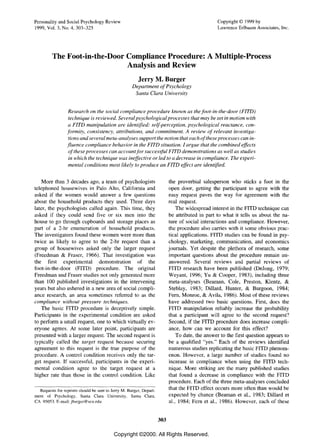
                  Research on the social compliance procedure known as the foot-in-the-door (FITD)
                  technique is reviewed. Several psychological processes that may be set in motion with
                  a FITD manipulation are identified: self-perception, psycholo/?ical reactance, con-
                  formity, consistency, attributions, and commitment. A review of relevant investiga-
                  tions and several meta-analyses support the notion that each ofthese processes can in-
                  fluence compliance behavior in the FITD situation. I argue that the combined effects
                  of these processes can accountfor successful FITD demonstrations as well as studies
                  in which the technique was ineffective or led to a decrease in compliance. The experi-
                  mental conditions most likely to produce an FITD effect are identified.


    More than 3 decades ago, a team of psychologists                       the proverbial salesperson who sticks a foot in the
telephoned housewives in Palo Alto, California and                         open door, getting the participant to agree with the
asked if the women would answer a few questions                            easy request paves the way for agreement with the
about the household products they used. Three days                         real request.
later, the psychologists called again. This time, they                         The widespread interest in the FITD technique can
asked if they could send five or six men into the                          be attributed in part to what it tells us about the na-
house to go through cupboards and storage places as                        ture of social interactions and compliance. However,
part of a 2-hr enumeration of household products.                          the procedure also carries with it some obvious prac-
The investigators found these women were more than                         tical applications. FITD studies can be found in psy-
twice as likely to agree to the 2-hr request than a                        chology, marketing, communication, and economics
group of housewives asked only the larger request                          journals. Yet despite the plethora of research, some
(Freedman & Fraser, 1966). That investigation was                          important questions about the procedure remain un-
the first experimental demonstration of the                                answered. Several reviews and partial reviews of
foot-in-the-door (FITD) procedure. The original                            FITD research have been published (Dejong, 1979;
Freedman and Fraser studies not only generated more                        Weyant, 1996; Yu & Cooper, 1983), including three
than 100 published investigations in the intervening                       meta-analyses (Beaman, Cole, Preston, KIentz, &
years but also ushered in a new area of social compli-                     Steblay, 1983; Dillard, Hunter, & Burgoon, 1984;
ance research, an area sometimes referred to as the                        Fern, Monroe, & Avila, 1986). Most of these reviews
compliance without pressure techniques.                                    have addressed two basic questions. First, does the
    The basic FITD procedure is deceptively simple.                        FITD manipulation reliably increase the probability
Participants in the experimental condition are asked                       that a participant will agree to the second request?
to perform a small request, one to which virtually ev-                     Second, if the FITD procedure: does increase compli-
eryone agrees. At some later point, participants are                       ance, how can we account for this effect?
presented with a larger request. The second request is                         To date, the answer to the first question appears to
typically called the target request because securing                       be a qualified "yes." Each of the reviews identified
agreement to this request is the true purpose of the                       numerous studies replicating the basic FITD phenom-
procedure. A control condition receives only the tar-                      enon. However, a large number of studies found no
get request. If successful, participants in the experi-                    increase in compliance when using the PITD tech-
mental condition agree to the target request at a                          nique. More striking are the many published studies
higher rate than those in the control condition. Like                      that found a decrease in compliance with the FITD
                                                                           procedure. Each of the three meta-analyses concluded
  Requests for reprints should be sent to Jerry M. Burger, Depart-         that the FlTD effect occurs more often than would be
ment of Psychology. Santa Clara University, Santa Clara,                   expected by chance (Beaman et aI., 1983; Dillard et
CA 95053. E-mail: jburger@scu.edu                                          aI., 1984; Fern et aI., 1986). However, each of these


                                                                     303

                                           Copyright ©2000. All Rights Reserved.
BURGER


reviews also pointed out that the size of the effect is                Psychological Processes Affecting
relatively small (overall r range = .09-.17). Also,                            FITD Outcomes
none was able to identify and explain the circum-
stances under which failure to produce the effect or             We begin by identifying several psychological pro-
reversals of the effect are most likely to occur.            cesses that theoretically playa role in participants' re-
    The reviewers' conclusions about the process un-         actions to the basic FITD manipulation. The list of
derlying the FITD phenomenon also are a bit mixed.           potentially relevant processes is presented in Table 1.
As described in greater detail later, the generally ac-      This multiprocess analysis contrasts with the typical
cepted explanation for the effectiveness of the FlTD         approach taken to explain the FlTD effect. That is, re-
procedure is that participants engage in an atti-            searchers and reviewers trying to explain the mecha-
tude-change process similar to that outlined in              nisms underlying the phenomenon have tended to
self-perception theory (Bem, 1972). Although several         search for a single process to account for the different
studies have provided results consistent with                findings. For most of the history of FITD research, this
self-perception theory, other findings are not easily        single process has been identified as the self-
accounted for with this explanation (Dejong, 1979;           perception explanation. However, we argue that
Gorassini & Olson, 1995). One team of reviewers              self-perception is but one process potentially set in mo-
(Dillard et aI., 1984) concluded that the self-              tion by the initial request. Moreover, the impact of this
perception explanation "come[s] up short" (p. 484).          self-perception process may be relatively weak. That
Another (Beaman et al., 1983) suggested that "[iJt           is, more powerful psychological processes also may be
may well be that rself-perception] theory is only a          operating in a given FITD situation, and these can
partial explanation accounting for only some of the          overwhelm whatever impact self-perception has on the
variance" (p. 192).                                          ultimate decision to agree with the target request.
    In short, questions remain about the effectiveness           How do the processes listed in Table 1 affect re-
of the FITD procedure, the conditions under which it         sponses to an FITD manipulation? First, the proce-
will be found, and how to explain successful demon-          dures used to initiate and carry out the FITD technique
strations of the effect. We hope to expand on the ear-       have the potential to set several psychological pro-
lier FlTD reviews in three ways. First, we begin by          cesses in motion. As shown in Table 1, some of these
identifying several processes that potentially come          processes increase the likelihood that the request recip-
into play in an FlTD situation. This approach leads to       ient win agree to the target request. However, others
several predictions that can be tested by examining          are likely to decrease the chance that the individual
relevant conditions in past FITD studies. Thus, we           will comply with the second request. Although we use
look at the effect of several variables left unexamined      the processes listed in the table to account for findings
in earlier reviews. Second, we are more exclusive            from most existing FITD studies, we do not presume
when selecting studies for the meta-analyses than            the list to be exhaustive. That is, other processes may
were some of the earlier reviewers. The term                 be identified in future research.
foot-in-the-door has been used to describe a wide va-            Second, the presence and strength of each of these
riety of experimental procedures. For example, some          processes will vary depending on the specific proce-
investigators have asked whether the original FITD           dures employed to create the FITD manipulation. The
compliance procedures might be expanded to encour-           methods employed by researchers to generate the
age people to do something good for themselves               FITD effect have been quite varied. Studies investigat-
(e.g., attending a class) or acting altruistically even      ing FITD phenomena differ in the amount of time be-
when no request is given (e.g., stopping to pick up          tween requests, the relative size of the requests,
dropped papers). Although these are interesting ques-        information about other respondents, the type of re-
tions, the findings from these studies may not reflect       quest, requester characteristics, whether the same or a
the same underlying processes at work in the type of
situation studied in the original FlTD research. Com-
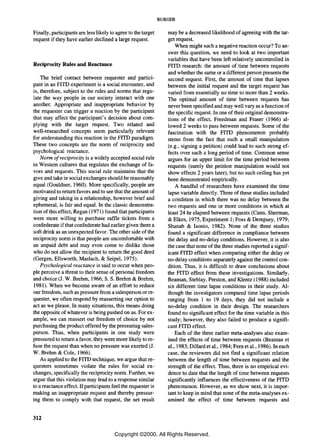
bining all investigations identified as FlTD studies         Table 1. Psychological Processes Affecting Compliance in
                                                             the Foot-in-the-Door Situation
potentially clouds the results of the review. Conse-
quently, we employ several criteria for including a                                            Potential Effect on
study in the meta-analyses. Each of these criteria is        Psychological Process             Foot-in-the-Door
used to eliminate studies and conditions that do not         Self-Perception                   Enhances effect
represent clear applications of the basic FlTD phe-          Reciprocity Rules and Reactance   Reduces effect
nomenon. Third, it has been about 15 years since the         Conformity to Norm                Reduces or enhances effect
last published meta-analysis of FITD research. Many          Consistency Needs                 Enhances effect
subsequent investigations provided more relevant             Attributions                      Reduces or enhances effect
                                                             Commitment                        Enhances effect
data on which to base our conclusions.


304

                                    Copyright ©2000. All Rights Reserved.
FOOT-IN-THE-DOOR


different person presents the second request, and so on.        5. The target behavior was requested. For example,
These differences in procedures mean that the studies       studies that examined whether participants told con-
differ in the extent to which they set in motion both fa-   federates that they had dropped a quarter were not in-
cilitating and inhibiting processes. We should note that    cluded.
some of these processes probably are not present in             6. Behavior or verbal intention to perform a behav-
many FITD manipulations. For example, conformity            ior was assessed. Studies that examined changes in
to the norm is unlikely to affect response rates unless     general attitudes were not included.
the participant somehow obtains information about the           7. Enough relevant data were reported so that nec-
normative response.                                         essary statistical information could be determined or
    Third, whether the FITD manipulation leads to an        reasonably estimated from the research report.
increase, a decrease, or no change in compliance                8. The majority of participants agreed to the ini-
compared to appropriate control groups depends on           tial request. Although these data often were not re-
the strength of the various processes activated or          ported and we can identify no clear cutoff point for
made salient by the manipulation. For example, pro-         inclusion, one study in which only 8 of 77 partici-
cedures that strongly activate two of the facilitating      pants agreed to the initial request was eliminated by
processes for an FITD effect and none of the inhibit-       this criterion (Harris, Liguori, & Stack, 1973, Experi-
ing processes will likely generate a significant in-        ment 2).
crease in compliance. On the other hand, procedures             9. We can assume that the person who responded
that only mildly set in motion one of the facilitating      to the first request was the same individual who re-
processes and strongly activate two of the inhibiting       ceived the second request. Although relevant infor-
processes may well lead to a decrease in compliance         mation on this assumption usually was not provided,
relative to a control condition.                            one study that clearly included participants not meet-
                                                            ing this criterion was eliminated (Groves &
                                                            Magilavy, 1981).
                                                                10. The study was reported in an Eng-
        General Criteria for Inclusion in the               lish-language academic journal. Dissertations, con-
                 Meta-Analyses                              vention presentations, and unpublished reports were
                                                            not included.
    We identified potential studies for inclusion in the
meta-analyses through several sources. We first lo-
cated all published studies that used the term                    Selection Criteria for Type of Data and
Joot-in-the-door in any field within the PsycLiT                            Statistical Analyses
(American Psychological Association, 1967-present)
retrieval system. Next, we located any additional               One of the limitations of meta-analyses is that re-
studies used in past reviews. Finally, we relied on         viewers often are forced to make a number of as-
personal awareness of any published study that might        sumptions and estimates about the data (Rosenthal,
meet the criteria outlined next. We should note that in      1991). This is because the information reported in
some cases the procedures used in a study met all the       journal articles often is incomplete. For example, re-
criteria for an FITD manipulation, yet the researchers      searchers may describe statistical tests that fall short
did not identify the investigation as an FITD study.        of traditional probability cutoffs only as non-
    Not all investigations identified as FITD studies       significant, forcing the meta-analytic reviewer to as-
were included in the meta-analyses. Studies were elim-      sume identical findings in the experimental and
inated from the analyses if they failed to meet any of      control conditions. Similarly, p values may be re-
the following criteria:                                     ported as .05 or .01 rather than as more precise and
                                                            more useful numbers. The net result is that
   1. Participants were adults.                             meta-analytic reviewers typically are forced to make
   2. A control group was included in which partici-        a number of estimates and assumptions that lower the
pants received only the target request.                     precision (and thus the validity) of the meta-analytic
   3. The target request could conceivably be seen as       results. Finally, often the cell comparison of interest
larger than the initial request.                            to the meta-analytic reviewer is not reported at all but
   4. The target request asked participants to do           rather analyzed within a larger experimental design.
something for either the requester, the organization            This latter problem is particularly troublesome for
he or she represented, or a cause. Studies in which         those reviewing FITD studies. The typical FITD in-
the participants were asked to do something for their       vestigation goes beyond the basic two-condition par-
own benefit (e.g., getting a health checkup) were not       adigm. Most FITD studies include conditions
included.                                                   examining the effects of such variables as the credi-


                                                                                                                305

                                      Copyright ©2000. All Rights Reserved.
BURGER


bility of the requester, whether the participant was re-                    those reporting behavioral compliance. A handful of
warded or punished for complying with the initial                           investigators reported both verbal and behavioral
request, and combinations of the FITD technique                             compliance data. In these cases, we decided to in-
with other compliance-inducing procedures. Al-                              clude the behavioral data only in the meta-analyses.
though some interesting findings have emerged from                          We reasoned that whether people actually performed
these studies, investigators typically report statistical                   the task was more valuable information than whether
analyses for the overall design rather than for the                         they simply agreed to perfonn the request at some fu-
conditions of interest to those compiling FTTD                              ture time.
results.                                                                        Finally, in addition to reporting the combined to-
    Fortunately, the nature ofthe data reported in all but                  tals and averages for relevant conditions, we calcu-
a handful of FTTD studies allowed us to avoid most of                       lated three statistics for each meta-analysis. We
these problems. That is, in virtually every study, we                       report a chi-square statistic to test for statistical sig-
found researchers reported the number of participants                       nificance. We also report two indexes of effect size.
in each cell who did and did not comply with the sec-                       One of these, phi, represents the correlation between
ond request (or this information could be reasonably                        two dichotomous variables. Because phi can be inter-
estimated). Thus, we were able to obtain data for the                       preted like a correlation coefficient, we report this
specific conditions of interest for each of the                             statistic as r. However, we also report what is perhaps
meta-analytic comparisons reported here. Moreover,                          a more meaningful statistic, the odds ratio. The odds
because we had the raw numbers, we did not have to                          ratio tells us the relative difference of a phenomenon
rely on estimates from p values or umepOlted data. The                      in two different conditions. For each analysis, we cal-
results from the different studies were combined in a                       culated the odds that someone in the experimental
weighted fashion simply by summing the numbers re-                          (FITD) condition would comply with the target re-
ported for relevant conditions. l The cost of relying on                    quest and the odds that someone in the control condi-
these numbers is that the data from a few studies were                      tion would comply with the request. The ratio of the
not included in the meta-analyses. For example, some                        two figures (experimental group odds:control group
studies (Baer & Goldman, 1978; Goldman, Creason, &                          odds) tells us the relative likelihood of compliance in
McCall, 1981; Goldman, Gier, & Smith, 1981) re-                             the two conditions. The higher the ratio, the more ef-
corded the participant's response on a 5-point scale                        fective the FITD manipulation. Because the FITD
ranging from 1 (refused without an excuse) to 3 (re-                        procedure has obvious applications for sales, recruit-
fused but offered to do some other time) to 5 (uncondi-                     ment, and the like, the odds ratio can be a particularly
tional compliance). A few others reported only                              useful statistic.
average amounts of money or hours donated
(Gorassini & Olsen, 1995; Rind & Benjamin, 1994).
However, these exceptions amount to fewer than 5% of                                     Examining the Effect of the
the studies meeting the previous criteria for inclusion.                                       Six Processes
Moreover, we include discussions of these excluded
studies where relevant.                                                        We examine the effect the six psychological pro-
    Another issue we had to address prior to conduct-                       cesses presented in Table 1 have on the FITD phe-
ing the meta-analyses concerns the use of verbal ver-                       nomenon through a series of meta-analyses as well as
sus behavioral data. FITD investigations have                               with some traditional review procedures. The organi-
typically reported either verbal agreement to perfonn                       zation scheme we employ looks at each of the pro-
the target request or actual performance of the re-                         cesses listed in the table separately. However, the
quest. Although researchers typically find the number                       reader should keep in mind that we argue that these
of people who say they will perfonn a behavior is                           processes combine to determine the effectiveness of
larger than the number who actually do, differences                         an FITD manipulation.
in verbal compliance across condition also are mean-
ingful within the FITD paradigm. Thus, we combined
data from studies reporting verbal compliance with                          Self-Perception Processes

    lOne concern when combining results from several studies this               The most common explanation for the FITD effect
way has been referred to as Simpson's paradox, the possibility that         is that participants engage in a process similar to that
the combined numbers will point to a conclusion opposite of that ob-        outlined in self-perception theory (Bem, 1972).
tained when the studies are examined individually (Vokey, 1997).
                                                                            Self-perception theory posits that people sometimes
However, this problem is not likely to occur unless the number of
participants in each condition varies a lot from study to study. Be-
                                                                            infer their attitudes by examining their own behavior.
cause this is not thc case here, Simpson's paradox is not likely to bc      Bem argued that people often have only a vague idea
operating.                                                                  about their attitudes and frequently do not know why


306

                                               Copyright ©2000. All Rights Reserved.
FOOT-IN-THE-DOOR


they engage in behaviors. As applied to the FlTD pro-           small requests as signing a petition or giving directions
cedure, people are said to change their attitudes as a re-      are sufficient to alter the way people think about
sult of seeing themselves agree to the initial request.         themselves.
Virtually all participants in FITD conditions agree to             To examine this prediction, we identified studies
the small request, such as signing a petition or answer-        that included two FlTD conditions that differed in the
ing a few questions. According to the explanation,              degree of involvement with the initial request. We
these participants are not entirely aware of why they           also added one selection criteria for this analysis to
acquiesce to the initial request, nor do they typically         the those listed earlier. We excluded one study be-
give their decision a great deal of thought at the time.        cause participants did not actually perform the initial
However, when later presented with the larger, second           request but only agreed to do so some time in the fu-
request, participants are said to ask themselves if they        ture (Shanab & Isonio, 1982). We reasoned that per-
are the type of person who supports these kinds of              formance was necessary to effectively manipulate
causes or engages in these kinds of actions. The most           involvement and salience. Finally, in this and in all
recent, and thus most salient, example of their own rel-        following meta-analyses, we included only relevant
evant behavior typically is their response to the initial       conditions in the analyses. Conditions designed to in-
request. Participants say to themselves something like,         crease or decrease compliance were not included. For
"I believe I am the kind of person who supports these           example, somc researchers included conditions in
kinds of causes, because I did so just the other day."          which participants were punished for trying to help or
   Although they did not tie their explanation to Bern's        told they would be paid for agreeing with the request.
(1972) then nascent theory, one of Freedman and Fra-            However, conditions added to the design to examine
ser's (1966) initial accounts of the FlTD effect sounds         variables that had no effect on compliance were com-
remarkably similar to self-perception theory:                   bined and included in the meta-analyses. For exam-
                                                                ple, some researchers compared the responses of
   What may occur is a change in the person's feelings          male and female participants but found no significant
   about getting involved or about taking action. Once he       difference.
   has agreed to a request, his attitude may change. He            We located eight studies with conditions that met all
   may become, in his own eyes, the kind of person who          the selection criteria. As shown in Table 2, the proce-
   does this sort of thing, who agrees to requests made by
                                                                dures used to increase involvement varied across the
   strangers, who takes action on things he believes in,
   who cooperates with good causes. (p. 20 I )
                                                                studies. Typically participants in the high-involvement
                                                                conditions were asked to either engage in a lengthier
   Self-perception theory leads to several testable hy-         task, such as answering more questions, or to act in a
potheses. Many of these have been identified and                more mindful manner when responding to the task,
                                                                such as elaborating on their answers to questions. As
tested by researchers over the years. We identify three
                                                                shown in the table, the combined low-involvement
hypotheses that we examined through a series of
                                                                conditions produced more compliance than the com-
meta-analyses. These analyses concern involvement
with the initial request, whether the initial request is        bined control conditions, X2(1, N = 1,098) = 7.54, p <
                                                                .008, r = .08, odds ratio = 1.28. However, as predicted
performed, and the size of the initial request. Wc also
look at relevant data for one additional hypothesis de-         from self-perception theory, the high-involvement
                                                                conditions created an even larger effect when com-
rived from self-perception theory. That hypothesis
                                                                pared with thc control conditions, X2(1, N = 1,147) =
concerns the similarity of the two requests.
                                                                31.66,p < .001, r= .17, odds ratio = 1.58. Finally, the
                                                                high-involvement conditions produced more compli-
                                                                ance than the low-involvement conditions, X2(l, N =
   Involvement with the initial request. If the pro-            1,083) = 7.24, p < .009, r = .08, odds ratio = 1.23.
cess outlined in self-perception theory operates in the
typical FITD study, then we would expect the more sa-
lient the initial request, the greater the likelihood of pro-      Performance of initial request. We also can
ducing an FITD effect. That is, the self-perception ex-         predict from self-perception theory that whether partic-
planation maintains that FITD participants recall their         ipants actually perform the initial request will affect the
performance of the initial request when deciding if they        likelihood that they will agree to the target request. If
are the kind of person who complies with these kinds of         people examine their behavior to determine their atti-
requests. If performing the initial request is                  tude, as self-perception theory maintains, then looking
noninvolving and inconsequential, it is less likely to be       back at actual behavior should provide much more sa-
recalled and less likely to affect the individual's             lient information about one's attitude than a simple ver-
self-perception than when the behavior is engaging and          bal promise. Participants who put a small "Drive Care-
memorable. Indeed, it is reasonable to ask whether such         fully" sign in their window are more likely to go


                                                                                                                      307

                                         Copyright ©2000. All Rights Reserved.
w
                                        ~


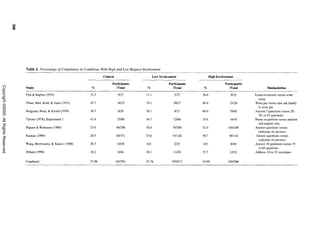
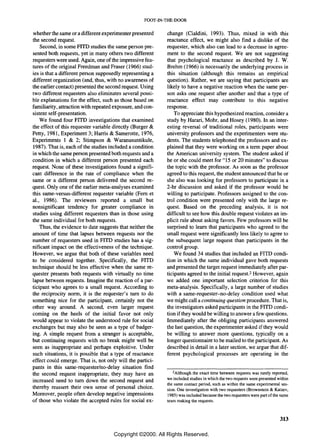
                                            Table 2. Percentage of Compliance in Conditions With High and Low Request Involvement

                                                                                            Control                            Low Involvement                 High Involvement

                                                                                                  Participants                           Participants                    Participants
Copyright ©2000. All Rights Reserved.


                                            Study                                    %              trotal               %                 trotal        %                 trotal                Manipulation

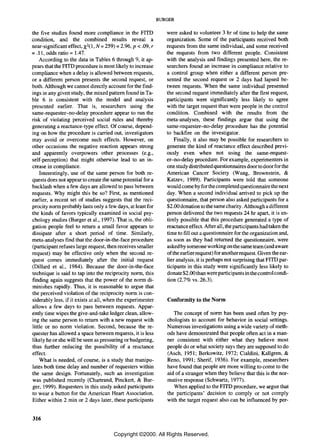
                                            Fish & Kaplan (1974)                    33.3               9/27             11.1                3/27        36.0                 9/25       Listen to lecture versus write
                                                                                                                                                                                          essay
                                            Pliner, Hart, Kohl, & Saari (1974)      45.7               16/35            74.1                20/27       80.8                21126       Wear pin versus also ask family
                                                                                                                                                                                          to wear pin
                                            Seligman, Bush, & Kirsch (1976)         30.7               8/26             38.1                8/21        60.0                39165       Answer 5 questions versus 20,
                                                                                                                                                                                          30, or 45 questions
                                            Tybout (1978), Experiment 1             41.6               25/60            36.7                22/60       35,6                16/45       Name on petition versus petition
                                                                                                                                                                                          and explain why
                                            Hansen & Robinson (1980)                23,0              461200            38.0               76/200       52.0               1041200      Answer questions versus
                                                                                                                                                                                          elaborate on answers
                                            Kamins (1989)                           26.5              401151            33.6               431128       38,7                481124      Answer questions versus
                                                                                                                                                                                          elaborate on answers
                                            Wang, Brownstein, & Katzev (1989)       26.3               10/38            8.0                 2125        0,0                  0/49       Answer 10 questions versus 35
                                                                                                                                                                                          or 60 questions
                                            Dillard (1990)                          18.2               8/44             38.1                11129       37.7                 12/32      Address 10 or 35 envelopes


                                            Combined                                27.88             162/581           35,78              185/517      43.99              2491566
FOOT-IN-THE-DOOR


through the hypothesized self-perception process than                note that this selection procedure is different than that
those who merely promise to do so.                                   used by Dillard et al. (1984) in their meta-analysis.
    We examined this hypothesis two ways. First, we                  Those reviewers combined studies in which the task
found four studies that tested the prediction directly.              clearly was not performed with those in which the au-
That is, the investigators included a per-                           thors failed to state specifically that the behavior was
form-not-perform variable in their designs. Interest-                performed.
ingly, one of these relevant studies was the original                   As shown in Table 4, studies in which participants
Freedman and Fraser (1966, Experiment 1) investiga-                  did not perform the initial task produced compliance
tion. As shown in Table 3, when we combined data for                 rates in the FlTD condition only slightly higher than
relevant conditions in the four studies, we found that               those in the control condition, X2(1, N = 780) = 2.23,
participants in the perform conditions tended to agree to            r = . 05, odds ratio = 1.16. However, the combined
the target request more often than those in the control              results of studies that allowed participants to perform
conditions, X2(1,N= 268) =3.61, p < .07, r= .12, odds                the initial request produced a large difference be-
ratio = 1.54. However, the rate of compliance in the                 tween the FITD and the control conditions, X2(1, N =
not-perform conditions was not noticeably higher than                8,356) = 159.84, p < .001, r = .14, odds ratio = 1.47.
in the control conditions, X2(1, N =249) =0.35, r =.04,              In sum, consistent with the prediction from
odds ratio = 1.19.                                                   self-perception theory, it appears that allowing partic-
    Next, we compared the results of studies that allowed            ipants to perform the initial request increases notice-
participants to perform the initial request versus those in          ably the likelihood that they will agree to the target
which the participant agreed to perform the request but              request.
did not do so. Again, we combined all relevant condi-
tions, except when a condition was included specifically                 Size of the initial request. Yet another predic-
to eliminate the FlTD effect. For reasons explained in               tion from the self-perception explanation concerns the
later sections, we did not include conditions in which               size of the initial request. The initial request used in the
participants were paid to perform the initial request,               typical FlTD study is so small and easy to perform that
were punished for performing the task, were given con-               virtually every participant agrees to the request. How-
sensus information about others' responses to the re-                ever, what if the initial request is so large that virtually
quest, or were overtly labeled by the requester.                     every participant declines the request? According to the
    We should note that each of the three earlier                    self-perception analysis, participants reflect back on
meta-analyses ofFITD studies conducted similar anal-                 their response to the initial request when deciding
yses. Both Beaman et al. (1983) and Fern et al. (1986)               whether or not to comply with the target request. If that
reported a small but statistically significant difference            is the case, then participants who reflect on their previ-
in this comparison, with performance leading to                      ous behavior and see a refusal should see themselves as
greater compliance. However, Dillard et al. (1984)                   the type of person who does not support these kinds of
found that this difference disappeared when other fac-               causes or go along with these kinds of requests. In this
tors, such as the type of appeal and whether partici-                situation, self-perception theory would predict a de-
pants were paid, were controlled for.                                crease in compliance relative to the control condition
    We included studies in the analysis only if we could             (Snyder & Cunningham, 1975).
clearly determine whether or not participants per-                       We found five studies that included the conditions
formed the initial request. In some cases, participants              necessary to test this prediction. Each of these studies
agreed to perform a task (e.g., distribute buttons to                included a condition in which participants were asked
family members), but apparently no effort was made to                a large request designed to elicit a refusal, then con-
determine if the behavior was actually performed.                    tacted later and presented with the target request. Each
These studies were not included in our analysis. We                  of the studies also included a control condition that re-

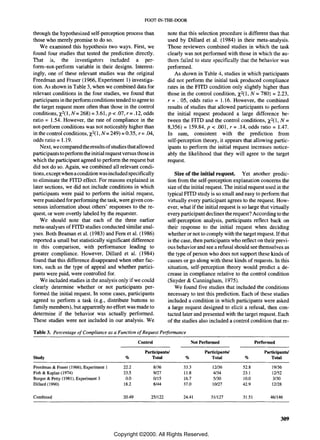
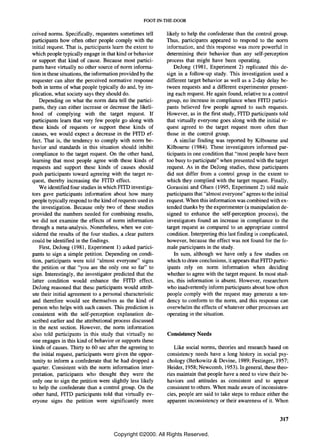
Table 3. Percentage of Compliance as a Function of Request Performance
                                                    Control                        Not Perfonned                  Performed

                                                       Participants!                     Participants!                Participants!
Study                                        %             Total             o/~            Total          %             Total

Freedman & Fraser (1966), Experiment 1      22.2              8/36          33.3            12/36         52.8           19/36
Fish & Kaplan (1974)                        33.5              9127          11.8            4/34          23.1           12/52
Burger & Petty (1981), Experiment 3          0.0              0115          16.7            5/30          10.0           3/30
Dillard (1990)                              18.2              8/44          37.0            10/27         42.9           12128


Combined                                    20.49         25/122            24.41           31/127        31.51          461146


                                                                                                                              309

                                         Copyright ©2000. All Rights Reserved.
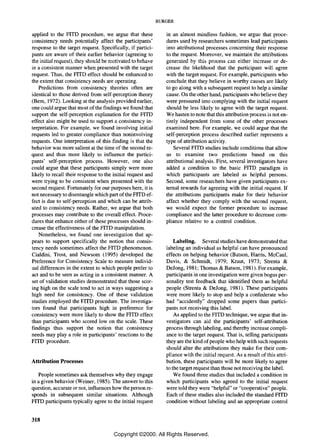
Table 4. Percentage of Compliance in Not-Performance Versus Performance Studies
                                                                 Control                        Foot·in·the·Door

Study                                                    %         Participantsrrotal    %           Participantsrrotal

Initial Request Not Performed
   Freedman & Fraser (1966), Experiment I               22.2                8/36        33.3               12/36
   Fish & Kaplan (1974)                                 33.5               9127         11.8               4/34
   Snyder & Cunningham (1975)                           33.3               10/30        51.7               15129
   Reingen & Kernan (1977)                              57.7               15/26        74.1               20/27
  Zuckerman, Lazzaro, & Waldgeir (1979)                 45.0               18/40        64.3               27/42
   Harari, Mohr, Hosey (1980)                           56.8               25/44        33.3               19/57
   Burger & Petty (1981), Experiment 3                   0.0               0115         16.7                5/30
   Shanab & Isonio (1982)                               25.6               10/39        28.6               22m
   Shanab & O'Neill (1982)                              30.0               12/40        47.5               38/80
   Dillard (1990)                                       18.2                8/44        37.0               10127
  Combined (Not Performed)                              33.78              115/341      39.18             172/439
Initial Request Performed
   Freedman & Fraser (1966), Experiment 1               22.2                 8/36       52.8               19/36
   Freedman & Fraser (1966), Experiment 2               16.7                 4124       55.7               49/88
   Harris (1972), Experiment 1                          11.1                 2/18       41.6               15/36
   Harris, Liguori, & Stack (1973), Experiment 3        25.0                15160       30.0               15/50
   Fish & Kaplan (1974)                                 46.5                20/43       21.6               16174
   Cann, Sherman, & Elkes (1975), Experiment 1          50.0                13/26       74.4               32143
   Cann et aI. (1975), Experiment 2                     45.0                 9120       72.2               13118
   Harris & Samerotte (1976), Experiment I              35.0                 7120       30.0               12/40
   Harris & Samerotte (1976), Experiment 2              28.6                 4/14       28.6               16/56
   Scott (1976)                                          9.0                9/100       15.6              37/237
   Seligman, Bush, & Kirsch (1976)                      30.7                 8/26       54.6               47/86
   Dejong & Funder (1977), Experiment 1                 55.6                20/36       45.8               11124
   Dejong & Funder (1977), Experiment 2                 55.6                30/54       65.5               19129
   Reingen (1978)                                       18.8                 6/32       34.4               1l/32
   Tybout (1978), Experiment 1                          41.6                25/60       36.2              381105
   Tybout (1978), Experiment 2                          22.5                 9/40       35.9               14/39
   Foss & Dempsey (1979), Experiment 2                   3.3                 1130        4.9                2/41
   Reingen & Kernan (1979)                              44.2               46/104       50.0              591118
   Allen, Schewe, & Wijk (1980)                         22.2               186/836      67.3               66/98
   Hansen & Robinson (1980)                             23.0               46/200       45.0              180/400
   Wagener & Laird (1980)                               35.7                27176       65.8               50176
   Burger & Petty (1981), Experiment 3                   0.0                 0115       10.0                3/30
   Dejong (1981), Experiment 2                          37.1                 13/35      41.0               16/39
   Furse, Stewart, & Rados (1981)                       20.7               611294       22.4              48/214
   Rittle (1981)                                        20.0                 3115       57.1                8/14
   Crano & Sivacek (1982)                               31.2                 10/32      71.9               23/32
   Dejong & Musilli (1982)                              40.0               401100       51.9              139/264
   Goldman, Seever, & Seever (1982)                     16.7                 5/30       40.0               12/30
   Swanson, Sherman, & Sherman (1982)                   52.5                21140       90.0               36/40
   Schwarzwald, Bizman, & Raz (1983)                    53.2                41m         92.2               71177
   Katzev & Johnson (1984)                              69.2                 9/13       61.5                8/13
   Brownstein & Katzev (1985)                           80.0                20/25       50.0               10/20
   Wynn & McDaniel (1985)                               17.6               57/324       48.4              59/122
   Goldman (1986)                                       22.4                 17176      46.0               35176
   Patch (1986)                                         52.5                42180       78.7               63/80
   Stimpson & Waranusuntikule (1987)                    25.0                 5/20       23.3                7/30
   Beaman, Steblay, Preston, & KIentz (1988)            22.4                 11147      23.9              59/246
   Patch (1988)                                         47.5                 19/40      75.0               30/40
   Kamins (1989)                                        26.5               401151       36.1              911252
   Kilbourne (1989), Experiment 1                        9.7                 6/62       13.3                8/60
   Kilbourne (1989), Experiment 2                       26.2                 16/61      28.3               17/60
   Kilbourne (1989), Experiment 3                        9.4                96/64       30.0               18/60
   Wang, Brownstein, & Katzev (1989)                    26.3                 10/38       2.7                2174
   Williams & Williams (1989)                           33.8                22/68       27.9               19/68
   Dillard (1990)                                       18.2                 8/44       42.9               12/28
   Hornik, Zaig, & Shadman (1991)                       46.7               64/137       59.7              711119
   Bell, Cholerton, Fraczek, & Smith (1994)             10.1                171169      23.1              39/169
   Cialdini, Trost, & Newsom (1995), Experiment 2       61.8               76/123       67.2              781116
   Martens, Kelly, & Diskin (1996)                      60.0                 12120      47.6               10/21
   Chartrand, Pinckert, & Burger (1999)                 27.0                 10/37      40.3              58/144
  Combined (Performed)                                  28.25         1,156/4,092       41.49            1,769/4,264


                                            Copyright ©2000. All Rights Reserved.
FOOT-IN-THE-DOOR

ceived only the target request. However, we added two             Although this hypothesis seems straightforward,
criteria for inclusion that resulted in dropping two of        we found only two investigations that examined this
the studies from the meta-analysis. One study was not          prediction directly. Again, one of these was from the
included because the majority of the participants              seminal article by Freedman and Fraser (1966, Experi-
agreed to the initial large request (Reingen & Kernan,         ment 2). The target request in that study asked partici-
1979). Obviously, these participants would not see             pants to display a large sign in their front lawns
themselves as the kind of people who refuse such re-           encouraging people to drive carefully. The highest rate
quests. Another study was not included because less            of compliance to this request came from participants
than an hour passed between the initial and target re-         who earlier had been asked to display a small sign en-
quest (Brownstein & Katzev, 1985). The time lapse be-          couraging driver safety. Compliance to the target re-
tween requests is necessary to avoid the creation of a         quest dropped off when the initial request was either to
"door-in-the-face effect" (Cialdini et aI., 1975). Nu-         engage in a different behavior (sign a petition) or to
merous investigations found that, compared to a sin-           support a different cause (keeping California beauti-
gle-request control group, participants are more likely        ful). The only other direct test of this prediction found
to comply to a small request if it comes immediately           no difference in compliance rates when using the same
after they refuse a large request. This door-in-the-face       or a different issue for the two requests (Seligman,
effect is said to be caused by a need to reciprocate the       Miller, et aI., 1976). Participants in this study accepted
requester's apparent concession (Cialdini et aI., 1975).       either a small campaign sign or a fire prevention sign to
However, the need to reciprocate small favors dissi-           fulfIll their agreement with the initial request. How-
pates quickly (Burger, Horita, Kinoshita, Roberts, &           ever, participants from both conditions were equally
Vera, 1997) and thus is not likely to affect responses a       likely to accept a large campaign poster when con-
day or two after participants refuse the initial request.      tacted later by the experimenters.
    As shown in Table 5, we found the predicted de-                Ideally, we could examine the similarity prediction
cline in compliance when participants refused the large        through a meta-analysis that compared studies using
initial request in each of the three remaining investiga-      similar requests with those using dissimilar requests.
tions. The meta-analysis of combined studies also              However, we did not attempt such an analysis because
points to a small but consistent difference between the        it would require a great deal of subjective judgment.
control and experimental conditions, :;e(1, N = 170) =         That is, it would be difficult to quantify and code the
2.82, P < .10, r = -.13, odds ratio = 0.65. In short, al-      degree to which the first and second request resembled
though only a handful of investigations have examined          one another. Perhaps for this reason, none of the earlier
the prediction, the findings from these studies are con-       FITD meta-analyses examined a similar-dissimilar
sistent with the notion that a self-perception process         variable. Consequently, relevant data on the similarity
plays a role in the effectiveness of the FITD procedure.       hypotheses derived from self-perception theory are
                                                               sparse. Although Freedman and Fraser (1966) pro-
    Similarity of requests. There is one additional            vided evidence consistent with the prediction in their
prediction derived from self-perception theory. We             original study, this obvious variable has gone rela-
would expect that the more similar the first and sec-          tively unexamined ever since.
ond request in an FITD situation, the higher the rate              In sum, we uncovered a pattern of findings consis-
of compliance with the target request. According to            tent with the notion that a self-perception process is op-
the self-perception explanation, agreeing to the initial       erating in the typical FITD manipulation. Participants
request causes participants to see themselves as the           are more likely to comply with the target request when
type of person who supports these causes or engages            agreeing to the initial request requires additional in-
in these kinds of tasks. The more similar the requests,        volvement and, hence, is presumably more salient.
the more likely it is that participants will draw this         Similarly, higher compliance is found when partici-
conclusion.                                                    pants are allowed to perform the initial request.


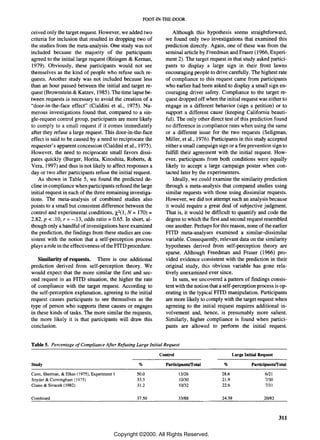
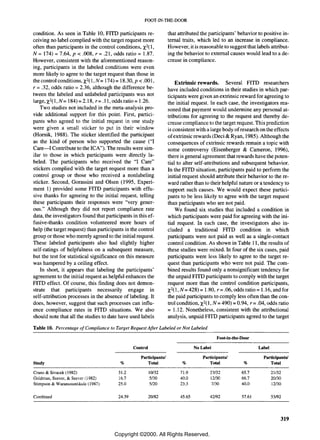
Table 5. Percentage of Compliance After Refusing Large Initial Request
                                                             Control                            Large Initial Request

Study                                              %            ParticipantsfI'otal       %               ParticipantsfI'otal

Cann, Shennan, & Elkes (1975), Experiment 1       50.0                 13/26             28.6                    6/21
Snyder & Cunningham (1975)                        33.3                 10/30             21.9                    7/30
Crano & Sivacek (1982)                            31.2                 10/32             22.6                    7/31


Combined                                          37.50                33/88             24.39                  20/82


                                                                                                                        311


                                          Copyright ©2000. All Rights Reserved.
BURGER

Finally, participants are less likely to agree to the target      may be a decreased likelihood of agreeing with the tar-
request if they have earlier declined a large request.            get request.
                                                                      When might such a negative reaction occur? To an-
                                                                  swer this question, we need to look at two important
                                                                  variables that have been left relatively uncontrolled in
Reciprocity Rules and Reactance                                   FITD research: the amount of time between requests
                                                                  and whether the same or a different person presents the
    The brief contact between requester and partici-              second request. First, the amount of time that lapses
pant in an FITD experiment is a social encounter, and             between the initial request and the target request has
is, therefore, subject to the rules and norms that regu-          varied from essentially no time to more than 2 weeks.
late the way people in our society interact with one              The optimal amount of time between requests has
another. Appropriate and inappropriate behavior by                never been specified and may well vary as a function of
the requester can trigger a reaction by the participant           the specific request. In one of their original demonstra-
that may affect the participant's decision about com-             tions of the effect, Freedman and Fraser (1966) al-
plying with the target request. Two related and                   lowed 2 weeks to pass between requests. Some of the
well-researched concepts seem particularly relevant               fascination with the FITD phenomenon probably
for understanding this reaction in the FITD paradigm.             stems from the fact that such a small manipulation
These two concepts are the norm of reciprocity and                (e.g., signing a petition) could lead to such strong ef-
psychological reactance.                                          fects over such a long period of time. Common sense
    Norm of reciprocity is a widely accepted social rule          argues for an upper limit for the time period between
in Western cultures that regulates the exchange of fa-            requests (surely the petition manipulation would not
vors and requests. This social rule maintains that the            show effects 2 years later), but no such ceiling has yet
give and take in social exchanges should be reasonably            been demonstrated empirically.
equal (Gouldner, 1960). More specifically, people are                 A handful of researchers have examined the time
motivated to return favors and to see that the amount of          lapse variable directly. Three of these studies included
giving and taking in a relationship, however brief and            a condition in which there was no delay between the
ephemeral, is fair and equal. In the classic demonstra-           two requests and one or more conditions in which at
tion of this effect, Regan (1971) found that participants         least 24 hr elapsed between requests (Cann, Sherman,
were more willing to purchase raffle tickets from a               & Elkes, 1975, Experiment 1; Foss & Dempsey, 1979;
confederate if that confederate had earlier given them a          Shanab & Isonio, 1982). None of the three studies
soft drink as an unexpected favor. The other side of the          found a significant difference in compliance between
reciprocity norm is that people are uncomfortable with            the delay and no-delay conditions. However, it is also
an unpaid debt and may even come to dislike those                 the case that none ofthe three studies reported a signif-
who do not allow the recipient to return the good deed            icant FITD effect when comparing either the delay or
(Gergen, Ellsworth, Maslach, & Seipel, 1975).                     no-delay conditions separately against the control con-
    Psychological reactance is said to occur when peo-            dition. Thus, it is difficult to draw conclusions about
ple perceive a threat to their sense of personal freedom          the FITD effect from these investigations. Similarly,
and choice (J. W. Brehm, 1966; S. S. Brehm & Brehm,               Beaman, Steblay, Preston, and KIentz (1988) included
1981). When we become aware of an effort to reduce                six different time lapse conditions in their study. Al-
our freedom, such as pressure from a salesperson or re-           though the investigators compared time lapse periods
quester, we often respond by reasserting our option to            ranging from 1 to 19 days, they did not include a
act as we please. In many situations, this means doing            no-delay condition in their design. The researchers
the opposite of whatever is being pushed on us. For ex-           found no significant effect for the time variable in this
ample, we can reassert our freedom of choice by not               study; however, they also failed to produce a signifi-
purchasing the product offered by the pressuring sales-           cant FITD effect.
person. Thus, when participants in one study were                     Each of the three earlier meta-analyses also exam-
pressured to return a favor, they were more likely to re-         ined the effects of time between requests (Beaman et
fuse the request than when no pressure was exerted (J.            aI., 1983; Dillardetal., 1984; Fern et aI., 1986). In each
W. Brehm & Cole, 1966).                                           case, the reviewers did not find a significant relation
    As applied to the FITD technique, we argue that re-           between the length of time between requests and the
questers sometimes violate the rules for social ex-               strength of the effect. Thus, there is no empirical evi-
changes, specifically the reciprocity norm. Further, we           dence to date that the length of time between requests
argue that this violation may lead to a response similar          significantly influences the effectiveness of the FITD
to a reactance effect. If participants feel the requester is      phenomenon. However, as we show next, it is impor-
making an inappropriate request and thereby pressur-              tant to keep in mind that none of the meta-analyses ex-
ing them to comply with that request, the net result              amined the effect of time between requests and


312

                                        Copyright ©2000. All Rights Reserved.
FOOT-IN-THE-OOOR


whether the same or a different experimenter presented     change (Cialdini, 1993). Thus, mixed in with this
the second request.                                        reactance effect, we might also find a dislike of the
    Second, in some FITD studies the same person pre-      requester, which also can lead to a decrease in agree-
sented both requests, yet in many others two different     ment to the second request. We are not suggesting
requesters were used. Again, one of the impressive fea-    that psychological reactance as described by J. W.
tures of the original Freedman and Fraser (1966) stud-     Brehm (1966) is necessarily the underlying process in
ies is that a different person supposedly representing a   this situation (although this remains an empirical
different organization (and, thus, with no awareness of    question). Rather, we are saying that participants are
the earlier contact) presented the second request. Using   likely to have a negative reaction when the same per-
two different requesters also eliminates several possi-    son asks one request after another and that a type of
ble explanations for the effect, such as those based on    reactance effect may contribute to this negative
familiarity, attraction with repeated exposure, and con-   response.
sistent self-presentation.                                     To appreciate this hypothesized reaction, consider a
    We found four FITD investigations that examined        study by Harari, Mohr, and Hosey (1980). In an inter-
the effect of this requester variable directly (Burger &   esting reversal of traditional roles, participants were
Petty, 1981, Experiment 3; Harris & Samerotte, 1976,       university professors and the experimenters were stu-
Experiments 1 & 2; Stimpson & Waranusuntikule,             dents. The students telephoned the professors and ex-
1987). That is, each of the studies included a condition   plained that they were working on a term paper about
in which the same person presented both requests and a     the American university system. The student asked if
condition in which a different person presented each       he or she could meet for "15 or 20 minutes" to discuss
request. None of these investigations found a signifi-     the topic with the professor. As soon as the professor
cant difference in the rate of compliance when the         agreed to this request, the student announced that he or
same or a different person delivered the second re-        she also was looking for professors to participate in a
quest. Only one of the earlier meta-analyses examined      2-hr discussion and asked if the professor would be
this same-versus-different requester variable (Fern et     willing to participate. Professors assigned to the con-
al., 1986). The reviewers reported a small but             trol condition were presented only with the large re-
nonsignificant tendency for greater compliance in          quest. Based on the preceding analysis, it is not
studies using different requesters than in those using     difficult to see how this double request violates an im-
the same individual for both requests.                     plicit rule about asking favors. Few professors will be
    Thus, the evidence to date suggests that neither the   surprised to learn that participants who agreed to the
amount of time that lapses between requests nor the        small request were significantly less likely to agree to
number of requesters used in FITD studies has a sig-       the subsequent large request than participants in the
nificant impact on the effectiveness of the technique.     control group.
However, we argue that both of these variables need            We found 34 studies that included an FITD condi-
to be considered together. Specifically, the FITD          tion in which the same individual gave both requests
technique should be less effective when the same re-       and presented the target request immediately after par-
quester presents both requests with virtually no time      ticipants agreed to the initial request. 2 However, again
lapse between requests. Imagine the reaction of a par-     we added one important selection criterion for this
ticipant who agrees to a small request. According to       meta-analysis. Specifically, a large number of studies
the reciprocity norm, it is the requester's turn to do     with a same-requester-no-delay condition used what
something nice for the participant, certainly not the      we might call a continuing question procedure. That is,
other way around. A second, even larger request            the investigators asked participants in the FITD condi-
coming on the heels of the initial favor not only          tion if they would be willing to answer a few questions.
would appear to violate the understood rule for social     Immediately after the obliging participants answered
exchanges but may also be seen as a type of badger-        the last question, the experimenter asked if they would
ing. A simple request from a stranger is acceptable,       be willing to answer more questions, typically on a
but continuing requests with no break might well be        longer questionnaire to be mailed to the participant. As
seen as inappropriate and perhaps exploitive. Under        described in detail in a later section, we argue that dif-
such situations, it is possible that a type of reactance   ferent psychological processes are operating in the
effect could emerge. That is, not only will the partici-
pants in this same-requester/no-delay situation find
the second request inappropriate, they may have an            2Although the exact time between requests was rarely reported.
                                                           we included studies in which the two requests were presented within
increased need to turn down the second request and
                                                           the same contact period. such as within the same experimental ses-
thereby reassert their own sense of personal choice.       sion. One investigation with two requesters (Brownstein & Katzev,
Moreover, people often develop negative impressions        1985) was included because the two requesters were part of the same
of those who violate the accepted rules for social ex-     team making the requests.


                                                                                                                         313

                                     Copyright ©2000. All Rights Reserved.
BURGER


continuing question procedure than in the procedures                  longest time lag was between 2 and 3 weeks. The com-
used in the studies listed in Table 6. Each of the studies            bined findings for these studies are shown in Table 7.
listed in Table 6 used a distinctively different task for             A glance at the table indicates that the differ-
the two requests.                                                     ent-requester-delayed-request procedure has been rea-
    A quick glance at Table 6 shows that the findings                 sonably effective in producing an FITD effect. The
from studies using the same-requester/no-delay proce-                 FITD manipulation produced more compliance to the
dure are quite varied. Of the 24 studies, exactly half                target request than the control condition in all but three
found more compliance in the FITD condition,                          cases, although many of the differences fell short of
whereas the other half found more compliance in the                   statistical significance. When the results of all 28 stud-
control condition. Although only a handful of these                   ies were combined, we found a significant difference
differences approach statistical significance, it is ap-              between the FITD and control conditions, X2(1, N =
parent that the same-requester/no-delay procedure of-                 3,627) =56.30, p < .001, r = .12, odds ratio = lAO.
ten is ineffective in increasing compliance and may in                    Although less cornmon, we found seven studies that
some cases lead to the opposite reaction. Nonetheless,                used the same person for both requests but also em-
when the results from all of the investigations were                  ployed a delay of at least 2 days between requests. As
combined, we still found a significant tendency for                   shown in Table 8, in six ofthe seven cases, participants
greater compliance with the FITD procedure, X2( 1, N =                in the FITD condition responded more favorably to the
2,121) =6.21, P < .02, r = .05, odds ratio = 1.21.                    target request than participants in the control condi-
    Before interpreting these findings, let us look at                tion. The lone exception reported a nonsignificant ten-
what researchers have found when they used each of                    dency in the opposite direction. When the data for all
the three remaining procedural possibilities. First,                  seven studies were combined, we again found a signifi-
FITD researchers often used two different requesters                  cant difference between conditions, X2(1, N = 892) =
and allowed a reasonable length of time to expire be-                 3.98, p < .05, r =.07, odds ratio =1.22.
tween requests. We found 28 studies with conditions                       Finally, we found five studies that included a condi-
meeting this description. Each of these investigations                tion in which different requesters were used with no
allowed at least 2 days to lapse between requests. The                delay between requests. As shown in Table 9, four of

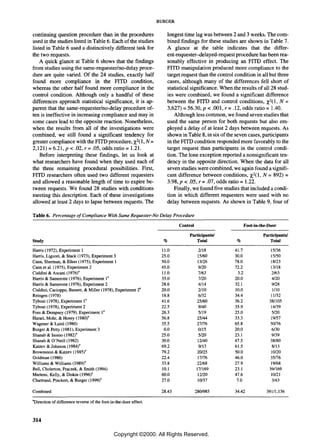
Table 6. Percentage of Compliance With Same Requester-No Delay Procedure
                                                                            Control                         Foot·in·the·Door

                                                                                 Participants/                       Participants/
Study                                                                %               Total            %                 Total

Harris (1972), Experiment 1                                         11.0               2/18          41.7                15/36
Harris, Liguori, & Stack (1973), Experiment 3                       25.0               15/60         30.0                15/50
Cann, Shennan, & Elkes (1975), Experiment 1                         50.0               13/26         78.0                18/23
Cann et aI. (1975), Experiment 2                                    45.0               9/20          72.2                13/18
CiaIdini & Ascani (1976)"                                           11.0               7/63           3.2                 2/63
Harris & Samerotte (1976), Experiment I'                            35.0               7/20          20.0                 4/20
Harris & Samerotte (1976), Experiment 2                             28.6               4/14          32.1                 9/28
Cialdini, Cacioppo, Bassett, & Miller (1978), Experiment 2'         20.0               2/10          10.0                 1110
Reingen (1978)                                                      18.8               6/32          34.4                11/32
Tybout (1978), Experiment I'                                        41.6              25/60          36.2               381105
Tybout (1978), Experiment 2                                         22.5               9/40          35.9                14/39
Foss & Dempsey (1979), Experiment I'                                26.3               5/19          25.0                 5/20
Harari, Mohr, & Hosey (1980)"                                       56.8              25/44          33.3                19/57
Wagener & Laird (1980)                                              35.5              27n6           65.8                50176
Burger & Petty (1981), Experiment 3                                  0.0               0/15          20.0                 6/30
Shanab & Isonio (1982)"                                             25.0               5120          23.1                 9/39
Shanab & O'Neill (1982)                                             30.0               12/40         47.5                38/80
Katzev & Johnson (1984)"                                            69.2               9/13          61.5                 8/13
Brownstein & Katzev (1985)'                                         79.2              20/25          50.0                10120
Goldman (1986)                                                      22.4               17176         46.0                35176
Williams & Williams (1989)'                                         33.8              22/68          27.9                19/68
Bell, Cholerton, Fraczek, & Smith (1994)                            10.1              171169         23.1               39/169
Martens, Kelly, & Diskin (1996)'                                    60.0               12/20         47.6                10/21
Chartrand, Pinckert, & Burger (1999)"                               27.0               10/37          7.0                 3/43

Combined                                                            28.43             2801985        34.42             39111,136

'Direction of difference reverse of the foot-in-the-door effect.


314

                                               Copyright ©2000. All Rights Reserved.
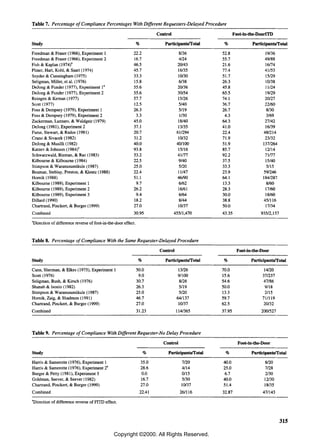
Table 7. Percentage of Compliance Percentages With Different Requesters-Delayed Procedure

                                                                           Control                            Foot-in·the·DoorITD

Study                                                          %               ParticipantsJ'TotaI     %               ParticipantsJ'Total
Freedman & Fraser (1966). Experiment 1                     22.2                         8/36          52.8                   19/36
Freedman & Fraser (1966). Experiment 2                     16.7                        4/24           55.7                   49/88
Fish & Kaplan (1974)"                                      46.5                       20143           21.6                   16174
Pliner. Hart. Kohl, & Saari (1974)                         45.7                        16/35          77.4                   41153
Snyder & Cunningham (1975)                                 33.3                        10/30          51.7                   15/29
Seligman. Miller. et al. (1976)                            15.8                         6/38          26.3                   10/38
Dejong & Funder (1977). Experiment I'                      55.6                        20/36          45.8                   11/24
DeJong & Funder (1977), Experiment 2                       55.6                        30/54          65.5                   19129
Reingen & Kernan (l977)                                    57.7                        15/26          74.1                   20127
Scott (1977)                                               12.5                         5/40          36.7                   22/60
Foss & Dempsey (1979). Experiment 1                        26.3                         5/19          26.7                    8/30
Foss & Dempsey (1979), Experiment 2                         3.3                         1130           4.3                    3/69
Zuckerman. Lazzaro. & Waldgeir (1979)                      45.0                        18/40          64.3                   27/42
Dejong (1981). Experiment 2                                37.1                        13/35          41.0                   16/39
Furse. Stewart. & Rados (1981)                             20.7                       611294          22.4                  48/214
Crano & Sivacek (1982)                                     31.2                        10/32          71.9                   23/32
Dejong & Musilli (1982)                                    40.0                       40/100          51.9                  137/264
Katzev & Johnson (1984)'                                   93.8                        15/16          85.7                   12114
Schwarzwald. Bizman. & Raz (1983)                          53.2                        41177          92.2                   71177
Kilbourne & Kilbourne (1984)                               22.5                        9/40           37.5                   15/40
Stimpson & Waranusuntiku1e (1987)                          25.0                         5/20          33.3                    5115
Beaman, Steblay, Preston. & Kientz (l988)                  22.4                        11147          23.9                  591246
Hornik (1988)                                              51.1                       46190           64.1                  184/287
Kilbourne (1989). Experiment 1                              9.7                         6/62          13.3                    8/60
Kilbourne (1989). Experiment 2                             26.2                        16/61          28.3                   17/60
Kilbourne (1989), Experiment 3                              9.4                         6/64          30.0                   18/60
Dillard (1990)                                             18.2                         8/44          38.8                  45/116
Chartrand, Pinckert, & Burger (1999)                       27.0                        10/37          50.0                   17/34
Combined                                                   30.95                     45511,470        43.35                935/2,157

'Direction of difference reverse of foot-in-tbe-door effect.


Table 8. Percentage of Compliance With the Same Requester-Delayed Procedure

                                                                            Control                            Foot·in·the·Door

Study                                                          %               ParticipantsJ'TotaI     %              ParticipantsJ'TotaI
Cann, Sherman. & Elkes (1975). Experiment 1                    50.0                    13/26          70.0                   14/20
Scott (1976)                                                    9.0                    9/100          15.6                  37/237
Seligman, Bush, & Kirsch (1976)                                30.7                     8126          54.6                   47/86
Shanab & Isonio (1982)                                         26.3                    5/19           50.0                    9/18
Stimpson & Waranusuntiku1e (1987)                              25.0                    5/20           13.3                    2115
Hornik, Zaig, & Shadmon (1991)                                 46.7                   64/137          59.7                  711119
Chartrand, Pinckert, & Burger (1999)                           27.0                    10/37          62.5                   20/32
Combined                                                       31.23                  114/365         37.95                200/527


Table 9. Percentage of Compliance With Different Requester-No Delay Procedure

                                                                              Control                           Foot-in-the-Door

Study                                                               %           ParticipantsJ'Total    %              ParticipantsJ'Total
Harris & Samerotte (1976), Experiment 1                            35.0                 7/20          40.0                   8120
Harris & Samerotte (1976), Experiment 2'                           28.6                 4/14          25.0                   7128
Burger & Petty (1981), Experiment 3                                0.0                  0/15           6.7                   2/30
Goldman, Seever, & Seever (1982)                                   16.7                 5/30          40.0                   12/30
Chartrand, Pinckert. & Burger (1999)                               27.0                 10137         51.4                   18/35
Combined                                                           22.41                26/116        32.87                 47/143

'Direction of difference reverse of FlTD effect.


                                                                                                                                       315

                                               Copyright ©2000. All Rights Reserved.
BURGER

the five studies found more compliance in the FITD                    were asked to volunteer 3 hr of time to help the same
condition, and the combined results reveal a                          organization. Some of the participants received both
near-significant effect, X2 (1, N:::: 259) :::: 2.96, p < .09, r      requests from the same individual, and some received
:::: .11, odds ratio:::: 1.47.                                        the requests from two different people. Consistent
      According to the data in Tables 6 through 9, it ap-             with the analysis and findings presented here, the re-
pears that the FITD procedure is most likely to increase              searchers found an increase in compliance relative to
compliance when a delay is allowed between requests,                  a control group when either a different person pre-
or a different person presents the second request, or                 sented the second request or 2 days had lapsed be-
both. Although we cannot directly account for the find-               tween requests. When the same individual presented
ings in any given study, the mixed pattern found in Ta-               the second request immediately after the first request,
ble 6 is consistent with the model and analysis                       participants were significantly less likely to agree
presented earlier. That is, researchers using the                     with the target request than were people in the control
 same-requester-no-delay procedure appear to run the                  condition. Combined with the results from the
risk of violating perceived social rules and thereby                  meta-analyses, these findings argue that using the
generating a reactance-type effect. Of course, depend-                same-requester-no-delay procedure has the potential
ing on how the procedure is carried out, investigators                to backfire on the investigator.
may avoid or overcome such effects. However, on                           Finally, it also may be possible for researchers to
other occasions the negative reaction appears strong                  generate the kind of reactance effect described previ-
 and apparently overpowers other processes (e.g.,                     ously even when not using the same-request-
 self-perception) that might otherwise lead to an in-                 er-no-delay procedure. For example, experimenters in
 crease in compliance.                                                one study distributed questionnaires door to door for the
      Interestingly, use of the same person for both re-              American Cancer Society (Wang, Brownstein, &
 quests does not appear to create the same potential for a            Katzev, 1989). Participants were told that someone
 backlash when a few days are allowed to pass between                 would come by for the completed questionnaire the next
 requests. Why might this be so? First, as mentioned                  day. When a second individual arrived to pick up the
earlier, a recent set of studies suggests that the reci-              questionnaire, that person also asked participants for a
 procity norm probably lasts only a few days, at least for            $2.00 donation to the same charity. Although a different
 the kinds of favors typically examined in social psy-                person delivered the two requests 24 hr apart, it is en-
 chology studies (Burger et aI., 1997). That is, the obli-            tirely possible that this procedure generated a type of
 gation people feel to return a small favor appears to                reactance effect. After all, the participants had taken the
 dissipate after a short period of time. Similarly,                   time to fill out a questionnaire for the organization and,
 meta-analyses find that the door-in-the-face procedure               as soon as they had returned the questionnaire, were
 (participant refuses large request, then receives smaller            asked by someone working on the same team (and aware
request) may be effective only when the second re-                    of the earlier request) for another request. Given the ear-
quest comes immediately after the initial request                     lier analysis, it is perhaps not surprising that FITD par-
 (Dillard et ai., 1984). Because the door-in-the-face                 ticipants in this study were significantly less likely to
 technique is said to tap into the reciprocity norm, this             donate $2 .00 than were partici pants in the control condi-
 finding again suggests that the power of the norm di-                tion (2.7% vs. 26.3).
 minishes rapidly. Thus, it is reasonable to argue that
 the perceived violation of the reciprocity norm is con-
 siderably less, if it exists at all, when the experimenter           Conformity to the Norm
 allows a few days to pass between requests. Appar-
 ently time wipes the give-and-take ledger clean, allow-                 The concept of norm has been used often by psy-
 ing the same person to return with a new request with                chologists to account for behavior in social settings.
 little or no norm violation. Second, because the re-                 Numerous investigations using a wide variety of meth-
 quester has allowed a space between requests, it is less             ods have demonstrated that people often act in a man-
 likely he or she will be seen as pressuring or badgering,            ner consistent with either what they believe most
 thus further reducing the possibility of a reactance                 people do or what society says they are supposed to do
 effect.                                                              (Asch, 1951; Berkowitz, 1972; Cialdini, Kallgren, &
      What is needed, of course, is a study that manipu-              Reno, 1991; Sherif, 1936). For example, researchers
 lates both time delay and number of requesters within                have found that people are more willing to come to the
 the same design. Fortunately, such an investigation                  aid of a stranger when they believe that this is the nor-
 was published recently (Chartrand, Pinckert, & Bur-                  mative response (Schwartz, 1977).
 ger, 1999). Requesters in this study asked participants                 When applied to the FITD procedure, we argue that
 to wear a button for the American Heart Association.                 the participants' decision to comply or not comply
 Either within 2 min or 2 days later, these participants              with the target request also can be influenced by per-


316

                                          Copyright ©2000. All Rights Reserved.
FOOT-IN-THE-DOOR

ceived norms. Specifically, requesters sometimes tell        likely to help the confederate than the control group.
participants how often other people comply with the          Thus, participants appeared to respond to the norm
initial request. That is, participants learn the extent to   information, and this response was more powerful in
which people typically engage in that kind or behavior       determining their behavior than any self-perception
or support that kind of cause. Because most partici-         process that might have been operating.
pants have virtually no other source of norm informa-            Dejong (1981, Experiment 2) replicated this de-
tion in these situations, the information provided by the    sign in a follow-up study. This investigation used a
requester can alter the perceived normative response         different target behavior as well as a 2-day delay be-
both in terms of what people typically do and, by im-        tween requests and a different experimenter present-
plication, what society says they should do.                 ing each request. He again found, relative to a control
    Depending on what the norm data tell the partici-        group, no increase in compliance when FITD partici-
pants, they can either increase or decrease the likeli-      pants believed few people agreed to such requests.
hood of complying with the target request. If                However, as in the first study, FITD participants told
participants learn that very few people go along with        that virtually everyone goes along with the initial re-
these kinds of requests or support these kinds of            quest agreed to the target request more often than
causes, we would expect a decrease in the FITD ef-           those in the control group.
fect. That is, the tendency to comply with norm be-              A similar finding was reported by Kilbourne and
havior and standards in this situation should inhibit        Kilbourne (1984). These investigators informed par-
compliance to the target request. On the other hand,         ticipants in one condition that "most people have been
learning that most people agree with these kinds of          too busy to participate" when presented with the target
requests and support these kinds of causes should            request. As in the Dejong studies, these participants
push participants toward agreeing with the target re-        did not differ from a control group in the extent to
quest, thereby increasing the FITD effect.                   which they complied with the target request. Finally,
    We identified four studies in which FITD investiga-      Gorassini and Olsen (1995, Experiment 2) told male
tors gave participants information about how many            participants that "almost everyone" agrees to the initial
people typically respond to the kind of requests used in     request. When this information was combined with ex-
the investigation. Because only two of these studies         tended thanks by the experimenter (a manipUlation de-
provided the numbers needed for combining results,           signed to enhance the self-perception process), the
we did not examine the effects of norm information           investigators found an increase in compliance to the
through a meta-analysis. Nonetheless, when we con-           target request as compared to an appropriate control
sidered the results of the four studies, a clear pattern     condition. Interpreting this last finding is complicated,
could be identified in the findings.                         however, because the effect was not found for the fe-
    First, Dejong (1981, Experiment 1) asked partici-        male participants in the study.
pants to sign a simple petition. Depending on condi-             In sum, although we have only a few studies on
tion, participants were told "almost everyone" signs         which to draw conclusions, it appears that FITD partic-
the petition or that "you are the only one so far" to        ipants rely on norm information when deciding
sign. Interestingly, the investigator predicted that the     whether to agree with the target request. In most stud-
latter condition would enhance the FITD effect.              ies, this information is absent. However, researchers
Dejong reasoned that these participants would attrib-        who inadvertently inform participants about how often
ute their initial agreement to a personal characteristic     people comply with the request may generate a ten-
and therefore would see themselves as the kind of            dency to conform to the norm, and this response can
person who helps with such causes. This prediction is        overwhelm the effects of whatever other processes are
consistent with the self-perception explanation de-          operating in the situation.
scribed earlier and the attributional process discussed
in the next section. However, the norm information
also told participants in this study that virtually no       Consistency Needs
one engages in this kind of behavior or supports these
kinds of causes. Thirty to 60 sec after the agreeing to         Like social norms, theories and research based on
the initial request, participants were given the oppor-      consistency needs have a long history in social psy-
tunity to inform a confederate that he had dropped a         chology (Berkowitz & Devine, 1989; Festinger, 1957;
quarter. Consistent with the norm information inter-         Heider, 1958; Newcomb, 1953). In general, these theo-
pretation, participants who thought they were the            ries maintain that people have a need to view their be-
only one to sign the petition were slightly less likely      haviors and attitudes as consistent and to appear
to help the confederate than a control group. On the         consistent to others. When made aware of inconsisten-
other hand, FITD participants told that virtually ev-        cies, people are said to take steps to reduce either the
eryone signs the petition were significantly more            apparent inconsistency or their awareness of it. When


                                                                                                                  317

                                      Copyright ©2000. All Rights Reserved.
BURGER


applied to the FITD procedure, we argue that these              in an almost mindless fashion, we argue that proce-
consistency needs potentially affect the participants'          dures used by researchers sometimes lead participants
response to the target request. Specifically, if partici-       into attributional processes concerning their response
pants are aware of their earlier behavior (agreeing to          to the request. Moreover, we maintain the attributions
the initial request), they should be motivated to behave        generated by this process can either increase or de-
in a consistent manner when presented with the target           crease the likelihood that the participant will agree
request. Thus, the FITD effect should be enhanced to            with the target request. For example, participants who
the extent that consistency needs are operating.                conclude that they believe in worthy causes are likely
   Predictions from consistency theories often are              to go along with a subsequent request to help a similar
identical to those derived from self-perception theory          cause. On the other hand, participants who believe they
(Bern, 1972). Looking at the analysis provided earlier,         were pressured into complying with the initial request
one could argue that most of the findings we found that         should be less likely to agree with the target request.
support the self-perception explanation for the FITD            We hasten to note that this attribution process is not en-
effect also might be used to support a consistency in-          tirely independent from some of the other processes
terpretation. For example, we found involving initial           examined here. For example, we could argue that the
requests led to greater compliance than noninvolving            self-perception process described earlier represents a
requests. One interpretation of this finding is that the        type of attribution activity.
behavior was more salient at the time of the second re-             Several FITD studies include conditions that allow
quest and thus more likely to influence the partici-            us to examine two predictions based on this
pants' self-perception process. However, one also               attributional analysis. First, several investigators have
could argue that these participants simply were more            added a condition to the basic FITD paradigm in
likely to recall their response to the initial request and      which participants are labeled as helpful persons.
were trying to be consistent when presented with the            Second, some researchers have given participants ex-
second request. Fortunately for our purposes here, it is        ternal rewards for agreeing with the initial request. If
not necessary to disentangle which part of the FITD ef-         the attributions participants make for their behavior
fect is due to self-perception and which can be attrib-         affect whether they comply with the second request,
uted to consistency needs. Rather, we argue that both           we would expect the former procedure to increase
processes may contribute to the overall effect. Proce-          compliance and the latter procedure to decrease com-
dures that enhance either of these processes should in-         pliance relative to a control condition.
crease the effectiveness of the FITD manipulation.
   Nonetheless, we found one investigation that ap-
pears to support specifically the notion that consis-               Labeling. Several studies have demonstrated that
tency needs sometimes affect the FITD phenomenon.               labeling an individual as helpful can have pronounced
Cialdini, Trost, and Newsom (1995) developed the                effects on helping behavior (Batson, Harris, McCaul,
Preference for Consistency Scale to measure individ-            Davis, & Schmidt, 1979; Kraut, 1973; Strenta &
ual differences in the extent to which people prefer to         Dejong, 1981; Thomas & Batson, 1981). For example,
act and to be seen as acting in a consistent manner. A          participants in one investigation were given bogus per-
set of validation studies demonstrated that those scor-         sonality test feedback that identified them as helpful
ing high on the scale tend to act in ways suggesting a          people (Strenta & Dejong, 1981). These participants
high need for consistency. One of these validation              were more likely to stop and help a confederate who
studies employed the FITD procedure. The investiga-             had "accidently" dropped some papers than partici-
tors found that participants high in preference for             pants not receiving this label.
consistency were more likely to show the FITD effect                As applied to the FITD technique, we argue that in-
than participants who scored low on the scale. These            vestigators can aid the participants' self-attribution
findings thus support the notion that consistency               process through labeling, and thereby increase compli-
needs may playa role in participants' reactions to the          ance to the target request. That is, telling participants
FITD procedure.                                                 they are the kind of people who help with such requests
                                                                should alter the attributions they make for their com-
                                                                pliance with the initial request. As a result of this attri-
Attribution Processes                                           bution, these participants will be more likely to agree
                                                                to the target request than those not receiving the label.
   People sometimes ask themselves why they engage                  We found three studies that included a condition in
in a given behavior (Weiner, 1985). The answer to this          which participants who agreed to the initial request
question, accurate or not, influences how the person re-        were told they were "helpful" or "cooperative" people.
sponds in subsequent similar situations. Although               Each of these studies also included the standard FITD
FITD participants typically agree to the initial request        condition without labeling and an appropriate control


318

                                       Copyright ©2000. All Rights Reserved.
FOOT-IN-THE-DOOR

condition. As seen in Table 10, FITD participants re-               that attributed the participants' behavior to positive in-
ceiving no label complied with the target request more              ternal traits, which led to an increase in compliance.
often than participants in the control conditions, X2(1,            However, it is reasonable to suggest that labels attribut-
N = 174) = 7.64, p < .008, r = .21, odds ratio = 1.87.              ing the behavior to external causes would lead to a de-
However, consistent with the aforementioned reason-                 crease in compliance.
ing, participants in the labeled conditions were even
more likely to agree to the target request than those in
the control conditions, X2(1, N = 174) = 18.30, p < .001,               Extrinsic rewards. Several FITD researchers
r = .32, odds ratio = 2.36, although the difference be-             have included conditions in their studies in which par-
tween the labeled and unlabeled participants was not                ticipants were gi ven an extrinsic reward for agreeing to
large, X2(l, N = 184) =2.18, r= .11, odds ratio = 1.26.             the initial request. In each case, the investigators rea-
    Two studies not included in the meta-analysis pro-              soned that payment would undermine any personal at-
vide additional support for this point. First, partici-             tributions for agreeing to the request and thereby de-
pants who agreed to the initial request in one study                crease compliance to the target request. This prediction
were given a small sticker to put in their window                   is consistent with a large body of research on the effects
(Hornik, 1988). The sticker identified the participant              of extrinsic rewards (Deci & Ryan, 1985). Although the
as the kind of person who supported the cause ("I                   consequences of extrinsic rewards remain a topic with
Care-I Contribute to the ICA"). The results were sim-               some controversy (Eisenberger & Cameron, 1996),
ilar to those in which participants were directly la-               there is general agreement that rewards have the poten-
beled. The participants who received the "I Care"                   tial to alter self-attributions and subsequent behavior.
stickers complied with the target request more than a               In the FITD situation, participants paid to perform the
control group or those who received a nonlabeling                   initial request should attribute their behavior to the re-
sticker. Second, Gorassini and Olsen (1995, Experi-                 ward rather than to their helpful nature or a tendency to
ment 1) provided some FITD participants with effu-                  support such causes. We would expect these partici-
sive thanks for agreeing to the initial request, telling            pants to be less likely to agree with the target request
these participants their responses were "very gener-                than participants who are not paid.
ous." Although they did not report compliance rate                      We found six studies that included a condition in
data, the investigators found that participants in this ef-         which participants were paid for agreeing with the ini-
fusive-thanks condition volunteered more hours of                   tial request. In each case, the investigators also in-
help (the target request) than participants in the control          cluded a traditional FITD condition in which
group or those who merely agreed to the initial request.            participants were not paid as well as a single-contact
These labeled participants also had slightly higher                 control condition. As shown in Table 11, the results of
self-ratings of helpfulness on a subsequent measure,                these studies were mixed. In four of the six cases, paid
but the test for statistical significance on this measure           participants were less likely to agree to the target re-
was hampered by a ceiling effect.                                   quest than participants who were not paid. The com-
    In short, it appears that labeling the participants'            bined results found only a nonsignificant tendency for
agreement to the initial request as helpful enhances the            the unpaid FITD participants to comply with the target
FITD effect. Of course, this finding does not demon-                request more than the control condition participants,
strate that participants necessarily engage in                      X2(I, N = 428) = 1.80, r= .06, odds ratio = 1.16, and for
self-attribution processes in the absence of labeling. It           the paid participants to comply less often than the con-
does, however, suggest that such processes can influ-               trol condition, X2( 1, N =490) =0.94, r =.04, odds ratio
ence compliance rates in FITD situations. We also                   = 1.12. Nonetheless, consistent with the attributional
should note that all the studies to date have used labels           analysis, unpaid FITD participants agreed to the target

Table 10. Percentage of Compliance to Target Request After Labeled or Not Labeled
                                                                                             Foot-in-the-Door

                                                 Control                          No Label                       Label

                                                    Participants!                     Participants!                Participants!
Study                                     %            Total               %             Total            %            Total

Crano & Sivacek (1982)                   31.2              10/32          71.9           23/32           65.7            21/32
Goldman, Seever, & Seever (1982)         16.7              5/30           40.0           12/30           66.7            20/30
Stimpson & Waranusuntikule (1987)        25.0              5/20           23.3            7/30           40.0            12/30


Combined                                 24.39             20/82          45.65          42/92           57.61           53/92


                                                                                                                             319

                                       Copyright ©2000. All Rights Reserved.
W
                                        N
                                        =
Copyright ©2000. All Rights Reserved.


                                            Table 11. Percentage of Compliance With Payment and No Payment

                                                                                                                                          Foot-in-the-Door

                                                                                                Control                     No Payment                         Payment

                                                                                                    Participants!                 Participants!                    Participants!
                                            Study                                        %             Total         %               Total              %             Total               Payment Procedure

                                            Dejong & Funder (1977), Experiment 1        55.6              20/36     45.8             11I24             78.3               18/23    $2 to answer survey
                                            Dejong & Funder (1977), Experiment 2        55.6              30/54     65.5             19/29             72.4               21129    $2 to answer survey
                                            Reingen & Kernan (1977)                     57.7              15/26     74.1             20/27             48.1               13/27    $5 gift certificate to answer survey
                                            Scott (1977)                                12.5              5/40      36.7             22160             26.7              321120    $1 or $3 to put up sign
                                            Zuckerman, Lazzaro, & Waldeir (1979)        45.0              18/40     64.3             27142             33.3               15/45    $1.50 to answer survey
                                            Stimpson & Waranusuntikule (1987)           25.0              5/20      23.3             7/30              20.0                6/30    Ball point pen to answer survey

                                            Combined                                    43.06             93/216    50.00           106/212            38.32         105/274
FOOT -IN-THE-DOOR

request significantly more often than the paid FITD           goal or action to which they are committed (Kiesler,
              x
participants, 2(1, N =486) = 6.17, p < .02, r = .11,          1971). This phenomenon is used to account for the ef-
odds ratio =1.30.                                             fectiveness of the low-ball procedure, a compliance
    Although the pattern shown in Table 11 generally is       technique similar to the FITD (Cialdini, Cacioppo,
consistent with expectations, a closer look at the rele-      Bassett, & Miller, 1978). Requesters using the low-ball
vant studies suggests even stronger support for the pre-      procedure first get participants to agree to an action at a
dictions. In particular, one of the studies listed in the     given price, then raise the price slightly. For example, a
table requires additional scrutiny. Contrary to predic-       customer might agree to buy a used car for $5,000,
tion, the paid participants in Dejong and Funder's            only to have the sales representative return to say that
(1977) first study were significantly more likely to          he or she can not sell the vehicle for less than $5,500.
agree to the second request than participants not paid to     Studies find that low-ball participants agree to the
perform the initial request.                                  higher priced action more often than control condition
    How can we account for this unexpected finding?           participants presented only with the final price.
The experimenters provided one reasonable explana-            Cialdini et al. (1978) argued that the participant in this
tion. When mailing paid participants their money (re-         situation is committed to perform the request, a com-
ceived shortly before the target request), the                mitment that remains even after the price has gone up.
researchers included a letter that contained language         Commitment also can extend to the person making the
that could have labeled the participant as the kind of        request. Burger and Petty (1981) argued that a commit-
person who agrees to these kinds of requests. If that         ment to the individual also contributes to the effective-
were the case, the facilitating effect of the label, as       ness of the low-ball procedure. For example, they
described previously, could have overwhelmed the              found the technique failed to produce an increase in
inhibiting effect of the payment. Indeed, when                compliance when a different requester presented the
Dejong and Funder (1977) removed the language                 higher price.
from the letter in their second experiment, the differ-           Returning to the FITD, we argue that under certain
ence between the payment and no-payment condi-                conditions participants feel committed to helping the
tions was negligible.                                         requester and his or her cause. This commitment is
    Although not included in the meta-analysis be-            most likely to be generated when the same person pres-
cause the target behavior was not a request, a study          ents both requests, the requests are presented without
by Uranowitz (1975) also sheds light on the impact of         interruption, and the second request resembles the ini-
external attributions within the general FITD proce-          tial request, that is, the second request appears to be a
dure. Participants were asked to watch a confeder-            continuation of the same task the individual already
ate's bags for a few minutes while he returned to the         has agreed to perform. Researchers who succeed in
store to retrieve something. Some of the participants         generating this sense of commitment should obtain
were told the confederate needed to retrieve his wal-         higher agreement to the target request than those who
let, the others that he had lost a dollar. Uranowitz rea-     do not.
soned that participants in the wallet condition would             One procedure commonly used by FITD research-
have a strong external attribution for agreeing to help       ers appears to meet all of these conditions. Spe-
(would not anyone help in this situation?). The partic-       cifically, participants in these studies initially are
ipants in the dollar situation would not. As expected,        asked to answer a few questions. As soon as partici-
participants in the dollar condition were significantly       pants finish this task, the same requester immediately
more likely to tell a confederate she had dropped             asks if they would be willing to answer a larger num-
something than participants provided with the exter-          ber of questions on the same general topic. We found
nal attribution for their behavior.                           10 studies that used this basic procedure. All but one
    In sum, it appears procedures used by researchers as      of these investigations contacted participants via tele-
part of an FITD manipulation can trigger attributional        phone calls. The exception (Swanson, Sherman, &
activity that leads to a subsequent increase or decrease      Sherman, 1982) contacted participants door to door.
in the effect. Although it is not clear that participants         As can be seen in Table 12, the continued-questions
engage in this kind of cognitive work in all or even          procedure is highly successful in producing the FITD
most FITD studies, investigators may be able to en-           effect. The combined data from the 10 investigations
hance the power of their FITD manipulations by either         produced a compliance rate in the FITD condition that
facilitating or reducing certain participant attributions.    is nearly twice that of the control condition. This effect
                                                              is highly significant, X2(1, N = 3,192) = 206.49, p <
Commitment                                                    .001, r= .25, odds ratio = 1.91.
                                                                  Interestingly, the very effective continued-question
  Once committed to a decision, individuals often be-         procedure is similar in many ways to the procedure
come resistant to altering their movement toward the          identified earlier as one of the least effective FITD ma-


                                                                                                                    321

                                      Copyright ©2000. All Rights Reserved.
BURGER

Table 12. Percentage of Compliance With the Continued-Questions Procedure
                                                                   Control                               Foot-in-the-Door

                                                                         Participants!                              Participants!
Study                                                     %                 Total                 %                    Total

Reingen & Kernan (1979)                                  44.2                 461104             50.0                 59/118
Allen, Schewe, & Wijk (1980)                             22.2                 186/836            67.3                  66/98
Hansen & Robinson (1980)                                 23.0                 46/200             45.0                 180/400
Swanson, Shennan, & Shennan (1982)                       52.5                  21/40             90.0                  36/40
Wynn & McDaniel (1985)                                   17.6                 57/324             48.4                  591122
Goldman (1986)                                           22.4                  17n6              46.0                   35n6
Patch (1986)                                             52.5                  42/80             78.7                   63/80
Patch (1988)                                             47.5                  19/40             75.0                   30/40
Kamins (1989)                                            26.5                 40/151             33.6                  43/128
Cialdini, Trost, & Newsom (1995), Experiment 2           61.8                 76/123             67.2                  78/116


Combined                                                 27.86               550/1,974           53.28               649/1,218


nipulations. As shown in Table 6, when the same indi-              nique can either increase, decrease, or have no effect
vidual immediately presents a second request that is               on compliance rates relative to appropriate controls.
not similar to the first, a type of reactance effect can oc-           When successfully implemented, the FITD tech-
cur. It appears that participants in this latter situation         nique can be an effective procedure for increasing
sometimes feel as if their commitment to the requester             compliance. We found that some FITD manipulations
is complete after performing the initial task. When the            produce a consistent and strong increase in compliance
requester then presents a second, unrelated request, the           relative to control conditions. For example, investiga-
requester is seen as violating the norm for social                 tors using the continued-questions manipulation pro-
give-and-take and perhaps unfairly pressuring the par-             duced an average compliance rate nearly double that of
ticipant. However, when the second request seems like              the control group. Other FITD manipUlations vary in
a continuation of the first, it appears the participants'          their effectiveness at increasing compliance. Our anal-
sense of commitment is extended to the second re-                  yses thus extend the conclusions drawn by earlier
quest. A parallel finding was uncovered in research on             FITD reviewers who pointed to the inconsistencies in
the low-ball procedure. When investigators allowed                 FITD studies and the overall small effect size. By iden-
participants to perform a different task and thereby ful-          tifying variables that theoretically increase and de-
fill their commitment to the requester, the effective-             crease compliance with the target request, we have
ness of the low-ball procedure declined (Burger &                  demonstrated some of the conditions most likely to
Petty, 1981).                                                      produce a significant FITD effect as well as conditions
    In sum, some of the methods used to generate an                under which a smaller or no effect is likely.
FITD effect appear to also create a sense of commit-                   Although we can not always account for the results
ment in participants. Commitment to the requester                  of any given study with our analysis, we can identify
and to the request is especially likely to develop                 conditions under which certain outcomes are most
when the same requester presents a target request                  likely to occur. Of course, this task is complicated
very similar to the initial request immediately after              when investigators use procedures that enhance the
the initial request. The result of this commitment is              FITD effect along with those that decrease the effect.
an increased likelihood that the participant will agree            For example, we found that greater participant in-
to the target request.                                             volvement with the initial request increased compli-
                                                                   ance to the target request, as compared to relatively
                                                                   noninvolving requests (Table 2). However, two of the
                   General Discussion                              studies examining the effects of involvement also used
                                                                   procedures that potentiall y generate a type of reactance
   We began by identifying several psychological pro-              response that decreases compliance (Tybout, 1978,
cesses that may be set in motion during an FITD ma-                Experiment 1; Wang, Brownstein, & Katzev, 1989).
nipulation and that potentially influence the                      Indeed, as seen in the table, in both cases the FITD par-
effectiveness of the procedure. Whether the FITD pro-              ticipants agreed to the target request less often than the
cedure increases participants' compliance to the target            control condition participants.
request is a function of the combined effects from each                Our review also provides insight into the processes
of these processes. Depending on the specific proce-               underlying the FITD effect. Most past investigations of
dures used to create an FITD manipulation, the tech-               this question have examined only one possible expla-


322

                                         Copyright ©2000. All Rights Reserved.
FOOT-IN-THE-DOOR


nation, typically a self-perception process. Inconsis-            the initial request. Researchers, salespeople, and the
tent findings have led some researchers to suggest that           like will reduce the effectiveness of the procedure and
self-perception theory should be replaced with another            may even do more harm than good when they (a) in-
explanation for the FITD effect. In contrast, our analy-          form individuals that few people agree to the initial re-
ses found a great deal of evidence to support a                   quest, (b) use the same person to deliver a second
self-perception explanation. However, we argue that               request for a different behavior immediately after the
self-perception is only one process set in motion by an           first request, and (c) pay individuals for performing the
FITD manipulation and that many of the inconsistent               initial request.
findings in the FITD literature can be understood by                  Researchers from several different disciplines have
considering the impact of processes in addition to                been investigating the effectiveness of and explana-
self-perception. For example, it appears that whatever            tions for the FITD procedure for a third of a century.
push self-perception gives toward agreement with the              The possibility of increasing sales, donations, recruit-
target request can be overwhelmed by telling the indi-            ment, and volunteers with a relatively quick, inexpen-
vidual that few people go along with such requests.               sive, and nonthreatening technique has proven
   Although our analyses suggest that self-perception             irresistibly tantalizing. Yet, as our review and analyses
processes contribute to the effectiveness of the FITD             demonstrate, there is more to this simple and
procedure, questions remain about how the process                 easy-to-use procedure than initially meets the eye.
works. In particular, several researchers have asked
whether the attitude change that takes place during the
self-perception process is for a specific behavior or                                        References
cause or for a more general and far-reaching attitude.
Does the manipulation change, for example, how help-              *References marked with an asterisk indicate studies included in one
                                                                       or more of the meta-analyses.
ful the participants believe themselves to be or how
                                                                  *Allen, C. T., Schewe. C. D., & Wijk, G. (1980). More on
they feel about safe driving? Indeed, this issue has been              self-perception theory's foot technique in the pre-calVmail sur-
part of FITD discussions from the outset. Freedman                     vey setting. Journal of Marketing Research, 17. 498-502.
and Fraser (1966) suggested that either a specific or a           American Psychological Association (I 974-present). PsycLlT
general change in attitude might be sufficient to pro-                 [CD-ROM]. Wellesley Hills. MA: SilverPlatter Information
                                                                       Services [Producer and Distributor].
duce the FITD effect:
                                                                  Asch, S. E. (1951). Effects of group pressure upon the modification
                                                                       and distortion of judgments. In H. Guetzkow (Ed.), Groups,
   The change in attitude could be toward any aspect of                leadership, and men (pp. 177-190). Pittsburgh, PA: Carnegie.
   the situation or toward the whole business of saying           Baer, R., & Goldman, M. (1978). Compliance as a function of prior
   "yes." The basic idea is that the change in attitude need           compliance, familiarization, effort and benefits: The
   not be toward any particular issue or person or activity,           foot-in-the-door technique extended. Psychological Reports,
   but may be toward activity or compliance in general.                43, 887-893.
   (p.201)                                                        Batson, C. D., Harris, A c., McCaul, K. D., Davis, M., & Schmidt, T.
                                                                       (1979). Compassion or compliance: Alternative dispositional
One suggestion worthy of further investigation is that                 attributions for one's helping behavior. Social Psychology
                                                                       Quarterly, 42, 405-409.
the FITD effect is enhanced to the extent that both a             Beaman, A. L., Cole, C. M., Preston, M., Kientz, B., & Steblay, N. M.
general and a specific change in attitude occurs. If the               (1983). Fifteen years of foot-in-the-door research: A
two requests resemble one another (e.g., support the                   meta-analysis. Personality and Social Psychology Bulletin, 9,
same cause or require the same action), then both the                  181-196.
general and specific attitude will affect the decision to         *Beaman, A L., Steblay, N. M., Preston, M., & Kientz, B. (1988).
                                                                       Compliance as a function of elapsed time between first and sec-
comply with the second request. This analysis is sup-
                                                                       ond requests. Journal of Social Psychology, 128, 233-243.
ported by the research described earlier that found a             *Bell, R. A, Cholerton, M., Fraczek, G. S. R., & Smith, B. A (1994).
stronger FITD effect when the two tasks were similar.                  Encouraging donations to charity: A field study of competing
   Finally, some obvious practical implications can be                 and complementary factors in tactic sequencing. Western Jour-
drawn from our analyses. The data patterns we uncov-                   nal of Communication, 58, 98-115.
                                                                  Bern, D. 1. (1972). Self-perception theory. In L. Berkowitz (Ed.), Ad·
ered provide guidelines for designing the most effec-
                                                                       vances in experimental social psychology (Vol. 6, pp. 1-62).
tive FITD manipulation. Researchers, salespeople,                      New York: Academic.
recruiters and others are most likely to increase com-            Berkowitz, L. (1972). Social norms, feelings, and other factors af-
pliance with the FITD technique when they (a) allow                    fecting helping and altruism. In L. Berkowitz (Ed.), Advances in
individuals to perform the initial request, (b) overtly la-            experimental social psychology (Vol. 6, pp. 63-108). New
                                                                       York: Academic.
bel the person as helpful or as a supporter of these
                                                                  Berkowitz, L., & Devine, P. G. (1989). Research traditions, analysis,
kinds of causes, (c) require more than a minimal                       and synthesis in social psychological theories: The case of dis-
amount of effort to perform the initial request, and (d)               sonance theory. Personality and Social Psychology Bulletin, 15,
make the target request essentially a continuation of                  493-507.


                                                                                                                                  323

                                          Copyright ©2000. All Rights Reserved.
BURGER

Brehm, 1. W. (1966). A theory of psychological reactance. New                 *Dillard, J. P. (1990). Self-inference and the foot-in-the-door tech-
     York: Academic.                                                               nique: Quantity of behavior and attitudinal mediation. Human
Brehm, J. W., & Cole, A. H. (1966). Effect of a favor which reduces                Communication Research, 16,422-447.
     freedom. Journal of Personality and Social Psychology, 3,                Dillard, 1. P., Hunter, J. E., & Burgoon, M. (1984). Sequen-
     420-426.                                                                      tial-request    persuasive     strategies:   Meta-analysis      of
Brehm. S. S .• & Brehm, J. W. (1981). Psychological reactance: A                   foot-in-the-door and door-in-the-face. Human Communication
     theory offreedom and control. New York: Academic.                             Research, 10, 461-488.
*Brownstein, R. 1., & Katzev. R. D. (1985). The relative effective-           Eisenberger, R., & Cameron, J. (1996). Detrimental effects of re-
     ness of three compliance techniques in eliciting donations to a               ward: Reality or myth? American Psychologist, 51,1153-1166.
     cultural organization. Journal ofApplied Social Psychology, IS,          Fern, E. F., Monroe, K. B., & Avila, R. A. (1986). Effectiveness of
     564-574.                                                                      multiple request strategies: A synthesis of research results.
Burger, J. M., Horita, M., Kinoshita, L., Roberts, K., & Vera, C.                  Journal of Marketing Research, 23, 144-152.
     (1997). The effects of time on the norm of reciprocity. Basic and        Festinger, L. (1957). A theory of cognitive dissonance. Stanford, CA:
     Applied Social Psychology, 19, 91-100.                                        Stanford University Press.
*Burger, J. M., & Petty. R. E. (1981). The low-ball compliance tech-          *Fish, B., & Kaplan, K. J. (1974). Does a "foot-in-the-door" get you
     nique: Task or person commitment? Journal of Personality and                  in or out? Psychological Reports, 34, 35-42.
     Social Psychology, 40, 492-500.                                          *Foss, R. D., & Dempsey, C. B. (1979). Blood donation and the
*Cann, A., Sherman, S. J., & Elkes, R. (1975). Effects of initial re-              foot-in-the-door technique: A limiting case. Journal of Person-
     quest size and timing of a second request on compliance: The                  ality and Social Psychology, 37, 580-590.
     foot in the door and the door in the face. Journal of Personality        *Freedman, 1. L., & Fraser, S. C. (1966). Compliance without pres-
     and Social Psychology, 32, 774-782.                                           sure: The foot-in-the-door technique. Journal of Personality
*Chartrand. T., Pinckert. S., & Burger. J. M. (1999). The effects of
                                                                                   and Social Psychology, 4, 195-202.
     time delay and requester on the foot-in-the-door technique.              *Furse, D. H., Stewart, D. W., & Rados, D. L. (1981). Effects of
     Journal of Applied Social Psychology. 29, 211-221.                            foot-in-the-door, cash incentives, and followups on survey re-
                                                                                   sponse. Journal of Marketing Research, 18,473-478.
Cialdini, R. B. (1993). Influence: Science and practice (3rd ed.). New
                                                                              Gergen, K. J., Ellsworth, P., Maslach, C., & Seipel, M. (1975). Obli-
     York: HarperCollins.
                                                                                   gation, donor resources, and reactions to aid in three cultures.
*Cialdini, R. B., & Ascani, K. (1976). Test of a concession procedure
                                                                                   Journal of Personality and Social Psychology, 31, 390-400.
     for inducing verbal, behavioral, and further compliance with a
                                                                              *Goldman, M. (1986). Compliance employing a combined
     request to give blood. Journal of Applied Psychology, 61.
                                                                                   foot-in-the-door and door-in-the-face procedure. Journal of So-
     295-300.
                                                                                   cial Psychology, 126, 111-116.
*Cialdini, R. B., Cacioppo, J. T., Bassett, R., & Miller, J. A. (1978).
                                                                              Goldman, M., Creason, C. R., & McCall, C. G. (1981). Compliance
     The low-ball procedure for producing compliance: Commit-
                                                                                   employing a two-feet-in-the-door procedure. Journal of Social
     ment then cost. Journal of Personality and Social Psychology.
                                                                                   Psychology, 114, 259-265.
     36, 463-476.
                                                                              Goldman, M., Gier, J. A., & Smith, D. E. (1981). Compliance as af-
Cialdini, R. B., Kallgren, C. A., & Reno, R. R. (1991). A focus theory
                                                                                   fected by task difficulty and order of tasks. Journal of Social
     of normative conduct: A theoretical refinement and reevalua-
                                                                                   Psychology, 114, 75-83.
     tion of the role of norms in human behavior. In M. P. Zanna
                                                                              *Goldman, M., Seever, M., & Seever, M. (1982). Sociallabeling and
     (Ed.), Advances in experimental social psychology (Vol. 24, pp.
                                                                                   the foot-in-the-door effect. Journal of Social Psychology, 117,
     201-234). San Diego, CA: Academic.
                                                                                   19-23.
*Cialdini, R. B., Trost, M. R., & Newsom, J. T. (1995). Preference for
                                                                              Gorassini, D. R., & Olson, J. M. (1995). Does self-perception change
     consistency: The development of a valid measure and discovery                 explain the foot-in-the-door effect? Journal of Personality and
     of surprising behavioral implications. Journal of Personality                 Social Psychology, 69, 91-105.
     and Social Psychology, 69, 318-328.                                      Gouldner. A. W. (1960). The norm of reciprocity: A preliminary
Cialdini, R. B., Vincent, J. E., Lewis, S. K., Catalan, J., Wheeler, D.,           statement. American Sociological Review, 25, 161-178.
     & Darby, B. L. (1975). Reciprocal concessions procedure for in-          Groves. R. M., & Magilavy, L. J. (1981). Increasing response rates to
     ducing compliance: The door-in-the-face technique. Journal of                 telephone surveys: A door in the face for foot-in-the-door? Pub-
     Personality and Social Psychology, 31, 206-215.                               lic Opinion Quarterly, 45, 346-358.
*Crano, W. D., & Sivacek, 1. (1982). Social reinforcement,                    *Hansen. R. A .• & Robinson, L. M. (1980). Testing the effectiveness
     self-attribution, and the foot-in-the-door phenomenon. Social                 of alternative foot-in-the-door manipUlations. Journal of Mar-
     Cognition, I, 110-125.                                                        keting Research, 17, 359-364.
Deci, E. L., & Ryan, R. M. (1985). Intrinsic motivation and                   *Harari, H., Mohr. D .• & Hosey. K. (1980). Faculty helpfulness to
     self-determination in human behavior. New York: Plenum.                       students: A comparison of compliance techniques. Personality
Dejong, W. (1979). An examination of self-perception mediation of                  and Social Psychology Bulletin, 6, 373-377.
     the foot-in-the-door effect. Journal of Personality and Social           *Harris, M. B. (1972). The effects of performing one altruistic act on
     Psychology, 37, 2221-2239.                                                    the likelihood of performing another. Journal ofSocial Psychol-
*DeJong, W. (1981). Consensus information and the                                  ogy, 88, 65-73.
     foot-in-the-door effect. Personality and Social Psychology Bul-          *Harris, M. B., Liguori. R. A., & Stack. C. (1973). Favors, bribes. and
     letin, 7, 423-430.                                                            altruism. Journal of Social Psychology, 89, 47-54.
*DeJong, W., & Funder, D. (1977). Effect of payment forinitial com-           *Harris, M. B .• & Samerotte, G. C. (1976). The effects of actual and
     pliance: Unanswered questions about the foot-in-the-door phe-                 attempted theft, need, and a previous favor on altruism. Journal
     nomenon. Personality and Social Psychology Bulletin, 3,                       of Social Psychology, 99,193-202.
     662...{i65.                                                              Heider, F. (1958). The psychology of interpersonal relations. New
*DeJong, W., & Musilli, L. (1982). External pressure to comply:                    York: Wiley.
     Handicapped versus nonhandicapped requesters and the                     *Hornik. J. (1988). Cognitive thoughts mediating compliance in mul-
     foot -in-the-door phenomenon. Personality and Social Psychol-                 tiple request situations. Journal of Economic Psychology, 9,
     ogy Bulletin, 8, 522-527.                                                     69-79.


324

                                                Copyright ©2000. All Rights Reserved.
FOOT-IN-THE-DOOR

*Hornik, J., Zaig, T., & Shadmon, D. (1991). Reducing refusals in               quest. Journal of Personality and Social Psychology, 33,
     telephone surveys on sensitive topics. Journal of Advertising              517-520.
     Research, 31, 49-56.                                                  *Seligman, c., Miller, R, Goldberg, G., Gelberd, L., Clark, N., &
*Kamins, M. A (1989). The enhancement of response rates to a mail               Bush, M. (1976). Compliance in the foot-in-the-door technique
     survey through a labeled probe foot-in-the-door approach. Jour-            as a function of issue similarity and persuasion. Social Behavior
     nal of the Market Research Society, 31, 273-283.                           and Personality, 4, 267-271.
*Katzev, RD., & Johnson, T. R (1984). Comparing the effects of             *Shanab, M. I., & Isonio, S. A (1982). The effects of contrast upon
     monetary incentives and foot-in-the-door strategies in promot-             compliance with socially undesirable requests in the
     ing residential electricity conservation. Journal of Applied So-           foot-in-the-door paradigm. Bulletin of the Psychonomic Soci-
     cial Psychology, 14, 12-27.                                                ety, 20, 180-182.
Kiesler, C. A. (1971). The psychology of commitment. New York:             *Shanab, M.l., & O'Neill, P. J. (1982). The effects of self-perception
     Academic.                                                                  and perceptual contrast upon compliance with socially undesir-
*Kilbourne, B. K. (1989). A cross-cultural investigation of the                 able requests. Bulletin of the Psychonomic Society, 19,
     foot-in-the-door compliance induction procedure. Journal of                279-281.
     Cross-Cultural Psychology, 20, 3-38.                                  Sherif, M. (1936). The psychology of social norms. New York:
*Kilbourne, B. K., & Kilbourne, M. T. (1984). Norms of social con-              Harper.
     duct and the foot-in-the-door. Journal of Social Psychology,          *Snyder, M., & Cunningham, M. R (1975). To comply or not com-
     123, 13-20.                                                                ply: Testing the self-perception explanation of the
Kraut, R. E. (1973). Effects of social labeling on giving to charity.           "foot-in-the-door" phenomenon. Journal ofPersonality and So-
     Journal of Experimental Social Psychology, 9, 551-562.                     cial Psychology, 31, 64-67.
*Martens, B. K., Kelly, S. Q., & Diskin, M. T. (1996). The effects of      *Stimpson, D. V., & Waranusuntikule, S. (1987). Mediating effects
     two sequential-request strategies on teachers' acceptability and           of material payment, social reinforcement, and familiarity on
     use of a classroom intervention. Journal of Educational and                foot-in-the-door phenomena in Thailand. Journal of Psychol-
     Psychological Consultation, 7,211-221.                                     ogy, 121, 515-520.
Newcomb, T. (1953). An approach to the study of communicative              Strenta, A., & Dejong, W. (1981). The effect of a prosociallabel on
     acts. Psychological Review, 60, 393-404.                                   helping behavior. Social Psychology Quarterly, 44, 142-147.
*Patch, M. A. (1986). The role of source legitimacy in sequential re-
                                                                           *Swanson, E. B., Sherman, M. F., & Sherman, N. C. (1982). Anxiety
     quest strategies. Personality and Social Psychology Bulletin,
                                                                                and the foot-in-the-door technique. Journal of Social Psychol-
     12, 199-205.
                                                                                ogy, 118, 269-275.
*Patch, M. A (1988). Differential perception of source legitimacy in
                                                                           Thomas, G., & Batson, C. D. (1981). Effect of helping under norma-
     sequential request strategies. Journal of Social Psychology,
                                                                                tive pressure on self-perceived altruism. Social Psychology
     128,817-823.
                                                                                Quarterly, 44, 127-131.
*Pliner, P., Hart, H., Kohl, J., & Saari, D. (1974). Compliance with-
                                                                           *Tybout, A. M. (1978). Relative effectiveness of three behavioral in-
     out pressure: Some further data on the foot-in-the-door tech-
                                                                                fluence strategies as supplements to persuasion in a marketing
     nique. Journal of Experimental Social Psychology, 10, 17-22.
                                                                                context. Journal of Marketing Research, 15, 229-242.
Regan, R T. (1971). Effects of a favor and liking on compliance.
                                                                           Uranowitz, S. W. (1975). Helping and self-attributions: A field ex-
     Journal of Experimental Social Psychology, 7,627-639.
                                                                                periment. Journal of Personality and Social Psychology, 31,
*Reingen, P. H. (1978). On inducing compliance with requests. Jour-
                                                                                852-854.
     nal of Consumer Research, 5, 96-102.
                                                                           Vokey, J. R (1997). Collapsing multiway contingency tables:
*Reingen, P. H., & Kernan, 1. B. (1977). Compliance with an inter-
                                                                                Simpson's paradox and homogenization. Behavior Research
     view request: A foot-in-the-door, self-perception interpretation.
     Journal of Marketing Research, 14, 365-369.                                Methods, Instruments, and Computers, 29, 210-215.
*Reingen, P. H., & Kernan, J. B. (1979). More evidence on interper-        *Wagener, J. 1., & Laird, J. D. (1980). The experimenter's
     sonal yielding. Journal of Marketing Research, 16, 588-593.                foot-in-the-door: Self-perception, body weight, and volunteer-
                                                                                ing. Personality and Social Psychology Bulletin, 6, 441-446.
Rind, B., & Benjamin, D. (1994). Effects of public image concerns
     and self-image on compliance. Journal of Social Psychology,           *Wang, T., Brownstein, R., & Katzev, R. (1989). Promoting charita-
     134,19-25.                                                                 ble behaviour with compliance techniques. Applied Psychol-
*Rittle, R H. (1981). Changes in helping behavior: Self- versus situa-          ogy: An International Review, 38, 165-183.
     tional perceptions as mediators of the foot-in-the-door effect.       Weiner, B. (1985). "Spontaneous" causal thinking. Psychological
     Personality and Social Psychology Bulletin, 7, 431-437.                    Bulletin, 97, 74-84.
Rosenthal, R (1991). Meta-analytic procedures for social research          Weyant, J. M. (1996). Application of compliance techniques to di-
     (2nd ed). Newbury Park, CA: Sage.                                          rect-mail requests for charitable donations. Psychology and
Schwartz, S. H. (1977). Normative influences on altruism. In L.                 Marketing, 13, 157-170.
     Berkowitz (Ed.), Advances in experimental social psychology           *Williams, K. D., & Williams, K. B. (1989). Impact of source
     (Vol. 10, pp. 221-279). New York: Academic.                                strength on two compliance techniques. Basic and Applied So-
*Schwarzwald, 1., Bizman, A, & Raz, M. (1983). The                              cial Psychology, 10, 149-159.
     foot-in-the-door paradigm: Effects of second request size on do-      *Wynn, G. W., & McDaniel, S. W. (1985). The effect of alternative
     nation probability and donor generosity. Personality and Social            foot-in-the-door manipulations on mailed questionnaire re-
     Psychology Bulletin, 9, 443-450.                                           sponse rate and quality. Journal ofthe Market Research Society,
*Scott, C. A. (1976). The effects of trial and incentives on repeat pur-        27,15-26.
     chase behavior. Journal of Marketing Research, 13, 263-269.           Yu, J., & Cooper, H. M. (1983). A quantitative review of research de-
*Scott, C. A. (1977). Modifying socially-conscious behavior: The                sign effects on response rates to questionnaires. Journal ofMar-
     foot-in-the-door technique. Journal of Consumer Research, 4,               keting Research, 20, 36-44.
     156-164.                                                              *Zuckerman, M., Lazzaro, M. M., & Waldgeir, D. (1979). Under-
*Seligman, C., Bush, M., & Kirsch, K. (1976). Relationship between              mining effects of the foot-in-the-door technique with extrinsic
     compliance in the foot -in-the-door paradigm and size of first re-         rewards. Journal of Applied Social Psychology, 9, 292-296.


                                                                                                                                           325


                                               Copyright ©2000. All Rights Reserved.

Burger

  • 1.
    Personality and SocialPsychology Review Copyright © 1999 by 1999, Vol. 3, No.4, 303-325 Lawrence Erlbaum Associates, Inc. The Foot-in-the-Door Compliance Procedure: A Multiple-Process Analysis and Review Jerry M. Burger Department of Psychology Santa Clara University Research on the social compliance procedure known as the foot-in-the-door (FITD) technique is reviewed. Several psychological processes that may be set in motion with a FITD manipulation are identified: self-perception, psycholo/?ical reactance, con- formity, consistency, attributions, and commitment. A review of relevant investiga- tions and several meta-analyses support the notion that each ofthese processes can in- fluence compliance behavior in the FITD situation. I argue that the combined effects of these processes can accountfor successful FITD demonstrations as well as studies in which the technique was ineffective or led to a decrease in compliance. The experi- mental conditions most likely to produce an FITD effect are identified. More than 3 decades ago, a team of psychologists the proverbial salesperson who sticks a foot in the telephoned housewives in Palo Alto, California and open door, getting the participant to agree with the asked if the women would answer a few questions easy request paves the way for agreement with the about the household products they used. Three days real request. later, the psychologists called again. This time, they The widespread interest in the FITD technique can asked if they could send five or six men into the be attributed in part to what it tells us about the na- house to go through cupboards and storage places as ture of social interactions and compliance. However, part of a 2-hr enumeration of household products. the procedure also carries with it some obvious prac- The investigators found these women were more than tical applications. FITD studies can be found in psy- twice as likely to agree to the 2-hr request than a chology, marketing, communication, and economics group of housewives asked only the larger request journals. Yet despite the plethora of research, some (Freedman & Fraser, 1966). That investigation was important questions about the procedure remain un- the first experimental demonstration of the answered. Several reviews and partial reviews of foot-in-the-door (FITD) procedure. The original FITD research have been published (Dejong, 1979; Freedman and Fraser studies not only generated more Weyant, 1996; Yu & Cooper, 1983), including three than 100 published investigations in the intervening meta-analyses (Beaman, Cole, Preston, KIentz, & years but also ushered in a new area of social compli- Steblay, 1983; Dillard, Hunter, & Burgoon, 1984; ance research, an area sometimes referred to as the Fern, Monroe, & Avila, 1986). Most of these reviews compliance without pressure techniques. have addressed two basic questions. First, does the The basic FITD procedure is deceptively simple. FITD manipulation reliably increase the probability Participants in the experimental condition are asked that a participant will agree to the second request? to perform a small request, one to which virtually ev- Second, if the FITD procedure: does increase compli- eryone agrees. At some later point, participants are ance, how can we account for this effect? presented with a larger request. The second request is To date, the answer to the first question appears to typically called the target request because securing be a qualified "yes." Each of the reviews identified agreement to this request is the true purpose of the numerous studies replicating the basic FITD phenom- procedure. A control condition receives only the tar- enon. However, a large number of studies found no get request. If successful, participants in the experi- increase in compliance when using the PITD tech- mental condition agree to the target request at a nique. More striking are the many published studies higher rate than those in the control condition. Like that found a decrease in compliance with the FITD procedure. Each of the three meta-analyses concluded Requests for reprints should be sent to Jerry M. Burger, Depart- that the FlTD effect occurs more often than would be ment of Psychology. Santa Clara University, Santa Clara, expected by chance (Beaman et aI., 1983; Dillard et CA 95053. E-mail: jburger@scu.edu aI., 1984; Fern et aI., 1986). However, each of these 303 Copyright ©2000. All Rights Reserved.
  • 2.
    BURGER reviews also pointedout that the size of the effect is Psychological Processes Affecting relatively small (overall r range = .09-.17). Also, FITD Outcomes none was able to identify and explain the circum- stances under which failure to produce the effect or We begin by identifying several psychological pro- reversals of the effect are most likely to occur. cesses that theoretically playa role in participants' re- The reviewers' conclusions about the process un- actions to the basic FITD manipulation. The list of derlying the FITD phenomenon also are a bit mixed. potentially relevant processes is presented in Table 1. As described in greater detail later, the generally ac- This multiprocess analysis contrasts with the typical cepted explanation for the effectiveness of the FlTD approach taken to explain the FlTD effect. That is, re- procedure is that participants engage in an atti- searchers and reviewers trying to explain the mecha- tude-change process similar to that outlined in nisms underlying the phenomenon have tended to self-perception theory (Bem, 1972). Although several search for a single process to account for the different studies have provided results consistent with findings. For most of the history of FITD research, this self-perception theory, other findings are not easily single process has been identified as the self- accounted for with this explanation (Dejong, 1979; perception explanation. However, we argue that Gorassini & Olson, 1995). One team of reviewers self-perception is but one process potentially set in mo- (Dillard et aI., 1984) concluded that the self- tion by the initial request. Moreover, the impact of this perception explanation "come[s] up short" (p. 484). self-perception process may be relatively weak. That Another (Beaman et al., 1983) suggested that "[iJt is, more powerful psychological processes also may be may well be that rself-perception] theory is only a operating in a given FITD situation, and these can partial explanation accounting for only some of the overwhelm whatever impact self-perception has on the variance" (p. 192). ultimate decision to agree with the target request. In short, questions remain about the effectiveness How do the processes listed in Table 1 affect re- of the FITD procedure, the conditions under which it sponses to an FITD manipulation? First, the proce- will be found, and how to explain successful demon- dures used to initiate and carry out the FITD technique strations of the effect. We hope to expand on the ear- have the potential to set several psychological pro- lier FlTD reviews in three ways. First, we begin by cesses in motion. As shown in Table 1, some of these identifying several processes that potentially come processes increase the likelihood that the request recip- into play in an FlTD situation. This approach leads to ient win agree to the target request. However, others several predictions that can be tested by examining are likely to decrease the chance that the individual relevant conditions in past FITD studies. Thus, we will comply with the second request. Although we use look at the effect of several variables left unexamined the processes listed in the table to account for findings in earlier reviews. Second, we are more exclusive from most existing FITD studies, we do not presume when selecting studies for the meta-analyses than the list to be exhaustive. That is, other processes may were some of the earlier reviewers. The term be identified in future research. foot-in-the-door has been used to describe a wide va- Second, the presence and strength of each of these riety of experimental procedures. For example, some processes will vary depending on the specific proce- investigators have asked whether the original FITD dures employed to create the FITD manipulation. The compliance procedures might be expanded to encour- methods employed by researchers to generate the age people to do something good for themselves FITD effect have been quite varied. Studies investigat- (e.g., attending a class) or acting altruistically even ing FITD phenomena differ in the amount of time be- when no request is given (e.g., stopping to pick up tween requests, the relative size of the requests, dropped papers). Although these are interesting ques- information about other respondents, the type of re- tions, the findings from these studies may not reflect quest, requester characteristics, whether the same or a the same underlying processes at work in the type of situation studied in the original FlTD research. Com- bining all investigations identified as FlTD studies Table 1. Psychological Processes Affecting Compliance in the Foot-in-the-Door Situation potentially clouds the results of the review. Conse- quently, we employ several criteria for including a Potential Effect on study in the meta-analyses. Each of these criteria is Psychological Process Foot-in-the-Door used to eliminate studies and conditions that do not Self-Perception Enhances effect represent clear applications of the basic FlTD phe- Reciprocity Rules and Reactance Reduces effect nomenon. Third, it has been about 15 years since the Conformity to Norm Reduces or enhances effect last published meta-analysis of FITD research. Many Consistency Needs Enhances effect subsequent investigations provided more relevant Attributions Reduces or enhances effect Commitment Enhances effect data on which to base our conclusions. 304 Copyright ©2000. All Rights Reserved.
  • 3.
    FOOT-IN-THE-DOOR different person presentsthe second request, and so on. 5. The target behavior was requested. For example, These differences in procedures mean that the studies studies that examined whether participants told con- differ in the extent to which they set in motion both fa- federates that they had dropped a quarter were not in- cilitating and inhibiting processes. We should note that cluded. some of these processes probably are not present in 6. Behavior or verbal intention to perform a behav- many FITD manipulations. For example, conformity ior was assessed. Studies that examined changes in to the norm is unlikely to affect response rates unless general attitudes were not included. the participant somehow obtains information about the 7. Enough relevant data were reported so that nec- normative response. essary statistical information could be determined or Third, whether the FITD manipulation leads to an reasonably estimated from the research report. increase, a decrease, or no change in compliance 8. The majority of participants agreed to the ini- compared to appropriate control groups depends on tial request. Although these data often were not re- the strength of the various processes activated or ported and we can identify no clear cutoff point for made salient by the manipulation. For example, pro- inclusion, one study in which only 8 of 77 partici- cedures that strongly activate two of the facilitating pants agreed to the initial request was eliminated by processes for an FITD effect and none of the inhibit- this criterion (Harris, Liguori, & Stack, 1973, Experi- ing processes will likely generate a significant in- ment 2). crease in compliance. On the other hand, procedures 9. We can assume that the person who responded that only mildly set in motion one of the facilitating to the first request was the same individual who re- processes and strongly activate two of the inhibiting ceived the second request. Although relevant infor- processes may well lead to a decrease in compliance mation on this assumption usually was not provided, relative to a control condition. one study that clearly included participants not meet- ing this criterion was eliminated (Groves & Magilavy, 1981). 10. The study was reported in an Eng- General Criteria for Inclusion in the lish-language academic journal. Dissertations, con- Meta-Analyses vention presentations, and unpublished reports were not included. We identified potential studies for inclusion in the meta-analyses through several sources. We first lo- cated all published studies that used the term Selection Criteria for Type of Data and Joot-in-the-door in any field within the PsycLiT Statistical Analyses (American Psychological Association, 1967-present) retrieval system. Next, we located any additional One of the limitations of meta-analyses is that re- studies used in past reviews. Finally, we relied on viewers often are forced to make a number of as- personal awareness of any published study that might sumptions and estimates about the data (Rosenthal, meet the criteria outlined next. We should note that in 1991). This is because the information reported in some cases the procedures used in a study met all the journal articles often is incomplete. For example, re- criteria for an FITD manipulation, yet the researchers searchers may describe statistical tests that fall short did not identify the investigation as an FITD study. of traditional probability cutoffs only as non- Not all investigations identified as FITD studies significant, forcing the meta-analytic reviewer to as- were included in the meta-analyses. Studies were elim- sume identical findings in the experimental and inated from the analyses if they failed to meet any of control conditions. Similarly, p values may be re- the following criteria: ported as .05 or .01 rather than as more precise and more useful numbers. The net result is that 1. Participants were adults. meta-analytic reviewers typically are forced to make 2. A control group was included in which partici- a number of estimates and assumptions that lower the pants received only the target request. precision (and thus the validity) of the meta-analytic 3. The target request could conceivably be seen as results. Finally, often the cell comparison of interest larger than the initial request. to the meta-analytic reviewer is not reported at all but 4. The target request asked participants to do rather analyzed within a larger experimental design. something for either the requester, the organization This latter problem is particularly troublesome for he or she represented, or a cause. Studies in which those reviewing FITD studies. The typical FITD in- the participants were asked to do something for their vestigation goes beyond the basic two-condition par- own benefit (e.g., getting a health checkup) were not adigm. Most FITD studies include conditions included. examining the effects of such variables as the credi- 305 Copyright ©2000. All Rights Reserved.
  • 4.
    BURGER bility of therequester, whether the participant was re- those reporting behavioral compliance. A handful of warded or punished for complying with the initial investigators reported both verbal and behavioral request, and combinations of the FITD technique compliance data. In these cases, we decided to in- with other compliance-inducing procedures. Al- clude the behavioral data only in the meta-analyses. though some interesting findings have emerged from We reasoned that whether people actually performed these studies, investigators typically report statistical the task was more valuable information than whether analyses for the overall design rather than for the they simply agreed to perfonn the request at some fu- conditions of interest to those compiling FTTD ture time. results. Finally, in addition to reporting the combined to- Fortunately, the nature ofthe data reported in all but tals and averages for relevant conditions, we calcu- a handful of FTTD studies allowed us to avoid most of lated three statistics for each meta-analysis. We these problems. That is, in virtually every study, we report a chi-square statistic to test for statistical sig- found researchers reported the number of participants nificance. We also report two indexes of effect size. in each cell who did and did not comply with the sec- One of these, phi, represents the correlation between ond request (or this information could be reasonably two dichotomous variables. Because phi can be inter- estimated). Thus, we were able to obtain data for the preted like a correlation coefficient, we report this specific conditions of interest for each of the statistic as r. However, we also report what is perhaps meta-analytic comparisons reported here. Moreover, a more meaningful statistic, the odds ratio. The odds because we had the raw numbers, we did not have to ratio tells us the relative difference of a phenomenon rely on estimates from p values or umepOlted data. The in two different conditions. For each analysis, we cal- results from the different studies were combined in a culated the odds that someone in the experimental weighted fashion simply by summing the numbers re- (FITD) condition would comply with the target re- ported for relevant conditions. l The cost of relying on quest and the odds that someone in the control condi- these numbers is that the data from a few studies were tion would comply with the request. The ratio of the not included in the meta-analyses. For example, some two figures (experimental group odds:control group studies (Baer & Goldman, 1978; Goldman, Creason, & odds) tells us the relative likelihood of compliance in McCall, 1981; Goldman, Gier, & Smith, 1981) re- the two conditions. The higher the ratio, the more ef- corded the participant's response on a 5-point scale fective the FITD manipulation. Because the FITD ranging from 1 (refused without an excuse) to 3 (re- procedure has obvious applications for sales, recruit- fused but offered to do some other time) to 5 (uncondi- ment, and the like, the odds ratio can be a particularly tional compliance). A few others reported only useful statistic. average amounts of money or hours donated (Gorassini & Olsen, 1995; Rind & Benjamin, 1994). However, these exceptions amount to fewer than 5% of Examining the Effect of the the studies meeting the previous criteria for inclusion. Six Processes Moreover, we include discussions of these excluded studies where relevant. We examine the effect the six psychological pro- Another issue we had to address prior to conduct- cesses presented in Table 1 have on the FITD phe- ing the meta-analyses concerns the use of verbal ver- nomenon through a series of meta-analyses as well as sus behavioral data. FITD investigations have with some traditional review procedures. The organi- typically reported either verbal agreement to perfonn zation scheme we employ looks at each of the pro- the target request or actual performance of the re- cesses listed in the table separately. However, the quest. Although researchers typically find the number reader should keep in mind that we argue that these of people who say they will perfonn a behavior is processes combine to determine the effectiveness of larger than the number who actually do, differences an FITD manipulation. in verbal compliance across condition also are mean- ingful within the FITD paradigm. Thus, we combined data from studies reporting verbal compliance with Self-Perception Processes lOne concern when combining results from several studies this The most common explanation for the FITD effect way has been referred to as Simpson's paradox, the possibility that is that participants engage in a process similar to that the combined numbers will point to a conclusion opposite of that ob- outlined in self-perception theory (Bem, 1972). tained when the studies are examined individually (Vokey, 1997). Self-perception theory posits that people sometimes However, this problem is not likely to occur unless the number of participants in each condition varies a lot from study to study. Be- infer their attitudes by examining their own behavior. cause this is not thc case here, Simpson's paradox is not likely to bc Bem argued that people often have only a vague idea operating. about their attitudes and frequently do not know why 306 Copyright ©2000. All Rights Reserved.
  • 5.
    FOOT-IN-THE-DOOR they engage inbehaviors. As applied to the FlTD pro- small requests as signing a petition or giving directions cedure, people are said to change their attitudes as a re- are sufficient to alter the way people think about sult of seeing themselves agree to the initial request. themselves. Virtually all participants in FITD conditions agree to To examine this prediction, we identified studies the small request, such as signing a petition or answer- that included two FlTD conditions that differed in the ing a few questions. According to the explanation, degree of involvement with the initial request. We these participants are not entirely aware of why they also added one selection criteria for this analysis to acquiesce to the initial request, nor do they typically the those listed earlier. We excluded one study be- give their decision a great deal of thought at the time. cause participants did not actually perform the initial However, when later presented with the larger, second request but only agreed to do so some time in the fu- request, participants are said to ask themselves if they ture (Shanab & Isonio, 1982). We reasoned that per- are the type of person who supports these kinds of formance was necessary to effectively manipulate causes or engages in these kinds of actions. The most involvement and salience. Finally, in this and in all recent, and thus most salient, example of their own rel- following meta-analyses, we included only relevant evant behavior typically is their response to the initial conditions in the analyses. Conditions designed to in- request. Participants say to themselves something like, crease or decrease compliance were not included. For "I believe I am the kind of person who supports these example, somc researchers included conditions in kinds of causes, because I did so just the other day." which participants were punished for trying to help or Although they did not tie their explanation to Bern's told they would be paid for agreeing with the request. (1972) then nascent theory, one of Freedman and Fra- However, conditions added to the design to examine ser's (1966) initial accounts of the FlTD effect sounds variables that had no effect on compliance were com- remarkably similar to self-perception theory: bined and included in the meta-analyses. For exam- ple, some researchers compared the responses of What may occur is a change in the person's feelings male and female participants but found no significant about getting involved or about taking action. Once he difference. has agreed to a request, his attitude may change. He We located eight studies with conditions that met all may become, in his own eyes, the kind of person who the selection criteria. As shown in Table 2, the proce- does this sort of thing, who agrees to requests made by dures used to increase involvement varied across the strangers, who takes action on things he believes in, who cooperates with good causes. (p. 20 I ) studies. Typically participants in the high-involvement conditions were asked to either engage in a lengthier Self-perception theory leads to several testable hy- task, such as answering more questions, or to act in a potheses. Many of these have been identified and more mindful manner when responding to the task, such as elaborating on their answers to questions. As tested by researchers over the years. We identify three shown in the table, the combined low-involvement hypotheses that we examined through a series of conditions produced more compliance than the com- meta-analyses. These analyses concern involvement with the initial request, whether the initial request is bined control conditions, X2(1, N = 1,098) = 7.54, p < .008, r = .08, odds ratio = 1.28. However, as predicted performed, and the size of the initial request. Wc also look at relevant data for one additional hypothesis de- from self-perception theory, the high-involvement conditions created an even larger effect when com- rived from self-perception theory. That hypothesis pared with thc control conditions, X2(1, N = 1,147) = concerns the similarity of the two requests. 31.66,p < .001, r= .17, odds ratio = 1.58. Finally, the high-involvement conditions produced more compli- ance than the low-involvement conditions, X2(l, N = Involvement with the initial request. If the pro- 1,083) = 7.24, p < .009, r = .08, odds ratio = 1.23. cess outlined in self-perception theory operates in the typical FITD study, then we would expect the more sa- lient the initial request, the greater the likelihood of pro- Performance of initial request. We also can ducing an FITD effect. That is, the self-perception ex- predict from self-perception theory that whether partic- planation maintains that FITD participants recall their ipants actually perform the initial request will affect the performance of the initial request when deciding if they likelihood that they will agree to the target request. If are the kind of person who complies with these kinds of people examine their behavior to determine their atti- requests. If performing the initial request is tude, as self-perception theory maintains, then looking noninvolving and inconsequential, it is less likely to be back at actual behavior should provide much more sa- recalled and less likely to affect the individual's lient information about one's attitude than a simple ver- self-perception than when the behavior is engaging and bal promise. Participants who put a small "Drive Care- memorable. Indeed, it is reasonable to ask whether such fully" sign in their window are more likely to go 307 Copyright ©2000. All Rights Reserved.
  • 6.
    w ~ Table 2. Percentage of Compliance in Conditions With High and Low Request Involvement Control Low Involvement High Involvement Participants Participants Participants Copyright ©2000. All Rights Reserved. Study % trotal % trotal % trotal Manipulation Fish & Kaplan (1974) 33.3 9/27 11.1 3/27 36.0 9/25 Listen to lecture versus write essay Pliner, Hart, Kohl, & Saari (1974) 45.7 16/35 74.1 20/27 80.8 21126 Wear pin versus also ask family to wear pin Seligman, Bush, & Kirsch (1976) 30.7 8/26 38.1 8/21 60.0 39165 Answer 5 questions versus 20, 30, or 45 questions Tybout (1978), Experiment 1 41.6 25/60 36.7 22/60 35,6 16/45 Name on petition versus petition and explain why Hansen & Robinson (1980) 23,0 461200 38.0 76/200 52.0 1041200 Answer questions versus elaborate on answers Kamins (1989) 26.5 401151 33.6 431128 38,7 481124 Answer questions versus elaborate on answers Wang, Brownstein, & Katzev (1989) 26.3 10/38 8.0 2125 0,0 0/49 Answer 10 questions versus 35 or 60 questions Dillard (1990) 18.2 8/44 38.1 11129 37.7 12/32 Address 10 or 35 envelopes Combined 27.88 162/581 35,78 185/517 43.99 2491566
  • 7.
    FOOT-IN-THE-DOOR through the hypothesizedself-perception process than note that this selection procedure is different than that those who merely promise to do so. used by Dillard et al. (1984) in their meta-analysis. We examined this hypothesis two ways. First, we Those reviewers combined studies in which the task found four studies that tested the prediction directly. clearly was not performed with those in which the au- That is, the investigators included a per- thors failed to state specifically that the behavior was form-not-perform variable in their designs. Interest- performed. ingly, one of these relevant studies was the original As shown in Table 4, studies in which participants Freedman and Fraser (1966, Experiment 1) investiga- did not perform the initial task produced compliance tion. As shown in Table 3, when we combined data for rates in the FlTD condition only slightly higher than relevant conditions in the four studies, we found that those in the control condition, X2(1, N = 780) = 2.23, participants in the perform conditions tended to agree to r = . 05, odds ratio = 1.16. However, the combined the target request more often than those in the control results of studies that allowed participants to perform conditions, X2(1,N= 268) =3.61, p < .07, r= .12, odds the initial request produced a large difference be- ratio = 1.54. However, the rate of compliance in the tween the FITD and the control conditions, X2(1, N = not-perform conditions was not noticeably higher than 8,356) = 159.84, p < .001, r = .14, odds ratio = 1.47. in the control conditions, X2(1, N =249) =0.35, r =.04, In sum, consistent with the prediction from odds ratio = 1.19. self-perception theory, it appears that allowing partic- Next, we compared the results of studies that allowed ipants to perform the initial request increases notice- participants to perform the initial request versus those in ably the likelihood that they will agree to the target which the participant agreed to perform the request but request. did not do so. Again, we combined all relevant condi- tions, except when a condition was included specifically Size of the initial request. Yet another predic- to eliminate the FlTD effect. For reasons explained in tion from the self-perception explanation concerns the later sections, we did not include conditions in which size of the initial request. The initial request used in the participants were paid to perform the initial request, typical FlTD study is so small and easy to perform that were punished for performing the task, were given con- virtually every participant agrees to the request. How- sensus information about others' responses to the re- ever, what if the initial request is so large that virtually quest, or were overtly labeled by the requester. every participant declines the request? According to the We should note that each of the three earlier self-perception analysis, participants reflect back on meta-analyses ofFITD studies conducted similar anal- their response to the initial request when deciding yses. Both Beaman et al. (1983) and Fern et al. (1986) whether or not to comply with the target request. If that reported a small but statistically significant difference is the case, then participants who reflect on their previ- in this comparison, with performance leading to ous behavior and see a refusal should see themselves as greater compliance. However, Dillard et al. (1984) the type of person who does not support these kinds of found that this difference disappeared when other fac- causes or go along with these kinds of requests. In this tors, such as the type of appeal and whether partici- situation, self-perception theory would predict a de- pants were paid, were controlled for. crease in compliance relative to the control condition We included studies in the analysis only if we could (Snyder & Cunningham, 1975). clearly determine whether or not participants per- We found five studies that included the conditions formed the initial request. In some cases, participants necessary to test this prediction. Each of these studies agreed to perform a task (e.g., distribute buttons to included a condition in which participants were asked family members), but apparently no effort was made to a large request designed to elicit a refusal, then con- determine if the behavior was actually performed. tacted later and presented with the target request. Each These studies were not included in our analysis. We of the studies also included a control condition that re- Table 3. Percentage of Compliance as a Function of Request Performance Control Not Perfonned Performed Participants! Participants! Participants! Study % Total o/~ Total % Total Freedman & Fraser (1966), Experiment 1 22.2 8/36 33.3 12/36 52.8 19/36 Fish & Kaplan (1974) 33.5 9127 11.8 4/34 23.1 12/52 Burger & Petty (1981), Experiment 3 0.0 0115 16.7 5/30 10.0 3/30 Dillard (1990) 18.2 8/44 37.0 10/27 42.9 12128 Combined 20.49 25/122 24.41 31/127 31.51 461146 309 Copyright ©2000. All Rights Reserved.
  • 8.
    Table 4. Percentageof Compliance in Not-Performance Versus Performance Studies Control Foot·in·the·Door Study % Participantsrrotal % Participantsrrotal Initial Request Not Performed Freedman & Fraser (1966), Experiment I 22.2 8/36 33.3 12/36 Fish & Kaplan (1974) 33.5 9127 11.8 4/34 Snyder & Cunningham (1975) 33.3 10/30 51.7 15129 Reingen & Kernan (1977) 57.7 15/26 74.1 20/27 Zuckerman, Lazzaro, & Waldgeir (1979) 45.0 18/40 64.3 27/42 Harari, Mohr, Hosey (1980) 56.8 25/44 33.3 19/57 Burger & Petty (1981), Experiment 3 0.0 0115 16.7 5/30 Shanab & Isonio (1982) 25.6 10/39 28.6 22m Shanab & O'Neill (1982) 30.0 12/40 47.5 38/80 Dillard (1990) 18.2 8/44 37.0 10127 Combined (Not Performed) 33.78 115/341 39.18 172/439 Initial Request Performed Freedman & Fraser (1966), Experiment 1 22.2 8/36 52.8 19/36 Freedman & Fraser (1966), Experiment 2 16.7 4124 55.7 49/88 Harris (1972), Experiment 1 11.1 2/18 41.6 15/36 Harris, Liguori, & Stack (1973), Experiment 3 25.0 15160 30.0 15/50 Fish & Kaplan (1974) 46.5 20/43 21.6 16174 Cann, Sherman, & Elkes (1975), Experiment 1 50.0 13/26 74.4 32143 Cann et aI. (1975), Experiment 2 45.0 9120 72.2 13118 Harris & Samerotte (1976), Experiment I 35.0 7120 30.0 12/40 Harris & Samerotte (1976), Experiment 2 28.6 4/14 28.6 16/56 Scott (1976) 9.0 9/100 15.6 37/237 Seligman, Bush, & Kirsch (1976) 30.7 8/26 54.6 47/86 Dejong & Funder (1977), Experiment 1 55.6 20/36 45.8 11124 Dejong & Funder (1977), Experiment 2 55.6 30/54 65.5 19129 Reingen (1978) 18.8 6/32 34.4 1l/32 Tybout (1978), Experiment 1 41.6 25/60 36.2 381105 Tybout (1978), Experiment 2 22.5 9/40 35.9 14/39 Foss & Dempsey (1979), Experiment 2 3.3 1130 4.9 2/41 Reingen & Kernan (1979) 44.2 46/104 50.0 591118 Allen, Schewe, & Wijk (1980) 22.2 186/836 67.3 66/98 Hansen & Robinson (1980) 23.0 46/200 45.0 180/400 Wagener & Laird (1980) 35.7 27176 65.8 50176 Burger & Petty (1981), Experiment 3 0.0 0115 10.0 3/30 Dejong (1981), Experiment 2 37.1 13/35 41.0 16/39 Furse, Stewart, & Rados (1981) 20.7 611294 22.4 48/214 Rittle (1981) 20.0 3115 57.1 8/14 Crano & Sivacek (1982) 31.2 10/32 71.9 23/32 Dejong & Musilli (1982) 40.0 401100 51.9 139/264 Goldman, Seever, & Seever (1982) 16.7 5/30 40.0 12/30 Swanson, Sherman, & Sherman (1982) 52.5 21140 90.0 36/40 Schwarzwald, Bizman, & Raz (1983) 53.2 41m 92.2 71177 Katzev & Johnson (1984) 69.2 9/13 61.5 8/13 Brownstein & Katzev (1985) 80.0 20/25 50.0 10/20 Wynn & McDaniel (1985) 17.6 57/324 48.4 59/122 Goldman (1986) 22.4 17176 46.0 35176 Patch (1986) 52.5 42180 78.7 63/80 Stimpson & Waranusuntikule (1987) 25.0 5/20 23.3 7/30 Beaman, Steblay, Preston, & KIentz (1988) 22.4 11147 23.9 59/246 Patch (1988) 47.5 19/40 75.0 30/40 Kamins (1989) 26.5 401151 36.1 911252 Kilbourne (1989), Experiment 1 9.7 6/62 13.3 8/60 Kilbourne (1989), Experiment 2 26.2 16/61 28.3 17/60 Kilbourne (1989), Experiment 3 9.4 96/64 30.0 18/60 Wang, Brownstein, & Katzev (1989) 26.3 10/38 2.7 2174 Williams & Williams (1989) 33.8 22/68 27.9 19/68 Dillard (1990) 18.2 8/44 42.9 12/28 Hornik, Zaig, & Shadman (1991) 46.7 64/137 59.7 711119 Bell, Cholerton, Fraczek, & Smith (1994) 10.1 171169 23.1 39/169 Cialdini, Trost, & Newsom (1995), Experiment 2 61.8 76/123 67.2 781116 Martens, Kelly, & Diskin (1996) 60.0 12120 47.6 10/21 Chartrand, Pinckert, & Burger (1999) 27.0 10/37 40.3 58/144 Combined (Performed) 28.25 1,156/4,092 41.49 1,769/4,264 Copyright ©2000. All Rights Reserved.
  • 9.
    FOOT-IN-THE-DOOR ceived only thetarget request. However, we added two Although this hypothesis seems straightforward, criteria for inclusion that resulted in dropping two of we found only two investigations that examined this the studies from the meta-analysis. One study was not prediction directly. Again, one of these was from the included because the majority of the participants seminal article by Freedman and Fraser (1966, Experi- agreed to the initial large request (Reingen & Kernan, ment 2). The target request in that study asked partici- 1979). Obviously, these participants would not see pants to display a large sign in their front lawns themselves as the kind of people who refuse such re- encouraging people to drive carefully. The highest rate quests. Another study was not included because less of compliance to this request came from participants than an hour passed between the initial and target re- who earlier had been asked to display a small sign en- quest (Brownstein & Katzev, 1985). The time lapse be- couraging driver safety. Compliance to the target re- tween requests is necessary to avoid the creation of a quest dropped off when the initial request was either to "door-in-the-face effect" (Cialdini et aI., 1975). Nu- engage in a different behavior (sign a petition) or to merous investigations found that, compared to a sin- support a different cause (keeping California beauti- gle-request control group, participants are more likely ful). The only other direct test of this prediction found to comply to a small request if it comes immediately no difference in compliance rates when using the same after they refuse a large request. This door-in-the-face or a different issue for the two requests (Seligman, effect is said to be caused by a need to reciprocate the Miller, et aI., 1976). Participants in this study accepted requester's apparent concession (Cialdini et aI., 1975). either a small campaign sign or a fire prevention sign to However, the need to reciprocate small favors dissi- fulfIll their agreement with the initial request. How- pates quickly (Burger, Horita, Kinoshita, Roberts, & ever, participants from both conditions were equally Vera, 1997) and thus is not likely to affect responses a likely to accept a large campaign poster when con- day or two after participants refuse the initial request. tacted later by the experimenters. As shown in Table 5, we found the predicted de- Ideally, we could examine the similarity prediction cline in compliance when participants refused the large through a meta-analysis that compared studies using initial request in each of the three remaining investiga- similar requests with those using dissimilar requests. tions. The meta-analysis of combined studies also However, we did not attempt such an analysis because points to a small but consistent difference between the it would require a great deal of subjective judgment. control and experimental conditions, :;e(1, N = 170) = That is, it would be difficult to quantify and code the 2.82, P < .10, r = -.13, odds ratio = 0.65. In short, al- degree to which the first and second request resembled though only a handful of investigations have examined one another. Perhaps for this reason, none of the earlier the prediction, the findings from these studies are con- FITD meta-analyses examined a similar-dissimilar sistent with the notion that a self-perception process variable. Consequently, relevant data on the similarity plays a role in the effectiveness of the FITD procedure. hypotheses derived from self-perception theory are sparse. Although Freedman and Fraser (1966) pro- Similarity of requests. There is one additional vided evidence consistent with the prediction in their prediction derived from self-perception theory. We original study, this obvious variable has gone rela- would expect that the more similar the first and sec- tively unexamined ever since. ond request in an FITD situation, the higher the rate In sum, we uncovered a pattern of findings consis- of compliance with the target request. According to tent with the notion that a self-perception process is op- the self-perception explanation, agreeing to the initial erating in the typical FITD manipulation. Participants request causes participants to see themselves as the are more likely to comply with the target request when type of person who supports these causes or engages agreeing to the initial request requires additional in- in these kinds of tasks. The more similar the requests, volvement and, hence, is presumably more salient. the more likely it is that participants will draw this Similarly, higher compliance is found when partici- conclusion. pants are allowed to perform the initial request. Table 5. Percentage of Compliance After Refusing Large Initial Request Control Large Initial Request Study % ParticipantsfI'otal % ParticipantsfI'otal Cann, Shennan, & Elkes (1975), Experiment 1 50.0 13/26 28.6 6/21 Snyder & Cunningham (1975) 33.3 10/30 21.9 7/30 Crano & Sivacek (1982) 31.2 10/32 22.6 7/31 Combined 37.50 33/88 24.39 20/82 311 Copyright ©2000. All Rights Reserved.
  • 10.
    BURGER Finally, participants areless likely to agree to the target may be a decreased likelihood of agreeing with the tar- request if they have earlier declined a large request. get request. When might such a negative reaction occur? To an- swer this question, we need to look at two important variables that have been left relatively uncontrolled in Reciprocity Rules and Reactance FITD research: the amount of time between requests and whether the same or a different person presents the The brief contact between requester and partici- second request. First, the amount of time that lapses pant in an FITD experiment is a social encounter, and between the initial request and the target request has is, therefore, subject to the rules and norms that regu- varied from essentially no time to more than 2 weeks. late the way people in our society interact with one The optimal amount of time between requests has another. Appropriate and inappropriate behavior by never been specified and may well vary as a function of the requester can trigger a reaction by the participant the specific request. In one of their original demonstra- that may affect the participant's decision about com- tions of the effect, Freedman and Fraser (1966) al- plying with the target request. Two related and lowed 2 weeks to pass between requests. Some of the well-researched concepts seem particularly relevant fascination with the FITD phenomenon probably for understanding this reaction in the FITD paradigm. stems from the fact that such a small manipulation These two concepts are the norm of reciprocity and (e.g., signing a petition) could lead to such strong ef- psychological reactance. fects over such a long period of time. Common sense Norm of reciprocity is a widely accepted social rule argues for an upper limit for the time period between in Western cultures that regulates the exchange of fa- requests (surely the petition manipulation would not vors and requests. This social rule maintains that the show effects 2 years later), but no such ceiling has yet give and take in social exchanges should be reasonably been demonstrated empirically. equal (Gouldner, 1960). More specifically, people are A handful of researchers have examined the time motivated to return favors and to see that the amount of lapse variable directly. Three of these studies included giving and taking in a relationship, however brief and a condition in which there was no delay between the ephemeral, is fair and equal. In the classic demonstra- two requests and one or more conditions in which at tion of this effect, Regan (1971) found that participants least 24 hr elapsed between requests (Cann, Sherman, were more willing to purchase raffle tickets from a & Elkes, 1975, Experiment 1; Foss & Dempsey, 1979; confederate if that confederate had earlier given them a Shanab & Isonio, 1982). None of the three studies soft drink as an unexpected favor. The other side of the found a significant difference in compliance between reciprocity norm is that people are uncomfortable with the delay and no-delay conditions. However, it is also an unpaid debt and may even come to dislike those the case that none ofthe three studies reported a signif- who do not allow the recipient to return the good deed icant FITD effect when comparing either the delay or (Gergen, Ellsworth, Maslach, & Seipel, 1975). no-delay conditions separately against the control con- Psychological reactance is said to occur when peo- dition. Thus, it is difficult to draw conclusions about ple perceive a threat to their sense of personal freedom the FITD effect from these investigations. Similarly, and choice (J. W. Brehm, 1966; S. S. Brehm & Brehm, Beaman, Steblay, Preston, and KIentz (1988) included 1981). When we become aware of an effort to reduce six different time lapse conditions in their study. Al- our freedom, such as pressure from a salesperson or re- though the investigators compared time lapse periods quester, we often respond by reasserting our option to ranging from 1 to 19 days, they did not include a act as we please. In many situations, this means doing no-delay condition in their design. The researchers the opposite of whatever is being pushed on us. For ex- found no significant effect for the time variable in this ample, we can reassert our freedom of choice by not study; however, they also failed to produce a signifi- purchasing the product offered by the pressuring sales- cant FITD effect. person. Thus, when participants in one study were Each of the three earlier meta-analyses also exam- pressured to return a favor, they were more likely to re- ined the effects of time between requests (Beaman et fuse the request than when no pressure was exerted (J. aI., 1983; Dillardetal., 1984; Fern et aI., 1986). In each W. Brehm & Cole, 1966). case, the reviewers did not find a significant relation As applied to the FITD technique, we argue that re- between the length of time between requests and the questers sometimes violate the rules for social ex- strength of the effect. Thus, there is no empirical evi- changes, specifically the reciprocity norm. Further, we dence to date that the length of time between requests argue that this violation may lead to a response similar significantly influences the effectiveness of the FITD to a reactance effect. If participants feel the requester is phenomenon. However, as we show next, it is impor- making an inappropriate request and thereby pressur- tant to keep in mind that none of the meta-analyses ex- ing them to comply with that request, the net result amined the effect of time between requests and 312 Copyright ©2000. All Rights Reserved.
  • 11.
    FOOT-IN-THE-OOOR whether the sameor a different experimenter presented change (Cialdini, 1993). Thus, mixed in with this the second request. reactance effect, we might also find a dislike of the Second, in some FITD studies the same person pre- requester, which also can lead to a decrease in agree- sented both requests, yet in many others two different ment to the second request. We are not suggesting requesters were used. Again, one of the impressive fea- that psychological reactance as described by J. W. tures of the original Freedman and Fraser (1966) stud- Brehm (1966) is necessarily the underlying process in ies is that a different person supposedly representing a this situation (although this remains an empirical different organization (and, thus, with no awareness of question). Rather, we are saying that participants are the earlier contact) presented the second request. Using likely to have a negative reaction when the same per- two different requesters also eliminates several possi- son asks one request after another and that a type of ble explanations for the effect, such as those based on reactance effect may contribute to this negative familiarity, attraction with repeated exposure, and con- response. sistent self-presentation. To appreciate this hypothesized reaction, consider a We found four FITD investigations that examined study by Harari, Mohr, and Hosey (1980). In an inter- the effect of this requester variable directly (Burger & esting reversal of traditional roles, participants were Petty, 1981, Experiment 3; Harris & Samerotte, 1976, university professors and the experimenters were stu- Experiments 1 & 2; Stimpson & Waranusuntikule, dents. The students telephoned the professors and ex- 1987). That is, each of the studies included a condition plained that they were working on a term paper about in which the same person presented both requests and a the American university system. The student asked if condition in which a different person presented each he or she could meet for "15 or 20 minutes" to discuss request. None of these investigations found a signifi- the topic with the professor. As soon as the professor cant difference in the rate of compliance when the agreed to this request, the student announced that he or same or a different person delivered the second re- she also was looking for professors to participate in a quest. Only one of the earlier meta-analyses examined 2-hr discussion and asked if the professor would be this same-versus-different requester variable (Fern et willing to participate. Professors assigned to the con- al., 1986). The reviewers reported a small but trol condition were presented only with the large re- nonsignificant tendency for greater compliance in quest. Based on the preceding analysis, it is not studies using different requesters than in those using difficult to see how this double request violates an im- the same individual for both requests. plicit rule about asking favors. Few professors will be Thus, the evidence to date suggests that neither the surprised to learn that participants who agreed to the amount of time that lapses between requests nor the small request were significantly less likely to agree to number of requesters used in FITD studies has a sig- the subsequent large request than participants in the nificant impact on the effectiveness of the technique. control group. However, we argue that both of these variables need We found 34 studies that included an FITD condi- to be considered together. Specifically, the FITD tion in which the same individual gave both requests technique should be less effective when the same re- and presented the target request immediately after par- quester presents both requests with virtually no time ticipants agreed to the initial request. 2 However, again lapse between requests. Imagine the reaction of a par- we added one important selection criterion for this ticipant who agrees to a small request. According to meta-analysis. Specifically, a large number of studies the reciprocity norm, it is the requester's turn to do with a same-requester-no-delay condition used what something nice for the participant, certainly not the we might call a continuing question procedure. That is, other way around. A second, even larger request the investigators asked participants in the FITD condi- coming on the heels of the initial favor not only tion if they would be willing to answer a few questions. would appear to violate the understood rule for social Immediately after the obliging participants answered exchanges but may also be seen as a type of badger- the last question, the experimenter asked if they would ing. A simple request from a stranger is acceptable, be willing to answer more questions, typically on a but continuing requests with no break might well be longer questionnaire to be mailed to the participant. As seen as inappropriate and perhaps exploitive. Under described in detail in a later section, we argue that dif- such situations, it is possible that a type of reactance ferent psychological processes are operating in the effect could emerge. That is, not only will the partici- pants in this same-requester/no-delay situation find the second request inappropriate, they may have an 2Although the exact time between requests was rarely reported. we included studies in which the two requests were presented within increased need to turn down the second request and the same contact period. such as within the same experimental ses- thereby reassert their own sense of personal choice. sion. One investigation with two requesters (Brownstein & Katzev, Moreover, people often develop negative impressions 1985) was included because the two requesters were part of the same of those who violate the accepted rules for social ex- team making the requests. 313 Copyright ©2000. All Rights Reserved.
  • 12.
    BURGER continuing question procedurethan in the procedures longest time lag was between 2 and 3 weeks. The com- used in the studies listed in Table 6. Each of the studies bined findings for these studies are shown in Table 7. listed in Table 6 used a distinctively different task for A glance at the table indicates that the differ- the two requests. ent-requester-delayed-request procedure has been rea- A quick glance at Table 6 shows that the findings sonably effective in producing an FITD effect. The from studies using the same-requester/no-delay proce- FITD manipulation produced more compliance to the dure are quite varied. Of the 24 studies, exactly half target request than the control condition in all but three found more compliance in the FITD condition, cases, although many of the differences fell short of whereas the other half found more compliance in the statistical significance. When the results of all 28 stud- control condition. Although only a handful of these ies were combined, we found a significant difference differences approach statistical significance, it is ap- between the FITD and control conditions, X2(1, N = parent that the same-requester/no-delay procedure of- 3,627) =56.30, p < .001, r = .12, odds ratio = lAO. ten is ineffective in increasing compliance and may in Although less cornmon, we found seven studies that some cases lead to the opposite reaction. Nonetheless, used the same person for both requests but also em- when the results from all of the investigations were ployed a delay of at least 2 days between requests. As combined, we still found a significant tendency for shown in Table 8, in six ofthe seven cases, participants greater compliance with the FITD procedure, X2( 1, N = in the FITD condition responded more favorably to the 2,121) =6.21, P < .02, r = .05, odds ratio = 1.21. target request than participants in the control condi- Before interpreting these findings, let us look at tion. The lone exception reported a nonsignificant ten- what researchers have found when they used each of dency in the opposite direction. When the data for all the three remaining procedural possibilities. First, seven studies were combined, we again found a signifi- FITD researchers often used two different requesters cant difference between conditions, X2(1, N = 892) = and allowed a reasonable length of time to expire be- 3.98, p < .05, r =.07, odds ratio =1.22. tween requests. We found 28 studies with conditions Finally, we found five studies that included a condi- meeting this description. Each of these investigations tion in which different requesters were used with no allowed at least 2 days to lapse between requests. The delay between requests. As shown in Table 9, four of Table 6. Percentage of Compliance With Same Requester-No Delay Procedure Control Foot·in·the·Door Participants/ Participants/ Study % Total % Total Harris (1972), Experiment 1 11.0 2/18 41.7 15/36 Harris, Liguori, & Stack (1973), Experiment 3 25.0 15/60 30.0 15/50 Cann, Shennan, & Elkes (1975), Experiment 1 50.0 13/26 78.0 18/23 Cann et aI. (1975), Experiment 2 45.0 9/20 72.2 13/18 CiaIdini & Ascani (1976)" 11.0 7/63 3.2 2/63 Harris & Samerotte (1976), Experiment I' 35.0 7/20 20.0 4/20 Harris & Samerotte (1976), Experiment 2 28.6 4/14 32.1 9/28 Cialdini, Cacioppo, Bassett, & Miller (1978), Experiment 2' 20.0 2/10 10.0 1110 Reingen (1978) 18.8 6/32 34.4 11/32 Tybout (1978), Experiment I' 41.6 25/60 36.2 381105 Tybout (1978), Experiment 2 22.5 9/40 35.9 14/39 Foss & Dempsey (1979), Experiment I' 26.3 5/19 25.0 5/20 Harari, Mohr, & Hosey (1980)" 56.8 25/44 33.3 19/57 Wagener & Laird (1980) 35.5 27n6 65.8 50176 Burger & Petty (1981), Experiment 3 0.0 0/15 20.0 6/30 Shanab & Isonio (1982)" 25.0 5120 23.1 9/39 Shanab & O'Neill (1982) 30.0 12/40 47.5 38/80 Katzev & Johnson (1984)" 69.2 9/13 61.5 8/13 Brownstein & Katzev (1985)' 79.2 20/25 50.0 10120 Goldman (1986) 22.4 17176 46.0 35176 Williams & Williams (1989)' 33.8 22/68 27.9 19/68 Bell, Cholerton, Fraczek, & Smith (1994) 10.1 171169 23.1 39/169 Martens, Kelly, & Diskin (1996)' 60.0 12/20 47.6 10/21 Chartrand, Pinckert, & Burger (1999)" 27.0 10/37 7.0 3/43 Combined 28.43 2801985 34.42 39111,136 'Direction of difference reverse of the foot-in-the-door effect. 314 Copyright ©2000. All Rights Reserved.
  • 13.
    Table 7. Percentageof Compliance Percentages With Different Requesters-Delayed Procedure Control Foot-in·the·DoorITD Study % ParticipantsJ'TotaI % ParticipantsJ'Total Freedman & Fraser (1966). Experiment 1 22.2 8/36 52.8 19/36 Freedman & Fraser (1966). Experiment 2 16.7 4/24 55.7 49/88 Fish & Kaplan (1974)" 46.5 20143 21.6 16174 Pliner. Hart. Kohl, & Saari (1974) 45.7 16/35 77.4 41153 Snyder & Cunningham (1975) 33.3 10/30 51.7 15/29 Seligman. Miller. et al. (1976) 15.8 6/38 26.3 10/38 Dejong & Funder (1977). Experiment I' 55.6 20/36 45.8 11/24 DeJong & Funder (1977), Experiment 2 55.6 30/54 65.5 19129 Reingen & Kernan (l977) 57.7 15/26 74.1 20127 Scott (1977) 12.5 5/40 36.7 22/60 Foss & Dempsey (1979). Experiment 1 26.3 5/19 26.7 8/30 Foss & Dempsey (1979), Experiment 2 3.3 1130 4.3 3/69 Zuckerman. Lazzaro. & Waldgeir (1979) 45.0 18/40 64.3 27/42 Dejong (1981). Experiment 2 37.1 13/35 41.0 16/39 Furse. Stewart. & Rados (1981) 20.7 611294 22.4 48/214 Crano & Sivacek (1982) 31.2 10/32 71.9 23/32 Dejong & Musilli (1982) 40.0 40/100 51.9 137/264 Katzev & Johnson (1984)' 93.8 15/16 85.7 12114 Schwarzwald. Bizman. & Raz (1983) 53.2 41177 92.2 71177 Kilbourne & Kilbourne (1984) 22.5 9/40 37.5 15/40 Stimpson & Waranusuntiku1e (1987) 25.0 5/20 33.3 5115 Beaman, Steblay, Preston. & Kientz (l988) 22.4 11147 23.9 591246 Hornik (1988) 51.1 46190 64.1 184/287 Kilbourne (1989). Experiment 1 9.7 6/62 13.3 8/60 Kilbourne (1989). Experiment 2 26.2 16/61 28.3 17/60 Kilbourne (1989), Experiment 3 9.4 6/64 30.0 18/60 Dillard (1990) 18.2 8/44 38.8 45/116 Chartrand, Pinckert, & Burger (1999) 27.0 10/37 50.0 17/34 Combined 30.95 45511,470 43.35 935/2,157 'Direction of difference reverse of foot-in-tbe-door effect. Table 8. Percentage of Compliance With the Same Requester-Delayed Procedure Control Foot·in·the·Door Study % ParticipantsJ'TotaI % ParticipantsJ'TotaI Cann, Sherman. & Elkes (1975). Experiment 1 50.0 13/26 70.0 14/20 Scott (1976) 9.0 9/100 15.6 37/237 Seligman, Bush, & Kirsch (1976) 30.7 8126 54.6 47/86 Shanab & Isonio (1982) 26.3 5/19 50.0 9/18 Stimpson & Waranusuntiku1e (1987) 25.0 5/20 13.3 2115 Hornik, Zaig, & Shadmon (1991) 46.7 64/137 59.7 711119 Chartrand, Pinckert, & Burger (1999) 27.0 10/37 62.5 20/32 Combined 31.23 114/365 37.95 200/527 Table 9. Percentage of Compliance With Different Requester-No Delay Procedure Control Foot-in-the-Door Study % ParticipantsJ'Total % ParticipantsJ'Total Harris & Samerotte (1976), Experiment 1 35.0 7/20 40.0 8120 Harris & Samerotte (1976), Experiment 2' 28.6 4/14 25.0 7128 Burger & Petty (1981), Experiment 3 0.0 0/15 6.7 2/30 Goldman, Seever, & Seever (1982) 16.7 5/30 40.0 12/30 Chartrand, Pinckert. & Burger (1999) 27.0 10137 51.4 18/35 Combined 22.41 26/116 32.87 47/143 'Direction of difference reverse of FlTD effect. 315 Copyright ©2000. All Rights Reserved.
  • 14.
    BURGER the five studiesfound more compliance in the FITD were asked to volunteer 3 hr of time to help the same condition, and the combined results reveal a organization. Some of the participants received both near-significant effect, X2 (1, N:::: 259) :::: 2.96, p < .09, r requests from the same individual, and some received :::: .11, odds ratio:::: 1.47. the requests from two different people. Consistent According to the data in Tables 6 through 9, it ap- with the analysis and findings presented here, the re- pears that the FITD procedure is most likely to increase searchers found an increase in compliance relative to compliance when a delay is allowed between requests, a control group when either a different person pre- or a different person presents the second request, or sented the second request or 2 days had lapsed be- both. Although we cannot directly account for the find- tween requests. When the same individual presented ings in any given study, the mixed pattern found in Ta- the second request immediately after the first request, ble 6 is consistent with the model and analysis participants were significantly less likely to agree presented earlier. That is, researchers using the with the target request than were people in the control same-requester-no-delay procedure appear to run the condition. Combined with the results from the risk of violating perceived social rules and thereby meta-analyses, these findings argue that using the generating a reactance-type effect. Of course, depend- same-requester-no-delay procedure has the potential ing on how the procedure is carried out, investigators to backfire on the investigator. may avoid or overcome such effects. However, on Finally, it also may be possible for researchers to other occasions the negative reaction appears strong generate the kind of reactance effect described previ- and apparently overpowers other processes (e.g., ously even when not using the same-request- self-perception) that might otherwise lead to an in- er-no-delay procedure. For example, experimenters in crease in compliance. one study distributed questionnaires door to door for the Interestingly, use of the same person for both re- American Cancer Society (Wang, Brownstein, & quests does not appear to create the same potential for a Katzev, 1989). Participants were told that someone backlash when a few days are allowed to pass between would come by for the completed questionnaire the next requests. Why might this be so? First, as mentioned day. When a second individual arrived to pick up the earlier, a recent set of studies suggests that the reci- questionnaire, that person also asked participants for a procity norm probably lasts only a few days, at least for $2.00 donation to the same charity. Although a different the kinds of favors typically examined in social psy- person delivered the two requests 24 hr apart, it is en- chology studies (Burger et aI., 1997). That is, the obli- tirely possible that this procedure generated a type of gation people feel to return a small favor appears to reactance effect. After all, the participants had taken the dissipate after a short period of time. Similarly, time to fill out a questionnaire for the organization and, meta-analyses find that the door-in-the-face procedure as soon as they had returned the questionnaire, were (participant refuses large request, then receives smaller asked by someone working on the same team (and aware request) may be effective only when the second re- of the earlier request) for another request. Given the ear- quest comes immediately after the initial request lier analysis, it is perhaps not surprising that FITD par- (Dillard et ai., 1984). Because the door-in-the-face ticipants in this study were significantly less likely to technique is said to tap into the reciprocity norm, this donate $2 .00 than were partici pants in the control condi- finding again suggests that the power of the norm di- tion (2.7% vs. 26.3). minishes rapidly. Thus, it is reasonable to argue that the perceived violation of the reciprocity norm is con- siderably less, if it exists at all, when the experimenter Conformity to the Norm allows a few days to pass between requests. Appar- ently time wipes the give-and-take ledger clean, allow- The concept of norm has been used often by psy- ing the same person to return with a new request with chologists to account for behavior in social settings. little or no norm violation. Second, because the re- Numerous investigations using a wide variety of meth- quester has allowed a space between requests, it is less ods have demonstrated that people often act in a man- likely he or she will be seen as pressuring or badgering, ner consistent with either what they believe most thus further reducing the possibility of a reactance people do or what society says they are supposed to do effect. (Asch, 1951; Berkowitz, 1972; Cialdini, Kallgren, & What is needed, of course, is a study that manipu- Reno, 1991; Sherif, 1936). For example, researchers lates both time delay and number of requesters within have found that people are more willing to come to the the same design. Fortunately, such an investigation aid of a stranger when they believe that this is the nor- was published recently (Chartrand, Pinckert, & Bur- mative response (Schwartz, 1977). ger, 1999). Requesters in this study asked participants When applied to the FITD procedure, we argue that to wear a button for the American Heart Association. the participants' decision to comply or not comply Either within 2 min or 2 days later, these participants with the target request also can be influenced by per- 316 Copyright ©2000. All Rights Reserved.
  • 15.
    FOOT-IN-THE-DOOR ceived norms. Specifically,requesters sometimes tell likely to help the confederate than the control group. participants how often other people comply with the Thus, participants appeared to respond to the norm initial request. That is, participants learn the extent to information, and this response was more powerful in which people typically engage in that kind or behavior determining their behavior than any self-perception or support that kind of cause. Because most partici- process that might have been operating. pants have virtually no other source of norm informa- Dejong (1981, Experiment 2) replicated this de- tion in these situations, the information provided by the sign in a follow-up study. This investigation used a requester can alter the perceived normative response different target behavior as well as a 2-day delay be- both in terms of what people typically do and, by im- tween requests and a different experimenter present- plication, what society says they should do. ing each request. He again found, relative to a control Depending on what the norm data tell the partici- group, no increase in compliance when FITD partici- pants, they can either increase or decrease the likeli- pants believed few people agreed to such requests. hood of complying with the target request. If However, as in the first study, FITD participants told participants learn that very few people go along with that virtually everyone goes along with the initial re- these kinds of requests or support these kinds of quest agreed to the target request more often than causes, we would expect a decrease in the FITD ef- those in the control group. fect. That is, the tendency to comply with norm be- A similar finding was reported by Kilbourne and havior and standards in this situation should inhibit Kilbourne (1984). These investigators informed par- compliance to the target request. On the other hand, ticipants in one condition that "most people have been learning that most people agree with these kinds of too busy to participate" when presented with the target requests and support these kinds of causes should request. As in the Dejong studies, these participants push participants toward agreeing with the target re- did not differ from a control group in the extent to quest, thereby increasing the FITD effect. which they complied with the target request. Finally, We identified four studies in which FITD investiga- Gorassini and Olsen (1995, Experiment 2) told male tors gave participants information about how many participants that "almost everyone" agrees to the initial people typically respond to the kind of requests used in request. When this information was combined with ex- the investigation. Because only two of these studies tended thanks by the experimenter (a manipUlation de- provided the numbers needed for combining results, signed to enhance the self-perception process), the we did not examine the effects of norm information investigators found an increase in compliance to the through a meta-analysis. Nonetheless, when we con- target request as compared to an appropriate control sidered the results of the four studies, a clear pattern condition. Interpreting this last finding is complicated, could be identified in the findings. however, because the effect was not found for the fe- First, Dejong (1981, Experiment 1) asked partici- male participants in the study. pants to sign a simple petition. Depending on condi- In sum, although we have only a few studies on tion, participants were told "almost everyone" signs which to draw conclusions, it appears that FITD partic- the petition or that "you are the only one so far" to ipants rely on norm information when deciding sign. Interestingly, the investigator predicted that the whether to agree with the target request. In most stud- latter condition would enhance the FITD effect. ies, this information is absent. However, researchers Dejong reasoned that these participants would attrib- who inadvertently inform participants about how often ute their initial agreement to a personal characteristic people comply with the request may generate a ten- and therefore would see themselves as the kind of dency to conform to the norm, and this response can person who helps with such causes. This prediction is overwhelm the effects of whatever other processes are consistent with the self-perception explanation de- operating in the situation. scribed earlier and the attributional process discussed in the next section. However, the norm information also told participants in this study that virtually no Consistency Needs one engages in this kind of behavior or supports these kinds of causes. Thirty to 60 sec after the agreeing to Like social norms, theories and research based on the initial request, participants were given the oppor- consistency needs have a long history in social psy- tunity to inform a confederate that he had dropped a chology (Berkowitz & Devine, 1989; Festinger, 1957; quarter. Consistent with the norm information inter- Heider, 1958; Newcomb, 1953). In general, these theo- pretation, participants who thought they were the ries maintain that people have a need to view their be- only one to sign the petition were slightly less likely haviors and attitudes as consistent and to appear to help the confederate than a control group. On the consistent to others. When made aware of inconsisten- other hand, FITD participants told that virtually ev- cies, people are said to take steps to reduce either the eryone signs the petition were significantly more apparent inconsistency or their awareness of it. When 317 Copyright ©2000. All Rights Reserved.
  • 16.
    BURGER applied to theFITD procedure, we argue that these in an almost mindless fashion, we argue that proce- consistency needs potentially affect the participants' dures used by researchers sometimes lead participants response to the target request. Specifically, if partici- into attributional processes concerning their response pants are aware of their earlier behavior (agreeing to to the request. Moreover, we maintain the attributions the initial request), they should be motivated to behave generated by this process can either increase or de- in a consistent manner when presented with the target crease the likelihood that the participant will agree request. Thus, the FITD effect should be enhanced to with the target request. For example, participants who the extent that consistency needs are operating. conclude that they believe in worthy causes are likely Predictions from consistency theories often are to go along with a subsequent request to help a similar identical to those derived from self-perception theory cause. On the other hand, participants who believe they (Bern, 1972). Looking at the analysis provided earlier, were pressured into complying with the initial request one could argue that most of the findings we found that should be less likely to agree with the target request. support the self-perception explanation for the FITD We hasten to note that this attribution process is not en- effect also might be used to support a consistency in- tirely independent from some of the other processes terpretation. For example, we found involving initial examined here. For example, we could argue that the requests led to greater compliance than noninvolving self-perception process described earlier represents a requests. One interpretation of this finding is that the type of attribution activity. behavior was more salient at the time of the second re- Several FITD studies include conditions that allow quest and thus more likely to influence the partici- us to examine two predictions based on this pants' self-perception process. However, one also attributional analysis. First, several investigators have could argue that these participants simply were more added a condition to the basic FITD paradigm in likely to recall their response to the initial request and which participants are labeled as helpful persons. were trying to be consistent when presented with the Second, some researchers have given participants ex- second request. Fortunately for our purposes here, it is ternal rewards for agreeing with the initial request. If not necessary to disentangle which part of the FITD ef- the attributions participants make for their behavior fect is due to self-perception and which can be attrib- affect whether they comply with the second request, uted to consistency needs. Rather, we argue that both we would expect the former procedure to increase processes may contribute to the overall effect. Proce- compliance and the latter procedure to decrease com- dures that enhance either of these processes should in- pliance relative to a control condition. crease the effectiveness of the FITD manipulation. Nonetheless, we found one investigation that ap- pears to support specifically the notion that consis- Labeling. Several studies have demonstrated that tency needs sometimes affect the FITD phenomenon. labeling an individual as helpful can have pronounced Cialdini, Trost, and Newsom (1995) developed the effects on helping behavior (Batson, Harris, McCaul, Preference for Consistency Scale to measure individ- Davis, & Schmidt, 1979; Kraut, 1973; Strenta & ual differences in the extent to which people prefer to Dejong, 1981; Thomas & Batson, 1981). For example, act and to be seen as acting in a consistent manner. A participants in one investigation were given bogus per- set of validation studies demonstrated that those scor- sonality test feedback that identified them as helpful ing high on the scale tend to act in ways suggesting a people (Strenta & Dejong, 1981). These participants high need for consistency. One of these validation were more likely to stop and help a confederate who studies employed the FITD procedure. The investiga- had "accidently" dropped some papers than partici- tors found that participants high in preference for pants not receiving this label. consistency were more likely to show the FITD effect As applied to the FITD technique, we argue that in- than participants who scored low on the scale. These vestigators can aid the participants' self-attribution findings thus support the notion that consistency process through labeling, and thereby increase compli- needs may playa role in participants' reactions to the ance to the target request. That is, telling participants FITD procedure. they are the kind of people who help with such requests should alter the attributions they make for their com- pliance with the initial request. As a result of this attri- Attribution Processes bution, these participants will be more likely to agree to the target request than those not receiving the label. People sometimes ask themselves why they engage We found three studies that included a condition in in a given behavior (Weiner, 1985). The answer to this which participants who agreed to the initial request question, accurate or not, influences how the person re- were told they were "helpful" or "cooperative" people. sponds in subsequent similar situations. Although Each of these studies also included the standard FITD FITD participants typically agree to the initial request condition without labeling and an appropriate control 318 Copyright ©2000. All Rights Reserved.
  • 17.
    FOOT-IN-THE-DOOR condition. As seenin Table 10, FITD participants re- that attributed the participants' behavior to positive in- ceiving no label complied with the target request more ternal traits, which led to an increase in compliance. often than participants in the control conditions, X2(1, However, it is reasonable to suggest that labels attribut- N = 174) = 7.64, p < .008, r = .21, odds ratio = 1.87. ing the behavior to external causes would lead to a de- However, consistent with the aforementioned reason- crease in compliance. ing, participants in the labeled conditions were even more likely to agree to the target request than those in the control conditions, X2(1, N = 174) = 18.30, p < .001, Extrinsic rewards. Several FITD researchers r = .32, odds ratio = 2.36, although the difference be- have included conditions in their studies in which par- tween the labeled and unlabeled participants was not ticipants were gi ven an extrinsic reward for agreeing to large, X2(l, N = 184) =2.18, r= .11, odds ratio = 1.26. the initial request. In each case, the investigators rea- Two studies not included in the meta-analysis pro- soned that payment would undermine any personal at- vide additional support for this point. First, partici- tributions for agreeing to the request and thereby de- pants who agreed to the initial request in one study crease compliance to the target request. This prediction were given a small sticker to put in their window is consistent with a large body of research on the effects (Hornik, 1988). The sticker identified the participant of extrinsic rewards (Deci & Ryan, 1985). Although the as the kind of person who supported the cause ("I consequences of extrinsic rewards remain a topic with Care-I Contribute to the ICA"). The results were sim- some controversy (Eisenberger & Cameron, 1996), ilar to those in which participants were directly la- there is general agreement that rewards have the poten- beled. The participants who received the "I Care" tial to alter self-attributions and subsequent behavior. stickers complied with the target request more than a In the FITD situation, participants paid to perform the control group or those who received a nonlabeling initial request should attribute their behavior to the re- sticker. Second, Gorassini and Olsen (1995, Experi- ward rather than to their helpful nature or a tendency to ment 1) provided some FITD participants with effu- support such causes. We would expect these partici- sive thanks for agreeing to the initial request, telling pants to be less likely to agree with the target request these participants their responses were "very gener- than participants who are not paid. ous." Although they did not report compliance rate We found six studies that included a condition in data, the investigators found that participants in this ef- which participants were paid for agreeing with the ini- fusive-thanks condition volunteered more hours of tial request. In each case, the investigators also in- help (the target request) than participants in the control cluded a traditional FITD condition in which group or those who merely agreed to the initial request. participants were not paid as well as a single-contact These labeled participants also had slightly higher control condition. As shown in Table 11, the results of self-ratings of helpfulness on a subsequent measure, these studies were mixed. In four of the six cases, paid but the test for statistical significance on this measure participants were less likely to agree to the target re- was hampered by a ceiling effect. quest than participants who were not paid. The com- In short, it appears that labeling the participants' bined results found only a nonsignificant tendency for agreement to the initial request as helpful enhances the the unpaid FITD participants to comply with the target FITD effect. Of course, this finding does not demon- request more than the control condition participants, strate that participants necessarily engage in X2(I, N = 428) = 1.80, r= .06, odds ratio = 1.16, and for self-attribution processes in the absence of labeling. It the paid participants to comply less often than the con- does, however, suggest that such processes can influ- trol condition, X2( 1, N =490) =0.94, r =.04, odds ratio ence compliance rates in FITD situations. We also = 1.12. Nonetheless, consistent with the attributional should note that all the studies to date have used labels analysis, unpaid FITD participants agreed to the target Table 10. Percentage of Compliance to Target Request After Labeled or Not Labeled Foot-in-the-Door Control No Label Label Participants! Participants! Participants! Study % Total % Total % Total Crano & Sivacek (1982) 31.2 10/32 71.9 23/32 65.7 21/32 Goldman, Seever, & Seever (1982) 16.7 5/30 40.0 12/30 66.7 20/30 Stimpson & Waranusuntikule (1987) 25.0 5/20 23.3 7/30 40.0 12/30 Combined 24.39 20/82 45.65 42/92 57.61 53/92 319 Copyright ©2000. All Rights Reserved.
  • 18.
    W N = Copyright ©2000. All Rights Reserved. Table 11. Percentage of Compliance With Payment and No Payment Foot-in-the-Door Control No Payment Payment Participants! Participants! Participants! Study % Total % Total % Total Payment Procedure Dejong & Funder (1977), Experiment 1 55.6 20/36 45.8 11I24 78.3 18/23 $2 to answer survey Dejong & Funder (1977), Experiment 2 55.6 30/54 65.5 19/29 72.4 21129 $2 to answer survey Reingen & Kernan (1977) 57.7 15/26 74.1 20/27 48.1 13/27 $5 gift certificate to answer survey Scott (1977) 12.5 5/40 36.7 22160 26.7 321120 $1 or $3 to put up sign Zuckerman, Lazzaro, & Waldeir (1979) 45.0 18/40 64.3 27142 33.3 15/45 $1.50 to answer survey Stimpson & Waranusuntikule (1987) 25.0 5/20 23.3 7/30 20.0 6/30 Ball point pen to answer survey Combined 43.06 93/216 50.00 106/212 38.32 105/274
  • 19.
    FOOT -IN-THE-DOOR request significantlymore often than the paid FITD goal or action to which they are committed (Kiesler, x participants, 2(1, N =486) = 6.17, p < .02, r = .11, 1971). This phenomenon is used to account for the ef- odds ratio =1.30. fectiveness of the low-ball procedure, a compliance Although the pattern shown in Table 11 generally is technique similar to the FITD (Cialdini, Cacioppo, consistent with expectations, a closer look at the rele- Bassett, & Miller, 1978). Requesters using the low-ball vant studies suggests even stronger support for the pre- procedure first get participants to agree to an action at a dictions. In particular, one of the studies listed in the given price, then raise the price slightly. For example, a table requires additional scrutiny. Contrary to predic- customer might agree to buy a used car for $5,000, tion, the paid participants in Dejong and Funder's only to have the sales representative return to say that (1977) first study were significantly more likely to he or she can not sell the vehicle for less than $5,500. agree to the second request than participants not paid to Studies find that low-ball participants agree to the perform the initial request. higher priced action more often than control condition How can we account for this unexpected finding? participants presented only with the final price. The experimenters provided one reasonable explana- Cialdini et al. (1978) argued that the participant in this tion. When mailing paid participants their money (re- situation is committed to perform the request, a com- ceived shortly before the target request), the mitment that remains even after the price has gone up. researchers included a letter that contained language Commitment also can extend to the person making the that could have labeled the participant as the kind of request. Burger and Petty (1981) argued that a commit- person who agrees to these kinds of requests. If that ment to the individual also contributes to the effective- were the case, the facilitating effect of the label, as ness of the low-ball procedure. For example, they described previously, could have overwhelmed the found the technique failed to produce an increase in inhibiting effect of the payment. Indeed, when compliance when a different requester presented the Dejong and Funder (1977) removed the language higher price. from the letter in their second experiment, the differ- Returning to the FITD, we argue that under certain ence between the payment and no-payment condi- conditions participants feel committed to helping the tions was negligible. requester and his or her cause. This commitment is Although not included in the meta-analysis be- most likely to be generated when the same person pres- cause the target behavior was not a request, a study ents both requests, the requests are presented without by Uranowitz (1975) also sheds light on the impact of interruption, and the second request resembles the ini- external attributions within the general FITD proce- tial request, that is, the second request appears to be a dure. Participants were asked to watch a confeder- continuation of the same task the individual already ate's bags for a few minutes while he returned to the has agreed to perform. Researchers who succeed in store to retrieve something. Some of the participants generating this sense of commitment should obtain were told the confederate needed to retrieve his wal- higher agreement to the target request than those who let, the others that he had lost a dollar. Uranowitz rea- do not. soned that participants in the wallet condition would One procedure commonly used by FITD research- have a strong external attribution for agreeing to help ers appears to meet all of these conditions. Spe- (would not anyone help in this situation?). The partic- cifically, participants in these studies initially are ipants in the dollar situation would not. As expected, asked to answer a few questions. As soon as partici- participants in the dollar condition were significantly pants finish this task, the same requester immediately more likely to tell a confederate she had dropped asks if they would be willing to answer a larger num- something than participants provided with the exter- ber of questions on the same general topic. We found nal attribution for their behavior. 10 studies that used this basic procedure. All but one In sum, it appears procedures used by researchers as of these investigations contacted participants via tele- part of an FITD manipulation can trigger attributional phone calls. The exception (Swanson, Sherman, & activity that leads to a subsequent increase or decrease Sherman, 1982) contacted participants door to door. in the effect. Although it is not clear that participants As can be seen in Table 12, the continued-questions engage in this kind of cognitive work in all or even procedure is highly successful in producing the FITD most FITD studies, investigators may be able to en- effect. The combined data from the 10 investigations hance the power of their FITD manipulations by either produced a compliance rate in the FITD condition that facilitating or reducing certain participant attributions. is nearly twice that of the control condition. This effect is highly significant, X2(1, N = 3,192) = 206.49, p < Commitment .001, r= .25, odds ratio = 1.91. Interestingly, the very effective continued-question Once committed to a decision, individuals often be- procedure is similar in many ways to the procedure come resistant to altering their movement toward the identified earlier as one of the least effective FITD ma- 321 Copyright ©2000. All Rights Reserved.
  • 20.
    BURGER Table 12. Percentageof Compliance With the Continued-Questions Procedure Control Foot-in-the-Door Participants! Participants! Study % Total % Total Reingen & Kernan (1979) 44.2 461104 50.0 59/118 Allen, Schewe, & Wijk (1980) 22.2 186/836 67.3 66/98 Hansen & Robinson (1980) 23.0 46/200 45.0 180/400 Swanson, Shennan, & Shennan (1982) 52.5 21/40 90.0 36/40 Wynn & McDaniel (1985) 17.6 57/324 48.4 591122 Goldman (1986) 22.4 17n6 46.0 35n6 Patch (1986) 52.5 42/80 78.7 63/80 Patch (1988) 47.5 19/40 75.0 30/40 Kamins (1989) 26.5 40/151 33.6 43/128 Cialdini, Trost, & Newsom (1995), Experiment 2 61.8 76/123 67.2 78/116 Combined 27.86 550/1,974 53.28 649/1,218 nipulations. As shown in Table 6, when the same indi- nique can either increase, decrease, or have no effect vidual immediately presents a second request that is on compliance rates relative to appropriate controls. not similar to the first, a type of reactance effect can oc- When successfully implemented, the FITD tech- cur. It appears that participants in this latter situation nique can be an effective procedure for increasing sometimes feel as if their commitment to the requester compliance. We found that some FITD manipulations is complete after performing the initial task. When the produce a consistent and strong increase in compliance requester then presents a second, unrelated request, the relative to control conditions. For example, investiga- requester is seen as violating the norm for social tors using the continued-questions manipulation pro- give-and-take and perhaps unfairly pressuring the par- duced an average compliance rate nearly double that of ticipant. However, when the second request seems like the control group. Other FITD manipUlations vary in a continuation of the first, it appears the participants' their effectiveness at increasing compliance. Our anal- sense of commitment is extended to the second re- yses thus extend the conclusions drawn by earlier quest. A parallel finding was uncovered in research on FITD reviewers who pointed to the inconsistencies in the low-ball procedure. When investigators allowed FITD studies and the overall small effect size. By iden- participants to perform a different task and thereby ful- tifying variables that theoretically increase and de- fill their commitment to the requester, the effective- crease compliance with the target request, we have ness of the low-ball procedure declined (Burger & demonstrated some of the conditions most likely to Petty, 1981). produce a significant FITD effect as well as conditions In sum, some of the methods used to generate an under which a smaller or no effect is likely. FITD effect appear to also create a sense of commit- Although we can not always account for the results ment in participants. Commitment to the requester of any given study with our analysis, we can identify and to the request is especially likely to develop conditions under which certain outcomes are most when the same requester presents a target request likely to occur. Of course, this task is complicated very similar to the initial request immediately after when investigators use procedures that enhance the the initial request. The result of this commitment is FITD effect along with those that decrease the effect. an increased likelihood that the participant will agree For example, we found that greater participant in- to the target request. volvement with the initial request increased compli- ance to the target request, as compared to relatively noninvolving requests (Table 2). However, two of the General Discussion studies examining the effects of involvement also used procedures that potentiall y generate a type of reactance We began by identifying several psychological pro- response that decreases compliance (Tybout, 1978, cesses that may be set in motion during an FITD ma- Experiment 1; Wang, Brownstein, & Katzev, 1989). nipulation and that potentially influence the Indeed, as seen in the table, in both cases the FITD par- effectiveness of the procedure. Whether the FITD pro- ticipants agreed to the target request less often than the cedure increases participants' compliance to the target control condition participants. request is a function of the combined effects from each Our review also provides insight into the processes of these processes. Depending on the specific proce- underlying the FITD effect. Most past investigations of dures used to create an FITD manipulation, the tech- this question have examined only one possible expla- 322 Copyright ©2000. All Rights Reserved.
  • 21.
    FOOT-IN-THE-DOOR nation, typically aself-perception process. Inconsis- the initial request. Researchers, salespeople, and the tent findings have led some researchers to suggest that like will reduce the effectiveness of the procedure and self-perception theory should be replaced with another may even do more harm than good when they (a) in- explanation for the FITD effect. In contrast, our analy- form individuals that few people agree to the initial re- ses found a great deal of evidence to support a quest, (b) use the same person to deliver a second self-perception explanation. However, we argue that request for a different behavior immediately after the self-perception is only one process set in motion by an first request, and (c) pay individuals for performing the FITD manipulation and that many of the inconsistent initial request. findings in the FITD literature can be understood by Researchers from several different disciplines have considering the impact of processes in addition to been investigating the effectiveness of and explana- self-perception. For example, it appears that whatever tions for the FITD procedure for a third of a century. push self-perception gives toward agreement with the The possibility of increasing sales, donations, recruit- target request can be overwhelmed by telling the indi- ment, and volunteers with a relatively quick, inexpen- vidual that few people go along with such requests. sive, and nonthreatening technique has proven Although our analyses suggest that self-perception irresistibly tantalizing. Yet, as our review and analyses processes contribute to the effectiveness of the FITD demonstrate, there is more to this simple and procedure, questions remain about how the process easy-to-use procedure than initially meets the eye. works. In particular, several researchers have asked whether the attitude change that takes place during the self-perception process is for a specific behavior or References cause or for a more general and far-reaching attitude. Does the manipulation change, for example, how help- *References marked with an asterisk indicate studies included in one or more of the meta-analyses. ful the participants believe themselves to be or how *Allen, C. T., Schewe. C. D., & Wijk, G. (1980). More on they feel about safe driving? Indeed, this issue has been self-perception theory's foot technique in the pre-calVmail sur- part of FITD discussions from the outset. Freedman vey setting. Journal of Marketing Research, 17. 498-502. and Fraser (1966) suggested that either a specific or a American Psychological Association (I 974-present). PsycLlT general change in attitude might be sufficient to pro- [CD-ROM]. Wellesley Hills. MA: SilverPlatter Information Services [Producer and Distributor]. duce the FITD effect: Asch, S. E. (1951). Effects of group pressure upon the modification and distortion of judgments. In H. Guetzkow (Ed.), Groups, The change in attitude could be toward any aspect of leadership, and men (pp. 177-190). Pittsburgh, PA: Carnegie. the situation or toward the whole business of saying Baer, R., & Goldman, M. (1978). Compliance as a function of prior "yes." The basic idea is that the change in attitude need compliance, familiarization, effort and benefits: The not be toward any particular issue or person or activity, foot-in-the-door technique extended. Psychological Reports, but may be toward activity or compliance in general. 43, 887-893. (p.201) Batson, C. D., Harris, A c., McCaul, K. D., Davis, M., & Schmidt, T. (1979). Compassion or compliance: Alternative dispositional One suggestion worthy of further investigation is that attributions for one's helping behavior. Social Psychology Quarterly, 42, 405-409. the FITD effect is enhanced to the extent that both a Beaman, A. L., Cole, C. M., Preston, M., Kientz, B., & Steblay, N. M. general and a specific change in attitude occurs. If the (1983). Fifteen years of foot-in-the-door research: A two requests resemble one another (e.g., support the meta-analysis. Personality and Social Psychology Bulletin, 9, same cause or require the same action), then both the 181-196. general and specific attitude will affect the decision to *Beaman, A L., Steblay, N. M., Preston, M., & Kientz, B. (1988). Compliance as a function of elapsed time between first and sec- comply with the second request. This analysis is sup- ond requests. Journal of Social Psychology, 128, 233-243. ported by the research described earlier that found a *Bell, R. A, Cholerton, M., Fraczek, G. S. R., & Smith, B. A (1994). stronger FITD effect when the two tasks were similar. Encouraging donations to charity: A field study of competing Finally, some obvious practical implications can be and complementary factors in tactic sequencing. Western Jour- drawn from our analyses. The data patterns we uncov- nal of Communication, 58, 98-115. Bern, D. 1. (1972). Self-perception theory. In L. Berkowitz (Ed.), Ad· ered provide guidelines for designing the most effec- vances in experimental social psychology (Vol. 6, pp. 1-62). tive FITD manipulation. Researchers, salespeople, New York: Academic. recruiters and others are most likely to increase com- Berkowitz, L. (1972). Social norms, feelings, and other factors af- pliance with the FITD technique when they (a) allow fecting helping and altruism. In L. Berkowitz (Ed.), Advances in individuals to perform the initial request, (b) overtly la- experimental social psychology (Vol. 6, pp. 63-108). New York: Academic. bel the person as helpful or as a supporter of these Berkowitz, L., & Devine, P. G. (1989). Research traditions, analysis, kinds of causes, (c) require more than a minimal and synthesis in social psychological theories: The case of dis- amount of effort to perform the initial request, and (d) sonance theory. Personality and Social Psychology Bulletin, 15, make the target request essentially a continuation of 493-507. 323 Copyright ©2000. All Rights Reserved.
  • 22.
    BURGER Brehm, 1. W.(1966). A theory of psychological reactance. New *Dillard, J. P. (1990). Self-inference and the foot-in-the-door tech- York: Academic. nique: Quantity of behavior and attitudinal mediation. Human Brehm, J. W., & Cole, A. H. (1966). Effect of a favor which reduces Communication Research, 16,422-447. freedom. Journal of Personality and Social Psychology, 3, Dillard, 1. P., Hunter, J. E., & Burgoon, M. (1984). Sequen- 420-426. tial-request persuasive strategies: Meta-analysis of Brehm. S. S .• & Brehm, J. W. (1981). Psychological reactance: A foot-in-the-door and door-in-the-face. Human Communication theory offreedom and control. New York: Academic. Research, 10, 461-488. *Brownstein, R. 1., & Katzev. R. D. (1985). The relative effective- Eisenberger, R., & Cameron, J. (1996). Detrimental effects of re- ness of three compliance techniques in eliciting donations to a ward: Reality or myth? American Psychologist, 51,1153-1166. cultural organization. Journal ofApplied Social Psychology, IS, Fern, E. F., Monroe, K. B., & Avila, R. A. (1986). Effectiveness of 564-574. multiple request strategies: A synthesis of research results. Burger, J. M., Horita, M., Kinoshita, L., Roberts, K., & Vera, C. Journal of Marketing Research, 23, 144-152. (1997). The effects of time on the norm of reciprocity. Basic and Festinger, L. (1957). A theory of cognitive dissonance. Stanford, CA: Applied Social Psychology, 19, 91-100. Stanford University Press. *Burger, J. M., & Petty. R. E. (1981). The low-ball compliance tech- *Fish, B., & Kaplan, K. J. (1974). Does a "foot-in-the-door" get you nique: Task or person commitment? Journal of Personality and in or out? Psychological Reports, 34, 35-42. Social Psychology, 40, 492-500. *Foss, R. D., & Dempsey, C. B. (1979). Blood donation and the *Cann, A., Sherman, S. J., & Elkes, R. (1975). Effects of initial re- foot-in-the-door technique: A limiting case. Journal of Person- quest size and timing of a second request on compliance: The ality and Social Psychology, 37, 580-590. foot in the door and the door in the face. Journal of Personality *Freedman, 1. L., & Fraser, S. C. (1966). Compliance without pres- and Social Psychology, 32, 774-782. sure: The foot-in-the-door technique. Journal of Personality *Chartrand. T., Pinckert. S., & Burger. J. M. (1999). The effects of and Social Psychology, 4, 195-202. time delay and requester on the foot-in-the-door technique. *Furse, D. H., Stewart, D. W., & Rados, D. L. (1981). Effects of Journal of Applied Social Psychology. 29, 211-221. foot-in-the-door, cash incentives, and followups on survey re- sponse. Journal of Marketing Research, 18,473-478. Cialdini, R. B. (1993). Influence: Science and practice (3rd ed.). New Gergen, K. J., Ellsworth, P., Maslach, C., & Seipel, M. (1975). Obli- York: HarperCollins. gation, donor resources, and reactions to aid in three cultures. *Cialdini, R. B., & Ascani, K. (1976). Test of a concession procedure Journal of Personality and Social Psychology, 31, 390-400. for inducing verbal, behavioral, and further compliance with a *Goldman, M. (1986). Compliance employing a combined request to give blood. Journal of Applied Psychology, 61. foot-in-the-door and door-in-the-face procedure. Journal of So- 295-300. cial Psychology, 126, 111-116. *Cialdini, R. B., Cacioppo, J. T., Bassett, R., & Miller, J. A. (1978). Goldman, M., Creason, C. R., & McCall, C. G. (1981). Compliance The low-ball procedure for producing compliance: Commit- employing a two-feet-in-the-door procedure. Journal of Social ment then cost. Journal of Personality and Social Psychology. Psychology, 114, 259-265. 36, 463-476. Goldman, M., Gier, J. A., & Smith, D. E. (1981). Compliance as af- Cialdini, R. B., Kallgren, C. A., & Reno, R. R. (1991). A focus theory fected by task difficulty and order of tasks. Journal of Social of normative conduct: A theoretical refinement and reevalua- Psychology, 114, 75-83. tion of the role of norms in human behavior. In M. P. Zanna *Goldman, M., Seever, M., & Seever, M. (1982). Sociallabeling and (Ed.), Advances in experimental social psychology (Vol. 24, pp. the foot-in-the-door effect. Journal of Social Psychology, 117, 201-234). San Diego, CA: Academic. 19-23. *Cialdini, R. B., Trost, M. R., & Newsom, J. T. (1995). Preference for Gorassini, D. R., & Olson, J. M. (1995). Does self-perception change consistency: The development of a valid measure and discovery explain the foot-in-the-door effect? Journal of Personality and of surprising behavioral implications. Journal of Personality Social Psychology, 69, 91-105. and Social Psychology, 69, 318-328. Gouldner. A. W. (1960). The norm of reciprocity: A preliminary Cialdini, R. B., Vincent, J. E., Lewis, S. K., Catalan, J., Wheeler, D., statement. American Sociological Review, 25, 161-178. & Darby, B. L. (1975). Reciprocal concessions procedure for in- Groves. R. M., & Magilavy, L. J. (1981). Increasing response rates to ducing compliance: The door-in-the-face technique. Journal of telephone surveys: A door in the face for foot-in-the-door? Pub- Personality and Social Psychology, 31, 206-215. lic Opinion Quarterly, 45, 346-358. *Crano, W. D., & Sivacek, 1. (1982). Social reinforcement, *Hansen. R. A .• & Robinson, L. M. (1980). Testing the effectiveness self-attribution, and the foot-in-the-door phenomenon. Social of alternative foot-in-the-door manipUlations. Journal of Mar- Cognition, I, 110-125. keting Research, 17, 359-364. Deci, E. L., & Ryan, R. M. (1985). Intrinsic motivation and *Harari, H., Mohr. D .• & Hosey. K. (1980). Faculty helpfulness to self-determination in human behavior. New York: Plenum. students: A comparison of compliance techniques. Personality Dejong, W. (1979). An examination of self-perception mediation of and Social Psychology Bulletin, 6, 373-377. the foot-in-the-door effect. Journal of Personality and Social *Harris, M. B. (1972). The effects of performing one altruistic act on Psychology, 37, 2221-2239. the likelihood of performing another. Journal ofSocial Psychol- *DeJong, W. (1981). Consensus information and the ogy, 88, 65-73. foot-in-the-door effect. Personality and Social Psychology Bul- *Harris, M. B., Liguori. R. A., & Stack. C. (1973). Favors, bribes. and letin, 7, 423-430. altruism. Journal of Social Psychology, 89, 47-54. *DeJong, W., & Funder, D. (1977). Effect of payment forinitial com- *Harris, M. B .• & Samerotte, G. C. (1976). The effects of actual and pliance: Unanswered questions about the foot-in-the-door phe- attempted theft, need, and a previous favor on altruism. Journal nomenon. Personality and Social Psychology Bulletin, 3, of Social Psychology, 99,193-202. 662...{i65. Heider, F. (1958). The psychology of interpersonal relations. New *DeJong, W., & Musilli, L. (1982). External pressure to comply: York: Wiley. Handicapped versus nonhandicapped requesters and the *Hornik. J. (1988). Cognitive thoughts mediating compliance in mul- foot -in-the-door phenomenon. Personality and Social Psychol- tiple request situations. Journal of Economic Psychology, 9, ogy Bulletin, 8, 522-527. 69-79. 324 Copyright ©2000. All Rights Reserved.
  • 23.
    FOOT-IN-THE-DOOR *Hornik, J., Zaig,T., & Shadmon, D. (1991). Reducing refusals in quest. Journal of Personality and Social Psychology, 33, telephone surveys on sensitive topics. Journal of Advertising 517-520. Research, 31, 49-56. *Seligman, c., Miller, R, Goldberg, G., Gelberd, L., Clark, N., & *Kamins, M. A (1989). The enhancement of response rates to a mail Bush, M. (1976). Compliance in the foot-in-the-door technique survey through a labeled probe foot-in-the-door approach. Jour- as a function of issue similarity and persuasion. Social Behavior nal of the Market Research Society, 31, 273-283. and Personality, 4, 267-271. *Katzev, RD., & Johnson, T. R (1984). Comparing the effects of *Shanab, M. I., & Isonio, S. A (1982). The effects of contrast upon monetary incentives and foot-in-the-door strategies in promot- compliance with socially undesirable requests in the ing residential electricity conservation. Journal of Applied So- foot-in-the-door paradigm. Bulletin of the Psychonomic Soci- cial Psychology, 14, 12-27. ety, 20, 180-182. Kiesler, C. A. (1971). The psychology of commitment. New York: *Shanab, M.l., & O'Neill, P. J. (1982). The effects of self-perception Academic. and perceptual contrast upon compliance with socially undesir- *Kilbourne, B. K. (1989). A cross-cultural investigation of the able requests. Bulletin of the Psychonomic Society, 19, foot-in-the-door compliance induction procedure. Journal of 279-281. Cross-Cultural Psychology, 20, 3-38. Sherif, M. (1936). The psychology of social norms. New York: *Kilbourne, B. K., & Kilbourne, M. T. (1984). Norms of social con- Harper. duct and the foot-in-the-door. Journal of Social Psychology, *Snyder, M., & Cunningham, M. R (1975). To comply or not com- 123, 13-20. ply: Testing the self-perception explanation of the Kraut, R. E. (1973). Effects of social labeling on giving to charity. "foot-in-the-door" phenomenon. Journal ofPersonality and So- Journal of Experimental Social Psychology, 9, 551-562. cial Psychology, 31, 64-67. *Martens, B. K., Kelly, S. Q., & Diskin, M. T. (1996). The effects of *Stimpson, D. V., & Waranusuntikule, S. (1987). Mediating effects two sequential-request strategies on teachers' acceptability and of material payment, social reinforcement, and familiarity on use of a classroom intervention. Journal of Educational and foot-in-the-door phenomena in Thailand. Journal of Psychol- Psychological Consultation, 7,211-221. ogy, 121, 515-520. Newcomb, T. (1953). An approach to the study of communicative Strenta, A., & Dejong, W. (1981). The effect of a prosociallabel on acts. Psychological Review, 60, 393-404. helping behavior. Social Psychology Quarterly, 44, 142-147. *Patch, M. A. (1986). The role of source legitimacy in sequential re- *Swanson, E. B., Sherman, M. F., & Sherman, N. C. (1982). Anxiety quest strategies. Personality and Social Psychology Bulletin, and the foot-in-the-door technique. Journal of Social Psychol- 12, 199-205. ogy, 118, 269-275. *Patch, M. A (1988). Differential perception of source legitimacy in Thomas, G., & Batson, C. D. (1981). Effect of helping under norma- sequential request strategies. Journal of Social Psychology, tive pressure on self-perceived altruism. Social Psychology 128,817-823. Quarterly, 44, 127-131. *Pliner, P., Hart, H., Kohl, J., & Saari, D. (1974). Compliance with- *Tybout, A. M. (1978). Relative effectiveness of three behavioral in- out pressure: Some further data on the foot-in-the-door tech- fluence strategies as supplements to persuasion in a marketing nique. Journal of Experimental Social Psychology, 10, 17-22. context. Journal of Marketing Research, 15, 229-242. Regan, R T. (1971). Effects of a favor and liking on compliance. Uranowitz, S. W. (1975). Helping and self-attributions: A field ex- Journal of Experimental Social Psychology, 7,627-639. periment. Journal of Personality and Social Psychology, 31, *Reingen, P. H. (1978). On inducing compliance with requests. Jour- 852-854. nal of Consumer Research, 5, 96-102. Vokey, J. R (1997). Collapsing multiway contingency tables: *Reingen, P. H., & Kernan, 1. B. (1977). Compliance with an inter- Simpson's paradox and homogenization. Behavior Research view request: A foot-in-the-door, self-perception interpretation. Journal of Marketing Research, 14, 365-369. Methods, Instruments, and Computers, 29, 210-215. *Reingen, P. H., & Kernan, J. B. (1979). More evidence on interper- *Wagener, J. 1., & Laird, J. D. (1980). The experimenter's sonal yielding. Journal of Marketing Research, 16, 588-593. foot-in-the-door: Self-perception, body weight, and volunteer- ing. Personality and Social Psychology Bulletin, 6, 441-446. Rind, B., & Benjamin, D. (1994). Effects of public image concerns and self-image on compliance. Journal of Social Psychology, *Wang, T., Brownstein, R., & Katzev, R. (1989). Promoting charita- 134,19-25. ble behaviour with compliance techniques. Applied Psychol- *Rittle, R H. (1981). Changes in helping behavior: Self- versus situa- ogy: An International Review, 38, 165-183. tional perceptions as mediators of the foot-in-the-door effect. Weiner, B. (1985). "Spontaneous" causal thinking. Psychological Personality and Social Psychology Bulletin, 7, 431-437. Bulletin, 97, 74-84. Rosenthal, R (1991). Meta-analytic procedures for social research Weyant, J. M. (1996). Application of compliance techniques to di- (2nd ed). Newbury Park, CA: Sage. rect-mail requests for charitable donations. Psychology and Schwartz, S. H. (1977). Normative influences on altruism. In L. Marketing, 13, 157-170. Berkowitz (Ed.), Advances in experimental social psychology *Williams, K. D., & Williams, K. B. (1989). Impact of source (Vol. 10, pp. 221-279). New York: Academic. strength on two compliance techniques. Basic and Applied So- *Schwarzwald, 1., Bizman, A, & Raz, M. (1983). The cial Psychology, 10, 149-159. foot-in-the-door paradigm: Effects of second request size on do- *Wynn, G. W., & McDaniel, S. W. (1985). The effect of alternative nation probability and donor generosity. Personality and Social foot-in-the-door manipulations on mailed questionnaire re- Psychology Bulletin, 9, 443-450. sponse rate and quality. Journal ofthe Market Research Society, *Scott, C. A. (1976). The effects of trial and incentives on repeat pur- 27,15-26. chase behavior. Journal of Marketing Research, 13, 263-269. Yu, J., & Cooper, H. M. (1983). A quantitative review of research de- *Scott, C. A. (1977). Modifying socially-conscious behavior: The sign effects on response rates to questionnaires. Journal ofMar- foot-in-the-door technique. Journal of Consumer Research, 4, keting Research, 20, 36-44. 156-164. *Zuckerman, M., Lazzaro, M. M., & Waldgeir, D. (1979). Under- *Seligman, C., Bush, M., & Kirsch, K. (1976). Relationship between mining effects of the foot-in-the-door technique with extrinsic compliance in the foot -in-the-door paradigm and size of first re- rewards. Journal of Applied Social Psychology, 9, 292-296. 325 Copyright ©2000. All Rights Reserved.