

Ravali.A.V Bulls And Bears
Objective Making a layman to take part in stock exchange trading.
WHAT IS STOCK EXCHANGE Stock exchange is that place where trading of shares is done in terms of sale and purchase.
Stock market foundation was laid in  1773 . This gave rise to investment banks, brokers, investment advisers and fund managers. ORIGIN OF STOCKS
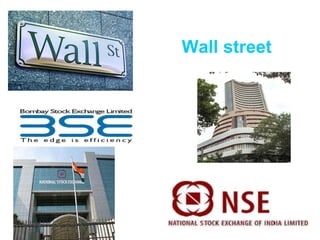
Wall street
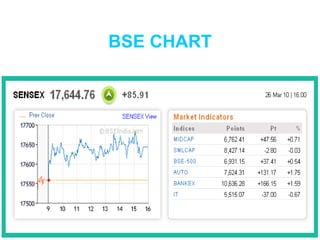
BSE   CHART
SPECULATION   Speculation involves the buying, holding, selling. Short-term selling of stocks, bonds, commodities, currencies, collectibles or any valuable financial instrument to profit. Fluctuations in its price as opposed to buying it for use or for income via method like dividends or interest.
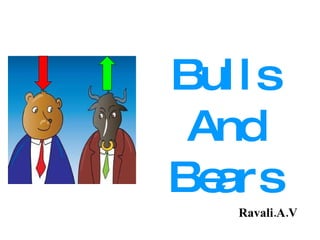
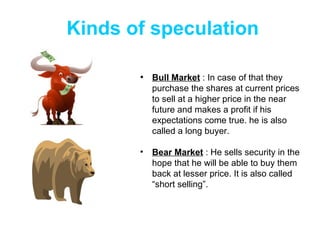
Kinds of speculation Bull Market  : In case of that they purchase the shares at current prices to sell at a higher price in the near future and makes a profit if his expectations come true. he is also called a long buyer. Bear Market  : He sells security in the hope that he will be able to buy them back at lesser price. It is also called “short selling”.
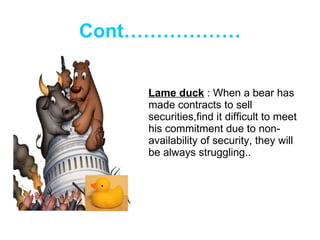
Cont……………… Lame duck  : When a bear has made contracts to sell securities,find it difficult to meet his commitment due to non-availability of security, they will be always struggling..
BENEFITS OF STOCK EXCHANGE It assists the economic development by providing a body of interested investors. It uploads the position of superior enterprises and assists them in raising further funds. It is the stock exchanges that central bank of a country can control credit by undertaking open market operations (purchase and sale of securities) FROM THE POINT OF VIEW OF COMMUNITY:
FROM THE COMPANY POINT OF VIEW A company whose shares are quoted on stock exchange, enjoy better reputation and credit. The market for the shares of such a company is naturally widened. Market price raises the bargaining power of the company in the event of a takeover,merger or amalgamation.
FROM THE INVESTORS POINT OF VIEW Liquidity of the investment is increased The stock exchange safeguards interests of investors through strict enforcement of rules and regulations. The present net worth of investments can be easily known by the daily quotations. His risk is considerably less when he holds or purchases listed securities.
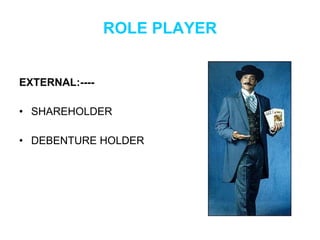
ROLE PLAYER EXTERNAL:---- SHAREHOLDER DEBENTURE HOLDER
SHAREHOLDER Shareholders are divided into two parts Preference share  Equity share holders  holders
Preference   Shareholder Preference shareholders are those which have preferential right to the payment of dividend during the life time of  the company Preferential right to the return of the capital when the company is wound up.  Paid according to the rate every year.
Equity Shareholders All shares which are not preference shares are equity shares.These shares do not have a fixed rate of dividend,they are always irredeemable and their holders have normal voting rights. They are also the owners of the company. They receive  dividend
DEBENTURES “ A  document  under the company seal which provides for the  payment of a principal  sum and interest there on at  regular intervals  which is usually secured by a fixed or  floating charge  on the company’s property or undertaking which  acknowledges a loan  to the company ” .
INTERNAL PLAYERS Broker  :  He is a commission agent who transacts business in securities on behalf of non-members.They may have number of sub-brokers to canvass and secure business for them . Investor  :  He purchase and sells securities on his own name with  personal trading account via online. The members of the stock exchange can be divided into two parts:
Floor Trading Floor Trading is done by a   floor trader  who trades on the floor of that exchange for his or her own account.  The floor trader must abide by trading rules similar to those of the exchange specialists    who trade on behalf of others.
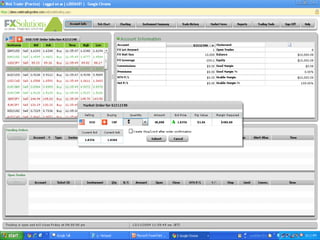
Electronic Trading Market trend upgrading Observation Demate account  Online trading software Guidelines
 
CAUSES OF PRICE FLUCTUATION Company Policies Bank Rate Speculative Pressure Actions of underwriters and other financial institutions Political Factors (Budget) Global Effects (crisis) Stock Market Scandals
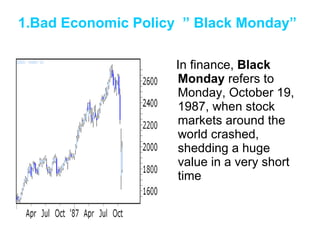
1.Bad Economic Policy  ” Black Monday”   In finance,  Black Monday  refers to Monday, October 19, 1987, when stock markets around the world crashed, shedding a huge value in a very short time
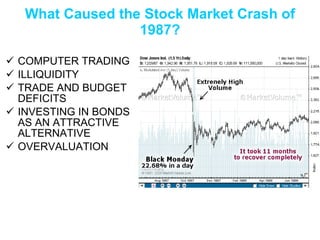
What Caused the Stock Market Crash of 1987? COMPUTER TRADING ILLIQUIDITY TRADE AND BUDGET DEFICITS INVESTING IN BONDS AS AN ATTRACTIVE ALTERNATIVE OVERVALUATION
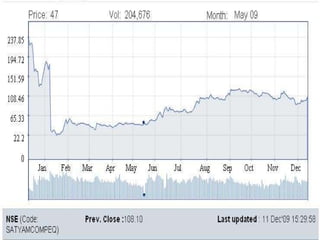
2.Satyam Scandal IT major Satyam nosedived nearly  70 per cent  to an all-time low  Shares of Satyam plunged as much as 67.71 per cent, but was later trading at  Rs 73.50, down 58.96  per cent in the afternoon trade on the BSE. The scrip, which had opened at Rs 179.10, plunged within minutes of Satyam Chairman and Managing Director tendering their resignation. The counter saw frantic selling after the announcement and nearly 13 crore shares had changed hands on both the bourses within an hour. Satyam stock holds a 1.56 per cent weight in the 30-share blue-chip index Sensex. Following the same, the benchmark index also plunged over 400 points and was trading down nearly 4 per cent at 9,922 points in the noon trade on the BSE.
 
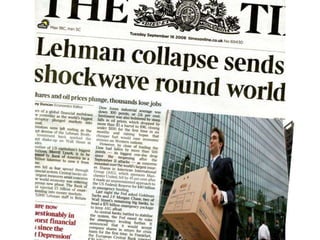
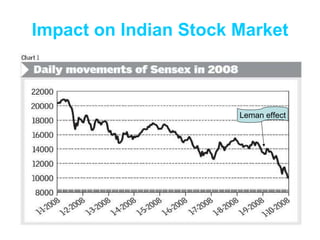
3.Global Financial Crisis Effecting Indian Stock Market   On September 15, 2008,  Lehman Brothers  filed for bankruptcy. With $639 billion in assets and $619 billion in debt. Lehman's  bankruptcy  filing was the largest in history. Lehman was the  fourth-largest  U.S. investment bank at the time of its collapse Lehman's collapse was an intensified the  2008 crisis and contributed to the erosion close to $10 trillion  in market capitalization in October 2008, the biggest monthly decline on record at the time.
 
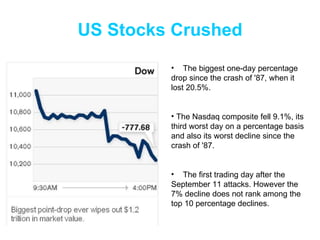
US Stocks Crushed The biggest one-day percentage drop since the crash of '87, when it lost 20.5%. The Nasdaq composite fell 9.1%, its third worst day on a percentage basis and also its worst decline since the crash of '87.  The first trading day after the September 11 attacks. However the 7% decline does not rank among the top 10 percentage declines.
Impact on Indian Stock Market Leman effect
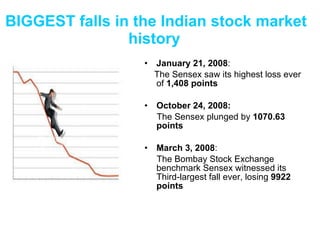
BIGGEST falls in the Indian stock market history   January 21, 2008 :  The Sensex saw its highest loss ever of  1,408   points October 24, 2008:   The Sensex plunged by  1070.63 points  March 3, 2008 :  The Bombay Stock Exchange benchmark Sensex witnessed its Third-largest fall ever, losing  9922 points
Be professional Do specific and selected trades Don’t be greedy and fearful in day trading Avoid panic by not doing over trading Day Trading Strategies
Day Trading Precautions If you are new comer to share market  When you have a strong mind set (especially new comers to share  market) that you want to earn big amount of money very fast in single day. Not confident and not sure Not able to judge market  No good mind frame When market opens and closes (especially few are new comers). When shares and markets are trading in very narrow range. Impatience, Greed and Fear Every situation is not suitable for day trading.
 
Queries   ?

Bulls and bears

  • 1.
  • 2.
    Objective Making alayman to take part in stock exchange trading.
  • 3.
    WHAT IS STOCKEXCHANGE Stock exchange is that place where trading of shares is done in terms of sale and purchase.
  • 4.
    Stock market foundationwas laid in 1773 . This gave rise to investment banks, brokers, investment advisers and fund managers. ORIGIN OF STOCKS
  • 5.
  • 6.
    BSE CHART
  • 7.
    SPECULATION Speculation involves the buying, holding, selling. Short-term selling of stocks, bonds, commodities, currencies, collectibles or any valuable financial instrument to profit. Fluctuations in its price as opposed to buying it for use or for income via method like dividends or interest.
  • 8.
    Kinds of speculationBull Market : In case of that they purchase the shares at current prices to sell at a higher price in the near future and makes a profit if his expectations come true. he is also called a long buyer. Bear Market : He sells security in the hope that he will be able to buy them back at lesser price. It is also called “short selling”.
  • 9.
    Cont……………… Lame duck : When a bear has made contracts to sell securities,find it difficult to meet his commitment due to non-availability of security, they will be always struggling..
  • 10.
    BENEFITS OF STOCKEXCHANGE It assists the economic development by providing a body of interested investors. It uploads the position of superior enterprises and assists them in raising further funds. It is the stock exchanges that central bank of a country can control credit by undertaking open market operations (purchase and sale of securities) FROM THE POINT OF VIEW OF COMMUNITY:
  • 11.
    FROM THE COMPANYPOINT OF VIEW A company whose shares are quoted on stock exchange, enjoy better reputation and credit. The market for the shares of such a company is naturally widened. Market price raises the bargaining power of the company in the event of a takeover,merger or amalgamation.
  • 12.
    FROM THE INVESTORSPOINT OF VIEW Liquidity of the investment is increased The stock exchange safeguards interests of investors through strict enforcement of rules and regulations. The present net worth of investments can be easily known by the daily quotations. His risk is considerably less when he holds or purchases listed securities.
  • 13.
    ROLE PLAYER EXTERNAL:----SHAREHOLDER DEBENTURE HOLDER
  • 14.
    SHAREHOLDER Shareholders aredivided into two parts Preference share Equity share holders holders
  • 15.
    Preference Shareholder Preference shareholders are those which have preferential right to the payment of dividend during the life time of the company Preferential right to the return of the capital when the company is wound up. Paid according to the rate every year.
  • 16.
    Equity Shareholders Allshares which are not preference shares are equity shares.These shares do not have a fixed rate of dividend,they are always irredeemable and their holders have normal voting rights. They are also the owners of the company. They receive dividend
  • 17.
    DEBENTURES “ A document under the company seal which provides for the payment of a principal sum and interest there on at regular intervals which is usually secured by a fixed or floating charge on the company’s property or undertaking which acknowledges a loan to the company ” .
  • 18.
    INTERNAL PLAYERS Broker : He is a commission agent who transacts business in securities on behalf of non-members.They may have number of sub-brokers to canvass and secure business for them . Investor : He purchase and sells securities on his own name with personal trading account via online. The members of the stock exchange can be divided into two parts:
  • 19.
    Floor Trading FloorTrading is done by a   floor trader  who trades on the floor of that exchange for his or her own account. The floor trader must abide by trading rules similar to those of the exchange specialists  who trade on behalf of others.
  • 20.
    Electronic Trading Markettrend upgrading Observation Demate account Online trading software Guidelines
  • 21.
  • 22.
    CAUSES OF PRICEFLUCTUATION Company Policies Bank Rate Speculative Pressure Actions of underwriters and other financial institutions Political Factors (Budget) Global Effects (crisis) Stock Market Scandals
  • 23.
    1.Bad Economic Policy ” Black Monday” In finance,  Black Monday  refers to Monday, October 19, 1987, when stock markets around the world crashed, shedding a huge value in a very short time
  • 24.
    What Caused theStock Market Crash of 1987? COMPUTER TRADING ILLIQUIDITY TRADE AND BUDGET DEFICITS INVESTING IN BONDS AS AN ATTRACTIVE ALTERNATIVE OVERVALUATION
  • 25.
    2.Satyam Scandal ITmajor Satyam nosedived nearly 70 per cent to an all-time low Shares of Satyam plunged as much as 67.71 per cent, but was later trading at Rs 73.50, down 58.96 per cent in the afternoon trade on the BSE. The scrip, which had opened at Rs 179.10, plunged within minutes of Satyam Chairman and Managing Director tendering their resignation. The counter saw frantic selling after the announcement and nearly 13 crore shares had changed hands on both the bourses within an hour. Satyam stock holds a 1.56 per cent weight in the 30-share blue-chip index Sensex. Following the same, the benchmark index also plunged over 400 points and was trading down nearly 4 per cent at 9,922 points in the noon trade on the BSE.
  • 26.
  • 27.
    3.Global Financial CrisisEffecting Indian Stock Market On September 15, 2008, Lehman Brothers filed for bankruptcy. With $639 billion in assets and $619 billion in debt. Lehman's bankruptcy filing was the largest in history. Lehman was the fourth-largest  U.S. investment bank at the time of its collapse Lehman's collapse was an intensified the 2008 crisis and contributed to the erosion close to $10 trillion in market capitalization in October 2008, the biggest monthly decline on record at the time.
  • 28.
  • 29.
    US Stocks CrushedThe biggest one-day percentage drop since the crash of '87, when it lost 20.5%. The Nasdaq composite fell 9.1%, its third worst day on a percentage basis and also its worst decline since the crash of '87. The first trading day after the September 11 attacks. However the 7% decline does not rank among the top 10 percentage declines.
  • 30.
    Impact on IndianStock Market Leman effect
  • 31.
    BIGGEST falls inthe Indian stock market history January 21, 2008 : The Sensex saw its highest loss ever of  1,408   points October 24, 2008:   The Sensex plunged by  1070.63 points  March 3, 2008 : The Bombay Stock Exchange benchmark Sensex witnessed its Third-largest fall ever, losing  9922 points
  • 32.
    Be professional Dospecific and selected trades Don’t be greedy and fearful in day trading Avoid panic by not doing over trading Day Trading Strategies
  • 33.
    Day Trading PrecautionsIf you are new comer to share market  When you have a strong mind set (especially new comers to share market) that you want to earn big amount of money very fast in single day. Not confident and not sure Not able to judge market  No good mind frame When market opens and closes (especially few are new comers). When shares and markets are trading in very narrow range. Impatience, Greed and Fear Every situation is not suitable for day trading.
  • 34.
  • 35.