Lyuben Karavelov Primary School, Vidin, Bulgaria
Together with Arts 2020 - 2022
Bulgaria is one of the oldest European countries that continues its existence to the
present day. It was founded in 681 by Khan Asparuh as a union state of ancient
Bulgarians and Slavs and occupies vast territories: from the Dnieper River and Black
Seas in the east to the Timok River in the west, from the Carpathians in the north to
the ridge of Stara Planina in the south. Its first capital was Pliska. The greatest
political sublimity and power it reached during the reign of the kings Simeon (893-
927) and Ivan Assen II (1218-1241), when its borders were on three seas - Black, White
and Adriatic.
Territory of Bulgaria during the reign of
Khan Asparuh
Together with Arts 2020 - 2022
Territory of Bulgaria during the reign of Khan Asparuh
Territory of Bulgaria during the reign of Tsar
Simeon
Together with Arts 2020 - 2022
The capital Pliska
This period is
characterized
mainly by the
strength of the
pagan tradition.
Material culture
monuments have
been preserved
from this period.
Together with Arts 2020 - 2022
Kaloyan’s ring
"Nevertheless a person
lives well, he dies and
another is born. And may
the last to be born,
looking at these writings,
also remembers the one
who made them.”
-Khan Omurtag
The column of Khan Omurtag
transferred to the church "Holy
40 Martyrs" in Tarnovo
When it comes to the development of the
medieval Bulgarian culture two main periods stand
out clearly. The first covers the period since
Bulgaria was founded till the middle of the ninth
century.
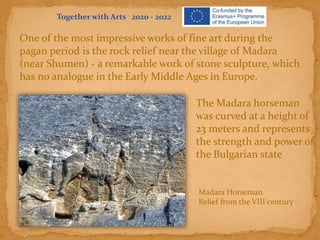
One of the most impressive works of fine art during the
pagan period is the rock relief near the village of Madara
(near Shumen) - a remarkable work of stone sculpture, which
has no analogue in the Early Middle Ages in Europe.
Together with Arts 2020 - 2022
Madara Horseman.
Relief from the VIII century
The Madara horseman
was curved at a height of
23 meters and represents
the strength and power of
the Bulgarian state
Together with Arts 2020 - 2022
During the period of the First Bulgarian Kingdom, sculptures also
prospered. Various plants motifs can be seen on them, mystic and
real animals, human figures.
The baptism (adoption of the Christian faith) of the Bulgarians in 864 marked
the beginning of a new stage in the development of the old Bulgarian culture.
Many churches and monasteries were built and became center of active literary
life. The second Bulgarian capital, Preslav, became the main cultural center in the
10th century. Unique for the Balkan Peninsula is the round "Golden Church" built
in the early tenth century:
Together with Arts 2020 - 2022
During the reign of Tsar Simeon
the Great (893 - 927) Bulgaria
experienced its greatest power
and prosperity since the time of
the First Bulgarian State.
His military and political
successes were accompanied
by the flourishing of Bulgarian
culture. The period of his reign is
known as the Golden Age.
Simeon moved the capital of the
country from Pliska to Preslav,
which became an important
literary center .
Together with Arts 2020 - 2022
The fortress wall in Veliki Preslav
 A superb phenomenon from
this period was the painted
ceramic of Preslav. It could be
seen everywhere - wall
decoration, flooring, icons,
dishes and more. Real
masterpieces such as the
ceramic icon of St. Theodore
Stratilat from the tenth
century, consisting of 12 plates
was made of it.
 Icons of the same type were
made to decorate certain
temples. Apart from
monumental ones, small icons
were also found, probably for
home use.
Together with Arts 2020 - 2022
In terms of scope, volume, technique and style, the painted ceramic of Preslav
had no equal in Europe at that time..
Not only household items were
made of painted ceramic, but
also various decorative elements
for decoration of buildings in the
Bulgarian capital.
Together with Arts 2020 - 2022
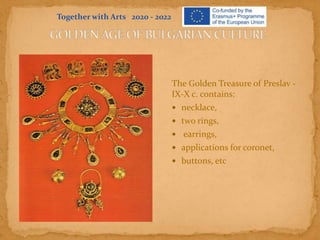
The Golden Treasure of Preslav -
IX-X c. contains:
 necklace,
 two rings,
 earrings,
 applications for coronet,
 buttons, etc
Together with Arts 2020 - 2022
Baba Vida Fortress is one of the best preserved medieval fortresses in
Bulgaria. It is located in the northern part of our town Vidin, on the bank
of the Danube River. It was built in the second half of the 10th century on
the foundations of the Roman fortress of Bononia with an area of 9.5
acres, Surrounded by a ditch that was filled with water. The fortress also
houses the summer theater of Vidin.
https://www.youtube.com/watch?v=QACXfF-OxZs - a virtual walk
around the fortress.
Together with Arts 2020 - 2022
Tarnovo was the capital during the Second Bulgarian Kingdom (1185
- 1396). During the Middle Ages, the hill Tsarevets, on which it is
located, was totally built up with residential and administrative
buildings.
Along with the church painting in
the XIII - XIV century in Bulgaria the
miniature painting was also marked
by a serious development. Several
literary works have been preserved,
mainly from the time of Ivan
Alexander (1331-1371), with exquisitely
made miniatures. The most famous
of these is the London Gospel, which
contains 366 multicolored
miniatures. Another famous
monument decorated with
miniatures is the Chronicle of
Manasseh.
Together with Arts 2020 - 2022
London Gospel
Together with Arts 2020 - 2022
Dishes from the XIV century -
the village of Cherven
Typical dishes from the town of
Ahtopol
Together with Arts 2020 - 2022
During the Middle Ages, Bulgaria was the
cradle and centre of Slavic writing and
literature.
Old Bulgarian manuscripts were richly decorated
with various ornaments, initials, capital letters
Together with Arts 2020 - 2022
Miniatures (illustrations) from medieval books
Together with Arts 2020 - 2022
Embroidery of towels and clothes from VII-IX century
Together with Arts 2020 - 2022
Presentation made by a school team of Lyuben
Karavelov Primary School – Vidin, Bulgaria with the
assistance of the headmaster of the school Lyubka
Naydenova.

Bulgaria.medieval.art

  • 1.
    Lyuben Karavelov PrimarySchool, Vidin, Bulgaria Together with Arts 2020 - 2022
  • 2.
    Bulgaria is oneof the oldest European countries that continues its existence to the present day. It was founded in 681 by Khan Asparuh as a union state of ancient Bulgarians and Slavs and occupies vast territories: from the Dnieper River and Black Seas in the east to the Timok River in the west, from the Carpathians in the north to the ridge of Stara Planina in the south. Its first capital was Pliska. The greatest political sublimity and power it reached during the reign of the kings Simeon (893- 927) and Ivan Assen II (1218-1241), when its borders were on three seas - Black, White and Adriatic. Territory of Bulgaria during the reign of Khan Asparuh Together with Arts 2020 - 2022 Territory of Bulgaria during the reign of Khan Asparuh Territory of Bulgaria during the reign of Tsar Simeon
  • 3.
    Together with Arts2020 - 2022 The capital Pliska
  • 4.
    This period is characterized mainlyby the strength of the pagan tradition. Material culture monuments have been preserved from this period. Together with Arts 2020 - 2022 Kaloyan’s ring "Nevertheless a person lives well, he dies and another is born. And may the last to be born, looking at these writings, also remembers the one who made them.” -Khan Omurtag The column of Khan Omurtag transferred to the church "Holy 40 Martyrs" in Tarnovo When it comes to the development of the medieval Bulgarian culture two main periods stand out clearly. The first covers the period since Bulgaria was founded till the middle of the ninth century.
  • 5.
    One of themost impressive works of fine art during the pagan period is the rock relief near the village of Madara (near Shumen) - a remarkable work of stone sculpture, which has no analogue in the Early Middle Ages in Europe. Together with Arts 2020 - 2022 Madara Horseman. Relief from the VIII century The Madara horseman was curved at a height of 23 meters and represents the strength and power of the Bulgarian state
  • 6.
    Together with Arts2020 - 2022 During the period of the First Bulgarian Kingdom, sculptures also prospered. Various plants motifs can be seen on them, mystic and real animals, human figures.
  • 7.
    The baptism (adoptionof the Christian faith) of the Bulgarians in 864 marked the beginning of a new stage in the development of the old Bulgarian culture. Many churches and monasteries were built and became center of active literary life. The second Bulgarian capital, Preslav, became the main cultural center in the 10th century. Unique for the Balkan Peninsula is the round "Golden Church" built in the early tenth century: Together with Arts 2020 - 2022
  • 8.
    Together with Arts2020 - 2022 During the reign of Tsar Simeon the Great (893 - 927) Bulgaria experienced its greatest power and prosperity since the time of the First Bulgarian State. His military and political successes were accompanied by the flourishing of Bulgarian culture. The period of his reign is known as the Golden Age. Simeon moved the capital of the country from Pliska to Preslav, which became an important literary center .
  • 9.
    Together with Arts2020 - 2022 The fortress wall in Veliki Preslav
  • 10.
     A superbphenomenon from this period was the painted ceramic of Preslav. It could be seen everywhere - wall decoration, flooring, icons, dishes and more. Real masterpieces such as the ceramic icon of St. Theodore Stratilat from the tenth century, consisting of 12 plates was made of it.  Icons of the same type were made to decorate certain temples. Apart from monumental ones, small icons were also found, probably for home use. Together with Arts 2020 - 2022 In terms of scope, volume, technique and style, the painted ceramic of Preslav had no equal in Europe at that time..
  • 11.
    Not only householditems were made of painted ceramic, but also various decorative elements for decoration of buildings in the Bulgarian capital. Together with Arts 2020 - 2022
  • 12.
    The Golden Treasureof Preslav - IX-X c. contains:  necklace,  two rings,  earrings,  applications for coronet,  buttons, etc Together with Arts 2020 - 2022
  • 13.
    Baba Vida Fortressis one of the best preserved medieval fortresses in Bulgaria. It is located in the northern part of our town Vidin, on the bank of the Danube River. It was built in the second half of the 10th century on the foundations of the Roman fortress of Bononia with an area of 9.5 acres, Surrounded by a ditch that was filled with water. The fortress also houses the summer theater of Vidin. https://www.youtube.com/watch?v=QACXfF-OxZs - a virtual walk around the fortress. Together with Arts 2020 - 2022
  • 14.
    Together with Arts2020 - 2022 Tarnovo was the capital during the Second Bulgarian Kingdom (1185 - 1396). During the Middle Ages, the hill Tsarevets, on which it is located, was totally built up with residential and administrative buildings.
  • 15.
    Along with thechurch painting in the XIII - XIV century in Bulgaria the miniature painting was also marked by a serious development. Several literary works have been preserved, mainly from the time of Ivan Alexander (1331-1371), with exquisitely made miniatures. The most famous of these is the London Gospel, which contains 366 multicolored miniatures. Another famous monument decorated with miniatures is the Chronicle of Manasseh. Together with Arts 2020 - 2022 London Gospel
  • 16.
    Together with Arts2020 - 2022 Dishes from the XIV century - the village of Cherven Typical dishes from the town of Ahtopol
  • 17.
    Together with Arts2020 - 2022 During the Middle Ages, Bulgaria was the cradle and centre of Slavic writing and literature. Old Bulgarian manuscripts were richly decorated with various ornaments, initials, capital letters
  • 18.
    Together with Arts2020 - 2022 Miniatures (illustrations) from medieval books
  • 19.
    Together with Arts2020 - 2022 Embroidery of towels and clothes from VII-IX century
  • 20.
    Together with Arts2020 - 2022 Presentation made by a school team of Lyuben Karavelov Primary School – Vidin, Bulgaria with the assistance of the headmaster of the school Lyubka Naydenova.