
www.polestarllp.com
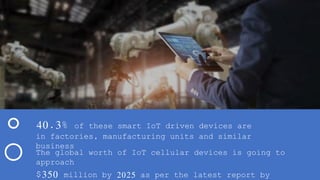
40.3% of these smart IoT driven devices are
in factories, manufacturing units and similar
business
The global worth of IoT cellular devices is going to
approach
$350 million by 2025 as per the latest report by
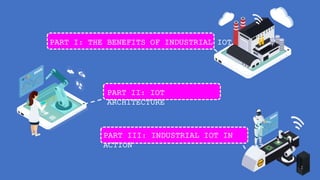
PART II: IOT
ARCHITECTURE
PART III: INDUSTRIAL IOT IN
ACTION
PART I: THE BENEFITS OF INDUSTRIAL IOT
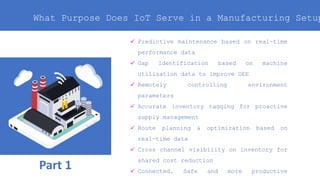
What Purpose Does IoT Serve in a Manufacturing Setup
 Predictive maintenance based on real-time
performance data
 Gap Identification based on machine
utilization data to improve OEE
 Remotely controlling environment
parameters
 Accurate inventory tagging for proactive
supply management
 Route planning & optimization based on
real-time data
 Cross channel visibility on inventory for
shared cost reduction
 Connected, Safe and more productive
Part 1
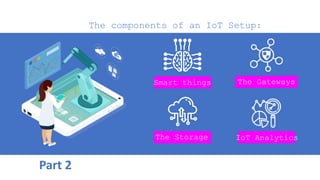
The components of an IoT Setup:
Part 2
Smart things The Gateways
IoT AnalyticsThe Storage
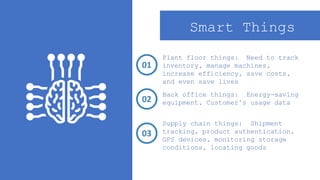
Plant floor things: Need to track
inventory, manage machines,
increase efficiency, save costs,
and even save lives
Supply chain things: Shipment
tracking, product authentication,
GPS devices, monitoring storage
conditions, locating goods
Back office things: Energy-saving
equipment, Customer’s usage data
Smart Things
01
02
03
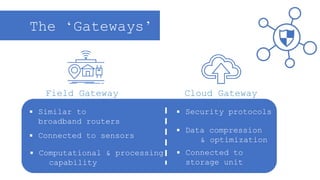
The ‘Gateways’
Cloud GatewayField Gateway
 Similar to
broadband routers
 Connected to sensors
 Computational & processing
capability
 Connected to
storage unit
 Security protocols
 Data compression
& optimization
These sensors are
gathering data all the
time which is streamed
through the gateways to
a storage unit.
The ‘Storage’
This is Big data; you
need huge storage and
hence data lake is an
ideal fit.
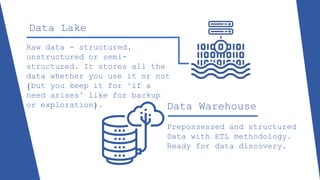
Raw data - structured,
unstructured or semi-
structured. It stores all the
data whether you use it or not
(but you keep it for ‘if a
need arises’ like for backup
or exploration).
Data Lake
Prepossessed and structured
Data with ETL methodology.
Ready for data discovery.
Data Warehouse
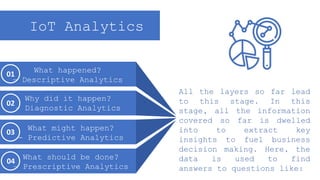
IoT Analytics
All the layers so far lead
to this stage. In this
stage, all the information
covered so far is dwelled
into to extract key
insights to fuel business
decision making. Here, the
data is used to find
answers to questions like:
What happened?
– Descriptive Analytics
Why did it happen?
– Diagnostic Analytics
What might happen?
- Predictive Analytics
What should be done?
– Prescriptive Analytics
01
02
03
04
Part 3
INDUSTRIAL
IOT IN ACTION
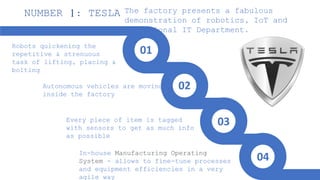
NUMBER 1: TESLA
In-house Manufacturing Operating
System - allows to fine-tune processes
and equipment efficiencies in a very
agile way
Robots quickening the
repetitive & strenuous
task of lifting, placing &
bolting
Autonomous vehicles are moving
inside the factory
Every piece of item is tagged
with sensors to get as much info
as possible
The factory presents a fabulous
demonstration of robotics, IoT and
exceptional IT Department.
04
03
02
01
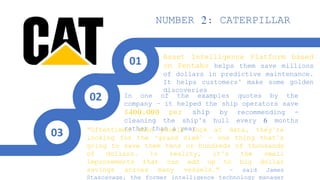
Asset Intelligence Platform based
on Pentaho helps them save millions
of dollars in predictive maintenance.
It helps customers’ make some golden
discoveries
In one of the examples quotes by the
company – it helped the ship operators save
$400,000 per ship by recommending -
cleaning the ship’s hull every 6 months
rather than a year“Oftentimes when people look at data, they’re
looking for the ‘grand slam’ – one thing that’s
going to save them tens or hundreds of thousands
of dollars. In reality, it’s the small
improvements that can add up to big dollar
savings across many vessels.” – said James
Stascavage, the former intelligence technology manager
NUMBER 2: CATERPILLAR
01
02
03
Plant floor personnel equipped with
iPads that allows them to manage
machine efficiency, fuel consumption
rate to tracking shipments and
confirming reception
The network allows them to do this by
centralizing PLC data and connecting
operations to execution and logistics
systems
Maintenance and scheduling were
just a click away and everyone
was notified with all the
necessary information
NUMBER 3: DAIMLER
01
02
03
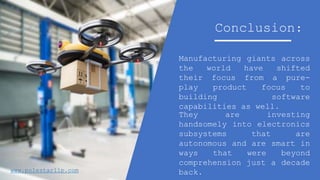
Manufacturing giants across
the world have shifted
their focus from a pure-
play product focus to
building software
capabilities as well.
Conclusion:
They are investing
handsomely into electronics
subsystems that are
autonomous and are smart in
ways that were beyond
comprehension just a decade
back.www.polestarllp.com
THANK YOU!
Visit: www.polestarllp.com
Email: rishabh.rai@polestarllp.com

Building smart factories with iot and analytics

  • 1.
  • 2.
    40.3% of thesesmart IoT driven devices are in factories, manufacturing units and similar business The global worth of IoT cellular devices is going to approach $350 million by 2025 as per the latest report by
  • 3.
    PART II: IOT ARCHITECTURE PARTIII: INDUSTRIAL IOT IN ACTION PART I: THE BENEFITS OF INDUSTRIAL IOT
  • 4.
    What Purpose DoesIoT Serve in a Manufacturing Setup  Predictive maintenance based on real-time performance data  Gap Identification based on machine utilization data to improve OEE  Remotely controlling environment parameters  Accurate inventory tagging for proactive supply management  Route planning & optimization based on real-time data  Cross channel visibility on inventory for shared cost reduction  Connected, Safe and more productive Part 1
  • 5.
    The components ofan IoT Setup: Part 2 Smart things The Gateways IoT AnalyticsThe Storage
  • 6.
    Plant floor things:Need to track inventory, manage machines, increase efficiency, save costs, and even save lives Supply chain things: Shipment tracking, product authentication, GPS devices, monitoring storage conditions, locating goods Back office things: Energy-saving equipment, Customer’s usage data Smart Things 01 02 03
  • 7.
    The ‘Gateways’ Cloud GatewayFieldGateway  Similar to broadband routers  Connected to sensors  Computational & processing capability  Connected to storage unit  Security protocols  Data compression & optimization
  • 8.
    These sensors are gatheringdata all the time which is streamed through the gateways to a storage unit. The ‘Storage’ This is Big data; you need huge storage and hence data lake is an ideal fit.
  • 9.
    Raw data -structured, unstructured or semi- structured. It stores all the data whether you use it or not (but you keep it for ‘if a need arises’ like for backup or exploration). Data Lake Prepossessed and structured Data with ETL methodology. Ready for data discovery. Data Warehouse
  • 10.
    IoT Analytics All thelayers so far lead to this stage. In this stage, all the information covered so far is dwelled into to extract key insights to fuel business decision making. Here, the data is used to find answers to questions like: What happened? – Descriptive Analytics Why did it happen? – Diagnostic Analytics What might happen? - Predictive Analytics What should be done? – Prescriptive Analytics 01 02 03 04
  • 11.
  • 12.
    NUMBER 1: TESLA In-houseManufacturing Operating System - allows to fine-tune processes and equipment efficiencies in a very agile way Robots quickening the repetitive & strenuous task of lifting, placing & bolting Autonomous vehicles are moving inside the factory Every piece of item is tagged with sensors to get as much info as possible The factory presents a fabulous demonstration of robotics, IoT and exceptional IT Department. 04 03 02 01
  • 13.
    Asset Intelligence Platformbased on Pentaho helps them save millions of dollars in predictive maintenance. It helps customers’ make some golden discoveries In one of the examples quotes by the company – it helped the ship operators save $400,000 per ship by recommending - cleaning the ship’s hull every 6 months rather than a year“Oftentimes when people look at data, they’re looking for the ‘grand slam’ – one thing that’s going to save them tens or hundreds of thousands of dollars. In reality, it’s the small improvements that can add up to big dollar savings across many vessels.” – said James Stascavage, the former intelligence technology manager NUMBER 2: CATERPILLAR 01 02 03
  • 14.
    Plant floor personnelequipped with iPads that allows them to manage machine efficiency, fuel consumption rate to tracking shipments and confirming reception The network allows them to do this by centralizing PLC data and connecting operations to execution and logistics systems Maintenance and scheduling were just a click away and everyone was notified with all the necessary information NUMBER 3: DAIMLER 01 02 03
  • 15.
    Manufacturing giants across theworld have shifted their focus from a pure- play product focus to building software capabilities as well. Conclusion: They are investing handsomely into electronics subsystems that are autonomous and are smart in ways that were beyond comprehension just a decade back.www.polestarllp.com
  • 16.