Procurement,Supply
Chain and Internet of
Things (IoT)
Harmeet Singh
What is IoT?
The Internet of Things, or IoT, is set to
be the next mega-trend in technology.
It is important to understand what IoT
exactly refers to.
Gartner defines IoT as the network of
physical objects that contain
embedded technology to
communicate and sense or interact
with their internal states or the external environment.
In simple words, IoT refers to the connection of various devices to the Internet and to one
another. These devices could be anything: an industrial machine, a delivery truck, a weighing
scale, a street light, a health monitor, an ERP, a mobile phone - just anything.
Why so much buzz about IoT?
IoT refers to enormous amounts of data that millions of devices around us are capable to produce. With
advanced analytic capabilities this unstructured data can be transformed into meaningful datasets. This
data can cater the growth of information based system which utilizes the capabilities of real time data
and advanced analytics to deliver real
time enhanced productivity. This
concept can be applied across all
verticals and horizontal levels in an
organization to unlock the huge
potential benefits associated with
usage of data produced by IoT.
As per a report:
 Annual cost savings from IoT could be $500 billion in manufacturing
 22% potential margin impact through supply chain efficiencies can be achieved in area of
logistics
 50% reductions in shrinkage in grocery stores can be achieved in area of retail
What is in IoT for procurement and supply
chain?
The huge amounts of data generated by IoT can
be leveraged very effectively in the area of
procurement. The benefits achieved using IoT
and advanced analytics based on big data can
be broadly classified into following categories
for procurement.
Managing risks in Supply Chain
Analytics over IoT can be leveraged to identify
trends and events that can serve as an alarm or
a warning signal for the supply chain risk. It
could relate to supplier risk metrics, risks
associated with a certain route for movement
of goods, identifiable trends in price fluctuation
of raw materials etc.
Cost savings in sourcing
IoT can be a major source of information which
can be used to identify opportunities for better
sourcing opportunities. By constantly
monitoring market prices and economic
forecasts, an organization could identify the
right time and budgets for a more cost efficient
sourcing process.
Agile and efficient sourcing processes
As per a report, around 20 – 50 % of time in
procurement is linked to searching for
information. Analytics over real time data
generated by IoT can link, aggregate and
analyze information which can be used by
purchasers to take a decision; hence, leading to
an efficient an agile strategic and operational
procurement process.
Effective decision making driven by facts
Purchasers can make decisions that are
supported by data oriented evidences such as
quality issues arising related to a particular
supplier, or material availability etc.
Spend Analytics / Forecasting and Predictive
Analysis
This would be the most obvious use case for
analytics over IoT. Merging various datasets of
various factors together with your organizations
policies could give organizations a good view of
their performance and efficiencies.
One of the greatest opportunities available
from huge amounts of IoT data is achieving
higher level of accuracy and predictions in
forecasting demand and managing the supply
‘in time’.
Supplier Management
Suppliers are an integral and crucial part of any
business. The extensive data available from IoT
can be utilized for an in depth analysis of
supplier performance and relationship
management.
The Hackett Group's research revealed a change
in procurement's priorities for 2015. While
traditional goals such as cost reduction and
expanding the scope of spend influence remain
important, new objectives are coming into
focus. More than 70 percent of study
respondents cited elevating procurements role
to more of a trusted advisor as their top priority
for 2015, making it the number one
procurement strategy. Improving
procurement's business agility was cited as the
third most critical goal, right below cost
reduction. Procurement has the opportunity to
drive insights and powerful strategic advantage
if it can improve its ability to capture and
analyze both information generated internally
and also data from suppliers and other external
sources.
Data Sets for IoT
IoT consists of data being generated from any source. For an organization, we could broadly classify the
source of data as:
1. Internal: Data generated from sources within the organization.
2. External: Data generated from sources outside the organization.
This classification could include various sources of data such as:
Internal
1. Data generated by end users
2. Internal inventory and warehouse data
3. Data generated by machines
External
1. Data generated by ERP’s of various organizations
2. Data generated by transport and logistics
3. Visibility of supplier inventory
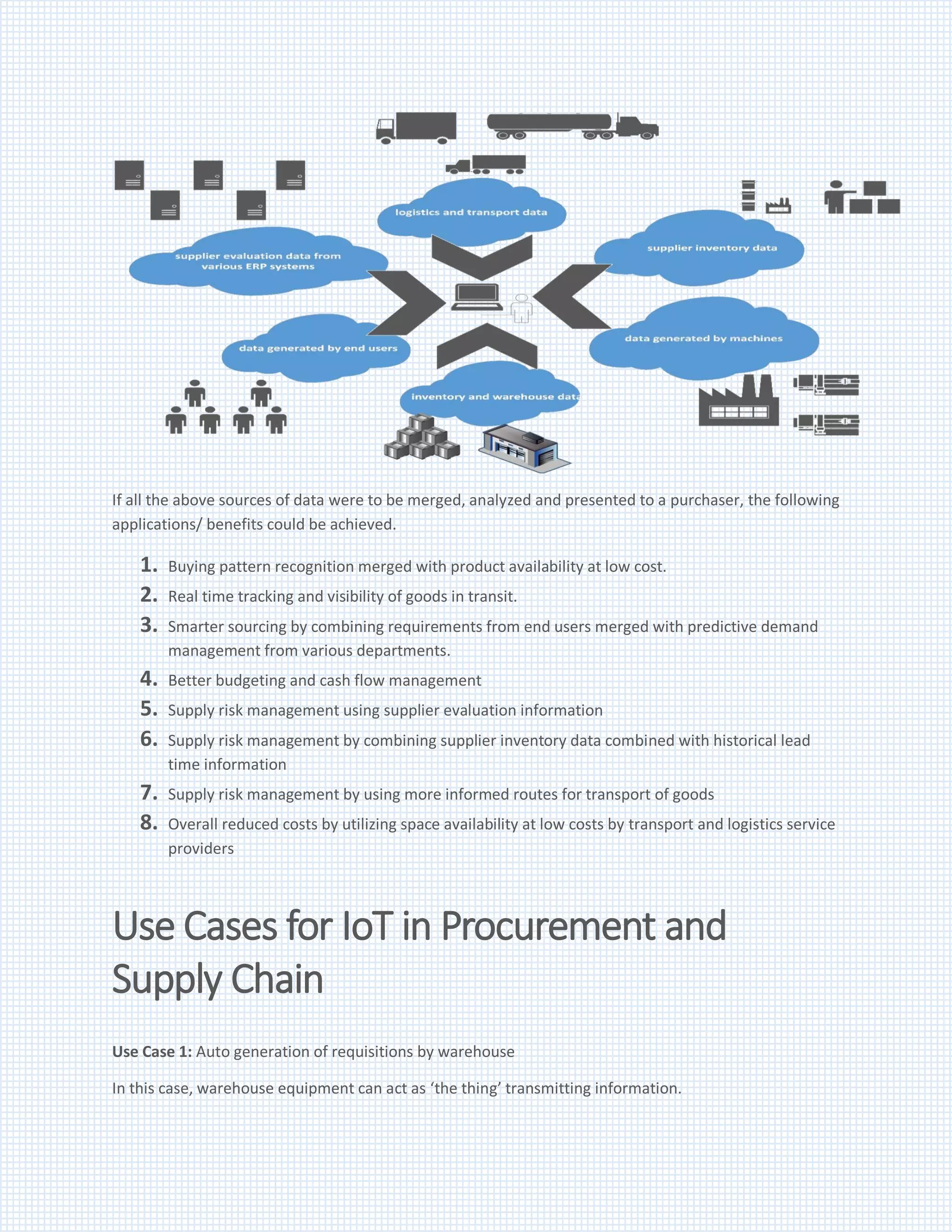
Various data sources mentioned above have been illustrated below. It can be easily observed that
massive amount of data is already being generated in a single process and with IoT coming into scenario,
enormous amount of meaningful information can be generated.
If all the above sources of data were to be merged, analyzed and presented to a purchaser, the following
applications/ benefits could be achieved.
1. Buying pattern recognition merged with product availability at low cost.
2. Real time tracking and visibility of goods in transit.
3. Smarter sourcing by combining requirements from end users merged with predictive demand
management from various departments.
4. Better budgeting and cash flow management
5. Supply risk management using supplier evaluation information
6. Supply risk management by combining supplier inventory data combined with historical lead
time information
7. Supply risk management by using more informed routes for transport of goods
8. Overall reduced costs by utilizing space availability at low costs by transport and logistics service
providers
Use Cases for IoT in Procurement and
Supply Chain
Use Case 1: Auto generation of requisitions by warehouse
In this case, warehouse equipment can act as ‘the thing’ transmitting information.
- With IoT, warehouses could automatically generate requisition in the system based on material
availability.
- This could lead to a more efficient process where the procurement or the replenishment
process is triggered much before the MRP run is executed. Hence, giving real time visibility to
business and automatically executing business process well in advance.
Use Case 2: IoT in sub-contracting process:
In a sub-contracting process, a semi-finished product with a bar code can act as ‘the thing’ transmitting
information. Following steps can be made more efficient by using this information:
- A bar code is applied on each part which is subject to a sub-contracting process.
- Workers and machines on the floor can easily identify the details of the sub-contracting process
e.g. Service order details, required follow on process details etc.
- Details of vehicle/carrier on which it should be transported
- Tracking of process completion levels at the sub-contractor’s place
- Quality control process
- Inventory management
- Invoice Management
There can be many more such use cases that organizations can use to enhance their efficiency, agility
and better manage supply risks. However, the key for success for organizations embarking on journey to
utilize IoT is not to boil the ocean, but identify and work with information sets that are meaningful and
useful for them.

IOT & Procuement

  • 1.
    Procurement,Supply Chain and Internetof Things (IoT) Harmeet Singh
  • 2.
    What is IoT? TheInternet of Things, or IoT, is set to be the next mega-trend in technology. It is important to understand what IoT exactly refers to. Gartner defines IoT as the network of physical objects that contain embedded technology to communicate and sense or interact with their internal states or the external environment. In simple words, IoT refers to the connection of various devices to the Internet and to one another. These devices could be anything: an industrial machine, a delivery truck, a weighing scale, a street light, a health monitor, an ERP, a mobile phone - just anything. Why so much buzz about IoT? IoT refers to enormous amounts of data that millions of devices around us are capable to produce. With advanced analytic capabilities this unstructured data can be transformed into meaningful datasets. This data can cater the growth of information based system which utilizes the capabilities of real time data and advanced analytics to deliver real time enhanced productivity. This concept can be applied across all verticals and horizontal levels in an organization to unlock the huge potential benefits associated with usage of data produced by IoT. As per a report:  Annual cost savings from IoT could be $500 billion in manufacturing  22% potential margin impact through supply chain efficiencies can be achieved in area of logistics  50% reductions in shrinkage in grocery stores can be achieved in area of retail
  • 3.
    What is inIoT for procurement and supply chain? The huge amounts of data generated by IoT can be leveraged very effectively in the area of procurement. The benefits achieved using IoT and advanced analytics based on big data can be broadly classified into following categories for procurement. Managing risks in Supply Chain Analytics over IoT can be leveraged to identify trends and events that can serve as an alarm or a warning signal for the supply chain risk. It could relate to supplier risk metrics, risks associated with a certain route for movement of goods, identifiable trends in price fluctuation of raw materials etc. Cost savings in sourcing IoT can be a major source of information which can be used to identify opportunities for better sourcing opportunities. By constantly monitoring market prices and economic forecasts, an organization could identify the right time and budgets for a more cost efficient sourcing process. Agile and efficient sourcing processes As per a report, around 20 – 50 % of time in procurement is linked to searching for information. Analytics over real time data generated by IoT can link, aggregate and analyze information which can be used by purchasers to take a decision; hence, leading to an efficient an agile strategic and operational procurement process. Effective decision making driven by facts Purchasers can make decisions that are supported by data oriented evidences such as quality issues arising related to a particular supplier, or material availability etc. Spend Analytics / Forecasting and Predictive Analysis This would be the most obvious use case for analytics over IoT. Merging various datasets of various factors together with your organizations policies could give organizations a good view of their performance and efficiencies. One of the greatest opportunities available from huge amounts of IoT data is achieving higher level of accuracy and predictions in forecasting demand and managing the supply ‘in time’. Supplier Management Suppliers are an integral and crucial part of any business. The extensive data available from IoT can be utilized for an in depth analysis of supplier performance and relationship management. The Hackett Group's research revealed a change in procurement's priorities for 2015. While
  • 4.
    traditional goals suchas cost reduction and expanding the scope of spend influence remain important, new objectives are coming into focus. More than 70 percent of study respondents cited elevating procurements role to more of a trusted advisor as their top priority for 2015, making it the number one procurement strategy. Improving procurement's business agility was cited as the third most critical goal, right below cost reduction. Procurement has the opportunity to drive insights and powerful strategic advantage if it can improve its ability to capture and analyze both information generated internally and also data from suppliers and other external sources. Data Sets for IoT IoT consists of data being generated from any source. For an organization, we could broadly classify the source of data as: 1. Internal: Data generated from sources within the organization. 2. External: Data generated from sources outside the organization. This classification could include various sources of data such as: Internal 1. Data generated by end users 2. Internal inventory and warehouse data 3. Data generated by machines External 1. Data generated by ERP’s of various organizations 2. Data generated by transport and logistics 3. Visibility of supplier inventory Various data sources mentioned above have been illustrated below. It can be easily observed that massive amount of data is already being generated in a single process and with IoT coming into scenario, enormous amount of meaningful information can be generated.
  • 5.
    If all theabove sources of data were to be merged, analyzed and presented to a purchaser, the following applications/ benefits could be achieved. 1. Buying pattern recognition merged with product availability at low cost. 2. Real time tracking and visibility of goods in transit. 3. Smarter sourcing by combining requirements from end users merged with predictive demand management from various departments. 4. Better budgeting and cash flow management 5. Supply risk management using supplier evaluation information 6. Supply risk management by combining supplier inventory data combined with historical lead time information 7. Supply risk management by using more informed routes for transport of goods 8. Overall reduced costs by utilizing space availability at low costs by transport and logistics service providers Use Cases for IoT in Procurement and Supply Chain Use Case 1: Auto generation of requisitions by warehouse In this case, warehouse equipment can act as ‘the thing’ transmitting information.
  • 6.
    - With IoT,warehouses could automatically generate requisition in the system based on material availability. - This could lead to a more efficient process where the procurement or the replenishment process is triggered much before the MRP run is executed. Hence, giving real time visibility to business and automatically executing business process well in advance. Use Case 2: IoT in sub-contracting process: In a sub-contracting process, a semi-finished product with a bar code can act as ‘the thing’ transmitting information. Following steps can be made more efficient by using this information: - A bar code is applied on each part which is subject to a sub-contracting process. - Workers and machines on the floor can easily identify the details of the sub-contracting process e.g. Service order details, required follow on process details etc. - Details of vehicle/carrier on which it should be transported - Tracking of process completion levels at the sub-contractor’s place - Quality control process - Inventory management - Invoice Management There can be many more such use cases that organizations can use to enhance their efficiency, agility and better manage supply risks. However, the key for success for organizations embarking on journey to utilize IoT is not to boil the ocean, but identify and work with information sets that are meaningful and useful for them.