BUILDING ECONOMICS
BAR4009
ELEMENTARY CONCEPTS OF ECONOMICS
Submitted to –
Ar. Sanshlesh Kumar
Submitted by – B.Arch 2nd Year,
4rd Sem
Session: 2020 - 2021
Economics is a social science concerned with the production, distribution, and consumption of goods and
services. It studies how individuals, businesses, governments, and nations make choices about how to
allocate resources.
Economics focuses on the actions of human beings, based on assumptions that humans act with rational
behavior, seeking the most optimal level of benefit or utility. The building blocks of economics are the
studies of labor and trade. Economics is especially concerned with efficiency in production and exchange
and uses models and assumptions to understand how to create incentives and policies that will maximize
efficiency.
Economics can generally be broken down into macroeconomics, which concentrates on the behavior of
the economy as a whole, and microeconomics, which focuses on individual people and businesses.
Building Economics is a branch of general economics. It is based on application of principles of
economics related to construction industry. Building Economics is concerned with: construction industry,
its place in economy, role of construction firms, role of designers and constructors (builders), processes
employed in construction and final building product. Present scope of Building Economics lays emphasis
on - Building Product and how to make it more economical, effective and efficient, But does not involve
resources and accounting practices.
INTRODUCTION TO ECONOMICS
BASIS FOR COMPARISON NEEDS WANTS
Meaning Needs refers to an individual's basic requirement
that must be fulfilled, in order to survive.
Wants are described as the goods and services,
which an individual like to have, as a part of his
caprices.
Nature Limited Unlimited
What is it? Something you must have. Something you wish to have.
Represents Necessity Desire
Survival Essential Inessential
Change May remain constant over time. May change over time.
Non-fulfilment May result in onset of disease or even death. May result in disappointment.
NEEDS AND WANTS
Nature of Economics
The nature of economics deals with the
question that whether economics falls
into the category of science or arts.
Various economists have given their
arguments in favour of science while
others have their reservations for arts.
Scope of Economics
Economists use different economic
theories to solve various economic
problems in society. Its applicability is
very vast. From a small organization to a
multinational firm, economic laws come
into play. The scope of economics can be
understood under two subheads:
Microeconomics and Macroeconomics.
The nature and scope of economics depend upon the interaction of economic agents
and how economies work.
THE NATURE AND SCOPE OF ECONOMICS
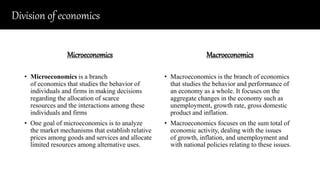
Division of economics
Microeconomics
• Microeconomics is a branch
of economics that studies the behavior of
individuals and firms in making decisions
regarding the allocation of scarce
resources and the interactions among these
individuals and firms
• One goal of microeconomics is to analyze
the market mechanisms that establish relative
prices among goods and services and allocate
limited resources among alternative uses.
Macroeconomics
• Macroeconomics is the branch of economics
that studies the behavior and performance of
an economy as a whole. It focuses on the
aggregate changes in the economy such as
unemployment, growth rate, gross domestic
product and inflation.
• Macroeconomics focuses on the sum total of
economic activity, dealing with the issues
of growth, inflation, and unemployment and
with national policies relating to these issues.
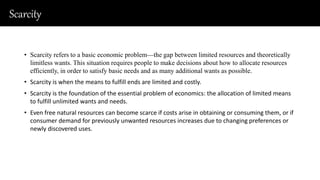
Scarcity
• Scarcity refers to a basic economic problem—the gap between limited resources and theoretically
limitless wants. This situation requires people to make decisions about how to allocate resources
efficiently, in order to satisfy basic needs and as many additional wants as possible.
• Scarcity is when the means to fulfill ends are limited and costly.
• Scarcity is the foundation of the essential problem of economics: the allocation of limited means
to fulfill unlimited wants and needs.
• Even free natural resources can become scarce if costs arise in obtaining or consuming them, or if
consumer demand for previously unwanted resources increases due to changing preferences or
newly discovered uses.
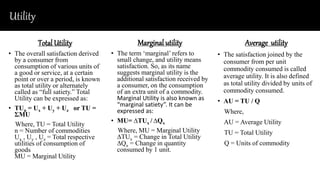
Utility
Total Utility
• The overall satisfaction derived
by a consumer from
consumption of various units of
a good or service, at a certain
point or over a period, is known
as total utility or alternately
called as “full satiety.” Total
Utility can be expressed as:
• TUn = Ux + Uy + Uz or TU =
ƩMU
Where, TU = Total Utility
n = Number of commodities
Ux , Uy , Uz = Total respective
utilities of consumption of
goods
MU = Marginal Utility
Marginal utility
• The term ‘marginal’ refers to
small change, and utility means
satisfaction. So, as its name
suggests marginal utility is the
additional satisfaction received by
a consumer, on the consumption
of an extra unit of a commodity.
Marginal Utility is also known as
“marginal satiety”. It can be
expressed as:
• MU= ∆TUx / ∆Qx
Where, MU = Marginal Utility
∆TUx = Change in Total Utility
∆Qx = Change in quantity
consumed by 1 unit.
Average utility
• The satisfaction joined by the
consumer from per unit
commodity consumed is called
average utility. It is also defined
as total utility divided by units of
commodity consumed.
• AU = TU / Q
Where,
AU = Average Utility
TU = Total Utility
Q = Units of commodity
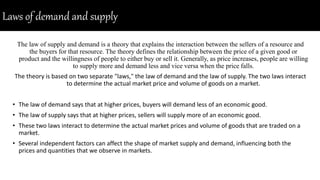
Laws of demand and supply
The law of supply and demand is a theory that explains the interaction between the sellers of a resource and
the buyers for that resource. The theory defines the relationship between the price of a given good or
product and the willingness of people to either buy or sell it. Generally, as price increases, people are willing
to supply more and demand less and vice versa when the price falls.
The theory is based on two separate "laws," the law of demand and the law of supply. The two laws interact
to determine the actual market price and volume of goods on a market.
• The law of demand says that at higher prices, buyers will demand less of an economic good.
• The law of supply says that at higher prices, sellers will supply more of an economic good.
• These two laws interact to determine the actual market prices and volume of goods that are traded on a
market.
• Several independent factors can affect the shape of market supply and demand, influencing both the
prices and quantities that we observe in markets.

Building economics

  • 1.
    BUILDING ECONOMICS BAR4009 ELEMENTARY CONCEPTSOF ECONOMICS Submitted to – Ar. Sanshlesh Kumar Submitted by – B.Arch 2nd Year, 4rd Sem Session: 2020 - 2021
  • 2.
    Economics is asocial science concerned with the production, distribution, and consumption of goods and services. It studies how individuals, businesses, governments, and nations make choices about how to allocate resources. Economics focuses on the actions of human beings, based on assumptions that humans act with rational behavior, seeking the most optimal level of benefit or utility. The building blocks of economics are the studies of labor and trade. Economics is especially concerned with efficiency in production and exchange and uses models and assumptions to understand how to create incentives and policies that will maximize efficiency. Economics can generally be broken down into macroeconomics, which concentrates on the behavior of the economy as a whole, and microeconomics, which focuses on individual people and businesses. Building Economics is a branch of general economics. It is based on application of principles of economics related to construction industry. Building Economics is concerned with: construction industry, its place in economy, role of construction firms, role of designers and constructors (builders), processes employed in construction and final building product. Present scope of Building Economics lays emphasis on - Building Product and how to make it more economical, effective and efficient, But does not involve resources and accounting practices. INTRODUCTION TO ECONOMICS
  • 3.
    BASIS FOR COMPARISONNEEDS WANTS Meaning Needs refers to an individual's basic requirement that must be fulfilled, in order to survive. Wants are described as the goods and services, which an individual like to have, as a part of his caprices. Nature Limited Unlimited What is it? Something you must have. Something you wish to have. Represents Necessity Desire Survival Essential Inessential Change May remain constant over time. May change over time. Non-fulfilment May result in onset of disease or even death. May result in disappointment. NEEDS AND WANTS
  • 4.
    Nature of Economics Thenature of economics deals with the question that whether economics falls into the category of science or arts. Various economists have given their arguments in favour of science while others have their reservations for arts. Scope of Economics Economists use different economic theories to solve various economic problems in society. Its applicability is very vast. From a small organization to a multinational firm, economic laws come into play. The scope of economics can be understood under two subheads: Microeconomics and Macroeconomics. The nature and scope of economics depend upon the interaction of economic agents and how economies work. THE NATURE AND SCOPE OF ECONOMICS
  • 5.
    Division of economics Microeconomics •Microeconomics is a branch of economics that studies the behavior of individuals and firms in making decisions regarding the allocation of scarce resources and the interactions among these individuals and firms • One goal of microeconomics is to analyze the market mechanisms that establish relative prices among goods and services and allocate limited resources among alternative uses. Macroeconomics • Macroeconomics is the branch of economics that studies the behavior and performance of an economy as a whole. It focuses on the aggregate changes in the economy such as unemployment, growth rate, gross domestic product and inflation. • Macroeconomics focuses on the sum total of economic activity, dealing with the issues of growth, inflation, and unemployment and with national policies relating to these issues.
  • 6.
    Scarcity • Scarcity refersto a basic economic problem—the gap between limited resources and theoretically limitless wants. This situation requires people to make decisions about how to allocate resources efficiently, in order to satisfy basic needs and as many additional wants as possible. • Scarcity is when the means to fulfill ends are limited and costly. • Scarcity is the foundation of the essential problem of economics: the allocation of limited means to fulfill unlimited wants and needs. • Even free natural resources can become scarce if costs arise in obtaining or consuming them, or if consumer demand for previously unwanted resources increases due to changing preferences or newly discovered uses.
  • 7.
    Utility Total Utility • Theoverall satisfaction derived by a consumer from consumption of various units of a good or service, at a certain point or over a period, is known as total utility or alternately called as “full satiety.” Total Utility can be expressed as: • TUn = Ux + Uy + Uz or TU = ƩMU Where, TU = Total Utility n = Number of commodities Ux , Uy , Uz = Total respective utilities of consumption of goods MU = Marginal Utility Marginal utility • The term ‘marginal’ refers to small change, and utility means satisfaction. So, as its name suggests marginal utility is the additional satisfaction received by a consumer, on the consumption of an extra unit of a commodity. Marginal Utility is also known as “marginal satiety”. It can be expressed as: • MU= ∆TUx / ∆Qx Where, MU = Marginal Utility ∆TUx = Change in Total Utility ∆Qx = Change in quantity consumed by 1 unit. Average utility • The satisfaction joined by the consumer from per unit commodity consumed is called average utility. It is also defined as total utility divided by units of commodity consumed. • AU = TU / Q Where, AU = Average Utility TU = Total Utility Q = Units of commodity
  • 8.
    Laws of demandand supply The law of supply and demand is a theory that explains the interaction between the sellers of a resource and the buyers for that resource. The theory defines the relationship between the price of a given good or product and the willingness of people to either buy or sell it. Generally, as price increases, people are willing to supply more and demand less and vice versa when the price falls. The theory is based on two separate "laws," the law of demand and the law of supply. The two laws interact to determine the actual market price and volume of goods on a market. • The law of demand says that at higher prices, buyers will demand less of an economic good. • The law of supply says that at higher prices, sellers will supply more of an economic good. • These two laws interact to determine the actual market prices and volume of goods that are traded on a market. • Several independent factors can affect the shape of market supply and demand, influencing both the prices and quantities that we observe in markets.