Systems Design
Thoughtfully Critical #18
Why Rushing System Design Leads to Shipwrecks
● The pressure is (always) on
● We all want to see our ideas come to life
● It's tempting to rush straight to the shiny, finished product (but that's often a
recipe for disaster)
● Jumping to the end usually ends up janky and unmaintainable
● A deliberate, three-phase build is the way to go for robust systems
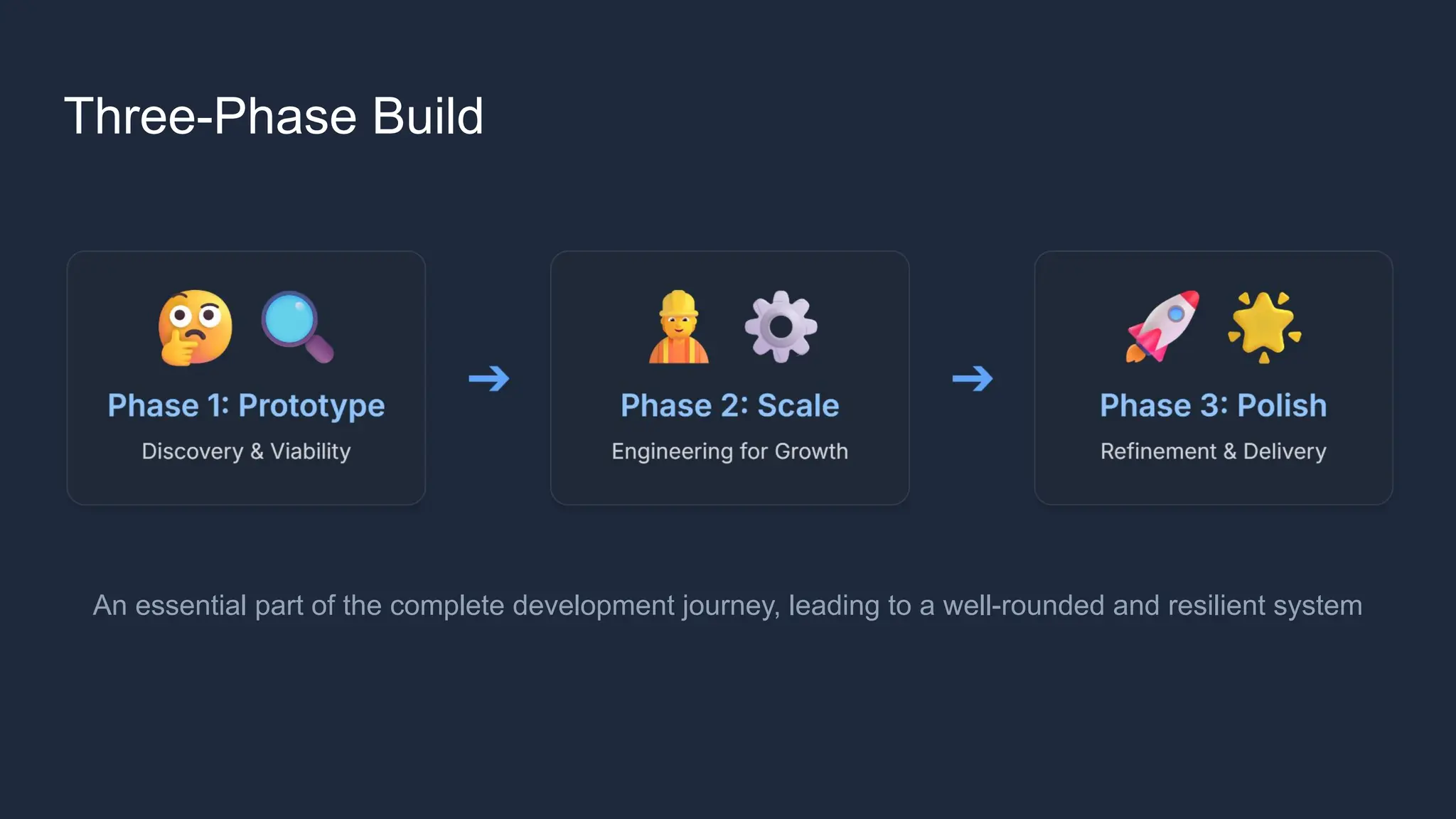
Three-Phase Build
An essential part of the complete development journey, leading to a well-rounded and resilient system
Phase 1: Does This Crazy Thing Even Work?
The first build is all about exploration and learning
The primary goal here isn't elegance, scalability, or even clean code
It's about answering fundamental questions:
1. Can we actually connect these disparate components and services?
2. Does the core logic function as intended?
3. What are the immediate, unforeseen roadblocks in just getting a signal from A
to B?
Phase 1: Does This Crazy Thing Even Work?
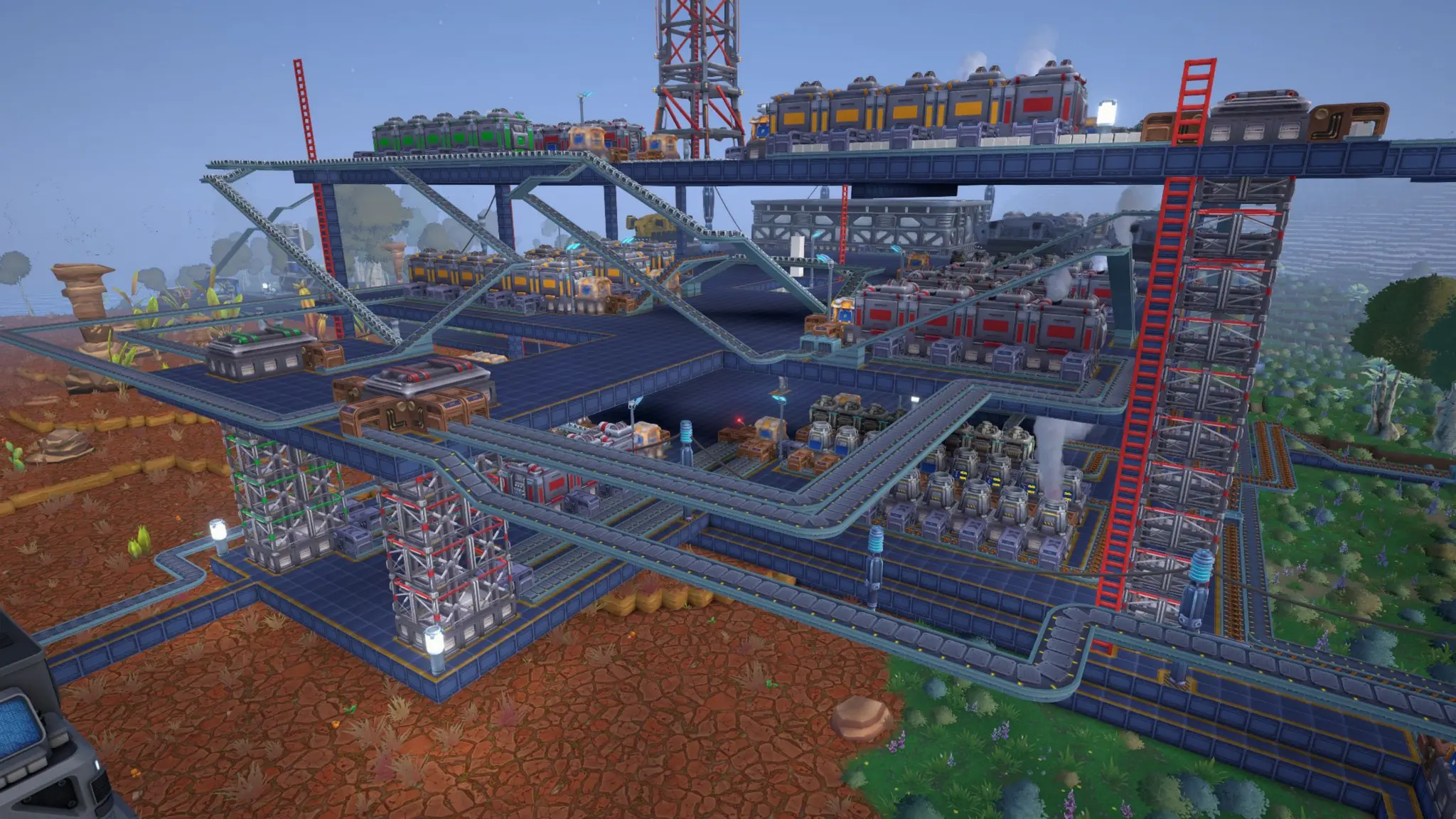
You're cobbling things together, trying out different libraries or APIs, and making a
raw, unpolished, glorious mess
It might be ugly, inefficient, and barely hold together, but it works
💡 Why it's crucial
● This phase is where you gain invaluable, hands-on experience with the
building blocks of your system
● You discover the quirks of third-party services, the unexpected
incompatibilities, and the true complexity of the problem you're trying to
solve
● Trying to design for scale or perfect abstraction at this stage is premature
optimization; you don't even know if the core idea is viable yet
Phase 2: Okay, Now … How Do We Make It BIG?
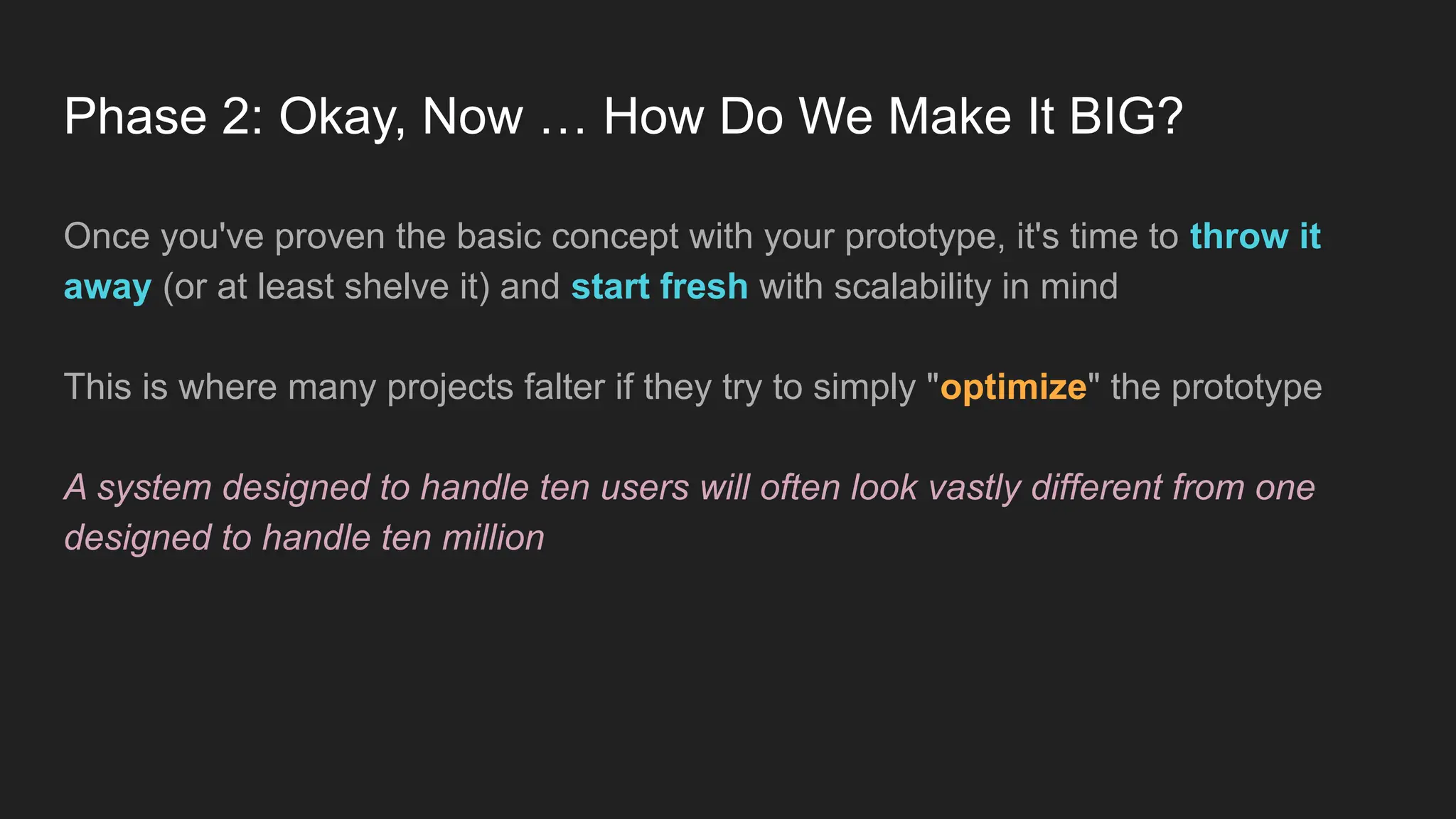
Once you've proven the basic concept with your prototype, it's time to throw it
away (or at least shelve it) and start fresh with scalability in mind
This is where many projects falter if they try to simply "optimize" the prototype
A system designed to handle ten users will often look vastly different from one
designed to handle ten million
Phase 2: Okay, Now … How Do We Make It BIG?
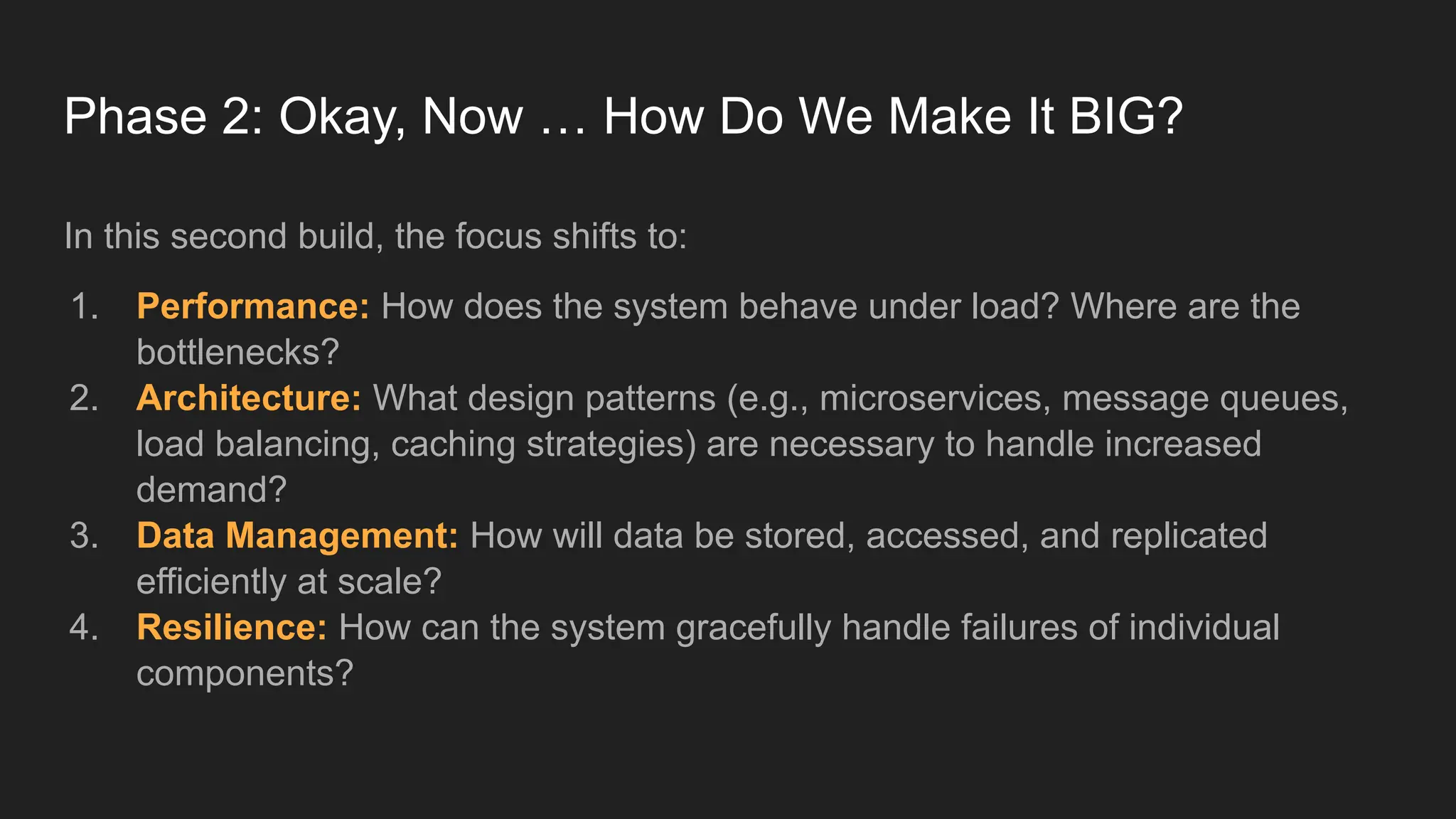
In this second build, the focus shifts to:
1. Performance: How does the system behave under load? Where are the
bottlenecks?
2. Architecture: What design patterns (e.g., microservices, message queues,
load balancing, caching strategies) are necessary to handle increased
demand?
3. Data Management: How will data be stored, accessed, and replicated
efficiently at scale?
4. Resilience: How can the system gracefully handle failures of individual
components?
Phase 2: Okay, Now … How Do We Make It BIG?
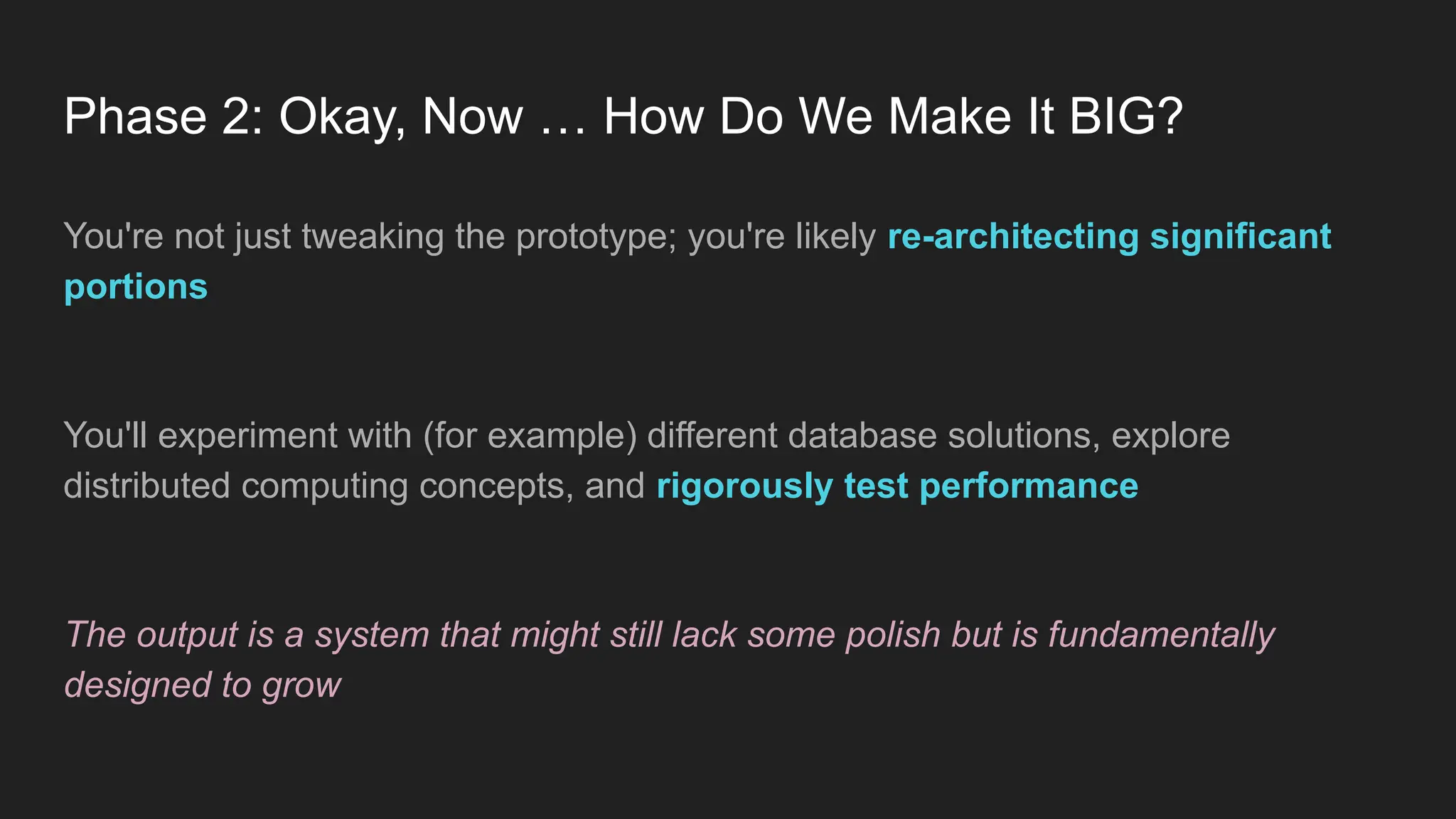
You're not just tweaking the prototype; you're likely re-architecting significant
portions
You'll experiment with (for example) different database solutions, explore
distributed computing concepts, and rigorously test performance
The output is a system that might still lack some polish but is fundamentally
designed to grow
⚙ Why it's crucial
● Scalability isn't an afterthought; it's a core architectural concern
● Bolting on scaling solutions to a system not designed for them is like trying to
add an extra cabin to an airplane ✈
● This phase forces you to confront the hard problems of distributed systems
and resource management before they become critical emergencies in
production
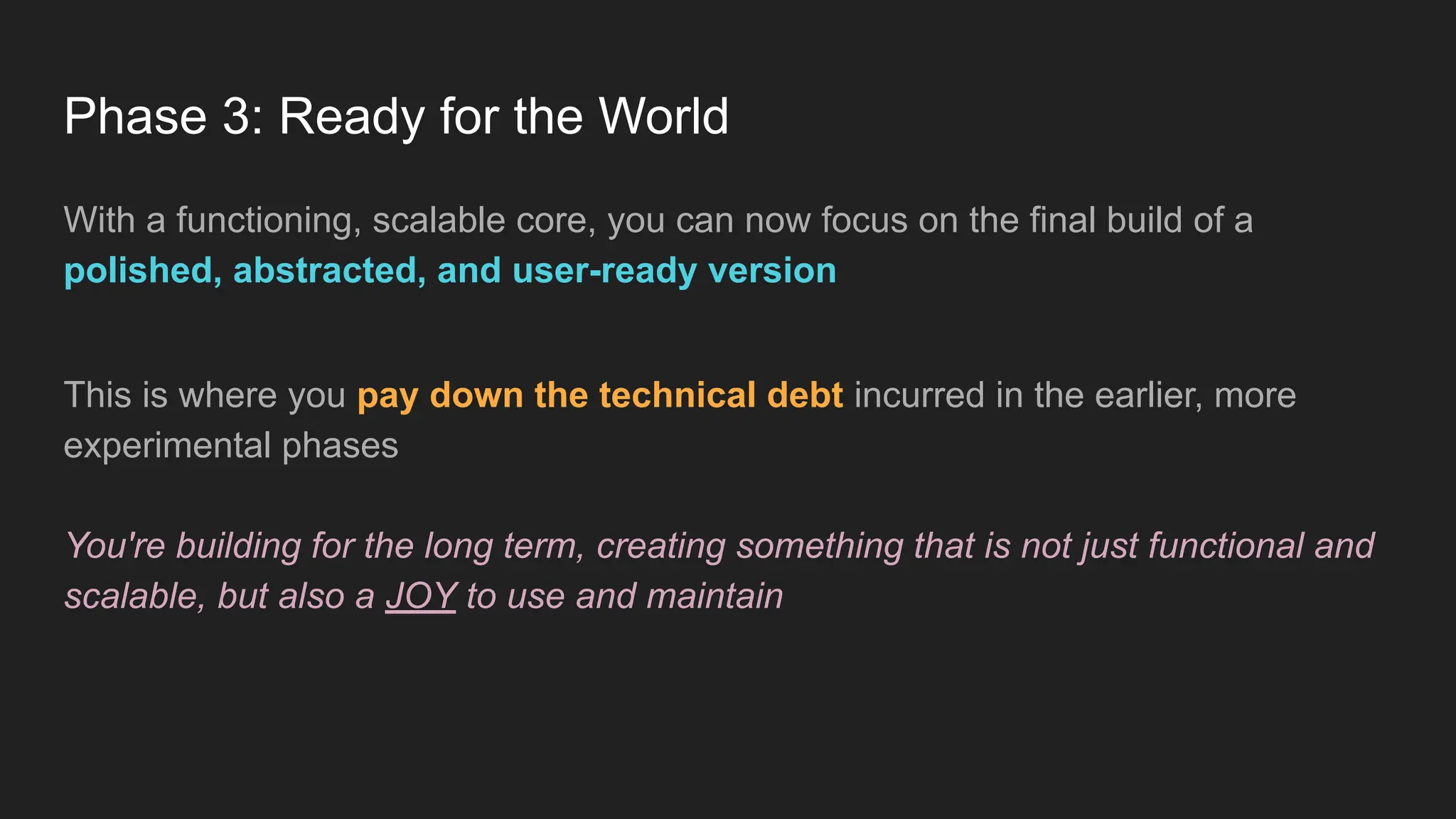
Phase 3: Ready for the World
With a functioning, scalable core, you can now focus on the final build of a
polished, abstracted, and user-ready version
This is where you pay down the technical debt incurred in the earlier, more
experimental phases
You're building for the long term, creating something that is not just functional and
scalable, but also a JOY to use and maintain
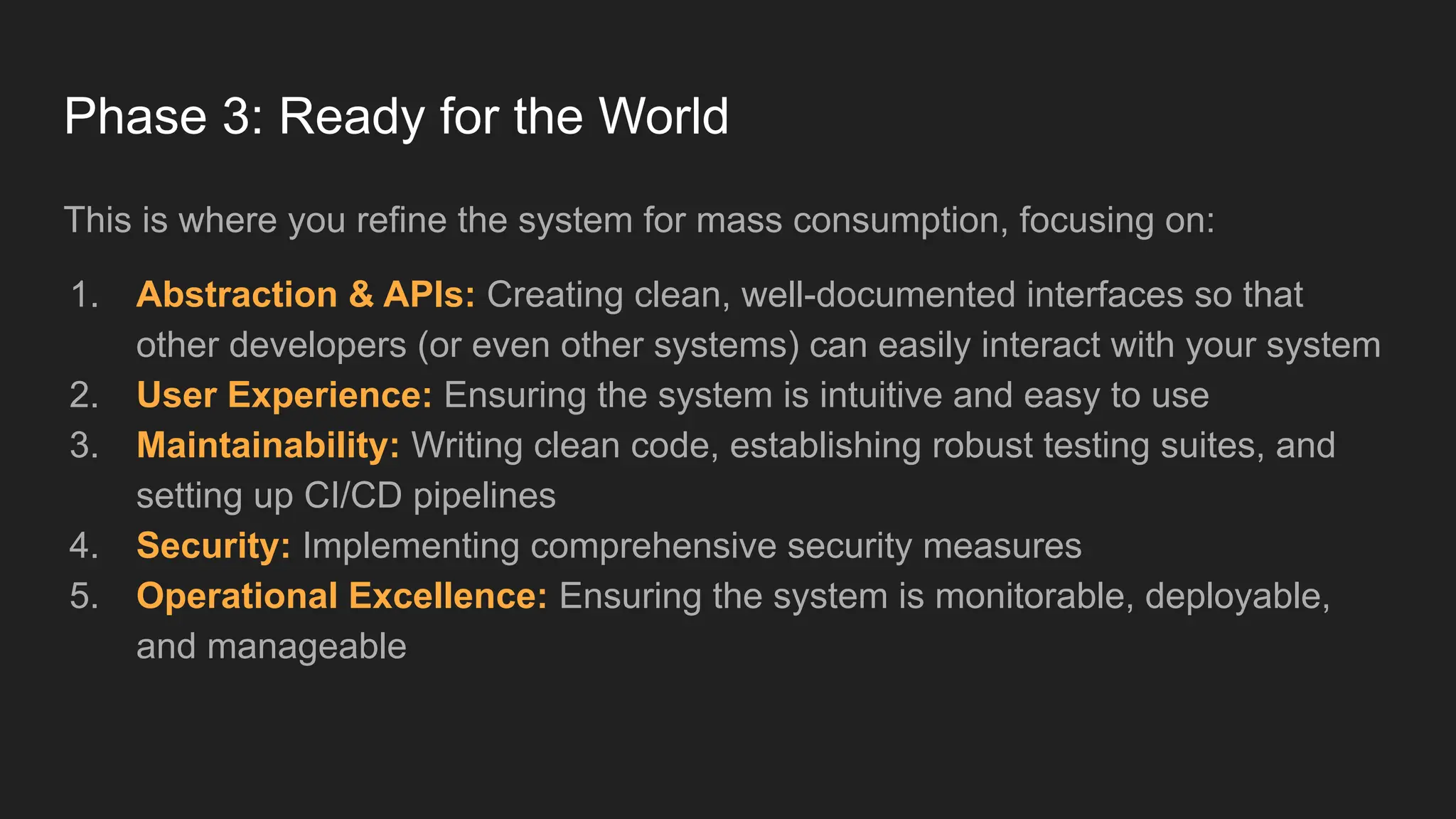
Phase 3: Ready for the World
This is where you refine the system for mass consumption, focusing on:
1. Abstraction & APIs: Creating clean, well-documented interfaces so that
other developers (or even other systems) can easily interact with your system
2. User Experience: Ensuring the system is intuitive and easy to use
3. Maintainability: Writing clean code, establishing robust testing suites, and
setting up CI/CD pipelines
4. Security: Implementing comprehensive security measures
5. Operational Excellence: Ensuring the system is monitorable, deployable,
and manageable
🌟 Why it's crucial
● This is the version that end-users and other developers will interact with
● A powerful and scalable system is useless if it's impossible to understand,
integrate with, or maintain
● Abstraction hides the underlying complexity, making the system more
approachable and reducing the cognitive load for everyone who interacts
with it
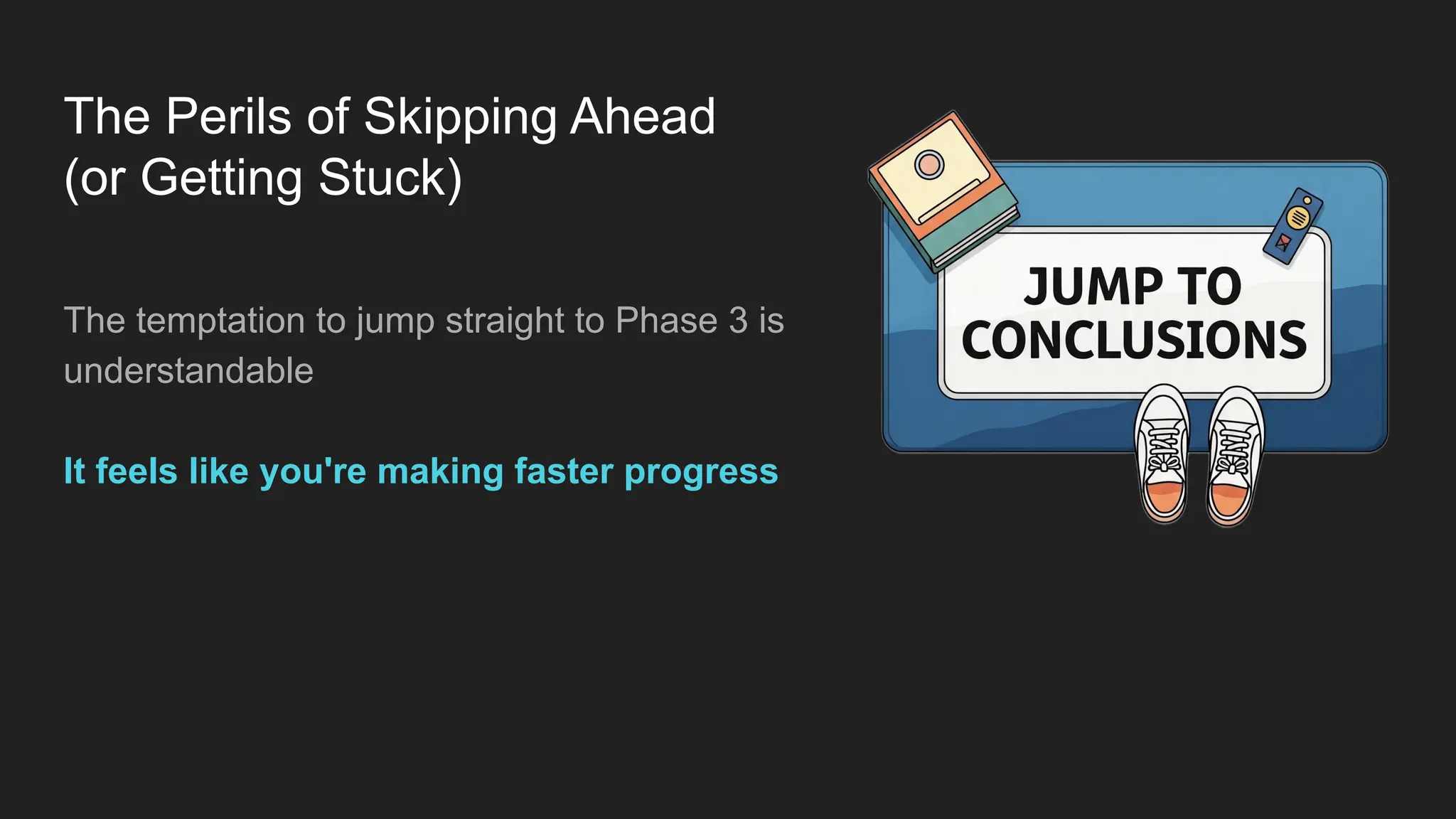
The Perils of Skipping Ahead
(or Getting Stuck)
The temptation to jump straight to Phase 3 is
understandable
It feels like you're making faster progress
The Perils of Skipping Ahead
However, this often leads to:
1. Janky Designs:
a. Building abstractions on top of unproven or poorly understood foundations
b. The system might look good on the surface but be brittle and inefficient underneath
2. Scalability Nightmares:
a. Discovering fundamental architectural flaws only when user load increases
b. Forcing costly and time-consuming redesigns
The Perils of Getting Stuck
Conversely, living forever in Phase 1 and constantly tinkering with a prototype
and trying to shoehorn scalability into it is equally problematic
You end up with a "Frankenstein" system with a patchwork of quick fixes and
workarounds that becomes increasingly difficult to manage and impossible to
scale reliably
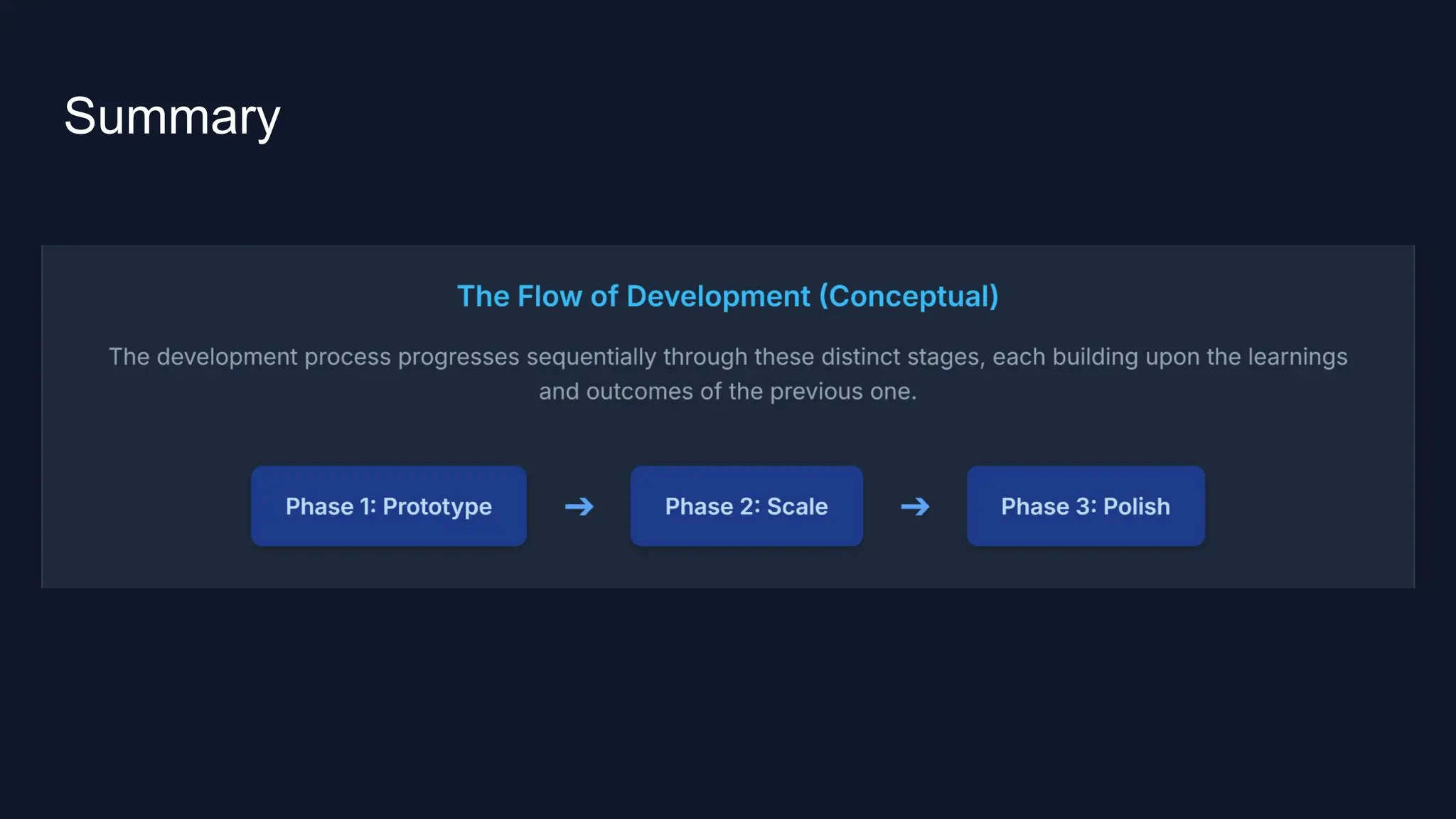
Summary
Building Better, Stronger Systems
The three-phase approach – Prototype, Scale, Polish – isn't about adding
unnecessary work
It's about acknowledging the different challenges that arise at different
stages of a system's life cycle
Building Better, Stronger Systems
By tackling these challenges systematically, we can learn faster, build more
robust architectures, and ultimately deliver systems that are not only powerful
and scalable but also elegant and maintainable
It requires discipline and a willingness to "throw away" work, but the payoff is a
system built on a solid foundation, ready to meet the demands of today and
tomorrow

Building Better, Stronger Systems - Thoughtfully Critical Podcast

  • 1.
  • 3.
    Why Rushing SystemDesign Leads to Shipwrecks ● The pressure is (always) on ● We all want to see our ideas come to life ● It's tempting to rush straight to the shiny, finished product (but that's often a recipe for disaster) ● Jumping to the end usually ends up janky and unmaintainable ● A deliberate, three-phase build is the way to go for robust systems
  • 4.
    Three-Phase Build An essentialpart of the complete development journey, leading to a well-rounded and resilient system
  • 6.
    Phase 1: DoesThis Crazy Thing Even Work? The first build is all about exploration and learning The primary goal here isn't elegance, scalability, or even clean code It's about answering fundamental questions: 1. Can we actually connect these disparate components and services? 2. Does the core logic function as intended? 3. What are the immediate, unforeseen roadblocks in just getting a signal from A to B?
  • 7.
    Phase 1: DoesThis Crazy Thing Even Work? You're cobbling things together, trying out different libraries or APIs, and making a raw, unpolished, glorious mess It might be ugly, inefficient, and barely hold together, but it works
  • 10.
    💡 Why it'scrucial ● This phase is where you gain invaluable, hands-on experience with the building blocks of your system ● You discover the quirks of third-party services, the unexpected incompatibilities, and the true complexity of the problem you're trying to solve ● Trying to design for scale or perfect abstraction at this stage is premature optimization; you don't even know if the core idea is viable yet
  • 12.
    Phase 2: Okay,Now … How Do We Make It BIG? Once you've proven the basic concept with your prototype, it's time to throw it away (or at least shelve it) and start fresh with scalability in mind This is where many projects falter if they try to simply "optimize" the prototype A system designed to handle ten users will often look vastly different from one designed to handle ten million
  • 13.
    Phase 2: Okay,Now … How Do We Make It BIG? In this second build, the focus shifts to: 1. Performance: How does the system behave under load? Where are the bottlenecks? 2. Architecture: What design patterns (e.g., microservices, message queues, load balancing, caching strategies) are necessary to handle increased demand? 3. Data Management: How will data be stored, accessed, and replicated efficiently at scale? 4. Resilience: How can the system gracefully handle failures of individual components?
  • 14.
    Phase 2: Okay,Now … How Do We Make It BIG? You're not just tweaking the prototype; you're likely re-architecting significant portions You'll experiment with (for example) different database solutions, explore distributed computing concepts, and rigorously test performance The output is a system that might still lack some polish but is fundamentally designed to grow
  • 17.
    ⚙ Why it'scrucial ● Scalability isn't an afterthought; it's a core architectural concern ● Bolting on scaling solutions to a system not designed for them is like trying to add an extra cabin to an airplane ✈ ● This phase forces you to confront the hard problems of distributed systems and resource management before they become critical emergencies in production
  • 19.
    Phase 3: Readyfor the World With a functioning, scalable core, you can now focus on the final build of a polished, abstracted, and user-ready version This is where you pay down the technical debt incurred in the earlier, more experimental phases You're building for the long term, creating something that is not just functional and scalable, but also a JOY to use and maintain
  • 20.
    Phase 3: Readyfor the World This is where you refine the system for mass consumption, focusing on: 1. Abstraction & APIs: Creating clean, well-documented interfaces so that other developers (or even other systems) can easily interact with your system 2. User Experience: Ensuring the system is intuitive and easy to use 3. Maintainability: Writing clean code, establishing robust testing suites, and setting up CI/CD pipelines 4. Security: Implementing comprehensive security measures 5. Operational Excellence: Ensuring the system is monitorable, deployable, and manageable
  • 23.
    🌟 Why it'scrucial ● This is the version that end-users and other developers will interact with ● A powerful and scalable system is useless if it's impossible to understand, integrate with, or maintain ● Abstraction hides the underlying complexity, making the system more approachable and reducing the cognitive load for everyone who interacts with it
  • 24.
    The Perils ofSkipping Ahead (or Getting Stuck) The temptation to jump straight to Phase 3 is understandable It feels like you're making faster progress
  • 25.
    The Perils ofSkipping Ahead However, this often leads to: 1. Janky Designs: a. Building abstractions on top of unproven or poorly understood foundations b. The system might look good on the surface but be brittle and inefficient underneath 2. Scalability Nightmares: a. Discovering fundamental architectural flaws only when user load increases b. Forcing costly and time-consuming redesigns
  • 26.
    The Perils ofGetting Stuck Conversely, living forever in Phase 1 and constantly tinkering with a prototype and trying to shoehorn scalability into it is equally problematic You end up with a "Frankenstein" system with a patchwork of quick fixes and workarounds that becomes increasingly difficult to manage and impossible to scale reliably
  • 27.
  • 28.
    Building Better, StrongerSystems The three-phase approach – Prototype, Scale, Polish – isn't about adding unnecessary work It's about acknowledging the different challenges that arise at different stages of a system's life cycle
  • 29.
    Building Better, StrongerSystems By tackling these challenges systematically, we can learn faster, build more robust architectures, and ultimately deliver systems that are not only powerful and scalable but also elegant and maintainable It requires discipline and a willingness to "throw away" work, but the payoff is a system built on a solid foundation, ready to meet the demands of today and tomorrow