

F.Kordon-UniversitéP.&M.Curie-CC2016
Fabrice.Kordon@lip6.fr
Building and verifying a
quasi-certification entity
over Distributed Hash Tables
Join work with X. Bonnaire, R. Cortes & O. Marin
UPMC (France), UFSM (Chile), NYUS (China)
F.Kordon-UniversitéP.&M.Curie-CC2016
Certification, why?
Motivations
Digital filling for tax purpose
‣ Certify that somebody did it before a given deadline
Certified emails
‣ Use emails for legal purposes
Online game refereeing
e-voting, etc.
2
F.Kordon-UniversitéP.&M.Curie-CC2016
Certification, why?
Motivations
Digital filling for tax purpose
‣ Certify that somebody did it before a given deadline
Certified emails
‣ Use emails for legal purposes
Online game refereeing
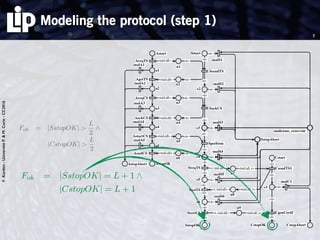
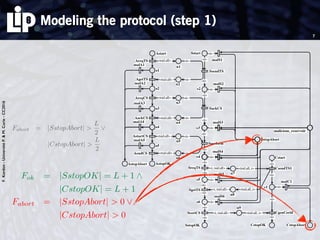
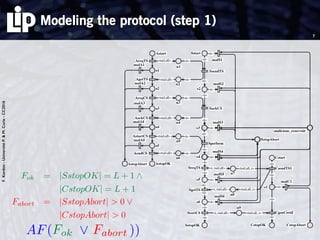
e-voting, etc.
Existing Solutions
Centralized
‣ Public Key Infrastructures (traditional PKI)
‣ Scaling problem/prone to faults/implementation (atomic multicast)
Decentralized
‣ Certification on top of Distributed Hash Tables (DHT)
‣ Rapidly brings Byzantine consensus (for a 100.0% guarantee)
2
F.Kordon-UniversitéP.&M.Curie-CC2016
Certification, why?
Motivations
Digital filling for tax purpose
‣ Certify that somebody did it before a given deadline
Certified emails
‣ Use emails for legal purposes
Online game refereeing
e-voting, etc.
Existing Solutions
Centralized
‣ Public Key Infrastructures (traditional PKI)
‣ Scaling problem/prone to faults/implementation (atomic multicast)
Decentralized
‣ Certification on top of Distributed Hash Tables (DHT)
‣ Rapidly brings Byzantine consensus (for a 100.0% guarantee)
2
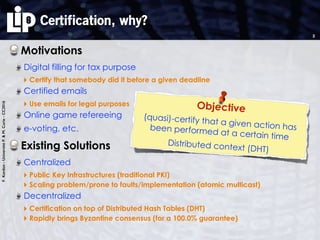
Objective
(quasi)-certify that a given action hasbeen performed at a certain time
Distributed context (DHT)
F.Kordon-UniversitéP.&M.Curie-CC2016
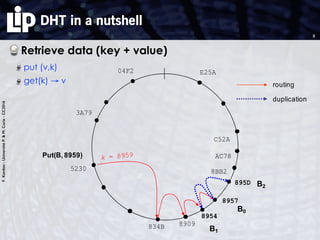
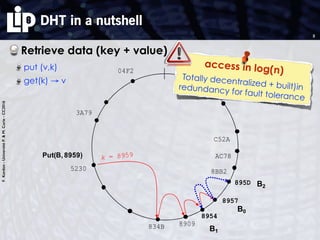
DHT in a nutshell
Retrieve data (key + value)
put (v,k)
get(k) → v
3
Large Scale Distributed System, Design Principles 47
F.Kordon-UniversitéP.&M.Curie-CC2016
DHT in a nutshell
Retrieve data (key + value)
put (v,k)
get(k) → v
3
Large Scale Distributed System, Design Principles 47
access in log(n)
Totally decentralized + built)inredundancy for fault tolerance
F.Kordon-UniversitéP.&M.Curie-CC2016
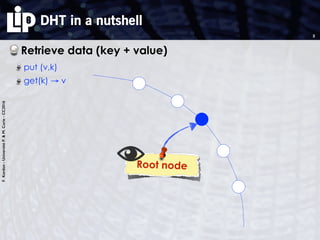
DHT in a nutshell
Retrieve data (key + value)
put (v,k)
get(k) → v
3
Root node
F.Kordon-UniversitéP.&M.Curie-CC2016
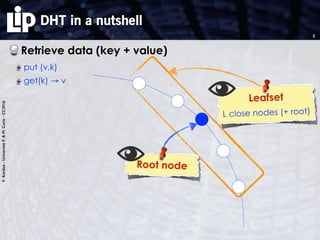
DHT in a nutshell
Retrieve data (key + value)
put (v,k)
get(k) → v
3
Root node
Leafset
L close nodes (+ root)
F.Kordon-UniversitéP.&M.Curie-CC2016
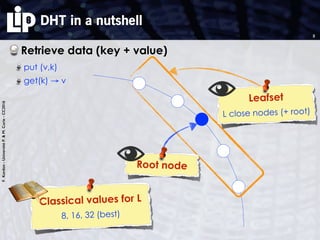
DHT in a nutshell
Retrieve data (key + value)
put (v,k)
get(k) → v
3
Root node
Leafset
L close nodes (+ root)
Classical values for L
8, 16, 32 (best)
F.Kordon-UniversitéP.&M.Curie-CC2016
Quasi-certification — entities
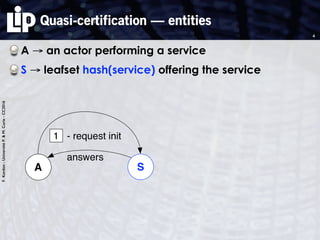
A → an actor performing a service
4
A
F.Kordon-UniversitéP.&M.Curie-CC2016
Quasi-certification — entities
A → an actor performing a service
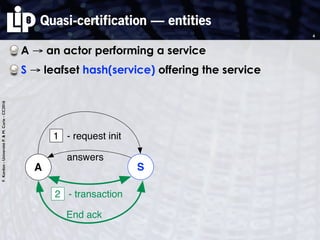
S → leafset hash(service) offering the service
4
A S
1 - request init
answers
F.Kordon-UniversitéP.&M.Curie-CC2016
Quasi-certification — entities
A → an actor performing a service
S → leafset hash(service) offering the service
4
A S
1 - request init
answers
2 - transaction
End ack
F.Kordon-UniversitéP.&M.Curie-CC2016
Quasi-certification — entities
A → an actor performing a service
S → leafset hash(service) offering the service
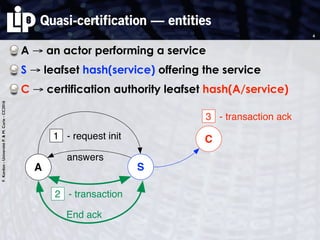
C → certification authority leafset hash(A/service)
4
A S
1 - request init
answers
2 - transaction
End ack
C
3 - transaction ack
F.Kordon-UniversitéP.&M.Curie-CC2016
Quasi-certification — entities
A → an actor performing a service
S → leafset hash(service) offering the service
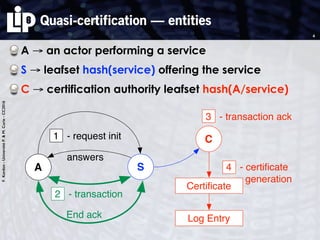
C → certification authority leafset hash(A/service)
4
A S
1 - request init
answers
2 - transaction
End ack
C
3 - transaction ack
Certificate
Log Entry
4 - certificate
generation
F.Kordon-UniversitéP.&M.Curie-CC2016
Quasi-certification — protocol structure
5
A S C
5
F.Kordon-UniversitéP.&M.Curie-CC2016
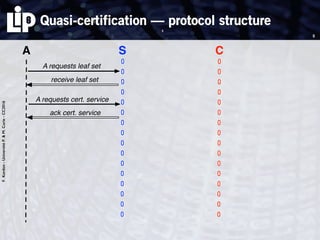
Quasi-certification — protocol structure
5
A S C
A requests cert. service
ack cert. service
A requests leaf set
receive leaf set
5
F.Kordon-UniversitéP.&M.Curie-CC2016
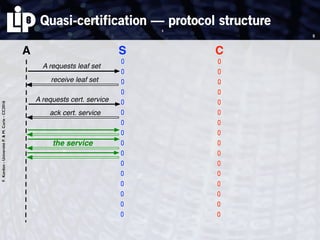
Quasi-certification — protocol structure
5
A S C
A requests cert. service
ack cert. service
A requests leaf set
receive leaf set
the service
5
F.Kordon-UniversitéP.&M.Curie-CC2016
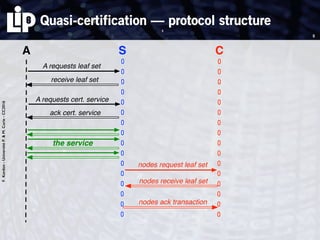
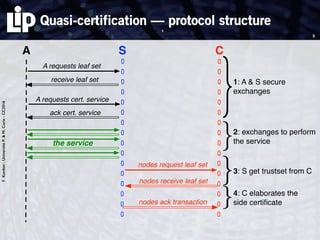
Quasi-certification — protocol structure
5
A S C
A requests cert. service
ack cert. service
A requests leaf set
receive leaf set
the service
nodes ack transaction
nodes request leaf set
nodes receive leaf set
5
F.Kordon-UniversitéP.&M.Curie-CC2016
Quasi-certification — protocol structure
5
A S C
A requests cert. service
ack cert. service
A requests leaf set
receive leaf set
the service
nodes ack transaction
nodes request leaf set
nodes receive leaf set
}1: A & S secure
exchanges
}3: S get trustset from C
}2: exchanges to perform
the service
}4: C elaborates the
side certificate
5
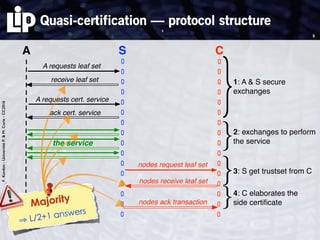
F.Kordon-UniversitéP.&M.Curie-CC2016
Quasi-certification — protocol structure
5
A S C
A requests cert. service
ack cert. service
A requests leaf set
receive leaf set
the service
nodes ack transaction
nodes request leaf set
nodes receive leaf set
}1: A & S secure
exchanges
}3: S get trustset from C
}2: exchanges to perform
the service
}4: C elaborates the
side certificate
5
Majority
⇒ L/2+1 answers
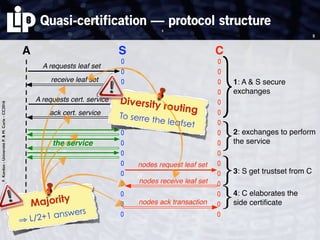
F.Kordon-UniversitéP.&M.Curie-CC2016
Quasi-certification — protocol structure
5
A S C
A requests cert. service
ack cert. service
A requests leaf set
receive leaf set
the service
nodes ack transaction
nodes request leaf set
nodes receive leaf set
}1: A & S secure
exchanges
}3: S get trustset from C
}2: exchanges to perform
the service
}4: C elaborates the
side certificate
5
Diversity routing
To serre the leafset
Majority
⇒ L/2+1 answers
F.Kordon-UniversitéP.&M.Curie-CC2016
The verification process
Proof (by any method?)
Proven to be undecidable [FLP 85]
6
F.Kordon-UniversitéP.&M.Curie-CC2016
The verification process
Proof (by any method?)
Proven to be undecidable [FLP 85]
So what?
Being pragmatic
Going for «quasi»
6
F.Kordon-UniversitéP.&M.Curie-CC2016
The verification process
Proof (by any method?)
Proven to be undecidable [FLP 85]
So what?
Being pragmatic
Going for «quasi»
Two steps
1. modeling the protocol in a perfect world (no error)
Use of Petri nets
2. Probabilistic analysis to evaluate the failure rate
Use of a classical fault model,
building a formula + numeric evaluation
6
F.Kordon-UniversitéP.&M.Curie-CC2016
Hypotheses
H1: perfect world
H2: service reduced to 1 interaction
H3: L+1 answer requested instead of L/2+1
‣ Symmetric net with Bags?
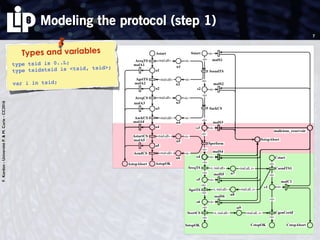
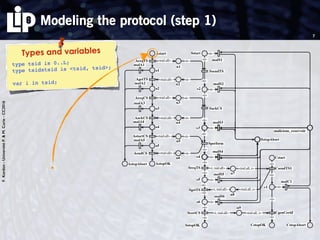
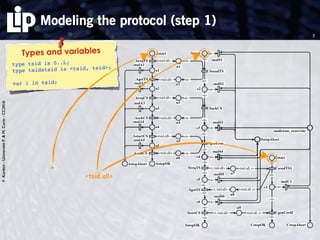
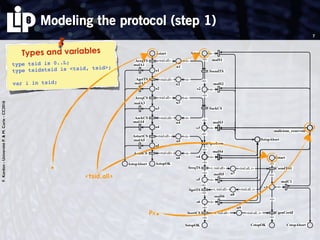
Modeling the protocol (step 1)
7
F.Kordon-UniversitéP.&M.Curie-CC2016
Modeling the protocol (step 1)
7
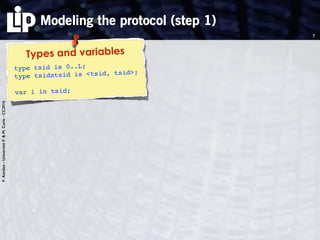
Types and variables
type tsid is 0..L;
type tsidxtsid is <tsid, tsid>;
var i in tsid;
F.Kordon-UniversitéP.&M.Curie-CC2016
Modeling the protocol (step 1)
7
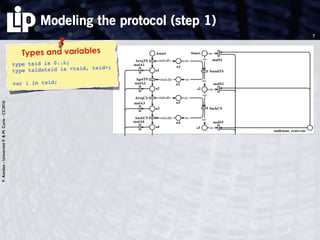
Types and variables
type tsid is 0..L;
type tsidxtsid is <tsid, tsid>;
var i in tsid;
<i>
<i>
<i>
<i><i>
<i>
<i>
<tsid.all> <i>
<tsid.all>
<tsid.all> <i>
<tsid.all>
<i>
<i>
malicious_reservoir
malS3
malS2
malS1
malA3
malA4
malA2
malA1
n4
n3
n2
n1
Sstart
s2
s3
SsendTS
SackCS
AackCS
AreqCS
AgetTS
AreqTS
a4
a3
a2
a1
Astart
F.Kordon-UniversitéP.&M.Curie-CC2016
Modeling the protocol (step 1)
7
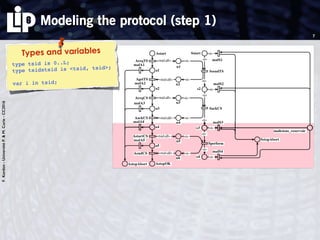
Types and variables
type tsid is 0..L;
type tsidxtsid is <tsid, tsid>;
var i in tsid;
<i>
<i>
<i>
<i><i>
<i>
<i>
<tsid.all> <i>
<tsid.all>
<tsid.all> <i>
<tsid.all>
<i>
<i>
malicious_reservoir
malS3
malS2
malS1
malA3
malA4
malA2
malA1
n4
n3
n2
n1
Sstart
s2
s3
SsendTS
SackCS
AackCS
AreqCS
AgetTS
AreqTS
a4
a3
a2
a1
Astart
<i>
<i>
<i>
<i>
<tsid.all> <i>
<tsid.all>
<i>
<i>
malicious_reservoir
malS4
malS3
malA5
malA4
SstopAbort
AstopAbort
n6
n5
s3
s4
Sperform
AendCS
AstartCS
a5
a4
AstopOK
F.Kordon-UniversitéP.&M.Curie-CC2016
Modeling the protocol (step 1)
7
Types and variables
type tsid is 0..L;
type tsidxtsid is <tsid, tsid>;
var i in tsid;
<i>
<i>
<i>
<i><i>
<i>
<i>
<tsid.all> <i>
<tsid.all>
<tsid.all> <i>
<tsid.all>
<i>
<i>
malicious_reservoir
malS3
malS2
malS1
malA3
malA4
malA2
malA1
n4
n3
n2
n1
Sstart
s2
s3
SsendTS
SackCS
AackCS
AreqCS
AgetTS
AreqTS
a4
a3
a2
a1
Astart
<i>
<i>
<i>
<i>
<tsid.all> <i>
<tsid.all>
<i>
<i>
malicious_reservoir
malS4
malS3
malA5
malA4
SstopAbort
AstopAbort
n6
n5
s3
s4
Sperform
AendCS
AstartCS
a5
a4
AstopOK
<i>
<i>
<tsid.all, i>
<i>
<i>
<i>
<i>
<tsid.all, i><i, tsid.all>
<i, tsid.all>
<tsid.all, i><i, tsid.all>
<i>
<i>
<i>
<i>
<i>
<i>
<i>
<i>
malicious_reservoir
malC1
malS6
malS5
malS4
CstopAbort
SstopAbort
n9
n8
n7
CgenCertif
CsendTS1
c1
Cstarts4
s5
s6
SstopOK
SreqTS
SgetTS
ScertCS
CstopOK
F.Kordon-UniversitéP.&M.Curie-CC2016
Modeling the protocol (step 1)
7
Types and variables
type tsid is 0..L;
type tsidxtsid is <tsid, tsid>;
var i in tsid;
<i>
<i>
<i>
<i><i>
<i>
<i>
<tsid.all> <i>
<tsid.all>
<tsid.all> <i>
<tsid.all>
<i>
<i>
malicious_reservoir
malS3
malS2
malS1
malA3
malA4
malA2
malA1
n4
n3
n2
n1
Sstart
s2
s3
SsendTS
SackCS
AackCS
AreqCS
AgetTS
AreqTS
a4
a3
a2
a1
Astart
<i>
<i>
<i>
<i>
<tsid.all> <i>
<tsid.all>
<i>
<i>
malicious_reservoir
malS4
malS3
malA5
malA4
SstopAbort
AstopAbort
n6
n5
s3
s4
Sperform
AendCS
AstartCS
a5
a4
AstopOK
<i>
<i>
<tsid.all, i>
<i>
<i>
<i>
<i>
<tsid.all, i><i, tsid.all>
<i, tsid.all>
<tsid.all, i><i, tsid.all>
<i>
<i>
<i>
<i>
<i>
<i>
<i>
<i>
malicious_reservoir
malC1
malS6
malS5
malS4
CstopAbort
SstopAbort
n9
n8
n7
CgenCertif
CsendTS1
c1
Cstarts4
s5
s6
SstopOK
SreqTS
SgetTS
ScertCS
CstopOK
●
F.Kordon-UniversitéP.&M.Curie-CC2016
Modeling the protocol (step 1)
7
Types and variables
type tsid is 0..L;
type tsidxtsid is <tsid, tsid>;
var i in tsid;
<i>
<i>
<i>
<i><i>
<i>
<i>
<tsid.all> <i>
<tsid.all>
<tsid.all> <i>
<tsid.all>
<i>
<i>
malicious_reservoir
malS3
malS2
malS1
malA3
malA4
malA2
malA1
n4
n3
n2
n1
Sstart
s2
s3
SsendTS
SackCS
AackCS
AreqCS
AgetTS
AreqTS
a4
a3
a2
a1
Astart
<i>
<i>
<i>
<i>
<tsid.all> <i>
<tsid.all>
<i>
<i>
malicious_reservoir
malS4
malS3
malA5
malA4
SstopAbort
AstopAbort
n6
n5
s3
s4
Sperform
AendCS
AstartCS
a5
a4
AstopOK
<i>
<i>
<tsid.all, i>
<i>
<i>
<i>
<i>
<tsid.all, i><i, tsid.all>
<i, tsid.all>
<tsid.all, i><i, tsid.all>
<i>
<i>
<i>
<i>
<i>
<i>
<i>
<i>
malicious_reservoir
malC1
malS6
malS5
malS4
CstopAbort
SstopAbort
n9
n8
n7
CgenCertif
CsendTS1
c1
Cstarts4
s5
s6
SstopOK
SreqTS
SgetTS
ScertCS
CstopOK
●
<tsid.all>
F.Kordon-UniversitéP.&M.Curie-CC2016
Modeling the protocol (step 1)
7
Types and variables
type tsid is 0..L;
type tsidxtsid is <tsid, tsid>;
var i in tsid;
<i>
<i>
<i>
<i><i>
<i>
<i>
<tsid.all> <i>
<tsid.all>
<tsid.all> <i>
<tsid.all>
<i>
<i>
malicious_reservoir
malS3
malS2
malS1
malA3
malA4
malA2
malA1
n4
n3
n2
n1
Sstart
s2
s3
SsendTS
SackCS
AackCS
AreqCS
AgetTS
AreqTS
a4
a3
a2
a1
Astart
<i>
<i>
<i>
<i>
<tsid.all> <i>
<tsid.all>
<i>
<i>
malicious_reservoir
malS4
malS3
malA5
malA4
SstopAbort
AstopAbort
n6
n5
s3
s4
Sperform
AendCS
AstartCS
a5
a4
AstopOK
<i>
<i>
<tsid.all, i>
<i>
<i>
<i>
<i>
<tsid.all, i><i, tsid.all>
<i, tsid.all>
<tsid.all, i><i, tsid.all>
<i>
<i>
<i>
<i>
<i>
<i>
<i>
<i>
malicious_reservoir
malC1
malS6
malS5
malS4
CstopAbort
SstopAbort
n9
n8
n7
CgenCertif
CsendTS1
c1
Cstarts4
s5
s6
SstopOK
SreqTS
SgetTS
ScertCS
CstopOK
●
<tsid.all>
Px●
F.Kordon-UniversitéP.&M.Curie-CC2016
Modeling the protocol (step 1)
7
<i>
<i>
<i>
<i><i>
<i>
<i>
<tsid.all> <i>
<tsid.all>
<tsid.all> <i>
<tsid.all>
<i>
<i>
malicious_reservoir
malS3
malS2
malS1
malA3
malA4
malA2
malA1
n4
n3
n2
n1
Sstart
s2
s3
SsendTS
SackCS
AackCS
AreqCS
AgetTS
AreqTS
a4
a3
a2
a1
Astart
<i>
<i>
<i>
<i>
<tsid.all> <i>
<tsid.all>
<i>
<i>
malicious_reservoir
malS4
malS3
malA5
malA4
SstopAbort
AstopAbort
n6
n5
s3
s4
Sperform
AendCS
AstartCS
a5
a4
AstopOK
<i>
<i>
<tsid.all, i>
<i>
<i>
<i>
<i>
<tsid.all, i><i, tsid.all>
<i, tsid.all>
<tsid.all, i><i, tsid.all>
<i>
<i>
<i>
<i>
<i>
<i>
<i>
<i>
malicious_reservoir
malC1
malS6
malS5
malS4
CstopAbort
SstopAbort
n9
n8
n7
CgenCertif
CsendTS1
c1
Cstarts4
s5
s6
SstopOK
SreqTS
SgetTS
ScertCS
CstopOK
Fok = |SstopOK| = L + 1
|CstopOK| = L + 1
Fok = |SstopOK| >
L
2
^
|CstopOK| >
L
2
F.Kordon-UniversitéP.&M.Curie-CC2016
Modeling the protocol (step 1)
7
<i>
<i>
<i>
<i><i>
<i>
<i>
<tsid.all> <i>
<tsid.all>
<tsid.all> <i>
<tsid.all>
<i>
<i>
malicious_reservoir
malS3
malS2
malS1
malA3
malA4
malA2
malA1
n4
n3
n2
n1
Sstart
s2
s3
SsendTS
SackCS
AackCS
AreqCS
AgetTS
AreqTS
a4
a3
a2
a1
Astart
<i>
<i>
<i>
<i>
<tsid.all> <i>
<tsid.all>
<i>
<i>
malicious_reservoir
malS4
malS3
malA5
malA4
SstopAbort
AstopAbort
n6
n5
s3
s4
Sperform
AendCS
AstartCS
a5
a4
AstopOK
<i>
<i>
<tsid.all, i>
<i>
<i>
<i>
<i>
<tsid.all, i><i, tsid.all>
<i, tsid.all>
<tsid.all, i><i, tsid.all>
<i>
<i>
<i>
<i>
<i>
<i>
<i>
<i>
malicious_reservoir
malC1
malS6
malS5
malS4
CstopAbort
SstopAbort
n9
n8
n7
CgenCertif
CsendTS1
c1
Cstarts4
s5
s6
SstopOK
SreqTS
SgetTS
ScertCS
CstopOK
Fok = |SstopOK| = L + 1
|CstopOK| = L + 1
Fabort = |SstopAbort| > 0
|CstopAbort| > 0
Fabort = |SstopAbort| >
L
2
_
|CstopAbort| >
L
2
F.Kordon-UniversitéP.&M.Curie-CC2016
Modeling the protocol (step 1)
7
<i>
<i>
<i>
<i><i>
<i>
<i>
<tsid.all> <i>
<tsid.all>
<tsid.all> <i>
<tsid.all>
<i>
<i>
malicious_reservoir
malS3
malS2
malS1
malA3
malA4
malA2
malA1
n4
n3
n2
n1
Sstart
s2
s3
SsendTS
SackCS
AackCS
AreqCS
AgetTS
AreqTS
a4
a3
a2
a1
Astart
<i>
<i>
<i>
<i>
<tsid.all> <i>
<tsid.all>
<i>
<i>
malicious_reservoir
malS4
malS3
malA5
malA4
SstopAbort
AstopAbort
n6
n5
s3
s4
Sperform
AendCS
AstartCS
a5
a4
AstopOK
<i>
<i>
<tsid.all, i>
<i>
<i>
<i>
<i>
<tsid.all, i><i, tsid.all>
<i, tsid.all>
<tsid.all, i><i, tsid.all>
<i>
<i>
<i>
<i>
<i>
<i>
<i>
<i>
malicious_reservoir
malC1
malS6
malS5
malS4
CstopAbort
SstopAbort
n9
n8
n7
CgenCertif
CsendTS1
c1
Cstarts4
s5
s6
SstopOK
SreqTS
SgetTS
ScertCS
CstopOK
FabortFokAF( _ ))
Fok = |SstopOK| = L + 1
|CstopOK| = L + 1
Fabort = |SstopAbort| > 0
|CstopAbort| > 0
F.Kordon-UniversitéP.&M.Curie-CC2016
Verifying the perfect world
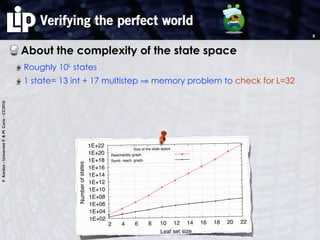
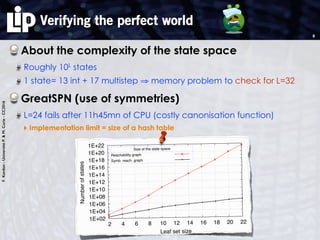
About the complexity of the state space
Roughly 10L
states
1 state= 13 int + 17 multistep ⇒ memory problem to check for L=32
8
1E+02
1E+04
1E+06
1E+08
1E+10
1E+12
1E+14
1E+16
1E+18
1E+20
1E+22
2 4 6 8 10 12 14 16 18 20 22
Numberofstates
Leaf set size
Size of the state space
Reachability graph
Symb. reach. graph
F.Kordon-UniversitéP.&M.Curie-CC2016
Verifying the perfect world
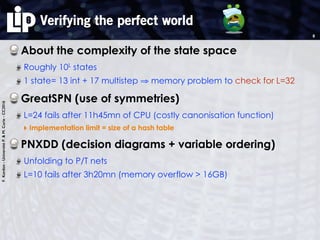
About the complexity of the state space
Roughly 10L
states
1 state= 13 int + 17 multistep ⇒ memory problem to check for L=32
GreatSPN (use of symmetries)
L=24 fails after 11h45mn of CPU (costly canonisation function)
‣ Implementation limit = size of a hash table
8
1E+02
1E+04
1E+06
1E+08
1E+10
1E+12
1E+14
1E+16
1E+18
1E+20
1E+22
2 4 6 8 10 12 14 16 18 20 22
Numberofstates
Leaf set size
Size of the state space
Reachability graph
Symb. reach. graph
F.Kordon-UniversitéP.&M.Curie-CC2016
Verifying the perfect world
About the complexity of the state space
Roughly 10L
states
1 state= 13 int + 17 multistep ⇒ memory problem to check for L=32
GreatSPN (use of symmetries)
L=24 fails after 11h45mn of CPU (costly canonisation function)
‣ Implementation limit = size of a hash table
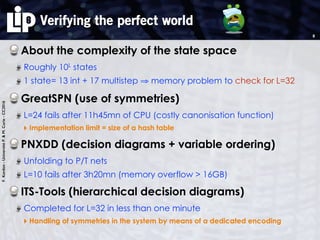
PNXDD (decision diagrams + variable ordering)
Unfolding to P/T nets
L=10 fails after 3h20mn (memory overflow > 16GB)
8
F.Kordon-UniversitéP.&M.Curie-CC2016
Verifying the perfect world
About the complexity of the state space
Roughly 10L
states
1 state= 13 int + 17 multistep ⇒ memory problem to check for L=32
GreatSPN (use of symmetries)
L=24 fails after 11h45mn of CPU (costly canonisation function)
‣ Implementation limit = size of a hash table
PNXDD (decision diagrams + variable ordering)
Unfolding to P/T nets
L=10 fails after 3h20mn (memory overflow > 16GB)
ITS-Tools (hierarchical decision diagrams)
Completed for L=32 in less than one minute
‣ Handling of symmetries in the system by means of a dedicated encoding
8
F.Kordon-UniversitéP.&M.Curie-CC2016
Verifying the perfect world
8
http://cosyverif.org
F.Kordon-UniversitéP.&M.Curie-CC2016
Probabilistic analysis (step 2)
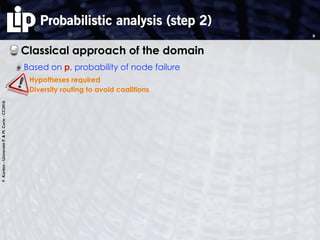
Classical approach of the domain
Based on p, probability of node failure
‣ Hypotheses required
‣ Diversity routing to avoid coalitions
9
F.Kordon-UniversitéP.&M.Curie-CC2016
Probabilistic analysis (step 2)
Classical approach of the domain
Based on p, probability of node failure
‣ Hypotheses required
‣ Diversity routing to avoid coalitions
Origin of problems
Source 1 → failure of the protocol
‣ No answer to A + no ack to A
‣ Interactions between A, S (leafset)
Source 2 → inappropriate certificate
‣ Lost of a certificate (inconsistency)
‣ Interactions between S (leafset) and C (leafset)
9
F.Kordon-UniversitéP.&M.Curie-CC2016
Probabilistic analysis (step 2)
Classical approach of the domain
Based on p, probability of node failure
‣ Hypotheses required
‣ Diversity routing to avoid coalitions
Origin of problems
Source 1 → failure of the protocol
‣ No answer to A + no ack to A
‣ Interactions between A, S (leafset)
Source 2 → inappropriate certificate
‣ Lost of a certificate (inconsistency)
‣ Interactions between S (leafset) and C (leafset)
9
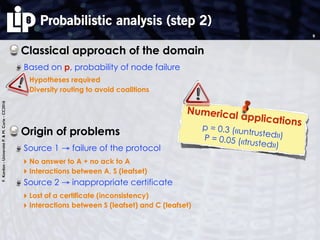
Numerical applicationsp = 0.3 («untrusted»)
P = 0.05 («trusted»)
F.Kordon-UniversitéP.&M.Curie-CC2016
Formulas and experimental values
Protocol failure
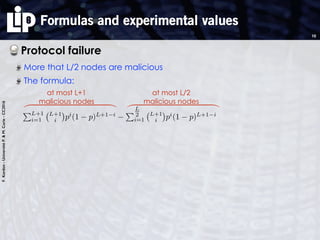
More that L/2 nodes are malicious
The formula:
10
PL+1
i=1
L+1
i pi
(1 p)L+1 i
PL
2
i=1
L+1
i pi
(1 p)L+1 i
at most L+1
malicious nodes
at most L/2
malicious nodes
⎞
⎟
⎟
⎟
⎟
⎟
⎟
⎟
⎟
⎟
⎠
⎞
⎟
⎟
⎟
⎟
⎟
⎟
⎟
⎟
⎟
⎠
F.Kordon-UniversitéP.&M.Curie-CC2016
Formulas and experimental values
Protocol failure
More that L/2 nodes are malicious
The formula:
10
PL+1
i=1
L+1
i pi
(1 p)L+1 i
PL
2
i=1
L+1
i pi
(1 p)L+1 i
at most L+1
malicious nodes
at most L/2
malicious nodes
⎞
⎟
⎟
⎟
⎟
⎟
⎟
⎟
⎟
⎟
⎠
⎞
⎟
⎟
⎟
⎟
⎟
⎟
⎟
⎟
⎟
⎠
1.16e-43
1 4 8 12 16 20 24 28
Amount of faulty nodes [k]
CORPS 5% of faulty nodes
FIGURE 5.1. Probability to have more than k malicinodes
L DHT - p = 0.3 CORPS - p = 0.05
8 0.188 6.64 ⇥ 10 5
16 0.079 6.57 ⇥ 10 8
32 0.016 8.24 ⇥ 10 14
TABLE 3. Probability of failure of the transaction betweA and S
From equation 5.6 we can deduce the probability thaS won’t respond to the RequestInit or won’t send thfinal ACKs as
PAS = (1 P>L/2)P>|L|/2 + P>|L|/2
PAS = 2P>|L|/2 P 2
>|L|/2
(5.7
Table 3 shows the probability of failure between Aand S, for a trustset size of |L| = {8, 16, 32} nodes, andcompares a quasi CA built directly above the DHT toone built above CORPS. We consider that the worstcase is when the malicious nodes represent 30% of theDHT nodes. In
F.Kordon-UniversitéP.&M.Curie-CC2016
Formulas and experimental values
Protocol failure
More that L/2 nodes are malicious
The formula:
Inappropriate certificate generation
Two parts
‣ Existence of more L/2 malicious nodes
‣ Unable to retrieve at least L/2 + 1 identical answers
The formula (combines problems between S and C)
10
PL+1
i=1
L+1
i pi
(1 p)L+1 i
PL
2
i=1
L+1
i pi
(1 p)L+1 i
at most L+1
malicious nodes
at most L/2
malicious nodes
⎞
⎟
⎟
⎟
⎟
⎟
⎟
⎟
⎟
⎟
⎠
⎞
⎟
⎟
⎟
⎟
⎟
⎟
⎟
⎟
⎟
⎠
1.16e-43
1 4 8 12 16 20 24 28
Amount of faulty nodes [k]
CORPS 5% of faulty nodes
FIGURE 5.1. Probability to have more than k malicinodes
L DHT - p = 0.3 CORPS - p = 0.05
8 0.188 6.64 ⇥ 10 5
16 0.079 6.57 ⇥ 10 8
32 0.016 8.24 ⇥ 10 14
TABLE 3. Probability of failure of the transaction betweA and S
From equation 5.6 we can deduce the probability thaS won’t respond to the RequestInit or won’t send thfinal ACKs as
PAS = (1 P>L/2)P>|L|/2 + P>|L|/2
PAS = 2P>|L|/2 P 2
>|L|/2
(5.7
Table 3 shows the probability of failure between Aand S, for a trustset size of |L| = {8, 16, 32} nodes, andcompares a quasi CA built directly above the DHT toone built above CORPS. We consider that the worstcase is when the malicious nodes represent 30% of theDHT nodes. In
1 (1 P> L
2
)2
F.Kordon-UniversitéP.&M.Curie-CC2016
Formulas and experimental values
Protocol failure
More that L/2 nodes are malicious
The formula:
Inappropriate certificate generation
Two parts
‣ Existence of more L/2 malicious nodes
‣ Unable to retrieve at least L/2 + 1 identical answers
The formula (combines problems between S and C)
10
PL+1
i=1
L+1
i pi
(1 p)L+1 i
PL
2
i=1
L+1
i pi
(1 p)L+1 i
at most L+1
malicious nodes
at most L/2
malicious nodes
⎞
⎟
⎟
⎟
⎟
⎟
⎟
⎟
⎟
⎟
⎠
⎞
⎟
⎟
⎟
⎟
⎟
⎟
⎟
⎟
⎟
⎠
1.16e-43
1 4 8 12 16 20 24 28
Amount of faulty nodes [k]
CORPS 5% of faulty nodes
FIGURE 5.1. Probability to have more than k malicinodes
L DHT - p = 0.3 CORPS - p = 0.05
8 0.188 6.64 ⇥ 10 5
16 0.079 6.57 ⇥ 10 8
32 0.016 8.24 ⇥ 10 14
TABLE 3. Probability of failure of the transaction betweA and S
From equation 5.6 we can deduce the probability thaS won’t respond to the RequestInit or won’t send thfinal ACKs as
PAS = (1 P>L/2)P>|L|/2 + P>|L|/2
PAS = 2P>|L|/2 P 2
>|L|/2
(5.7
Table 3 shows the probability of failure between Aand S, for a trustset size of |L| = {8, 16, 32} nodes, andcompares a quasi CA built directly above the DHT toone built above CORPS. We consider that the worstcase is when the malicious nodes represent 30% of theDHT nodes. In
1
⇣
1
PL+1
i=1
L+1
i pi
(1 p)L+1 i
+
PL
2
i=1
L+1
i pi
(1 p)L+1 i
⌘2
1 (1 P> L
2
)2
F.Kordon-UniversitéP.&M.Curie-CC2016
Formulas and experimental values
Protocol failure
More that L/2 nodes are malicious
The formula:
Inappropriate certificate generation
Two parts
‣ Existence of more L/2 malicious nodes
‣ Unable to retrieve at least L/2 + 1 identical answers
The formula (combines problems between S and C)
10
PL+1
i=1
L+1
i pi
(1 p)L+1 i
PL
2
i=1
L+1
i pi
(1 p)L+1 i
at most L+1
malicious nodes
at most L/2
malicious nodes
⎞
⎟
⎟
⎟
⎟
⎟
⎟
⎟
⎟
⎟
⎠
⎞
⎟
⎟
⎟
⎟
⎟
⎟
⎟
⎟
⎟
⎠
1.16e-43
1 4 8 12 16 20 24 28
Amount of faulty nodes [k]
CORPS 5% of faulty nodes
FIGURE 5.1. Probability to have more than k malicinodes
L DHT - p = 0.3 CORPS - p = 0.05
8 0.188 6.64 ⇥ 10 5
16 0.079 6.57 ⇥ 10 8
32 0.016 8.24 ⇥ 10 14
TABLE 3. Probability of failure of the transaction betweA and S
From equation 5.6 we can deduce the probability thaS won’t respond to the RequestInit or won’t send thfinal ACKs as
PAS = (1 P>L/2)P>|L|/2 + P>|L|/2
PAS = 2P>|L|/2 P 2
>|L|/2
(5.7
Table 3 shows the probability of failure between Aand S, for a trustset size of |L| = {8, 16, 32} nodes, andcompares a quasi CA built directly above the DHT toone built above CORPS. We consider that the worstcase is when the malicious nodes represent 30% of theDHT nodes. In
1
⇣
1
PL+1
i=1
L+1
i pi
(1 p)L+1 i
+
PL
2
i=1
L+1
i pi
(1 p)L+1 i
⌘2
1 (1 P> L
2
)2
L DHT - p = 0.3 CORPS - p = 0.058 0.216 4.97 ⇥ 10 4
16 0.075 3.50 ⇥ 10 8
32 0.014 4.24 ⇥ 10 13
F.Kordon-UniversitéP.&M.Curie-CC2016
Conclusion
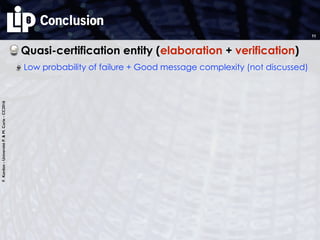
Quasi-certification entity (elaboration + verification)
Low probability of failure + Good message complexity (not discussed)
11
F.Kordon-UniversitéP.&M.Curie-CC2016
Conclusion
Quasi-certification entity (elaboration + verification)
Low probability of failure + Good message complexity (not discussed)
11
Application to digital tax filling in France
‣ 36.5 M revenues declarations (in 2012)
‣ a wrong tax certificate every 5132 years
‣ lost of a tax certificate every 997 years
F.Kordon-UniversitéP.&M.Curie-CC2016
Conclusion
Quasi-certification entity (elaboration + verification)
Low probability of failure + Good message complexity (not discussed)
3 years of work (details recently fixed)
‣ Work partially published in TrustCom’2013
‣ Without formal proof (there was yet glitches details with hypotheses)
11
Application to digital tax filling in France
‣ 36.5 M revenues declarations (in 2012)
‣ a wrong tax certificate every 5132 years
‣ lost of a tax certificate every 997 years
F.Kordon-UniversitéP.&M.Curie-CC2016
Conclusion
Quasi-certification entity (elaboration + verification)
Low probability of failure + Good message complexity (not discussed)
3 years of work (details recently fixed)
‣ Work partially published in TrustCom’2013
‣ Without formal proof (there was yet glitches details with hypotheses)
Realistic problem with applicability to e-government
Probably numerous applications in the future
The model is now a metric for the Model Checking Contest
Potential applicability for Symmetric Nets with Bags
‣ Excellent playground for this type of problems
11
Application to digital tax filling in France
‣ 36.5 M revenues declarations (in 2012)
‣ a wrong tax certificate every 5132 years
‣ lost of a tax certificate every 997 years
Building and verifying a quasi-certification entity over Distributed Hash Tables

Building and verifying a quasi-certification entity over Distributed Hash Tables

  • 1.
    F.Kordon-UniversitéP.&M.Curie-CC2016 Fabrice.Kordon@lip6.fr Building and verifyinga quasi-certification entity over Distributed Hash Tables Join work with X. Bonnaire, R. Cortes & O. Marin UPMC (France), UFSM (Chile), NYUS (China)
  • 2.
    F.Kordon-UniversitéP.&M.Curie-CC2016 Certification, why? Motivations Digital fillingfor tax purpose ‣ Certify that somebody did it before a given deadline Certified emails ‣ Use emails for legal purposes Online game refereeing e-voting, etc. 2
  • 3.
    F.Kordon-UniversitéP.&M.Curie-CC2016 Certification, why? Motivations Digital fillingfor tax purpose ‣ Certify that somebody did it before a given deadline Certified emails ‣ Use emails for legal purposes Online game refereeing e-voting, etc. Existing Solutions Centralized ‣ Public Key Infrastructures (traditional PKI) ‣ Scaling problem/prone to faults/implementation (atomic multicast) Decentralized ‣ Certification on top of Distributed Hash Tables (DHT) ‣ Rapidly brings Byzantine consensus (for a 100.0% guarantee) 2
  • 4.
    F.Kordon-UniversitéP.&M.Curie-CC2016 Certification, why? Motivations Digital fillingfor tax purpose ‣ Certify that somebody did it before a given deadline Certified emails ‣ Use emails for legal purposes Online game refereeing e-voting, etc. Existing Solutions Centralized ‣ Public Key Infrastructures (traditional PKI) ‣ Scaling problem/prone to faults/implementation (atomic multicast) Decentralized ‣ Certification on top of Distributed Hash Tables (DHT) ‣ Rapidly brings Byzantine consensus (for a 100.0% guarantee) 2 Objective (quasi)-certify that a given action hasbeen performed at a certain time Distributed context (DHT)
  • 5.
    F.Kordon-UniversitéP.&M.Curie-CC2016 DHT in anutshell Retrieve data (key + value) put (v,k) get(k) → v 3 Large Scale Distributed System, Design Principles 47
  • 6.
    F.Kordon-UniversitéP.&M.Curie-CC2016 DHT in anutshell Retrieve data (key + value) put (v,k) get(k) → v 3 Large Scale Distributed System, Design Principles 47 access in log(n) Totally decentralized + built)inredundancy for fault tolerance
  • 7.
    F.Kordon-UniversitéP.&M.Curie-CC2016 DHT in anutshell Retrieve data (key + value) put (v,k) get(k) → v 3 Root node
  • 8.
    F.Kordon-UniversitéP.&M.Curie-CC2016 DHT in anutshell Retrieve data (key + value) put (v,k) get(k) → v 3 Root node Leafset L close nodes (+ root)
  • 9.
    F.Kordon-UniversitéP.&M.Curie-CC2016 DHT in anutshell Retrieve data (key + value) put (v,k) get(k) → v 3 Root node Leafset L close nodes (+ root) Classical values for L 8, 16, 32 (best)
  • 10.
  • 11.
    F.Kordon-UniversitéP.&M.Curie-CC2016 Quasi-certification — entities A→ an actor performing a service S → leafset hash(service) offering the service 4 A S 1 - request init answers
  • 12.
    F.Kordon-UniversitéP.&M.Curie-CC2016 Quasi-certification — entities A→ an actor performing a service S → leafset hash(service) offering the service 4 A S 1 - request init answers 2 - transaction End ack
  • 13.
    F.Kordon-UniversitéP.&M.Curie-CC2016 Quasi-certification — entities A→ an actor performing a service S → leafset hash(service) offering the service C → certification authority leafset hash(A/service) 4 A S 1 - request init answers 2 - transaction End ack C 3 - transaction ack
  • 14.
    F.Kordon-UniversitéP.&M.Curie-CC2016 Quasi-certification — entities A→ an actor performing a service S → leafset hash(service) offering the service C → certification authority leafset hash(A/service) 4 A S 1 - request init answers 2 - transaction End ack C 3 - transaction ack Certificate Log Entry 4 - certificate generation
  • 15.
  • 16.
    F.Kordon-UniversitéP.&M.Curie-CC2016 Quasi-certification — protocolstructure 5 A S C A requests cert. service ack cert. service A requests leaf set receive leaf set 5
  • 17.
    F.Kordon-UniversitéP.&M.Curie-CC2016 Quasi-certification — protocolstructure 5 A S C A requests cert. service ack cert. service A requests leaf set receive leaf set the service 5
  • 18.
    F.Kordon-UniversitéP.&M.Curie-CC2016 Quasi-certification — protocolstructure 5 A S C A requests cert. service ack cert. service A requests leaf set receive leaf set the service nodes ack transaction nodes request leaf set nodes receive leaf set 5
  • 19.
    F.Kordon-UniversitéP.&M.Curie-CC2016 Quasi-certification — protocolstructure 5 A S C A requests cert. service ack cert. service A requests leaf set receive leaf set the service nodes ack transaction nodes request leaf set nodes receive leaf set }1: A & S secure exchanges }3: S get trustset from C }2: exchanges to perform the service }4: C elaborates the side certificate 5
  • 20.
    F.Kordon-UniversitéP.&M.Curie-CC2016 Quasi-certification — protocolstructure 5 A S C A requests cert. service ack cert. service A requests leaf set receive leaf set the service nodes ack transaction nodes request leaf set nodes receive leaf set }1: A & S secure exchanges }3: S get trustset from C }2: exchanges to perform the service }4: C elaborates the side certificate 5 Majority ⇒ L/2+1 answers
  • 21.
    F.Kordon-UniversitéP.&M.Curie-CC2016 Quasi-certification — protocolstructure 5 A S C A requests cert. service ack cert. service A requests leaf set receive leaf set the service nodes ack transaction nodes request leaf set nodes receive leaf set }1: A & S secure exchanges }3: S get trustset from C }2: exchanges to perform the service }4: C elaborates the side certificate 5 Diversity routing To serre the leafset Majority ⇒ L/2+1 answers
  • 22.
    F.Kordon-UniversitéP.&M.Curie-CC2016 The verification process Proof(by any method?) Proven to be undecidable [FLP 85] 6
  • 23.
    F.Kordon-UniversitéP.&M.Curie-CC2016 The verification process Proof(by any method?) Proven to be undecidable [FLP 85] So what? Being pragmatic Going for «quasi» 6
  • 24.
    F.Kordon-UniversitéP.&M.Curie-CC2016 The verification process Proof(by any method?) Proven to be undecidable [FLP 85] So what? Being pragmatic Going for «quasi» Two steps 1. modeling the protocol in a perfect world (no error) Use of Petri nets 2. Probabilistic analysis to evaluate the failure rate Use of a classical fault model, building a formula + numeric evaluation 6
  • 25.
    F.Kordon-UniversitéP.&M.Curie-CC2016 Hypotheses H1: perfect world H2:service reduced to 1 interaction H3: L+1 answer requested instead of L/2+1 ‣ Symmetric net with Bags? Modeling the protocol (step 1) 7
  • 26.
    F.Kordon-UniversitéP.&M.Curie-CC2016 Modeling the protocol(step 1) 7 Types and variables type tsid is 0..L; type tsidxtsid is <tsid, tsid>; var i in tsid;
  • 27.
    F.Kordon-UniversitéP.&M.Curie-CC2016 Modeling the protocol(step 1) 7 Types and variables type tsid is 0..L; type tsidxtsid is <tsid, tsid>; var i in tsid; <i> <i> <i> <i><i> <i> <i> <tsid.all> <i> <tsid.all> <tsid.all> <i> <tsid.all> <i> <i> malicious_reservoir malS3 malS2 malS1 malA3 malA4 malA2 malA1 n4 n3 n2 n1 Sstart s2 s3 SsendTS SackCS AackCS AreqCS AgetTS AreqTS a4 a3 a2 a1 Astart
  • 28.
    F.Kordon-UniversitéP.&M.Curie-CC2016 Modeling the protocol(step 1) 7 Types and variables type tsid is 0..L; type tsidxtsid is <tsid, tsid>; var i in tsid; <i> <i> <i> <i><i> <i> <i> <tsid.all> <i> <tsid.all> <tsid.all> <i> <tsid.all> <i> <i> malicious_reservoir malS3 malS2 malS1 malA3 malA4 malA2 malA1 n4 n3 n2 n1 Sstart s2 s3 SsendTS SackCS AackCS AreqCS AgetTS AreqTS a4 a3 a2 a1 Astart <i> <i> <i> <i> <tsid.all> <i> <tsid.all> <i> <i> malicious_reservoir malS4 malS3 malA5 malA4 SstopAbort AstopAbort n6 n5 s3 s4 Sperform AendCS AstartCS a5 a4 AstopOK
  • 29.
    F.Kordon-UniversitéP.&M.Curie-CC2016 Modeling the protocol(step 1) 7 Types and variables type tsid is 0..L; type tsidxtsid is <tsid, tsid>; var i in tsid; <i> <i> <i> <i><i> <i> <i> <tsid.all> <i> <tsid.all> <tsid.all> <i> <tsid.all> <i> <i> malicious_reservoir malS3 malS2 malS1 malA3 malA4 malA2 malA1 n4 n3 n2 n1 Sstart s2 s3 SsendTS SackCS AackCS AreqCS AgetTS AreqTS a4 a3 a2 a1 Astart <i> <i> <i> <i> <tsid.all> <i> <tsid.all> <i> <i> malicious_reservoir malS4 malS3 malA5 malA4 SstopAbort AstopAbort n6 n5 s3 s4 Sperform AendCS AstartCS a5 a4 AstopOK <i> <i> <tsid.all, i> <i> <i> <i> <i> <tsid.all, i><i, tsid.all> <i, tsid.all> <tsid.all, i><i, tsid.all> <i> <i> <i> <i> <i> <i> <i> <i> malicious_reservoir malC1 malS6 malS5 malS4 CstopAbort SstopAbort n9 n8 n7 CgenCertif CsendTS1 c1 Cstarts4 s5 s6 SstopOK SreqTS SgetTS ScertCS CstopOK
  • 30.
    F.Kordon-UniversitéP.&M.Curie-CC2016 Modeling the protocol(step 1) 7 Types and variables type tsid is 0..L; type tsidxtsid is <tsid, tsid>; var i in tsid; <i> <i> <i> <i><i> <i> <i> <tsid.all> <i> <tsid.all> <tsid.all> <i> <tsid.all> <i> <i> malicious_reservoir malS3 malS2 malS1 malA3 malA4 malA2 malA1 n4 n3 n2 n1 Sstart s2 s3 SsendTS SackCS AackCS AreqCS AgetTS AreqTS a4 a3 a2 a1 Astart <i> <i> <i> <i> <tsid.all> <i> <tsid.all> <i> <i> malicious_reservoir malS4 malS3 malA5 malA4 SstopAbort AstopAbort n6 n5 s3 s4 Sperform AendCS AstartCS a5 a4 AstopOK <i> <i> <tsid.all, i> <i> <i> <i> <i> <tsid.all, i><i, tsid.all> <i, tsid.all> <tsid.all, i><i, tsid.all> <i> <i> <i> <i> <i> <i> <i> <i> malicious_reservoir malC1 malS6 malS5 malS4 CstopAbort SstopAbort n9 n8 n7 CgenCertif CsendTS1 c1 Cstarts4 s5 s6 SstopOK SreqTS SgetTS ScertCS CstopOK ●
  • 31.
    F.Kordon-UniversitéP.&M.Curie-CC2016 Modeling the protocol(step 1) 7 Types and variables type tsid is 0..L; type tsidxtsid is <tsid, tsid>; var i in tsid; <i> <i> <i> <i><i> <i> <i> <tsid.all> <i> <tsid.all> <tsid.all> <i> <tsid.all> <i> <i> malicious_reservoir malS3 malS2 malS1 malA3 malA4 malA2 malA1 n4 n3 n2 n1 Sstart s2 s3 SsendTS SackCS AackCS AreqCS AgetTS AreqTS a4 a3 a2 a1 Astart <i> <i> <i> <i> <tsid.all> <i> <tsid.all> <i> <i> malicious_reservoir malS4 malS3 malA5 malA4 SstopAbort AstopAbort n6 n5 s3 s4 Sperform AendCS AstartCS a5 a4 AstopOK <i> <i> <tsid.all, i> <i> <i> <i> <i> <tsid.all, i><i, tsid.all> <i, tsid.all> <tsid.all, i><i, tsid.all> <i> <i> <i> <i> <i> <i> <i> <i> malicious_reservoir malC1 malS6 malS5 malS4 CstopAbort SstopAbort n9 n8 n7 CgenCertif CsendTS1 c1 Cstarts4 s5 s6 SstopOK SreqTS SgetTS ScertCS CstopOK ● <tsid.all>
  • 32.
    F.Kordon-UniversitéP.&M.Curie-CC2016 Modeling the protocol(step 1) 7 Types and variables type tsid is 0..L; type tsidxtsid is <tsid, tsid>; var i in tsid; <i> <i> <i> <i><i> <i> <i> <tsid.all> <i> <tsid.all> <tsid.all> <i> <tsid.all> <i> <i> malicious_reservoir malS3 malS2 malS1 malA3 malA4 malA2 malA1 n4 n3 n2 n1 Sstart s2 s3 SsendTS SackCS AackCS AreqCS AgetTS AreqTS a4 a3 a2 a1 Astart <i> <i> <i> <i> <tsid.all> <i> <tsid.all> <i> <i> malicious_reservoir malS4 malS3 malA5 malA4 SstopAbort AstopAbort n6 n5 s3 s4 Sperform AendCS AstartCS a5 a4 AstopOK <i> <i> <tsid.all, i> <i> <i> <i> <i> <tsid.all, i><i, tsid.all> <i, tsid.all> <tsid.all, i><i, tsid.all> <i> <i> <i> <i> <i> <i> <i> <i> malicious_reservoir malC1 malS6 malS5 malS4 CstopAbort SstopAbort n9 n8 n7 CgenCertif CsendTS1 c1 Cstarts4 s5 s6 SstopOK SreqTS SgetTS ScertCS CstopOK ● <tsid.all> Px●
  • 33.
    F.Kordon-UniversitéP.&M.Curie-CC2016 Modeling the protocol(step 1) 7 <i> <i> <i> <i><i> <i> <i> <tsid.all> <i> <tsid.all> <tsid.all> <i> <tsid.all> <i> <i> malicious_reservoir malS3 malS2 malS1 malA3 malA4 malA2 malA1 n4 n3 n2 n1 Sstart s2 s3 SsendTS SackCS AackCS AreqCS AgetTS AreqTS a4 a3 a2 a1 Astart <i> <i> <i> <i> <tsid.all> <i> <tsid.all> <i> <i> malicious_reservoir malS4 malS3 malA5 malA4 SstopAbort AstopAbort n6 n5 s3 s4 Sperform AendCS AstartCS a5 a4 AstopOK <i> <i> <tsid.all, i> <i> <i> <i> <i> <tsid.all, i><i, tsid.all> <i, tsid.all> <tsid.all, i><i, tsid.all> <i> <i> <i> <i> <i> <i> <i> <i> malicious_reservoir malC1 malS6 malS5 malS4 CstopAbort SstopAbort n9 n8 n7 CgenCertif CsendTS1 c1 Cstarts4 s5 s6 SstopOK SreqTS SgetTS ScertCS CstopOK Fok = |SstopOK| = L + 1 |CstopOK| = L + 1 Fok = |SstopOK| > L 2 ^ |CstopOK| > L 2
  • 34.
    F.Kordon-UniversitéP.&M.Curie-CC2016 Modeling the protocol(step 1) 7 <i> <i> <i> <i><i> <i> <i> <tsid.all> <i> <tsid.all> <tsid.all> <i> <tsid.all> <i> <i> malicious_reservoir malS3 malS2 malS1 malA3 malA4 malA2 malA1 n4 n3 n2 n1 Sstart s2 s3 SsendTS SackCS AackCS AreqCS AgetTS AreqTS a4 a3 a2 a1 Astart <i> <i> <i> <i> <tsid.all> <i> <tsid.all> <i> <i> malicious_reservoir malS4 malS3 malA5 malA4 SstopAbort AstopAbort n6 n5 s3 s4 Sperform AendCS AstartCS a5 a4 AstopOK <i> <i> <tsid.all, i> <i> <i> <i> <i> <tsid.all, i><i, tsid.all> <i, tsid.all> <tsid.all, i><i, tsid.all> <i> <i> <i> <i> <i> <i> <i> <i> malicious_reservoir malC1 malS6 malS5 malS4 CstopAbort SstopAbort n9 n8 n7 CgenCertif CsendTS1 c1 Cstarts4 s5 s6 SstopOK SreqTS SgetTS ScertCS CstopOK Fok = |SstopOK| = L + 1 |CstopOK| = L + 1 Fabort = |SstopAbort| > 0 |CstopAbort| > 0 Fabort = |SstopAbort| > L 2 _ |CstopAbort| > L 2
  • 35.
    F.Kordon-UniversitéP.&M.Curie-CC2016 Modeling the protocol(step 1) 7 <i> <i> <i> <i><i> <i> <i> <tsid.all> <i> <tsid.all> <tsid.all> <i> <tsid.all> <i> <i> malicious_reservoir malS3 malS2 malS1 malA3 malA4 malA2 malA1 n4 n3 n2 n1 Sstart s2 s3 SsendTS SackCS AackCS AreqCS AgetTS AreqTS a4 a3 a2 a1 Astart <i> <i> <i> <i> <tsid.all> <i> <tsid.all> <i> <i> malicious_reservoir malS4 malS3 malA5 malA4 SstopAbort AstopAbort n6 n5 s3 s4 Sperform AendCS AstartCS a5 a4 AstopOK <i> <i> <tsid.all, i> <i> <i> <i> <i> <tsid.all, i><i, tsid.all> <i, tsid.all> <tsid.all, i><i, tsid.all> <i> <i> <i> <i> <i> <i> <i> <i> malicious_reservoir malC1 malS6 malS5 malS4 CstopAbort SstopAbort n9 n8 n7 CgenCertif CsendTS1 c1 Cstarts4 s5 s6 SstopOK SreqTS SgetTS ScertCS CstopOK FabortFokAF( _ )) Fok = |SstopOK| = L + 1 |CstopOK| = L + 1 Fabort = |SstopAbort| > 0 |CstopAbort| > 0
  • 36.
    F.Kordon-UniversitéP.&M.Curie-CC2016 Verifying the perfectworld About the complexity of the state space Roughly 10L states 1 state= 13 int + 17 multistep ⇒ memory problem to check for L=32 8 1E+02 1E+04 1E+06 1E+08 1E+10 1E+12 1E+14 1E+16 1E+18 1E+20 1E+22 2 4 6 8 10 12 14 16 18 20 22 Numberofstates Leaf set size Size of the state space Reachability graph Symb. reach. graph
  • 37.
    F.Kordon-UniversitéP.&M.Curie-CC2016 Verifying the perfectworld About the complexity of the state space Roughly 10L states 1 state= 13 int + 17 multistep ⇒ memory problem to check for L=32 GreatSPN (use of symmetries) L=24 fails after 11h45mn of CPU (costly canonisation function) ‣ Implementation limit = size of a hash table 8 1E+02 1E+04 1E+06 1E+08 1E+10 1E+12 1E+14 1E+16 1E+18 1E+20 1E+22 2 4 6 8 10 12 14 16 18 20 22 Numberofstates Leaf set size Size of the state space Reachability graph Symb. reach. graph
  • 38.
    F.Kordon-UniversitéP.&M.Curie-CC2016 Verifying the perfectworld About the complexity of the state space Roughly 10L states 1 state= 13 int + 17 multistep ⇒ memory problem to check for L=32 GreatSPN (use of symmetries) L=24 fails after 11h45mn of CPU (costly canonisation function) ‣ Implementation limit = size of a hash table PNXDD (decision diagrams + variable ordering) Unfolding to P/T nets L=10 fails after 3h20mn (memory overflow > 16GB) 8
  • 39.
    F.Kordon-UniversitéP.&M.Curie-CC2016 Verifying the perfectworld About the complexity of the state space Roughly 10L states 1 state= 13 int + 17 multistep ⇒ memory problem to check for L=32 GreatSPN (use of symmetries) L=24 fails after 11h45mn of CPU (costly canonisation function) ‣ Implementation limit = size of a hash table PNXDD (decision diagrams + variable ordering) Unfolding to P/T nets L=10 fails after 3h20mn (memory overflow > 16GB) ITS-Tools (hierarchical decision diagrams) Completed for L=32 in less than one minute ‣ Handling of symmetries in the system by means of a dedicated encoding 8
  • 40.
  • 41.
    F.Kordon-UniversitéP.&M.Curie-CC2016 Probabilistic analysis (step2) Classical approach of the domain Based on p, probability of node failure ‣ Hypotheses required ‣ Diversity routing to avoid coalitions 9
  • 42.
    F.Kordon-UniversitéP.&M.Curie-CC2016 Probabilistic analysis (step2) Classical approach of the domain Based on p, probability of node failure ‣ Hypotheses required ‣ Diversity routing to avoid coalitions Origin of problems Source 1 → failure of the protocol ‣ No answer to A + no ack to A ‣ Interactions between A, S (leafset) Source 2 → inappropriate certificate ‣ Lost of a certificate (inconsistency) ‣ Interactions between S (leafset) and C (leafset) 9
  • 43.
    F.Kordon-UniversitéP.&M.Curie-CC2016 Probabilistic analysis (step2) Classical approach of the domain Based on p, probability of node failure ‣ Hypotheses required ‣ Diversity routing to avoid coalitions Origin of problems Source 1 → failure of the protocol ‣ No answer to A + no ack to A ‣ Interactions between A, S (leafset) Source 2 → inappropriate certificate ‣ Lost of a certificate (inconsistency) ‣ Interactions between S (leafset) and C (leafset) 9 Numerical applicationsp = 0.3 («untrusted»)
P = 0.05 («trusted»)
  • 44.
    F.Kordon-UniversitéP.&M.Curie-CC2016 Formulas and experimentalvalues Protocol failure More that L/2 nodes are malicious The formula: 10 PL+1 i=1 L+1 i pi (1 p)L+1 i PL 2 i=1 L+1 i pi (1 p)L+1 i at most L+1 malicious nodes at most L/2 malicious nodes ⎞ ⎟ ⎟ ⎟ ⎟ ⎟ ⎟ ⎟ ⎟ ⎟ ⎠ ⎞ ⎟ ⎟ ⎟ ⎟ ⎟ ⎟ ⎟ ⎟ ⎟ ⎠
  • 45.
    F.Kordon-UniversitéP.&M.Curie-CC2016 Formulas and experimentalvalues Protocol failure More that L/2 nodes are malicious The formula: 10 PL+1 i=1 L+1 i pi (1 p)L+1 i PL 2 i=1 L+1 i pi (1 p)L+1 i at most L+1 malicious nodes at most L/2 malicious nodes ⎞ ⎟ ⎟ ⎟ ⎟ ⎟ ⎟ ⎟ ⎟ ⎟ ⎠ ⎞ ⎟ ⎟ ⎟ ⎟ ⎟ ⎟ ⎟ ⎟ ⎟ ⎠ 1.16e-43 1 4 8 12 16 20 24 28 Amount of faulty nodes [k] CORPS 5% of faulty nodes FIGURE 5.1. Probability to have more than k malicinodes L DHT - p = 0.3 CORPS - p = 0.05 8 0.188 6.64 ⇥ 10 5 16 0.079 6.57 ⇥ 10 8 32 0.016 8.24 ⇥ 10 14 TABLE 3. Probability of failure of the transaction betweA and S From equation 5.6 we can deduce the probability thaS won’t respond to the RequestInit or won’t send thfinal ACKs as PAS = (1 P>L/2)P>|L|/2 + P>|L|/2 PAS = 2P>|L|/2 P 2 >|L|/2 (5.7 Table 3 shows the probability of failure between Aand S, for a trustset size of |L| = {8, 16, 32} nodes, andcompares a quasi CA built directly above the DHT toone built above CORPS. We consider that the worstcase is when the malicious nodes represent 30% of theDHT nodes. In
  • 46.
    F.Kordon-UniversitéP.&M.Curie-CC2016 Formulas and experimentalvalues Protocol failure More that L/2 nodes are malicious The formula: Inappropriate certificate generation Two parts ‣ Existence of more L/2 malicious nodes ‣ Unable to retrieve at least L/2 + 1 identical answers The formula (combines problems between S and C) 10 PL+1 i=1 L+1 i pi (1 p)L+1 i PL 2 i=1 L+1 i pi (1 p)L+1 i at most L+1 malicious nodes at most L/2 malicious nodes ⎞ ⎟ ⎟ ⎟ ⎟ ⎟ ⎟ ⎟ ⎟ ⎟ ⎠ ⎞ ⎟ ⎟ ⎟ ⎟ ⎟ ⎟ ⎟ ⎟ ⎟ ⎠ 1.16e-43 1 4 8 12 16 20 24 28 Amount of faulty nodes [k] CORPS 5% of faulty nodes FIGURE 5.1. Probability to have more than k malicinodes L DHT - p = 0.3 CORPS - p = 0.05 8 0.188 6.64 ⇥ 10 5 16 0.079 6.57 ⇥ 10 8 32 0.016 8.24 ⇥ 10 14 TABLE 3. Probability of failure of the transaction betweA and S From equation 5.6 we can deduce the probability thaS won’t respond to the RequestInit or won’t send thfinal ACKs as PAS = (1 P>L/2)P>|L|/2 + P>|L|/2 PAS = 2P>|L|/2 P 2 >|L|/2 (5.7 Table 3 shows the probability of failure between Aand S, for a trustset size of |L| = {8, 16, 32} nodes, andcompares a quasi CA built directly above the DHT toone built above CORPS. We consider that the worstcase is when the malicious nodes represent 30% of theDHT nodes. In 1 (1 P> L 2 )2
  • 47.
    F.Kordon-UniversitéP.&M.Curie-CC2016 Formulas and experimentalvalues Protocol failure More that L/2 nodes are malicious The formula: Inappropriate certificate generation Two parts ‣ Existence of more L/2 malicious nodes ‣ Unable to retrieve at least L/2 + 1 identical answers The formula (combines problems between S and C) 10 PL+1 i=1 L+1 i pi (1 p)L+1 i PL 2 i=1 L+1 i pi (1 p)L+1 i at most L+1 malicious nodes at most L/2 malicious nodes ⎞ ⎟ ⎟ ⎟ ⎟ ⎟ ⎟ ⎟ ⎟ ⎟ ⎠ ⎞ ⎟ ⎟ ⎟ ⎟ ⎟ ⎟ ⎟ ⎟ ⎟ ⎠ 1.16e-43 1 4 8 12 16 20 24 28 Amount of faulty nodes [k] CORPS 5% of faulty nodes FIGURE 5.1. Probability to have more than k malicinodes L DHT - p = 0.3 CORPS - p = 0.05 8 0.188 6.64 ⇥ 10 5 16 0.079 6.57 ⇥ 10 8 32 0.016 8.24 ⇥ 10 14 TABLE 3. Probability of failure of the transaction betweA and S From equation 5.6 we can deduce the probability thaS won’t respond to the RequestInit or won’t send thfinal ACKs as PAS = (1 P>L/2)P>|L|/2 + P>|L|/2 PAS = 2P>|L|/2 P 2 >|L|/2 (5.7 Table 3 shows the probability of failure between Aand S, for a trustset size of |L| = {8, 16, 32} nodes, andcompares a quasi CA built directly above the DHT toone built above CORPS. We consider that the worstcase is when the malicious nodes represent 30% of theDHT nodes. In 1 ⇣ 1 PL+1 i=1 L+1 i pi (1 p)L+1 i + PL 2 i=1 L+1 i pi (1 p)L+1 i ⌘2 1 (1 P> L 2 )2
  • 48.
    F.Kordon-UniversitéP.&M.Curie-CC2016 Formulas and experimentalvalues Protocol failure More that L/2 nodes are malicious The formula: Inappropriate certificate generation Two parts ‣ Existence of more L/2 malicious nodes ‣ Unable to retrieve at least L/2 + 1 identical answers The formula (combines problems between S and C) 10 PL+1 i=1 L+1 i pi (1 p)L+1 i PL 2 i=1 L+1 i pi (1 p)L+1 i at most L+1 malicious nodes at most L/2 malicious nodes ⎞ ⎟ ⎟ ⎟ ⎟ ⎟ ⎟ ⎟ ⎟ ⎟ ⎠ ⎞ ⎟ ⎟ ⎟ ⎟ ⎟ ⎟ ⎟ ⎟ ⎟ ⎠ 1.16e-43 1 4 8 12 16 20 24 28 Amount of faulty nodes [k] CORPS 5% of faulty nodes FIGURE 5.1. Probability to have more than k malicinodes L DHT - p = 0.3 CORPS - p = 0.05 8 0.188 6.64 ⇥ 10 5 16 0.079 6.57 ⇥ 10 8 32 0.016 8.24 ⇥ 10 14 TABLE 3. Probability of failure of the transaction betweA and S From equation 5.6 we can deduce the probability thaS won’t respond to the RequestInit or won’t send thfinal ACKs as PAS = (1 P>L/2)P>|L|/2 + P>|L|/2 PAS = 2P>|L|/2 P 2 >|L|/2 (5.7 Table 3 shows the probability of failure between Aand S, for a trustset size of |L| = {8, 16, 32} nodes, andcompares a quasi CA built directly above the DHT toone built above CORPS. We consider that the worstcase is when the malicious nodes represent 30% of theDHT nodes. In 1 ⇣ 1 PL+1 i=1 L+1 i pi (1 p)L+1 i + PL 2 i=1 L+1 i pi (1 p)L+1 i ⌘2 1 (1 P> L 2 )2 L DHT - p = 0.3 CORPS - p = 0.058 0.216 4.97 ⇥ 10 4 16 0.075 3.50 ⇥ 10 8 32 0.014 4.24 ⇥ 10 13
  • 49.
    F.Kordon-UniversitéP.&M.Curie-CC2016 Conclusion Quasi-certification entity (elaboration+ verification) Low probability of failure + Good message complexity (not discussed) 11
  • 50.
    F.Kordon-UniversitéP.&M.Curie-CC2016 Conclusion Quasi-certification entity (elaboration+ verification) Low probability of failure + Good message complexity (not discussed) 11 Application to digital tax filling in France ‣ 36.5 M revenues declarations (in 2012) ‣ a wrong tax certificate every 5132 years ‣ lost of a tax certificate every 997 years
  • 51.
    F.Kordon-UniversitéP.&M.Curie-CC2016 Conclusion Quasi-certification entity (elaboration+ verification) Low probability of failure + Good message complexity (not discussed) 3 years of work (details recently fixed) ‣ Work partially published in TrustCom’2013 ‣ Without formal proof (there was yet glitches details with hypotheses) 11 Application to digital tax filling in France ‣ 36.5 M revenues declarations (in 2012) ‣ a wrong tax certificate every 5132 years ‣ lost of a tax certificate every 997 years
  • 52.
    F.Kordon-UniversitéP.&M.Curie-CC2016 Conclusion Quasi-certification entity (elaboration+ verification) Low probability of failure + Good message complexity (not discussed) 3 years of work (details recently fixed) ‣ Work partially published in TrustCom’2013 ‣ Without formal proof (there was yet glitches details with hypotheses) Realistic problem with applicability to e-government Probably numerous applications in the future The model is now a metric for the Model Checking Contest Potential applicability for Symmetric Nets with Bags ‣ Excellent playground for this type of problems 11 Application to digital tax filling in France ‣ 36.5 M revenues declarations (in 2012) ‣ a wrong tax certificate every 5132 years ‣ lost of a tax certificate every 997 years