
Building and operating a global

DNS content delivery anycast network
Gael Hernandez
Packet Clearing House
Kathmandu, Nepal
APRICOT 2018
Who are we?
• Packet Clearing House (PCH) is the global non-profit
organisation providing operational support and security to
critical Internet infrastructure, including Internet exchange
points and the core of the DNS.
• Funded by government grants, service-provision fees from the
Internet operations industry and specialised consultancies on
IXP construction/operation.
• Global footprint with head office in San Francisco (US) and
regional offices in Buenos Aires, Johannesburg, Dublin and
Kathmandu.
Anycast technology
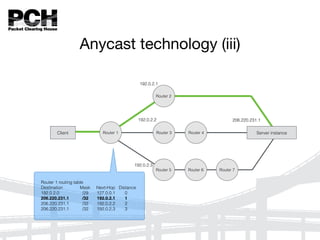
• Routing technology used among content delivery networks as
it allows optimal routing to closer cluster.
• An anycast cloud is a distributed cluster of identical instances
of a server, each typically containing identical data, and
capable of servicing requests identically.
• Each instance has a regular unique globally routable IP
address for management purposes, but… each instance also
shares an IP address in common with all the others.
• The Internetʼs global routing system (BGP) routes every query
to the instance of the anycast cloud that is closest in routing
terms to the user who originated the query.
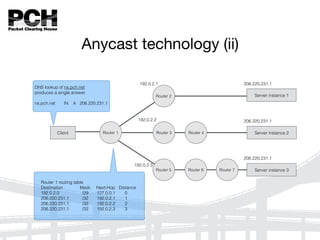
Client Router 1
Router 2
Router 5 Router 6
Server instance 1
Server instance 3
206.220.231.1
206.220.231.1
192.0.2.1
192.0.2.3
DNS lookup of ns.pch.net
produces a single answer
ns.pch.net IN A 206.220.231.1
Router 1 routing table
Destination Mask Next-Hop Distance
192.0.2.0 /29 127.0.0.1 0
206.220.231.1 /32 192.0.2.1 1
206.220.231.1 /32 192.0.2.2 2
206.220.231.1 /32 192.0.2.3 3
Router 3 Router 4 Server instance 2
206.220.231.1192.0.2.2
Router 7
Anycast technology (ii)
Anycast technology (iii)
Client Router 1
Router 2
Router 5 Router 6
Router 3 Router 4 Server instance
206.220.231.1
Router 7
Router 1 routing table
Destination Mask Next-Hop Distance
192.0.2.0 /29 127.0.0.1 0
206.220.231.1 /32 192.0.2.1 1
206.220.231.1 /32 192.0.2.2 2
206.220.231.1 /32 192.0.2.3 3
192.0.2.1
192.0.2.3
192.0.2.2
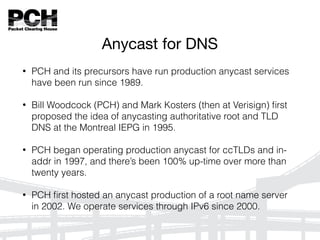
• PCH and its precursors have run production anycast services
have been run since 1989.
• Bill Woodcock (PCH) and Mark Kosters (then at Verisign) first
proposed the idea of anycasting authoritative root and TLD
DNS at the Montreal IEPG in 1995.
• PCH began operating production anycast for ccTLDs and in-
addr in 1997, and there’s been 100% up-time over more than
twenty years.
• PCH first hosted an anycast production of a root name server
in 2002. We operate services through IPv6 since 2000.
Anycast for DNS
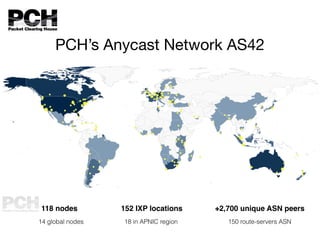
PCH’s Anycast Network AS42
118 nodes
14 global nodes
152 IXP locations +2,700 unique ASN peers
18 in APNIC region 150 route-servers ASN
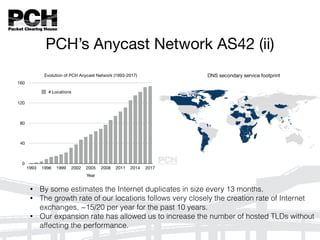
PCH’s Anycast Network AS42 (ii)
• By some estimates the Internet duplicates in size every 13 months.
• The growth rate of our locations follows very closely the creation rate of Internet
exchanges, ~15/20 per year for the past 10 years.
• Our expansion rate has allowed us to increase the number of hosted TLDs without
affecting the performance.
Evolution of PCH Anycast Network (1993-2017)
0
40
80
120
160
Year
1993 1996 1999 2002 2005 2008 2011 2014 2017
# Locations
DNS secondary service footprint
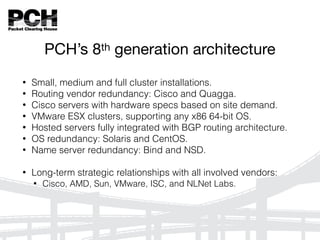
PCH’s 8th generation architecture
• Small, medium and full cluster installations.
• Routing vendor redundancy: Cisco and Quagga.
• Cisco servers with hardware specs based on site demand.
• VMware ESX clusters, supporting any x86 64-bit OS.
• Hosted servers fully integrated with BGP routing architecture.
• OS redundancy: Solaris and CentOS.
• Name server redundancy: Bind and NSD.
• Long-term strategic relationships with all involved vendors:
• Cisco, AMD, Sun, VMware, ISC, and NLNet Labs.
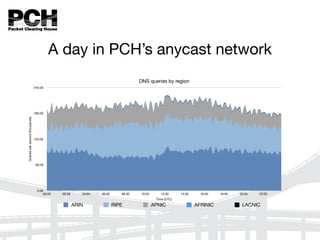
A day in PCH’s anycast network
DNS queries by region
Queriespersecond(thousands)
0.00
60.00
120.00
180.00
240.00
Time (UTC)
00:00 02:00 04:00 06:00 08:00 10:00 12:00 14:00 16:00 18:00 20:00 22:00
ARIN RIPE APNIC AFRINIC LACNIC
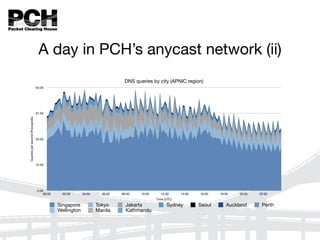
A day in PCH’s anycast network (ii)
DNS queries by city (APNIC region)
Queriespersecond(thousands)
0.00
12.50
25.00
37.50
50.00
Time (UTC)
00:00 02:00 04:00 06:00 08:00 10:00 12:00 14:00 16:00 18:00 20:00 22:00
Singapore Tokyo Jakarta Sydney Seoul Auckland Perth
Wellington Manila Kathmandu
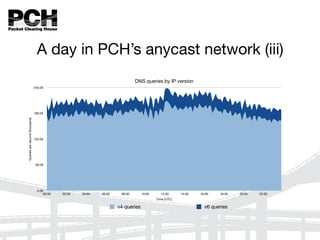
A day in PCH’s anycast network (iii)
DNS queries by IP version
Queriespersecond(thousand)
0.00
60.00
120.00
180.00
240.00
Time (UTC)
00:00 02:00 04:00 06:00 08:00 10:00 12:00 14:00 16:00 18:00 20:00 22:00
v4 queries v6 queries
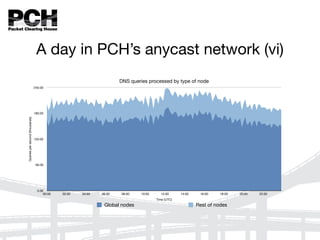
A day in PCH’s anycast network (vi)
DNS queries processed by type of node
Queriespersecond(thousands)
0.00
60.00
120.00
180.00
240.00
Time (UTC)
00:00 02:00 04:00 06:00 08:00 10:00 12:00 14:00 16:00 18:00 20:00 22:00
Global nodes Rest of nodes
Planning Anycast Nodes
• Anycast is a robust and well-proven technology
• E-root is the fastest in the U.S., South Africa, Poland, Ireland,
and Malaysia and D-root is the fastest in the U.K., Netherlands,
Austria, and Thailand (Thousand Eyes, June 2017)
• Considerations when planning for new sites
• Invitation from an IX operator to host a DNS node
• Traffic levels, number of participants and prefixes at the IX
• Availability of our transit providers (NTT and CenturyLink)
• Relative location of neighbouring nodes
• Delivering content in some regions is challenging
• Less developed interconnection market in emerging economies
• Absence of open and neutral exchanges with public peering
• Large networks won’t be peering at small exchanges
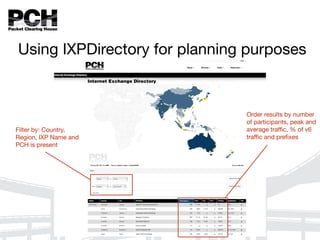
Using IXPDirectory for planning purposes
Filter by: Country,
Region, IXP Name and
PCH is present
Order results by number
of participants, peak and
average traffic, % of v6
traffic and prefixes
Operations
• Services run in separated virtual machines
• Dedicated VMs for root servers, TLDs and monitoring services.
• Depending on the type of deployment (small/medium/large) and
type of node (local/global), we BGP-announce a full or a partial
set of services:
• Small sites: anywhere in the world, local-only and partial service
announcements.
• Medium sites: medium to high-volume locations, local-only and
partial service announcements.
• Full sites: global nodes in high volume locations, with full service
announcements via our transit providers NTT and Level3.
• A failure in the DNS service triggers the removing of the node
from the routing table by stopping its BGP announcement
Monitoring
• Multiple layers of monitoring to proactively detect issues that
could be leading to a degradation of the service
• Hardware layer: CPU levels, temperature, RAM.
• Interconnection layer: ports and traffic levels.
• Routing layer: AS-PATH and prefix announcements.
• Service layer: queries per second, replies per second.
• Passive monitoring tools
• Cacti/Nagios with custom plugins for DNS and DNSSEC
• Netflow monitoring traffic levels
• Active monitoring of global performance using RIPE Atlas and
RIPE DNSMon measurements on a regular basis
What keeps us busy?
• UDP spoofing and network operators not implementing BCP38
• Network operators doing too much traffic engineering
• Critical zero-day exploits affecting name servers and other
critical software
• Automating the provisioning process to reduce the time to
deploy new nodes
• Research lab work and benchmark of software alternatives, for
instance Knot DNS by CZ.NIC.
Questions?

Thanks for your attention
Gael Hernandez

Senior Manager, Interconnection Policy and Regulatory Affairs
gael@pch.net

Building and operating a global DNS content delivery anycast network

  • 1.
    Building and operatinga global DNS content delivery anycast network Gael Hernandez Packet Clearing House Kathmandu, Nepal APRICOT 2018
  • 2.
    Who are we? •Packet Clearing House (PCH) is the global non-profit organisation providing operational support and security to critical Internet infrastructure, including Internet exchange points and the core of the DNS. • Funded by government grants, service-provision fees from the Internet operations industry and specialised consultancies on IXP construction/operation. • Global footprint with head office in San Francisco (US) and regional offices in Buenos Aires, Johannesburg, Dublin and Kathmandu.
  • 3.
    Anycast technology • Routingtechnology used among content delivery networks as it allows optimal routing to closer cluster. • An anycast cloud is a distributed cluster of identical instances of a server, each typically containing identical data, and capable of servicing requests identically. • Each instance has a regular unique globally routable IP address for management purposes, but… each instance also shares an IP address in common with all the others. • The Internetʼs global routing system (BGP) routes every query to the instance of the anycast cloud that is closest in routing terms to the user who originated the query.
  • 4.
    Client Router 1 Router2 Router 5 Router 6 Server instance 1 Server instance 3 206.220.231.1 206.220.231.1 192.0.2.1 192.0.2.3 DNS lookup of ns.pch.net produces a single answer ns.pch.net IN A 206.220.231.1 Router 1 routing table Destination Mask Next-Hop Distance 192.0.2.0 /29 127.0.0.1 0 206.220.231.1 /32 192.0.2.1 1 206.220.231.1 /32 192.0.2.2 2 206.220.231.1 /32 192.0.2.3 3 Router 3 Router 4 Server instance 2 206.220.231.1192.0.2.2 Router 7 Anycast technology (ii)
  • 5.
    Anycast technology (iii) ClientRouter 1 Router 2 Router 5 Router 6 Router 3 Router 4 Server instance 206.220.231.1 Router 7 Router 1 routing table Destination Mask Next-Hop Distance 192.0.2.0 /29 127.0.0.1 0 206.220.231.1 /32 192.0.2.1 1 206.220.231.1 /32 192.0.2.2 2 206.220.231.1 /32 192.0.2.3 3 192.0.2.1 192.0.2.3 192.0.2.2
  • 6.
    • PCH andits precursors have run production anycast services have been run since 1989. • Bill Woodcock (PCH) and Mark Kosters (then at Verisign) first proposed the idea of anycasting authoritative root and TLD DNS at the Montreal IEPG in 1995. • PCH began operating production anycast for ccTLDs and in- addr in 1997, and there’s been 100% up-time over more than twenty years. • PCH first hosted an anycast production of a root name server in 2002. We operate services through IPv6 since 2000. Anycast for DNS
  • 7.
    PCH’s Anycast NetworkAS42 118 nodes 14 global nodes 152 IXP locations +2,700 unique ASN peers 18 in APNIC region 150 route-servers ASN
  • 8.
    PCH’s Anycast NetworkAS42 (ii) • By some estimates the Internet duplicates in size every 13 months. • The growth rate of our locations follows very closely the creation rate of Internet exchanges, ~15/20 per year for the past 10 years. • Our expansion rate has allowed us to increase the number of hosted TLDs without affecting the performance. Evolution of PCH Anycast Network (1993-2017) 0 40 80 120 160 Year 1993 1996 1999 2002 2005 2008 2011 2014 2017 # Locations DNS secondary service footprint
  • 9.
    PCH’s 8th generationarchitecture • Small, medium and full cluster installations. • Routing vendor redundancy: Cisco and Quagga. • Cisco servers with hardware specs based on site demand. • VMware ESX clusters, supporting any x86 64-bit OS. • Hosted servers fully integrated with BGP routing architecture. • OS redundancy: Solaris and CentOS. • Name server redundancy: Bind and NSD. • Long-term strategic relationships with all involved vendors: • Cisco, AMD, Sun, VMware, ISC, and NLNet Labs.
  • 10.
    A day inPCH’s anycast network DNS queries by region Queriespersecond(thousands) 0.00 60.00 120.00 180.00 240.00 Time (UTC) 00:00 02:00 04:00 06:00 08:00 10:00 12:00 14:00 16:00 18:00 20:00 22:00 ARIN RIPE APNIC AFRINIC LACNIC
  • 11.
    A day inPCH’s anycast network (ii) DNS queries by city (APNIC region) Queriespersecond(thousands) 0.00 12.50 25.00 37.50 50.00 Time (UTC) 00:00 02:00 04:00 06:00 08:00 10:00 12:00 14:00 16:00 18:00 20:00 22:00 Singapore Tokyo Jakarta Sydney Seoul Auckland Perth Wellington Manila Kathmandu
  • 12.
    A day inPCH’s anycast network (iii) DNS queries by IP version Queriespersecond(thousand) 0.00 60.00 120.00 180.00 240.00 Time (UTC) 00:00 02:00 04:00 06:00 08:00 10:00 12:00 14:00 16:00 18:00 20:00 22:00 v4 queries v6 queries
  • 13.
    A day inPCH’s anycast network (vi) DNS queries processed by type of node Queriespersecond(thousands) 0.00 60.00 120.00 180.00 240.00 Time (UTC) 00:00 02:00 04:00 06:00 08:00 10:00 12:00 14:00 16:00 18:00 20:00 22:00 Global nodes Rest of nodes
  • 14.
    Planning Anycast Nodes •Anycast is a robust and well-proven technology • E-root is the fastest in the U.S., South Africa, Poland, Ireland, and Malaysia and D-root is the fastest in the U.K., Netherlands, Austria, and Thailand (Thousand Eyes, June 2017) • Considerations when planning for new sites • Invitation from an IX operator to host a DNS node • Traffic levels, number of participants and prefixes at the IX • Availability of our transit providers (NTT and CenturyLink) • Relative location of neighbouring nodes • Delivering content in some regions is challenging • Less developed interconnection market in emerging economies • Absence of open and neutral exchanges with public peering • Large networks won’t be peering at small exchanges
  • 15.
    Using IXPDirectory forplanning purposes Filter by: Country, Region, IXP Name and PCH is present Order results by number of participants, peak and average traffic, % of v6 traffic and prefixes
  • 16.
    Operations • Services runin separated virtual machines • Dedicated VMs for root servers, TLDs and monitoring services. • Depending on the type of deployment (small/medium/large) and type of node (local/global), we BGP-announce a full or a partial set of services: • Small sites: anywhere in the world, local-only and partial service announcements. • Medium sites: medium to high-volume locations, local-only and partial service announcements. • Full sites: global nodes in high volume locations, with full service announcements via our transit providers NTT and Level3. • A failure in the DNS service triggers the removing of the node from the routing table by stopping its BGP announcement
  • 17.
    Monitoring • Multiple layersof monitoring to proactively detect issues that could be leading to a degradation of the service • Hardware layer: CPU levels, temperature, RAM. • Interconnection layer: ports and traffic levels. • Routing layer: AS-PATH and prefix announcements. • Service layer: queries per second, replies per second. • Passive monitoring tools • Cacti/Nagios with custom plugins for DNS and DNSSEC • Netflow monitoring traffic levels • Active monitoring of global performance using RIPE Atlas and RIPE DNSMon measurements on a regular basis
  • 18.
    What keeps usbusy? • UDP spoofing and network operators not implementing BCP38 • Network operators doing too much traffic engineering • Critical zero-day exploits affecting name servers and other critical software • Automating the provisioning process to reduce the time to deploy new nodes • Research lab work and benchmark of software alternatives, for instance Knot DNS by CZ.NIC.
  • 19.
    Questions? Thanks for yourattention Gael Hernandez Senior Manager, Interconnection Policy and Regulatory Affairs gael@pch.net