Building a Security Operations Center
Randy Marchany
VA Tech IT Security Office and Lab
marchany@vt.edu
2
CyberSecurity Operations Center
• Security Operations Center (SOC) term is
being taken over by physical surveillance
companies
• We’re building a Cyber Security Operations
Center (CSOC) that doesn’t have any
physical surveillance capability.
• It could be a component of a SOC in the
future
4
Why?
• We’ve been collecting security related data
for a number of years and needed a focal
point to help us see the big picture
• Data from
• Security Reviews
• Vulnerability scans (push/pull)
• IPS/IDS data
• System logs
• We want to build a “security history” for a host
5
Why?
• The CSOC is a logical place to collect,
analyze and distribute data collected to
support our Defense in Depth Strategy
• Preventing Network Based Attacks
• Preventing Host Based Attacks
• Eliminating Security Vulnerabilities
• Supporting Authorized Users
• Providing tools for Minimizing Business Loss
6
Why?
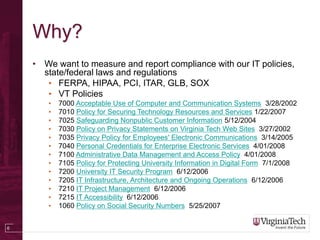
• We want to measure and report compliance with our IT policies,
state/federal laws and regulations
• FERPA, HIPAA, PCI, ITAR, GLB, SOX
• VT Policies
• 7000 Acceptable Use of Computer and Communication Systems 3/28/2002
• 7010 Policy for Securing Technology Resources and Services 1/22/2007
• 7025 Safeguarding Nonpublic Customer Information 5/12/2004
• 7030 Policy on Privacy Statements on Virginia Tech Web Sites 3/27/2002
• 7035 Privacy Policy for Employees' Electronic Communications 3/14/2005
• 7040 Personal Credentials for Enterprise Electronic Services 4/01/2008
• 7100 Administrative Data Management and Access Policy 4/01/2008
• 7105 Policy for Protecting University Information in Digital Form 7/1/2008
• 7200 University IT Security Program 6/12/2006
• 7205 IT Infrastructure, Architecture and Ongoing Operations 6/12/2006
• 7210 IT Project Management 6/12/2006
• 7215 IT Accessibility 6/12/2006
• 1060 Policy on Social Security Numbers 5/25/2007
7
Where?
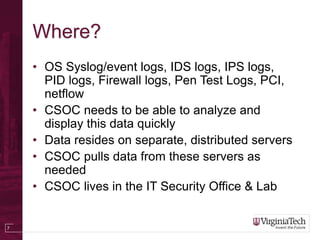
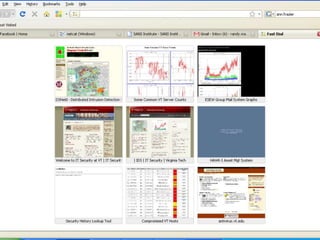
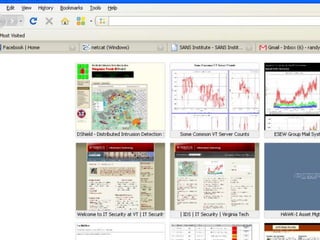
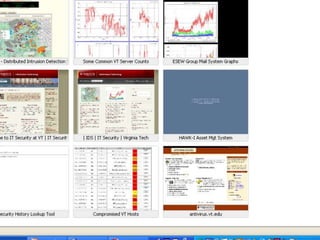
• OS Syslog/event logs, IDS logs, IPS logs,
PID logs, Firewall logs, Pen Test Logs, PCI,
netflow
• CSOC needs to be able to analyze and
display this data quickly
• Data resides on separate, distributed servers
• CSOC pulls data from these servers as
needed
• CSOC lives in the IT Security Office & Lab
8
What?
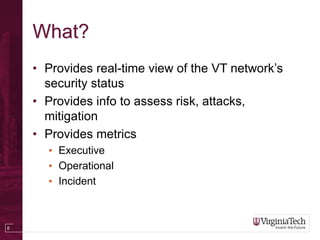
• Provides real-time view of the VT network’s
security status
• Provides info to assess risk, attacks,
mitigation
• Provides metrics
• Executive
• Operational
• Incident
9
What?
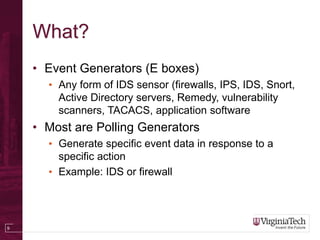
• Event Generators (E boxes)
• Any form of IDS sensor (firewalls, IPS, IDS, Snort,
Active Directory servers, Remedy, vulnerability
scanners, TACACS, application software
• Most are Polling Generators
• Generate specific event data in response to a
specific action
• Example: IDS or firewall
13
14
15
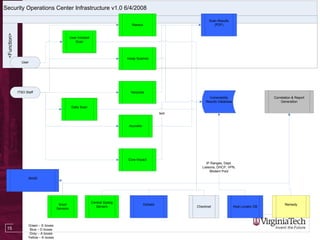
Security Operations Center Infrastructure v1.0 6/4/2008
<Function>
ITSO Staff
Daily Scan
Nexpose
Acunetix
Core Impact
Vulnerability
Results Database
Central Syslog
Servers
Dshield
Checknet
Snort
Sensors
Host Locator DB
Remedy
Correlation & Report
Generation
text
BASE
IP Ranges, Dept.
Liaisons, DHCP, VPN,
Modem Pool
Nessus
nmap Scanner
User
Scan Results
(PDF)
User Initiated
Scan
Green – E boxes
Blue – D boxes
Grey – A boxes
Yellow – K boxes
16
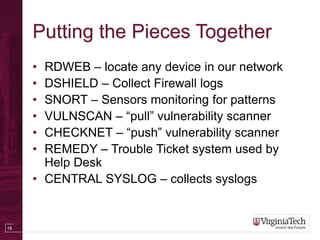
Putting the Pieces Together
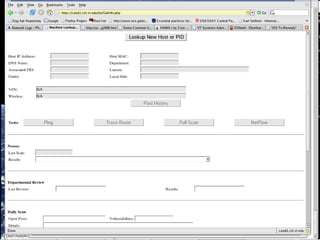
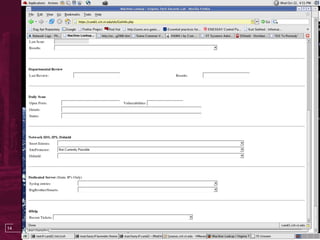
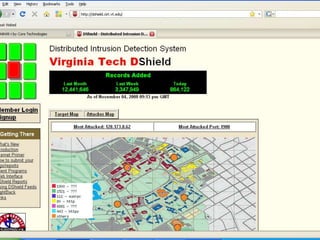
• RDWEB – locate any device in our network
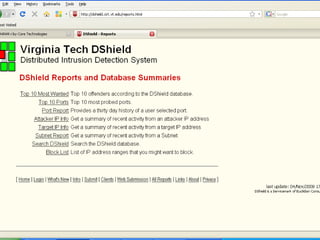
• DSHIELD – Collect Firewall logs
• SNORT – Sensors monitoring for patterns
• VULNSCAN – “pull” vulnerability scanner
• CHECKNET – “push” vulnerability scanner
• REMEDY – Trouble Ticket system used by
Help Desk
• CENTRAL SYSLOG – collects syslogs
17
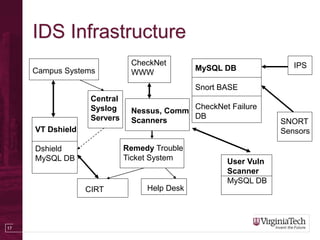
IDS Infrastructure
Campus Systems
VT Dshield
Dshield
MySQL DB
MySQL DB
Snort BASE
CheckNet Failure
DB
CheckNet
WWW
Nessus, Comm
Scanners
User Vuln
Scanner
MySQL DB
Remedy Trouble
Ticket System
CIRT Help Desk
IPS
SNORT
Sensors
Central
Syslog
Servers
18
19
20
21
22
23
24
25
26
27
28
29
30
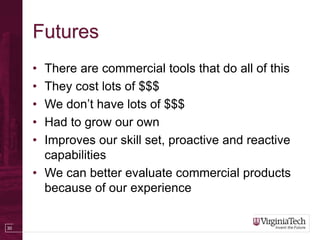
Futures
• There are commercial tools that do all of this
• They cost lots of $$$
• We don’t have lots of $$$
• Had to grow our own
• Improves our skill set, proactive and reactive
capabilities
• We can better evaluate commercial products
because of our experience
31
Reference
• Reference paper “Security Operation
Center Concepts & Implementation” by
Renaud Bidou
• We used this as our blueprint
32
Contact Information
• Randy Marchany
• VA Tech IT Security Office & Lab
• 1300 Torgersen Hall
• VA Tech
• Blacksburg, VA 24060
• 540-231-9523
• marchany@vt.edu
• http://security.vt.edu

Building a Security Operations Center

  • 1.
    Building a SecurityOperations Center Randy Marchany VA Tech IT Security Office and Lab marchany@vt.edu
  • 2.
    2 CyberSecurity Operations Center •Security Operations Center (SOC) term is being taken over by physical surveillance companies • We’re building a Cyber Security Operations Center (CSOC) that doesn’t have any physical surveillance capability. • It could be a component of a SOC in the future
  • 3.
    4 Why? • We’ve beencollecting security related data for a number of years and needed a focal point to help us see the big picture • Data from • Security Reviews • Vulnerability scans (push/pull) • IPS/IDS data • System logs • We want to build a “security history” for a host
  • 4.
    5 Why? • The CSOCis a logical place to collect, analyze and distribute data collected to support our Defense in Depth Strategy • Preventing Network Based Attacks • Preventing Host Based Attacks • Eliminating Security Vulnerabilities • Supporting Authorized Users • Providing tools for Minimizing Business Loss
  • 5.
    6 Why? • We wantto measure and report compliance with our IT policies, state/federal laws and regulations • FERPA, HIPAA, PCI, ITAR, GLB, SOX • VT Policies • 7000 Acceptable Use of Computer and Communication Systems 3/28/2002 • 7010 Policy for Securing Technology Resources and Services 1/22/2007 • 7025 Safeguarding Nonpublic Customer Information 5/12/2004 • 7030 Policy on Privacy Statements on Virginia Tech Web Sites 3/27/2002 • 7035 Privacy Policy for Employees' Electronic Communications 3/14/2005 • 7040 Personal Credentials for Enterprise Electronic Services 4/01/2008 • 7100 Administrative Data Management and Access Policy 4/01/2008 • 7105 Policy for Protecting University Information in Digital Form 7/1/2008 • 7200 University IT Security Program 6/12/2006 • 7205 IT Infrastructure, Architecture and Ongoing Operations 6/12/2006 • 7210 IT Project Management 6/12/2006 • 7215 IT Accessibility 6/12/2006 • 1060 Policy on Social Security Numbers 5/25/2007
  • 6.
    7 Where? • OS Syslog/eventlogs, IDS logs, IPS logs, PID logs, Firewall logs, Pen Test Logs, PCI, netflow • CSOC needs to be able to analyze and display this data quickly • Data resides on separate, distributed servers • CSOC pulls data from these servers as needed • CSOC lives in the IT Security Office & Lab
  • 7.
    8 What? • Provides real-timeview of the VT network’s security status • Provides info to assess risk, attacks, mitigation • Provides metrics • Executive • Operational • Incident
  • 8.
    9 What? • Event Generators(E boxes) • Any form of IDS sensor (firewalls, IPS, IDS, Snort, Active Directory servers, Remedy, vulnerability scanners, TACACS, application software • Most are Polling Generators • Generate specific event data in response to a specific action • Example: IDS or firewall
  • 9.
  • 10.
  • 11.
    15 Security Operations CenterInfrastructure v1.0 6/4/2008 <Function> ITSO Staff Daily Scan Nexpose Acunetix Core Impact Vulnerability Results Database Central Syslog Servers Dshield Checknet Snort Sensors Host Locator DB Remedy Correlation & Report Generation text BASE IP Ranges, Dept. Liaisons, DHCP, VPN, Modem Pool Nessus nmap Scanner User Scan Results (PDF) User Initiated Scan Green – E boxes Blue – D boxes Grey – A boxes Yellow – K boxes
  • 12.
    16 Putting the PiecesTogether • RDWEB – locate any device in our network • DSHIELD – Collect Firewall logs • SNORT – Sensors monitoring for patterns • VULNSCAN – “pull” vulnerability scanner • CHECKNET – “push” vulnerability scanner • REMEDY – Trouble Ticket system used by Help Desk • CENTRAL SYSLOG – collects syslogs
  • 13.
    17 IDS Infrastructure Campus Systems VTDshield Dshield MySQL DB MySQL DB Snort BASE CheckNet Failure DB CheckNet WWW Nessus, Comm Scanners User Vuln Scanner MySQL DB Remedy Trouble Ticket System CIRT Help Desk IPS SNORT Sensors Central Syslog Servers
  • 14.
  • 15.
  • 16.
  • 17.
  • 18.
  • 19.
  • 20.
  • 21.
  • 22.
  • 23.
  • 24.
  • 25.
  • 26.
    30 Futures • There arecommercial tools that do all of this • They cost lots of $$$ • We don’t have lots of $$$ • Had to grow our own • Improves our skill set, proactive and reactive capabilities • We can better evaluate commercial products because of our experience
  • 27.
    31 Reference • Reference paper“Security Operation Center Concepts & Implementation” by Renaud Bidou • We used this as our blueprint
  • 28.
    32 Contact Information • RandyMarchany • VA Tech IT Security Office & Lab • 1300 Torgersen Hall • VA Tech • Blacksburg, VA 24060 • 540-231-9523 • marchany@vt.edu • http://security.vt.edu