BUILD A BETTER YOU,
ONE ACTIVITY AT A TIME!
Marissa Yovetich MS, HE
BENEFITS OF ACTIVITY
 Improvements in:
 Emotional well – being
 Reduce stress, anxiety, depression, anger – increased endorphins!
 Physical wellness
 Reduce heart disease risk by 30 – 40%
 Reduce stroke risk by 20% in moderately active and 27% in very active
 Quality of life
 Accomplish Activities of Daily Living (ADL)
 Decrease the risk of injury
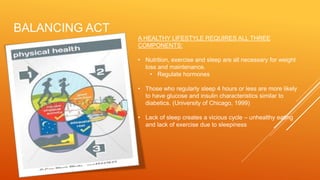
BALANCING ACT
A HEALTHY LIFESTYLE REQUIRES ALL THREE
COMPONENTS:
• Nutrition, exercise and sleep are all necessary for weight
loss and maintenance.
• Regulate hormones
• Those who regularly sleep 4 hours or less are more likely
to have glucose and insulin characteristics similar to
diabetics. (University of Chicago, 1999)
• Lack of sleep creates a vicious cycle – unhealthy eating
and lack of exercise due to sleepiness
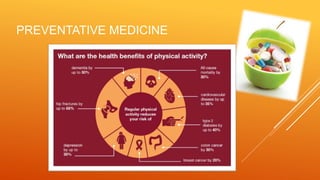
PREVENTATIVE MEDICINE
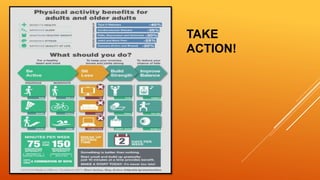
TAKE
ACTION!
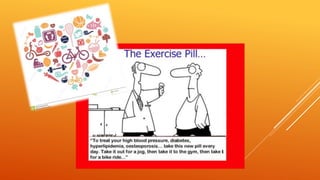
Prescriptions or
Prevention?!
THE COST OF INACTIVITY
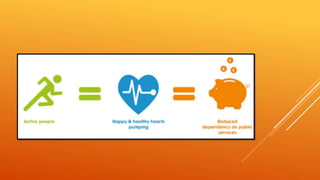
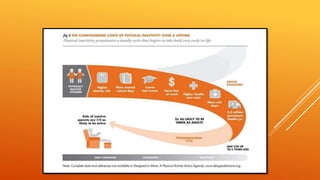
 On average, inactive adults pay $1500 more per year in healthcare costs
than active adults
 Inactive Americans take 1 week of extra sick days per year vs. active

Americans
 Physical inactivity is linked to the “top 10 killers” in the 50 highest income
countries
 Inactivity accounts for more deaths per year than smoking, 5.3 million and
5.0 million, respectively.
A SIGN OF THE TIMES
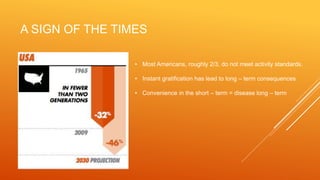
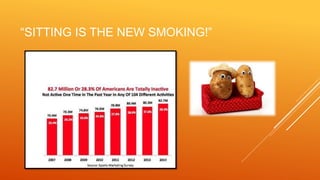
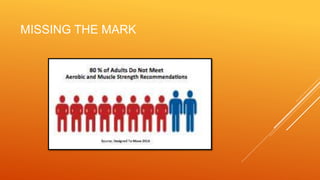
• Most Americans, roughly 2/3, do not meet activity standards.
• Instant gratification has lead to long – term consequences
• Convenience in the short – term = disease long – term
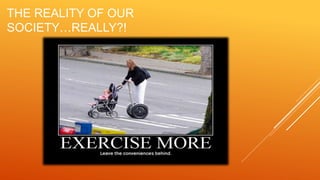
THE REALITY OF OUR
SOCIETY…REALLY?!
“SITTING IS THE NEW SMOKING!”
HOW MUCH IS “ENOUGH”?
 Engaging in physical activity for about 7 hours per week has been
shown to result in a 40% lower risk of early death, compared to 3.5
hours of activity per week
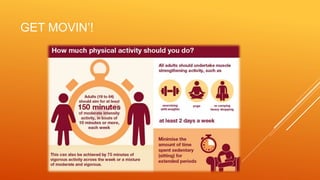
 The surgeon general recommends a minimum of 150 minutes of
moderate intensity activity per week
 Lower risk of disease and early death
GET MOVIN’!
HOW MUCH IS “ENOUGH”?
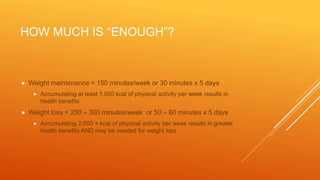
 Weight maintenance = 150 minutes/week or 30 minutes x 5 days
 Accumulating at least 1,000 kcal of physical activity per week results in
health benefits
 Weight loss = 250 – 300 minutes/week or 50 – 60 minutes x 5 days
 Accumulating 2,000 + kcal of physical activity per week results in greater
health benefits AND may be needed for weight loss
MISSING THE MARK
TIME CRUNCH?!
 Weekly activity minutes can be accumulated continuously (i.e. one
session) or intermittently through multiple sessions
 To achieve physical activity benefits, sessions should be at least 10
minutes in duration
 Total caloric expenditure and daily step count can be used as an
alternate measure of exercise duration
LET’S GET PHYSICAL, PHYSICAL…
 Exercise and activity can be defined using the following framework:
 F.I.T.T. Principle
 F = Frequency
 I = Intensity
 T = Time
 T = Type
F.I.T.T. PRINCIPLE: FREQUENCY
 Frequency = how often activity/exercise is performed
 Daily/weekly/monthly
 Cardiovascular activity 30 minutes 5 + days/week
 Walk/run/hike/swim/bike etc.
 Muscular Fitness 2 – 3 days/week
 Target major muscle groups
 Flexibility/Mobility 10 minutes 2 – 3 days/week
 Target major muscle groups
F.I.T.T. PRINCIPLE: INTENSITY
 Intensity = the amount of effort required to perform an exercise
 Measured as a percent of maximum heart rate (220 – age) x 50 – 65%
 Moderate intensity is considered 50 – 65% maximum heart rate
 Cardiovascular activity
 30 – 60 minutes at 50 -65% max heart rate, “talk test” 2 sentences at a time
 Muscular strength
 2 – 3 sets of 10 – 15 repetitions, 60 seconds rest between sets
 Perform each set to the point of fatigue, but not failure
 Mobility/Flexibility
 Hold each stretch at the point of mild tension, but not pain
 Static stretches held for 15 – 60 seconds per major muscle group
F.I.T.T. PRINCIPLE: TIME
 Time = the duration or length that the activity is performed for
 Cardiovascular Activity
 30 – 60 minutes/day
 150 – 300 minutes/week
 Muscular Strength
 20 – 60 minutes 2 – 3 times/week
 Mobility/Flexibility
 10 minutes 2 – 3 times per week
F.I.T.T. PRINCIPLE: TYPE
 Type = the mode of activity
 Cardiovascular Activity
 Moderate intensity: 50 – 65% max heart rate, “fat burning activity”
 High Intensity Interval Training: 80 – 100% max heart rate, “carb burning activity”
 Muscular Strength
 Improve strength and endurance: 60 – 80% of 1 rep max for 2 – 3 sets 8 – 12 reps
 Muscular endurance: ~ 50% of 1 rep mx for 2 – 3 sets of 10 – 15 reps
 Mobility/Flexibility
 Dynamic warm – up: prior to exercise, increases blood flow to major muscles
 Static stretching: post exercise, increases range of motion, balance and
reduces soarness
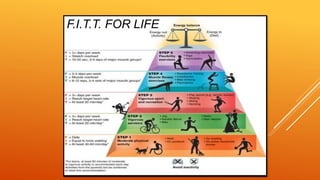
F.I.T.T. FOR LIFE
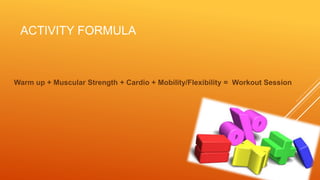
ACTIVITY FORMULA
Warm up + Muscular Strength + Cardio + Mobility/Flexibility = Workout Session
ABC, EASY AS 1, 2, 3…ACTIVITY!
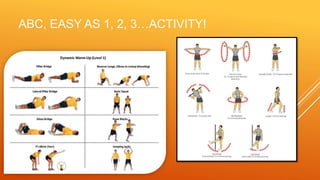
 1. Warm – up
 Dynamic warm – up, pre – cardio exercise (5 – 10 minutes)
OR
 One set of lighter weights, pre – muscular strength
ABC, EASY AS 1, 2, 3…ACTIVITY!
 2. Activity Selection
 Muscular Strength
 Exercises targeting large muscle groups precede smaller muscle groups
 Multi – joint vs. Single joint exercises
 Cardiovascular
 ALWAYS follows muscular strength exercises
 Impact vs. No/low impact activity
ABC, EASY AS 1, 2, 3…ACTIVITY!
 3. Mobility/Flexibility
 Complete post – activity
 10 minutes in duration – target major muscle groups
 Major muscles: neck/shoulders/upper & lower back/pelvis/hips/legs
 Static stretching/ foam rolling/yoga/tai chi
 Static stretch held for 15 – 60 seconds
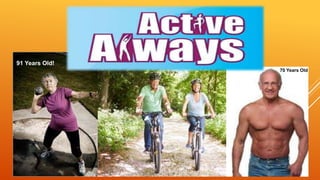
91 Years Old!
70 Years Old
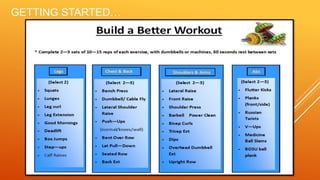
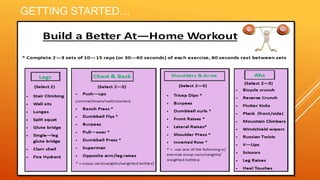
GETTING STARTED…
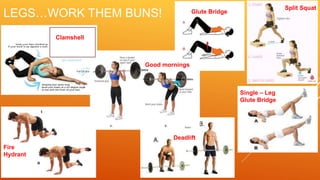
LEGS…WORK THEM BUNS!
Clamshell
Good mornings
Deadlift
Glute Bridge
Single – Leg
Glute Bridge
Split Squat
Fire
Hydrant
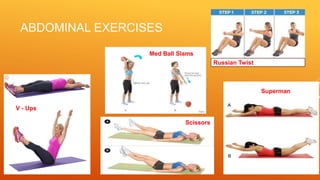
ABDOMINAL EXERCISES
Superman
Med Ball Slams
V - Ups
Russian Twist
Scissors
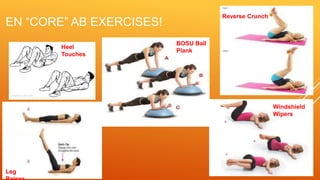
EN “CORE” AB EXERCISES!
Heel
Touches
Leg
Windshield
Wipers
Reverse Crunch
BOSU Ball
Plank
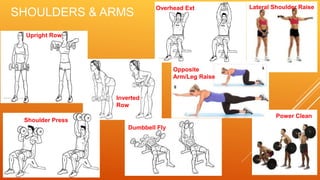
SHOULDERS & ARMS
Upright Row
Shoulder Press
Inverted
Row
Dumbbell Fly
Overhead Ext Lateral Shoulder Raise
Power Clean
Opposite
Arm/Leg Raise
GETTING STARTED…
REFERENCES
 American College of Sports Medicine. (2010). ACSM's Guidelines for Exercise Testing and Prescription (Eigth ed.). Wolters Kluwer Health.
 American Heart Association. (2015, March 2). Physical Activity Improves Quality of Life. Retrieved August 15, 2016, from
http://www.heart.org/HEARTORG/HealthyLiving/PhysicalActivity/ FitnessBasics/Physical-activity-improves-quality-of-
life_UCM_307977_Article.jsp#.V7IjL3nVx7g
 Centers for Disease Control and Prevention. (2016, April 27). Leading Causes of Death. Retrieved August 16, 2016, from
http://www.cdc.gov/nchs/fastats/leading-causes-of-death.htm
 Centers for Disease Control and Prevention. (2015, June 4). Physical Activity and Health. Retrieved August 15, 2016, from
http://www.cdc.gov/physicalactivity/basics/pa-health/index.htm
 National Sleep Foundation. (n.d.). Diet, Exercise and Sleep. Retrieved August 17, 2016, from https://sleepfoundation.org/sleep-
topics/diet-exercise-and-sleep
 PhitAmerica. (n.d.). The Tremendous Impact of the Inactivity Pandemic and Obesity. Retrieved August 16, 2016, from
http://www.phitamerica.org/Page1137.aspx
 The Mayo Clinic. (2014, March 4). Stretching: Focus on Flexibility. Retrieved August 16, 2016, from http://www.mayoclinic.org/healthy-
lifestyle/fitness/in-depth/stretching/art-20047931

Build a Better You, One Activity at a Time

  • 1.
    BUILD A BETTERYOU, ONE ACTIVITY AT A TIME! Marissa Yovetich MS, HE
  • 2.
    BENEFITS OF ACTIVITY Improvements in:  Emotional well – being  Reduce stress, anxiety, depression, anger – increased endorphins!  Physical wellness  Reduce heart disease risk by 30 – 40%  Reduce stroke risk by 20% in moderately active and 27% in very active  Quality of life  Accomplish Activities of Daily Living (ADL)  Decrease the risk of injury
  • 4.
    BALANCING ACT A HEALTHYLIFESTYLE REQUIRES ALL THREE COMPONENTS: • Nutrition, exercise and sleep are all necessary for weight loss and maintenance. • Regulate hormones • Those who regularly sleep 4 hours or less are more likely to have glucose and insulin characteristics similar to diabetics. (University of Chicago, 1999) • Lack of sleep creates a vicious cycle – unhealthy eating and lack of exercise due to sleepiness
  • 5.
  • 6.
  • 8.
  • 9.
    THE COST OFINACTIVITY  On average, inactive adults pay $1500 more per year in healthcare costs than active adults  Inactive Americans take 1 week of extra sick days per year vs. active Americans  Physical inactivity is linked to the “top 10 killers” in the 50 highest income countries  Inactivity accounts for more deaths per year than smoking, 5.3 million and 5.0 million, respectively.
  • 11.
    A SIGN OFTHE TIMES • Most Americans, roughly 2/3, do not meet activity standards. • Instant gratification has lead to long – term consequences • Convenience in the short – term = disease long – term
  • 12.
    THE REALITY OFOUR SOCIETY…REALLY?!
  • 13.
    “SITTING IS THENEW SMOKING!”
  • 14.
    HOW MUCH IS“ENOUGH”?  Engaging in physical activity for about 7 hours per week has been shown to result in a 40% lower risk of early death, compared to 3.5 hours of activity per week  The surgeon general recommends a minimum of 150 minutes of moderate intensity activity per week  Lower risk of disease and early death
  • 15.
  • 16.
    HOW MUCH IS“ENOUGH”?  Weight maintenance = 150 minutes/week or 30 minutes x 5 days  Accumulating at least 1,000 kcal of physical activity per week results in health benefits  Weight loss = 250 – 300 minutes/week or 50 – 60 minutes x 5 days  Accumulating 2,000 + kcal of physical activity per week results in greater health benefits AND may be needed for weight loss
  • 17.
  • 18.
    TIME CRUNCH?!  Weeklyactivity minutes can be accumulated continuously (i.e. one session) or intermittently through multiple sessions  To achieve physical activity benefits, sessions should be at least 10 minutes in duration  Total caloric expenditure and daily step count can be used as an alternate measure of exercise duration
  • 20.
    LET’S GET PHYSICAL,PHYSICAL…  Exercise and activity can be defined using the following framework:  F.I.T.T. Principle  F = Frequency  I = Intensity  T = Time  T = Type
  • 21.
    F.I.T.T. PRINCIPLE: FREQUENCY Frequency = how often activity/exercise is performed  Daily/weekly/monthly  Cardiovascular activity 30 minutes 5 + days/week  Walk/run/hike/swim/bike etc.  Muscular Fitness 2 – 3 days/week  Target major muscle groups  Flexibility/Mobility 10 minutes 2 – 3 days/week  Target major muscle groups
  • 22.
    F.I.T.T. PRINCIPLE: INTENSITY Intensity = the amount of effort required to perform an exercise  Measured as a percent of maximum heart rate (220 – age) x 50 – 65%  Moderate intensity is considered 50 – 65% maximum heart rate  Cardiovascular activity  30 – 60 minutes at 50 -65% max heart rate, “talk test” 2 sentences at a time  Muscular strength  2 – 3 sets of 10 – 15 repetitions, 60 seconds rest between sets  Perform each set to the point of fatigue, but not failure  Mobility/Flexibility  Hold each stretch at the point of mild tension, but not pain  Static stretches held for 15 – 60 seconds per major muscle group
  • 23.
    F.I.T.T. PRINCIPLE: TIME Time = the duration or length that the activity is performed for  Cardiovascular Activity  30 – 60 minutes/day  150 – 300 minutes/week  Muscular Strength  20 – 60 minutes 2 – 3 times/week  Mobility/Flexibility  10 minutes 2 – 3 times per week
  • 24.
    F.I.T.T. PRINCIPLE: TYPE Type = the mode of activity  Cardiovascular Activity  Moderate intensity: 50 – 65% max heart rate, “fat burning activity”  High Intensity Interval Training: 80 – 100% max heart rate, “carb burning activity”  Muscular Strength  Improve strength and endurance: 60 – 80% of 1 rep max for 2 – 3 sets 8 – 12 reps  Muscular endurance: ~ 50% of 1 rep mx for 2 – 3 sets of 10 – 15 reps  Mobility/Flexibility  Dynamic warm – up: prior to exercise, increases blood flow to major muscles  Static stretching: post exercise, increases range of motion, balance and reduces soarness
  • 25.
  • 26.
    ACTIVITY FORMULA Warm up+ Muscular Strength + Cardio + Mobility/Flexibility = Workout Session
  • 27.
    ABC, EASY AS1, 2, 3…ACTIVITY!  1. Warm – up  Dynamic warm – up, pre – cardio exercise (5 – 10 minutes) OR  One set of lighter weights, pre – muscular strength
  • 28.
    ABC, EASY AS1, 2, 3…ACTIVITY!
  • 29.
    ABC, EASY AS1, 2, 3…ACTIVITY!  2. Activity Selection  Muscular Strength  Exercises targeting large muscle groups precede smaller muscle groups  Multi – joint vs. Single joint exercises  Cardiovascular  ALWAYS follows muscular strength exercises  Impact vs. No/low impact activity
  • 30.
    ABC, EASY AS1, 2, 3…ACTIVITY!  3. Mobility/Flexibility  Complete post – activity  10 minutes in duration – target major muscle groups  Major muscles: neck/shoulders/upper & lower back/pelvis/hips/legs  Static stretching/ foam rolling/yoga/tai chi  Static stretch held for 15 – 60 seconds
  • 31.
  • 32.
  • 33.
    LEGS…WORK THEM BUNS! Clamshell Goodmornings Deadlift Glute Bridge Single – Leg Glute Bridge Split Squat Fire Hydrant
  • 34.
    ABDOMINAL EXERCISES Superman Med BallSlams V - Ups Russian Twist Scissors
  • 35.
    EN “CORE” ABEXERCISES! Heel Touches Leg Windshield Wipers Reverse Crunch BOSU Ball Plank
  • 36.
    SHOULDERS & ARMS UprightRow Shoulder Press Inverted Row Dumbbell Fly Overhead Ext Lateral Shoulder Raise Power Clean Opposite Arm/Leg Raise
  • 37.
  • 38.
    REFERENCES  American Collegeof Sports Medicine. (2010). ACSM's Guidelines for Exercise Testing and Prescription (Eigth ed.). Wolters Kluwer Health.  American Heart Association. (2015, March 2). Physical Activity Improves Quality of Life. Retrieved August 15, 2016, from http://www.heart.org/HEARTORG/HealthyLiving/PhysicalActivity/ FitnessBasics/Physical-activity-improves-quality-of- life_UCM_307977_Article.jsp#.V7IjL3nVx7g  Centers for Disease Control and Prevention. (2016, April 27). Leading Causes of Death. Retrieved August 16, 2016, from http://www.cdc.gov/nchs/fastats/leading-causes-of-death.htm  Centers for Disease Control and Prevention. (2015, June 4). Physical Activity and Health. Retrieved August 15, 2016, from http://www.cdc.gov/physicalactivity/basics/pa-health/index.htm  National Sleep Foundation. (n.d.). Diet, Exercise and Sleep. Retrieved August 17, 2016, from https://sleepfoundation.org/sleep- topics/diet-exercise-and-sleep  PhitAmerica. (n.d.). The Tremendous Impact of the Inactivity Pandemic and Obesity. Retrieved August 16, 2016, from http://www.phitamerica.org/Page1137.aspx  The Mayo Clinic. (2014, March 4). Stretching: Focus on Flexibility. Retrieved August 16, 2016, from http://www.mayoclinic.org/healthy- lifestyle/fitness/in-depth/stretching/art-20047931

Editor's Notes

  • #3 Research has shown that individuals who watch more than 4 hours of television per day have a 46% increased risk of death from any cause and an 80% increased risk of death from cardiovascular disease Maintain healthy weight and reduce the risk of obesity Improve cholesterol levels Stretching may improve flexibility, and consequently, ROM in your joints.
  • #5 Cortisol levels increase when the body is stressed. This causes circulating glucose levels to increase, as the body thinks that it needs to prepare itself for a “fight or flight” response. When the body doesn’t end up utilizing that glucose it is stored and fat accumulation results. Roughly 18 million Americans have sleep apnea, a sleep – related breathing disorder that leads individuals to repeatedly stop breathing during sleep. This condition increases one’s risk of stroke, heart attack, congestive heart failure and excessive daytime sleepiness. Sleep apnea is commonly associated with people who are overweight, as weight gain leads to compromised respiratory function when an individual’s trunk and neck area increase from weight gain. Slippery slope = tired from lack of sleep may result in poor nutrition choices and a failure to exercise
  • #10 Leading causes of death in the United States: Heart disease (614,348) Cancer (591,699) Chronic Lower Respiratory Disease (147,101) Accidents (unintentional injuries) (136,053) Stroke (cerebrovascular disease) (133, 103) Alzheimer’s disease (93,541) Diabetes (76,488) Influenza and pneumonia (55,227) Nephritis, nephrotic syndrome and nephrosis (48,146) Intentional self – harm (suicide) (42,773)
  • #15 To maintain weight, work up to 150 minutes of moderate activity per week or 75 minutes of vigorous activity or a combination of the two
  • #25 Improve muscular strength and endurance: 60 – 80% 1 RM for 2 – 3 sets of 8 – 12 reps (ex. If an individual is able to lift 100 lbs for 1 rep this would be their 1 rep max or 1 RM. To improve muscular strength and endurance they would perform 2 – 3 sets of 8 – 12 reps with 60 – 80 lbs.
  • #27 Exercise order matters! A dynamic warm up should be completed first, followed by muscular strength, cardio, and finally, mobility/flexibility. A dynamic warm up increases the blood flow to the major muscle groups, ensuring that they are ready to take on the increased demands of activity. Muscular strength should always be completed before cardiovascular exercise, to ensure that proper form is practiced on each exercise. During exercise, muscle glycogen becomes depleted which results in peripheral fatigue (muscular fatigue). This occurs, because performance is not able to be sustained due to a lack of carbs to produce energy. Performing muscular strength exercises in a fatigued state further depletes the muscle and can lead to improper form and likely injury. That being said, cardiovascular activity should follow muscular strength. Cardiovascular strength should be performed at a moderate intensity, 50 – 65% of max heart rate, or being able to talk in 1 – 2 sentences at a time. Mobility/flexibility training should be completed at the end of a workout. This consists of static stretching, in which the muscle is held at a mild tension for 15 – 60 seconds, and or foam rolling. These forms of stretching should be reserved until after muscular strength and cardiovascular training are complete, because there is an increase in blood flow to the major muscle groups. Increased blood flow allows for the muscles to stretch and increase in range of motion (ROM). It also allows for microscopic damage to tendons/fascia to be broken up, thus, increasing blood flow and healing to a given area.
  • #30 Multi- joint/compound exercises effect more than one muscle group (i.e. bench press, leg press, dips, abdominal crunch, leg press) Single – joint exercises still target major muscle groups, however, they do so in an “isolating” manner (i.e. bicep curls, tricep ext, quad ext, leg curls, calf raises Impact exercise: running/lifting/hiking/step aerobics No/low impact exercise: swimming/biking/elliptical/rowing
  • #31 Any muscle group that was exercised should be stretched