Stephen Gimple, MD, FACC
Meritas Health Cardiology
June 2022
Hypertension
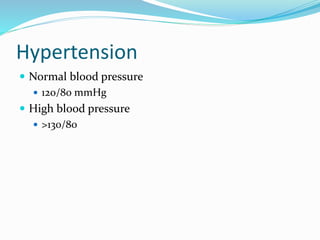
 Normal blood pressure
 120/80 mmHg
 High blood pressure
 >130/80
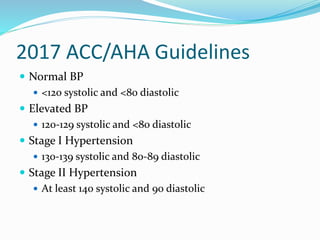
2017 ACC/AHA Guidelines
 Normal BP
 <120 systolic and <80 diastolic
 Elevated BP
 120-129 systolic and <80 diastolic
 Stage I Hypertension
 130-139 systolic and 80-89 diastolic
 Stage II Hypertension
 At least 140 systolic and 90 diastolic
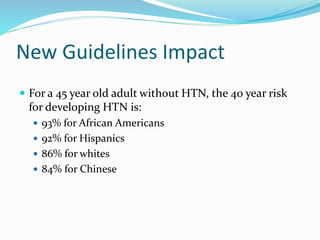
New Guidelines Impact
 For a 45 year old adult without HTN, the 40 year risk
for developing HTN is:
 93% for African Americans
 92% for Hispanics
 86% for whites
 84% for Chinese
SPRINT Trial
 Hypothesis: treating SBP to <120 mmHg is superior to
less aggressive target of treating to <140 mmHg.
SPRINT Trial
 9361 patients
 Higher risk patients
 50 years old or above (25% above age 75)
 At least one cardiovascular risk factor
 Clinical cardiovascular disease
 Chronic kidney disease stage III or worse
 Framingham risk score >15%
 Age >75 yo
SPRINT trial
 Exclusions
 Diabetes
 Prior stroke
 Polycystic kidney disease or ESRD
 CHF
SPRINT Trial
 Primary outcome: composite of CV death, stroke or
MI, hospital for heart failure or acute coronary
syndrome.
 Secondary endpoints: individual components of
primary endpoint, all cause mortality, and composite
for primary endpoint and all cause mortality
SPRINT Trial
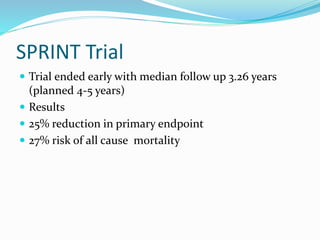
 Intensive treatment group: on average, were on 3
antihypertensives
 Comparison, less aggressive group: on average, were on
2 antihypertensives
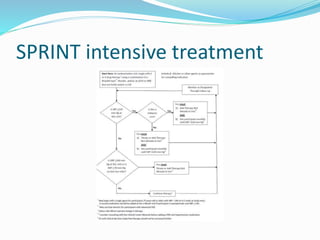
SPRINT intensive treatment
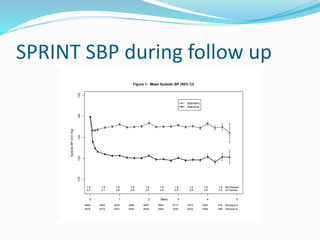
SPRINT SBP during follow up
SPRINT Trial
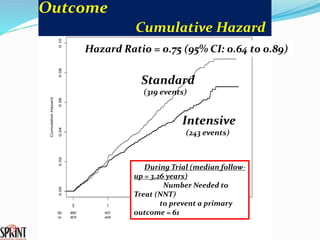
 Trial ended early with median follow up 3.26 years
(planned 4-5 years)
 Results
 25% reduction in primary endpoint
 27% risk of all cause mortality
Number of
Participants
Hazard Ratio = 0.75 (95% CI: 0.64 to 0.89)
Standard
Intensive
(243 events)
During Trial (median follow-
up = 3.26 years)
Number Needed to
Treat (NNT)
to prevent a primary
outcome = 61
Outcome
Cumulative Hazard
(319 events)
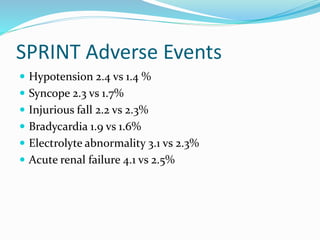
SPRINT Adverse Events
 Hypotension 2.4 vs 1.4 %
 Syncope 2.3 vs 1.7%
 Injurious fall 2.2 vs 2.3%
 Bradycardia 1.9 vs 1.6%
 Electrolyte abnormality 3.1 vs 2.3%
 Acute renal failure 4.1 vs 2.5%
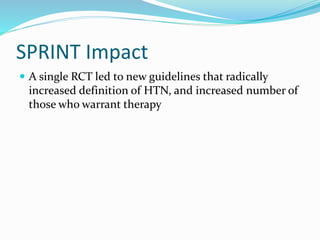
SPRINT Impact
 A single RCT led to new guidelines that radically
increased definition of HTN, and increased number of
those who warrant therapy
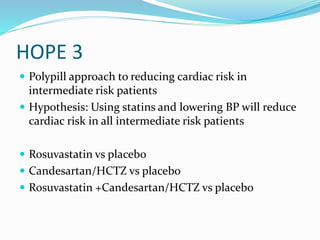
HOPE 3
 Polypill approach to reducing cardiac risk in
intermediate risk patients
 Hypothesis: Using statins and lowering BP will reduce
cardiac risk in all intermediate risk patients
 Rosuvastatin vs placebo
 Candesartan/HCTZ vs placebo
 Rosuvastatin +Candesartan/HCTZ vs placebo
HOPE 3
 Men >55, Women>65
 All have at least one risk factor
 Obesity
 Low HDL
 Tobacco use
 Dysglycemia
 Family history of early CAD
 Mild CKD
HOPE 3
 Exclusion criteria
 Known CVD
 Indication for, or contraindication against one of the
trial meds
12,705 enrolled
Duration of follow up 5.6 years
HOPE 3 Results
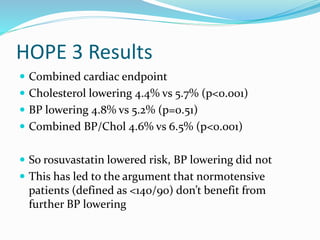
 Combined cardiac endpoint
 Cholesterol lowering 4.4% vs 5.7% (p<0.001)
 BP lowering 4.8% vs 5.2% (p=0.51)
 Combined BP/Chol 4.6% vs 6.5% (p<0.001)
 So rosuvastatin lowered risk, BP lowering did not
 This has led to the argument that normotensive
patients (defined as <140/90) don’t benefit from
further BP lowering
HOPE 3 Results
 However, these are all patients at intermediate risk,
not those with hypertension.
 The subgroup of patients with SBP> 143.5mmHg did
have statistically significant difference in endpoint
(p=0.009).
Lessons from Hope
 In intermediate risk patients, statins lower risk more
than BP meds unless BP starts out significantly high.
Lessons from SPRINT
 In high risk patients, lower BP is likely better
 How you take a blood pressure matters. 24 hour
average BP is what is most important. BP measured in
clinic does seem to be higher than BP measured at
home.
 BP medications need to be aggressively titrated
 Often, you should start with two medications from the
very beginning.
Treatment of Hypertension
 Nonpharmacologic
 Low salt diet
 High potassium foods
 Exercise
 Limiting alcohol
 Each lifestyle change can lower SBP by 4-5mmHg.
HTN treatment 2017 Guidelines
 Low or intermediate risk patients with SBP 120-129 or
130-139 should start with nonpharmacologic changes
only
 High risk patients can start one med if SBP>130, and
two meds if SBP>140 or DBP>90.
HTN Treatment
 First line therapy:
 Thiazide diuretics
 Calcium channel blockers
 ACE inhibitors or ARBs
 Beta blockers are no longer first line
ALLHAT
 41,000 hypertensive patients
 Randomized to
 Amlodipine
 Lisinopril
 Chlorthalidone
 Doxasozin (ended early due to CHF risk)
ALLHAT
 Lisinopril, chlorthalidone, and amlodipine were all
equivalent for primary outcome of fatal CAD or
nonfatal myocardial infarction
 Chlorthalidone had greater BP reduction and lowest
rate of CHF.
HTN Treatment
 African Americans (and likely Africans) have lower
rate of response to ACEi/ARB and greater response to
calcium channel blockers than whites
My usual 1st line treatment
 Whites: start lisinopril and hydrochlorothiazide
 Titrate these up to maximum tolerated dose
 Then add amlodipine
 Blacks: start amlodipine and hydrochlorothiazide
 Titrate these up to maximum tolerated dose
 Then add lisinopril
Add on Therapy
 Forth agent should usually be spironolactone
 This is due to hyperaldosteronism. Strongly suspect if
hypokalemic.
 Bblockers Cavedilol, labatelol, nibivolol better than
metoprolol
 Hydralazine
 Minoxidil
 Alpha blockers
Special Populations
 Systolic CHF:
 ACEi/ARB first-line for all
 Bblockers (carvedilol, metop succinate, bisoprolol) for
all
 Consider Hydralazine, isosorbide dinitrate for blacks
 History of myocardial infarction or aortic disease
 All need bblockers
 Diabetics
 ACEi/ARB are first line in all with microalbuminemia
Medication Issues
 ACEi/ARB
 Hyperkalemia and renal dysfunction
 Need to check potassium and creatinine at one week
 Angioedema
 Spironolactone
 Hyperkalemia in up to 20%
 Most important med of all to check potassium
Medication Issues
 Thiazide Diuretics
 Hypokalemia and hyponatremia (check labs one week)
 gout
 Calcium channel blockers
 Increased edema
 Beta blockers
 Fatigue and bradycardia
 Hydralazine
 edema
Resistant Hypertension
 Defined as BP not controlled with 3 medications
 What is the most common cause of resistant
hypertension?
 What is the most common cause of resistant
hypertension?
 Noncompliance with medication
 In USA, 25% never fill the first prescription
 At any one time, 50% are without their medicine
Tips to improve compliance
 Explain to patients the reason for treatment (the Silent
Killer)
 Start the meds at the dose you think will work best
 Warn patients that titration is necessary
 Schedule follow up to make titrations and to check on
side effects
 Warn patients about the potential side effects
Secondary Hypertension
 Rare
 Renal Disease
 Renal Artery stenosis
 Obstructive sleep apnea
 Other medications
 Hyperaldosteronism
 Pheochromocytoma

Bugando Hypertension.pptx

  • 1.
    Stephen Gimple, MD,FACC Meritas Health Cardiology June 2022
  • 2.
    Hypertension  Normal bloodpressure  120/80 mmHg  High blood pressure  >130/80
  • 3.
    2017 ACC/AHA Guidelines Normal BP  <120 systolic and <80 diastolic  Elevated BP  120-129 systolic and <80 diastolic  Stage I Hypertension  130-139 systolic and 80-89 diastolic  Stage II Hypertension  At least 140 systolic and 90 diastolic
  • 4.
    New Guidelines Impact For a 45 year old adult without HTN, the 40 year risk for developing HTN is:  93% for African Americans  92% for Hispanics  86% for whites  84% for Chinese
  • 5.
    SPRINT Trial  Hypothesis:treating SBP to <120 mmHg is superior to less aggressive target of treating to <140 mmHg.
  • 6.
    SPRINT Trial  9361patients  Higher risk patients  50 years old or above (25% above age 75)  At least one cardiovascular risk factor  Clinical cardiovascular disease  Chronic kidney disease stage III or worse  Framingham risk score >15%  Age >75 yo
  • 7.
    SPRINT trial  Exclusions Diabetes  Prior stroke  Polycystic kidney disease or ESRD  CHF
  • 8.
    SPRINT Trial  Primaryoutcome: composite of CV death, stroke or MI, hospital for heart failure or acute coronary syndrome.  Secondary endpoints: individual components of primary endpoint, all cause mortality, and composite for primary endpoint and all cause mortality
  • 9.
    SPRINT Trial  Intensivetreatment group: on average, were on 3 antihypertensives  Comparison, less aggressive group: on average, were on 2 antihypertensives
  • 10.
  • 11.
  • 12.
    SPRINT Trial  Trialended early with median follow up 3.26 years (planned 4-5 years)  Results  25% reduction in primary endpoint  27% risk of all cause mortality
  • 13.
    Number of Participants Hazard Ratio= 0.75 (95% CI: 0.64 to 0.89) Standard Intensive (243 events) During Trial (median follow- up = 3.26 years) Number Needed to Treat (NNT) to prevent a primary outcome = 61 Outcome Cumulative Hazard (319 events)
  • 14.
    SPRINT Adverse Events Hypotension 2.4 vs 1.4 %  Syncope 2.3 vs 1.7%  Injurious fall 2.2 vs 2.3%  Bradycardia 1.9 vs 1.6%  Electrolyte abnormality 3.1 vs 2.3%  Acute renal failure 4.1 vs 2.5%
  • 15.
    SPRINT Impact  Asingle RCT led to new guidelines that radically increased definition of HTN, and increased number of those who warrant therapy
  • 16.
    HOPE 3  Polypillapproach to reducing cardiac risk in intermediate risk patients  Hypothesis: Using statins and lowering BP will reduce cardiac risk in all intermediate risk patients  Rosuvastatin vs placebo  Candesartan/HCTZ vs placebo  Rosuvastatin +Candesartan/HCTZ vs placebo
  • 17.
    HOPE 3  Men>55, Women>65  All have at least one risk factor  Obesity  Low HDL  Tobacco use  Dysglycemia  Family history of early CAD  Mild CKD
  • 18.
    HOPE 3  Exclusioncriteria  Known CVD  Indication for, or contraindication against one of the trial meds 12,705 enrolled Duration of follow up 5.6 years
  • 19.
    HOPE 3 Results Combined cardiac endpoint  Cholesterol lowering 4.4% vs 5.7% (p<0.001)  BP lowering 4.8% vs 5.2% (p=0.51)  Combined BP/Chol 4.6% vs 6.5% (p<0.001)  So rosuvastatin lowered risk, BP lowering did not  This has led to the argument that normotensive patients (defined as <140/90) don’t benefit from further BP lowering
  • 20.
    HOPE 3 Results However, these are all patients at intermediate risk, not those with hypertension.  The subgroup of patients with SBP> 143.5mmHg did have statistically significant difference in endpoint (p=0.009).
  • 21.
    Lessons from Hope In intermediate risk patients, statins lower risk more than BP meds unless BP starts out significantly high.
  • 22.
    Lessons from SPRINT In high risk patients, lower BP is likely better  How you take a blood pressure matters. 24 hour average BP is what is most important. BP measured in clinic does seem to be higher than BP measured at home.  BP medications need to be aggressively titrated  Often, you should start with two medications from the very beginning.
  • 23.
    Treatment of Hypertension Nonpharmacologic  Low salt diet  High potassium foods  Exercise  Limiting alcohol  Each lifestyle change can lower SBP by 4-5mmHg.
  • 24.
    HTN treatment 2017Guidelines  Low or intermediate risk patients with SBP 120-129 or 130-139 should start with nonpharmacologic changes only  High risk patients can start one med if SBP>130, and two meds if SBP>140 or DBP>90.
  • 25.
    HTN Treatment  Firstline therapy:  Thiazide diuretics  Calcium channel blockers  ACE inhibitors or ARBs  Beta blockers are no longer first line
  • 26.
    ALLHAT  41,000 hypertensivepatients  Randomized to  Amlodipine  Lisinopril  Chlorthalidone  Doxasozin (ended early due to CHF risk)
  • 27.
    ALLHAT  Lisinopril, chlorthalidone,and amlodipine were all equivalent for primary outcome of fatal CAD or nonfatal myocardial infarction  Chlorthalidone had greater BP reduction and lowest rate of CHF.
  • 28.
    HTN Treatment  AfricanAmericans (and likely Africans) have lower rate of response to ACEi/ARB and greater response to calcium channel blockers than whites
  • 29.
    My usual 1stline treatment  Whites: start lisinopril and hydrochlorothiazide  Titrate these up to maximum tolerated dose  Then add amlodipine  Blacks: start amlodipine and hydrochlorothiazide  Titrate these up to maximum tolerated dose  Then add lisinopril
  • 30.
    Add on Therapy Forth agent should usually be spironolactone  This is due to hyperaldosteronism. Strongly suspect if hypokalemic.  Bblockers Cavedilol, labatelol, nibivolol better than metoprolol  Hydralazine  Minoxidil  Alpha blockers
  • 31.
    Special Populations  SystolicCHF:  ACEi/ARB first-line for all  Bblockers (carvedilol, metop succinate, bisoprolol) for all  Consider Hydralazine, isosorbide dinitrate for blacks  History of myocardial infarction or aortic disease  All need bblockers  Diabetics  ACEi/ARB are first line in all with microalbuminemia
  • 32.
    Medication Issues  ACEi/ARB Hyperkalemia and renal dysfunction  Need to check potassium and creatinine at one week  Angioedema  Spironolactone  Hyperkalemia in up to 20%  Most important med of all to check potassium
  • 33.
    Medication Issues  ThiazideDiuretics  Hypokalemia and hyponatremia (check labs one week)  gout  Calcium channel blockers  Increased edema  Beta blockers  Fatigue and bradycardia  Hydralazine  edema
  • 34.
    Resistant Hypertension  Definedas BP not controlled with 3 medications  What is the most common cause of resistant hypertension?
  • 35.
     What isthe most common cause of resistant hypertension?  Noncompliance with medication  In USA, 25% never fill the first prescription  At any one time, 50% are without their medicine
  • 36.
    Tips to improvecompliance  Explain to patients the reason for treatment (the Silent Killer)  Start the meds at the dose you think will work best  Warn patients that titration is necessary  Schedule follow up to make titrations and to check on side effects  Warn patients about the potential side effects
  • 37.
    Secondary Hypertension  Rare Renal Disease  Renal Artery stenosis  Obstructive sleep apnea  Other medications  Hyperaldosteronism  Pheochromocytoma