BUDGETING
UNIT- II
By:- Priya Sinha
Lecturer IHM Meerut
Session Objective
• At the end of this session students will be able
to understands:
• Introduction to budget
• Types of budget & budget cycle
• Advantages & disadvantages of budgeting
• Refining budgets, budgetary control
• Forecasting room revenue
Introduction
• The term budget means “ An annual estimated or
forecasted revenue/sales and expenditure.”
• Also may be defined as a Financial statement prepared
prior to a defined period of time which the money
available and for the purpose of attaining determined
goals.
• Budget is a planning process and also set a benchmark
for evaluation.
• According to Terry, “ Budget is an estimate of future
needs arranged according to an orderly basis covering
some of all the activities of an enterprise for a definite
period of time”.
Contd….
• The term ‘Budgeting’ is used for the complete
preparing of budgets & other procedures for
planning, co-ordination and control of
business enterprise.
• The budget plans become standards and
management evaluates the different
department’s performance with the budget
plans.
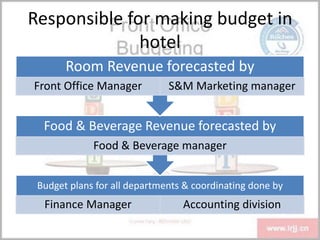
Responsible for making budget in
hotel
Budget plans for all departments & coordinating done by
Finance Manager Accounting division
Food & Beverage Revenue forecasted by
Food & Beverage manager
Room Revenue forecasted by
Front Office Manager S&M Marketing manager
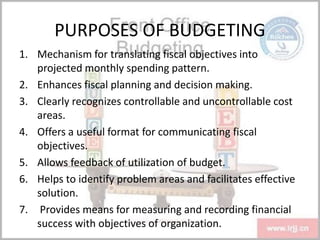
PURPOSES OF BUDGETING
1. Mechanism for translating fiscal objectives into
projected monthly spending pattern.
2. Enhances fiscal planning and decision making.
3. Clearly recognizes controllable and uncontrollable cost
areas.
4. Offers a useful format for communicating fiscal
objectives.
5. Allows feedback of utilization of budget.
6. Helps to identify problem areas and facilitates effective
solution.
7. Provides means for measuring and recording financial
success with objectives of organization.
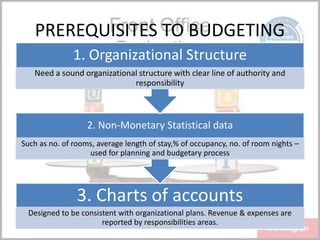
PREREQUISITES TO BUDGETING
3. Charts of accounts
Designed to be consistent with organizational plans. Revenue & expenses are
reported by responsibilities areas.
2. Non-Monetary Statistical data
Such as no. of rooms, average length of stay,% of occupancy, no. of room nights –
used for planning and budgetary process
1. Organizational Structure
Need a sound organizational structure with clear line of authority and
responsibility
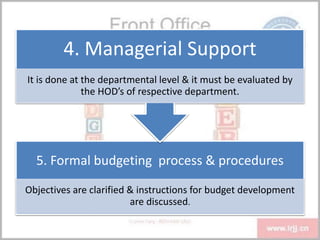
5. Formal budgeting process & procedures
Objectives are clarified & instructions for budget development
are discussed.
4. Managerial Support
It is done at the departmental level & it must be evaluated by
the HOD’s of respective department.
CHARACTERISTICS OF BUDGETING
• Should be flexible.
• Should be synthesis of past ,present and future.
• Should be product of joint venture and cooperation
of executive/department head at different level of
management.
• Should be in the form of statistical standard laid
down in the specific numerical terms.
• Should have support of top management
throughout the period of its planning and
implementation.
Importance/Objective of Budget
• To ensure perfect planning for future by
setting up various budgets.
• To increase the revenue.
• To reduce the cost / expenditure.
• To have proper co-ordination among different
depts.
• To maximize the profit.
• To minimize the capital investment.
• To operate depts. with efficiency & economy.
Contd….
• To anticipate capital expenditure for future.
• Elimination of wastes & increase in
profitability.
• Fixation of responsibility of various individuals
in the organization.
• To have a separate control dept. under the
supervision of senior manager.
PRINCIPLES OF BUDGET
• Should provide sound financial management by
focusing on requirement of the organization
• Should focus on the objectives and policies of the
organization.
• Should ensure the most effective use of financial and
non financial resources.
• Programme activities should be planned in advance.
• Requires consistent delegation for framing and
executive budget.
• Must be appropriate to nature of buisness ,services and to the
type of budget.
Contd…..
• Should include coordinating efforts of various departments
establishing a frame of reference for managerial decision
and evaluate managerial performance.
• Requires an adequate checks and balance against adoption
of too high and too low estimates.
• Prepared under the direction and supervision of
administrator or financial officer.
• To be prepared and interpreted throughout the
organization .
• Requires review of performance of previous year and
adequacy both quantitatively and qualitatively.
• Provision should be made for flexibility.
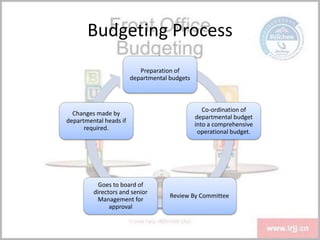
Budgeting Process
Preparation of
departmental budgets
Co-ordination of
departmental budget
into a comprehensive
operational budget.
Review By Committee
Goes to board of
directors and senior
Management for
approval
Changes made by
departmental heads if
required.
Budgetary Control
• It is the process of determining various
budgeted figures of the hotel and comparing
them with the actual performance for
calculating the VARIANCE.
• This enables the management to find out
discrepancies and take necessary actions.
Objectives of budgetary control
• To ensure perfect planning for future by setting
up various budgets.
• To increase revenue.
• To reduce cost
• To have proper coordination among various
departments.
• To maximize profits
• To maximize capital investments
• To operate departments with efficiency and
economy.
• To anticipate expenditure for future.
Contd.....
• Elimination of waste and increase in
profitability.
• Fixation of responsibility.
Types of budget
&
Budget cycle
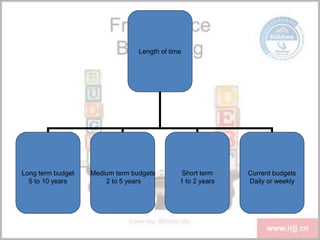
Length of time
Long term budget
5 to 10 years
Medium term budgets
2 to 5 years
Short term
1 to 2 years
Current budgets
Daily or weekly
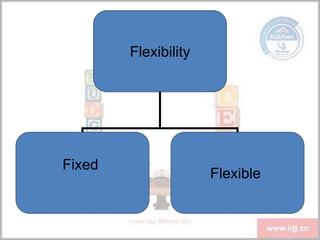
Flexibility
Fixed
Flexible
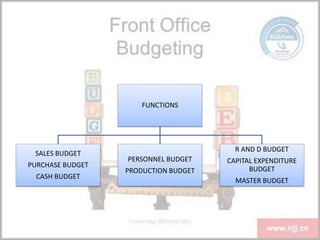
FUNCTIONS
SALES BUDGET
PURCHASE BUDGET
CASH BUDGET
PERSONNEL BUDGET
PRODUCTION BUDGET
R AND D BUDGET
CAPITAL EXPENDITURE
BUDGET
MASTER BUDGET
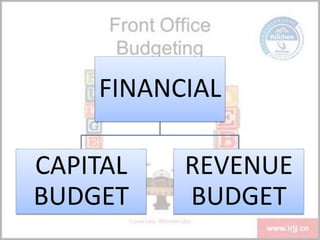
FINANCIAL
CAPITAL
BUDGET
REVENUE
BUDGET
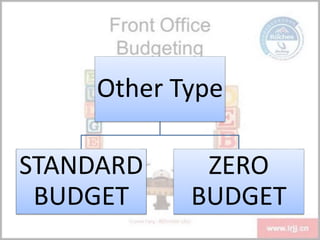
Other Type
STANDARD
BUDGET
ZERO
BUDGET
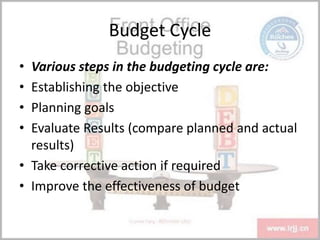
Budget Cycle
• Various steps in the budgeting cycle are:
• Establishing the objective
• Planning goals
• Evaluate Results (compare planned and actual
results)
• Take corrective action if required
• Improve the effectiveness of budget
Advantages
• Maximization of profits
• Coordination
• Specific aims
• Tool for measuring performance
• Determining weakness
• Corrective actions
• Cost reduction
Limitations
• Uncertain future
• Budgeting revision is required
• Budgets may be too easy to achieve
• Non achievable budgets discourage the staff
• Needs a lot of time.
Factors affecting on budget
planning
When preparing a budget the following
factors affecting budgets should be
considered:
• Previous sales figures
• The economy
• Competitors' actions
• Market research
• Government legislation
Preparing the budget for F.O.
Since the rooms department is the profit center of the hotel,
the rooms’ division manager is responsible for maximizing
sales and minimizing profits, also he is responsible for
preparing the budget. Any budgeting process starts with the
departmental budget or income statement and rest of the
budgeting process depends upon the operating department’s
individual expenses.
• Budget in front office is calculated by knowledge of
departmental revenue and expenses.
• Long term budgets are prepared by adding certain small
budgets showing the revenue which will be generated by the
internal operations and external resources.
• Budget income statements are primary concern of day to day
management of the hotel.
Contd…..
The procedure for preparing the budget of
Front Office is:
• Estimate sales revenue levels by the depts.
• Deduct estimated departmental operating
expenses for each dept.
• Combine estimated departmental operating
income and deduct estimated undistributed
expenses to arrive at net income.
Refining Budgets
• The term refining the budget means to
reconsider or review the budget and make
certain required changes in order to cope up
with the current situation and conditions in
the business.
• The departmental budgets are supported by
detailed information gathered during budget
preparation process and recording it into
summary files and saved.
Contd…..
• This information provides the answers to the
questions during budget reviews.
• Many hotels refine expected results of
operations and revise operational budgets as
they progress through the budget year.
• Sometimes re forecasting is done when actual
results start varying significantly from the
budgeted.
• Such variance may indicate the conditions
have changed since the budget was first
prepared.
Room Division Budget Reports
Hotel’s accounting division prepares monthly
budget reports that compares actual revenue
and expenses figures to budget amount.
• These reports provide timely information for
evaluating front office operations.
• The budget reports should show both monthly
variances and year-to-date variances.
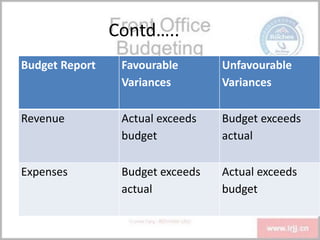
• The variances could be: Favourable or
Unfavourable.
Contd…..
Budget Report Favourable
Variances
Unfavourable
Variances
Revenue Actual exceeds
budget
Budget exceeds
actual
Expenses Budget exceeds
actual
Actual exceeds
budget
Budgeting Unit II.ppt

Budgeting Unit II.ppt

  • 1.
    BUDGETING UNIT- II By:- PriyaSinha Lecturer IHM Meerut
  • 2.
    Session Objective • Atthe end of this session students will be able to understands: • Introduction to budget • Types of budget & budget cycle • Advantages & disadvantages of budgeting • Refining budgets, budgetary control • Forecasting room revenue
  • 3.
    Introduction • The termbudget means “ An annual estimated or forecasted revenue/sales and expenditure.” • Also may be defined as a Financial statement prepared prior to a defined period of time which the money available and for the purpose of attaining determined goals. • Budget is a planning process and also set a benchmark for evaluation. • According to Terry, “ Budget is an estimate of future needs arranged according to an orderly basis covering some of all the activities of an enterprise for a definite period of time”.
  • 4.
    Contd…. • The term‘Budgeting’ is used for the complete preparing of budgets & other procedures for planning, co-ordination and control of business enterprise. • The budget plans become standards and management evaluates the different department’s performance with the budget plans.
  • 5.
    Responsible for makingbudget in hotel Budget plans for all departments & coordinating done by Finance Manager Accounting division Food & Beverage Revenue forecasted by Food & Beverage manager Room Revenue forecasted by Front Office Manager S&M Marketing manager
  • 6.
    PURPOSES OF BUDGETING 1.Mechanism for translating fiscal objectives into projected monthly spending pattern. 2. Enhances fiscal planning and decision making. 3. Clearly recognizes controllable and uncontrollable cost areas. 4. Offers a useful format for communicating fiscal objectives. 5. Allows feedback of utilization of budget. 6. Helps to identify problem areas and facilitates effective solution. 7. Provides means for measuring and recording financial success with objectives of organization.
  • 7.
    PREREQUISITES TO BUDGETING 3.Charts of accounts Designed to be consistent with organizational plans. Revenue & expenses are reported by responsibilities areas. 2. Non-Monetary Statistical data Such as no. of rooms, average length of stay,% of occupancy, no. of room nights – used for planning and budgetary process 1. Organizational Structure Need a sound organizational structure with clear line of authority and responsibility
  • 8.
    5. Formal budgetingprocess & procedures Objectives are clarified & instructions for budget development are discussed. 4. Managerial Support It is done at the departmental level & it must be evaluated by the HOD’s of respective department.
  • 9.
    CHARACTERISTICS OF BUDGETING •Should be flexible. • Should be synthesis of past ,present and future. • Should be product of joint venture and cooperation of executive/department head at different level of management. • Should be in the form of statistical standard laid down in the specific numerical terms. • Should have support of top management throughout the period of its planning and implementation.
  • 10.
    Importance/Objective of Budget •To ensure perfect planning for future by setting up various budgets. • To increase the revenue. • To reduce the cost / expenditure. • To have proper co-ordination among different depts. • To maximize the profit. • To minimize the capital investment. • To operate depts. with efficiency & economy.
  • 11.
    Contd…. • To anticipatecapital expenditure for future. • Elimination of wastes & increase in profitability. • Fixation of responsibility of various individuals in the organization. • To have a separate control dept. under the supervision of senior manager.
  • 12.
    PRINCIPLES OF BUDGET •Should provide sound financial management by focusing on requirement of the organization • Should focus on the objectives and policies of the organization. • Should ensure the most effective use of financial and non financial resources. • Programme activities should be planned in advance. • Requires consistent delegation for framing and executive budget. • Must be appropriate to nature of buisness ,services and to the type of budget.
  • 13.
    Contd….. • Should includecoordinating efforts of various departments establishing a frame of reference for managerial decision and evaluate managerial performance. • Requires an adequate checks and balance against adoption of too high and too low estimates. • Prepared under the direction and supervision of administrator or financial officer. • To be prepared and interpreted throughout the organization . • Requires review of performance of previous year and adequacy both quantitatively and qualitatively. • Provision should be made for flexibility.
  • 14.
    Budgeting Process Preparation of departmentalbudgets Co-ordination of departmental budget into a comprehensive operational budget. Review By Committee Goes to board of directors and senior Management for approval Changes made by departmental heads if required.
  • 15.
    Budgetary Control • Itis the process of determining various budgeted figures of the hotel and comparing them with the actual performance for calculating the VARIANCE. • This enables the management to find out discrepancies and take necessary actions.
  • 16.
    Objectives of budgetarycontrol • To ensure perfect planning for future by setting up various budgets. • To increase revenue. • To reduce cost • To have proper coordination among various departments. • To maximize profits • To maximize capital investments • To operate departments with efficiency and economy. • To anticipate expenditure for future.
  • 17.
    Contd..... • Elimination ofwaste and increase in profitability. • Fixation of responsibility.
  • 18.
  • 19.
    Length of time Longterm budget 5 to 10 years Medium term budgets 2 to 5 years Short term 1 to 2 years Current budgets Daily or weekly
  • 20.
  • 21.
    FUNCTIONS SALES BUDGET PURCHASE BUDGET CASHBUDGET PERSONNEL BUDGET PRODUCTION BUDGET R AND D BUDGET CAPITAL EXPENDITURE BUDGET MASTER BUDGET
  • 22.
  • 23.
  • 24.
    Budget Cycle • Varioussteps in the budgeting cycle are: • Establishing the objective • Planning goals • Evaluate Results (compare planned and actual results) • Take corrective action if required • Improve the effectiveness of budget
  • 25.
    Advantages • Maximization ofprofits • Coordination • Specific aims • Tool for measuring performance • Determining weakness • Corrective actions • Cost reduction
  • 26.
    Limitations • Uncertain future •Budgeting revision is required • Budgets may be too easy to achieve • Non achievable budgets discourage the staff • Needs a lot of time.
  • 27.
    Factors affecting onbudget planning When preparing a budget the following factors affecting budgets should be considered: • Previous sales figures • The economy • Competitors' actions • Market research • Government legislation
  • 28.
    Preparing the budgetfor F.O. Since the rooms department is the profit center of the hotel, the rooms’ division manager is responsible for maximizing sales and minimizing profits, also he is responsible for preparing the budget. Any budgeting process starts with the departmental budget or income statement and rest of the budgeting process depends upon the operating department’s individual expenses. • Budget in front office is calculated by knowledge of departmental revenue and expenses. • Long term budgets are prepared by adding certain small budgets showing the revenue which will be generated by the internal operations and external resources. • Budget income statements are primary concern of day to day management of the hotel.
  • 29.
    Contd….. The procedure forpreparing the budget of Front Office is: • Estimate sales revenue levels by the depts. • Deduct estimated departmental operating expenses for each dept. • Combine estimated departmental operating income and deduct estimated undistributed expenses to arrive at net income.
  • 30.
    Refining Budgets • Theterm refining the budget means to reconsider or review the budget and make certain required changes in order to cope up with the current situation and conditions in the business. • The departmental budgets are supported by detailed information gathered during budget preparation process and recording it into summary files and saved.
  • 31.
    Contd….. • This informationprovides the answers to the questions during budget reviews. • Many hotels refine expected results of operations and revise operational budgets as they progress through the budget year. • Sometimes re forecasting is done when actual results start varying significantly from the budgeted. • Such variance may indicate the conditions have changed since the budget was first prepared.
  • 32.
    Room Division BudgetReports Hotel’s accounting division prepares monthly budget reports that compares actual revenue and expenses figures to budget amount. • These reports provide timely information for evaluating front office operations. • The budget reports should show both monthly variances and year-to-date variances. • The variances could be: Favourable or Unfavourable.
  • 33.
    Contd….. Budget Report Favourable Variances Unfavourable Variances RevenueActual exceeds budget Budget exceeds actual Expenses Budget exceeds actual Actual exceeds budget

Editor's Notes

  • #29 Budgeted balance sheet cannot be made without reference to income statements A cash budget cannot be made without knowledge of departmental revenues and expenses. Long term budgets for equipments and furniture replacement cannot be prepared without a budget showing what income or funds are going to generated from the internal operations and external resources. Budgeted income statements are the primary concern of day to day management of the hotel.