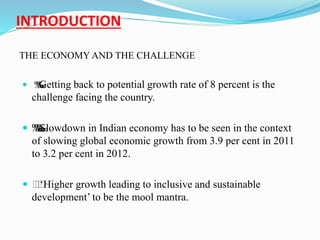
INTRODUCTION
THE ECONOMY AND THE CHALLENGE
 ‰‰‰Getting back to potential growth rate of 8 percent is the
challenge facing the country.
 ‰‰‰‰‰Slowdown in Indian economy has to be seen in the context
of slowing global economic growth from 3.9 per cent in 2011
to 3.2 per cent in 2012.
 ‰‰‰‰‰‘Higher growth leading to inclusive and sustainable
development’ to be the mool mantra.
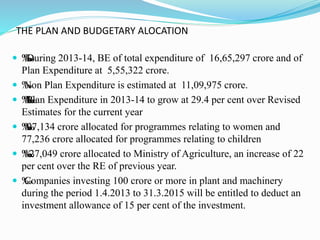
THE PLAN AND BUDGETARY ALOCATION
 ‰‰‰‰During 2013-14, BE of total expenditure of 16,65,297 crore and of
Plan Expenditure at 5,55,322 crore.
 ‰Non Plan Expenditure is estimated at 11,09,975 crore.
 ‰‰‰‰‰Plan Expenditure in 2013-14 to grow at 29.4 per cent over Revised
Estimates for the current year
 ‰‰‰‰97,134 crore allocated for programmes relating to women and
77,236 crore allocated for programmes relating to children
 ‰‰‰‰27,049 crore allocated to Ministry of Agriculture, an increase of 22
per cent over the RE of previous year.
 ‰Companies investing 100 crore or more in plant and machinery
during the period 1.4.2013 to 31.3.2015 will be entitled to deduct an
investment allowance of 15 per cent of the investment.
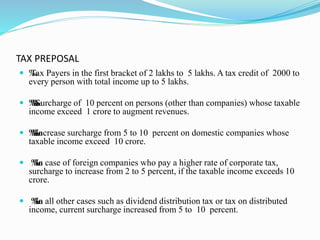
TAX PREPOSAL
 ‰Tax Payers in the first bracket of 2 lakhs to 5 lakhs. A tax credit of 2000 to
every person with total income up to 5 lakhs.
 ‰‰‰‰‰Surcharge of 10 percent on persons (other than companies) whose taxable
income exceed 1 crore to augment revenues.
 ‰‰‰‰‰Increase surcharge from 5 to 10 percent on domestic companies whose
taxable income exceed 10 crore.
 ‰‰‰In case of foreign companies who pay a higher rate of corporate tax,
surcharge to increase from 2 to 5 percent, if the taxable income exceeds 10
crore.
 ‰‰‰In all other cases such as dividend distribution tax or tax on distributed
income, current surcharge increased from 5 to 10 percent.
CURRENT ECONOMIC PROBLEMS
 Fiscal deficit
 Slow down GDP growth
 Stock market performance
 BOP & Rupee depreciation
FISCAL DEFICIT, CAD
 Definition: It gives you the extent the Government
needs to borrow to meet its expenditure.
 For current year-5.3%, for next year-4.8%.
 CAD: Import over export.
 Reasons for increasing CAD:- increasing demand for
oil imports, our passion for gold and slow down
export.
 We have to find an additional $75 billion for financing
CAD.
 Measures:-FDI,FII,ECB
GDP GROWTH
 For current FY-5 to 5.5% , For next FY-6.1 to 6.7.
 Growth without impacting on inflation
 Slight changes in Tax rates
 Excise duty, Custom duty
 Put more money in the hands of customers
 Increasing consumption
 Increase in GDP leads to reduce fiscal deficit.
STOCK MARKET PERFORMANCE
 KYC norms recommended in mutual fund.
 Opened up market.
 Source of funds comes from overseas.
 Advantages and disadvantages
 Discouraging foreign investors.
BOP & RUPEE DEPRECIATION
 BOP include tow account, one is current account and
another is capital account.
 Negative current account
 Out flow of capital, weakness showing by capital account.
 Balance of payment starts turning negative
 If BOP turning negative the rupee is start depreciating.
 FII’s withdraw money from our market because their $
returns come down.
 Uncontrollable current account.
 Increasing oil price.
CONCLUSION
I would like to conclude this presentation by saying
that, the budget presented by our financial minister
for the financial year 2013-2014 was a balanced one.
He was actually trying to maintain a balance between
all these problems but measures he suggested cannot
be implemented in short run, it will take some time to
make some impact on our current economic problems.

BUDGET 2013-14

  • 2.
    INTRODUCTION THE ECONOMY ANDTHE CHALLENGE  ‰‰‰Getting back to potential growth rate of 8 percent is the challenge facing the country.  ‰‰‰‰‰Slowdown in Indian economy has to be seen in the context of slowing global economic growth from 3.9 per cent in 2011 to 3.2 per cent in 2012.  ‰‰‰‰‰‘Higher growth leading to inclusive and sustainable development’ to be the mool mantra.
  • 3.
    THE PLAN ANDBUDGETARY ALOCATION  ‰‰‰‰During 2013-14, BE of total expenditure of 16,65,297 crore and of Plan Expenditure at 5,55,322 crore.  ‰Non Plan Expenditure is estimated at 11,09,975 crore.  ‰‰‰‰‰Plan Expenditure in 2013-14 to grow at 29.4 per cent over Revised Estimates for the current year  ‰‰‰‰97,134 crore allocated for programmes relating to women and 77,236 crore allocated for programmes relating to children  ‰‰‰‰27,049 crore allocated to Ministry of Agriculture, an increase of 22 per cent over the RE of previous year.  ‰Companies investing 100 crore or more in plant and machinery during the period 1.4.2013 to 31.3.2015 will be entitled to deduct an investment allowance of 15 per cent of the investment.
  • 4.
    TAX PREPOSAL  ‰TaxPayers in the first bracket of 2 lakhs to 5 lakhs. A tax credit of 2000 to every person with total income up to 5 lakhs.  ‰‰‰‰‰Surcharge of 10 percent on persons (other than companies) whose taxable income exceed 1 crore to augment revenues.  ‰‰‰‰‰Increase surcharge from 5 to 10 percent on domestic companies whose taxable income exceed 10 crore.  ‰‰‰In case of foreign companies who pay a higher rate of corporate tax, surcharge to increase from 2 to 5 percent, if the taxable income exceeds 10 crore.  ‰‰‰In all other cases such as dividend distribution tax or tax on distributed income, current surcharge increased from 5 to 10 percent.
  • 5.
    CURRENT ECONOMIC PROBLEMS Fiscal deficit  Slow down GDP growth  Stock market performance  BOP & Rupee depreciation
  • 6.
    FISCAL DEFICIT, CAD Definition: It gives you the extent the Government needs to borrow to meet its expenditure.  For current year-5.3%, for next year-4.8%.  CAD: Import over export.  Reasons for increasing CAD:- increasing demand for oil imports, our passion for gold and slow down export.  We have to find an additional $75 billion for financing CAD.  Measures:-FDI,FII,ECB
  • 7.
    GDP GROWTH  Forcurrent FY-5 to 5.5% , For next FY-6.1 to 6.7.  Growth without impacting on inflation  Slight changes in Tax rates  Excise duty, Custom duty  Put more money in the hands of customers  Increasing consumption  Increase in GDP leads to reduce fiscal deficit.
  • 8.
    STOCK MARKET PERFORMANCE KYC norms recommended in mutual fund.  Opened up market.  Source of funds comes from overseas.  Advantages and disadvantages  Discouraging foreign investors.
  • 9.
    BOP & RUPEEDEPRECIATION  BOP include tow account, one is current account and another is capital account.  Negative current account  Out flow of capital, weakness showing by capital account.  Balance of payment starts turning negative  If BOP turning negative the rupee is start depreciating.  FII’s withdraw money from our market because their $ returns come down.  Uncontrollable current account.  Increasing oil price.
  • 10.
    CONCLUSION I would liketo conclude this presentation by saying that, the budget presented by our financial minister for the financial year 2013-2014 was a balanced one. He was actually trying to maintain a balance between all these problems but measures he suggested cannot be implemented in short run, it will take some time to make some impact on our current economic problems.