Key Features

     of

  Budget

 2012-2013
Economy
For Indian economy, recovery was interrupted this
year due to intensification of debt crises in Euro
zone, political turmoil in Middle East, rise in crude oil
price and earthquake in Japan.
 GDP is estimated to grow by 6.9 per cent in 2011-
 12, after having grown at 8.4 per cent in preceding two
 years.

 India however remains front runner in economic
 growth in any cross-country comparison.
 Growth: The Finance Minister mentioned that as
  per the latest Economic Survey, India's GDP is
  expected to grow at 7.6% plus minus 0.25% in FY13.
  India's GDP estimated to grow at 6.9% in 2011-12.
 Inflation: Headline inflation to moderate from
  current level in next few months and remain
  stable thereafter.
Fiscal deficit
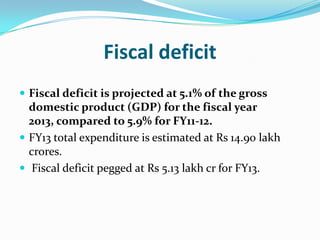
 Fiscal deficit is projected at 5.1% of the gross
  domestic product (GDP) for the fiscal year
  2013, compared to 5.9% for FY11-12.
 FY13 total expenditure is estimated at Rs 14.90 lakh
  crores.
 Fiscal deficit pegged at Rs 5.13 lakh cr for FY13.
Fiscal deficit slipped to 5.9% in
          2012-Reasons
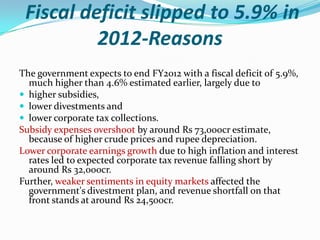
The government expects to end FY2012 with a fiscal deficit of 5.9%,
  much higher than 4.6% estimated earlier, largely due to
 higher subsidies,
 lower divestments and
 lower corporate tax collections.
Subsidy expenses overshoot by around Rs 73,000cr estimate,
  because of higher crude prices and rupee depreciation.
Lower corporate earnings growth due to high inflation and interest
  rates led to expected corporate tax revenue falling short by
  around Rs 32,000cr.
Further, weaker sentiments in equity markets affected the
  government's divestment plan, and revenue shortfall on that
  front stands at around Rs 24,500cr.
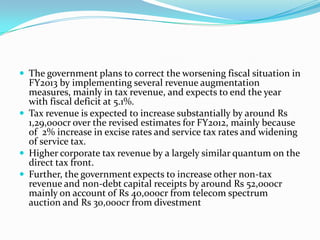
 The government plans to correct the worsening fiscal situation in
  FY2013 by implementing several revenue augmentation
  measures, mainly in tax revenue, and expects to end the year
  with fiscal deficit at 5.1%.
 Tax revenue is expected to increase substantially by around Rs
  1,29,000cr over the revised estimates for FY2012, mainly because
  of 2% increase in excise rates and service tax rates and widening
  of service tax.
 Higher corporate tax revenue by a largely similar quantum on the
  direct tax front.
 Further, the government expects to increase other non-tax
  revenue and non-debt capital receipts by around Rs 52,000cr
  mainly on account of Rs 40,000cr from telecom spectrum
  auction and Rs 30,000cr from divestment
Taxes
Individual & Corporate:
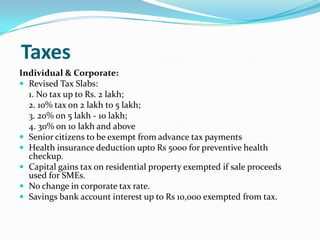
 Revised Tax Slabs:
  1. No tax up to Rs. 2 lakh;
  2. 10% tax on 2 lakh to 5 lakh;
  3. 20% on 5 lakh - 10 lakh;
  4. 30% on 10 lakh and above
 Senior citizens to be exempt from advance tax payments
 Health insurance deduction upto Rs 5000 for preventive health
  checkup.
 Capital gains tax on residential property exempted if sale proceeds
  used for SMEs.
 No change in corporate tax rate.
 Savings bank account interest up to Rs 10,000 exempted from tax.
TAX REFORMS


 DTC Bill to be enacted at the earliest after expeditious
  examination of the report of the Parliamentary
  Standing Committee.
 Drafting of model legislation for the Centre and State
  GST in concert with States is under progress.
DISINVESTMENT POLICY


 Government has further evolved its approach to
 divestment of Central Public Sector Enterprises by
 allowing them a level playing field vis-à-vis the private
 sector in respect of practices like buy backs and listing
 at stock exchanges.

 For 2012-13, `30,000 crore to be raised through
 disinvestment. At least 51 per cent ownership and
 management control to remain with Government.
STRENGTHENING INVESTMENT
        ENVIRONMENT
Foreign Direct Investment
 Efforts to arrive at a broadbased consensus in
  consultation with the State
 Governments in respect of decision to allow FDI in
  multi-brand retail upto 51 per cent.
Financial Sector


 Rajiv Gandhi Equity Saving Scheme to allow for
 income tax deduction of 50 per cent to new retail
 investors, who invest upto `50,000 directly in equities
 and whose annual income is below `10 lakh to be
 introduced. The scheme will have a lock-in period of 3
 years.
Thank you

Budget 12 13

  • 1.
    Key Features of Budget 2012-2013
  • 2.
    Economy For Indian economy,recovery was interrupted this year due to intensification of debt crises in Euro zone, political turmoil in Middle East, rise in crude oil price and earthquake in Japan.
  • 3.
     GDP isestimated to grow by 6.9 per cent in 2011- 12, after having grown at 8.4 per cent in preceding two years.  India however remains front runner in economic growth in any cross-country comparison.
  • 4.
     Growth: TheFinance Minister mentioned that as per the latest Economic Survey, India's GDP is expected to grow at 7.6% plus minus 0.25% in FY13. India's GDP estimated to grow at 6.9% in 2011-12.  Inflation: Headline inflation to moderate from current level in next few months and remain stable thereafter.
  • 5.
    Fiscal deficit  Fiscaldeficit is projected at 5.1% of the gross domestic product (GDP) for the fiscal year 2013, compared to 5.9% for FY11-12.  FY13 total expenditure is estimated at Rs 14.90 lakh crores.  Fiscal deficit pegged at Rs 5.13 lakh cr for FY13.
  • 6.
    Fiscal deficit slippedto 5.9% in 2012-Reasons The government expects to end FY2012 with a fiscal deficit of 5.9%, much higher than 4.6% estimated earlier, largely due to  higher subsidies,  lower divestments and  lower corporate tax collections. Subsidy expenses overshoot by around Rs 73,000cr estimate, because of higher crude prices and rupee depreciation. Lower corporate earnings growth due to high inflation and interest rates led to expected corporate tax revenue falling short by around Rs 32,000cr. Further, weaker sentiments in equity markets affected the government's divestment plan, and revenue shortfall on that front stands at around Rs 24,500cr.
  • 7.
     The governmentplans to correct the worsening fiscal situation in FY2013 by implementing several revenue augmentation measures, mainly in tax revenue, and expects to end the year with fiscal deficit at 5.1%.  Tax revenue is expected to increase substantially by around Rs 1,29,000cr over the revised estimates for FY2012, mainly because of 2% increase in excise rates and service tax rates and widening of service tax.  Higher corporate tax revenue by a largely similar quantum on the direct tax front.  Further, the government expects to increase other non-tax revenue and non-debt capital receipts by around Rs 52,000cr mainly on account of Rs 40,000cr from telecom spectrum auction and Rs 30,000cr from divestment
  • 8.
    Taxes Individual & Corporate: Revised Tax Slabs: 1. No tax up to Rs. 2 lakh; 2. 10% tax on 2 lakh to 5 lakh; 3. 20% on 5 lakh - 10 lakh; 4. 30% on 10 lakh and above  Senior citizens to be exempt from advance tax payments  Health insurance deduction upto Rs 5000 for preventive health checkup.  Capital gains tax on residential property exempted if sale proceeds used for SMEs.  No change in corporate tax rate.  Savings bank account interest up to Rs 10,000 exempted from tax.
  • 9.
    TAX REFORMS  DTCBill to be enacted at the earliest after expeditious examination of the report of the Parliamentary Standing Committee.  Drafting of model legislation for the Centre and State GST in concert with States is under progress.
  • 10.
    DISINVESTMENT POLICY  Governmenthas further evolved its approach to divestment of Central Public Sector Enterprises by allowing them a level playing field vis-à-vis the private sector in respect of practices like buy backs and listing at stock exchanges.  For 2012-13, `30,000 crore to be raised through disinvestment. At least 51 per cent ownership and management control to remain with Government.
  • 11.
    STRENGTHENING INVESTMENT ENVIRONMENT Foreign Direct Investment  Efforts to arrive at a broadbased consensus in consultation with the State  Governments in respect of decision to allow FDI in multi-brand retail upto 51 per cent.
  • 12.
    Financial Sector  RajivGandhi Equity Saving Scheme to allow for income tax deduction of 50 per cent to new retail investors, who invest upto `50,000 directly in equities and whose annual income is below `10 lakh to be introduced. The scheme will have a lock-in period of 3 years.
  • 13.