LESSON OBJECTIVES
0
1
Explain Copernicus’
heliocentrictheory 0
2
Describe Darwin’s
evolution concept
0
3
Discuss Freud’s
theory of mind
0
4
Link thinkers to
scientific revolution
0
Explore revolution
across world regions
0
6
Compare impacts
in global contexts
3.
INTRODUCTION
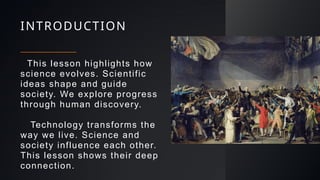
This lesson highlightshow
science evolves. Scientific
ideas shape and guide
society. We explore progress
through human discovery.
Technology transforms the
way we live. Science and
society influence each other.
This lesson shows their deep
connection.
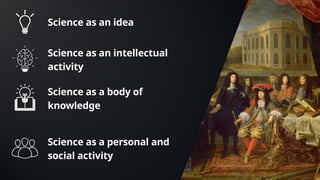
Science as anidea
Science as an intellectual
activity
Science as a body of
knowledge
Science as a personal and
social activity
7.
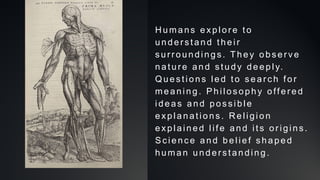
Hu ma nse xp lo re t o
u n de rst a n d t he i r
su rro u n d in g s. T h e y o b se rv e
n a t u re an d st u dy d e ep l y.
Q ue st i o n s le d t o se a rc h f o r
me a n in g . P hi l oso p h y o ff e re d
id e a s a n d p o ssib l e
e xp la n a t io n s. Rel ig i o n
e xp la in e d l if e an d i t s o ri gi n s.
S cie nce a n d b e li e f sh a p e d
h u ma n u nd e rst a n d in g .
8.
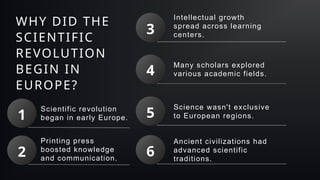
WHY DID THE
SCIENTIFIC
REVOLUTION
BEGININ
EUROPE?
Intellectual growth
spread across learning
centers.
3
Many scholars explored
various academic fields.
4
Science wasn't exclusive
to European regions.
5
Ancient civilizations had
advanced scientific
traditions.
6
Scientific revolution
began in early Europe.
1
Printing press
boosted knowledge
and communication.
2
9.
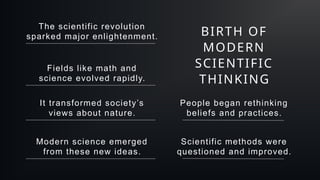
BIRTH OF
MODERN
SCIENTIFIC
THINKING
The scientificrevolution
sparked major enlightenment.
Fields like math and
science evolved rapidly.
It transformed society’s
views about nature.
Modern science emerged
from these new ideas.
People began rethinking
beliefs and practices.
Scientific methods were
questioned and improved.
10.
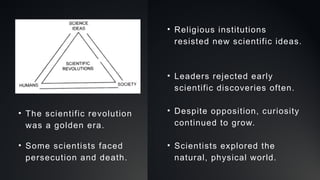
• The scientificrevolution
was a golden era.
• Some scientists faced
persecution and death.
• Religious institutions
resisted new scientific ideas.
• Leaders rejected early
scientific discoveries often.
• Despite opposition, curiosity
continued to grow.
• Scientists explored the
natural, physical world.
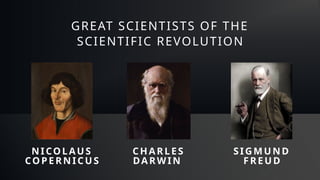
GREAT SCIENTISTS OFTHE
SCIENTIFIC REVOLUTION
NICOLAUS
COPERNICUS
CHARLES
DARWIN
SIGMUND
FREUD
13.
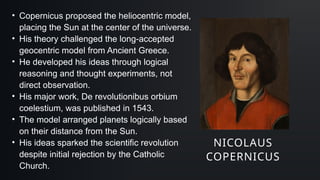
NICOLAUS
COPERNICUS
• Copernicus proposedthe heliocentric model,
placing the Sun at the center of the universe.
• His theory challenged the long-accepted
geocentric model from Ancient Greece.
• He developed his ideas through logical
reasoning and thought experiments, not
direct observation.
• His major work, De revolutionibus orbium
coelestium, was published in 1543.
• The model arranged planets logically based
on their distance from the Sun.
• His ideas sparked the scientific revolution
despite initial rejection by the Catholic
Church.
14.
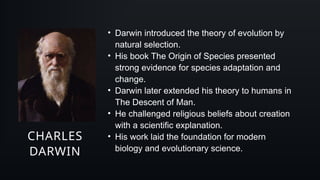
CHARLES
DARWIN
• Darwin introducedthe theory of evolution by
natural selection.
• His book The Origin of Species presented
strong evidence for species adaptation and
change.
• Darwin later extended his theory to humans in
The Descent of Man.
• He challenged religious beliefs about creation
with a scientific explanation.
• His work laid the foundation for modern
biology and evolutionary science.
15.
SIGMUND
FREUD
• Freud foundedpsychoanalysis, a method to
study the unconscious mind.
• He used observation and introspection to
understand human behavior.
• His theories explained psychological disorders
beyond the reach of traditional medicine.
• Freud emphasized the roles of sexuality and
unconscious desires in human actions.
• His ideas were controversial but revolutionized
views on mental health.
• Freud’s work influenced psychology,
philosophy, literature, and modern therapy.
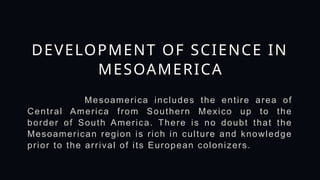
Mesoamerica includes theentire area of
Central America from Southern Mexico up to the
border of South America. There is no doubt that the
Mesoamerican region is rich in culture and knowledge
prior to the arrival of its European colonizers.
DEVELOPMENT OF SCIENCE IN
MESOAMERICA
18.
MAYA CIVILIZATION
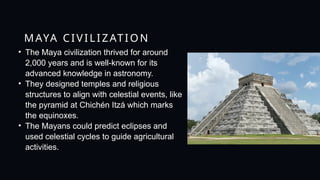
• TheMaya civilization thrived for around
2,000 years and is well-known for its
advanced knowledge in astronomy.
• They designed temples and religious
structures to align with celestial events, like
the pyramid at Chichén Itzá which marks
the equinoxes.
• The Mayans could predict eclipses and
used celestial cycles to guide agricultural
activities.
19.
MAYA CIVILIZATION
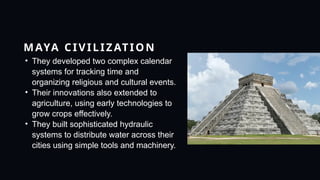
• Theydeveloped two complex calendar
systems for tracking time and
organizing religious and cultural events.
• Their innovations also extended to
agriculture, using early technologies to
grow crops effectively.
• They built sophisticated hydraulic
systems to distribute water across their
cities using simple tools and machinery.
20.
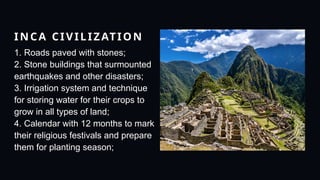
INCA CIVILIZATION
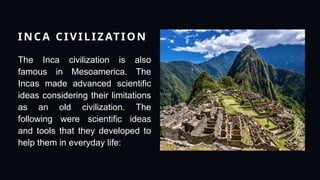
The Incacivilization is also
famous in Mesoamerica. The
Incas made advanced scientific
ideas considering their limitations
as an old civilization. The
following were scientific ideas
and tools that they developed to
help them in everyday life:
21.
INCA CIVILIZATION
1. Roadspaved with stones;
2. Stone buildings that surmounted
earthquakes and other disasters;
3. Irrigation system and technique
for storing water for their crops to
grow in all types of land;
4. Calendar with 12 months to mark
their religious festivals and prepare
them for planting season;
22.
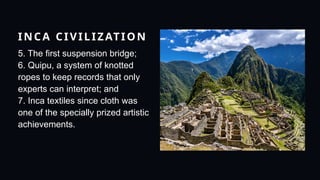
INCA CIVILIZATION
5. Thefirst suspension bridge;
6. Quipu, a system of knotted
ropes to keep records that only
experts can interpret; and
7. Inca textiles since cloth was
one of the specially prized artistic
achievements.
23.
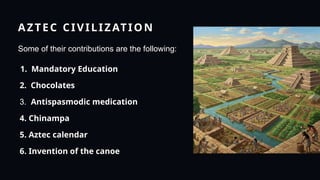
AZTEC CIVILIZATION
Some oftheir contributions are the following:
1. Mandatory Education
2. Chocolates
3. Antispasmodic medication
4. Chinampa
5. Aztec calendar
6. Invention of the canoe
24.
DEVELOPMENT OF
SCIENCE INASIA
Asia, the largest continent, has been home to many
ancient civilizations that greatly contributed to science,
technology, and mathematics. Notably, India, China,
and Middle Eastern civilizations made significant
advancements that shaped the development of
knowledge in their time.
25.
INDIA
• Geography andMetallurgy
• Medicine
• Early Mathematics
• Famous Mathematicians
• Legacy in Math and Science
26.
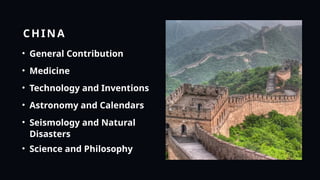
CHINA
• General Contribution
•Medicine
• Technology and Inventions
• Astronomy and Calendars
• Seismology and Natural
Disasters
• Science and Philosophy
27.
MIDDLE EAST COUNTRIES
•Golden Age of Islam
• Optics - Ibn al-Haytham
• Mathematics - Al-Khwarizmi
• Chemistry - Jabir Ibn Hayyan
• Medicine - Ibn Sina
• Legacy and Decline
28.
Africa, rich innatural and mineral resources, developed
science and mathematics long before European
colonization. Like other ancient civilizations, early African
societies were also creators of knowledge.
DEVELOPMENT OF
SCIENCE IN AFRICA
29.
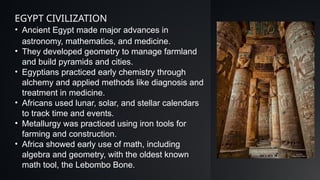
• Ancient Egyptmade major advances in
astronomy, mathematics, and medicine.
• They developed geometry to manage farmland
and build pyramids and cities.
• Egyptians practiced early chemistry through
alchemy and applied methods like diagnosis and
treatment in medicine.
• Africans used lunar, solar, and stellar calendars
to track time and events.
• Metallurgy was practiced using iron tools for
farming and construction.
• Africa showed early use of math, including
algebra and geometry, with the oldest known
math tool, the Lebombo Bone.
EGYPT CIVILIZATION
30.
SUMMARY
The Scientific Revolutionwas a golden age in science that marked the
beginning of modern scientific thought. Introducing methods focusing
on experiments and data. Giving rise to discoveries that changed how
people viewed the world, inspiring critical thinking and innovation.
Even before this revolution, various civilizations contributed to
science. Creating tools, studied stars, built structures, used
mathematics and medicine to solve everyday problems. Science
helped these societies grow and better understand the world around
them.
31.
THANK YOU
F OR L I S T E N I N G
A L A S , R U T H A B I G AY L E L .
G A N Z O N , J U L I E A N N G .
S I M A G A L A , C L A R I N D A