Intellectual
Revolution that
Defined Society
Introduction
Scientists are inspired by their curiosity, critical thinking, and creativity to explore the
physical and natural world. Their love for science is driven by their deep passion to know
and to discover. To comprehend what happened during the scientific revolution, it is
advisable to examine the different scientists whose ideas have shaken and contested the
dominant theories and ideas during this period-the truths of their time.
Creativity
Curiosity
Critical thinking
Scientists
Passion to know
Passion to discover
Eagerness to share
Scientific
knowledge
Scientific
discoveries and
practice
Technology
Scientists are doing ordinary people doing extra ordinary things for human kind in spite of all the predicaments and
challenges they experience, they never stopped experimenting, theorizing, and discovering new knowledge and ideas
Copernican
- In 1500, Copernicus idea and model of the universe was
fundamentally completed. The publication of his book De
revolution or bium coelestium (on the Revolution of the
heavenly spheres) in 1543 is often cited as the start of the
specific revolution. Copernicus model automatically
positioned the plannets into a logical sequence. The
moon, however, would still be seen orbiting the earth.
In this model, Copernicus outlined two kinds of planetary
motion:
•The orbits of Venus and Mercury lay inside the orbit of the
Earth, thus, closer to the Sun;
•The orbits of Mars, Saturn, and Jupiter lay outside the
Earth's orbit, thus, father from the sun.
Darwinian
- In 1589, Darwin published his book The origin of spicies, which is
considered most scientific important work in scientific literature.
Darwin collected significant data to support his theory with over
whelming evidence it is book presented pieces of evidence on how
species evolved over time.
Darwin's skills as a scientist moved beyond the realm of plants and
animals into the realm of humans . His book , the descent of man, was
impressive yet very controversial. Darwin's theory of evolution
scientifically introduce the idea that all organic life, including human
beings, under the realm of evolutionary thinking . This superseded the
prevailing religious or biblical views that God created human beings.
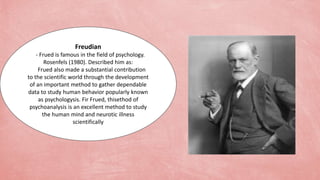
Freudian
- Frued is famous in the field of psychology.
Rosenfels (1980). Described him as:
Frued also made a substantial contribution
to the scientific world through the development
of an important method to gather dependable
data to study human behavior popularly known
as psychologysis. Fir Frued, thisethod of
psychoanalysis is an excellent method to study
the human mind and neurotic illness
scientifically
In simple terms, Sigmund Freud's theory
suggests that human behavior is influenced by
unconscious memories, thoughts, and urges. This
theory also proposes that the psyche comprises
three aspects: the I'd, ego, and super ego. The
I'd is entirely unconscious, while the ego
operates in the conscious mind.
The Incan civilization is also renowned in Mesoamerica. They developed scientific ideas and technology such as:
1. Building roads covered with stones;
2. Constructing stone structure that could survive earthquakes and others natural calamities;
3. Developing quipu, a system of knotted ropes to keep records that only experts can interpret;
4. Inventing a calendar with 12months to mark their religious festivals and prepare then planting season;
5. Developing irrigation system and technique for storing water for their crops to grow in all types of lands;
6. Building the first suspension bridge; and
7. Creating Inca textiles.
Following the Inca, the Aztec civilization has also creative extensive contribution to science and technology.some of their contributions are the
following:
1. Mandatory Education
2. Antispasmodic Medication
3. Chinampa
4. Invention of the canoe
5. Chocolates
7. Aztec calendar
Mesoamerica
Mesoamerica covers the entire area of central America, from southern Mexico up to the boarder of South America. In Meso-America the Maya civilization made
the greatest progress in science and technology. Among its innovations were the position-value number system with zero, the development of the most accurate
known calendar,the invention of rubber and the corbelled arch. The Mayan civilization is one of the prominent civilization during the ancient period that lasted for
approximately 2000 years.
Sigmund Freud was an Austrian neurologist and the
founder of psychoanalysis, a clinical method for treating
psychopathology through dialogue between a patient
and a psychoanalyst. He developed several theories,
including the concepts of the unconscious mind, the
Oedipus complex, and defense mechanisms like
repression. Freud's work had a significant impact on
psychology and continues to influence fields such as
psychiatry, anthropology, and literature.
Asia, the Largest continent in the world, is
the home of several ancient civilizations. It
is a home to diverse cultural, economic,
scientific, and political Activities. There are
civilizations that are known in the fields of
sciences, technology and mathematics,
such as India, China, and the middle East
civilization.
Asian
India
The Indians had creatively developed useful
ideas and technologist.
China
China is among the ancient
civilizations with considerable
contribution to areas like medicine,
astronomy, science, mathematics, art,
philosophy, and music among others.
In astronomy, the Chinese recorded
and preserved several data on
supernovas, lunar and solar eclipses,
and comets, to understand better the
heavenly bodies and their effects to the
world..
Middle East
This led to the introduction of the scientific
method in the Muslim world.
In medicine, Ibn sina founded the science of
experimental medicine and was the first
physician to conduct clinical trials (jacquard
2008).
There are more Muslim scholars in the field of
science, mathematics, astronomy, philosophy,
and even in the field of social science.
Reporters:
JOVANIE M. CALVO
JANUARY DE CASTRO NAQUE
MARY GRACE ALVARADO
JENELYN BUCAY SOMAOY
JAYLOURD BACTONG
LEAH LOZADA
CRISCHEL AVILA DEQUINION
JAKE SIMOGAN
Thank you
very much!

Science and Technology PUBLIC ADMINISTRA

  • 1.
  • 2.
    Introduction Scientists are inspiredby their curiosity, critical thinking, and creativity to explore the physical and natural world. Their love for science is driven by their deep passion to know and to discover. To comprehend what happened during the scientific revolution, it is advisable to examine the different scientists whose ideas have shaken and contested the dominant theories and ideas during this period-the truths of their time. Creativity Curiosity Critical thinking Scientists Passion to know Passion to discover Eagerness to share Scientific knowledge Scientific discoveries and practice Technology
  • 3.
    Scientists are doingordinary people doing extra ordinary things for human kind in spite of all the predicaments and challenges they experience, they never stopped experimenting, theorizing, and discovering new knowledge and ideas Copernican - In 1500, Copernicus idea and model of the universe was fundamentally completed. The publication of his book De revolution or bium coelestium (on the Revolution of the heavenly spheres) in 1543 is often cited as the start of the specific revolution. Copernicus model automatically positioned the plannets into a logical sequence. The moon, however, would still be seen orbiting the earth.
  • 4.
    In this model,Copernicus outlined two kinds of planetary motion: •The orbits of Venus and Mercury lay inside the orbit of the Earth, thus, closer to the Sun; •The orbits of Mars, Saturn, and Jupiter lay outside the Earth's orbit, thus, father from the sun.
  • 5.
    Darwinian - In 1589,Darwin published his book The origin of spicies, which is considered most scientific important work in scientific literature. Darwin collected significant data to support his theory with over whelming evidence it is book presented pieces of evidence on how species evolved over time. Darwin's skills as a scientist moved beyond the realm of plants and animals into the realm of humans . His book , the descent of man, was impressive yet very controversial. Darwin's theory of evolution scientifically introduce the idea that all organic life, including human beings, under the realm of evolutionary thinking . This superseded the prevailing religious or biblical views that God created human beings.
  • 7.
    Freudian - Frued isfamous in the field of psychology. Rosenfels (1980). Described him as: Frued also made a substantial contribution to the scientific world through the development of an important method to gather dependable data to study human behavior popularly known as psychologysis. Fir Frued, thisethod of psychoanalysis is an excellent method to study the human mind and neurotic illness scientifically
  • 8.
    In simple terms,Sigmund Freud's theory suggests that human behavior is influenced by unconscious memories, thoughts, and urges. This theory also proposes that the psyche comprises three aspects: the I'd, ego, and super ego. The I'd is entirely unconscious, while the ego operates in the conscious mind.
  • 10.
    The Incan civilizationis also renowned in Mesoamerica. They developed scientific ideas and technology such as: 1. Building roads covered with stones; 2. Constructing stone structure that could survive earthquakes and others natural calamities; 3. Developing quipu, a system of knotted ropes to keep records that only experts can interpret; 4. Inventing a calendar with 12months to mark their religious festivals and prepare then planting season; 5. Developing irrigation system and technique for storing water for their crops to grow in all types of lands; 6. Building the first suspension bridge; and 7. Creating Inca textiles. Following the Inca, the Aztec civilization has also creative extensive contribution to science and technology.some of their contributions are the following: 1. Mandatory Education 2. Antispasmodic Medication 3. Chinampa 4. Invention of the canoe 5. Chocolates 7. Aztec calendar Mesoamerica Mesoamerica covers the entire area of central America, from southern Mexico up to the boarder of South America. In Meso-America the Maya civilization made the greatest progress in science and technology. Among its innovations were the position-value number system with zero, the development of the most accurate known calendar,the invention of rubber and the corbelled arch. The Mayan civilization is one of the prominent civilization during the ancient period that lasted for approximately 2000 years.
  • 11.
    Sigmund Freud wasan Austrian neurologist and the founder of psychoanalysis, a clinical method for treating psychopathology through dialogue between a patient and a psychoanalyst. He developed several theories, including the concepts of the unconscious mind, the Oedipus complex, and defense mechanisms like repression. Freud's work had a significant impact on psychology and continues to influence fields such as psychiatry, anthropology, and literature.
  • 12.
    Asia, the Largestcontinent in the world, is the home of several ancient civilizations. It is a home to diverse cultural, economic, scientific, and political Activities. There are civilizations that are known in the fields of sciences, technology and mathematics, such as India, China, and the middle East civilization. Asian
  • 13.
    India The Indians hadcreatively developed useful ideas and technologist. China China is among the ancient civilizations with considerable contribution to areas like medicine, astronomy, science, mathematics, art, philosophy, and music among others. In astronomy, the Chinese recorded and preserved several data on supernovas, lunar and solar eclipses, and comets, to understand better the heavenly bodies and their effects to the world..
  • 14.
    Middle East This ledto the introduction of the scientific method in the Muslim world. In medicine, Ibn sina founded the science of experimental medicine and was the first physician to conduct clinical trials (jacquard 2008). There are more Muslim scholars in the field of science, mathematics, astronomy, philosophy, and even in the field of social science.
  • 15.
    Reporters: JOVANIE M. CALVO JANUARYDE CASTRO NAQUE MARY GRACE ALVARADO JENELYN BUCAY SOMAOY JAYLOURD BACTONG LEAH LOZADA CRISCHEL AVILA DEQUINION JAKE SIMOGAN
  • 16.