WELCOME TO
Básico - 2
UNIT 3 - VOCABULARY
 What’s new?
 Actually, I have some good news.
 That’s great.
 Congratulations.
 Thanks!
 Actually, I have some bad news.
 [My sister] just got [divorced].
 I’m sorry to hear that. Is [she] OK?
 Thanks for asking.
 So tell me about [her fiancé].
 Do you come from a large family?
 Not really. I have [one brother].
 What about [cousins]?
 I have [three aunts] on [my father’s] side.
 That’s pretty big!
 Do you have any [grandchildren]?
 How many [children] does your [son] have?
 Do you look alike?
 How are you similar?
 How are you different?
 Do you both [like rock music]?
 Do you [wear] the same kind of [clothes]?
 Do you [listen to] different kinds of [music]?
Vocabulary UNIT 3
THE SIMPLE PRESENT TENSE
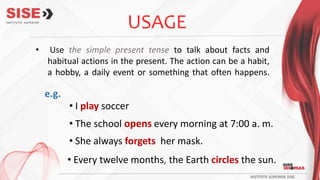
USAGE
e.g.
• Use the simple present tense to talk about facts and
habitual actions in the present. The action can be a habit,
a hobby, a daily event or something that often happens.
• I play soccer
• The school opens every morning at 7:00 a. m.
• She always forgets her mask.
• Every twelve months, the Earth circles the sun.
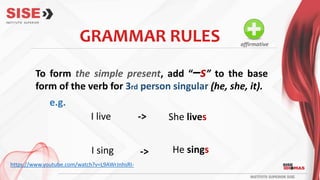
GRAMMAR RULES
To form the simple present, add “–s” to the base
form of the verb for 3rd person singular (he, she, it).
I live She lives
I sing
->
He sings
->
e.g.
affirmative
https://www.youtube.com/watch?v=L9AWrJnhsRI-
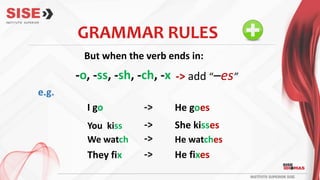
But when the verb ends in:
GRAMMAR RULES
-o, -ss, -sh, -ch, -x -> add “–es”
e.g.
I go He goes
->
You kiss She kisses
->
We watch He watches
->
They fix He fixes
->
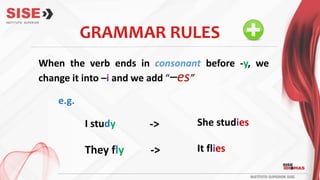
When the verb ends in consonant before -y, we
change it into –i and we add “–es”
GRAMMAR RULES
I study She studies
->
e.g.
They fly It flies
->
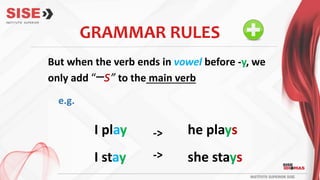
But when the verb ends in vowel before -y, we
only add “–s” to the main verb
I play
I stay
he plays
she stays
->
->
e.g.
GRAMMAR RULES
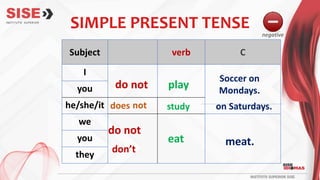
Subject verb C
I
you
he/she/it
we
you
they
do not
do not
does
don’t
Soccer on
Mondays.
meat.
not
play
study
eat
on Saturdays.
SIMPLE PRESENT TENSE negative
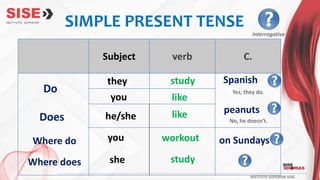
Subject verb C.
Do
Does
Where do
Where does
Spanish
study
like
peanuts
like
on Sundays
you
she
workout
study
he/she
you
they
SIMPLE PRESENT TENSE
interrogative
Yes, they do.
No, he doesn’t.
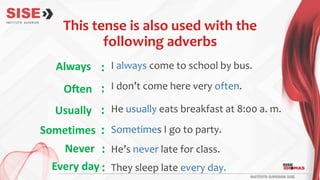
This tense is also used with the
following adverbs
Always
Often
Usually
Sometimes
Never
Every day
I always come to school by bus.
I don’t come here very often.
He usually eats breakfast at 8:00 a. m.
Sometimes I go to party.
He’s never late for class.
They sleep late every day.
:
:
:
:
:
:
LET’S
PRACTICE!
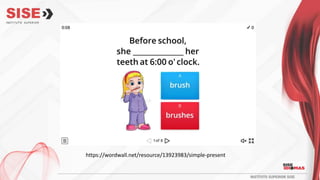
https://wordwall.net/resource/13923983/simple-present
REFERENCES
Saslow, J. & Ascher, A. (2015). Top Notch: English for Today’s World Level 1 (3rd ed.) [ebook]. Pearson
Education.
Wordwall. Simple present. From https://wordwall.net/resource/13923983/simple-present
THANK YOU

BÁSICO-2-UNIT-3.pptx

  • 1.
  • 2.
    UNIT 3 -VOCABULARY
  • 3.
     What’s new? Actually, I have some good news.  That’s great.  Congratulations.  Thanks!  Actually, I have some bad news.  [My sister] just got [divorced].  I’m sorry to hear that. Is [she] OK?  Thanks for asking.  So tell me about [her fiancé].  Do you come from a large family?  Not really. I have [one brother].  What about [cousins]?  I have [three aunts] on [my father’s] side.  That’s pretty big!  Do you have any [grandchildren]?  How many [children] does your [son] have?  Do you look alike?  How are you similar?  How are you different?  Do you both [like rock music]?  Do you [wear] the same kind of [clothes]?  Do you [listen to] different kinds of [music]? Vocabulary UNIT 3
  • 4.
  • 5.
    USAGE e.g. • Use thesimple present tense to talk about facts and habitual actions in the present. The action can be a habit, a hobby, a daily event or something that often happens. • I play soccer • The school opens every morning at 7:00 a. m. • She always forgets her mask. • Every twelve months, the Earth circles the sun.
  • 6.
    GRAMMAR RULES To formthe simple present, add “–s” to the base form of the verb for 3rd person singular (he, she, it). I live She lives I sing -> He sings -> e.g. affirmative https://www.youtube.com/watch?v=L9AWrJnhsRI-
  • 7.
    But when theverb ends in: GRAMMAR RULES -o, -ss, -sh, -ch, -x -> add “–es” e.g. I go He goes -> You kiss She kisses -> We watch He watches -> They fix He fixes ->
  • 8.
    When the verbends in consonant before -y, we change it into –i and we add “–es” GRAMMAR RULES I study She studies -> e.g. They fly It flies ->
  • 9.
    But when theverb ends in vowel before -y, we only add “–s” to the main verb I play I stay he plays she stays -> -> e.g. GRAMMAR RULES
  • 10.
    Subject verb C I you he/she/it we you they donot do not does don’t Soccer on Mondays. meat. not play study eat on Saturdays. SIMPLE PRESENT TENSE negative
  • 11.
    Subject verb C. Do Does Wheredo Where does Spanish study like peanuts like on Sundays you she workout study he/she you they SIMPLE PRESENT TENSE interrogative Yes, they do. No, he doesn’t.
  • 12.
    This tense isalso used with the following adverbs Always Often Usually Sometimes Never Every day I always come to school by bus. I don’t come here very often. He usually eats breakfast at 8:00 a. m. Sometimes I go to party. He’s never late for class. They sleep late every day. : : : : : :
  • 13.
  • 14.
  • 15.
    REFERENCES Saslow, J. &Ascher, A. (2015). Top Notch: English for Today’s World Level 1 (3rd ed.) [ebook]. Pearson Education. Wordwall. Simple present. From https://wordwall.net/resource/13923983/simple-present
  • 16.