BSC IT cloud subject ppt from Centurion University
1.
BY :
LAT ALOUKIKSWAIN
REGD NO. 230704140004
BRANCH: B.Sc IT 3RD
SEM
SUB : CLOUD PRACTITIONERS (CUTM 1892)
GUIDED BY : PARTHA SARATHI PRADHAN
VIRTUAL PRIVATE CLOUD (VPC) IN AWS
2.
INTRODUCTION
Amazon Virtual PrivateCloud (Amazon VPC) is a service that lets you launch AWS
resources in a logically isolated virtual network that you define. You have complete
control over your virtual networking environment, including selection of your own
IP address range, creation of subnets, and configuration of route tables and
network gateways. You can use both IPv4 and IPv6 for most resources in your
virtual private cloud, helping to ensure secure and easy access to resources and
applications.
3.
COMPONENTS OF VPC
•SUBNETS: These are regional resources in aws cloud.That divide the larger
network within vpc into smaller segments allowing smooth flow of traffic It can
also be used to isolate a network within the vpc.
• ROUTE TABLES: It is a set of rules in a VPC that determines where network traffic
is directed. Each rule in a route table specifies a destination (such as a subnet or
an external network) and the path that traffic should take to reach it. Route tables
ensure that traffic within the VPC is routed correctly between subnets, the
internet, or other networks.
• INTERNET GATEWAY: An Internet Gateway (IGW) is a component that allows
resources within a Virtual Private Cloud (VPC) to communicate with the internet.
It provides a path for internet traffic to flow in and out of public subnets in the
VPC. Basically they control the flow of internet.
4.
NETWORK ACCESS CONTROLLIST: A Network Access Control List (ACL) is an optional
security layer in a VPC that acts as a virtual firewall to control inbound and
outbound traffic at the subnet level. It allows or denies specific IP addresses or
ranges based on defined rules.
Network ACLs are especially useful for adding an extra layer of security to control
traffic flow between different subnets or to restrict certain IP ranges.
SECURITY GROUPS: It is a virtual firewall for controlling inbound and outbound
traffic to and from instances within a VPC. Unlike Network ACLs, which operate at
the subnet level, security groups are applied directly to individual instances, offering
instance-level security
5.
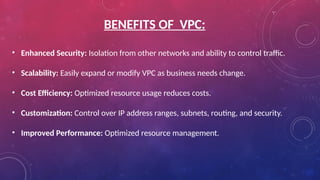
BENEFITS OF VPC:
•Enhanced Security: Isolation from other networks and ability to control traffic.
• Scalability: Easily expand or modify VPC as business needs change.
• Cost Efficiency: Optimized resource usage reduces costs.
• Customization: Control over IP address ranges, subnets, routing, and security.
• Improved Performance: Optimized resource management.
6.
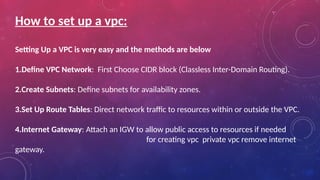
How to setup a vpc:
Setting Up a VPC is very easy and the methods are below
1.Define VPC Network: First Choose CIDR block (Classless Inter-Domain Routing).
2.Create Subnets: Define subnets for availability zones.
3.Set Up Route Tables: Direct network traffic to resources within or outside the VPC.
4.Internet Gateway: Attach an IGW to allow public access to resources if needed
for creating vpc private vpc remove internet
gateway.
Use cases ofvpc:
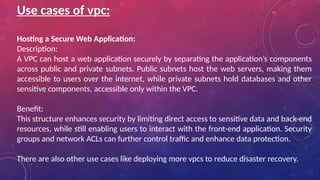
Hosting a Secure Web Application:
Description:
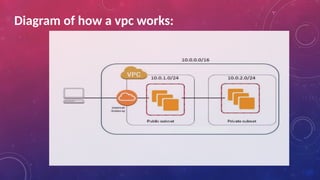
A VPC can host a web application securely by separating the application’s components
across public and private subnets. Public subnets host the web servers, making them
accessible to users over the internet, while private subnets hold databases and other
sensitive components, accessible only within the VPC.
Benefit:
This structure enhances security by limiting direct access to sensitive data and back-end
resources, while still enabling users to interact with the front-end application. Security
groups and network ACLs can further control traffic and enhance data protection.
There are also other use cases like deploying more vpcs to reduce disaster recovery.