An MM Activ Publication | www.BioSpectrumAsia.com | June 2016 | BioSpectrum 3
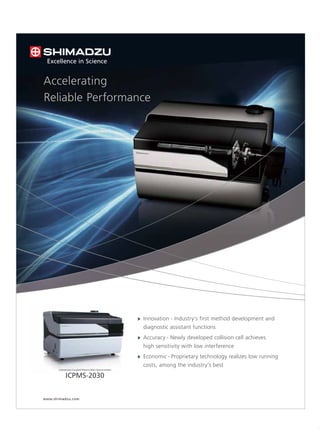
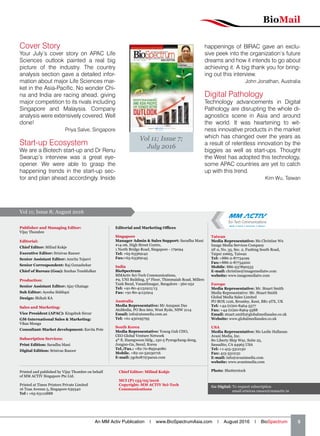
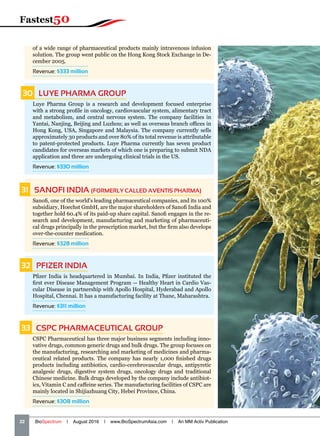
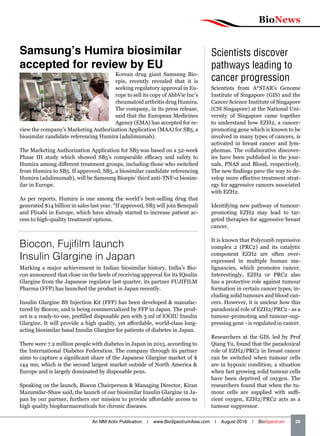
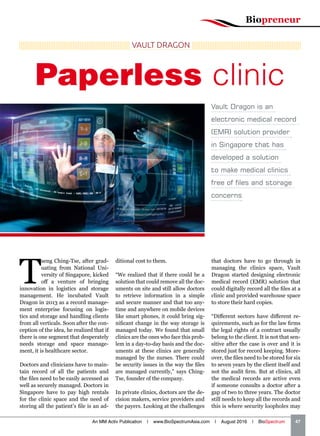
Inductively Coupled Plasma Mass Spectrometer
ICPMS-2030
Innovation - Industry's first method development and
diagnostic assistant functions
Accuracy - Newly developed collision cell achieves
high sensitivity with low interference
Economic - Proprietary technology realizes low running
costs, among the industry’s best
0
10
20
30
40
50
60
70
80
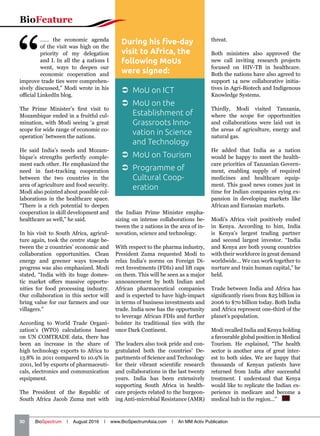
EFC+ Control Day 13 Day 9 Day 5
G0F
G1F_1
G1F_2
G2F
Mann5/A1F
Day of transition from EFC+ to GTC+
%Relativequantity
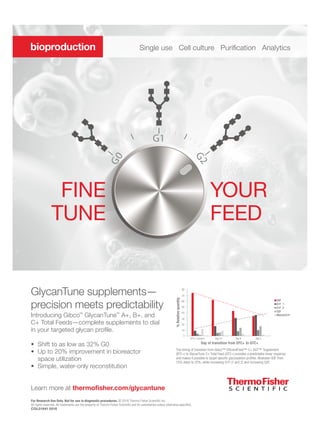
GlycanTune supplements—
precision meets predictability
Introducing Gibco™
GlycanTune™
A+, B+, and
C+ Total Feeds—complete supplements to dial
in your targeted glycan profile.
• Shift to as low as 32% G0
• Up to 20% improvement in bioreactor
space utilization
• Simple, water-only reconstitution
Learn more at thermofisher.com/glycantune
For Research Use Only. Not for use in diagnostic procedures. © 2016 Thermo Fisher Scientific Inc.
All rights reserved. All trademarks are the property of Thermo Fisher Scientific and its subsidiaries unless otherwise specified.
COL01841 0516
bioproduction Single use Cell culture Purification Analytics
FINE
TUNE
YOUR
FEED
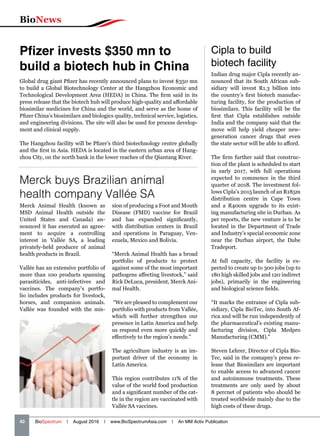
The timing of transition from Gibco™ EfficientFeed™ C+ AGT™ Supplement
(EFC+) to GlycanTune C+ Total Feed (GTC+) provides a predictable linear response
and makes it possible to target specific glycosylation profiles. Modulate G0F from
75% down to 32%, while increasing G1F (1 and 2) and increasing G2F.
BioEdit
4   BioSpectrum | August 2016 | www.BioSpectrumAsia.com | An MM Activ Publication
A
Deloitte report
has predicted
that in 2016 life
sciences com-
panies will have to face
challenges emanating not
only from increasing global
market place but they will
also have to address region
specific issues. One such
issue that is expected to
have an impact on the sec-
tor is Brexit. Its outcome
is expected to multiply the
challenges for life sciences,
healthcare sector in APAC
region in the near future when UK will actu-
ally move out of European Union.
Among the various repercussions one is
related to regulatory processes and market
authorization of drugs. With UK withdraw-
ing from EU after two years what would be
the procedure for drug regulation and mar-
ket authorization. For companies export-
ing drugs to EU this assumes significance
since they may have to acquire two market
authorisations, one for EU and another for
UK, instead of the present common one,
complicating the procedure, which may re-
sult in delay.
Another important issue is related to pass-
porting rights among EU member countries
which allows companies in one member
country to sell services in any member state.
But with UK parting company from EU the
companies cannot use their passports in
other EU member countries. This will be
problematic for companies from Asia Pacific
region which enter Europe through their UK
subsidiaries. They will have to set up estab-
lishments in one of the EU member coun-
tries in addition to UK.
There is possibility that as a part of Brexit
negotiation passporting rights will continue.
But it is all unclear. Much depends on the
type of relationship UK maintains with EU
– if it joins European Economic Area (EEA)
or joins European Free Trade Association
(EFTA) or completely distances itself from
EU. Clarity on the issue will be visible when
UK parts away from EU.
The third issue relates to free trade agree-
ments that several Asia Pacific countries
have or are negotiating with EU. South Ko-
rea signed FTA with EU in 2010, Australia
and New Zealand are in initial stages of ex-
ploring FTAs with EU. For New Zealand,
EU is one of the largest trading partner and
for Australia EU is the second largest trad-
ing partner. With UK out of EU the existing
FTAs will have to be renegotiated and the
ongoing negotiations may be delayed and
independent FTAs will have to be negotiated
with UK. China too would have problem on
this front as UK was strongly backing China-
EU FTA. But, now with UK out of EU, China
does not have supporters with EU members
for the FTA. The new, renegotiated FTAs
will certainly have impact on trading in
healthcare and life sciences sector.
However, on exit even UK would have to
negotiate separate FTAs with Asia Pacific
countries. This is likely to benefit Asia Pacif-
ic region and its business as UK, which will
be isolated from EU, may like to have strong
trade relationships in the region.
This has added additional level of uncertain-
ty for business in Asia Pacific and in turn to
life sciences and healthcare sectors. This un-
certainty, which is caused by developments
in European region, may pose some chal-
lenges for Asia Pacific for some time.  BS
Milind Kokje
Chief Editor
milind.kokje@mmactiv.in
U ncertainty Ahead
BioMail
An MM Activ Publication | www.BioSpectrumAsia.com | August 2016 | BioSpectrum    5
Cover Story
Your July’s cover story on APAC Life
Sciences outlook painted a real big
picture of the industry. The country
analysis section gave a detailed infor-
mation about major Life Sciences mar-
ket in the Asia-Pacific. No wonder Chi-
na and India are racing ahead, giving
major competition to its rivals including
Singapore and Malaysia. Company
analysis were extensively covered. Well
done!
Priya Salve, Singapore
Start-up Ecosystem
We are a Biotech start-up and Dr Renu
Swarup’s interview was a great eye-
opener. We were able to grasp the
happening trends in the start-up sec-
tor and plan ahead accordingly. Inside
happenings of BIRAC gave an exclu-
sive peek into the organization’s future
dreams and how it intends to go about
achieving it. A big thank you for bring-
ing out this interview.
John Jonathan, Australia
Digital Pathology
Technology advancements in Digital
Pathology are disrupting the whole di-
agnostics scene in Asia and around
the world. It was heartening to wit-
ness innovative products in the market
which has changed over the years as
a result of relentless innovation by the
biggies as well as start-ups. Thought
the West has adopted this technology,
some APAC countries are yet to catch
up with this trend.
Kim Wu, Taiwan
Vol 11; Issue 7;
July 2016
Publisher and Managing Editor:
Vijay Thombre
Editorial:
Chief Editor: Milind Kokje
Executive Editor: Srinivas Rasoor
Senior Assistant Editor: Amrita Tejasvi
Senior Correspondent: Raj Gunashekar
Chief of Bureau (Goa): Suuhas Tenddulkar
Production:
Senior Assistant Editor: Ajay Ghatage
Sub Editor: Ayesha Siddiqui
Design: Shihab KA
Sales and Marketing:
Vice President (APAC): Kingshuk Sircar
GM-International Sales & Marketing:
Vikas Monga
Consultant-Market development: Kavita Pote
Subscription Services:
Print Edition: Saradha Mani
Digital Edition: Srinivas Rasoor
Editorial and Marketing Offices
Singapore
Manager Admin & Sales Support: Saradha Mani
#14-06, High Street Centre,
1 North Bridge Road, Singapore - 179094
Tel: +65-63369142
Fax:+65-63369145
India
BioSpectrum
MMActiv Sci-Tech Communications,
#9, UNI Building, 3rd
Floor, Thimmaiah Road, Millers
Tank Bund, Vasanthnagar, Bangalore - 560 052
Tel: +91-80-41131912/13
Fax: +91-80-41131914
Australia
Media Representative: Mr Anupam Das
AtsMedia, PO Box 660, West Ryde, NSW 2114
Email: info@atsmedia.com.au
Tel: +61-430195795
South Korea
Media Representative: Young Guk CHO,
CEO Global Venture Network
4th
fl, Haengwoon bldg., 150-5 Pyungchang-dong,
Jongno-Gu, Seoul, Korea
Tel./Fax.: +82-70-89504080
Mobile. +82-10-52030716
E-mail: ygcho87@paran.com
Printed and published by Vijay Thombre on behalf
of MM ACTIV Singapore Pte Ltd.
Printed at Times Printers Private Limited
16 Tuas Avenue 5, Singapore 639340
Tel : +65-63112888
Chief Editor: Milind Kokje
MCI (P) 133/05/2016
Copyright: MM ACTIV Sci-Tech
Communications
Taiwan
Media Representative: Ms Christine Wu
Image Media Services Company
2F-2, No. 35, Sec. 2, Fushing South Road,
Taipei 10665, Taiwan
Tel: +886-2-87734199
Fax:+886-2-87734200
Mobile: 886-937890533
E-mail: christine@imagemediatw.com
website: www.imagemediatw.com
Europe
Media Representative: Mr. Stuart Smith
Global Media Sales Limited
PO BOX 1126, Bromley, Kent, BR1 9TX, UK
Tel: +44-(0)20-8464-5577
Fax: +44-(0)20-8464-5588
Email: stuart.smith@globalmediasales.co.uk
Website: www.globalmediasales.co.uk
USA
Media Representative: Ms Leslie Hallanan
Avani Media, Inc.
80 Liberty Ship Way, Suite 25,
Sausalito, CA 94965 USA
Tel: +1-415-3312150
Fax: 415-3312151
E-mail: info@avanimedia.com
website: www.avanimedia.com
Photo: Shutterstock
Go Digital: To request subscription
email srinivas.rasoor@mmactiv.in
Vol 11; Issue 8; August 2016
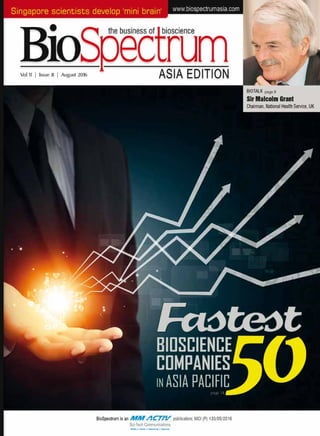
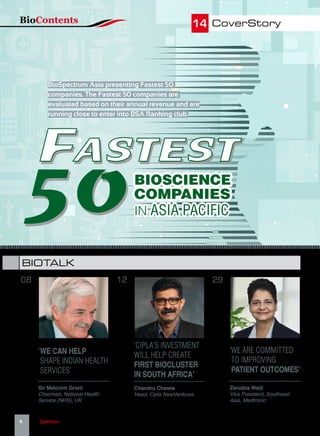
FASTEST
50
FASTEST
50
FASTEST
50
14 CoverStory
‘WE ARE COMMITTED
TO IMPROVING
PATIENT OUTCOMES’
‘WE CAN HELP
SHAPE INDIAN HEALTH
SERVICES’
Zenobia Walji
Vice President, Southeast
Asia, Medtronic
Sir Malcolm Grant
Chairman, National Health
Service (NHS), UK
2908
BIOTALK
BioSpectrum Asia presenting Fastest 50
companies. The Fastest 50 companies are
evaluated based on their annual revenue and are
running close to enter into BSA Ranking club.
BIOSCIENCE
COMPANIES
IN ASIA PACIFIC
‘CIPLA’S INVESTMENT
WILL HELP CREATE
FIRST BIOCLUSTER
IN SOUTH AFRICA’
Chandru Chawla
Head, Cipla NewVentures
12
BioContents
6   BioSpectrum | August 2016 | www.BioSpectrumAsia.com | An MM Activ Publication
32
BIOCLUSTER
A GATEWAY TO EUROPEAN MARKETS
Deep insights and happenings in Ireland’s Life Sciences sector, and why
Indian Pharma and Biotech companies should consider investing more in
Ireland than ever before.
REGULARS
BioEdit�����������������������������������������������������������������������������������������������������������������������04
BioMail����������������������������������������������������������������������������������������������������������������������05
BioNews�������������������������������������������������������������������������������������������������������������36
BioSuppliers������������������������������������������������������������������������������������������43
49
BIOSPECIAL
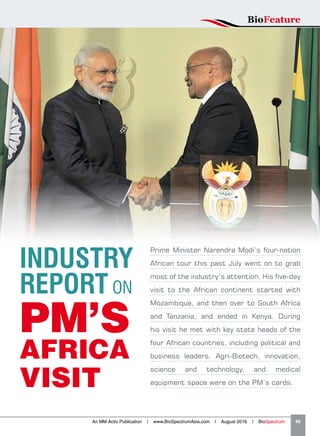
INDUSTRY REPORT ON
PM’S AFRICA VISIT
Prime Minister Narendra
Modi’s four-nation African
tour this past July went on to
grab most of the industry’s
attention.
27
BIOCOLUMN
GLOBAL BUSINESS
SERVICES A NEW
WAY FORWARD
FOR LIFE SCIENCES
COMPANIES
Ajay Sanganeria
Life Sciences Partner,
KPMG in Singapore
Juvanus Tjandra
Management Consulting Partner,
KPMG, Singapore
47
BIOPRENEUR
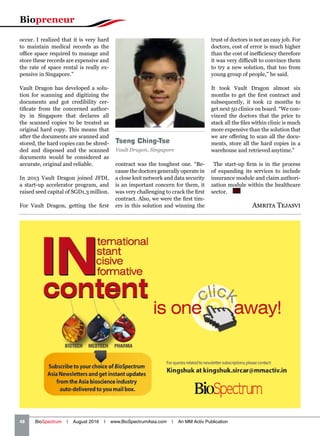
PAPERLESS CLINIC
is an electronic medical record (EMR) solution provider in Singapore that has
developed a solution to make medical clinics free of files and storage concerns
VAULT DRAGON
An MM Activ Publication | www.BioSpectrumAsia.com | August 2016 | BioSpectrum    7
8   BioSpectrum | August 2016 | www.BioSpectrumAsia.com | An MM Activ Publication
BioTalk
I
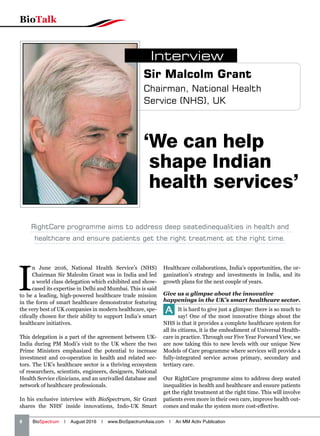
n June 2016, National Health Service’s (NHS)
Chairman Sir Malcolm Grant was in India and led
a world class delegation which exhibited and show-
cased its expertise in Delhi and Mumbai. This is said
to be a leading, high-powered healthcare trade mission
in the form of smart healthcare demonstrator featuring
the very best of UK companies in modern healthcare, spe-
cifically chosen for their ability to support India’s smart
healthcare initiatives.
This delegation is a part of the agreement between UK-
India during PM Modi’s visit to the UK where the two
Prime Ministers emphasized the potential to increase
investment and co-operation in health and related sec-
tors. The UK’s healthcare sector is a thriving ecosystem
of researchers, scientists, engineers, designers, National
Health Service clinicians, and an unrivalled database and
network of healthcare professionals.
In his exclusive interview with BioSpectrum, Sir Grant
shares the NHS’ inside innovations, Indo-UK Smart
Healthcare collaborations, India’s opportunities, the or-
ganization’s strategy and investments in India, and its
growth plans for the next couple of years.
Give us a glimpse about the innovative
happenings in the UK’s smart healthcare sector.
A It is hard to give just a glimpse: there is so much to
say! One of the most innovative things about the
NHS is that it provides a complete healthcare system for
all its citizens, it is the embodiment of Universal Health-
care in practice. Through our Five Year Forward View, we
are now taking this to new levels with our unique New
Models of Care programme where services will provide a
fully-integrated service across primary, secondary and
tertiary care.
Our RightCare programme aims to address deep seated
inequalities in health and healthcare and ensure patients
get the right treatment at the right time. This will involve
patients even more in their own care, improve health out-
comes and make the system more cost-effective.
‘We can help
shape Indian
health services’
Sir Malcolm Grant
Chairman, National Health
Service (NHS), UK
Interview
RightCare programme aims to address deep seatedinequalities in health and
healthcare and ensure patients get the right treatment at the right time.
ACTNOW
ANDGETACCESS
TO6MONTHS
ARCHIVALISSUES
FREE
*
Subscribe to digital edition in 3 easy steps:
1. Log in to digitalmagazines.mmactiv.in
2. Select your subscription option-
you can subscribe for 3/6/12 months
or buy a single issue
3. Register and complete your order
4. Read your BioSpectrum magazine on the go!
For more information contact priyamvada.bhide@mmactiv.in
Subscribe to
the Digital Edition
Your most trusted bioscience magazine
now available in digital format on
Windows Desktop
Find us on Facebook:
facebook.com/BioSpectrumMagazine
Follow us on Twitter:
twitter.com/BioSpectrumMag
Volume 13  Issue 3  March 2015 www.biospectrumindia.com
An Publication
`100
Totalpagesincludingcover68
Hot Biotech
Industry reacts
to Budget 2015
11Start-ups…
A year later
Debate still rages on GM crops
BIOSPECTRUM11HOTBIOTECHSTARTUPS-AYEARLATERMARCH2015
10   BioSpectrum | August 2016 | www.BioSpectrumAsia.com | An MM Activ Publication
BioTalk
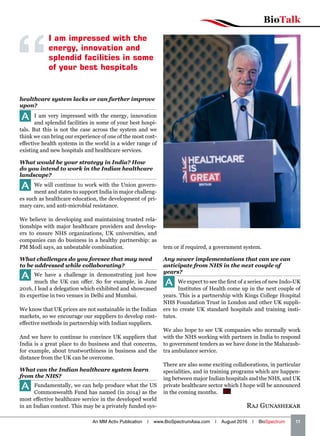
Our NHS digital programme promotes self-management
apps and systems for patients and confidential sharing of
data between professionals to make care more effective
and efficient. Our 1,00,000 Genomes Project puts the
UK in the forefront of developing personalised medicine
where genetic technology will mean patients get exactly
the right treatment they need and are not treated unnec-
essarily.
What is most exciting about the NHS is the day-to-day
innovation that goes on across our services: we see inno-
vative ways of keeping people from unnecessary visits or
admissions to hospital, reducing delays when a patient is
in hospital, or systems to ensure the right staff are always
in the right place. The UK offers one of the widest range
of tax incentives and specials funds to incentivise invest-
ment in our vibrant life sciences industry. Our industry
is at the forefront of discovery and innovation in, for ex-
ample, genomics, cellular biology and imaging physics.
This has given us 77 Nobel prizes for contributions to bio-
medical science.
What opportunities are available for the Indian
smart healthcare sector in the UK?
A We want to encourage Indian companies to work
with the NHS in solving the challenges faced by all
healthcare systems. One example of this are our NHS
Test Beds where innovative companies from across the
world will work with frontline NHS staff to pioneer and
evaluate novel combinations of interconnected devices
like wearable monitors, data analysis and ways of work-
ing to help patients stay well and monitor their condi-
tions at home. Five Test Beds have been announced so
far.
We welcome investment by Indian smart healthcare
companies into the UK, and provide incentives for them
to do so.
How do you think the UK can contribute in
shaping the Indian healthcare sector?
A In five main areas of building design and manage-
ment, effective clinical practice, top-class training,
specialist digital applications and whole system manage-
ment.
The UK has some of the best designers and engineers
for creating and managing healthcare buildings and fa-
cilities. These promote health and recovery for patients,
well-being for staff, and efficient for the funders. They
are sustainable buildings that reduce energy use and will
adapt to changes in climate and medical practice.
The UK is known for the highest quality clinical practice
informed by world class research, training, equipment
and systems. We can help shape Indian health services
to give the best outcomes and highest satisfaction for pa-
tients.
We also have top-class universities, colleges and train-
ing companies that can provide specialist post graduate
training for all professional staff in every speciality. We
can provide this online and face-to-face in India and the
UK.
The UK has innovative digital systems that collect rel-
evant data for managing the quality of clinical services,
and uses big data to ensure the right diagnosis; treat-
ments are given and services are efficient. Whilst India
has great digital innovations, the UK has some niche ap-
plications, for example, in telemedicine and creating safe
facilities.
We have experience in managing services for whole pop-
ulations of insured patients: whether behavioural inter-
ventions to promote health or systems, to ensure consis-
tently high standards of care are maintained.
What collaborations do you think India and
the UK healthcare sector needs to immediately
work upon?
A The UK can help design smart city health systems
that ensure people live and work in a healthy envi-
ronment and live a healthy lifestyle. We can show how
providing a range of accessible services reduces ill-health
and unnecessary use of hospital services.
We can work on systems to make hospitals top-class in
both quality and efficiency. We can partner with Indian
digital companies to bring specialist niche expertise to
make healthcare work better.
We recognize that most of the new investment is going
into the private sector and aim to work with investors,
developers and operators in this sector whilst maintain-
ing our supportive role with National and State govern-
ments.
According to you where do you think Indian
We welcome investment
by Indian smart
healthcare companies into
the UK
BioTalk
An MM Activ Publication | www.BioSpectrumAsia.com | August 2016 | BioSpectrum    11
Raj Gunashekar
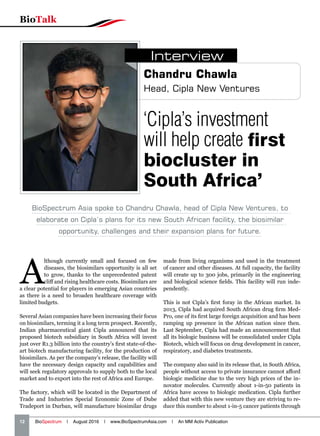
I am impressed with the
energy, innovation and
splendid facilities in some
of your best hospitals
healthcare system lacks or can further improve
upon?
A I am very impressed with the energy, innovation
and splendid facilities in some of your best hospi-
tals. But this is not the case across the system and we
think we can bring our experience of one of the most cost-
effective health systems in the world in a wider range of
existing and new hospitals and healthcare services.
What would be your strategy in India? How
do you intend to work in the Indian healthcare
landscape?
A We will continue to work with the Union govern-
ment and states to support India in major challeng-
es such as healthcare education, the development of pri-
mary care, and anti-microbial resistance.
We believe in developing and maintaining trusted rela-
tionships with major healthcare providers and develop-
ers to ensure NHS organizations, UK universities, and
companies can do business in a healthy partnership: as
PM Modi says, an unbeatable combination.
What challenges do you foresee that may need
to be addressed while collaborating?
A We have a challenge in demonstrating just how
much the UK can offer. So for example, in June
2016, I lead a delegation which exhibited and showcased
its expertise in two venues in Delhi and Mumbai.
We know that UK prices are not sustainable in the Indian
markets, so we encourage our suppliers to develop cost-
effective methods in partnership with Indian suppliers.
And we have to continue to convince UK suppliers that
India is a great place to do business and that concerns,
for example, about trustworthiness in business and the
distance from the UK can be overcome.
What can the Indian healthcare system learn
from the NHS?
A Fundamentally, we can help produce what the US
Commonwealth Fund has named (in 2014) as the
most effective healthcare service in the developed world
in an Indian context. This may be a privately funded sys-
tem or if required, a government system.
Any newer implementations that can we can
anticipate from NHS in the next couple of
years?
A We expect to see the first of a series of new Indo-UK
Institutes of Health come up in the next couple of
years. This is a partnership with Kings College Hospital
NHS Foundation Trust in London and other UK suppli-
ers to create UK standard hospitals and training insti-
tutes.
We also hope to see UK companies who normally work
with the NHS working with partners in India to respond
to government tenders as we have done in the Maharash-
tra ambulance service.
There are also some exciting collaborations, in particular
specialities, and in training programs which are happen-
ing between major Indian hospitals and the NHS, and UK
private healthcare sector which I hope will be announced
in the coming months.  BS
12   BioSpectrum | August 2016 | www.BioSpectrumAsia.com | An MM Activ Publication
BioTalk
A
lthough currently small and focused on few
diseases, the biosimilars opportunity is all set
to grow, thanks to the unprecedented patent
cliff and rising healthcare costs. Biosimilars are
a clear potential for players in emerging Asian countries
as there is a need to broaden healthcare coverage with
limited budgets.
Several Asian companies have been increasing their focus
on biosimilars, terming it a long term prospect. Recently,
Indian pharmaceutical giant Cipla announced that its
proposed biotech subsidiary in South Africa will invest
just over R1.3 billion into the country’s first state-of-the-
art biotech manufacturing facility, for the production of
biosimilars. As per the company’s release, the facility will
have the necessary design capacity and capabilities and
will seek regulatory approvals to supply both to the local
market and to export into the rest of Africa and Europe.
The factory, which will be located in the Department of
Trade and Industries Special Economic Zone of Dube
Tradeport in Durban, will manufacture biosimilar drugs
made from living organisms and used in the treatment
of cancer and other diseases. At full capacity, the facility
will create up to 300 jobs, primarily in the engineering
and biological science fields. This facility will run inde-
pendently.
This is not Cipla’s first foray in the African market. In
2013, Cipla had acquired South African drug firm Med-
Pro, one of its first large foreign acquisition and has been
ramping up presence in the African nation since then.
Last September, Cipla had made an announcement that
all its biologic business will be consolidated under Cipla
Biotech, which will focus on drug development in cancer,
respiratory, and diabetes treatments.
The company also said in its release that, in South Africa,
people without access to private insurance cannot afford
biologic medicine due to the very high prices of the in-
novator molecules. Currently about 1-in-50 patients in
Africa have access to biologic medication. Cipla further
added that with this new venture they are striving to re-
duce this number to about 1-in-5 cancer patients through
‘Cipla’s investment
will help create first
biocluster in
South Africa’
Chandru Chawla
Head, Cipla New Ventures
Interview
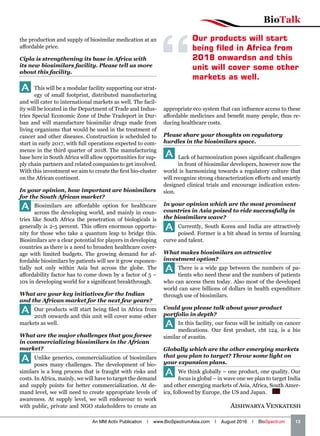
BioSpectrum Asia spoke to Chandru Chawla, head of Cipla New Ventures, to
elaborate on Cipla’s plans for its new South African facility, the biosimilar
opportunity, challenges and their expansion plans for future.
BioTalk
An MM Activ Publication | www.BioSpectrumAsia.com | August 2016 | BioSpectrum    13
the production and supply of biosimilar medication at an
affordable price.
Cipla is strengthening its base in Africa with
its new biosimilars facility. Please tell us more
about this facility.
A This will be a modular facility supporting our strat-
egy of small footprint, distributed manufacturing
and will cater to international markets as well. The facil-
ity will be located in the Department of Trade and Indus-
tries Special Economic Zone of Dube Tradeport in Dur-
ban and will manufacture biosimilar drugs made from
living organisms that would be used in the treatment of
cancer and other diseases. Construction is scheduled to
start in early 2017, with full operations expected to com-
mence in the third quarter of 2018. The manufacturing
base here in South Africa will allow opportunities for sup-
ply chain partners and related companies to get involved.
With this investment we aim to create the first bio-cluster
on the African continent.
In your opinion, how important are biosimilars
for the South African market?
A Biosimilars are affordable option for healthcare
across the developing world, and mainly in coun-
tries like South Africa the penetration of biologicals is
generally is 2-5 percent. This offers enormous opportu-
nity for those who take a quantum leap to bridge this.
Biosimilars are a clear potential for players in developing
countries as there is a need to broaden healthcare cover-
age with limited budgets. The growing demand for af-
fordable biosimilars by patients will see it grow exponen-
tially not only within Asia but across the globe. The
affordability factor has to come down by a factor of 5 –
10x in developing world for a significant breakthrough.
What are your key initiatives for the Indian
and the African market for the next few years?
A Our products will start being filed in Africa from
2018 onwards and this unit will cover some other
markets as well.
What are the major challenges that you forsee
in commercializing biosimilars in the African
market?
A Unlike generics, commercialization of biosimilars
poses many challenges. The development of bio-
similars is a long process that is fraught with risks and
costs. In Africa, mainly, we will have to target the demand
and supply points for better commercialization. At de-
mand level, we will need to create appropriate levels of
awareness. At supply level, we will endeavour to work
with public, private and NGO stakeholders to create an
appropriate eco system that can influence access to these
affordable medicines and benefit many people, thus re-
ducing healthcare costs.
Please share your thoughts on regulatory
hurdles in the biosimilars space.
A Lack of harmonization poses significant challenges
in front of biosimilar developers, however now the
world is harmonizing towards a regulatory culture that
will recognize strong characterization efforts and smartly
designed clinical trials and encourage indication exten-
sion.
In your opinion which are the most prominent
countries in Asia poised to ride successfully in
the biosimilars wave?
A Currently, South Korea and India are attractively
poised. Former is a bit ahead in terms of learning
curve and talent.
What makes biosimilars an attractive
investment option?
A There is a wide gap between the numbers of pa-
tients who need these and the numbers of patients
who can access them today. Also most of the developed
world can save billions of dollars in health expenditure
through use of biosimilars.
Could you please talk about your product
portfolio in depth?
A In this facility, our focus will be initially on cancer
medications. Our first product, cbt 124, is a bio
similar of avastin.
Globally which are the other emerging markets
that you plan to target? Throw some light on
your expansion plans.
A We think globally – one product, one quality. Our
focus is global – in wave one we plan to target India
and other emerging markets of Asia, Africa, South Amer-
ica, followed by Europe, the US and Japan.  BS
Aishwarya Venkatesh
Our products will start
being filed in Africa from
2018 onwardsn and this
unit will cover some other
markets as well.
FASTEST
50
FASTEST
50
FASTEST
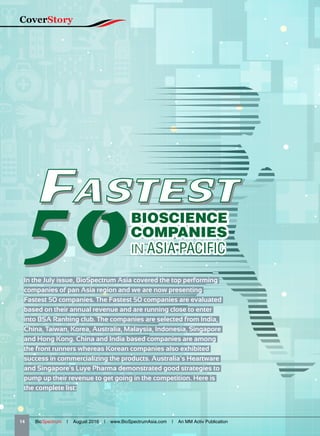
50In the July issue, BioSpectrum Asia covered the top performing
companies of pan Asia region and we are now presenting
Fastest 50 companies. The Fastest 50 companies are evaluated
based on their annual revenue and are running close to enter
into BSA Ranking club. The companies are selected from India,
China, Taiwan, Korea, Australia, Malaysia, Indonesia, Singapore
and Hong Kong. China and India based companies are among
the front runners whereas Korean companies also exhibited
success in commercializing the products. Australia’s Heartware
and Singapore's Luye Pharma demonstrated good strategies to
pump up their revenue to get going in the competition. Here is
the complete list:
BIOSCIENCE
COMPANIES
IN ASIA PACIFIC
14   BioSpectrum | August 2016 | www.BioSpectrumAsia.com | An MM Activ Publication
CoverStory
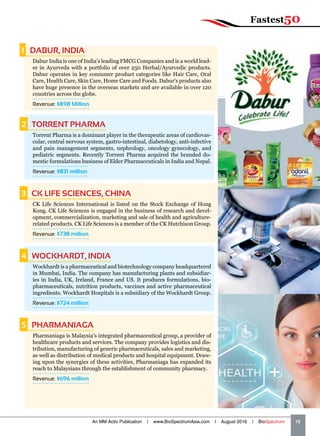
1   DABUR, INDIA
Dabur India is one of India’s leading FMCG Companies and is a world lead-
er in Ayurveda with a portfolio of over 250 Herbal/Ayurvedic products.
Dabur operates in key consumer product categories like Hair Care, Oral
Care, Health Care, Skin Care, Home Care and Foods. Dabur's products also
have huge presence in the overseas markets and are available in over 120
countries across the globe.
Revenue: $898 Million
2   TORRENT PHARMA
Torrent Pharma is a dominant player in the therapeutic areas of cardiovas-
cular, central nervous system, gastro-intestinal, diabetology, anti-infective
and pain management segments, nephrology, oncology gynecology, and
pediatric segments. Recently Torrent Pharma acquired the branded do-
mestic formulations business of Elder Pharmaceuticals in India and Nepal.
Revenue: $831 million
3   CK LIFE SCIENCES, CHINA
CK Life Sciences International is listed on the Stock Exchange of Hong
Kong. CK Life Sciences is engaged in the business of research and devel-
opment, commercialization, marketing and sale of health and agriculture-
related products. CK Life Sciences is a member of the CK Hutchison Group.
Revenue: $738 million
4   WOCKHARDT, INDIA
Wockhardt is a pharmaceutical and biotechnology company headquartered
in Mumbai, India. The company has manufacturing plants and subsidiar-
ies in India, UK, Ireland, France and US. It produces formulations, bio-
pharmaceuticals, nutrition products, vaccines and active pharmaceutical
ingredients. Wockhardt Hospitals is a subsidiary of the Wockhardt Group.
Revenue: $724 million
5  PHARMANIAGA
Pharmaniaga is Malaysia’s integrated pharmaceutical group, a provider of
healthcare products and services. The company provides logistics and dis-
tribution, manufacturing of generic pharmaceuticals, sales and marketing,
as well as distribution of medical products and hospital equipment. Draw-
ing upon the synergies of these activities, Pharmaniaga has expanded its
reach to Malaysians through the establishment of community pharmacy.
Revenue: $696 million
An MM Activ Publication | www.BioSpectrumAsia.com | August 2016 | BioSpectrum    15
Fastest50
6  CHENGZHI
Chengzi is engaged in the production and distribution of chemicals, life
science and pharmaceutical products. The company’s products portfolio
consists of biological products, including D-ribose, L-glutamine and oth-
ers. The company distributes its products in Jiangxi province, Beijing, Lia-
oning province, Hebei province and Guangdong province, China.	
Revenue: $606 million
7  CELLTRION
Celltrion Healthcare is a biopharmaceutical company headquartered in
Incheon, South Korea. Celltrion Healthcare conducts worldwide market-
ing, sales, and distribution of biological medicines. The company’s prod-
ucts are manufactured at mammalian cell culture facilities designed and
built to comply with the United States FDA’s cGMP, and the European
Medicines Agency’s GMP standards.
Revenue: $603 million
8   JEIL PHARMACEUTICAL
Jeil Pharmaceutical is a Korea-based company mainly engaged in the man-
ufacture and distribution of pharmaceuticals.
Revenue: $595 million
9  COCHLEAR
Cochlear is an Australian biotechnology company that designs, manufac-
tures and supplies the Nucleuscochlear implant, the Hybrid electro-acous-
tic implant and the Baha bone conduction implant. Cochlear was formed
in 1981 with finance from the Australian government to commercialize the
implants pioneered by Dr Graeme Clark.
Revenue: $555 million
10   FISHER  PAYKEL HEALTHCARE
Fisher  Paykel Healthcare is a manufacturer, designer and marketer of
products and systems for use in respiratory care, acute care, and the treat-
ment of obstructive sleep apnea. Based in New Zealand, their products and
systems are sold in around 120 countries worldwide.
Revenue: $555 million
11   SHANDONG XINHUA PHARMACEUTICAL
COMPANY LIMITED
Shandong Xinhua Pharmaceutical is in a leading position in the manu-
facturing technology and capacity for antipyretics and analgesics in China
16   BioSpectrum | August 2016 | www.BioSpectrumAsia.com | An MM Activ Publication
Fastest50
and is an important manufacturer in China for central nervous system, ste-
roids, cardio cerebrovascular system drugs as well as finished dosage forms
and pharmaceutical intermediates.
Revenue: $533 million
12   SHENZHEN SALUBRIS PHARMACEUTICALS
Shenzhen Salubris Pharmaceuticals is a professional pharmaceutical en-
terprise rooted in China and devoted to improving health worldwide. The
company focuses on the new generation of specialty medicine, and it has
nationally approved modern GMP pharmaceutical manufacturing facili-
ties, advanced equipment and testing instruments, producing tablet, cap-
sule, and injection formulations and active pharmaceutical ingredients,
with subsidiary branches and marketing network throughout China.
Revenue: $521 million
13   PIRAMAL HEALTHCARE
Piramal Healthcare forayed into the health care space in 1988. The compa-
ny has manufacturing bases across India, UK, Scotland, USA and Canada
through subsidiaries. Piramal’s critical care products are available in the
emergency rooms of hospitals across the globe and the company’s products
are available in over 100 countries. Piramal is presently the third largest
player in the global Inhalation Anesthesia (IA) market, and the only com-
pany in the world with a complete product portfolio of Inhalation Anes-
thetics drugs.
Revenue: $494 million
14   CHINA GRAND PHARMACEUTICAL AND
HEALTHCARE HOLDINGS
China Grand Pharmaceutical and Healthcare Holdings is an investment
holding company, its subsidiaries are principally engaged in the devel-
opment, manufacture and sale of pharmaceutical preparations, medi-
cal devices pharmaceutical intermediates, specialized raw material and
healthcare products. We aim to become one of the largest pharmaceuti-
cal and healthcare manufacturers in the PRC through organic growth and
acquisitions.
Revenue: $487 million
15   JINLING PHARMACEUTICAL, CHINA
Jinling Pharmaceutical manufactures and markets pharmaceutical prod-
ucts. The company's products include the Mailuoning injection for the
treatment of arteries and veins, as well as traditional Chinese and western
pharmaceutical preparations.
Revenue: $482 million
An MM Activ Publication | www.BioSpectrumAsia.com | August 2016 | BioSpectrum    17
Fastest50
16   SIHUAN PHARMACEUTICAL COMPANY
Sihuan Pharmaceutical has emerged as a recognized pharmaceutical
company in China’s prescription drug market as one of the recognized
cardio-cerebral vascular prescription drug franchise by market share. The
company’s product portfolio includes medical therapeutic areas in cardio-
cerebral vascular system, central nervous system, metabolism, oncology
and anti-infectives. The company has over 70 new drugs under various de-
velopment stages, including 14 innovative patented drugs.
Revenue: $481 million
17   ILDONG PHARMACEUTICAL, KOREA
Il Dong Pharmaceutical develops and manufactures over-the-counter
drugs, such as vitamins, antibiotics, and antifebriles. The company also
produces air fresheners, detergents, and water antiseptic solutions.
Revenue: $476 million
18  BLACKMORES
Blackmores is Australia's most trusted manufacturer and distributor of vi-
tamins, minerals, and nutritional supplements. Blackmores was 	
founded more than 80 years ago by naturopath Maurice Blackmore. The
company has a strong range of more than 250 vitamins, minerals, herbal
and nutritional supplements that are developed by its in-house experts
that exacts the requirements under the international Pharmaceutical In-
spection Convention and Pharmaceutical Inspection Co-operation Scheme
(PIC/s) standards of good manufacturing practice (GMP).
Revenue: $472 million
19   ALEMBIC PHARMACEUTICALS
Established in 1907, Alembic Pharmaceuticals is a leading pharmaceutical
company in India. The company is vertically integrated with the ability to
develop, manufacture and market pharmaceutical products, pharmaceuti-
cal substances and Intermediates.
Revenue: $462 million
20   LG LIFE SCIENCES
LG Life Sciences is a Korea-based company mainly engaged in the phar-
maceutical business and fine chemical business. The company operates its
business through two segments: pharmaceutical segment, which engages
in the manufacture of pharmaceutical products, such as vaccines, espogen,
cardiovascular remedies, anti-infective drugs, hyaluronic acid products,
growth hormone substances, arthritis drugs, infertility drugs and others,
as well as animal drugs, such as milk production stimulants for cows, and
fine chemical segment, which provides synthetic drugs raw material, ag-
ricultural pesticides raw material and others. The company distributes its
18   BioSpectrum | August 2016 | www.BioSpectrumAsia.com | An MM Activ Publication
Fastest50
www.nuffoodsspectrum.in
The integrated B2B media platform for
Nutritionals  Nutraceuticals Industry
Get Connected to
CONTACT :
Advertisement: gurunath.angadi@mmactiv.in
Subscription: pavana.praveen@mmactiv.in
Nutritionals Nutraceuticals Functional Foods Dietary Supplements
products within domestic market and to overseas markets.
Revenue: $451 million
21   IPCA LABORATORIES
Ipca is a fully-integrated Indian pharmaceutical company manufacturing
over 350 formulations and 80 APIs for various therapeutic segments. The
company manufactures and supplies APIs from the basic stage at manu-
facturing facilities endorsed by the world's most discerning drug regula-
tory authorities. Ipca is a therapy leader in India for anti-malarials with a
market share of over 34%.
Revenue: $446 million
22   JW PHARMACEUTICAL (FORMERLY KNOWN AS
CHOONGWAE PHARMA)
JW Pharmaceutical Corporation develops and sells anticancer, gastroin-
testinal, rheumatic arthritis, renal, antibiotic, amino acids and TPN, car-
diovascular, respiratory, and many other products. The company produces
medical appliances, such as digital X-ray, LED astral lamps, incubators,
etc. It has operations in Japan, Europe, Germany, the United States, the
Middle East, and South Korea. JW Pharmaceutical was founded in 1945
and is based in Seoul, South Korea.
Revenue: $434 million
23   GLAXOSMITHKLINE PHARMACEUTICALS
GlaxoSmithKline Pharmaceuticals is an Indian subsidiary of GlaxoSmith-
Kline. It is one of the oldest pharmaceuticals companies in India. Its prod-
uct portfolio includes prescription medicines and vaccines. The company
also offers a range of vaccines, for the prevention of hepatitis A, hepatitis B,
invasive disease caused by H influenzae, chickenpox, diphtheria, pertussis,
tetanus, rotavirus, cervical cancer and others.
Revenue: $425 million
24  EMAMI (FORMERLY ZANDU PHARMA)
Emami is an Indian producer of fast-moving consumer goods (FMCG), en-
gaged in personal care and healthcare businesses. The company's health
products unit offers tonics for colds and coughs as well as nutraceuticals.
In 2008, Emami acquired Zandu Pharmaceutical Works. The company de-
merged Zandu FMCG into Emami and raised Rs.310 crore through QIP.
The company became debt free within 2 years of the Zandu deal.
Revenue: $401 million
20   BioSpectrum | August 2016 | www.BioSpectrumAsia.com | An MM Activ Publication
Fastest50
25   ABBOTT INDIA
Abbott India is part of Abbott's Global Pharmaceutical business in India.
Headquartered in Mumbai, Abbott India, a publicly listed company and a
subsidiary of Abbott Laboratories, enjoys strong brand equity in multiple
therapeutic categories such as Women's Health, Gastroenterology, Neu-
rology, Thyroid, Diabetes  Urology, Pain Management, Vitamins, Anti-
Infectives  other therapy areas.
Revenue: $398 million
26   ZHEJIANG XIANJU PHARMACEUTICAL
Zhejiang Xianju Pharmaceutical is a Chinese company manufacturing ste-
roid drug products, steroid hormone medicines, and medicines for birth
control. The company’s main business is focused on the development, pro-
duction, and sale of raw material and preparation of pharmaceutics for ste-
roid drugs. It has built a long-term partnership with more than 20 famous
scientific research institutes and universities in China such as Shanghai
Institute of Organic Chemistry and Chinese Pharmaceutical University.
Revenue: $370 million
27   ZHEJIANG HISOAR PHARMACEUTICAL
Zhejiang Hisoar Pharmaceutical is a Chinese company engaged in the
manufacture and sale of pharmaceutical raw material and pharmaceuti-
cal intermediates. The company’s products comprise antibiotic drugs,
fine chemicals, antiviral drugs, hypoglycemic series, psychotropic series,
preparations, deworming series, cardiovascular drugs and other series.
The company distributes its products within the domestic market and to
overseas markets.
Revenue: $367 million
28  BIOCON
Biocon is an India-based company that manufactures pharmaceuticals,
medicinal chemical and botanical products. The company is engaged in
developing biologics and biosimilars for addressing chronic diseases, such
as cancer, diabetes and autoimmune conditions for patients across the
world. The company offers Insugen, which is a generic insulin brand. The
company's subsidiaries include Syngene International, Biocon Research,
Biocon Pharma, Biocon SA, Biocon SDN BHD, NeoBiocon FZ and Biocon
Academy.
Revenue: $337 million
29   SSY GROUP
SSY Group (formerly known as Lijun International Pharmaceutical Hold-
ing) is one of the leading pharmaceutical manufacturers in China and is
principally engaged in the research, development, manufacture and sale
An MM Activ Publication | www.BioSpectrumAsia.com | August 2016 | BioSpectrum    21
Fastest50
of a wide range of pharmaceutical products mainly intravenous infusion
solution. The group went public on the Hong Kong Stock Exchange in De-
cember 2005.
Revenue: $333 million
30   LUYE PHARMA GROUP
Luye Pharma Group is a research and development focused enterprise
with a strong profile in oncology, cardiovascular system, alimentary tract
and metabolism, and central nervous system. The company facilities in
Yantai, Nanjing, Beijing and Luzhou; as well as overseas branch offices in
Hong Kong, USA, Singapore and Malaysia. The company currently sells
approximately 30 products and over 80% of its total revenue is attributable
to patent-protected products. Luye Pharma currently has seven product
candidates for overseas markets of which one is preparing to submit NDA
application and three are undergoing clinical trials in the US.
Revenue: $330 million
31   SANOFI INDIA (FORMERLY CALLED AVENTIS PHARMA)
Sanofi, one of the world's leading pharmaceutical companies, and its 100%
subsidiary, Hoechst GmbH, are the major shareholders of Sanofi India and
together hold 60.4% of its paid-up share capital. Sanofi engages in the re-
search and development, manufacturing and marketing of pharmaceuti-
cal drugs principally in the prescription market, but the firm also develops
over-the-counter medication.
Revenue: $328 million
32   PFIZER INDIA
Pfizer India is headquartered in Mumbai. In India, Pfizer instituted the
first ever Disease Management Program -- Healthy Heart in Cardio Vas-
cular Disease in partnership with Apollo Hospital, Hyderabad and Apollo
Hospital, Chennai. It has a manufacturing facility at Thane, Maharashtra.
Revenue: $311 million
33   CSPC PHARMACEUTICAL GROUP
CSPC Pharmaceutical has three major business segments including inno-
vative drugs, common generic drugs and bulk drugs. The group focuses on
the manufacturing, researching and marketing of medicines and pharma-
ceutical related products. The company has nearly 1,000 finished drugs
products including antibiotics, cardio-cerebrovascular drugs, antipyretic
analgesic drugs, digestive system drugs, oncology drugs and traditional
Chinese medicine. Bulk drugs developed by the company include antibiot-
ics, Vitamin C and caffeine series. The manufacturing facilities of CSPC are
mainly located in Shijiazhuang City, Hebei Province, China.
Revenue: $308 million
22   BioSpectrum | August 2016 | www.BioSpectrumAsia.com | An MM Activ Publication
Fastest50
34   CHINA SHINEWAY PHARMACEUTICAL
GROUP
China Shineway Pharmaceutical Group is a Chinese medicine injection
and soft capsule manufacturer in the PRC. The company’s shares are listed
on the Main Board of Hong Kong Stock Exchange. Shineway’s products are
primarily categorized into three major types: injection, soft capsule and
granule.
Revenue: $308 million
35   SHANGHAI RAAS BLOOD PRODUCTS
Shanghai RAAS Blood Products specializes in the manufacture of plasma
derived medical products for therapeutic use in the areas of immunology,
hematology and intensive care medicines. Its subsidiaries and partner
companies produce vaccines and Recombinant DNA pharmaceuticals.
Revenue: $302 million
36   HEARTWARE INTERNATIONAL
HeartWare International develops and manufactures miniaturized im-
plantable heart pumps, or ventricular assist devices, to treat patients suf-
fering from advanced heart failure. The HeartWare Ventricular Assist Sys-
tem obtained US market approval in 2012 from the US Food and Drug
Administration (FDA) as a bridge-to-transplant therapy for patients with
advanced stage heart failure. The HeartWare System has been commer-
cially available in other global markets including Europe and Australia,
since 2009.
Revenue: $277 million
37   NECTAR LIFESCIENCES
Nectar Lifesciences is a pharmaceutical company in India that manufac-
tures generic products for EU and USA. The company manufactures oral
and sterile cephalosporins. Its facilities are approved by USFDA, the Euro-
pean Union and Japan. The company is also in business of providing lead-
ing pharmaceutical organizations with contract research and manufactur-
ing services. It also manufactures empty hard gelatin capsules and exports
natural menthol and allied products.
Revenue: $260 million
An MM Activ Publication | www.BioSpectrumAsia.com | August 2016 | BioSpectrum    23
Fastest50
38   3SBIO INC
3SBio Inc is a biotechnology company located in China. The company fo-
cuses on mammalian cell-based biopharmaceuticals in the biotechnology
industry. 3SBio also develops, manufactures and markets biopharmaceu-
tical products globally. The company has a pipeline of 20 product candi-
dates, 14 of which are being developed as National Class I New Drugs in
China. The company has several product candidates that target auto-im-
mune diseases like rheumatoid arthritis and refractory gout.
Revenue: $251 million
39   AJANTA PHARMA
Ajanta Pharma is an Indian company engaged in development, manufac-
ture and marketing of pharmaceutical formulations worldwide, with its
headquarters in Mumbai. It has a robust business of Branded Generics
across India and about 30 emerging markets. The company has presence
in fast-growing specialty therapeutic segments of cardiology, dermatology,
ophthalmology and pain management apart from serving many other main
line therapeutic segments like anti-malarial, premium anti-biotic, anti-al-
lergy etc.
Revenue: $239 million
40   GUANGDONG ZHONGSHENG
PHARMACEUTICAL
Guangdong Zhongsheng Pharmaceutical is engaged in the manufacture
and distribution of Chinese patent medicines and pharmaceutical chemi-
cals. It provides proprietary Chinese medicine preparations such as cap-
sules for thrombus, pellets for upper respiratory tract diseases and granu-
lar for sunstroke, among others. Through its subsidiaries, it also engages
in the wholesale of active pharmaceutical ingredients, intermediates and
Chinese medicines.
Revenue: $233 million
41   GRAPE KING
Grape King is one of the top manufacturers in the health food biotechnol-
ogy industry of Taiwan and is also a cGMP (Current Good Manufacturing
Practices) certified pharmaceutical manufacturer. The company was estab-
lished in 1991 for research and development as well as production of drugs
including Antrodia camphorata, Antrodia salmonea and antibiotics. The
company has been awarded one US patent, two China patents and six Tai-
wan patents via working with national academic and research institutions
to develop and improve products through cooperative research.
Revenue: $232 million
24   BioSpectrum | August 2016 | www.BioSpectrumAsia.com | An MM Activ Publication
Fastest50
42   ANHUI FENGYUAN PHARMACEUTICAL
Anhui Fengyuan Pharmaceutical is engaged in the research, development,
manufacture and distribution of biological medicines, Chinese medicines,
as well as chemical synthetic medicines and preparations. The company
offers ibutilide fumarate injections for the treatment of cardiovascular
diseases, cilnidipine tablets for the treatment of hypertension, aspirin-DL-
lysine for injection reducing fever, Ruzengning Jiaonang for the treatment
of hyperplasia of mammary glands, paracetanmol pseudophedrine sulfate
and clemastine fumarate tablets for the treatment of influenza, diclofenac
sodium patches for relieving pains, naftopidil tablets for the treatment of
urinary obstruction and zalepion tablets for the treatment of insomnia.
The company operates its businesses mainly in China domestic market.
Revenue: $227 million
43   GRANULES INDIA
Granules India is an Indian pharmaceutical manufacturing company based
in Hyderabad, India. The company manufactures tablets, Pharmaceutical
Formulation Intermediates (PFIs) and APIs which are distributed in over
50 countries. Granules manufactures several off-patent drugs, including
Paracetamol, Ibuprofen, Metformin and Guaifenesin, on a large scale for
customers in the regulated and semi-regulated markets.
Revenue: $226 million
44   DONGWHA PHARM
Dongwha Pharm is a Korea-based company engaged in the manufacture of
pharmaceuticals. The company’s products consist of ethical drugs, includ-
ing digestive system remedies, antibiotics, cardiovascular and metabolic
disease treatments, non steroidal anti-inflammatory drugs, respiratory
remedies, muscle relaxants, nervous, etc.
Revenue: $223 million
45   HUALAN BIOLOGICAL ENGINEERING
Hualan Biological Engineering is a China-based company principally engaged
in the research, development, production and sale of blood products and vac-
cine products. The company mainly provides human albumin, intravenous
immunoglobulin, influenza vaccines and other products. The company dis-
tributes its products in the domestic market and to the overseas markets.
Revenue: $220 million
46   CENTRAL LABORATORIES
Central Laboratories was established in November 1959 as Zhengshi Phar-
maceutical and was mainly engaged in the production of capsule and tablet
An MM Activ Publication | www.BioSpectrumAsia.com | August 2016 | BioSpectrum    25
Fastest50
formulations. In 1996 the company was renamed as Central Laboratories
and its main products include liquid and tablets for oral medication.
Revenue: $217 million
47   DAEWON PHARM
Daewon Pharm is a Korea-based advanced pharmaceutical company hav-
ing its own new medicine development ability and is developing various
modified new medicines and natural drugs such as hepatitis medicine.
Revenue: $216 million
48   ZHEJIANG JINGXIN PHARMACEUTICAL
Zhejiang Jingxin Pharmaceutical is a China-based company engaged in
manufacture and sale of pharmaceuticals. The company provides raw ma-
terial of chemical drugs, chemical preparations and Chinese herbal prepa-
rations, including quinolone drugs, drugs for cardio-cerebral-vascular
diseases, cephalosporin drugs, antidepressant drugs, anti-inflammatory
analgesic, anti-allergic agents, traditional Chinese herbal medicines and
other drugs. It distributes its products principally within domestic market
and to overseas markets.
Revenue: $209 million
49   GUILIN SANJIN PHARMACEUTICAL
Guilin Sanjin Pharmaceutical was founded in 1967. It is specialized in re-
search and production of Traditional Chinese Medicine (TCM) and natural
medicine, and is also one of the earliest enterprises that produces contem-
porary TCM preparations. The company’s watermelon frost is a well-
known throat medicine with 200 years of history.
Revenue: $206 million
50   MINDRAY MEDICAL INTERNATIONAL
Mindray Medical International is China's largest medical equipment man-
ufacturer that develops, manufactures, and markets a variety of medical
devices, equipment and accessories for both human and veterinary use.
The company is currently organized into three key business lines: Patient
Monitoring  Life Support, In-Vitro Diagnostic Products, and Medical Im-
aging Systems. Mindray possesses 41 subsidiaries and branch offices in 31
countries in North and Latin America, Europe, Africa and Asia-Pacific, as
well as 32 branch offices in China. To date, Mindray has around 8,200 em-
ployees around the world. Its North American headquarters are located in
Mahwah, New Jersey.
Revenue: $198 million
26   BioSpectrum | August 2016 | www.BioSpectrumAsia.com | An MM Activ Publication
Fastest50
BioColumn
An MM Activ Publication | www.BioSpectrumAsia.com | August 2016 | BioSpectrum    27
Global business
services a new
way forward for life
sciences companies
G
reater uncertainty in the
global macroeconomic
environment is prompt-
ing companies around the
world, including life sciences firms,
to take a closer look at their opera-
tions in a bid to improve operational
processes and derive greater cost
savings. One of the means of doing
so is through outsourcing, which has
been going on for a long time, though
it was done previously in a fragment-
ed and decentralized manner.
Now, companies – particularly those
with operations in many different
jurisdictions – are adopting a more
holistic approach in how they deliver
services like IT, finance, account-
ing, human resources, procurement
and other business services across
an organisation. As international
life sciences companies seek ways
to transform their operations in the
midst of wrenching change, they are
establishing global business services
(GBS), which is a cross-functional,
globe-spanning model that inte-
grates resources, capabilities and
systems throughout the entire enter-
prise. GBS includes centres of excel-
lence, shared services centres and
outsourcing, extending operational
improvements considerably further
into every corner of the organisation.
A key element of GBS is the focus on
processes that span the entire enter-
prise. The orientation of end-to-end
processes as part of GBS can enable
the enterprise to adopt new technol-
ogies more rapidly and benefit from
them faster. An example of this is
cognitive automation, a continuum
of technologies that companies can
use to automate business processes
and operations.
For instance, cognitive automation
can help to monitor the supply chain
continually to ensure that a pharma-
A key element of GBS is the focus on
processes that span the entire enterprise.
End-toend processes can enable the
enterprise to adopt new technologies
Juvanus Tjandra
Management Consulting Partner,
KPMG, Singapore
Ajay Sanganeria
Life Sciences Partner, KPMG in
Singapore
BioColumn
28   BioSpectrum | August 2016 | www.BioSpectrumAsia.com | An MM Activ Publication
gressive with the increased aware-
ness of tax planning ideas and flow of
information to them. As such, a full-
fledged GBS model is critical for tax
function so that information can be
provided to tax authorities in a more
coordinated manner rather than in
a fragmented manner by different
shared service centres which may not
have full visibility of the business and
operating models. It will also help
to create a Tax Risk Management
framework to proactively identify red
flags and effectively manage compli-
ance.
Despite these benefits, many compa-
nies have not yet taken full advantage
of the effect of establishing GBS for
their organisations. Once they see
the wide-ranging gains from GBS
and implement it fully, they will be
able to realise the value. But they
should not underestimate the scope
of the changes required and the de-
gree of resistance that might be met
with in the company. The roles and
responsibilities of many people at all
levels of the organization will be af-
fected, as one would expect with any
profound alteration in governance
and processes.
Company leaders then, should com-
municate the benefits of GBS to the
entire company and build support for
behind the structural change. They
should also ensure that GBS imple-
mentation is closely aligned with the
company’s overall strategy. With the
right preparation, the journey to-
wards GBS can bring about the gain
while lessening the pain.  BS
ceutical company and its suppliers
comply with the anti-bribery and
corruption regulations around the
world, by combining databases to
look for outliers.
There are many other benefits of
GBS, which are outlined in a report
by KPMG International, Global Busi-
ness Services in Life Sciences: A
Window to the Future. The report is
based on years of advisory work by
KPMG subject matter experts who
advise companies on how to imple-
ment GBS to transform their opera-
tions.
Among the benefits of GBS highlight-
ed in the report is first and foremost,
cost savings through the centralisa-
tion of core functions. Companies
can continue to extract savings long
after they have exhausted other av-
enues for achieving efficiencies. For
example, a study by KPMG in the US
has found that when cognitive auto-
mation is part of GBS, labour costs
can be reduced by 40 to 75 percent,
more than double the savings de-
rived from shifting the operations to
cheaper labour markets.
Another benefit of GBS is stronger
compliance, as organisations will be
able to build more robust structures
and standard processes to comply
with growing demands from regu-
lators around the world, for better
business conduct.
In addition, there can be faster imple-
mentation of corporate transactions,
where the completion of mergers
and divestitures can be accelerated,
shortening the time-to-market and
time-to-benefit. In one case, a phar-
maceutical company bought 11 busi-
nesses within two years and its GBS
organization was able to help disen-
tangle and integrate them into the
central organisation.
Increased flexibility is also another
advantage that GBS organisations
can look forward to, as they will be
able to be more responsive to busi-
ness needs than a regionally-focused,
siloed structure of shared services.
As corporate transactions in the in-
dustry pick up speed, there is a need
for a flexible and adaptable platform
for the back and middle office. This
in turn helps the organisations to
scale up quickly to meet new busi-
ness needs.
By incorporating all key services
worldwide into a single GBS organ-
isation, companies can fully realise
economies of scale. For example,
multinational corporations that have
offices in various regions would have
different cultures and languages to
contend with. By standardising pro-
cesses globally, it makes it easier to
implement the changes.
Business impact is also greater when
GBS is fully implemented, as it can
become an independent operating
unit providing fully integrated end-
to-end services ranging from trans-
actional activities to strategic analyt-
ics and insights. It can then leverage
on digital and innovative solutions to
acquire new customers and increase
revenue.
Improved tax risk management is an-
other benefit for GBS firms. What is
seen now is that tax rules worldwide
and particularly in the Asia-Pacific
region are changing faster than ever
before with the adoption of Base Ero-
sion and Profit Shifting guidelines
by Government authorities. Tax au-
thorities are getting increasingly ag-
Disclaimer: The views and opin-
ions are those of the authors and do
not necessarily represent the views
and opinions of KPMG in Singa-
pore. All information provided is of
a general nature and is not intended
to address the circumstances of any
particular individual or entity.
Many companies
have not taken full
advantage of the effect
of establishing GBS for
their organisations
BioTalk
An MM Activ Publication | www.BioSpectrumAsia.com | August 2016 | BioSpectrum    29
Zenobia Walji
Vice President, Southeast Asia, Medtronic
Q What are the expansion plans of Medtronic
in Southeast Asia for next couple of years?
A
Like many parts of the world, healthcare in South-
east Asia, faces many challenges. The developed
portions of Southeast Asia have an aging popula-
tion with rising costs in a tight economy. The emerging
portions of Southeast Asia face a higher demand for
healthcare, but with inadequate infrastructure and clini-
cal capability to serve the needs of the population. This
places a heavy toll on patients and their families, as infra-
structure development will take time to catch up with de-
mand. At Medtronic, we recognize the constraints of the
developed and emerging markets and are committed to
improving patient outcomes, optimizing costs and ex-
panding access to care to counter these growing demands.
With Singapore as our regional hub, we are well placed to
play a central role in solving these issues. Our scale and
breadth of resources now enhanced by the acquisition of
Covidien, enables us to stretch further and reinforce our
dedication to help lead a transformation in healthcare,
not only across this region but throughout the world.
We believe that there are unlimited opportunities to
transform healthcare in Southeast Asia. A key driver of
our strategy focuses on instituting new ways of working
and collaborating with like-minded partners. These ap-
proaches will help Medtronic to strengthen health sys-
tems and improve delivery of innovative treatments and
therapies across the region.
For example, we recently signed two MoU’s, one with
National Neuroscience Institute to establish a Center of
Excellence for deep brain stimulation to advance treat-
ment for patients with Parkinson’s Disease, and another
with SingHealth to set up a Center of Excellence in dia-
‘We are
committed
to improving
patient
outcomes’
A key driver of our strategy focuses on instituting new ways of working and
collaborating with like-minded partners.
30   BioSpectrum | August 2016 | www.BioSpectrumAsia.com | An MM Activ Publication
BioTalk
betes treatment and management
in Southeast Asia. Through these
efforts, we are educating physicians
and patients about advanced life-en-
hancing technologies and therapies,
while also working to make them
more accessible in the region.
Q
What is the share of
business generated from
Southeast Asia?
A
Southeast Asia represents an
exciting, sustainable growth
region for Medtronic. As part
of the Asean Economic Community,
this is a region that is getting better
organized to capitalize on growth,
with the region evolving from being
the 7th largest world economy to ex-
pecting to become the 4th largest by
2030.
With over 650 million people, this
region therefore has the potential to
be in the Top 3-4 highest growth con-
tributing regions.
Q
Singapore considers med
tech an important
industry for economy
growth. Are other Asian
countries keen enough to
invest in med tech sector?
A
In a McKinsey report in Febru-
ary 2016, it was reported that
by 2020, Asia Pacific is expect-
ed to surpass the European Union as
the world’s second largest med tech
market after the United States. The
demand for med tech in Asia Pacific
is growing rapidly, and we anticipate
that many Asian countries will con-
tinue to invest in this sector to ad-
dress the growing demand for medi-
cal devices and patient needs.
Q
How can new medical
technologies revolutionize
the healthcare system?
A
Asia Pacific, including South-
east Asia, faces serious health-
care challenges such as ineffi-
cient care delivery, rising costs, an
aging population and the burden of
chronic diseases, among others.
We are focused on helping patients
with certain chronic and complex
medical conditions, including but
not limited to diabetes, stroke and
coronary artery disease. We real-
ized that these types of conditions
are high volume, high cost, well-
studied medical conditions and dis-
ease states with significant variation
in treatment costs and outcomes. By
focusing on them, these are the types
of conditions that can result in mean-
ingful improvements in cost and out-
comes.
This is why, beyond focusing on de-
veloping technologies and services,
Medtronic is looking at new ways
and avenues to improve healthcare
delivery and systems to drive better
patient outcomes.
For example, by signing the MoU
with SingHealth in June 2016, we
hope to advance joint efforts to ad-
dress the needs of people living with
diabetes, especially in terms of de-
veloping and deploying innovative
products and integrated solutions to
improve quality of care and patient
outcomes.
In 2011, Medtronic built a manufac-
turing facility to meet the expected
growth in the demand of cardiac de-
vices in the region. It allows us to re-
spond more effectively and efficiently
to the needs of customers and pa-
tients with cardiac rhythm disorders,
improving standards of care in this
region. We also built an education
center to provide hands-on training
for the latest technologies.
Q
Can you share some new
innovative products
developed by Medtronic?
A
Medtronic strives to offer prod-
ucts and services that deliver
clinical and economic value to
healthcare consumers and providers
around the world.
We have recently announced new
results from the Medtronic Micra
Transcatheter Pacing System (TPS)
Global Clinical Trial in a late-break-
ing trial session in Europe.
The Micra TPS is less than one-tenth
the size of traditional pacemakers
and the only leadless pacemaker ap-
proved for use in both the US and Eu-
rope. It is attached to the heart with
small tines and delivers electrical
impulses that pace the heart through
an electrode at the end of the device.
Unlike traditional pacemakers, the
Micra TPS does not require leads or
a surgical ‘pocket’ under the skin, so
potential sources of complications
related to such leads and pocket are
eliminated-as are any visible signs
of the device. New clinical data con-
tinues to show the safety benefits of
the Micra TPS for patients enrolled
in the pre-market Micra TPS Global
Clinical Trial.
In collaboration with leading clini-
cians, researchers and scientists
worldwide, Medtronic offers the
broadest range of innovative medical
technology for the interventional and
surgical treatment of cardiovascular
disease and cardiac arrhythmias.
Q Can pharma and med tech
companies work more
closely to bring
integrated products for
healthcare?
In 2011 Medtronic
built a manufacturing
facility to meet the
growth in demand
BioTalk
An MM Activ Publication | www.BioSpectrumAsia.com | August 2016 | BioSpectrum    31
Amrita Tejasvi
A
In a region as diverse and com-
plex as Southeast Asia, no sin-
gle entity in the healthcare eco-
system can solve patients’ challenges
alone. Only by working together with
a variety of stakeholders from aca-
demia, medical institutions and gov-
ernment bodies, can we create far-
reaching advancements in healthcare
that patients around the world need
and deserve.
Q
How is regulatory in
Southeast Asia evolving
in the med tech sector in
accordance to the new and
innovative technologies?
A
ASEAN countries have come
together as early as 2005 to
form a Medical Device Product
Working Group (MDPWG) and have
developed a uniform system of regis-
tering and assessing medical devices
across all members states. This is
called ASEAN Medical Device Direc-
tive (AMDD) which was signed by the
10 member states in August 2014 and
for transposition into their national
regulations in January 2015. Thus,
these member countries have started
to draft, finalize and implement their
medical device regulations in accor-
dance to the provisions of AMDD.
With the regulations being defined
clearer and technical requirements
being harmonized in the region, it is
expected to have an increasing num-
ber of medical device companies en-
tering into the ASEAN market with
their most advanced and new genera-
tion medical technologies.
In 2015, this Medical Device Product
Working Group had their last session
and formed a new group called ASE-
AN Medical Technical Committee to
discuss the detailed implementation
plans of AMDD and challenges of
each member country, to present new
areas of discussion (e.g. refurbish-
ment, medical device nomenclature)
and to obtain technical assistance
with dialogue partners. With the con-
tinued capacity building program for
both ASEAN regulators and indus-
try to support the implementation
of the AMDD under the ASEAN-US
Enhanced Partnership, it is expected
that efficiency and proficiency shall be
achieved in the assessment of medi-
cal devices, thus ensures faster regis-
tration approval for ASEAN countries
resulting to faster and greater access
to new technologies.
Q
Is Southeast Asia an
important region for
clinical trial of new
technologies?
A
Most definitely! Southeast Asia
has over 650 million people
and is a region that is fast grow-
ing in numbers and wealth and an
aging population.
We know that many conditions such
as vascular diseases manifest them-
selves differently in this part of the
world due to a variety of factors, in-
cluding anatomy, disease progres-
sion, patient age, lifestyle choices
(nutrition, compliance, etc). So there
are important clinical insights we
could obtain here that are not avail-
able from Europe or the US and that
will enable better product develop-
ment, treatment and diagnosis pro-
tocols that are better suited for the
Asian population. In fact, because
European or US data does not apply
to Southeast Asia, it has slowed down
the adoption of new technologies.
The collection of local clinical data it-
self is a powerful tool to raise disease
awareness among governments and
make stronger reimbursement ar-
guments that open up access to care
for more patients. In Southeast Asia,
Singapore is a great market for trials
and registries because of its infra-
structure and credibility around exe-
cuting high quality research. We also
have the advantage that we have so
many regional ethnicities. Thailand
also has good potential for research
given their bigger population base,
physician skill, comparatively good
infrastructure, and more reimburse-
ment which provides for greater ac-
cess to care.
Q
What are the challenges
of conducting clinical
trials in Asia?
A
The main challenges are around
experience in conducting clini-
cal research, access to enough
(paying) patients in some markets,
and infrastructure in some countries.
The competition among centers to
become part of research efforts or the
disappointment of not being selected
is stronger here than in more mature
markets where certain therapies are
more broadly adopted. There is also
less experience in writing peer-re-
viewed articles and conducting the
analysis. This means that we either
need to pair centers up with Western
KOLs to write the articles or we need
to invest in providing training for
this. Writing these articles is difficult
and requires a lot of experience. I
have had numerous discussions
about this with Western KOLs who
had SEA physicians attached to them
and most felt that research and writ-
ing experience is lacking. This is part-
ly due to language barriers and partly
to a predominant focus on clinical
practice versus research, which is
very understandable. This also closes
the door on access to premium jour-
nals, which Medtronic and Western
KOLs can help with.  BS
IDA Ireland (Investment  Development Agency) is Irish Government’s investment and
development agency responsible for attracting Foreign Direct Investment (FDI) to Ireland.
The country houses tech giants including Facebook, Sanofi, Intel, Yahoo, Adobe, Microsoft,
SAP, HP, Apple, LinkedIn, Deutsche Bank, Google and Amazon among others. IDA is in
business since the 1950s, and has offices in Australia, China, India, Japan, Korea and
Singapore. It employs over 300 people and half of them are from overseas.
Based in Shanghai, John Conlon is the EVP and head of APAC Operations at IDA Ireland.
He recently visited India on a business trip, and spoke exclusively to BioSpectrum providing
deep insights and happenings in Ireland’s Life Sciences sector, and why Indian Pharma and
Biotech companies should consider investing more in Ireland than ever before.
A gateway to
European markets
BioCluster
32   BioSpectrum | August 2016 | www.BioSpectrumAsia.com | An MM Activ Publication
F
or Ireland, 70 percent of its
business comes from the US,
20 percent from Europe and
the rest from APAC. In the
next two to five years, the country
aims to accelerate its business to the
next level.
With a population of 5 million, the
country is a host to 2 million work-
force.
Ireland’s GDP stands at €215 billion
and its exports are worth €200 bil-
lion. The country’s pharma exports
amounts to €64 billion, and medtech
alone is about €15 billion, totaling
the Life Sciences business to a value
of €79 billion.
Thriving ecosystem
Decades ago, Pfizer was the first
pharma company to invest in Ire-
land. The country now boasts of hav-
ing nine out of top 10 global pharma
companies including Novartis, John-
son  Johnson, Sanofi and AbbVie,
except AstraZeneca.
In the medtech industry, out of the
top 15 global companies, 13 of them
operate in Ireland. Its Life Sciences
sector alone employs 50,000 profes-
sionals and mainly focuses on novel
drugs and generics.
Ireland produces 30 percent of the
world’s contact lenses and 25 percent
of the global injectables for diabetes.
It also manufactures 75 percent of
the world’s orthopedic knees and 90
percent of Botox.
“In 2015, Ireland encountered over
200 major investments. Fifty per-
cent of those companies which in-
vested have never done business in
Ireland before. Pharma and Biotech
alone have seen investments worth
10 billion Euros in the last 10 years.
Between 2012 and 2015, we have had
4 billion Euros worth investments in
this sector,” said Conlon.
providing best quality of services and
products. “India is strong in gener-
ics, and its quality should meet the
EU standards. If Indian companies
want to access the EU markets, then
Ireland would be the place to start
with,” Conlon held.
There are many fundings of differ-
ent varieties offered by the Irish
Government to international com-
panies. Science Foundation Ireland
(SFI) funds basic research in the Bio-
pharmaceutical sector in the areas
of cancer, auto-immune disease and
Alzheimer’s.
Recently, SFI signed a deal with Pfiz-
er for a jointly-funded Biomedical re-
search, helping Pfizer’s drug discov-
ery efforts in and out of Ireland.
The Irish Government provides capi-
tal grants, employment grants, and
for existing companies it offers train-
ing grants, RD development grants,
and RD tax credits which is about
25 percent.
“There are many financial mecha-
nisms which depend on the budget
and the relevancy of the companies.
John Conlon
EVP  Head of APAC Ops, Investment 
Development Agency (IDA) Ireland
Manufacturing excellence in Bio-
pharmaceuticals is a hallmark of
Ireland’s success in the sector. The
country has now developed 18 manu-
facturing sites till 2015.
Clinical trials
Major Indian corporates in Ireland
include Wockhardt, Infosys, Tata,
Wipro and Tech Mahindra to name
a few.
Ireland is more known for its excel-
lence in managing clinical trials than
running them.
“The population is very small. If you
want to run clinical trials Europe
would be the best place. But we are
more on the clinical trials manage-
ment space,” stated Conlon.
Ireland is the gateway to the Europe-
an markets, he said. Indian compa-
nies in Ireland face the same market
challenges as elsewhere. The Irish
Government has become cost-con-
scious and it controls the healthcare
spends.
Irish fundings
Indian companies are expected in
In the medtech
industry, out of the top
15 global companies,
13 of them operate
in Ireland. Ireland
produces 30 percent
of the world’s contact
lenses.
BioCluster
An MM Activ Publication | www.BioSpectrumAsia.com | August 2016 | BioSpectrum    33
Finished Pharma
Abbvie
Elanco
Stiefel (GSK)
Charles River
Allergan
Sligo IT
Athlone IT
University, Institute of Technology
Speciality Research Centres
Limerick Universities and
Institutes of Technology
• University of Limerick
• Limerick IT
Speciality Research Centres
• Biomedical 
Environmental Sensor
Technology Centre
• Biomedical Electronics
Centre
• Solid State
Pharmaceuticals Cluster
Ranbaxy
Cork
AmerisourceBergen Abbvie
Cara Partners Gilead
GE Healthcare GSK
Janssen Pharma Hovione
Janssen Biologics McKesson
Leo Pharma Novartis
Pfizer Recordati
Pharmaceutical Companies
Airports
Waterford IT
Institute of
Technology
Tralee
Carlow IT
Dundalk IT
Letterkenny IT
Dublin’s Universities and
Institutes of Technology
• Trinity College
• Dublin City University
• University College
Dublin
Blanchardstown IT
• Dublin IT
• IT Tallaght
Speciality Research
Centres In Dublin
• National Institute for
Bioprocessing
Research and Training
(NIBRT)
• Biomedical Diagnostic
Institute (BDI), DCU
• Clarity, UCD
• Molecular
Therapeutics
for Cancer, Ireland
Overseas Owned Pharmaceutical
and Biopharmaceutical
Companies in Ireland
Dublin
Allergan Amgen
Aspen Alexion
Astellas BMS
Clarochem Covidien
DiaSorin Gilead
Helsinn Ipsen
Jazz Pharma MSD
Leo Pharma Mylan
Niche Generics Pfizer
Perrigo Shire
Rottapharm Takeda
Regeneron
Forest Laboratories
Alltech
Athlone Pharma
MSD
Suir Pharma
Wockhardt
Alkermes
Eli Lilly
Astellas
Aenova
SAFC
Servier
Beckman Coulter
Roche
Rowa Pharma
Takeda
Merck
Pfizer
UCB
Abbvie Allergan
Alltech Arkopharma
Astellas Forest
GSK Gilead
Helsinn Hovione
Leo Pharma MSD
Pfizer Servier
Stiefel (GSK) Takeda
Astellas Abbvie
Alkermes BMS
Cara Partners Clarochem
Eli Lilly GSK
Ipsen Roche
Janssen Leo Pharma
MSD Novartis
Pfizer Recordati
Rottapharm SAFC
Takeda Temmler
UCB
Abbott
Beckman Coulter
Biotrin (DiaSorin)
Covidien
GE Healthcare
Allergan Alkermes
Abbvie Aspen Pharma
Alexion AmerisourceBergen
BioMarin Bayer
Eli Lilly Gilead
GSK Jazz Pharma
McKesson MSD
Novartis Perrigo
PPD Pfizer
Quintiles Regeneron
Shire Warner Chilcott
Lancaster Labs (Eurofins)
Allergan Amgen
BioMarin Eli Lilly
MSD Genzyme (Sanofi)
Mylan Janssen Biologics
Pfizer Reliance
Regeneron Ethicon
Jazz Pharma Alexion
Elanco [Animal Vaccines]
Athlone Pharma
Mylan
Norbrook
Teva
Temmler (Aenova)
Ranbaxy
Rowa Pharma
Suir Pharma
Wockhardt
Randox
Norbrook Labs
PPD
Queens
University
UU Jordanstown
UU Coleraine
Mylan
Reliance
MSD
Warner Chilcott
Bulk Pharma DiagnosticsCorporate Functions GenericsBioPharmaceuticals
Lancaster Labs (Eurofins)
Genzyme (Sanofi)
Arkopharma
GSK
TEVA
Galway Universities and
Institutes of Technology
• National University of
Ireland
• Galway Mayo IT
Speciality Research Centres
• National Centre for
Biomedical Engineering
Science
• National Centre for Laser
Applications
• Regenerative Medicine
Institute (REMEDI)
Cork Universities and
Institutes of Technology
• Institute of Technology
• University College Cork
Speciality Research Centres
• Alimentary Pharmabiotic
Centre, UCC
Merck
Ethicon
Regeneron
Jazz Pharma
BioCluster
34   BioSpectrum | August 2016 | www.BioSpectrumAsia.com | An MM Activ Publication
Organizations will not get all of the
grants but it will a combination of
grants, which makes sense. Grants
are provided as an assistance to setup
in Ireland and not a reason to setup.
Companies are there for talent, track
record, ability to run facilities and ex-
port products,” emphasized Conlon.
Ease of business
He also pointed about the excellence
in Ireland’s education system and the
ease of doing business.
“One can easily setup companies in
Ireland. The ease of doing business
is excellent. English speaking tal-
ent, access to the EU market, being a
member of the European Single Cur-
rency, exceptional talent base includ-
ing engineers, managers, sales and
RD professionals, and excellent
University system all add to Ireland’s
great business ecosystem,” noted
Conlon.
The National Institute for Bioprocess
Research and Training (NIBRT), cre-
ated from a €60 million investment
by the IDA, offers practical training
to thousands of people every year.
Start-up ecosystem
Enterprise Ireland is the Govern-
ment organization responsible for
the development and growth of Irish
enterprises in global markets.
“It helps grow Irish companies.
They fund three start-ups per week.
Ireland is one of the entrepreneur-
ial countries in Europe,” expressed
Conlon.
The country has a concentrated clus-
ter of electronics, IT and Biotech
companies. “We have Pfizer, Micro-
soft, Google, eBay, Yahoo, IBM lo-
cated next to each other. It leads to
interesting collaborations giving rise
to hybrid products,” he highlighted.
Conlon advises companies to first
hire the best general manager while
setting up in Ireland.
“A good general manager can man-
age a bad business. But bad general
managers can mess up a good busi-
ness. It’s worth spending good mon-
ey in hiring the best personnel who
come with great experience, network
and culture, and can build business
better,” he advised.
RD activities
The Irish Government has commit-
ted €8 billion to research funding to
further bolster Ireland’s reputation
as a growing hub for RD.
“A lot of pharma RD takes place
at companies’ headquarters which
house large labs and facilities. Very
little happens in Ireland,” he added.
“In Ireland, it is more of process de-
velopment when it comes to cost and
drug delivery. However, a lot hap-
pens in the medtech space in Ire-
land.”
Companies entering Ireland can reg-
ister their patents in Ireland and can
use the same registration to patent in
Europe.
“In IPs, Ireland is very similar to In-
dia. The process is straight-forward
and clear. Companies will see patent
protection as an advantage,” Conlon
said.
Global economy, economic crisis and
politics – all of them affect invest-
ments in Ireland.
“There are many commonalities
between India and Ireland start-
ing from our national flags. Indian
companies and professionals do well
in Ireland. We look forward in en-
gaging with Indian companies,” he
concluded.  BS
Raj Gunashekar
 9 of the top 10
world’s pharmaceuti-
cal companies oper-
ate in Ireland
 7th largest exporter
of medicinal and
pharmaceutical prod-
ucts in the world in
2014
 €39 billion in annual
exports of pharma,
bio and chemistry
produce
 75+ pharmaceutical
companies
 33 FDA approved
pharma  biopharma
plants
 12.5% rate of Corpo-
ration Tax on trading
activities
THE BIG PICTURE
BioCluster
An MM Activ Publication | www.BioSpectrumAsia.com | August 2016 | BioSpectrum    35
BioNews
36   BioSpectrum | August 2016 | www.BioSpectrumAsia.com | An MM Activ Publication
Bangladesh’s Beacon Pharma
produces generic Hep C drug
As per a recent report, Bangladeshi
drug maker Beacon Pharma has be-
come the first generic drug company in
the world to produce copycat versions
of Gilead’s newly launched Epclusa (So-
fosbuvir + Velpatasvir) -- a drug used to
treat all types of Hepatitis C infections.
As per sources, the drug Epclusa has a
cure rate of 95 percent.
The report further said that the drug
has a very high price tag of $75,000,
however, Beacon, will look at pricing the drug 10x less than that of its originator.
“Our brand will be known as SOFOSVEL, this will be the first generic launch of
this drug,” said Monjul Alam, senior vice-president, Beacon Pharma.
The USFDA had approved this combination as a path breaking therapy to cure
even the harshest genotype of patients suffering from the disease. The report fur-
ther mentioned that Beacon is hoping to reach out to patients from 45 countries
across the world, including India, through its patient support program which
allows patients to directly purchase the drug through the manufacturer. Beacon
manufactures more than 200 generic drugs and 65 oncology products. In each
year, Beacon is introducing more than 15-20 Hi-Tech new products. By virtue of
strong RD team, Beacon has introduced a number of global first generic, which
makes Beacon popular to the pharmaceutical arena of the world.
Sanofi begins
dengue
immunization
program
Sanofi Pasteur, the vaccines di-
vision of Sanofi, has launched
the first public dengue immu-
nization program in Parana,
a densely populated state in
South of Brazil.
“The world finally has a clinical
prevention tool against dengue
that has been shown to be effi-
cacious in the Brazilian popula-
tion, as well as endorsed by the
WHO,” says, Michele Caputo
Neto, Minister of Health for
Paraná State. “With our strong
disease surveillance and com-
munity mobilization infrastruc-
ture in Paraná State, we are
well-positioned to introduce the
first public dengue immuniza-
tion program in the Americas to
significantly reduce our disease
burden.”
The safety, efficacy and public
health value of Sanofi Pasteur’s
dengue vaccine has been inde-
pendently endorsed by the Stra-
tegic Advisory Group of Experts
on Immunization (SAGE) to
the World Health Organization
(WHO). This positive WHO rec-
ommendation for use of the vac-
cine in endemic countries like
Brazil as part of integrated den-
gue prevention efforts is based
on extensive clinical documen-
tation for the vaccine involving
over 40,000 individuals from
15 countries around the world.
In these studies, Dengvaxia
demonstrated consistent safety
and efficacy across a diverse
ethnic, geographic and socio-
economic population.
Sun Pharma pact with Spainish firm
Sun Pharma and Almirall announced a licensing agreement on development
and commercialization of tildrakizumab for psoriasis in Europe. Tildrakizumab
is a investigational IL-23p19 inhibitor currently being evaluated in patients
with moderate-to-severe plaque psoriasis.
Under terms of the license agreement, Almirall will pay Sun Pharma an initial
upfront payment of $50 million. Phase-3 studies of tildrakizumab have recently
been completed. Sun Pharma will be eligible to receive development and regu-
latory milestone payments and, additionally, sales milestone payments and roy-
alties on net sales, the terms of which are confidential.
Almirall will be able to lead European studies, and participate in larger global
clinical studies for psoriasis indication subject to the terms of the Sun Pharma
- Merck agreements, as well as certain cost sharing agreements. Sun Pharma
will continue to lead development of tildrakizumab for other indications, where
Almirall will have right of first negotiation for certain indications in Europe.
“Sun Pharma is committed to growing our dermatology franchise, with tildraki-
zumab as our lead investigational compound. We continue to build our pipeline
and capabilities in this important therapeutic area of significant unmet need,”
said Dilip Shanghvi, Managing Director, Sun Pharma.
BioNews
An MM Activ Publication | www.BioSpectrumAsia.com | August 2016 | BioSpectrum    37
China launches nationwide
inspection of vaccines
Ahead of a huge recent vaccine
scandal racket revealing China’s
vaccine black market in March
this year, Chinese health authori-
ties have now appointed a special
investigation team to look into
the nation’s vaccine distribution
chains. The announcement came
after a scandal broke involving
nearly $90 million (S$122 mil-
lion) worth of illegal vaccines that
were suspected of being sold in
dozens of provinces.
In a statement published online
by the country’s National Health
and Family Planning Commis-
sion, authorities said that the
investigation aims to track pur-
chases as well as the distribution
of vaccines and vaccination re-
cords, to ensure they are legally
traded and properly handled and
used. Random checks will be con-
ducted at 20 percent of hospitals
and clinics providing vaccina-
tions, while all disease control
and prevention agencies nation-
wide will be inspected, it said.
In March, authorities pledged to
crack down on the black market
sale of vaccines after a mother
and daughter in Shandong prov-
ince were found to have illegally
boughtvaccinesfromtradersand
sold on to hundreds of re-sellers
around China. The police in
China also uncovered a $90 mil-
lion black market scheme which
involved the illegal purchase and
distribution of non-refrigerated
vaccines treating meningitis, ra-
bies, polio, mumps, hepatitis B,
encephalitis and other illnesses.
The investigation later revealed
that the vaccines were made by
licensed producers, were not
kept and transported in the re-
quired cold conditions, which
could mean that patients taking
them could suffer severe side ef-
fects or even death.
With these measure the admin-
istration aims to reveal unsafe
practices within the vaccine
market. Vaccines that are not
properly refrigerated, for exam-
ple, can be completely ineffective
in children or can cause the pa-
tient to develop toxicity associat-
ed with bacterial contamination.
China’s Fosun
Pharma to
buy Indian
Gland Pharma
In a first, China’s Fosun Pharmaceutical
Group is all set to acquire 96 reports stake
in India’s Gland Pharma for $1.3-1.5 bil-
lion, a leading daily reported. Hyderabad-
based Gland Pharma is backed by global
private equity firm KKR  Co.
The two companies will ink an agreement
where Fosun will acquire 96 percent of
the stake including shares held by found-
ers of Gland Pharma Ravi Penmetsa and
family and private equity giant, KKR  Co
LP. However reports also suggested that
Gland will initially buy 86 percent of the
company while Penmetsa may retain a 10
percent stake. The deal may need FIPB
approval.
Established in 1978, Gland Pharma devel-
ops and manufactures generic injectables,
primarily for the US market. It also sells
its products in India and other semi-reg-
ulated markets. Its manufacturing facili-
ties are approved by the US and UK drug
regulators. Shanghai Fosun Pharmaceuti-
cal (Group), is part of Fosun International
group, the flagship company of billionaire
Guo Guangchang, one of China’s best-
known entrepreneurs.
With wide presence across business seg-
ments in the healthcare chain - drug
manufacturing, distribution and retail
to high-end diagnostics and medical de-
vices, Shanghai-based Fosun Pharma has
grown rapidly through acquisitions. The
company has a Fosun’s portfolio covers
liver diseases, diabetes, tuberculosis and
diagnostic products, and it’s also the lead-
ing provider of anti-malaria medicines
globally. This agreement, on closure, will
be first significantly large foreign direct
investment (FDI) from China in Indian
manufacturing.
BioNews
38   BioSpectrum | August 2016 | www.BioSpectrumAsia.com | An MM Activ Publication
India continues to lead
China in pharma exports
India has maintained its lead over China in terms of phar-
ma exports, according to a statement by the ministry of
commerce and industry. The country’s pharma rose grew
7.55 percent, from $11.66 billion in 2014 to $12.54 billion
in 2015. China’s pharma exports rose 5.3 percent from
$6.59 billion to $6.94 billion in the same period.
India maintained its lead over China in all the major
markets including the US, European Union and Africa.
Exports of pharma products to the US increased 23.4
percent from $3.84 billion to $4.74 billion while China’s
exports to the US rose from $1.16 billion to $1.34 billion
in the same period. India also maintained its lead with
pharma exports to the European Union and Africa both
growing to $1.5 billion and $3.04 billion respectively.
India continues to be a hub for low-cost production which
in turn aids manufacturing for exports. Sun Pharmaceu-
tical Industries, Cipla, Dr. Reddy’s Laboratories, Lupin,
Zydus Cadila and Wockhardt, which between them ac-
count for 33% of the country’s total exports, have emerged
as world leaders in low-cost innovation and production
of Active Pharmaceutical Ingredients, Contract Research
and Manufacturing Services (CRAMS), Formulations and
Biosimilars.
Vietnamese pharma to
reach $6.6 bn by 2020
The company’s latest report states that the increas-
ing elderly population, widespread preference for im-
ported branded drugs, rising government support for
the healthcare sector and the impending gains from
the Trans-Pacific Partnership (TPP) will be the main
drivers of growth for the Vietnamese pharmaceutical
market during the forecast period.
Vietnam signed the TPP, a trade agreement between
12 countries, on February 4, 2016.
It is expected that, once implemented, tariffs on phar-
maceutical imports will fall to 0%, and patents on
foreign pharmaceutical companies’ drugs will be ex-
tended from five to 10 years.
While the Vietnamese market is seen as attractive for
pharmaceutical companies, drug prices are high com-
pared with average incomes, which may hinder pa-
tient access to medicine.
However, foreign pharmaceutical companies are able
to generate more revenue not only due to patent pro-
tection, but also because locals believe imported drugs
are much more effective and tend to prefer them over
generics.
Domestic pharmaceutical companies focus mainly on
generic drugs, with very low expenditure on RD.
This restricts the scope of domestic companies’ op-
erations, forcing them to establish themselves either
within Vietnam or through exports.
Dr Reddy’s launch
Omeprazole capsules in US
Dr Reddy’s Laboratories announced that it has launched
Omeprazole and Sodium bicarbonate capsules,
20mg/1100mg and 40mg/1100mg, a therapeutic equiva-
lent generic version of Zegerid (omeprazole/sodium bi-
carbonate) capsules in the United States market, having
been approved by the US Food  Drug Administration
(USFDA).
The Zegerid brand and generic had US sales of approxi-
mately $306.7 million MAT for the most recent twelve
months ending in May 2016 according to IMS Health.
Dr Reddy’s Omeprazole and Sodium bicarbonate cap-
sules 20 mg/1100 mg and 40 mg/1100 mg are available in
bottle count size of 30.
Zegerid is a registered trademark of Santarus, a wholly
owned subsidiary of Salix Pharmaceuticals.
BioNews
An MM Activ Publication | www.BioSpectrumAsia.com | August 2016 | BioSpectrum    39
Scientists discover
pathways leading to
cancer progression
Scientists from A*STAR’s Genome
Institute of Singapore (GIS) and the
Cancer Science Institute of Singapore
(CSI Singapore) at the National Uni-
versity of Singapore came together
to understand how EZH2, a cancer-
promoting gene which is known to be
involved in many types of cancers, is
activated in breast cancer and lym-
phomas. The collaborative discover-
ies have been published in the jour-
nals, PNAS and Blood, respectively.
The new findings pave the way to de-
velop more effective treatment strat-
egy for aggressive cancers associated
with EZH2.
Identifying new pathway of tumour-
promoting EZH2 may lead to tar-
geted therapies for aggressive breast
cancer.
It is known that Polycomb repressive
complex 2 (PRC2) and its catalytic
component EZH2 are often over-
expressed in multiple human ma-
lignancies, which promotes cancer.
Interestingly, EZH2 or PRC2 also
has a protective role against tumour
formation in certain cancer types, in-
cluding solid tumours and blood can-
cers. However, it is unclear how this
paradoxical role of EZH2/PRC2 - as a
tumour-promoting and tumour-sup-
pressing gene - is regulated in cancer.
Researchers at the GIS, led by Prof
Qiang Yu, found that the paradoxical
role of EZH2/PRC2 in breast cancer
can be switched when tumour cells
are in hypoxic condition, a situation
when fast growing solid tumour cells
have been deprived of oxygen. The
researchers found that when the tu-
mour cells are supplied with suffi-
cient oxygen, EZH2/PRC2 acts as a
tumour suppressor.
Biocon, Fujifilm launch
Insulin Glargine in Japan
Marking a major achievement in Indian biosimilar history, India’s Bio-
con announced that close on the heels of receiving approval for its IQsulin
Glargine from the Japanese regulator last quarter, its partner FUJIFILM
Pharma (FFP) has launched the product in Japan recently.
Insulin Glargine BS Injection Kit (FFP) has been developed  manufac-
tured by Biocon, and is being commercialized by FFP in Japan. The prod-
uct is a ready-to-use, prefilled disposable pen with 3 ml of lOOIU Insulin
Glargine. It will provide a high quality, yet affordable, world-class long-
acting biosimilar basal Insulin Glargine for patients of diabetes in Japan.
There were 7.2 million people with diabetes in Japan in 2015, according to
the International Diabetes Federation. The company through its partner
aims to capture a significant share of the Japanese Glargine market of $
144 mn, which is the second largest market outside of North America 
Europe and is largely dominated by disposable pens.
Speaking on the launch, Biocon Chairperson  Managing Director, Kiran
Mazumdar-Shaw said, the launch of our biosimilar Insulin Glargine in Ja-
pan by our partner, furthers our mission to provide affordable access to
high quality biopharmaceuticals for chronic diseases.
Samsung’s Humira biosimilar
accepted for review by EU
Korean drug giant Samsung Bio-
epis, recently revealed that it is
seeking regulatory approval in Eu-
rope to sell its copy of AbbVie Inc’s
rheumatoid arthritis drug Humira.
The company, in its press release,
said that the European Medicines
Agency (EMA) has accepted for re-
view the company’s Marketing Authorization Application (MAA) for SB5, a
biosimilar candidate referencing Humira (adalimumab).
The Marketing Authorization Application for SB5 was based on a 52-week
Phase III study which showed SB5’s comparable efficacy and safety to
Humira among different treatment groups, including those who switched
from Humira to SB5. If approved, SB5, a biosimilar candidate referencing
Humira (adalimumab), will be Samsung Bioepis’ third anti-TNF-α biosim-
ilar in Europe.
As per reports, Humira is one among the world’s best-selling drug that
generated $14 billion in sales last year. “If approved, SB5 will join Benepali
and Flixabi in Europe, which have already started to increase patient ac-
cess to high-quality treatment options.
BioNews
40   BioSpectrum | August 2016 | www.BioSpectrumAsia.com | An MM Activ Publication
Merck buys Brazilian animal
health company Vallée SA
Merck Animal Health (known as
MSD Animal Health outside the
United States and Canada) an-
nounced it has executed an agree-
ment to acquire a controlling
interest in Vallée SA, a leading
privately-held producer of animal
health products in Brazil.
Vallée has an extensive portfolio of
more than 100 products spanning
parasiticides, anti-infectives and
vaccines. The company’s portfo-
lio includes products for livestock,
horses, and companion animals.
Vallée was founded with the mis-
sion of producing a Foot and Mouth
Disease (FMD) vaccine for Brazil
and has expanded significantly,
with distribution centers in Brazil
and operations in Paraguay, Ven-
ezuela, Mexico and Bolivia.
“Merck Animal Health has a broad
portfolio of products to protect
against some of the most important
pathogens affecting livestock,” said
Rick DeLuca, president, Merck Ani-
mal Health.
“We are pleased to complement our
portfolio with products from Vallée,
which will further strengthen our
presence in Latin America and help
us respond even more quickly and
effectively to the region’s needs.”
The agriculture industry is an im-
portant driver of the economy in
Latin America.
This region contributes 11% of the
value of the world food production
and a significant number of the cat-
tle in the region are vaccinated with
Vallée SA vaccines.
Cipla to build
biotech facility
Indian drug major Cipla recently an-
nounced that its South African sub-
sidiary will invest R1.3 billion into
the country’s first biotech manufac-
turing facility, for the production of
biosimilars. This facility will be the
first that Cipla establishes outside
India and the company said that the
move will help yield cheaper new-
generation cancer drugs that even
the state sector will be able to afford.
The firm further said that construc-
tion of the plant is scheduled to start
in early 2017, with full operations
expected to commence in the third
quarter of 2018. The investment fol-
lows Cipla’s 2015 launch of an R185m
distribution centre in Cape Town
and a R400m upgrade to its exist-
ing manufacturing site in Durban. As
per reports, the new venture is to be
located in the Department of Trade
and Industry’s special economic zone
near the Durban airport, the Dube
Tradeport.
At full capacity, the facility is ex-
pected to create up to 300 jobs (up to
180 high skilled jobs and 120 indirect
jobs), primarily in the engineering
and biological science fields.
“It marks the entrance of Cipla sub-
sidiary, Cipla BioTec, into South Af-
rica and will be run independently of
the pharmaceutical’s existing manu-
facturing division, Cipla Medpro
Manufacturing (CMM).”
Steven Lehrer, Director of Cipla Bio-
Tec, said in the comapny’s press re-
lease that Biosimilars are important
to enable access to advanced cancer
and autoimmune treatments. These
treatments are only used by about
8 percnet of patients who should be
treated worldwide mainly due to the
high costs of these drugs.
Pfizer invests $350 mn to
build a biotech hub in China
Global drug giant Pfizer has recently announced plans to invest $350 mn
to build a Global Biotechnology Center at the Hangzhou Economic and
Technological Development Area (HEDA) in China. The firm said in its
press release that the biotech hub will produce high-quality and affordable
biosimilar medicines for China and the world, and serve as the home of
Pfizer China’s biosimilars and biologics quality, technical service, logistics,
and engineering divisions. The site will also be used for process develop-
ment and clinical supply.
The Hangzhou facility will be Pfizer’s third biotechnology centre globally
and the first in Asia. HEDA is located in the eastern urban area of Hang-
zhou City, on the north bank in the lower reaches of the Qiantang River.
BioNews
An MM Activ Publication | www.BioSpectrumAsia.com | August 2016 | BioSpectrum    41
India free of neonatal tetanus, yaws: WHO
Marking a new milestone in Indian
health system, the World Health Or-
ganization has presented India with
certificates declaring elimination
of yaws and maternal and neonatal
tetanus (MNT). The certificate was
received by the Health and Family
Welfare Minister J P Nadda.
Earlier this year, in May, WHO had
certified India yaws-free after a team
of experts verified interruption of
disease transmission in the country.
India is the first country under the
2012 WHO neglected tropical diseases (NTD) roadmap
to eliminate yaws, a disease known to affect the most un-
derserved population.
Receiving the citation, Health Minister J P Nadda called
the occasion a ‘proud’ moment and promised enhanced
surveillance to eliminate major infections to prevent child
mortality. MNT occurs in newborns
through infection of the unhealed
umbilical stump when it is cut with
a non-sterile instrument. Maternal
tetanus is considered eliminated once
neonatal tetanus elimination has been
achieved. The elimination of yaws
is also important with India being
certified as the first yaws-free nation
among the ones than continue to re-
port the bacterial infection of the skin.
The Regional Director of WHO for
South-East Asia Region, Dr Poonam
Khetrapal Singh, described India’s achievement of ma-
ternal and neonatal tetanus elimination (MNTE) as a mo-
mentous public health feat, as until a few decades ago the
country reported 1,50,000 to 2,00,000 neonatal tetanus
cases annually. Reducing maternal and neonatal tetanus
to less than one case per 1,000 live births in all 675 dis-
tricts demonstrates India’s strong commitment.
Food for thought
Want to know the industry in and out?
Then you can’t miss NuFFooDS Spectrum
Want to know more, contact us at enquiry@nuffoodsspectrum.in
Print Online Events
Singapore scientists develop
‘mini brain’
This creation is a key breakthrough for studies in PD, which affects
an estimated seven to 10 million people worldwide.
BioNews
42   BioSpectrum | August 2016 | www.BioSpectrumAsia.com | An MM Activ Publication
S
cientists in Singapore have
made a big leap on research
on the ‘mini-brain’, an ad-
vanced mini versions of the
human midbrain that will help re-
searchers develop treatments and
conduct other studies into Parkin-
son’s Disease (PD) and ageing-relat-
ed brain diseases.
These mini midbrain versions are
three-dimensional miniature tissues
that are grown in the laboratory and
they have certain properties of spe-
cific parts of the human brains. This
is the first time that the black pig-
ment neuromelanin has been detect-
ed in an organoid model. The study
also revealed functionally active do-
paminergic neurons.
The human midbrain, which is the
information superhighway, controls
auditory, eye movements, vision and
body movements. It contains special
dopaminergic neurons that produce
dopamine, which carries out sig-
nificant roles in executive functions,
motor control, motivation, reinforce-
ment, and reward. High levels of do-
pamine elevate motor activity and
impulsive behaviour, whereas low
levels of dopamine lead to slowed re-
actions and disorders like PD, which
is characterised by stiffness and dif-
ficulties in initiating movements.
Also causing PD is the dramatic re-
duction in neuromelanin production,
leading to the degenerative condition
of patients, which includes tremors
and impaired motor skills. This cre-
ation is a key breakthrough for stud-
ies in PD, which affects an estimated
seven to 10 million people world-
wide. Furthermore, there are people
who are affected by other causes
of parkinsonism. Researchers now
have access to the material that is af-
fected in the disease itself, and differ-
ent types of studies can be conducted
in the laboratory instead of through
simulations or on animals. Using
stem cells, scientists have grown
pieces of tissue, known as brain or-
ganoids, measuring about 2 to 3 mm
long. These organoids contain the
necessary hallmarks of the human
midbrain, which are dopaminergic
neurons and neuromelanin.
Jointly led by Prof Ng Huck Hui
from A*STAR’s Genome Institute of
Singapore (GIS) and Assistant Prof
Shawn Je from Duke-NUS Medical
School, this collaborative research
between GIS, Duke-NUS, and the
National Neuroscience Institute
(NNI) is funded by the National
Medical Research Council’s Transla-
tional Clinical Research (TCR) Pro-
gramme In Parkinson’s disease (PD)
and A*STAR. Other collaborators are
from the Lieber Institute for Brain
Development, the Johns Hopkins
University School of Medicine, and
the Nanyang Technological Univer-
sity.  BS
BioSuppliers
An MM Activ Publication | www.BioSpectrumAsia.com | August 2016 | BioSpectrum    43
Columbia Asia receives $101mn
investment from Mitsui
Columbia Asia has announced it is
receiving $101 million in investment
from Mitsui.
Columbia Asia, part of Seattle-based
Columbia Pacific Management, has
27 hospitals and one clinic in India,
Malaysia, Vietnam and Indonesia,
built with an innovative busi-
ness model focused on serv-
ing Asia’s rapidly growing
middle class with modern
and efficient multispecialty
hospitals located close to
where patients live and work.
Tokyo-based Mitsui, already
a major healthcare investor in
Asia, said it saw tremendous
growth potential in the Co-
lumbia Asia platform, which
is the only healthcare provid-
er in Asia to operate hospitals
in so many countries under a
single brand, and one of the
few large, multinational providers in
Asia to build the vast majority of its
hospitals itself.
“Columbia Asia has proven over
more than 20 years that it can enter
new markets across various coun-
tries and develop international, high-
quality hospitals that meet the needs
of the emerging middle class,” said
Koji Nagatomi, Managing Officer and
Chief Operating Officer, Healthcare
 Service Business Unit, of Mitsui.
“The company has also established
a firm presence in countries where
healthcare spending and insurance
coverage are going up at a very rapid
pace, which positions the firm well in
coming decades.”
Columbia Asia will use the proceeds
from the Mitsui investment to con-
tinue to expand its network of hos-
pitals across Asia, including
several current development
projects. In addition, the
company will open its first
facility in Africa next month,
a multispecialty clinic in
Nairobi, Kenya under a new
brand, Columbia Africa. Since
opening its first hospital in
Malaysia in 1996, Columbia
Asia has focused on provid-
ing high-quality, affordable,
standardized care in hospitals
built on a single design.
The company currently has
10,000 employees serving
more than 2.5 million patients a year,
with 2,200 beds across 27 hospitals
and one clinic.
Fujifilm presents latest digital radiography
innovations at AHRA 2016
Fujifilm Medical Systems
USA, a leading provider
of diagnostic imaging
products and medical in-
formatics solutions, will
have a major presence at
the American Healthcare
Radiology Administrators
(AHRA) annual meeting
held from July 31-August
3, 2016, at The Gaylord
Opryland Resort  Con-
vention Center in Nash-
ville, TN.
In addition to showcasing
its comprehensive portfo-
lio of digital radiography
products and women’s im-
aging solutions, Fujifilm
sponsored the keynote pre-
sentation on Tuesday as
well as led an educational
symposium on DR and the
impact of the Consolidated
Appropriations Act of 2016
on Wednesday.
“Our participation at
AHRA 2016 extended well
beyond the walls of our
booth, offering radiology
professionals valuable in-
formation, insights and
experience that they could
take back to their facilities
to improve department
processes and patient out-
comes,” said Rob Fabrizio,
director of strategic mar-
keting, Digital Radiogra-
phy and Women’s Health,
Fujifilm Medical Systems
USA.
BioSuppliers
44   BioSpectrum | August 2016 | www.BioSpectrumAsia.com | An MM Activ Publication
Agilent launches New Triple
Quadrupole GC/MS Instruments
Agilent Technologies enhanced its
line of scientific instruments with
two new models of the company’s
7000 Series Triple Quadrupole Gas
Chromatography/Mass Spectrom-
etry systems.
Agilent showcased the new quadru-
pole GC/MS/MS instruments - along
with a new analyzer for pesticides
and environmental pollutants - at
the North American Chemical Resi-
due Workshop, a four-day gathering
for scientists interested in develop-
ing better analytical methods, in St.
Pete Beach, Florida.
“Increasingly, laboratories that test
the safety of our food and water are
turning to triple quadrupole GC/
MS systems because their selectiv-
ity makes them better able to handle
complex matrices than standard sin-
gle quadrupole systems,” said Monty
Benefiel, vice president and general
manager of Agilent’s Mass Spec-
trometry Division. “Both of our new
instruments - the 7000D and 7010B
- include enhancements that not only
improve analytical performance but
make them easier to use than any
previous triple quad GC/MS system.”
Benefiel noted that Agilent’s exten-
sive single quad GC/MS installed
customer base, who want to run sam-
ples on their triple quad, can open
existing single quad GC/MS methods
with a single mouse click using Agi-
lent MassHunter software. “Nobody
else makes it that easy to distribute
your total workload among all of
your available Agilent GC/MS sys-
tems, adding greater capacity to their
laboratory,” he said. “This capability
also streamlines the transition from
SIM on the single quad to MS/MS on
the triple quad.”
The 7010B includes Agilent’s exclu-
sive high-efficiency ion source, which
enhances the instrument’s sensitiv-
ity by a factor of 10. Both models are
also available with Agilent’s patented
JetClean self-cleaning ion source.
Using a carefully controlled hydro-
gen flow, the JetClean source readily
removes matrix deposits, which can
build up over time.
Melanoma Institute Australia to
exploit IBM’s cognitive technology
IBM Research in Australia has an-
nounced plans to undertake research
with Melanoma Institute Australia
to help further advance the identifi-
cation of melanoma using cognitive
technology.
This planned research builds on
IBM’s existing research agreement
with MoleMap, which uses advanced
visual analytics to analyze more than
40,000 data sets including images
and text. IBM Research plans to ana-
lyze dermatological images of skin le-
sions to help identify specific clinical
patterns in the early stages of mela-
noma. The Australian research aims
to help reduce unnecessary biopsies
and help clinicians more accurately
understand skin cancer, which could
help to improve patient care.
Using advanced visual analytics IBM
Research will conduct retrospective
analysis on de-identified data, which
will include access to more than one
million images from 9,000 Austra-
lian and New Zealand patients, as
well as text based clinical notes in an
effort to improve the accuracy of its
machine learning algorithms. IBM’s
cognitive technology would aim to
learn to understand skin cancers
such as melanoma, basal cell carci-
noma and squamous cell carcinoma
using lower resolution clinical imag-
es, with a goal of similar accuracy to
what can be achieved with dermos-
copy images.
The planned research aims to scale
and test this performance. Melano-
ma Institute Australia and MoleMap
will help IBM Research to further
train and validate the algorithms.
BioSuppliers
An MM Activ Publication | www.BioSpectrumAsia.com | August 2016 | BioSpectrum    45
Servier Canada to sell
Daiichi Sankyo’s Factor
Xa Inhibitor Edoxaban
Japanese drug manufacturer Daiichi Sankyo has
entered into an agreement with Servier Canada.
The agreement allows Servier Canada to market
the oral, once-daily anti-coagulant edoxaban in
Canada, if approved by the Canadian Health au-
thorities.
Daiichi Sankyo filed a new drug submission for
edoxaban with the Health Products and Food
Branch (HPFB) of Health Canada in August 2015.
Edoxaban is an oral, once-daily anticoagulant that
specifically inhibits factor Xa, which is an impor-
tant factor in the coagulation system that leads to
blood clotting. The global edoxaban clinical trial
program includes two phase III clinical studies,
Hokusai-VTE and ENGAGE AF-TIMI 48 (Effec-
tive aNticoaGulation with Factor XA Next GEnera-
tion in Atrial Fibrillation).
The results from these trials formed the basis of
the new drug submission in Canada for edoxaban
for the prevention of stroke and systemic embolic
events (SEE) in patients with nonvalvular atrial fi-
brillation (NVAF), as well as for the treatment of
venous thromboembolism (VTE), including deep
vein thrombosis (DVT) and pulmonary embolism
(PE), and the prevention of recurrent VTE.
“We are pleased to partner with Servier Canada, a
well-established and respected organization with
extensive expertise in marketing cardiovascular
products in Canada,” says Ken Keller, President,
US Commercial, Daiichi Sankyo, who is responsi-
ble for commercial oversight of the partnership in
Canada. “This partnership will further broaden the
availability of edoxaban to patients in need of this
important oral, once-daily anti-coagulant.”
Under the agreement, Daiichi Sankyo will receive
an upfront payment, payments based on regulato-
ry and commercial milestones, as well as royalties
on net product sales. Further financial details were
not disclosed. Edoxaban has been approved in the
US, EU, Switzerland, Japan, South Korea, Taiwan
and Hong Kong. Edoxaban is marketed as Savaysa
in the US and as Lixiana elsewhere.
UPS expands clinical trial
logistics capabilities
UPS announced a significant global expansion of its health-
care-specific capabilities to support clinical trials.
UPS’s investments in a range of specialized solutions will
help pharmaceutical companies and clinical investigators
move sensitive material and specimens globally, particu-
larly in and out of complex geographies.
Building on its expansive, integrated network, UPS has
made improvements specifically targeted to meet strict clin-
ical trial logistics requirements.
Enhancements include: development of an easy-to-use
shipping system for clinical investigator sites; an expansion
of the healthcare control tower network, package intercept
and re-icing capabilities; and upgraded operations to move
temperature-sensitive biological specimens in and out of
more than 60 countries more efficiently.
Making these investments, together with utilizing an estab-
lished network of local specialty couriers, helps UPS serve
the clinical trial research community by providing efficiency
in the transport of specimens without sacrificing service.
Given the global reach of clinical studies, streamlined logis-
tics are an increasingly important component of successful
trials.
UPS is well-poised to serve this expanding market, with ca-
pabilities that cover many geographies, from San Francisco
to Sao Paulo, or Bangkok to Berlin.
This allows GSK and Verily to combine forces and have a huge impact on an
emerging field and provides an opportunity to further Verily’s mission.
BioSuppliers
46   BioSpectrum | August 2016 | www.BioSpectrumAsia.com | An MM Activ Publication
G
SK announced an
agreement with Ver-
ily Life Sciences
(formerly Google
Life Sciences), an
Alphabet company,
to form Galvani Bioelectronics to en-
able the research, development and
commercialisation of bioelectronic
medicines. GSK will hold a 55% eq-
uity interest in the new jointly owned
company and Verily will hold 45%.
Galvani Bioelectronics will be head-
quartered in the UK, with the parent
companies contributing existing in-
tellectual property rights and an in-
vestment of up to £540 million over
seven years, subject to successful
completion of various discovery and
development milestones.
Bioelectronic medicine is a relatively
new scientific field that aims to tackle
a wide range of chronic diseases us-
ing miniaturised, implantable devic-
es that can modify electrical signals
that pass along nerves in the body,
including irregular or altered im-
pulses that occur in many illnesses.
GSK has been active in this field since
2012 and believes certain chronic
conditions such as arthritis, diabe-
tes and asthma could potentially be
treated using these devices.
The agreement to establish Galvani
Bioelectronics represents an impor-
tant next step in GSK’s bioelectron-
ics research. The new company will
bring together GSK’s world class drug
discovery and development expertise
and deep understanding of disease
biology with Verily’s world leading
technical expertise in the miniaturi-
sation of low power electronics, de-
vice development, data analytics and
software development for clinical ap-
plications. Initial work will centre on
establishing clinical proofs of prin-
ciple in inflammatory, metabolic and
endocrine disorders, including type 2
diabetes, where substantial evidence
already exists in animal models; and
developing associated miniaturised,
precision devices.
Moncef Slaoui, GSK’s Chairman of
Global Vaccines, who was instru-
mental in establishing GSK’s invest-
ments in the field of bioelectronics,
will chair the board of the new com-
pany. He said: “Many of the process-
es of the human body are controlled
by electrical signals firing between
the nervous system and the body’s
organs, which may become distorted
in many chronic diseases. Bioelec-
tronic medicine’s vision is to employ
the latest advances in biology and
technology to interpret this electrical
conversation and to correct the irreg-
ular patterns found in disease states,
using miniaturised devices attached
to individual nerves. If successful,
this approach offers the potential for
a new therapeutic modality alongside
traditional medicines and vaccines.
“This agreement with Verily to estab-
lish Galvani Bioelectronics signals
a crucial step forward in GSK’s bio-
electronics journey, bringing together
health and tech to realise a shared vi-
sion of miniaturised, precision elec-
trical therapies. Together, we can rap-
idly accelerate the pace of progress in
this exciting field, to develop innova-
tive medicines that truly speak the
electrical language of the body.”  BS
GSK, Google to establish
bioelectronic medicines firm
BioSuppliers
Biopreneur
An MM Activ Publication | www.BioSpectrumAsia.com | August 2016 | BioSpectrum    47
T
seng Ching-Tse, after grad-
uating from National Uni-
versity of Singapore, kicked
off a venture of bringing
innovation in logistics and storage
management. He incubated Vault
Dragon in 2013 as a record manage-
ment enterprise focusing on logis-
tics and storage and handling clients
from all verticals. Soon after the con-
ception of the idea, he realized that if
there is one segment that desperately
needs storage and space manage-
ment, it is healthcare sector.
Doctors and clinicians have to main-
tain record of all the patients and
the files need to be easily accessed as
well as securely managed. Doctors in
Singapore have to pay high rentals
for the clinic space and the need of
storing all the patient’s file is an ad-
ditional cost to them.
“We realized that if there could be a
solution that could remove all the doc-
uments on site and still allow doctors
to retrieve information in a simple
and secure manner and that too any-
time and anywhere on mobile devices
like smart phones, it could bring sig-
nificant change in the way storage is
managed today. We found that small
clinics are the ones who face this prob-
lem in a day-to-day basis and the doc-
uments at these clinics are generally
managed by the nurses. There could
be security issues in the way the files
are managed currently,” says Ching-
Tse, founder of the company.
In private clinics, doctors are the de-
cision makers, service providers and
the payers. Looking at the challenges
that doctors have to go through in
managing the clinics space, Vault
Dragon started designing electronic
medical record (EMR) solution that
could digitally record all the files at a
clinic and provided warehouse space
to store their hard copies.
“Different sectors have different re-
quirements, such as for the law firms
the legal rights of a contract usually
belong to the client. It is not that sen-
sitive after the case is over and it is
stored just for record keeping. More-
over, the files need to be stored for six
to seven years by the client itself and
not the audit firm. But at clinics, all
the medical records are active even
if someone consults a doctor after a
gap of two to three years. The doctor
still needs to keep all the records and
this is where security loopholes may
Vault Dragon is an
electronic medical record
(EMR) solution provider
in Singapore that has
developed a solution
to make medical clinics
free of files and storage
concerns
VAULT DRAGON
Paperless clinic
Biopreneur
48   BioSpectrum | August 2016 | www.BioSpectrumAsia.com | An MM Activ Publication
occur. I realized that it is very hard
to maintain medical records as the
office space required to manage and
store these records are expensive and
the rate of space rental is really ex-
pensive in Singapore.”
Vault Dragon has developed a solu-
tion for scanning and digitizing the
documents and got credibility cer-
tificate from the concerned author-
ity in Singapore that declares all
the scanned copies to be treated as
original hard copy. This means that
after the documents are scanned and
stored, the hard copies can be shred-
ded and disposed and the scanned
documents would be considered as
accurate, original and reliable.
In 2013 Vault Dragon joined JFDI,
a start-up accelerator program, and
raised seed capital of SGD1.3 million.
For Vault Dragon, getting the first Amrita Tejasvi
contract was the toughest one. “Be-
cause the doctors generally operate in
a close knit network and data security
is an important concern for them, it
was very challenging to crack the first
contract. Also, we were the first tim-
ers in this solution and winning the
trust of doctors is not an easy job. For
doctors, cost of error is much higher
than the cost of inefficiency therefore
it was very difficult to convince them
to try a new solution, that too from
young group of people,” he said.
It took Vault Dragon almost six
months to get the first contract and
subsequently, it took 12 months to
get next 50 clinics on board. “We con-
vinced the doctors that the price to
stack all the files within clinic is much
more expensive than the solution that
we are offering to scan all the docu-
ments, store all the hard copies in a
warehouse and retrieved anytime.”
The start-up firm is in the process
of expanding its services to include
insurance module and claim authori-
zation module within the healthcare
sector.  BS
Tseng Ching-Tse
Vault Dragon, Singapore
Prime Minister Narendra Modi’s four-nation
African tour this past July went on to grab
most of the industry’s attention. His five-day
visit to the African continent started with
Mozambique, and then over to South Africa
and Tanzania, and ended in Kenya. During
his visit he met with key state heads of the
four African countries, including political and
business leaders. Agri-Biotech, innovation,
science and technology, and medical
equipment space were on the PM’s cards.
INDUSTRY
REPORT ON
PM’S
AFRICA
VISIT
BioFeature
An MM Activ Publication | www.BioSpectrumAsia.com | August 2016 | BioSpectrum    49
“
…… the economic agenda
of the visit was high on the
priority of my delegation
and I. In all the 4 nations I
went, ways to deepen our
economic cooperation and
improve trade ties were comprehen-
sively discussed,” Modi wrote in his
official LinkedIn blog.
The Prime Minister’s first visit to
Mozambique ended in a fruitful cul-
mination, with Modi seeing ‘a great
scope for wide range of economic co-
operation’ between the nations.
He said India’s needs and Mozam-
bique’s strengths perfectly comple-
ment each other. He emphasized the
need in fast-tracking cooperation
between the two countries in the
area of agriculture and food security.
Modi also pointed about possible col-
laborations in the healthcare space.
“There is a rich potential to deepen
cooperation in skill development and
healthcare as well,” he said.
In his visit to South Africa, agricul-
ture again, took the centre stage be-
tween the 2 countries’ economic and
collaboration opportunities. Clean
energy and greener ways towards
progress was also emphasized. Modi
stated, “India with its huge domes-
tic market offers massive opportu-
nities for food processing industry.
Our collaboration in this sector will
bring value for our farmers and our
villagers.”
According to World Trade Organi-
zation’s (WTO) calculations based
on UN COMTRADE data, there has
been an increase in the share of
high technology exports to Africa to
13.8% in 2011 compared to 10.9% in
2001, led by exports of pharmaceuti-
cals, electronics and communication
equipment.
The President of the Republic of
South Africa Jacob Zuma met with
the Indian Prime Minister empha-
sizing on intense collaborations be-
tween the 2 nations in the area of in-
novation, science and technology.
With respect to the pharma industry,
President Zuma requested Modi to
relax India’s norms on Foreign Di-
rect Investments (FDIs) and lift caps
on them. This will be seen as a major
announcement by both Indian and
African pharmaceutical companies
and is expected to have high-impact
in terms of business investments and
trade. India now has the opportunity
to leverage African FDIs and further
bolster its traditional ties with the
once Dark Continent.
The leaders also took pride and con-
gratulated both the countries’ De-
partments of Science and Technology
for their vibrant scientific research
and collaborations in the last twenty
years. India has been extensively
supporting South Africa in health-
care projects related to the burgeon-
ing Anti-microbial Resistance (AMR)
threat.
Both ministers also approved the
new call inviting research projects
focused on HIV-TB in healthcare.
Both the nations have also agreed to
support 14 new collaborative initia-
tives in Agri-Biotech and Indigenous
Knowledge Systems.
Thirdly, Modi visited Tanzania,
where the scope for opportunities
and collaborations were laid out in
the areas of agriculture, energy and
natural gas.
He added that India as a nation
would be happy to meet the health-
care priorities of Tanzanian Govern-
ment, enabling supply of required
medicines and healthcare equip-
ment. This good news comes just in
time for Indian companies eying ex-
pansion in developing markets like
African and Eurasian markets.
Modi’s Africa visit positively ended
in Kenya. According to him, India
is Kenya’s largest trading partner
and second largest investor. “India
and Kenya are both young countries
with their workforce in great demand
worldwide… We can work together to
nurture and train human capital,” he
held.
Trade between India and Africa has
significantly risen from $25 billion in
2006 to $70 billion today. Both India
and Africa represent one-third of the
planet’s population.
Modi recalled India and Kenya holding
a favourable global position in Medical
Tourism. He explained, “The health
sector is another area of great inter-
est to both sides. We are happy that
thousands of Kenyan patients have
returned from India after successful
treatment. I understand that Kenya
would like to replicate the Indian ex-
perience in medicare and become a
medical hub in the region...”  BS
During his five-day
visit to Africa, the
following MoUs
were signed:
 MoU on ICT
 MoU on the
Establishment of
Grassroots Inno-
vation in Science
and Technology
 MoU on Tourism
 Programme of
Cultural Coop-
eration
BioFeature
50   BioSpectrum | August 2016 | www.BioSpectrumAsia.com | An MM Activ Publication
Your media,
our expertise,
in 10 days
Bioproduction Schedule
1 2 3 4 5 6
7 8 9 10 11 12 13
14 15 16 17 18 19 20
21 22 23 24 25 26 27
28 29 30 31
BD™
Rapid Media Solutions
Right size. Right price. On time.
Our rapid, flexible and scalable media production solutions
are designed specifically to meet your process development
and research budgets and timelines. Our developmental
medium production service delivers—within 10 business
days* of specification confirmation—custom scalable lots
of liquid and/or powder media.
Prior to production, each custom medium is evaluated
by BD media development experts for a variety of
considerations including formulation composition,
product specifications and component stability to
ensure your medium is manufacturable at pilot and
production scale.
Trusted by leading pharmaceutical companies around
the world, BD Rapid Media Solutions offer a reliable and
collaborative approach to pilot-scale media manufacturing.
Available
formats
Volume Packaging** Container sizes
Liquid
medium
1 L–200 L Bag and
bottles
1 L flexible,
20 L flexible, 100 mL,
500 mL PET, 1 L PET
Powder
medium
1 kg–60 kg Bottles
and pails
100 g, 500 g,
1 kg, 5 kg, 10 kg
BD media formats
To learn more about BD’s Rapid Media
Solutions, please call +65 6432-2033 or
go to bdbiosciences.com/cellculture/advbio.
BD, Asia, +65 6432-2033
© 2016 BD. BD and the BD Logo are trademarks of Becton, Dickinson and Company. 23-18645-00
* Non-GMP pilot production. Additional time for shipping.
** Custom sizes are available upon request.
bd.com

BSA-AUG 2016_Raj Gunashekar

  • 2.
    An MM ActivPublication | www.BioSpectrumAsia.com | June 2016 | BioSpectrum 3 Inductively Coupled Plasma Mass Spectrometer ICPMS-2030 Innovation - Industry's first method development and diagnostic assistant functions Accuracy - Newly developed collision cell achieves high sensitivity with low interference Economic - Proprietary technology realizes low running costs, among the industry’s best
  • 3.
    0 10 20 30 40 50 60 70 80 EFC+ Control Day13 Day 9 Day 5 G0F G1F_1 G1F_2 G2F Mann5/A1F Day of transition from EFC+ to GTC+ %Relativequantity GlycanTune supplements— precision meets predictability Introducing Gibco™ GlycanTune™ A+, B+, and C+ Total Feeds—complete supplements to dial in your targeted glycan profile. • Shift to as low as 32% G0 • Up to 20% improvement in bioreactor space utilization • Simple, water-only reconstitution Learn more at thermofisher.com/glycantune For Research Use Only. Not for use in diagnostic procedures. © 2016 Thermo Fisher Scientific Inc. All rights reserved. All trademarks are the property of Thermo Fisher Scientific and its subsidiaries unless otherwise specified. COL01841 0516 bioproduction Single use Cell culture Purification Analytics FINE TUNE YOUR FEED The timing of transition from Gibco™ EfficientFeed™ C+ AGT™ Supplement (EFC+) to GlycanTune C+ Total Feed (GTC+) provides a predictable linear response and makes it possible to target specific glycosylation profiles. Modulate G0F from 75% down to 32%, while increasing G1F (1 and 2) and increasing G2F.
  • 4.
    BioEdit 4   BioSpectrum |August 2016 | www.BioSpectrumAsia.com | An MM Activ Publication A Deloitte report has predicted that in 2016 life sciences com- panies will have to face challenges emanating not only from increasing global market place but they will also have to address region specific issues. One such issue that is expected to have an impact on the sec- tor is Brexit. Its outcome is expected to multiply the challenges for life sciences, healthcare sector in APAC region in the near future when UK will actu- ally move out of European Union. Among the various repercussions one is related to regulatory processes and market authorization of drugs. With UK withdraw- ing from EU after two years what would be the procedure for drug regulation and mar- ket authorization. For companies export- ing drugs to EU this assumes significance since they may have to acquire two market authorisations, one for EU and another for UK, instead of the present common one, complicating the procedure, which may re- sult in delay. Another important issue is related to pass- porting rights among EU member countries which allows companies in one member country to sell services in any member state. But with UK parting company from EU the companies cannot use their passports in other EU member countries. This will be problematic for companies from Asia Pacific region which enter Europe through their UK subsidiaries. They will have to set up estab- lishments in one of the EU member coun- tries in addition to UK. There is possibility that as a part of Brexit negotiation passporting rights will continue. But it is all unclear. Much depends on the type of relationship UK maintains with EU – if it joins European Economic Area (EEA) or joins European Free Trade Association (EFTA) or completely distances itself from EU. Clarity on the issue will be visible when UK parts away from EU. The third issue relates to free trade agree- ments that several Asia Pacific countries have or are negotiating with EU. South Ko- rea signed FTA with EU in 2010, Australia and New Zealand are in initial stages of ex- ploring FTAs with EU. For New Zealand, EU is one of the largest trading partner and for Australia EU is the second largest trad- ing partner. With UK out of EU the existing FTAs will have to be renegotiated and the ongoing negotiations may be delayed and independent FTAs will have to be negotiated with UK. China too would have problem on this front as UK was strongly backing China- EU FTA. But, now with UK out of EU, China does not have supporters with EU members for the FTA. The new, renegotiated FTAs will certainly have impact on trading in healthcare and life sciences sector. However, on exit even UK would have to negotiate separate FTAs with Asia Pacific countries. This is likely to benefit Asia Pacif- ic region and its business as UK, which will be isolated from EU, may like to have strong trade relationships in the region. This has added additional level of uncertain- ty for business in Asia Pacific and in turn to life sciences and healthcare sectors. This un- certainty, which is caused by developments in European region, may pose some chal- lenges for Asia Pacific for some time.  BS Milind Kokje Chief Editor milind.kokje@mmactiv.in U ncertainty Ahead
  • 5.
    BioMail An MM ActivPublication | www.BioSpectrumAsia.com | August 2016 | BioSpectrum    5 Cover Story Your July’s cover story on APAC Life Sciences outlook painted a real big picture of the industry. The country analysis section gave a detailed infor- mation about major Life Sciences mar- ket in the Asia-Pacific. No wonder Chi- na and India are racing ahead, giving major competition to its rivals including Singapore and Malaysia. Company analysis were extensively covered. Well done! Priya Salve, Singapore Start-up Ecosystem We are a Biotech start-up and Dr Renu Swarup’s interview was a great eye- opener. We were able to grasp the happening trends in the start-up sec- tor and plan ahead accordingly. Inside happenings of BIRAC gave an exclu- sive peek into the organization’s future dreams and how it intends to go about achieving it. A big thank you for bring- ing out this interview. John Jonathan, Australia Digital Pathology Technology advancements in Digital Pathology are disrupting the whole di- agnostics scene in Asia and around the world. It was heartening to wit- ness innovative products in the market which has changed over the years as a result of relentless innovation by the biggies as well as start-ups. Thought the West has adopted this technology, some APAC countries are yet to catch up with this trend. Kim Wu, Taiwan Vol 11; Issue 7; July 2016 Publisher and Managing Editor: Vijay Thombre Editorial: Chief Editor: Milind Kokje Executive Editor: Srinivas Rasoor Senior Assistant Editor: Amrita Tejasvi Senior Correspondent: Raj Gunashekar Chief of Bureau (Goa): Suuhas Tenddulkar Production: Senior Assistant Editor: Ajay Ghatage Sub Editor: Ayesha Siddiqui Design: Shihab KA Sales and Marketing: Vice President (APAC): Kingshuk Sircar GM-International Sales & Marketing: Vikas Monga Consultant-Market development: Kavita Pote Subscription Services: Print Edition: Saradha Mani Digital Edition: Srinivas Rasoor Editorial and Marketing Offices Singapore Manager Admin & Sales Support: Saradha Mani #14-06, High Street Centre, 1 North Bridge Road, Singapore - 179094 Tel: +65-63369142 Fax:+65-63369145 India BioSpectrum MMActiv Sci-Tech Communications, #9, UNI Building, 3rd Floor, Thimmaiah Road, Millers Tank Bund, Vasanthnagar, Bangalore - 560 052 Tel: +91-80-41131912/13 Fax: +91-80-41131914 Australia Media Representative: Mr Anupam Das AtsMedia, PO Box 660, West Ryde, NSW 2114 Email: info@atsmedia.com.au Tel: +61-430195795 South Korea Media Representative: Young Guk CHO, CEO Global Venture Network 4th fl, Haengwoon bldg., 150-5 Pyungchang-dong, Jongno-Gu, Seoul, Korea Tel./Fax.: +82-70-89504080 Mobile. +82-10-52030716 E-mail: ygcho87@paran.com Printed and published by Vijay Thombre on behalf of MM ACTIV Singapore Pte Ltd. Printed at Times Printers Private Limited 16 Tuas Avenue 5, Singapore 639340 Tel : +65-63112888 Chief Editor: Milind Kokje MCI (P) 133/05/2016 Copyright: MM ACTIV Sci-Tech Communications Taiwan Media Representative: Ms Christine Wu Image Media Services Company 2F-2, No. 35, Sec. 2, Fushing South Road, Taipei 10665, Taiwan Tel: +886-2-87734199 Fax:+886-2-87734200 Mobile: 886-937890533 E-mail: christine@imagemediatw.com website: www.imagemediatw.com Europe Media Representative: Mr. Stuart Smith Media Representative: Mr. Stuart Smith Global Media Sales Limited PO BOX 1126, Bromley, Kent, BR1 9TX, UK Tel: +44-(0)20-8464-5577 Fax: +44-(0)20-8464-5588 Email: stuart.smith@globalmediasales.co.uk Website: www.globalmediasales.co.uk USA Media Representative: Ms Leslie Hallanan Avani Media, Inc. 80 Liberty Ship Way, Suite 25, Sausalito, CA 94965 USA Tel: +1-415-3312150 Fax: 415-3312151 E-mail: info@avanimedia.com website: www.avanimedia.com Photo: Shutterstock Go Digital: To request subscription email srinivas.rasoor@mmactiv.in Vol 11; Issue 8; August 2016
  • 6.
    FASTEST 50 FASTEST 50 FASTEST 50 14 CoverStory ‘WE ARECOMMITTED TO IMPROVING PATIENT OUTCOMES’ ‘WE CAN HELP SHAPE INDIAN HEALTH SERVICES’ Zenobia Walji Vice President, Southeast Asia, Medtronic Sir Malcolm Grant Chairman, National Health Service (NHS), UK 2908 BIOTALK BioSpectrum Asia presenting Fastest 50 companies. The Fastest 50 companies are evaluated based on their annual revenue and are running close to enter into BSA Ranking club. BIOSCIENCE COMPANIES IN ASIA PACIFIC ‘CIPLA’S INVESTMENT WILL HELP CREATE FIRST BIOCLUSTER IN SOUTH AFRICA’ Chandru Chawla Head, Cipla NewVentures 12 BioContents 6   BioSpectrum | August 2016 | www.BioSpectrumAsia.com | An MM Activ Publication
  • 7.
    32 BIOCLUSTER A GATEWAY TOEUROPEAN MARKETS Deep insights and happenings in Ireland’s Life Sciences sector, and why Indian Pharma and Biotech companies should consider investing more in Ireland than ever before. REGULARS BioEdit�����������������������������������������������������������������������������������������������������������������������04 BioMail����������������������������������������������������������������������������������������������������������������������05 BioNews�������������������������������������������������������������������������������������������������������������36 BioSuppliers������������������������������������������������������������������������������������������43 49 BIOSPECIAL INDUSTRY REPORT ON PM’S AFRICA VISIT Prime Minister Narendra Modi’s four-nation African tour this past July went on to grab most of the industry’s attention. 27 BIOCOLUMN GLOBAL BUSINESS SERVICES A NEW WAY FORWARD FOR LIFE SCIENCES COMPANIES Ajay Sanganeria Life Sciences Partner, KPMG in Singapore Juvanus Tjandra Management Consulting Partner, KPMG, Singapore 47 BIOPRENEUR PAPERLESS CLINIC is an electronic medical record (EMR) solution provider in Singapore that has developed a solution to make medical clinics free of files and storage concerns VAULT DRAGON An MM Activ Publication | www.BioSpectrumAsia.com | August 2016 | BioSpectrum    7
  • 8.
    8   BioSpectrum |August 2016 | www.BioSpectrumAsia.com | An MM Activ Publication BioTalk I n June 2016, National Health Service’s (NHS) Chairman Sir Malcolm Grant was in India and led a world class delegation which exhibited and show- cased its expertise in Delhi and Mumbai. This is said to be a leading, high-powered healthcare trade mission in the form of smart healthcare demonstrator featuring the very best of UK companies in modern healthcare, spe- cifically chosen for their ability to support India’s smart healthcare initiatives. This delegation is a part of the agreement between UK- India during PM Modi’s visit to the UK where the two Prime Ministers emphasized the potential to increase investment and co-operation in health and related sec- tors. The UK’s healthcare sector is a thriving ecosystem of researchers, scientists, engineers, designers, National Health Service clinicians, and an unrivalled database and network of healthcare professionals. In his exclusive interview with BioSpectrum, Sir Grant shares the NHS’ inside innovations, Indo-UK Smart Healthcare collaborations, India’s opportunities, the or- ganization’s strategy and investments in India, and its growth plans for the next couple of years. Give us a glimpse about the innovative happenings in the UK’s smart healthcare sector. A It is hard to give just a glimpse: there is so much to say! One of the most innovative things about the NHS is that it provides a complete healthcare system for all its citizens, it is the embodiment of Universal Health- care in practice. Through our Five Year Forward View, we are now taking this to new levels with our unique New Models of Care programme where services will provide a fully-integrated service across primary, secondary and tertiary care. Our RightCare programme aims to address deep seated inequalities in health and healthcare and ensure patients get the right treatment at the right time. This will involve patients even more in their own care, improve health out- comes and make the system more cost-effective. ‘We can help shape Indian health services’ Sir Malcolm Grant Chairman, National Health Service (NHS), UK Interview RightCare programme aims to address deep seatedinequalities in health and healthcare and ensure patients get the right treatment at the right time.
  • 9.
    ACTNOW ANDGETACCESS TO6MONTHS ARCHIVALISSUES FREE * Subscribe to digitaledition in 3 easy steps: 1. Log in to digitalmagazines.mmactiv.in 2. Select your subscription option- you can subscribe for 3/6/12 months or buy a single issue 3. Register and complete your order 4. Read your BioSpectrum magazine on the go! For more information contact priyamvada.bhide@mmactiv.in Subscribe to the Digital Edition Your most trusted bioscience magazine now available in digital format on Windows Desktop Find us on Facebook: facebook.com/BioSpectrumMagazine Follow us on Twitter: twitter.com/BioSpectrumMag Volume 13  Issue 3  March 2015 www.biospectrumindia.com An Publication `100 Totalpagesincludingcover68 Hot Biotech Industry reacts to Budget 2015 11Start-ups… A year later Debate still rages on GM crops BIOSPECTRUM11HOTBIOTECHSTARTUPS-AYEARLATERMARCH2015
  • 10.
    10   BioSpectrum |August 2016 | www.BioSpectrumAsia.com | An MM Activ Publication BioTalk Our NHS digital programme promotes self-management apps and systems for patients and confidential sharing of data between professionals to make care more effective and efficient. Our 1,00,000 Genomes Project puts the UK in the forefront of developing personalised medicine where genetic technology will mean patients get exactly the right treatment they need and are not treated unnec- essarily. What is most exciting about the NHS is the day-to-day innovation that goes on across our services: we see inno- vative ways of keeping people from unnecessary visits or admissions to hospital, reducing delays when a patient is in hospital, or systems to ensure the right staff are always in the right place. The UK offers one of the widest range of tax incentives and specials funds to incentivise invest- ment in our vibrant life sciences industry. Our industry is at the forefront of discovery and innovation in, for ex- ample, genomics, cellular biology and imaging physics. This has given us 77 Nobel prizes for contributions to bio- medical science. What opportunities are available for the Indian smart healthcare sector in the UK? A We want to encourage Indian companies to work with the NHS in solving the challenges faced by all healthcare systems. One example of this are our NHS Test Beds where innovative companies from across the world will work with frontline NHS staff to pioneer and evaluate novel combinations of interconnected devices like wearable monitors, data analysis and ways of work- ing to help patients stay well and monitor their condi- tions at home. Five Test Beds have been announced so far. We welcome investment by Indian smart healthcare companies into the UK, and provide incentives for them to do so. How do you think the UK can contribute in shaping the Indian healthcare sector? A In five main areas of building design and manage- ment, effective clinical practice, top-class training, specialist digital applications and whole system manage- ment. The UK has some of the best designers and engineers for creating and managing healthcare buildings and fa- cilities. These promote health and recovery for patients, well-being for staff, and efficient for the funders. They are sustainable buildings that reduce energy use and will adapt to changes in climate and medical practice. The UK is known for the highest quality clinical practice informed by world class research, training, equipment and systems. We can help shape Indian health services to give the best outcomes and highest satisfaction for pa- tients. We also have top-class universities, colleges and train- ing companies that can provide specialist post graduate training for all professional staff in every speciality. We can provide this online and face-to-face in India and the UK. The UK has innovative digital systems that collect rel- evant data for managing the quality of clinical services, and uses big data to ensure the right diagnosis; treat- ments are given and services are efficient. Whilst India has great digital innovations, the UK has some niche ap- plications, for example, in telemedicine and creating safe facilities. We have experience in managing services for whole pop- ulations of insured patients: whether behavioural inter- ventions to promote health or systems, to ensure consis- tently high standards of care are maintained. What collaborations do you think India and the UK healthcare sector needs to immediately work upon? A The UK can help design smart city health systems that ensure people live and work in a healthy envi- ronment and live a healthy lifestyle. We can show how providing a range of accessible services reduces ill-health and unnecessary use of hospital services. We can work on systems to make hospitals top-class in both quality and efficiency. We can partner with Indian digital companies to bring specialist niche expertise to make healthcare work better. We recognize that most of the new investment is going into the private sector and aim to work with investors, developers and operators in this sector whilst maintain- ing our supportive role with National and State govern- ments. According to you where do you think Indian We welcome investment by Indian smart healthcare companies into the UK
  • 11.
    BioTalk An MM ActivPublication | www.BioSpectrumAsia.com | August 2016 | BioSpectrum    11 Raj Gunashekar I am impressed with the energy, innovation and splendid facilities in some of your best hospitals healthcare system lacks or can further improve upon? A I am very impressed with the energy, innovation and splendid facilities in some of your best hospi- tals. But this is not the case across the system and we think we can bring our experience of one of the most cost- effective health systems in the world in a wider range of existing and new hospitals and healthcare services. What would be your strategy in India? How do you intend to work in the Indian healthcare landscape? A We will continue to work with the Union govern- ment and states to support India in major challeng- es such as healthcare education, the development of pri- mary care, and anti-microbial resistance. We believe in developing and maintaining trusted rela- tionships with major healthcare providers and develop- ers to ensure NHS organizations, UK universities, and companies can do business in a healthy partnership: as PM Modi says, an unbeatable combination. What challenges do you foresee that may need to be addressed while collaborating? A We have a challenge in demonstrating just how much the UK can offer. So for example, in June 2016, I lead a delegation which exhibited and showcased its expertise in two venues in Delhi and Mumbai. We know that UK prices are not sustainable in the Indian markets, so we encourage our suppliers to develop cost- effective methods in partnership with Indian suppliers. And we have to continue to convince UK suppliers that India is a great place to do business and that concerns, for example, about trustworthiness in business and the distance from the UK can be overcome. What can the Indian healthcare system learn from the NHS? A Fundamentally, we can help produce what the US Commonwealth Fund has named (in 2014) as the most effective healthcare service in the developed world in an Indian context. This may be a privately funded sys- tem or if required, a government system. Any newer implementations that can we can anticipate from NHS in the next couple of years? A We expect to see the first of a series of new Indo-UK Institutes of Health come up in the next couple of years. This is a partnership with Kings College Hospital NHS Foundation Trust in London and other UK suppli- ers to create UK standard hospitals and training insti- tutes. We also hope to see UK companies who normally work with the NHS working with partners in India to respond to government tenders as we have done in the Maharash- tra ambulance service. There are also some exciting collaborations, in particular specialities, and in training programs which are happen- ing between major Indian hospitals and the NHS, and UK private healthcare sector which I hope will be announced in the coming months.  BS
  • 12.
    12   BioSpectrum |August 2016 | www.BioSpectrumAsia.com | An MM Activ Publication BioTalk A lthough currently small and focused on few diseases, the biosimilars opportunity is all set to grow, thanks to the unprecedented patent cliff and rising healthcare costs. Biosimilars are a clear potential for players in emerging Asian countries as there is a need to broaden healthcare coverage with limited budgets. Several Asian companies have been increasing their focus on biosimilars, terming it a long term prospect. Recently, Indian pharmaceutical giant Cipla announced that its proposed biotech subsidiary in South Africa will invest just over R1.3 billion into the country’s first state-of-the- art biotech manufacturing facility, for the production of biosimilars. As per the company’s release, the facility will have the necessary design capacity and capabilities and will seek regulatory approvals to supply both to the local market and to export into the rest of Africa and Europe. The factory, which will be located in the Department of Trade and Industries Special Economic Zone of Dube Tradeport in Durban, will manufacture biosimilar drugs made from living organisms and used in the treatment of cancer and other diseases. At full capacity, the facility will create up to 300 jobs, primarily in the engineering and biological science fields. This facility will run inde- pendently. This is not Cipla’s first foray in the African market. In 2013, Cipla had acquired South African drug firm Med- Pro, one of its first large foreign acquisition and has been ramping up presence in the African nation since then. Last September, Cipla had made an announcement that all its biologic business will be consolidated under Cipla Biotech, which will focus on drug development in cancer, respiratory, and diabetes treatments. The company also said in its release that, in South Africa, people without access to private insurance cannot afford biologic medicine due to the very high prices of the in- novator molecules. Currently about 1-in-50 patients in Africa have access to biologic medication. Cipla further added that with this new venture they are striving to re- duce this number to about 1-in-5 cancer patients through ‘Cipla’s investment will help create first biocluster in South Africa’ Chandru Chawla Head, Cipla New Ventures Interview BioSpectrum Asia spoke to Chandru Chawla, head of Cipla New Ventures, to elaborate on Cipla’s plans for its new South African facility, the biosimilar opportunity, challenges and their expansion plans for future.
  • 13.
    BioTalk An MM ActivPublication | www.BioSpectrumAsia.com | August 2016 | BioSpectrum    13 the production and supply of biosimilar medication at an affordable price. Cipla is strengthening its base in Africa with its new biosimilars facility. Please tell us more about this facility. A This will be a modular facility supporting our strat- egy of small footprint, distributed manufacturing and will cater to international markets as well. The facil- ity will be located in the Department of Trade and Indus- tries Special Economic Zone of Dube Tradeport in Dur- ban and will manufacture biosimilar drugs made from living organisms that would be used in the treatment of cancer and other diseases. Construction is scheduled to start in early 2017, with full operations expected to com- mence in the third quarter of 2018. The manufacturing base here in South Africa will allow opportunities for sup- ply chain partners and related companies to get involved. With this investment we aim to create the first bio-cluster on the African continent. In your opinion, how important are biosimilars for the South African market? A Biosimilars are affordable option for healthcare across the developing world, and mainly in coun- tries like South Africa the penetration of biologicals is generally is 2-5 percent. This offers enormous opportu- nity for those who take a quantum leap to bridge this. Biosimilars are a clear potential for players in developing countries as there is a need to broaden healthcare cover- age with limited budgets. The growing demand for af- fordable biosimilars by patients will see it grow exponen- tially not only within Asia but across the globe. The affordability factor has to come down by a factor of 5 – 10x in developing world for a significant breakthrough. What are your key initiatives for the Indian and the African market for the next few years? A Our products will start being filed in Africa from 2018 onwards and this unit will cover some other markets as well. What are the major challenges that you forsee in commercializing biosimilars in the African market? A Unlike generics, commercialization of biosimilars poses many challenges. The development of bio- similars is a long process that is fraught with risks and costs. In Africa, mainly, we will have to target the demand and supply points for better commercialization. At de- mand level, we will need to create appropriate levels of awareness. At supply level, we will endeavour to work with public, private and NGO stakeholders to create an appropriate eco system that can influence access to these affordable medicines and benefit many people, thus re- ducing healthcare costs. Please share your thoughts on regulatory hurdles in the biosimilars space. A Lack of harmonization poses significant challenges in front of biosimilar developers, however now the world is harmonizing towards a regulatory culture that will recognize strong characterization efforts and smartly designed clinical trials and encourage indication exten- sion. In your opinion which are the most prominent countries in Asia poised to ride successfully in the biosimilars wave? A Currently, South Korea and India are attractively poised. Former is a bit ahead in terms of learning curve and talent. What makes biosimilars an attractive investment option? A There is a wide gap between the numbers of pa- tients who need these and the numbers of patients who can access them today. Also most of the developed world can save billions of dollars in health expenditure through use of biosimilars. Could you please talk about your product portfolio in depth? A In this facility, our focus will be initially on cancer medications. Our first product, cbt 124, is a bio similar of avastin. Globally which are the other emerging markets that you plan to target? Throw some light on your expansion plans. A We think globally – one product, one quality. Our focus is global – in wave one we plan to target India and other emerging markets of Asia, Africa, South Amer- ica, followed by Europe, the US and Japan.  BS Aishwarya Venkatesh Our products will start being filed in Africa from 2018 onwardsn and this unit will cover some other markets as well.
  • 14.
    FASTEST 50 FASTEST 50 FASTEST 50In the Julyissue, BioSpectrum Asia covered the top performing companies of pan Asia region and we are now presenting Fastest 50 companies. The Fastest 50 companies are evaluated based on their annual revenue and are running close to enter into BSA Ranking club. The companies are selected from India, China, Taiwan, Korea, Australia, Malaysia, Indonesia, Singapore and Hong Kong. China and India based companies are among the front runners whereas Korean companies also exhibited success in commercializing the products. Australia’s Heartware and Singapore's Luye Pharma demonstrated good strategies to pump up their revenue to get going in the competition. Here is the complete list: BIOSCIENCE COMPANIES IN ASIA PACIFIC 14   BioSpectrum | August 2016 | www.BioSpectrumAsia.com | An MM Activ Publication CoverStory
  • 15.
    1   DABUR,INDIA Dabur India is one of India’s leading FMCG Companies and is a world lead- er in Ayurveda with a portfolio of over 250 Herbal/Ayurvedic products. Dabur operates in key consumer product categories like Hair Care, Oral Care, Health Care, Skin Care, Home Care and Foods. Dabur's products also have huge presence in the overseas markets and are available in over 120 countries across the globe. Revenue: $898 Million 2   TORRENT PHARMA Torrent Pharma is a dominant player in the therapeutic areas of cardiovas- cular, central nervous system, gastro-intestinal, diabetology, anti-infective and pain management segments, nephrology, oncology gynecology, and pediatric segments. Recently Torrent Pharma acquired the branded do- mestic formulations business of Elder Pharmaceuticals in India and Nepal. Revenue: $831 million 3   CK LIFE SCIENCES, CHINA CK Life Sciences International is listed on the Stock Exchange of Hong Kong. CK Life Sciences is engaged in the business of research and devel- opment, commercialization, marketing and sale of health and agriculture- related products. CK Life Sciences is a member of the CK Hutchison Group. Revenue: $738 million 4   WOCKHARDT, INDIA Wockhardt is a pharmaceutical and biotechnology company headquartered in Mumbai, India. The company has manufacturing plants and subsidiar- ies in India, UK, Ireland, France and US. It produces formulations, bio- pharmaceuticals, nutrition products, vaccines and active pharmaceutical ingredients. Wockhardt Hospitals is a subsidiary of the Wockhardt Group. Revenue: $724 million 5  PHARMANIAGA Pharmaniaga is Malaysia’s integrated pharmaceutical group, a provider of healthcare products and services. The company provides logistics and dis- tribution, manufacturing of generic pharmaceuticals, sales and marketing, as well as distribution of medical products and hospital equipment. Draw- ing upon the synergies of these activities, Pharmaniaga has expanded its reach to Malaysians through the establishment of community pharmacy. Revenue: $696 million An MM Activ Publication | www.BioSpectrumAsia.com | August 2016 | BioSpectrum    15 Fastest50
  • 16.
    6  CHENGZHI Chengzi isengaged in the production and distribution of chemicals, life science and pharmaceutical products. The company’s products portfolio consists of biological products, including D-ribose, L-glutamine and oth- ers. The company distributes its products in Jiangxi province, Beijing, Lia- oning province, Hebei province and Guangdong province, China. Revenue: $606 million 7  CELLTRION Celltrion Healthcare is a biopharmaceutical company headquartered in Incheon, South Korea. Celltrion Healthcare conducts worldwide market- ing, sales, and distribution of biological medicines. The company’s prod- ucts are manufactured at mammalian cell culture facilities designed and built to comply with the United States FDA’s cGMP, and the European Medicines Agency’s GMP standards. Revenue: $603 million 8   JEIL PHARMACEUTICAL Jeil Pharmaceutical is a Korea-based company mainly engaged in the man- ufacture and distribution of pharmaceuticals. Revenue: $595 million 9  COCHLEAR Cochlear is an Australian biotechnology company that designs, manufac- tures and supplies the Nucleuscochlear implant, the Hybrid electro-acous- tic implant and the Baha bone conduction implant. Cochlear was formed in 1981 with finance from the Australian government to commercialize the implants pioneered by Dr Graeme Clark. Revenue: $555 million 10   FISHER PAYKEL HEALTHCARE Fisher Paykel Healthcare is a manufacturer, designer and marketer of products and systems for use in respiratory care, acute care, and the treat- ment of obstructive sleep apnea. Based in New Zealand, their products and systems are sold in around 120 countries worldwide. Revenue: $555 million 11   SHANDONG XINHUA PHARMACEUTICAL COMPANY LIMITED Shandong Xinhua Pharmaceutical is in a leading position in the manu- facturing technology and capacity for antipyretics and analgesics in China 16   BioSpectrum | August 2016 | www.BioSpectrumAsia.com | An MM Activ Publication Fastest50
  • 17.
    and is animportant manufacturer in China for central nervous system, ste- roids, cardio cerebrovascular system drugs as well as finished dosage forms and pharmaceutical intermediates. Revenue: $533 million 12   SHENZHEN SALUBRIS PHARMACEUTICALS Shenzhen Salubris Pharmaceuticals is a professional pharmaceutical en- terprise rooted in China and devoted to improving health worldwide. The company focuses on the new generation of specialty medicine, and it has nationally approved modern GMP pharmaceutical manufacturing facili- ties, advanced equipment and testing instruments, producing tablet, cap- sule, and injection formulations and active pharmaceutical ingredients, with subsidiary branches and marketing network throughout China. Revenue: $521 million 13   PIRAMAL HEALTHCARE Piramal Healthcare forayed into the health care space in 1988. The compa- ny has manufacturing bases across India, UK, Scotland, USA and Canada through subsidiaries. Piramal’s critical care products are available in the emergency rooms of hospitals across the globe and the company’s products are available in over 100 countries. Piramal is presently the third largest player in the global Inhalation Anesthesia (IA) market, and the only com- pany in the world with a complete product portfolio of Inhalation Anes- thetics drugs. Revenue: $494 million 14   CHINA GRAND PHARMACEUTICAL AND HEALTHCARE HOLDINGS China Grand Pharmaceutical and Healthcare Holdings is an investment holding company, its subsidiaries are principally engaged in the devel- opment, manufacture and sale of pharmaceutical preparations, medi- cal devices pharmaceutical intermediates, specialized raw material and healthcare products. We aim to become one of the largest pharmaceuti- cal and healthcare manufacturers in the PRC through organic growth and acquisitions. Revenue: $487 million 15   JINLING PHARMACEUTICAL, CHINA Jinling Pharmaceutical manufactures and markets pharmaceutical prod- ucts. The company's products include the Mailuoning injection for the treatment of arteries and veins, as well as traditional Chinese and western pharmaceutical preparations. Revenue: $482 million An MM Activ Publication | www.BioSpectrumAsia.com | August 2016 | BioSpectrum    17 Fastest50
  • 18.
    16   SIHUANPHARMACEUTICAL COMPANY Sihuan Pharmaceutical has emerged as a recognized pharmaceutical company in China’s prescription drug market as one of the recognized cardio-cerebral vascular prescription drug franchise by market share. The company’s product portfolio includes medical therapeutic areas in cardio- cerebral vascular system, central nervous system, metabolism, oncology and anti-infectives. The company has over 70 new drugs under various de- velopment stages, including 14 innovative patented drugs. Revenue: $481 million 17   ILDONG PHARMACEUTICAL, KOREA Il Dong Pharmaceutical develops and manufactures over-the-counter drugs, such as vitamins, antibiotics, and antifebriles. The company also produces air fresheners, detergents, and water antiseptic solutions. Revenue: $476 million 18  BLACKMORES Blackmores is Australia's most trusted manufacturer and distributor of vi- tamins, minerals, and nutritional supplements. Blackmores was founded more than 80 years ago by naturopath Maurice Blackmore. The company has a strong range of more than 250 vitamins, minerals, herbal and nutritional supplements that are developed by its in-house experts that exacts the requirements under the international Pharmaceutical In- spection Convention and Pharmaceutical Inspection Co-operation Scheme (PIC/s) standards of good manufacturing practice (GMP). Revenue: $472 million 19   ALEMBIC PHARMACEUTICALS Established in 1907, Alembic Pharmaceuticals is a leading pharmaceutical company in India. The company is vertically integrated with the ability to develop, manufacture and market pharmaceutical products, pharmaceuti- cal substances and Intermediates. Revenue: $462 million 20   LG LIFE SCIENCES LG Life Sciences is a Korea-based company mainly engaged in the phar- maceutical business and fine chemical business. The company operates its business through two segments: pharmaceutical segment, which engages in the manufacture of pharmaceutical products, such as vaccines, espogen, cardiovascular remedies, anti-infective drugs, hyaluronic acid products, growth hormone substances, arthritis drugs, infertility drugs and others, as well as animal drugs, such as milk production stimulants for cows, and fine chemical segment, which provides synthetic drugs raw material, ag- ricultural pesticides raw material and others. The company distributes its 18   BioSpectrum | August 2016 | www.BioSpectrumAsia.com | An MM Activ Publication Fastest50
  • 19.
    www.nuffoodsspectrum.in The integrated B2Bmedia platform for Nutritionals Nutraceuticals Industry Get Connected to CONTACT : Advertisement: gurunath.angadi@mmactiv.in Subscription: pavana.praveen@mmactiv.in Nutritionals Nutraceuticals Functional Foods Dietary Supplements
  • 20.
    products within domesticmarket and to overseas markets. Revenue: $451 million 21   IPCA LABORATORIES Ipca is a fully-integrated Indian pharmaceutical company manufacturing over 350 formulations and 80 APIs for various therapeutic segments. The company manufactures and supplies APIs from the basic stage at manu- facturing facilities endorsed by the world's most discerning drug regula- tory authorities. Ipca is a therapy leader in India for anti-malarials with a market share of over 34%. Revenue: $446 million 22   JW PHARMACEUTICAL (FORMERLY KNOWN AS CHOONGWAE PHARMA) JW Pharmaceutical Corporation develops and sells anticancer, gastroin- testinal, rheumatic arthritis, renal, antibiotic, amino acids and TPN, car- diovascular, respiratory, and many other products. The company produces medical appliances, such as digital X-ray, LED astral lamps, incubators, etc. It has operations in Japan, Europe, Germany, the United States, the Middle East, and South Korea. JW Pharmaceutical was founded in 1945 and is based in Seoul, South Korea. Revenue: $434 million 23   GLAXOSMITHKLINE PHARMACEUTICALS GlaxoSmithKline Pharmaceuticals is an Indian subsidiary of GlaxoSmith- Kline. It is one of the oldest pharmaceuticals companies in India. Its prod- uct portfolio includes prescription medicines and vaccines. The company also offers a range of vaccines, for the prevention of hepatitis A, hepatitis B, invasive disease caused by H influenzae, chickenpox, diphtheria, pertussis, tetanus, rotavirus, cervical cancer and others. Revenue: $425 million 24  EMAMI (FORMERLY ZANDU PHARMA) Emami is an Indian producer of fast-moving consumer goods (FMCG), en- gaged in personal care and healthcare businesses. The company's health products unit offers tonics for colds and coughs as well as nutraceuticals. In 2008, Emami acquired Zandu Pharmaceutical Works. The company de- merged Zandu FMCG into Emami and raised Rs.310 crore through QIP. The company became debt free within 2 years of the Zandu deal. Revenue: $401 million 20   BioSpectrum | August 2016 | www.BioSpectrumAsia.com | An MM Activ Publication Fastest50
  • 21.
    25   ABBOTTINDIA Abbott India is part of Abbott's Global Pharmaceutical business in India. Headquartered in Mumbai, Abbott India, a publicly listed company and a subsidiary of Abbott Laboratories, enjoys strong brand equity in multiple therapeutic categories such as Women's Health, Gastroenterology, Neu- rology, Thyroid, Diabetes Urology, Pain Management, Vitamins, Anti- Infectives other therapy areas. Revenue: $398 million 26   ZHEJIANG XIANJU PHARMACEUTICAL Zhejiang Xianju Pharmaceutical is a Chinese company manufacturing ste- roid drug products, steroid hormone medicines, and medicines for birth control. The company’s main business is focused on the development, pro- duction, and sale of raw material and preparation of pharmaceutics for ste- roid drugs. It has built a long-term partnership with more than 20 famous scientific research institutes and universities in China such as Shanghai Institute of Organic Chemistry and Chinese Pharmaceutical University. Revenue: $370 million 27   ZHEJIANG HISOAR PHARMACEUTICAL Zhejiang Hisoar Pharmaceutical is a Chinese company engaged in the manufacture and sale of pharmaceutical raw material and pharmaceuti- cal intermediates. The company’s products comprise antibiotic drugs, fine chemicals, antiviral drugs, hypoglycemic series, psychotropic series, preparations, deworming series, cardiovascular drugs and other series. The company distributes its products within the domestic market and to overseas markets. Revenue: $367 million 28  BIOCON Biocon is an India-based company that manufactures pharmaceuticals, medicinal chemical and botanical products. The company is engaged in developing biologics and biosimilars for addressing chronic diseases, such as cancer, diabetes and autoimmune conditions for patients across the world. The company offers Insugen, which is a generic insulin brand. The company's subsidiaries include Syngene International, Biocon Research, Biocon Pharma, Biocon SA, Biocon SDN BHD, NeoBiocon FZ and Biocon Academy. Revenue: $337 million 29   SSY GROUP SSY Group (formerly known as Lijun International Pharmaceutical Hold- ing) is one of the leading pharmaceutical manufacturers in China and is principally engaged in the research, development, manufacture and sale An MM Activ Publication | www.BioSpectrumAsia.com | August 2016 | BioSpectrum    21 Fastest50
  • 22.
    of a widerange of pharmaceutical products mainly intravenous infusion solution. The group went public on the Hong Kong Stock Exchange in De- cember 2005. Revenue: $333 million 30   LUYE PHARMA GROUP Luye Pharma Group is a research and development focused enterprise with a strong profile in oncology, cardiovascular system, alimentary tract and metabolism, and central nervous system. The company facilities in Yantai, Nanjing, Beijing and Luzhou; as well as overseas branch offices in Hong Kong, USA, Singapore and Malaysia. The company currently sells approximately 30 products and over 80% of its total revenue is attributable to patent-protected products. Luye Pharma currently has seven product candidates for overseas markets of which one is preparing to submit NDA application and three are undergoing clinical trials in the US. Revenue: $330 million 31   SANOFI INDIA (FORMERLY CALLED AVENTIS PHARMA) Sanofi, one of the world's leading pharmaceutical companies, and its 100% subsidiary, Hoechst GmbH, are the major shareholders of Sanofi India and together hold 60.4% of its paid-up share capital. Sanofi engages in the re- search and development, manufacturing and marketing of pharmaceuti- cal drugs principally in the prescription market, but the firm also develops over-the-counter medication. Revenue: $328 million 32   PFIZER INDIA Pfizer India is headquartered in Mumbai. In India, Pfizer instituted the first ever Disease Management Program -- Healthy Heart in Cardio Vas- cular Disease in partnership with Apollo Hospital, Hyderabad and Apollo Hospital, Chennai. It has a manufacturing facility at Thane, Maharashtra. Revenue: $311 million 33   CSPC PHARMACEUTICAL GROUP CSPC Pharmaceutical has three major business segments including inno- vative drugs, common generic drugs and bulk drugs. The group focuses on the manufacturing, researching and marketing of medicines and pharma- ceutical related products. The company has nearly 1,000 finished drugs products including antibiotics, cardio-cerebrovascular drugs, antipyretic analgesic drugs, digestive system drugs, oncology drugs and traditional Chinese medicine. Bulk drugs developed by the company include antibiot- ics, Vitamin C and caffeine series. The manufacturing facilities of CSPC are mainly located in Shijiazhuang City, Hebei Province, China. Revenue: $308 million 22   BioSpectrum | August 2016 | www.BioSpectrumAsia.com | An MM Activ Publication Fastest50
  • 23.
    34   CHINASHINEWAY PHARMACEUTICAL GROUP China Shineway Pharmaceutical Group is a Chinese medicine injection and soft capsule manufacturer in the PRC. The company’s shares are listed on the Main Board of Hong Kong Stock Exchange. Shineway’s products are primarily categorized into three major types: injection, soft capsule and granule. Revenue: $308 million 35   SHANGHAI RAAS BLOOD PRODUCTS Shanghai RAAS Blood Products specializes in the manufacture of plasma derived medical products for therapeutic use in the areas of immunology, hematology and intensive care medicines. Its subsidiaries and partner companies produce vaccines and Recombinant DNA pharmaceuticals. Revenue: $302 million 36   HEARTWARE INTERNATIONAL HeartWare International develops and manufactures miniaturized im- plantable heart pumps, or ventricular assist devices, to treat patients suf- fering from advanced heart failure. The HeartWare Ventricular Assist Sys- tem obtained US market approval in 2012 from the US Food and Drug Administration (FDA) as a bridge-to-transplant therapy for patients with advanced stage heart failure. The HeartWare System has been commer- cially available in other global markets including Europe and Australia, since 2009. Revenue: $277 million 37   NECTAR LIFESCIENCES Nectar Lifesciences is a pharmaceutical company in India that manufac- tures generic products for EU and USA. The company manufactures oral and sterile cephalosporins. Its facilities are approved by USFDA, the Euro- pean Union and Japan. The company is also in business of providing lead- ing pharmaceutical organizations with contract research and manufactur- ing services. It also manufactures empty hard gelatin capsules and exports natural menthol and allied products. Revenue: $260 million An MM Activ Publication | www.BioSpectrumAsia.com | August 2016 | BioSpectrum    23 Fastest50
  • 24.
    38   3SBIOINC 3SBio Inc is a biotechnology company located in China. The company fo- cuses on mammalian cell-based biopharmaceuticals in the biotechnology industry. 3SBio also develops, manufactures and markets biopharmaceu- tical products globally. The company has a pipeline of 20 product candi- dates, 14 of which are being developed as National Class I New Drugs in China. The company has several product candidates that target auto-im- mune diseases like rheumatoid arthritis and refractory gout. Revenue: $251 million 39   AJANTA PHARMA Ajanta Pharma is an Indian company engaged in development, manufac- ture and marketing of pharmaceutical formulations worldwide, with its headquarters in Mumbai. It has a robust business of Branded Generics across India and about 30 emerging markets. The company has presence in fast-growing specialty therapeutic segments of cardiology, dermatology, ophthalmology and pain management apart from serving many other main line therapeutic segments like anti-malarial, premium anti-biotic, anti-al- lergy etc. Revenue: $239 million 40   GUANGDONG ZHONGSHENG PHARMACEUTICAL Guangdong Zhongsheng Pharmaceutical is engaged in the manufacture and distribution of Chinese patent medicines and pharmaceutical chemi- cals. It provides proprietary Chinese medicine preparations such as cap- sules for thrombus, pellets for upper respiratory tract diseases and granu- lar for sunstroke, among others. Through its subsidiaries, it also engages in the wholesale of active pharmaceutical ingredients, intermediates and Chinese medicines. Revenue: $233 million 41   GRAPE KING Grape King is one of the top manufacturers in the health food biotechnol- ogy industry of Taiwan and is also a cGMP (Current Good Manufacturing Practices) certified pharmaceutical manufacturer. The company was estab- lished in 1991 for research and development as well as production of drugs including Antrodia camphorata, Antrodia salmonea and antibiotics. The company has been awarded one US patent, two China patents and six Tai- wan patents via working with national academic and research institutions to develop and improve products through cooperative research. Revenue: $232 million 24   BioSpectrum | August 2016 | www.BioSpectrumAsia.com | An MM Activ Publication Fastest50
  • 25.
    42   ANHUIFENGYUAN PHARMACEUTICAL Anhui Fengyuan Pharmaceutical is engaged in the research, development, manufacture and distribution of biological medicines, Chinese medicines, as well as chemical synthetic medicines and preparations. The company offers ibutilide fumarate injections for the treatment of cardiovascular diseases, cilnidipine tablets for the treatment of hypertension, aspirin-DL- lysine for injection reducing fever, Ruzengning Jiaonang for the treatment of hyperplasia of mammary glands, paracetanmol pseudophedrine sulfate and clemastine fumarate tablets for the treatment of influenza, diclofenac sodium patches for relieving pains, naftopidil tablets for the treatment of urinary obstruction and zalepion tablets for the treatment of insomnia. The company operates its businesses mainly in China domestic market. Revenue: $227 million 43   GRANULES INDIA Granules India is an Indian pharmaceutical manufacturing company based in Hyderabad, India. The company manufactures tablets, Pharmaceutical Formulation Intermediates (PFIs) and APIs which are distributed in over 50 countries. Granules manufactures several off-patent drugs, including Paracetamol, Ibuprofen, Metformin and Guaifenesin, on a large scale for customers in the regulated and semi-regulated markets. Revenue: $226 million 44   DONGWHA PHARM Dongwha Pharm is a Korea-based company engaged in the manufacture of pharmaceuticals. The company’s products consist of ethical drugs, includ- ing digestive system remedies, antibiotics, cardiovascular and metabolic disease treatments, non steroidal anti-inflammatory drugs, respiratory remedies, muscle relaxants, nervous, etc. Revenue: $223 million 45   HUALAN BIOLOGICAL ENGINEERING Hualan Biological Engineering is a China-based company principally engaged in the research, development, production and sale of blood products and vac- cine products. The company mainly provides human albumin, intravenous immunoglobulin, influenza vaccines and other products. The company dis- tributes its products in the domestic market and to the overseas markets. Revenue: $220 million 46   CENTRAL LABORATORIES Central Laboratories was established in November 1959 as Zhengshi Phar- maceutical and was mainly engaged in the production of capsule and tablet An MM Activ Publication | www.BioSpectrumAsia.com | August 2016 | BioSpectrum    25 Fastest50
  • 26.
    formulations. In 1996the company was renamed as Central Laboratories and its main products include liquid and tablets for oral medication. Revenue: $217 million 47   DAEWON PHARM Daewon Pharm is a Korea-based advanced pharmaceutical company hav- ing its own new medicine development ability and is developing various modified new medicines and natural drugs such as hepatitis medicine. Revenue: $216 million 48   ZHEJIANG JINGXIN PHARMACEUTICAL Zhejiang Jingxin Pharmaceutical is a China-based company engaged in manufacture and sale of pharmaceuticals. The company provides raw ma- terial of chemical drugs, chemical preparations and Chinese herbal prepa- rations, including quinolone drugs, drugs for cardio-cerebral-vascular diseases, cephalosporin drugs, antidepressant drugs, anti-inflammatory analgesic, anti-allergic agents, traditional Chinese herbal medicines and other drugs. It distributes its products principally within domestic market and to overseas markets. Revenue: $209 million 49   GUILIN SANJIN PHARMACEUTICAL Guilin Sanjin Pharmaceutical was founded in 1967. It is specialized in re- search and production of Traditional Chinese Medicine (TCM) and natural medicine, and is also one of the earliest enterprises that produces contem- porary TCM preparations. The company’s watermelon frost is a well- known throat medicine with 200 years of history. Revenue: $206 million 50   MINDRAY MEDICAL INTERNATIONAL Mindray Medical International is China's largest medical equipment man- ufacturer that develops, manufactures, and markets a variety of medical devices, equipment and accessories for both human and veterinary use. The company is currently organized into three key business lines: Patient Monitoring Life Support, In-Vitro Diagnostic Products, and Medical Im- aging Systems. Mindray possesses 41 subsidiaries and branch offices in 31 countries in North and Latin America, Europe, Africa and Asia-Pacific, as well as 32 branch offices in China. To date, Mindray has around 8,200 em- ployees around the world. Its North American headquarters are located in Mahwah, New Jersey. Revenue: $198 million 26   BioSpectrum | August 2016 | www.BioSpectrumAsia.com | An MM Activ Publication Fastest50
  • 27.
    BioColumn An MM ActivPublication | www.BioSpectrumAsia.com | August 2016 | BioSpectrum    27 Global business services a new way forward for life sciences companies G reater uncertainty in the global macroeconomic environment is prompt- ing companies around the world, including life sciences firms, to take a closer look at their opera- tions in a bid to improve operational processes and derive greater cost savings. One of the means of doing so is through outsourcing, which has been going on for a long time, though it was done previously in a fragment- ed and decentralized manner. Now, companies – particularly those with operations in many different jurisdictions – are adopting a more holistic approach in how they deliver services like IT, finance, account- ing, human resources, procurement and other business services across an organisation. As international life sciences companies seek ways to transform their operations in the midst of wrenching change, they are establishing global business services (GBS), which is a cross-functional, globe-spanning model that inte- grates resources, capabilities and systems throughout the entire enter- prise. GBS includes centres of excel- lence, shared services centres and outsourcing, extending operational improvements considerably further into every corner of the organisation. A key element of GBS is the focus on processes that span the entire enter- prise. The orientation of end-to-end processes as part of GBS can enable the enterprise to adopt new technol- ogies more rapidly and benefit from them faster. An example of this is cognitive automation, a continuum of technologies that companies can use to automate business processes and operations. For instance, cognitive automation can help to monitor the supply chain continually to ensure that a pharma- A key element of GBS is the focus on processes that span the entire enterprise. End-toend processes can enable the enterprise to adopt new technologies Juvanus Tjandra Management Consulting Partner, KPMG, Singapore Ajay Sanganeria Life Sciences Partner, KPMG in Singapore
  • 28.
    BioColumn 28   BioSpectrum |August 2016 | www.BioSpectrumAsia.com | An MM Activ Publication gressive with the increased aware- ness of tax planning ideas and flow of information to them. As such, a full- fledged GBS model is critical for tax function so that information can be provided to tax authorities in a more coordinated manner rather than in a fragmented manner by different shared service centres which may not have full visibility of the business and operating models. It will also help to create a Tax Risk Management framework to proactively identify red flags and effectively manage compli- ance. Despite these benefits, many compa- nies have not yet taken full advantage of the effect of establishing GBS for their organisations. Once they see the wide-ranging gains from GBS and implement it fully, they will be able to realise the value. But they should not underestimate the scope of the changes required and the de- gree of resistance that might be met with in the company. The roles and responsibilities of many people at all levels of the organization will be af- fected, as one would expect with any profound alteration in governance and processes. Company leaders then, should com- municate the benefits of GBS to the entire company and build support for behind the structural change. They should also ensure that GBS imple- mentation is closely aligned with the company’s overall strategy. With the right preparation, the journey to- wards GBS can bring about the gain while lessening the pain.  BS ceutical company and its suppliers comply with the anti-bribery and corruption regulations around the world, by combining databases to look for outliers. There are many other benefits of GBS, which are outlined in a report by KPMG International, Global Busi- ness Services in Life Sciences: A Window to the Future. The report is based on years of advisory work by KPMG subject matter experts who advise companies on how to imple- ment GBS to transform their opera- tions. Among the benefits of GBS highlight- ed in the report is first and foremost, cost savings through the centralisa- tion of core functions. Companies can continue to extract savings long after they have exhausted other av- enues for achieving efficiencies. For example, a study by KPMG in the US has found that when cognitive auto- mation is part of GBS, labour costs can be reduced by 40 to 75 percent, more than double the savings de- rived from shifting the operations to cheaper labour markets. Another benefit of GBS is stronger compliance, as organisations will be able to build more robust structures and standard processes to comply with growing demands from regu- lators around the world, for better business conduct. In addition, there can be faster imple- mentation of corporate transactions, where the completion of mergers and divestitures can be accelerated, shortening the time-to-market and time-to-benefit. In one case, a phar- maceutical company bought 11 busi- nesses within two years and its GBS organization was able to help disen- tangle and integrate them into the central organisation. Increased flexibility is also another advantage that GBS organisations can look forward to, as they will be able to be more responsive to busi- ness needs than a regionally-focused, siloed structure of shared services. As corporate transactions in the in- dustry pick up speed, there is a need for a flexible and adaptable platform for the back and middle office. This in turn helps the organisations to scale up quickly to meet new busi- ness needs. By incorporating all key services worldwide into a single GBS organ- isation, companies can fully realise economies of scale. For example, multinational corporations that have offices in various regions would have different cultures and languages to contend with. By standardising pro- cesses globally, it makes it easier to implement the changes. Business impact is also greater when GBS is fully implemented, as it can become an independent operating unit providing fully integrated end- to-end services ranging from trans- actional activities to strategic analyt- ics and insights. It can then leverage on digital and innovative solutions to acquire new customers and increase revenue. Improved tax risk management is an- other benefit for GBS firms. What is seen now is that tax rules worldwide and particularly in the Asia-Pacific region are changing faster than ever before with the adoption of Base Ero- sion and Profit Shifting guidelines by Government authorities. Tax au- thorities are getting increasingly ag- Disclaimer: The views and opin- ions are those of the authors and do not necessarily represent the views and opinions of KPMG in Singa- pore. All information provided is of a general nature and is not intended to address the circumstances of any particular individual or entity. Many companies have not taken full advantage of the effect of establishing GBS for their organisations
  • 29.
    BioTalk An MM ActivPublication | www.BioSpectrumAsia.com | August 2016 | BioSpectrum    29 Zenobia Walji Vice President, Southeast Asia, Medtronic Q What are the expansion plans of Medtronic in Southeast Asia for next couple of years? A Like many parts of the world, healthcare in South- east Asia, faces many challenges. The developed portions of Southeast Asia have an aging popula- tion with rising costs in a tight economy. The emerging portions of Southeast Asia face a higher demand for healthcare, but with inadequate infrastructure and clini- cal capability to serve the needs of the population. This places a heavy toll on patients and their families, as infra- structure development will take time to catch up with de- mand. At Medtronic, we recognize the constraints of the developed and emerging markets and are committed to improving patient outcomes, optimizing costs and ex- panding access to care to counter these growing demands. With Singapore as our regional hub, we are well placed to play a central role in solving these issues. Our scale and breadth of resources now enhanced by the acquisition of Covidien, enables us to stretch further and reinforce our dedication to help lead a transformation in healthcare, not only across this region but throughout the world. We believe that there are unlimited opportunities to transform healthcare in Southeast Asia. A key driver of our strategy focuses on instituting new ways of working and collaborating with like-minded partners. These ap- proaches will help Medtronic to strengthen health sys- tems and improve delivery of innovative treatments and therapies across the region. For example, we recently signed two MoU’s, one with National Neuroscience Institute to establish a Center of Excellence for deep brain stimulation to advance treat- ment for patients with Parkinson’s Disease, and another with SingHealth to set up a Center of Excellence in dia- ‘We are committed to improving patient outcomes’ A key driver of our strategy focuses on instituting new ways of working and collaborating with like-minded partners.
  • 30.
    30   BioSpectrum |August 2016 | www.BioSpectrumAsia.com | An MM Activ Publication BioTalk betes treatment and management in Southeast Asia. Through these efforts, we are educating physicians and patients about advanced life-en- hancing technologies and therapies, while also working to make them more accessible in the region. Q What is the share of business generated from Southeast Asia? A Southeast Asia represents an exciting, sustainable growth region for Medtronic. As part of the Asean Economic Community, this is a region that is getting better organized to capitalize on growth, with the region evolving from being the 7th largest world economy to ex- pecting to become the 4th largest by 2030. With over 650 million people, this region therefore has the potential to be in the Top 3-4 highest growth con- tributing regions. Q Singapore considers med tech an important industry for economy growth. Are other Asian countries keen enough to invest in med tech sector? A In a McKinsey report in Febru- ary 2016, it was reported that by 2020, Asia Pacific is expect- ed to surpass the European Union as the world’s second largest med tech market after the United States. The demand for med tech in Asia Pacific is growing rapidly, and we anticipate that many Asian countries will con- tinue to invest in this sector to ad- dress the growing demand for medi- cal devices and patient needs. Q How can new medical technologies revolutionize the healthcare system? A Asia Pacific, including South- east Asia, faces serious health- care challenges such as ineffi- cient care delivery, rising costs, an aging population and the burden of chronic diseases, among others. We are focused on helping patients with certain chronic and complex medical conditions, including but not limited to diabetes, stroke and coronary artery disease. We real- ized that these types of conditions are high volume, high cost, well- studied medical conditions and dis- ease states with significant variation in treatment costs and outcomes. By focusing on them, these are the types of conditions that can result in mean- ingful improvements in cost and out- comes. This is why, beyond focusing on de- veloping technologies and services, Medtronic is looking at new ways and avenues to improve healthcare delivery and systems to drive better patient outcomes. For example, by signing the MoU with SingHealth in June 2016, we hope to advance joint efforts to ad- dress the needs of people living with diabetes, especially in terms of de- veloping and deploying innovative products and integrated solutions to improve quality of care and patient outcomes. In 2011, Medtronic built a manufac- turing facility to meet the expected growth in the demand of cardiac de- vices in the region. It allows us to re- spond more effectively and efficiently to the needs of customers and pa- tients with cardiac rhythm disorders, improving standards of care in this region. We also built an education center to provide hands-on training for the latest technologies. Q Can you share some new innovative products developed by Medtronic? A Medtronic strives to offer prod- ucts and services that deliver clinical and economic value to healthcare consumers and providers around the world. We have recently announced new results from the Medtronic Micra Transcatheter Pacing System (TPS) Global Clinical Trial in a late-break- ing trial session in Europe. The Micra TPS is less than one-tenth the size of traditional pacemakers and the only leadless pacemaker ap- proved for use in both the US and Eu- rope. It is attached to the heart with small tines and delivers electrical impulses that pace the heart through an electrode at the end of the device. Unlike traditional pacemakers, the Micra TPS does not require leads or a surgical ‘pocket’ under the skin, so potential sources of complications related to such leads and pocket are eliminated-as are any visible signs of the device. New clinical data con- tinues to show the safety benefits of the Micra TPS for patients enrolled in the pre-market Micra TPS Global Clinical Trial. In collaboration with leading clini- cians, researchers and scientists worldwide, Medtronic offers the broadest range of innovative medical technology for the interventional and surgical treatment of cardiovascular disease and cardiac arrhythmias. Q Can pharma and med tech companies work more closely to bring integrated products for healthcare? In 2011 Medtronic built a manufacturing facility to meet the growth in demand
  • 31.
    BioTalk An MM ActivPublication | www.BioSpectrumAsia.com | August 2016 | BioSpectrum    31 Amrita Tejasvi A In a region as diverse and com- plex as Southeast Asia, no sin- gle entity in the healthcare eco- system can solve patients’ challenges alone. Only by working together with a variety of stakeholders from aca- demia, medical institutions and gov- ernment bodies, can we create far- reaching advancements in healthcare that patients around the world need and deserve. Q How is regulatory in Southeast Asia evolving in the med tech sector in accordance to the new and innovative technologies? A ASEAN countries have come together as early as 2005 to form a Medical Device Product Working Group (MDPWG) and have developed a uniform system of regis- tering and assessing medical devices across all members states. This is called ASEAN Medical Device Direc- tive (AMDD) which was signed by the 10 member states in August 2014 and for transposition into their national regulations in January 2015. Thus, these member countries have started to draft, finalize and implement their medical device regulations in accor- dance to the provisions of AMDD. With the regulations being defined clearer and technical requirements being harmonized in the region, it is expected to have an increasing num- ber of medical device companies en- tering into the ASEAN market with their most advanced and new genera- tion medical technologies. In 2015, this Medical Device Product Working Group had their last session and formed a new group called ASE- AN Medical Technical Committee to discuss the detailed implementation plans of AMDD and challenges of each member country, to present new areas of discussion (e.g. refurbish- ment, medical device nomenclature) and to obtain technical assistance with dialogue partners. With the con- tinued capacity building program for both ASEAN regulators and indus- try to support the implementation of the AMDD under the ASEAN-US Enhanced Partnership, it is expected that efficiency and proficiency shall be achieved in the assessment of medi- cal devices, thus ensures faster regis- tration approval for ASEAN countries resulting to faster and greater access to new technologies. Q Is Southeast Asia an important region for clinical trial of new technologies? A Most definitely! Southeast Asia has over 650 million people and is a region that is fast grow- ing in numbers and wealth and an aging population. We know that many conditions such as vascular diseases manifest them- selves differently in this part of the world due to a variety of factors, in- cluding anatomy, disease progres- sion, patient age, lifestyle choices (nutrition, compliance, etc). So there are important clinical insights we could obtain here that are not avail- able from Europe or the US and that will enable better product develop- ment, treatment and diagnosis pro- tocols that are better suited for the Asian population. In fact, because European or US data does not apply to Southeast Asia, it has slowed down the adoption of new technologies. The collection of local clinical data it- self is a powerful tool to raise disease awareness among governments and make stronger reimbursement ar- guments that open up access to care for more patients. In Southeast Asia, Singapore is a great market for trials and registries because of its infra- structure and credibility around exe- cuting high quality research. We also have the advantage that we have so many regional ethnicities. Thailand also has good potential for research given their bigger population base, physician skill, comparatively good infrastructure, and more reimburse- ment which provides for greater ac- cess to care. Q What are the challenges of conducting clinical trials in Asia? A The main challenges are around experience in conducting clini- cal research, access to enough (paying) patients in some markets, and infrastructure in some countries. The competition among centers to become part of research efforts or the disappointment of not being selected is stronger here than in more mature markets where certain therapies are more broadly adopted. There is also less experience in writing peer-re- viewed articles and conducting the analysis. This means that we either need to pair centers up with Western KOLs to write the articles or we need to invest in providing training for this. Writing these articles is difficult and requires a lot of experience. I have had numerous discussions about this with Western KOLs who had SEA physicians attached to them and most felt that research and writ- ing experience is lacking. This is part- ly due to language barriers and partly to a predominant focus on clinical practice versus research, which is very understandable. This also closes the door on access to premium jour- nals, which Medtronic and Western KOLs can help with.  BS
  • 32.
    IDA Ireland (Investment Development Agency) is Irish Government’s investment and development agency responsible for attracting Foreign Direct Investment (FDI) to Ireland. The country houses tech giants including Facebook, Sanofi, Intel, Yahoo, Adobe, Microsoft, SAP, HP, Apple, LinkedIn, Deutsche Bank, Google and Amazon among others. IDA is in business since the 1950s, and has offices in Australia, China, India, Japan, Korea and Singapore. It employs over 300 people and half of them are from overseas. Based in Shanghai, John Conlon is the EVP and head of APAC Operations at IDA Ireland. He recently visited India on a business trip, and spoke exclusively to BioSpectrum providing deep insights and happenings in Ireland’s Life Sciences sector, and why Indian Pharma and Biotech companies should consider investing more in Ireland than ever before. A gateway to European markets BioCluster 32   BioSpectrum | August 2016 | www.BioSpectrumAsia.com | An MM Activ Publication
  • 33.
    F or Ireland, 70percent of its business comes from the US, 20 percent from Europe and the rest from APAC. In the next two to five years, the country aims to accelerate its business to the next level. With a population of 5 million, the country is a host to 2 million work- force. Ireland’s GDP stands at €215 billion and its exports are worth €200 bil- lion. The country’s pharma exports amounts to €64 billion, and medtech alone is about €15 billion, totaling the Life Sciences business to a value of €79 billion. Thriving ecosystem Decades ago, Pfizer was the first pharma company to invest in Ire- land. The country now boasts of hav- ing nine out of top 10 global pharma companies including Novartis, John- son Johnson, Sanofi and AbbVie, except AstraZeneca. In the medtech industry, out of the top 15 global companies, 13 of them operate in Ireland. Its Life Sciences sector alone employs 50,000 profes- sionals and mainly focuses on novel drugs and generics. Ireland produces 30 percent of the world’s contact lenses and 25 percent of the global injectables for diabetes. It also manufactures 75 percent of the world’s orthopedic knees and 90 percent of Botox. “In 2015, Ireland encountered over 200 major investments. Fifty per- cent of those companies which in- vested have never done business in Ireland before. Pharma and Biotech alone have seen investments worth 10 billion Euros in the last 10 years. Between 2012 and 2015, we have had 4 billion Euros worth investments in this sector,” said Conlon. providing best quality of services and products. “India is strong in gener- ics, and its quality should meet the EU standards. If Indian companies want to access the EU markets, then Ireland would be the place to start with,” Conlon held. There are many fundings of differ- ent varieties offered by the Irish Government to international com- panies. Science Foundation Ireland (SFI) funds basic research in the Bio- pharmaceutical sector in the areas of cancer, auto-immune disease and Alzheimer’s. Recently, SFI signed a deal with Pfiz- er for a jointly-funded Biomedical re- search, helping Pfizer’s drug discov- ery efforts in and out of Ireland. The Irish Government provides capi- tal grants, employment grants, and for existing companies it offers train- ing grants, RD development grants, and RD tax credits which is about 25 percent. “There are many financial mecha- nisms which depend on the budget and the relevancy of the companies. John Conlon EVP Head of APAC Ops, Investment Development Agency (IDA) Ireland Manufacturing excellence in Bio- pharmaceuticals is a hallmark of Ireland’s success in the sector. The country has now developed 18 manu- facturing sites till 2015. Clinical trials Major Indian corporates in Ireland include Wockhardt, Infosys, Tata, Wipro and Tech Mahindra to name a few. Ireland is more known for its excel- lence in managing clinical trials than running them. “The population is very small. If you want to run clinical trials Europe would be the best place. But we are more on the clinical trials manage- ment space,” stated Conlon. Ireland is the gateway to the Europe- an markets, he said. Indian compa- nies in Ireland face the same market challenges as elsewhere. The Irish Government has become cost-con- scious and it controls the healthcare spends. Irish fundings Indian companies are expected in In the medtech industry, out of the top 15 global companies, 13 of them operate in Ireland. Ireland produces 30 percent of the world’s contact lenses. BioCluster An MM Activ Publication | www.BioSpectrumAsia.com | August 2016 | BioSpectrum    33
  • 34.
    Finished Pharma Abbvie Elanco Stiefel (GSK) CharlesRiver Allergan Sligo IT Athlone IT University, Institute of Technology Speciality Research Centres Limerick Universities and Institutes of Technology • University of Limerick • Limerick IT Speciality Research Centres • Biomedical Environmental Sensor Technology Centre • Biomedical Electronics Centre • Solid State Pharmaceuticals Cluster Ranbaxy Cork AmerisourceBergen Abbvie Cara Partners Gilead GE Healthcare GSK Janssen Pharma Hovione Janssen Biologics McKesson Leo Pharma Novartis Pfizer Recordati Pharmaceutical Companies Airports Waterford IT Institute of Technology Tralee Carlow IT Dundalk IT Letterkenny IT Dublin’s Universities and Institutes of Technology • Trinity College • Dublin City University • University College Dublin Blanchardstown IT • Dublin IT • IT Tallaght Speciality Research Centres In Dublin • National Institute for Bioprocessing Research and Training (NIBRT) • Biomedical Diagnostic Institute (BDI), DCU • Clarity, UCD • Molecular Therapeutics for Cancer, Ireland Overseas Owned Pharmaceutical and Biopharmaceutical Companies in Ireland Dublin Allergan Amgen Aspen Alexion Astellas BMS Clarochem Covidien DiaSorin Gilead Helsinn Ipsen Jazz Pharma MSD Leo Pharma Mylan Niche Generics Pfizer Perrigo Shire Rottapharm Takeda Regeneron Forest Laboratories Alltech Athlone Pharma MSD Suir Pharma Wockhardt Alkermes Eli Lilly Astellas Aenova SAFC Servier Beckman Coulter Roche Rowa Pharma Takeda Merck Pfizer UCB Abbvie Allergan Alltech Arkopharma Astellas Forest GSK Gilead Helsinn Hovione Leo Pharma MSD Pfizer Servier Stiefel (GSK) Takeda Astellas Abbvie Alkermes BMS Cara Partners Clarochem Eli Lilly GSK Ipsen Roche Janssen Leo Pharma MSD Novartis Pfizer Recordati Rottapharm SAFC Takeda Temmler UCB Abbott Beckman Coulter Biotrin (DiaSorin) Covidien GE Healthcare Allergan Alkermes Abbvie Aspen Pharma Alexion AmerisourceBergen BioMarin Bayer Eli Lilly Gilead GSK Jazz Pharma McKesson MSD Novartis Perrigo PPD Pfizer Quintiles Regeneron Shire Warner Chilcott Lancaster Labs (Eurofins) Allergan Amgen BioMarin Eli Lilly MSD Genzyme (Sanofi) Mylan Janssen Biologics Pfizer Reliance Regeneron Ethicon Jazz Pharma Alexion Elanco [Animal Vaccines] Athlone Pharma Mylan Norbrook Teva Temmler (Aenova) Ranbaxy Rowa Pharma Suir Pharma Wockhardt Randox Norbrook Labs PPD Queens University UU Jordanstown UU Coleraine Mylan Reliance MSD Warner Chilcott Bulk Pharma DiagnosticsCorporate Functions GenericsBioPharmaceuticals Lancaster Labs (Eurofins) Genzyme (Sanofi) Arkopharma GSK TEVA Galway Universities and Institutes of Technology • National University of Ireland • Galway Mayo IT Speciality Research Centres • National Centre for Biomedical Engineering Science • National Centre for Laser Applications • Regenerative Medicine Institute (REMEDI) Cork Universities and Institutes of Technology • Institute of Technology • University College Cork Speciality Research Centres • Alimentary Pharmabiotic Centre, UCC Merck Ethicon Regeneron Jazz Pharma BioCluster 34   BioSpectrum | August 2016 | www.BioSpectrumAsia.com | An MM Activ Publication
  • 35.
    Organizations will notget all of the grants but it will a combination of grants, which makes sense. Grants are provided as an assistance to setup in Ireland and not a reason to setup. Companies are there for talent, track record, ability to run facilities and ex- port products,” emphasized Conlon. Ease of business He also pointed about the excellence in Ireland’s education system and the ease of doing business. “One can easily setup companies in Ireland. The ease of doing business is excellent. English speaking tal- ent, access to the EU market, being a member of the European Single Cur- rency, exceptional talent base includ- ing engineers, managers, sales and RD professionals, and excellent University system all add to Ireland’s great business ecosystem,” noted Conlon. The National Institute for Bioprocess Research and Training (NIBRT), cre- ated from a €60 million investment by the IDA, offers practical training to thousands of people every year. Start-up ecosystem Enterprise Ireland is the Govern- ment organization responsible for the development and growth of Irish enterprises in global markets. “It helps grow Irish companies. They fund three start-ups per week. Ireland is one of the entrepreneur- ial countries in Europe,” expressed Conlon. The country has a concentrated clus- ter of electronics, IT and Biotech companies. “We have Pfizer, Micro- soft, Google, eBay, Yahoo, IBM lo- cated next to each other. It leads to interesting collaborations giving rise to hybrid products,” he highlighted. Conlon advises companies to first hire the best general manager while setting up in Ireland. “A good general manager can man- age a bad business. But bad general managers can mess up a good busi- ness. It’s worth spending good mon- ey in hiring the best personnel who come with great experience, network and culture, and can build business better,” he advised. RD activities The Irish Government has commit- ted €8 billion to research funding to further bolster Ireland’s reputation as a growing hub for RD. “A lot of pharma RD takes place at companies’ headquarters which house large labs and facilities. Very little happens in Ireland,” he added. “In Ireland, it is more of process de- velopment when it comes to cost and drug delivery. However, a lot hap- pens in the medtech space in Ire- land.” Companies entering Ireland can reg- ister their patents in Ireland and can use the same registration to patent in Europe. “In IPs, Ireland is very similar to In- dia. The process is straight-forward and clear. Companies will see patent protection as an advantage,” Conlon said. Global economy, economic crisis and politics – all of them affect invest- ments in Ireland. “There are many commonalities between India and Ireland start- ing from our national flags. Indian companies and professionals do well in Ireland. We look forward in en- gaging with Indian companies,” he concluded.  BS Raj Gunashekar  9 of the top 10 world’s pharmaceuti- cal companies oper- ate in Ireland  7th largest exporter of medicinal and pharmaceutical prod- ucts in the world in 2014  €39 billion in annual exports of pharma, bio and chemistry produce  75+ pharmaceutical companies  33 FDA approved pharma biopharma plants  12.5% rate of Corpo- ration Tax on trading activities THE BIG PICTURE BioCluster An MM Activ Publication | www.BioSpectrumAsia.com | August 2016 | BioSpectrum    35
  • 36.
    BioNews 36   BioSpectrum |August 2016 | www.BioSpectrumAsia.com | An MM Activ Publication Bangladesh’s Beacon Pharma produces generic Hep C drug As per a recent report, Bangladeshi drug maker Beacon Pharma has be- come the first generic drug company in the world to produce copycat versions of Gilead’s newly launched Epclusa (So- fosbuvir + Velpatasvir) -- a drug used to treat all types of Hepatitis C infections. As per sources, the drug Epclusa has a cure rate of 95 percent. The report further said that the drug has a very high price tag of $75,000, however, Beacon, will look at pricing the drug 10x less than that of its originator. “Our brand will be known as SOFOSVEL, this will be the first generic launch of this drug,” said Monjul Alam, senior vice-president, Beacon Pharma. The USFDA had approved this combination as a path breaking therapy to cure even the harshest genotype of patients suffering from the disease. The report fur- ther mentioned that Beacon is hoping to reach out to patients from 45 countries across the world, including India, through its patient support program which allows patients to directly purchase the drug through the manufacturer. Beacon manufactures more than 200 generic drugs and 65 oncology products. In each year, Beacon is introducing more than 15-20 Hi-Tech new products. By virtue of strong RD team, Beacon has introduced a number of global first generic, which makes Beacon popular to the pharmaceutical arena of the world. Sanofi begins dengue immunization program Sanofi Pasteur, the vaccines di- vision of Sanofi, has launched the first public dengue immu- nization program in Parana, a densely populated state in South of Brazil. “The world finally has a clinical prevention tool against dengue that has been shown to be effi- cacious in the Brazilian popula- tion, as well as endorsed by the WHO,” says, Michele Caputo Neto, Minister of Health for Paraná State. “With our strong disease surveillance and com- munity mobilization infrastruc- ture in Paraná State, we are well-positioned to introduce the first public dengue immuniza- tion program in the Americas to significantly reduce our disease burden.” The safety, efficacy and public health value of Sanofi Pasteur’s dengue vaccine has been inde- pendently endorsed by the Stra- tegic Advisory Group of Experts on Immunization (SAGE) to the World Health Organization (WHO). This positive WHO rec- ommendation for use of the vac- cine in endemic countries like Brazil as part of integrated den- gue prevention efforts is based on extensive clinical documen- tation for the vaccine involving over 40,000 individuals from 15 countries around the world. In these studies, Dengvaxia demonstrated consistent safety and efficacy across a diverse ethnic, geographic and socio- economic population. Sun Pharma pact with Spainish firm Sun Pharma and Almirall announced a licensing agreement on development and commercialization of tildrakizumab for psoriasis in Europe. Tildrakizumab is a investigational IL-23p19 inhibitor currently being evaluated in patients with moderate-to-severe plaque psoriasis. Under terms of the license agreement, Almirall will pay Sun Pharma an initial upfront payment of $50 million. Phase-3 studies of tildrakizumab have recently been completed. Sun Pharma will be eligible to receive development and regu- latory milestone payments and, additionally, sales milestone payments and roy- alties on net sales, the terms of which are confidential. Almirall will be able to lead European studies, and participate in larger global clinical studies for psoriasis indication subject to the terms of the Sun Pharma - Merck agreements, as well as certain cost sharing agreements. Sun Pharma will continue to lead development of tildrakizumab for other indications, where Almirall will have right of first negotiation for certain indications in Europe. “Sun Pharma is committed to growing our dermatology franchise, with tildraki- zumab as our lead investigational compound. We continue to build our pipeline and capabilities in this important therapeutic area of significant unmet need,” said Dilip Shanghvi, Managing Director, Sun Pharma.
  • 37.
    BioNews An MM ActivPublication | www.BioSpectrumAsia.com | August 2016 | BioSpectrum    37 China launches nationwide inspection of vaccines Ahead of a huge recent vaccine scandal racket revealing China’s vaccine black market in March this year, Chinese health authori- ties have now appointed a special investigation team to look into the nation’s vaccine distribution chains. The announcement came after a scandal broke involving nearly $90 million (S$122 mil- lion) worth of illegal vaccines that were suspected of being sold in dozens of provinces. In a statement published online by the country’s National Health and Family Planning Commis- sion, authorities said that the investigation aims to track pur- chases as well as the distribution of vaccines and vaccination re- cords, to ensure they are legally traded and properly handled and used. Random checks will be con- ducted at 20 percent of hospitals and clinics providing vaccina- tions, while all disease control and prevention agencies nation- wide will be inspected, it said. In March, authorities pledged to crack down on the black market sale of vaccines after a mother and daughter in Shandong prov- ince were found to have illegally boughtvaccinesfromtradersand sold on to hundreds of re-sellers around China. The police in China also uncovered a $90 mil- lion black market scheme which involved the illegal purchase and distribution of non-refrigerated vaccines treating meningitis, ra- bies, polio, mumps, hepatitis B, encephalitis and other illnesses. The investigation later revealed that the vaccines were made by licensed producers, were not kept and transported in the re- quired cold conditions, which could mean that patients taking them could suffer severe side ef- fects or even death. With these measure the admin- istration aims to reveal unsafe practices within the vaccine market. Vaccines that are not properly refrigerated, for exam- ple, can be completely ineffective in children or can cause the pa- tient to develop toxicity associat- ed with bacterial contamination. China’s Fosun Pharma to buy Indian Gland Pharma In a first, China’s Fosun Pharmaceutical Group is all set to acquire 96 reports stake in India’s Gland Pharma for $1.3-1.5 bil- lion, a leading daily reported. Hyderabad- based Gland Pharma is backed by global private equity firm KKR Co. The two companies will ink an agreement where Fosun will acquire 96 percent of the stake including shares held by found- ers of Gland Pharma Ravi Penmetsa and family and private equity giant, KKR Co LP. However reports also suggested that Gland will initially buy 86 percent of the company while Penmetsa may retain a 10 percent stake. The deal may need FIPB approval. Established in 1978, Gland Pharma devel- ops and manufactures generic injectables, primarily for the US market. It also sells its products in India and other semi-reg- ulated markets. Its manufacturing facili- ties are approved by the US and UK drug regulators. Shanghai Fosun Pharmaceuti- cal (Group), is part of Fosun International group, the flagship company of billionaire Guo Guangchang, one of China’s best- known entrepreneurs. With wide presence across business seg- ments in the healthcare chain - drug manufacturing, distribution and retail to high-end diagnostics and medical de- vices, Shanghai-based Fosun Pharma has grown rapidly through acquisitions. The company has a Fosun’s portfolio covers liver diseases, diabetes, tuberculosis and diagnostic products, and it’s also the lead- ing provider of anti-malaria medicines globally. This agreement, on closure, will be first significantly large foreign direct investment (FDI) from China in Indian manufacturing.
  • 38.
    BioNews 38   BioSpectrum |August 2016 | www.BioSpectrumAsia.com | An MM Activ Publication India continues to lead China in pharma exports India has maintained its lead over China in terms of phar- ma exports, according to a statement by the ministry of commerce and industry. The country’s pharma rose grew 7.55 percent, from $11.66 billion in 2014 to $12.54 billion in 2015. China’s pharma exports rose 5.3 percent from $6.59 billion to $6.94 billion in the same period. India maintained its lead over China in all the major markets including the US, European Union and Africa. Exports of pharma products to the US increased 23.4 percent from $3.84 billion to $4.74 billion while China’s exports to the US rose from $1.16 billion to $1.34 billion in the same period. India also maintained its lead with pharma exports to the European Union and Africa both growing to $1.5 billion and $3.04 billion respectively. India continues to be a hub for low-cost production which in turn aids manufacturing for exports. Sun Pharmaceu- tical Industries, Cipla, Dr. Reddy’s Laboratories, Lupin, Zydus Cadila and Wockhardt, which between them ac- count for 33% of the country’s total exports, have emerged as world leaders in low-cost innovation and production of Active Pharmaceutical Ingredients, Contract Research and Manufacturing Services (CRAMS), Formulations and Biosimilars. Vietnamese pharma to reach $6.6 bn by 2020 The company’s latest report states that the increas- ing elderly population, widespread preference for im- ported branded drugs, rising government support for the healthcare sector and the impending gains from the Trans-Pacific Partnership (TPP) will be the main drivers of growth for the Vietnamese pharmaceutical market during the forecast period. Vietnam signed the TPP, a trade agreement between 12 countries, on February 4, 2016. It is expected that, once implemented, tariffs on phar- maceutical imports will fall to 0%, and patents on foreign pharmaceutical companies’ drugs will be ex- tended from five to 10 years. While the Vietnamese market is seen as attractive for pharmaceutical companies, drug prices are high com- pared with average incomes, which may hinder pa- tient access to medicine. However, foreign pharmaceutical companies are able to generate more revenue not only due to patent pro- tection, but also because locals believe imported drugs are much more effective and tend to prefer them over generics. Domestic pharmaceutical companies focus mainly on generic drugs, with very low expenditure on RD. This restricts the scope of domestic companies’ op- erations, forcing them to establish themselves either within Vietnam or through exports. Dr Reddy’s launch Omeprazole capsules in US Dr Reddy’s Laboratories announced that it has launched Omeprazole and Sodium bicarbonate capsules, 20mg/1100mg and 40mg/1100mg, a therapeutic equiva- lent generic version of Zegerid (omeprazole/sodium bi- carbonate) capsules in the United States market, having been approved by the US Food Drug Administration (USFDA). The Zegerid brand and generic had US sales of approxi- mately $306.7 million MAT for the most recent twelve months ending in May 2016 according to IMS Health. Dr Reddy’s Omeprazole and Sodium bicarbonate cap- sules 20 mg/1100 mg and 40 mg/1100 mg are available in bottle count size of 30. Zegerid is a registered trademark of Santarus, a wholly owned subsidiary of Salix Pharmaceuticals.
  • 39.
    BioNews An MM ActivPublication | www.BioSpectrumAsia.com | August 2016 | BioSpectrum    39 Scientists discover pathways leading to cancer progression Scientists from A*STAR’s Genome Institute of Singapore (GIS) and the Cancer Science Institute of Singapore (CSI Singapore) at the National Uni- versity of Singapore came together to understand how EZH2, a cancer- promoting gene which is known to be involved in many types of cancers, is activated in breast cancer and lym- phomas. The collaborative discover- ies have been published in the jour- nals, PNAS and Blood, respectively. The new findings pave the way to de- velop more effective treatment strat- egy for aggressive cancers associated with EZH2. Identifying new pathway of tumour- promoting EZH2 may lead to tar- geted therapies for aggressive breast cancer. It is known that Polycomb repressive complex 2 (PRC2) and its catalytic component EZH2 are often over- expressed in multiple human ma- lignancies, which promotes cancer. Interestingly, EZH2 or PRC2 also has a protective role against tumour formation in certain cancer types, in- cluding solid tumours and blood can- cers. However, it is unclear how this paradoxical role of EZH2/PRC2 - as a tumour-promoting and tumour-sup- pressing gene - is regulated in cancer. Researchers at the GIS, led by Prof Qiang Yu, found that the paradoxical role of EZH2/PRC2 in breast cancer can be switched when tumour cells are in hypoxic condition, a situation when fast growing solid tumour cells have been deprived of oxygen. The researchers found that when the tu- mour cells are supplied with suffi- cient oxygen, EZH2/PRC2 acts as a tumour suppressor. Biocon, Fujifilm launch Insulin Glargine in Japan Marking a major achievement in Indian biosimilar history, India’s Bio- con announced that close on the heels of receiving approval for its IQsulin Glargine from the Japanese regulator last quarter, its partner FUJIFILM Pharma (FFP) has launched the product in Japan recently. Insulin Glargine BS Injection Kit (FFP) has been developed manufac- tured by Biocon, and is being commercialized by FFP in Japan. The prod- uct is a ready-to-use, prefilled disposable pen with 3 ml of lOOIU Insulin Glargine. It will provide a high quality, yet affordable, world-class long- acting biosimilar basal Insulin Glargine for patients of diabetes in Japan. There were 7.2 million people with diabetes in Japan in 2015, according to the International Diabetes Federation. The company through its partner aims to capture a significant share of the Japanese Glargine market of $ 144 mn, which is the second largest market outside of North America Europe and is largely dominated by disposable pens. Speaking on the launch, Biocon Chairperson Managing Director, Kiran Mazumdar-Shaw said, the launch of our biosimilar Insulin Glargine in Ja- pan by our partner, furthers our mission to provide affordable access to high quality biopharmaceuticals for chronic diseases. Samsung’s Humira biosimilar accepted for review by EU Korean drug giant Samsung Bio- epis, recently revealed that it is seeking regulatory approval in Eu- rope to sell its copy of AbbVie Inc’s rheumatoid arthritis drug Humira. The company, in its press release, said that the European Medicines Agency (EMA) has accepted for re- view the company’s Marketing Authorization Application (MAA) for SB5, a biosimilar candidate referencing Humira (adalimumab). The Marketing Authorization Application for SB5 was based on a 52-week Phase III study which showed SB5’s comparable efficacy and safety to Humira among different treatment groups, including those who switched from Humira to SB5. If approved, SB5, a biosimilar candidate referencing Humira (adalimumab), will be Samsung Bioepis’ third anti-TNF-α biosim- ilar in Europe. As per reports, Humira is one among the world’s best-selling drug that generated $14 billion in sales last year. “If approved, SB5 will join Benepali and Flixabi in Europe, which have already started to increase patient ac- cess to high-quality treatment options.
  • 40.
    BioNews 40   BioSpectrum |August 2016 | www.BioSpectrumAsia.com | An MM Activ Publication Merck buys Brazilian animal health company Vallée SA Merck Animal Health (known as MSD Animal Health outside the United States and Canada) an- nounced it has executed an agree- ment to acquire a controlling interest in Vallée SA, a leading privately-held producer of animal health products in Brazil. Vallée has an extensive portfolio of more than 100 products spanning parasiticides, anti-infectives and vaccines. The company’s portfo- lio includes products for livestock, horses, and companion animals. Vallée was founded with the mis- sion of producing a Foot and Mouth Disease (FMD) vaccine for Brazil and has expanded significantly, with distribution centers in Brazil and operations in Paraguay, Ven- ezuela, Mexico and Bolivia. “Merck Animal Health has a broad portfolio of products to protect against some of the most important pathogens affecting livestock,” said Rick DeLuca, president, Merck Ani- mal Health. “We are pleased to complement our portfolio with products from Vallée, which will further strengthen our presence in Latin America and help us respond even more quickly and effectively to the region’s needs.” The agriculture industry is an im- portant driver of the economy in Latin America. This region contributes 11% of the value of the world food production and a significant number of the cat- tle in the region are vaccinated with Vallée SA vaccines. Cipla to build biotech facility Indian drug major Cipla recently an- nounced that its South African sub- sidiary will invest R1.3 billion into the country’s first biotech manufac- turing facility, for the production of biosimilars. This facility will be the first that Cipla establishes outside India and the company said that the move will help yield cheaper new- generation cancer drugs that even the state sector will be able to afford. The firm further said that construc- tion of the plant is scheduled to start in early 2017, with full operations expected to commence in the third quarter of 2018. The investment fol- lows Cipla’s 2015 launch of an R185m distribution centre in Cape Town and a R400m upgrade to its exist- ing manufacturing site in Durban. As per reports, the new venture is to be located in the Department of Trade and Industry’s special economic zone near the Durban airport, the Dube Tradeport. At full capacity, the facility is ex- pected to create up to 300 jobs (up to 180 high skilled jobs and 120 indirect jobs), primarily in the engineering and biological science fields. “It marks the entrance of Cipla sub- sidiary, Cipla BioTec, into South Af- rica and will be run independently of the pharmaceutical’s existing manu- facturing division, Cipla Medpro Manufacturing (CMM).” Steven Lehrer, Director of Cipla Bio- Tec, said in the comapny’s press re- lease that Biosimilars are important to enable access to advanced cancer and autoimmune treatments. These treatments are only used by about 8 percnet of patients who should be treated worldwide mainly due to the high costs of these drugs. Pfizer invests $350 mn to build a biotech hub in China Global drug giant Pfizer has recently announced plans to invest $350 mn to build a Global Biotechnology Center at the Hangzhou Economic and Technological Development Area (HEDA) in China. The firm said in its press release that the biotech hub will produce high-quality and affordable biosimilar medicines for China and the world, and serve as the home of Pfizer China’s biosimilars and biologics quality, technical service, logistics, and engineering divisions. The site will also be used for process develop- ment and clinical supply. The Hangzhou facility will be Pfizer’s third biotechnology centre globally and the first in Asia. HEDA is located in the eastern urban area of Hang- zhou City, on the north bank in the lower reaches of the Qiantang River.
  • 41.
    BioNews An MM ActivPublication | www.BioSpectrumAsia.com | August 2016 | BioSpectrum    41 India free of neonatal tetanus, yaws: WHO Marking a new milestone in Indian health system, the World Health Or- ganization has presented India with certificates declaring elimination of yaws and maternal and neonatal tetanus (MNT). The certificate was received by the Health and Family Welfare Minister J P Nadda. Earlier this year, in May, WHO had certified India yaws-free after a team of experts verified interruption of disease transmission in the country. India is the first country under the 2012 WHO neglected tropical diseases (NTD) roadmap to eliminate yaws, a disease known to affect the most un- derserved population. Receiving the citation, Health Minister J P Nadda called the occasion a ‘proud’ moment and promised enhanced surveillance to eliminate major infections to prevent child mortality. MNT occurs in newborns through infection of the unhealed umbilical stump when it is cut with a non-sterile instrument. Maternal tetanus is considered eliminated once neonatal tetanus elimination has been achieved. The elimination of yaws is also important with India being certified as the first yaws-free nation among the ones than continue to re- port the bacterial infection of the skin. The Regional Director of WHO for South-East Asia Region, Dr Poonam Khetrapal Singh, described India’s achievement of ma- ternal and neonatal tetanus elimination (MNTE) as a mo- mentous public health feat, as until a few decades ago the country reported 1,50,000 to 2,00,000 neonatal tetanus cases annually. Reducing maternal and neonatal tetanus to less than one case per 1,000 live births in all 675 dis- tricts demonstrates India’s strong commitment. Food for thought Want to know the industry in and out? Then you can’t miss NuFFooDS Spectrum Want to know more, contact us at enquiry@nuffoodsspectrum.in Print Online Events
  • 42.
    Singapore scientists develop ‘minibrain’ This creation is a key breakthrough for studies in PD, which affects an estimated seven to 10 million people worldwide. BioNews 42   BioSpectrum | August 2016 | www.BioSpectrumAsia.com | An MM Activ Publication S cientists in Singapore have made a big leap on research on the ‘mini-brain’, an ad- vanced mini versions of the human midbrain that will help re- searchers develop treatments and conduct other studies into Parkin- son’s Disease (PD) and ageing-relat- ed brain diseases. These mini midbrain versions are three-dimensional miniature tissues that are grown in the laboratory and they have certain properties of spe- cific parts of the human brains. This is the first time that the black pig- ment neuromelanin has been detect- ed in an organoid model. The study also revealed functionally active do- paminergic neurons. The human midbrain, which is the information superhighway, controls auditory, eye movements, vision and body movements. It contains special dopaminergic neurons that produce dopamine, which carries out sig- nificant roles in executive functions, motor control, motivation, reinforce- ment, and reward. High levels of do- pamine elevate motor activity and impulsive behaviour, whereas low levels of dopamine lead to slowed re- actions and disorders like PD, which is characterised by stiffness and dif- ficulties in initiating movements. Also causing PD is the dramatic re- duction in neuromelanin production, leading to the degenerative condition of patients, which includes tremors and impaired motor skills. This cre- ation is a key breakthrough for stud- ies in PD, which affects an estimated seven to 10 million people world- wide. Furthermore, there are people who are affected by other causes of parkinsonism. Researchers now have access to the material that is af- fected in the disease itself, and differ- ent types of studies can be conducted in the laboratory instead of through simulations or on animals. Using stem cells, scientists have grown pieces of tissue, known as brain or- ganoids, measuring about 2 to 3 mm long. These organoids contain the necessary hallmarks of the human midbrain, which are dopaminergic neurons and neuromelanin. Jointly led by Prof Ng Huck Hui from A*STAR’s Genome Institute of Singapore (GIS) and Assistant Prof Shawn Je from Duke-NUS Medical School, this collaborative research between GIS, Duke-NUS, and the National Neuroscience Institute (NNI) is funded by the National Medical Research Council’s Transla- tional Clinical Research (TCR) Pro- gramme In Parkinson’s disease (PD) and A*STAR. Other collaborators are from the Lieber Institute for Brain Development, the Johns Hopkins University School of Medicine, and the Nanyang Technological Univer- sity.  BS
  • 43.
    BioSuppliers An MM ActivPublication | www.BioSpectrumAsia.com | August 2016 | BioSpectrum    43 Columbia Asia receives $101mn investment from Mitsui Columbia Asia has announced it is receiving $101 million in investment from Mitsui. Columbia Asia, part of Seattle-based Columbia Pacific Management, has 27 hospitals and one clinic in India, Malaysia, Vietnam and Indonesia, built with an innovative busi- ness model focused on serv- ing Asia’s rapidly growing middle class with modern and efficient multispecialty hospitals located close to where patients live and work. Tokyo-based Mitsui, already a major healthcare investor in Asia, said it saw tremendous growth potential in the Co- lumbia Asia platform, which is the only healthcare provid- er in Asia to operate hospitals in so many countries under a single brand, and one of the few large, multinational providers in Asia to build the vast majority of its hospitals itself. “Columbia Asia has proven over more than 20 years that it can enter new markets across various coun- tries and develop international, high- quality hospitals that meet the needs of the emerging middle class,” said Koji Nagatomi, Managing Officer and Chief Operating Officer, Healthcare Service Business Unit, of Mitsui. “The company has also established a firm presence in countries where healthcare spending and insurance coverage are going up at a very rapid pace, which positions the firm well in coming decades.” Columbia Asia will use the proceeds from the Mitsui investment to con- tinue to expand its network of hos- pitals across Asia, including several current development projects. In addition, the company will open its first facility in Africa next month, a multispecialty clinic in Nairobi, Kenya under a new brand, Columbia Africa. Since opening its first hospital in Malaysia in 1996, Columbia Asia has focused on provid- ing high-quality, affordable, standardized care in hospitals built on a single design. The company currently has 10,000 employees serving more than 2.5 million patients a year, with 2,200 beds across 27 hospitals and one clinic. Fujifilm presents latest digital radiography innovations at AHRA 2016 Fujifilm Medical Systems USA, a leading provider of diagnostic imaging products and medical in- formatics solutions, will have a major presence at the American Healthcare Radiology Administrators (AHRA) annual meeting held from July 31-August 3, 2016, at The Gaylord Opryland Resort Con- vention Center in Nash- ville, TN. In addition to showcasing its comprehensive portfo- lio of digital radiography products and women’s im- aging solutions, Fujifilm sponsored the keynote pre- sentation on Tuesday as well as led an educational symposium on DR and the impact of the Consolidated Appropriations Act of 2016 on Wednesday. “Our participation at AHRA 2016 extended well beyond the walls of our booth, offering radiology professionals valuable in- formation, insights and experience that they could take back to their facilities to improve department processes and patient out- comes,” said Rob Fabrizio, director of strategic mar- keting, Digital Radiogra- phy and Women’s Health, Fujifilm Medical Systems USA.
  • 44.
    BioSuppliers 44   BioSpectrum |August 2016 | www.BioSpectrumAsia.com | An MM Activ Publication Agilent launches New Triple Quadrupole GC/MS Instruments Agilent Technologies enhanced its line of scientific instruments with two new models of the company’s 7000 Series Triple Quadrupole Gas Chromatography/Mass Spectrom- etry systems. Agilent showcased the new quadru- pole GC/MS/MS instruments - along with a new analyzer for pesticides and environmental pollutants - at the North American Chemical Resi- due Workshop, a four-day gathering for scientists interested in develop- ing better analytical methods, in St. Pete Beach, Florida. “Increasingly, laboratories that test the safety of our food and water are turning to triple quadrupole GC/ MS systems because their selectiv- ity makes them better able to handle complex matrices than standard sin- gle quadrupole systems,” said Monty Benefiel, vice president and general manager of Agilent’s Mass Spec- trometry Division. “Both of our new instruments - the 7000D and 7010B - include enhancements that not only improve analytical performance but make them easier to use than any previous triple quad GC/MS system.” Benefiel noted that Agilent’s exten- sive single quad GC/MS installed customer base, who want to run sam- ples on their triple quad, can open existing single quad GC/MS methods with a single mouse click using Agi- lent MassHunter software. “Nobody else makes it that easy to distribute your total workload among all of your available Agilent GC/MS sys- tems, adding greater capacity to their laboratory,” he said. “This capability also streamlines the transition from SIM on the single quad to MS/MS on the triple quad.” The 7010B includes Agilent’s exclu- sive high-efficiency ion source, which enhances the instrument’s sensitiv- ity by a factor of 10. Both models are also available with Agilent’s patented JetClean self-cleaning ion source. Using a carefully controlled hydro- gen flow, the JetClean source readily removes matrix deposits, which can build up over time. Melanoma Institute Australia to exploit IBM’s cognitive technology IBM Research in Australia has an- nounced plans to undertake research with Melanoma Institute Australia to help further advance the identifi- cation of melanoma using cognitive technology. This planned research builds on IBM’s existing research agreement with MoleMap, which uses advanced visual analytics to analyze more than 40,000 data sets including images and text. IBM Research plans to ana- lyze dermatological images of skin le- sions to help identify specific clinical patterns in the early stages of mela- noma. The Australian research aims to help reduce unnecessary biopsies and help clinicians more accurately understand skin cancer, which could help to improve patient care. Using advanced visual analytics IBM Research will conduct retrospective analysis on de-identified data, which will include access to more than one million images from 9,000 Austra- lian and New Zealand patients, as well as text based clinical notes in an effort to improve the accuracy of its machine learning algorithms. IBM’s cognitive technology would aim to learn to understand skin cancers such as melanoma, basal cell carci- noma and squamous cell carcinoma using lower resolution clinical imag- es, with a goal of similar accuracy to what can be achieved with dermos- copy images. The planned research aims to scale and test this performance. Melano- ma Institute Australia and MoleMap will help IBM Research to further train and validate the algorithms.
  • 45.
    BioSuppliers An MM ActivPublication | www.BioSpectrumAsia.com | August 2016 | BioSpectrum    45 Servier Canada to sell Daiichi Sankyo’s Factor Xa Inhibitor Edoxaban Japanese drug manufacturer Daiichi Sankyo has entered into an agreement with Servier Canada. The agreement allows Servier Canada to market the oral, once-daily anti-coagulant edoxaban in Canada, if approved by the Canadian Health au- thorities. Daiichi Sankyo filed a new drug submission for edoxaban with the Health Products and Food Branch (HPFB) of Health Canada in August 2015. Edoxaban is an oral, once-daily anticoagulant that specifically inhibits factor Xa, which is an impor- tant factor in the coagulation system that leads to blood clotting. The global edoxaban clinical trial program includes two phase III clinical studies, Hokusai-VTE and ENGAGE AF-TIMI 48 (Effec- tive aNticoaGulation with Factor XA Next GEnera- tion in Atrial Fibrillation). The results from these trials formed the basis of the new drug submission in Canada for edoxaban for the prevention of stroke and systemic embolic events (SEE) in patients with nonvalvular atrial fi- brillation (NVAF), as well as for the treatment of venous thromboembolism (VTE), including deep vein thrombosis (DVT) and pulmonary embolism (PE), and the prevention of recurrent VTE. “We are pleased to partner with Servier Canada, a well-established and respected organization with extensive expertise in marketing cardiovascular products in Canada,” says Ken Keller, President, US Commercial, Daiichi Sankyo, who is responsi- ble for commercial oversight of the partnership in Canada. “This partnership will further broaden the availability of edoxaban to patients in need of this important oral, once-daily anti-coagulant.” Under the agreement, Daiichi Sankyo will receive an upfront payment, payments based on regulato- ry and commercial milestones, as well as royalties on net product sales. Further financial details were not disclosed. Edoxaban has been approved in the US, EU, Switzerland, Japan, South Korea, Taiwan and Hong Kong. Edoxaban is marketed as Savaysa in the US and as Lixiana elsewhere. UPS expands clinical trial logistics capabilities UPS announced a significant global expansion of its health- care-specific capabilities to support clinical trials. UPS’s investments in a range of specialized solutions will help pharmaceutical companies and clinical investigators move sensitive material and specimens globally, particu- larly in and out of complex geographies. Building on its expansive, integrated network, UPS has made improvements specifically targeted to meet strict clin- ical trial logistics requirements. Enhancements include: development of an easy-to-use shipping system for clinical investigator sites; an expansion of the healthcare control tower network, package intercept and re-icing capabilities; and upgraded operations to move temperature-sensitive biological specimens in and out of more than 60 countries more efficiently. Making these investments, together with utilizing an estab- lished network of local specialty couriers, helps UPS serve the clinical trial research community by providing efficiency in the transport of specimens without sacrificing service. Given the global reach of clinical studies, streamlined logis- tics are an increasingly important component of successful trials. UPS is well-poised to serve this expanding market, with ca- pabilities that cover many geographies, from San Francisco to Sao Paulo, or Bangkok to Berlin.
  • 46.
    This allows GSKand Verily to combine forces and have a huge impact on an emerging field and provides an opportunity to further Verily’s mission. BioSuppliers 46   BioSpectrum | August 2016 | www.BioSpectrumAsia.com | An MM Activ Publication G SK announced an agreement with Ver- ily Life Sciences (formerly Google Life Sciences), an Alphabet company, to form Galvani Bioelectronics to en- able the research, development and commercialisation of bioelectronic medicines. GSK will hold a 55% eq- uity interest in the new jointly owned company and Verily will hold 45%. Galvani Bioelectronics will be head- quartered in the UK, with the parent companies contributing existing in- tellectual property rights and an in- vestment of up to £540 million over seven years, subject to successful completion of various discovery and development milestones. Bioelectronic medicine is a relatively new scientific field that aims to tackle a wide range of chronic diseases us- ing miniaturised, implantable devic- es that can modify electrical signals that pass along nerves in the body, including irregular or altered im- pulses that occur in many illnesses. GSK has been active in this field since 2012 and believes certain chronic conditions such as arthritis, diabe- tes and asthma could potentially be treated using these devices. The agreement to establish Galvani Bioelectronics represents an impor- tant next step in GSK’s bioelectron- ics research. The new company will bring together GSK’s world class drug discovery and development expertise and deep understanding of disease biology with Verily’s world leading technical expertise in the miniaturi- sation of low power electronics, de- vice development, data analytics and software development for clinical ap- plications. Initial work will centre on establishing clinical proofs of prin- ciple in inflammatory, metabolic and endocrine disorders, including type 2 diabetes, where substantial evidence already exists in animal models; and developing associated miniaturised, precision devices. Moncef Slaoui, GSK’s Chairman of Global Vaccines, who was instru- mental in establishing GSK’s invest- ments in the field of bioelectronics, will chair the board of the new com- pany. He said: “Many of the process- es of the human body are controlled by electrical signals firing between the nervous system and the body’s organs, which may become distorted in many chronic diseases. Bioelec- tronic medicine’s vision is to employ the latest advances in biology and technology to interpret this electrical conversation and to correct the irreg- ular patterns found in disease states, using miniaturised devices attached to individual nerves. If successful, this approach offers the potential for a new therapeutic modality alongside traditional medicines and vaccines. “This agreement with Verily to estab- lish Galvani Bioelectronics signals a crucial step forward in GSK’s bio- electronics journey, bringing together health and tech to realise a shared vi- sion of miniaturised, precision elec- trical therapies. Together, we can rap- idly accelerate the pace of progress in this exciting field, to develop innova- tive medicines that truly speak the electrical language of the body.”  BS GSK, Google to establish bioelectronic medicines firm BioSuppliers
  • 47.
    Biopreneur An MM ActivPublication | www.BioSpectrumAsia.com | August 2016 | BioSpectrum    47 T seng Ching-Tse, after grad- uating from National Uni- versity of Singapore, kicked off a venture of bringing innovation in logistics and storage management. He incubated Vault Dragon in 2013 as a record manage- ment enterprise focusing on logis- tics and storage and handling clients from all verticals. Soon after the con- ception of the idea, he realized that if there is one segment that desperately needs storage and space manage- ment, it is healthcare sector. Doctors and clinicians have to main- tain record of all the patients and the files need to be easily accessed as well as securely managed. Doctors in Singapore have to pay high rentals for the clinic space and the need of storing all the patient’s file is an ad- ditional cost to them. “We realized that if there could be a solution that could remove all the doc- uments on site and still allow doctors to retrieve information in a simple and secure manner and that too any- time and anywhere on mobile devices like smart phones, it could bring sig- nificant change in the way storage is managed today. We found that small clinics are the ones who face this prob- lem in a day-to-day basis and the doc- uments at these clinics are generally managed by the nurses. There could be security issues in the way the files are managed currently,” says Ching- Tse, founder of the company. In private clinics, doctors are the de- cision makers, service providers and the payers. Looking at the challenges that doctors have to go through in managing the clinics space, Vault Dragon started designing electronic medical record (EMR) solution that could digitally record all the files at a clinic and provided warehouse space to store their hard copies. “Different sectors have different re- quirements, such as for the law firms the legal rights of a contract usually belong to the client. It is not that sen- sitive after the case is over and it is stored just for record keeping. More- over, the files need to be stored for six to seven years by the client itself and not the audit firm. But at clinics, all the medical records are active even if someone consults a doctor after a gap of two to three years. The doctor still needs to keep all the records and this is where security loopholes may Vault Dragon is an electronic medical record (EMR) solution provider in Singapore that has developed a solution to make medical clinics free of files and storage concerns VAULT DRAGON Paperless clinic
  • 48.
    Biopreneur 48   BioSpectrum |August 2016 | www.BioSpectrumAsia.com | An MM Activ Publication occur. I realized that it is very hard to maintain medical records as the office space required to manage and store these records are expensive and the rate of space rental is really ex- pensive in Singapore.” Vault Dragon has developed a solu- tion for scanning and digitizing the documents and got credibility cer- tificate from the concerned author- ity in Singapore that declares all the scanned copies to be treated as original hard copy. This means that after the documents are scanned and stored, the hard copies can be shred- ded and disposed and the scanned documents would be considered as accurate, original and reliable. In 2013 Vault Dragon joined JFDI, a start-up accelerator program, and raised seed capital of SGD1.3 million. For Vault Dragon, getting the first Amrita Tejasvi contract was the toughest one. “Be- cause the doctors generally operate in a close knit network and data security is an important concern for them, it was very challenging to crack the first contract. Also, we were the first tim- ers in this solution and winning the trust of doctors is not an easy job. For doctors, cost of error is much higher than the cost of inefficiency therefore it was very difficult to convince them to try a new solution, that too from young group of people,” he said. It took Vault Dragon almost six months to get the first contract and subsequently, it took 12 months to get next 50 clinics on board. “We con- vinced the doctors that the price to stack all the files within clinic is much more expensive than the solution that we are offering to scan all the docu- ments, store all the hard copies in a warehouse and retrieved anytime.” The start-up firm is in the process of expanding its services to include insurance module and claim authori- zation module within the healthcare sector.  BS Tseng Ching-Tse Vault Dragon, Singapore
  • 49.
    Prime Minister NarendraModi’s four-nation African tour this past July went on to grab most of the industry’s attention. His five-day visit to the African continent started with Mozambique, and then over to South Africa and Tanzania, and ended in Kenya. During his visit he met with key state heads of the four African countries, including political and business leaders. Agri-Biotech, innovation, science and technology, and medical equipment space were on the PM’s cards. INDUSTRY REPORT ON PM’S AFRICA VISIT BioFeature An MM Activ Publication | www.BioSpectrumAsia.com | August 2016 | BioSpectrum    49
  • 50.
    “ …… the economicagenda of the visit was high on the priority of my delegation and I. In all the 4 nations I went, ways to deepen our economic cooperation and improve trade ties were comprehen- sively discussed,” Modi wrote in his official LinkedIn blog. The Prime Minister’s first visit to Mozambique ended in a fruitful cul- mination, with Modi seeing ‘a great scope for wide range of economic co- operation’ between the nations. He said India’s needs and Mozam- bique’s strengths perfectly comple- ment each other. He emphasized the need in fast-tracking cooperation between the two countries in the area of agriculture and food security. Modi also pointed about possible col- laborations in the healthcare space. “There is a rich potential to deepen cooperation in skill development and healthcare as well,” he said. In his visit to South Africa, agricul- ture again, took the centre stage be- tween the 2 countries’ economic and collaboration opportunities. Clean energy and greener ways towards progress was also emphasized. Modi stated, “India with its huge domes- tic market offers massive opportu- nities for food processing industry. Our collaboration in this sector will bring value for our farmers and our villagers.” According to World Trade Organi- zation’s (WTO) calculations based on UN COMTRADE data, there has been an increase in the share of high technology exports to Africa to 13.8% in 2011 compared to 10.9% in 2001, led by exports of pharmaceuti- cals, electronics and communication equipment. The President of the Republic of South Africa Jacob Zuma met with the Indian Prime Minister empha- sizing on intense collaborations be- tween the 2 nations in the area of in- novation, science and technology. With respect to the pharma industry, President Zuma requested Modi to relax India’s norms on Foreign Di- rect Investments (FDIs) and lift caps on them. This will be seen as a major announcement by both Indian and African pharmaceutical companies and is expected to have high-impact in terms of business investments and trade. India now has the opportunity to leverage African FDIs and further bolster its traditional ties with the once Dark Continent. The leaders also took pride and con- gratulated both the countries’ De- partments of Science and Technology for their vibrant scientific research and collaborations in the last twenty years. India has been extensively supporting South Africa in health- care projects related to the burgeon- ing Anti-microbial Resistance (AMR) threat. Both ministers also approved the new call inviting research projects focused on HIV-TB in healthcare. Both the nations have also agreed to support 14 new collaborative initia- tives in Agri-Biotech and Indigenous Knowledge Systems. Thirdly, Modi visited Tanzania, where the scope for opportunities and collaborations were laid out in the areas of agriculture, energy and natural gas. He added that India as a nation would be happy to meet the health- care priorities of Tanzanian Govern- ment, enabling supply of required medicines and healthcare equip- ment. This good news comes just in time for Indian companies eying ex- pansion in developing markets like African and Eurasian markets. Modi’s Africa visit positively ended in Kenya. According to him, India is Kenya’s largest trading partner and second largest investor. “India and Kenya are both young countries with their workforce in great demand worldwide… We can work together to nurture and train human capital,” he held. Trade between India and Africa has significantly risen from $25 billion in 2006 to $70 billion today. Both India and Africa represent one-third of the planet’s population. Modi recalled India and Kenya holding a favourable global position in Medical Tourism. He explained, “The health sector is another area of great inter- est to both sides. We are happy that thousands of Kenyan patients have returned from India after successful treatment. I understand that Kenya would like to replicate the Indian ex- perience in medicare and become a medical hub in the region...”  BS During his five-day visit to Africa, the following MoUs were signed:  MoU on ICT  MoU on the Establishment of Grassroots Inno- vation in Science and Technology  MoU on Tourism  Programme of Cultural Coop- eration BioFeature 50   BioSpectrum | August 2016 | www.BioSpectrumAsia.com | An MM Activ Publication
  • 52.
    Your media, our expertise, in10 days Bioproduction Schedule 1 2 3 4 5 6 7 8 9 10 11 12 13 14 15 16 17 18 19 20 21 22 23 24 25 26 27 28 29 30 31 BD™ Rapid Media Solutions Right size. Right price. On time. Our rapid, flexible and scalable media production solutions are designed specifically to meet your process development and research budgets and timelines. Our developmental medium production service delivers—within 10 business days* of specification confirmation—custom scalable lots of liquid and/or powder media. Prior to production, each custom medium is evaluated by BD media development experts for a variety of considerations including formulation composition, product specifications and component stability to ensure your medium is manufacturable at pilot and production scale. Trusted by leading pharmaceutical companies around the world, BD Rapid Media Solutions offer a reliable and collaborative approach to pilot-scale media manufacturing. Available formats Volume Packaging** Container sizes Liquid medium 1 L–200 L Bag and bottles 1 L flexible, 20 L flexible, 100 mL, 500 mL PET, 1 L PET Powder medium 1 kg–60 kg Bottles and pails 100 g, 500 g, 1 kg, 5 kg, 10 kg BD media formats To learn more about BD’s Rapid Media Solutions, please call +65 6432-2033 or go to bdbiosciences.com/cellculture/advbio. BD, Asia, +65 6432-2033 © 2016 BD. BD and the BD Logo are trademarks of Becton, Dickinson and Company. 23-18645-00 * Non-GMP pilot production. Additional time for shipping. ** Custom sizes are available upon request. bd.com