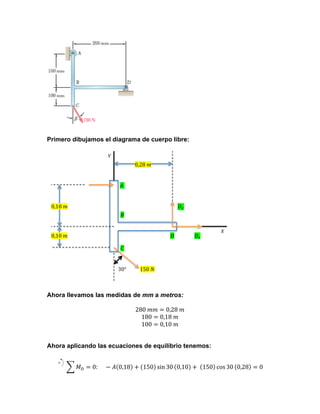
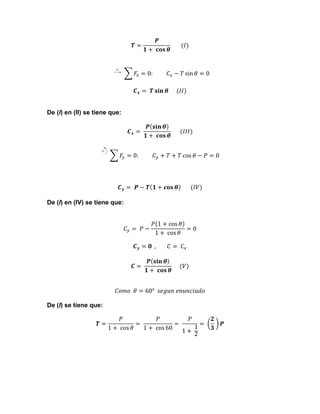
Primero dibujamos el diagrama de cuerpo libre:
!
0,28!!

!!

0,18!!

!!
!

0,10!!

!

!

!

30°

150!!

Ahora llevamos las medidas de mm a metros:

ne Solutions Manual Organization System

280  𝑚𝑚 = 0,28  𝑚
180 = 0,18  𝑚
100 = 0,10  𝑚

on 19.

m:

!!

Ahora aplicando las ecuaciones de equilibrio tenemos:
(a) From free-body diagram of lever BCD

ΣM C = 0: TAB ( 50 mm ) − 200 N ( 75 mm ) = 0

𝑀! = 0:           − 𝐴 0,18 + 150 sin 30 0,10 +    150 cos 30 0,28 = 0
∴ TAB = 300

(b) From free-body diagram of lever BCD

ΣFx = 0: 200 N + Cx + 0.6 ( 300 N ) = 0
∴ C x = −380 N

or

C x = 380 N
21.

OS: Complete Online Solutions Manual Organization System

COSMOS: Complete Online Solutions Manual Organization System

pter 4, Solution 19.

𝑨 =   

Chapter 4, Solution 19.

e-Body Diagram:

150 sin 30 0,10 +    150 cos 30 0,28
= 𝟐𝟒𝟑, 𝟕𝟒  𝑵
0,18

(a) From free-body diagram of lever BCD

Free-Body Diagram:

ΣM C = 0: TAB ( 50 mm ) − 200 N ( 75 mm ) = 0
(a) From free-body        𝑜                    𝑨lever𝟐𝟒𝟒  𝑵   →    
diagram of = BCD

∴ TAB = 300
ΣM C = 0: TAB ( 50 mm ) − 200 N ( 75 mm ) = 0
⎛ 2.4 in. ⎞
(b) From
−⎜
⎟ A − (0.9 in.)Fsp = 0 free-body diagram of lever BCD
Βx = 0 :
⎝ cosα ⎠
∴ T = 300
ΣFx = 0: 0:                    243,74 +300 N ) = 0 30 +    𝐷 = 0 AB
𝐹! = 200 N + Cx + 0.6 ( 150 sin
!
8
(b) From free-body diagram of lever BCD
Fsp =
lb = kx = k (1.2 in.)
∴ C x = −380 N
or
C x = 380 N
cos 30°
ΣFx = 0: 200 N + C + 0.6 ( 300 N ) = 0
𝑫 𝒙 = 0: C y + − 150 xsin 30
ΣFy= −243,74 0.8 ( 300 N ) = 0 = −𝟑𝟏𝟖, 𝟕𝟒  𝑵
∴ C x = −380 N
or
k = 7.69800 lb/in.
k = 7.70 lb/in. ▹ C x = 380 N
∴ C y = −240 N
or
C y = 240 N
ΣFy = 0: C y + 0.8 ( 300 N ) = 0

or

Then
8 lb ⎞
( 3 lb ) sin 30° + Bx + ⎛
⎜
⎟=0
⎝ cos30° ⎠
and Then
Bx = −10.7376 lb

0:

− ( 3 lb ) cos 30° + B y = 0

0:

C =

𝐹! = 0:                  𝐷2 − 150 cos 30 = 0
!
2

2
2
C x + C y C = 380 ) N ( 240 ) = 449.44240 N
∴ = y ( −240 +
or
Cy = N

C
𝑫 ⎛ =    ⎞ 150 cos 30 = 𝟏𝟐𝟗, 𝟗𝟎𝟒  𝑵
2
2

− 240 ⎞
2
C 1 y 2 = C y =⎛
) 32240 )
θ = tan −=𝒚⎜ C x⎟ + tan −1 ⎜ ( 380⎟ =+ ( .276° = 449.44 N
⎜C ⎟
⎝ − 380 ⎠

⎠
⎛ Cy ⎞
⎛ − 240 ⎞ C = 449 N
or = 32.276°
32.3° ▹
and
θ = tan −1 ⎜ ⎟ = tan −1 ⎜
⎟
⎜ C!⎟
!
⎝ − 380 ⎠ ! +    129,904 ! = 𝟑𝟒𝟒, 𝟐𝟎  𝑵
x ⎠
By = 2.5981 lb 𝑃𝑜𝑟  𝑙𝑜  𝑡𝑎𝑛𝑡𝑜:      𝑫 =    𝐷! +    ⎝ 𝐷!    =    −318,74
or
or C = 449 N
32.3° ▹
2
2
= ( −10.7376 ) + ( 2.5981) = 11.0475 lb, and
𝐷
129,904

2.5981
= tan −1
= 13.6020°
10.7376

⎝

x

𝑎𝑑𝑒𝑚𝑎𝑠                          𝜽 =    tan!!

!

𝐷!

=    tan!!

B     𝟑𝟒𝟒  𝑵
𝑜                𝑫 = = 11.05 lb

s: Statics and Dynamics, 8/e, Ferdinand P. Beer, E. Russell Johnston, Jr.,
Clausen, David Mazurek, Phillip J. Cornwell
mpanies.

Mechanics for Engineers: Statics and Dynamics, 8/e, Ferdinand P. Beer, E. Russell Johnston, Jr.,
. Eisenberg, William E. Clausen, David Mazurek, Phillip J. Cornwell
7 The McGraw-Hill Companies.
Vector Mechanics for Engineers: Statics and Dynamics, 8/e, Ferdinand P. Beer, E. Russell Johnston, Jr.,
Elliot R. Eisenberg, William E. Clausen, David Mazurek, Phillip J. Cornwell
© 2007 The McGraw-Hill Companies.

−318,74

13.60° 𝟐𝟐, 𝟐°
𝜽= ▹

= −𝟐𝟐, 𝟏𝟕𝟒°
Primero dibujamos el diagrama de cuerpo libre:

!!

!!

2!

+

!

os
!c

!!

!

!!

!

!!
!!
!!
!!

OS: Complete Online Solutions Manual Organization System

!

!

pter 4, Solution 19.

e-Body Diagram:

Ahora aplicando las ecuaciones de equilibrio tenemos:
(a) From free-body diagram of lever BCD

ΣM C = 0: TAB ( 50 mm ) − 200 N ( 75 mm ) = 0

𝑀! = 0:                      𝑇 2𝑎 + 𝑎 cos 𝜃 −   𝑇𝑎 + 𝑃𝑎 = 0

∴ TAB = 300

(b) From free-body diagram of lever BCD

ΣFx = 0: 200 N + Cx + 0.6 ( 300 N ) = 0
∴ C x = −380 N

or

C x = 380 N

ΣFy = 0: C y + 0.8 ( 300 N ) = 0

∴ C = −240 N

or

C = 240 N
Chapter 4, Solution 19.
Free-Body Diagram:
(a) From free-body diagram of lever BCD

𝑷
ΣM C = 0: TAB ( 50 mm ) − 200 N ( 75 mm ) = 0
𝑻=

𝟏 +    𝐜𝐨𝐬 𝜽

              (𝐼)

∴ TAB = 300

(b) From free-body diagram of lever BCD

ΣFx = 0: 0:                    𝐶 x− 0.6 ( 300 = )0= 0
𝐹! = 200 N + C + 𝑇 sin 𝜃 N
!
∴ C x = −380 N
or
C x = 380 N

COSMOS: Complete Online Solutions Manual Organization System

𝑪 = C + 0.8 ( 300 N )
ΣFy = 𝒙0:   𝑻y 𝐬𝐢𝐧 𝜽          (𝐼𝐼) = 0
∴ C y = −240 N

C y = 240 N

or

De (I)
2
2
Chapter 4, Solution 19. en (II) se tiene que: C = Cx + C y = ( 380 )2 + ( 240 )2 = 449.44 N
Then
Free-Body Diagram:

𝑷 𝐬𝐢𝐧 𝜽
⎛C ⎞

⎛ − 240 ⎞
y
𝑪𝒙 =
θ = tan −1   ⎜ ⎟ = tan −1            (𝐼𝐼𝐼)= 32.276°
⎜ 𝟏 +⎟ 𝐜𝐨𝐬 𝜽 ⎜ − 380 ⎟
  
⎠
⎝
⎝ Cx ⎠
(a) From free-body diagram of lever BCD

and

or C = 449 N
ΣM C = 0: TAB ( 50 mm ) − 200 N ( 75 mm ) = 0

𝐹! = 0:                    𝐶! + 𝑇 + 𝑇 cos 𝜃 − 𝑃 = 0

32.3° ▹

∴ TAB = 300

(b) From free-body diagram of lever BCD

ΣFx = 0: 200 N + Cx + 0.6 ( 300 N ) = 0

𝑪 𝒚 =   𝑷 − 𝑻 𝟏 + 𝐜𝐨𝐬 𝜽               (𝐼𝑉)
∴ C x = −380 N

C x = 380 N

or

ΣFy
De (I) en (IV) se tiene que:= 0: C y + 0.8 ( 300 N ) = 0

∴ C y = −240 N

C y = 240 N

or

Then

2
2
2
C = 𝐶C x=   𝑃y− 𝑃 ( 380 )cos (𝜃 = 0= 449.44 N
+ C 2 = 1 + + 240 )
!

and

⎛ Cy ⎞
⎛ − 240 ⎞
θ = tan ⎜ ⎟ = tan −1 ⎜
⎟
⎟
⎜ 𝑪 𝒚 = 𝟎    ,                𝐶 =    =!32.276°
⎝ − 380 ⎠ 𝐶
⎝ Cx ⎠

1 +    cos 𝜃

−1

or C = 449 N

32.3° ▹

𝑷 𝐬𝐢𝐧 𝜽
𝑪 =   
          (𝑉)
𝟏 +    𝐜𝐨𝐬 𝜽

𝐶𝑜𝑚𝑜    𝜃 = 60°    𝑠𝑒𝑔𝑢𝑛  𝑒𝑛𝑢𝑛𝑐𝑖𝑎𝑑𝑜
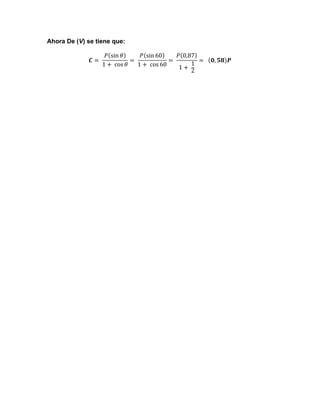
De (I) se tiene que:
𝑻=

𝑃
𝑃
𝑃
𝟐
=   
=   
=      
1
1 +    cos 𝜃
1 +    cos 60
𝟑
1 +    2

Vector Mechanics for Engineers: Statics and Dynamics, 8/e, Ferdinand P. Beer, E. Russell Johnston, Jr.,
Elliot R. Eisenberg, William E. Clausen, David Mazurek, Phillip J. Cornwell
© 2007 The McGraw-Hill Companies.

𝑷
Ahora De (V) se tiene que:
𝑪 =   

𝑃 sin 𝜃
𝑃 sin 60
𝑃 0,87
=   
=   
=      𝟎, 𝟓𝟖 𝑷
1
1 +    cos 𝜃
1 +    cos 60
1 +    2

Bryan

  • 1.
    Primero dibujamos eldiagrama de cuerpo libre: ! 0,28!! !! 0,18!! !! ! 0,10!! ! ! ! 30° 150!! Ahora llevamos las medidas de mm a metros: ne Solutions Manual Organization System 280  𝑚𝑚 = 0,28  𝑚 180 = 0,18  𝑚 100 = 0,10  𝑚 on 19. m: !! Ahora aplicando las ecuaciones de equilibrio tenemos: (a) From free-body diagram of lever BCD ΣM C = 0: TAB ( 50 mm ) − 200 N ( 75 mm ) = 0 𝑀! = 0:           − 𝐴 0,18 + 150 sin 30 0,10 +   150 cos 30 0,28 = 0 ∴ TAB = 300 (b) From free-body diagram of lever BCD ΣFx = 0: 200 N + Cx + 0.6 ( 300 N ) = 0 ∴ C x = −380 N or C x = 380 N
  • 2.
    21. OS: Complete OnlineSolutions Manual Organization System COSMOS: Complete Online Solutions Manual Organization System pter 4, Solution 19. 𝑨 =   Chapter 4, Solution 19. e-Body Diagram: 150 sin 30 0,10 +   150 cos 30 0,28 = 𝟐𝟒𝟑, 𝟕𝟒  𝑵 0,18 (a) From free-body diagram of lever BCD Free-Body Diagram: ΣM C = 0: TAB ( 50 mm ) − 200 N ( 75 mm ) = 0 (a) From free-body        𝑜                    𝑨lever𝟐𝟒𝟒  𝑵   →     diagram of = BCD ∴ TAB = 300 ΣM C = 0: TAB ( 50 mm ) − 200 N ( 75 mm ) = 0 ⎛ 2.4 in. ⎞ (b) From −⎜ ⎟ A − (0.9 in.)Fsp = 0 free-body diagram of lever BCD Βx = 0 : ⎝ cosα ⎠ ∴ T = 300 ΣFx = 0: 0:                    243,74 +300 N ) = 0 30 +   𝐷 = 0 AB 𝐹! = 200 N + Cx + 0.6 ( 150 sin ! 8 (b) From free-body diagram of lever BCD Fsp = lb = kx = k (1.2 in.) ∴ C x = −380 N or C x = 380 N cos 30° ΣFx = 0: 200 N + C + 0.6 ( 300 N ) = 0 𝑫 𝒙 = 0: C y + − 150 xsin 30 ΣFy= −243,74 0.8 ( 300 N ) = 0 = −𝟑𝟏𝟖, 𝟕𝟒  𝑵 ∴ C x = −380 N or k = 7.69800 lb/in. k = 7.70 lb/in. ▹ C x = 380 N ∴ C y = −240 N or C y = 240 N ΣFy = 0: C y + 0.8 ( 300 N ) = 0 or Then 8 lb ⎞ ( 3 lb ) sin 30° + Bx + ⎛ ⎜ ⎟=0 ⎝ cos30° ⎠ and Then Bx = −10.7376 lb 0: − ( 3 lb ) cos 30° + B y = 0 0: C = 𝐹! = 0:                  𝐷2 − 150 cos 30 = 0 ! 2 2 2 C x + C y C = 380 ) N ( 240 ) = 449.44240 N ∴ = y ( −240 + or Cy = N C 𝑫 ⎛ =   ⎞ 150 cos 30 = 𝟏𝟐𝟗, 𝟗𝟎𝟒  𝑵 2 2 − 240 ⎞ 2 C 1 y 2 = C y =⎛ ) 32240 ) θ = tan −=𝒚⎜ C x⎟ + tan −1 ⎜ ( 380⎟ =+ ( .276° = 449.44 N ⎜C ⎟ ⎝ − 380 ⎠ ⎠ ⎛ Cy ⎞ ⎛ − 240 ⎞ C = 449 N or = 32.276° 32.3° ▹ and θ = tan −1 ⎜ ⎟ = tan −1 ⎜ ⎟ ⎜ C!⎟ ! ⎝ − 380 ⎠ ! +   129,904 ! = 𝟑𝟒𝟒, 𝟐𝟎  𝑵 x ⎠ By = 2.5981 lb 𝑃𝑜𝑟  𝑙𝑜  𝑡𝑎𝑛𝑡𝑜:      𝑫 =   𝐷! +   ⎝ 𝐷!   =   −318,74 or or C = 449 N 32.3° ▹ 2 2 = ( −10.7376 ) + ( 2.5981) = 11.0475 lb, and 𝐷 129,904 2.5981 = tan −1 = 13.6020° 10.7376 ⎝ x 𝑎𝑑𝑒𝑚𝑎𝑠                          𝜽 =   tan!! ! 𝐷! =   tan!! B    𝟑𝟒𝟒  𝑵 𝑜                𝑫 = = 11.05 lb s: Statics and Dynamics, 8/e, Ferdinand P. Beer, E. Russell Johnston, Jr., Clausen, David Mazurek, Phillip J. Cornwell mpanies. Mechanics for Engineers: Statics and Dynamics, 8/e, Ferdinand P. Beer, E. Russell Johnston, Jr., . Eisenberg, William E. Clausen, David Mazurek, Phillip J. Cornwell 7 The McGraw-Hill Companies. Vector Mechanics for Engineers: Statics and Dynamics, 8/e, Ferdinand P. Beer, E. Russell Johnston, Jr., Elliot R. Eisenberg, William E. Clausen, David Mazurek, Phillip J. Cornwell © 2007 The McGraw-Hill Companies. −318,74 13.60° 𝟐𝟐, 𝟐° 𝜽= ▹ = −𝟐𝟐, 𝟏𝟕𝟒°
  • 3.
    Primero dibujamos eldiagrama de cuerpo libre: !! !! 2! + ! os !c !! ! !! ! !! !! !! !! OS: Complete Online Solutions Manual Organization System ! ! pter 4, Solution 19. e-Body Diagram: Ahora aplicando las ecuaciones de equilibrio tenemos: (a) From free-body diagram of lever BCD ΣM C = 0: TAB ( 50 mm ) − 200 N ( 75 mm ) = 0 𝑀! = 0:                      𝑇 2𝑎 + 𝑎 cos 𝜃 −  𝑇𝑎 + 𝑃𝑎 = 0 ∴ TAB = 300 (b) From free-body diagram of lever BCD ΣFx = 0: 200 N + Cx + 0.6 ( 300 N ) = 0 ∴ C x = −380 N or C x = 380 N ΣFy = 0: C y + 0.8 ( 300 N ) = 0 ∴ C = −240 N or C = 240 N
  • 4.
    Chapter 4, Solution19. Free-Body Diagram: (a) From free-body diagram of lever BCD 𝑷 ΣM C = 0: TAB ( 50 mm ) − 200 N ( 75 mm ) = 0 𝑻= 𝟏 +   𝐜𝐨𝐬 𝜽              (𝐼) ∴ TAB = 300 (b) From free-body diagram of lever BCD ΣFx = 0: 0:                    𝐶 x− 0.6 ( 300 = )0= 0 𝐹! = 200 N + C + 𝑇 sin 𝜃 N ! ∴ C x = −380 N or C x = 380 N COSMOS: Complete Online Solutions Manual Organization System 𝑪 = C + 0.8 ( 300 N ) ΣFy = 𝒙0:  𝑻y 𝐬𝐢𝐧 𝜽          (𝐼𝐼) = 0 ∴ C y = −240 N C y = 240 N or De (I) 2 2 Chapter 4, Solution 19. en (II) se tiene que: C = Cx + C y = ( 380 )2 + ( 240 )2 = 449.44 N Then Free-Body Diagram: 𝑷 𝐬𝐢𝐧 𝜽 ⎛C ⎞ ⎛ − 240 ⎞ y 𝑪𝒙 = θ = tan −1   ⎜ ⎟ = tan −1            (𝐼𝐼𝐼)= 32.276° ⎜ 𝟏 +⎟ 𝐜𝐨𝐬 𝜽 ⎜ − 380 ⎟   ⎠ ⎝ ⎝ Cx ⎠ (a) From free-body diagram of lever BCD and or C = 449 N ΣM C = 0: TAB ( 50 mm ) − 200 N ( 75 mm ) = 0 𝐹! = 0:                    𝐶! + 𝑇 + 𝑇 cos 𝜃 − 𝑃 = 0 32.3° ▹ ∴ TAB = 300 (b) From free-body diagram of lever BCD ΣFx = 0: 200 N + Cx + 0.6 ( 300 N ) = 0 𝑪 𝒚 =  𝑷 − 𝑻 𝟏 + 𝐜𝐨𝐬 𝜽              (𝐼𝑉) ∴ C x = −380 N C x = 380 N or ΣFy De (I) en (IV) se tiene que:= 0: C y + 0.8 ( 300 N ) = 0 ∴ C y = −240 N C y = 240 N or Then 2 2 2 C = 𝐶C x=  𝑃y− 𝑃 ( 380 )cos (𝜃 = 0= 449.44 N + C 2 = 1 + + 240 ) ! and ⎛ Cy ⎞ ⎛ − 240 ⎞ θ = tan ⎜ ⎟ = tan −1 ⎜ ⎟ ⎟ ⎜ 𝑪 𝒚 = 𝟎    ,                𝐶 =   =!32.276° ⎝ − 380 ⎠ 𝐶 ⎝ Cx ⎠ 1 +   cos 𝜃 −1 or C = 449 N 32.3° ▹ 𝑷 𝐬𝐢𝐧 𝜽 𝑪 =            (𝑉) 𝟏 +   𝐜𝐨𝐬 𝜽 𝐶𝑜𝑚𝑜    𝜃 = 60°    𝑠𝑒𝑔𝑢𝑛  𝑒𝑛𝑢𝑛𝑐𝑖𝑎𝑑𝑜 De (I) se tiene que: 𝑻= 𝑃 𝑃 𝑃 𝟐 =   =   =     1 1 +   cos 𝜃 1 +   cos 60 𝟑 1 +   2 Vector Mechanics for Engineers: Statics and Dynamics, 8/e, Ferdinand P. Beer, E. Russell Johnston, Jr., Elliot R. Eisenberg, William E. Clausen, David Mazurek, Phillip J. Cornwell © 2007 The McGraw-Hill Companies. 𝑷
  • 5.
    Ahora De (V)se tiene que: 𝑪 =   𝑃 sin 𝜃 𝑃 sin 60 𝑃 0,87 =   =   =     𝟎, 𝟓𝟖 𝑷 1 1 +   cos 𝜃 1 +   cos 60 1 +   2