Brownfields
A Diamond in the Rough
What are Brownfields?
“…real property, the expansion, redevelopment or reuse of which may be complicated by the presence or
potential presence of a hazardous substance, pollutant, or contaminant.”
10/25/20182
 Blighted, abandoned, derelict
property
 Contaminated property
 Property that everyone
believes is contaminated
 Fear of environmental liability
■ An economic engine
■ A jobs magnet
■ A new community gateway
■ A public gathering spot
Bush’s Recycling Florence, SC before and now: health clinic
Perception:
If it looks blighted, it’s going to be expensive to cleanup and
redevelop.
Perception:
If it looks blighted, it’s going to be expensive to cleanup and
redevelop.
Reality:
About 30% of the properties our grantees
assess do not require cleanup.
Perception:
If it looks blighted, it’s going to be expensive to cleanup and
redevelop.
Reality:
About 30% of the properties our grantees
assess do not require cleanup.
Reality:
Not all cleanups are as expensive as you might think.
0
0-300
300-1000
1K-5000
5K-10000
10K-50000
50K-100000
100000+
Tons
Remediated
Source: Georgia Department of Natural Resources
How Big is a Typical Soil Cleanup?
63%18%
6%
4%
3%
2% 2% 2%
Brownfield Grant Types (3 years unless otherwise noted)
• Assessment ($400k max or $600k for coalitions)
• Revolving Loan Fund (RLF) ($800k-1M, 5-15 years)
• Cleanup (now up to $500k per parcel)
• Environmental Workforce Development and Job Training ($200k)
• Multi-Purpose ($800,000, 5 years)
Also Available:
Targeted Brownfields Assessments (not a grant)
Some States/Tribes offer assistance through their EPA 128a grant
This Year’s Grant Rotations
• Multi-Purpose Grant
• Now: “MAC” grants (Multi-purpose, Assessment, Cleanup – for FY19, no RLF until
2020); open in early November, 2018
• Job Training: solicitation in 2019, funded with 2020 funds (going to every
other year)
• RLF: every other year; next in 2020
• Hazardous Substances
• Petroleum Contamination
• Asbestos & Lead Based Paint are eligible
• Controlled Substances (e.g., Meth labs)
• Mine-Scarred Lands
• Other environmental contaminants
• Community-wide
• Site-specific (single site)
• Assessment Coalition
Grants
To inventory, characterize, assess, and conduct planning and
community involvement related to brownfields sites.
• Up to $200K per property (parceling is an option)
• Must own site at time of application
• Hazardous substances or petroleum contamination
• May apply for up to 3 properties: Separate proposals for each property
• Non-profits may apply
• Cost share requirement of 20% (May request a hardship waiver)
• Phase II must be completed (Threshold Criteria)
• Analysis of Brownfields Cleanup Alternatives (ABCA) must be included
To carry out cleanup activities at brownfield sites
• Up to $1M per eligible
entity
• Coalitions may apply
• (Maximum) 50/50% loan
to subgrant ratio (may
request a waiver)
• Cost share requirement
of 20%
• Nonprofit organizations
are not eligible to apply
To make low interest loans to carry out cleanup activities at
brownfields properties
• Targets unemployed
and underemployed
individuals
• 3 Year Grants
• $200,000
To provide full-time, sustainable employment in various aspects of hazardous and solid
waste management
Multi-Purpose
• Assessment & Cleanup in one grant
• Does not need to be the same sites
• 5 year, $500,000 max; $200,000 must be spent on cleanup
New for FY19!
• Local Governments
• Land Clearance Authorities/Quasi-Governmental Entities
Under Local Governmental Control
• State Legislated Government Entities
• Regional Councils of Government or Group of Local
Governments
• Redevelopment Agency (State Chartered/Sanctioned)
• States
• Tribes
• Nonprofits
EPA Grantee Accomplishments
Accomplishment EPA Region
4 FY18
EPA
Region 4
Since 1995
National
Cumulative
Assessment complete 329 3,987 28,629
Cleanups complete 14 120
Dollars Leveraged $291 Million $5.9 Billion $26.4 Billion
Jobs Leveraged 1,687 21,434 138,643
Acres Ready for Reuse 1031 23,627
Properties Ready for
Reuse
150 939 76,119
● $17 leveraged for each
grant dollar spent
● 9 jobs created for every
$100,000 grant dollar spent
A 2017 study concluded that cleaning
up brownfield properties led to
residential property value increases
of 5 - 15.2% within 1.29 miles of the
sites.1 Analyzing data near 48 of those
brownfields, another study found an
estimated $29 to $97 million in
additional tax revenue for local
governments in a single year after
cleanup—2 to 7 times more than the
$12.4 million EPA contributed to the
cleanup of those brownfields.2
2. Sullivan, K. 2017. Brownfields Remediation: Impact of Local Residential Property Tax Revenue1 Haninger, K., L. Ma, and C. Timmins. 2017. The Value of Brownfield Remediation. Journal of
the Association of Environmental and Resource Economists 4(1): 197-241.
So, You want a Brownfield Grant?
Good proposals begin with applicants who are well positioned for success.
Some things to think about before you apply:
Who will champion your project?
Do you have a vision for your community?
Have you involved your community?
Do you have political support?
Can you get access to properties you want to assess?
10/25/201817
Identify Your Project Manager
 A dedicated energetic PM
is often the difference
between a successful or
unsuccessful community.
 Key Questions:
• Clear decision-making authority
• Retained for 3-5 yrs
• Driven / high energy
10/25/201818
Put Together a Brownfields Team
 Political Leaders
 Local Government Planners
 Community Leaders
 Local Environmental Consultants
 Developers
 State/EPA
10/25/201819
Identify Your Project Area
 Single site
 Main street
 City-wide
 Catalyst properties
10/25/201820
Involve Your Targeted Community
• Education
• Identify concerns
• Keep informed
• Involve the Property
Owners!!
10/25/201821
Develop Your Vision for Project Area
10/25/201822
• Begin building support
• Identify financial interest
• Motivate community groups
• Develop funding proposals
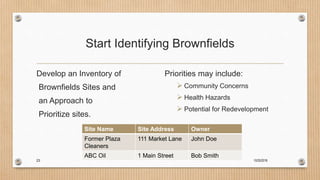
Start Identifying Brownfields
Develop an Inventory of
Brownfields Sites and
an Approach to
Prioritize sites.
Priorities may include:
 Community Concerns
 Health Hazards
 Potential for Redevelopment
10/25/201823
Site Name Site Address Owner
Former Plaza
Cleaners
111 Market Lane John Doe
ABC Oil 1 Main Street Bob Smith
EPA Grant Program Type of EPA Assistance/Grants
Website
Environmental Justice Support and empower communities as they
develop and implement solutions that significantly
address environmental and/or public health issues
at the local level.
https://www.epa.gov/grants/open-
announcements-competitive-grant-
opportunities
Urban Waters Support to communities make water quality
restoration relevant to public health, social,
economic, and livability goals.
https://www.epa.gov/urbanwaters/urban-
waters-small-grants
Brownfields • Assessment
• Cleanup
• Revolving Loan Fund (RLF)
• Area Wide Planning (AWP)
• Employment Workforce Development and
Job Training Grant (EWDJTG)
• Targeted Brownfield Assessment (TBA)
• Technical Assistance through:
Technical Assistance for Brownfields
(TAB) - CCLR
Groundwork USA
Council of Development Finance
Agencies (CDFA)
https://www.epa.gov/brownfields/types-
brownfields-grant-funding
https://www.epa.gov/brownfields/brownfield
s-technical-assistance
http://www.cclr.org/technical-assistance
http://groundworkusa.org/
http://www.cdfa.net/
Partnership for Sustainable
Communities / Smart Growth
Technical Assistance - Local Foods, Local Places,
Building Blocks for Sustainable Communities
https://www.epa.gov/smartgrowth/smart-
growth-technical-assistance-programs
EPA Grant Funding and Technical Assistance
• The target audience is municipal officials interested in
facilitating the cleanup and redevelopment of contaminated
properties.
• The workbook may also be useful to tribes, county and state
governments, and quasi-governmental entities such as
economic development corporations.
• PREPARED (Process for Risk Evaluation, Property Analysis
and Reuse Decisions) is a risk management based approach to
help municipalities evaluate potential property recovery actions
for specific properties.
• https://www.epa.gov/sites/production/files/2015-
04/documents/munimanual.pdf
PREPARED WORKBOOK
Process for Risk Evaluation, Property Analysis and Reuse
Decisions
• Document is designed to help local governments overcome
obstacles and encourage infill development, particularly in
distressed communities.
• Document presents 30 strategies into two main categories:
foundation and funding.
• Strategies in the foundation category refer to critical steps a
jurisdiction can take to make infill development more feasible, such
as establishing priorities, policies, and partnerships, and changing
public perceptions. they dedicate time, energy, and resources.
• Strategies in the funding category include some common and
innovative federal, state, and local programs and strategies that can
fund infill and infrastructure.
• https://www.epa.gov/sites/production/files/2015-
05/documents/fresno_final_report_042215_508_final.pdf
ATTRACTING INFILL DEVELOPMENT IN DISTRESSED
COMMUNITIES: 30 STRATEGIES
• Provides guidance and technical assistance to localities and
brownfields practitioners on leveraging resources for
brownfields revitalization.
• This guide explores how communities can prepare to
successfully leverage funding and other resources for
brownfields revitalization.
• It focuses primarily on what communities can do before they
solicit funding to organize themselves and make the
preparations necessary for mounting a successful leveraging
effort.
• https://www.epa.gov/sites/production/files/2016-
04/documents/final_leveraging_guide_document_4-19-16.pdf
Setting the Stage for Leveraging Resources for Brownfields
Revitalization

Brownfields Redevelopment Journey: Nolan

  • 1.
  • 2.
    What are Brownfields? “…realproperty, the expansion, redevelopment or reuse of which may be complicated by the presence or potential presence of a hazardous substance, pollutant, or contaminant.” 10/25/20182  Blighted, abandoned, derelict property  Contaminated property  Property that everyone believes is contaminated  Fear of environmental liability ■ An economic engine ■ A jobs magnet ■ A new community gateway ■ A public gathering spot Bush’s Recycling Florence, SC before and now: health clinic
  • 3.
    Perception: If it looksblighted, it’s going to be expensive to cleanup and redevelop.
  • 4.
    Perception: If it looksblighted, it’s going to be expensive to cleanup and redevelop. Reality: About 30% of the properties our grantees assess do not require cleanup.
  • 5.
    Perception: If it looksblighted, it’s going to be expensive to cleanup and redevelop. Reality: About 30% of the properties our grantees assess do not require cleanup. Reality: Not all cleanups are as expensive as you might think.
  • 6.
    0 0-300 300-1000 1K-5000 5K-10000 10K-50000 50K-100000 100000+ Tons Remediated Source: Georgia Departmentof Natural Resources How Big is a Typical Soil Cleanup? 63%18% 6% 4% 3% 2% 2% 2%
  • 7.
    Brownfield Grant Types(3 years unless otherwise noted) • Assessment ($400k max or $600k for coalitions) • Revolving Loan Fund (RLF) ($800k-1M, 5-15 years) • Cleanup (now up to $500k per parcel) • Environmental Workforce Development and Job Training ($200k) • Multi-Purpose ($800,000, 5 years) Also Available: Targeted Brownfields Assessments (not a grant) Some States/Tribes offer assistance through their EPA 128a grant
  • 8.
    This Year’s GrantRotations • Multi-Purpose Grant • Now: “MAC” grants (Multi-purpose, Assessment, Cleanup – for FY19, no RLF until 2020); open in early November, 2018 • Job Training: solicitation in 2019, funded with 2020 funds (going to every other year) • RLF: every other year; next in 2020
  • 9.
    • Hazardous Substances •Petroleum Contamination • Asbestos & Lead Based Paint are eligible • Controlled Substances (e.g., Meth labs) • Mine-Scarred Lands • Other environmental contaminants
  • 10.
    • Community-wide • Site-specific(single site) • Assessment Coalition Grants To inventory, characterize, assess, and conduct planning and community involvement related to brownfields sites.
  • 11.
    • Up to$200K per property (parceling is an option) • Must own site at time of application • Hazardous substances or petroleum contamination • May apply for up to 3 properties: Separate proposals for each property • Non-profits may apply • Cost share requirement of 20% (May request a hardship waiver) • Phase II must be completed (Threshold Criteria) • Analysis of Brownfields Cleanup Alternatives (ABCA) must be included To carry out cleanup activities at brownfield sites
  • 12.
    • Up to$1M per eligible entity • Coalitions may apply • (Maximum) 50/50% loan to subgrant ratio (may request a waiver) • Cost share requirement of 20% • Nonprofit organizations are not eligible to apply To make low interest loans to carry out cleanup activities at brownfields properties
  • 13.
    • Targets unemployed andunderemployed individuals • 3 Year Grants • $200,000 To provide full-time, sustainable employment in various aspects of hazardous and solid waste management
  • 14.
    Multi-Purpose • Assessment &Cleanup in one grant • Does not need to be the same sites • 5 year, $500,000 max; $200,000 must be spent on cleanup New for FY19!
  • 15.
    • Local Governments •Land Clearance Authorities/Quasi-Governmental Entities Under Local Governmental Control • State Legislated Government Entities • Regional Councils of Government or Group of Local Governments • Redevelopment Agency (State Chartered/Sanctioned) • States • Tribes • Nonprofits
  • 16.
    EPA Grantee Accomplishments AccomplishmentEPA Region 4 FY18 EPA Region 4 Since 1995 National Cumulative Assessment complete 329 3,987 28,629 Cleanups complete 14 120 Dollars Leveraged $291 Million $5.9 Billion $26.4 Billion Jobs Leveraged 1,687 21,434 138,643 Acres Ready for Reuse 1031 23,627 Properties Ready for Reuse 150 939 76,119 ● $17 leveraged for each grant dollar spent ● 9 jobs created for every $100,000 grant dollar spent A 2017 study concluded that cleaning up brownfield properties led to residential property value increases of 5 - 15.2% within 1.29 miles of the sites.1 Analyzing data near 48 of those brownfields, another study found an estimated $29 to $97 million in additional tax revenue for local governments in a single year after cleanup—2 to 7 times more than the $12.4 million EPA contributed to the cleanup of those brownfields.2 2. Sullivan, K. 2017. Brownfields Remediation: Impact of Local Residential Property Tax Revenue1 Haninger, K., L. Ma, and C. Timmins. 2017. The Value of Brownfield Remediation. Journal of the Association of Environmental and Resource Economists 4(1): 197-241.
  • 17.
    So, You wanta Brownfield Grant? Good proposals begin with applicants who are well positioned for success. Some things to think about before you apply: Who will champion your project? Do you have a vision for your community? Have you involved your community? Do you have political support? Can you get access to properties you want to assess? 10/25/201817
  • 18.
    Identify Your ProjectManager  A dedicated energetic PM is often the difference between a successful or unsuccessful community.  Key Questions: • Clear decision-making authority • Retained for 3-5 yrs • Driven / high energy 10/25/201818
  • 19.
    Put Together aBrownfields Team  Political Leaders  Local Government Planners  Community Leaders  Local Environmental Consultants  Developers  State/EPA 10/25/201819
  • 20.
    Identify Your ProjectArea  Single site  Main street  City-wide  Catalyst properties 10/25/201820
  • 21.
    Involve Your TargetedCommunity • Education • Identify concerns • Keep informed • Involve the Property Owners!! 10/25/201821
  • 22.
    Develop Your Visionfor Project Area 10/25/201822 • Begin building support • Identify financial interest • Motivate community groups • Develop funding proposals
  • 23.
    Start Identifying Brownfields Developan Inventory of Brownfields Sites and an Approach to Prioritize sites. Priorities may include:  Community Concerns  Health Hazards  Potential for Redevelopment 10/25/201823 Site Name Site Address Owner Former Plaza Cleaners 111 Market Lane John Doe ABC Oil 1 Main Street Bob Smith
  • 24.
    EPA Grant ProgramType of EPA Assistance/Grants Website Environmental Justice Support and empower communities as they develop and implement solutions that significantly address environmental and/or public health issues at the local level. https://www.epa.gov/grants/open- announcements-competitive-grant- opportunities Urban Waters Support to communities make water quality restoration relevant to public health, social, economic, and livability goals. https://www.epa.gov/urbanwaters/urban- waters-small-grants Brownfields • Assessment • Cleanup • Revolving Loan Fund (RLF) • Area Wide Planning (AWP) • Employment Workforce Development and Job Training Grant (EWDJTG) • Targeted Brownfield Assessment (TBA) • Technical Assistance through: Technical Assistance for Brownfields (TAB) - CCLR Groundwork USA Council of Development Finance Agencies (CDFA) https://www.epa.gov/brownfields/types- brownfields-grant-funding https://www.epa.gov/brownfields/brownfield s-technical-assistance http://www.cclr.org/technical-assistance http://groundworkusa.org/ http://www.cdfa.net/ Partnership for Sustainable Communities / Smart Growth Technical Assistance - Local Foods, Local Places, Building Blocks for Sustainable Communities https://www.epa.gov/smartgrowth/smart- growth-technical-assistance-programs EPA Grant Funding and Technical Assistance
  • 25.
    • The targetaudience is municipal officials interested in facilitating the cleanup and redevelopment of contaminated properties. • The workbook may also be useful to tribes, county and state governments, and quasi-governmental entities such as economic development corporations. • PREPARED (Process for Risk Evaluation, Property Analysis and Reuse Decisions) is a risk management based approach to help municipalities evaluate potential property recovery actions for specific properties. • https://www.epa.gov/sites/production/files/2015- 04/documents/munimanual.pdf PREPARED WORKBOOK Process for Risk Evaluation, Property Analysis and Reuse Decisions
  • 26.
    • Document isdesigned to help local governments overcome obstacles and encourage infill development, particularly in distressed communities. • Document presents 30 strategies into two main categories: foundation and funding. • Strategies in the foundation category refer to critical steps a jurisdiction can take to make infill development more feasible, such as establishing priorities, policies, and partnerships, and changing public perceptions. they dedicate time, energy, and resources. • Strategies in the funding category include some common and innovative federal, state, and local programs and strategies that can fund infill and infrastructure. • https://www.epa.gov/sites/production/files/2015- 05/documents/fresno_final_report_042215_508_final.pdf ATTRACTING INFILL DEVELOPMENT IN DISTRESSED COMMUNITIES: 30 STRATEGIES
  • 27.
    • Provides guidanceand technical assistance to localities and brownfields practitioners on leveraging resources for brownfields revitalization. • This guide explores how communities can prepare to successfully leverage funding and other resources for brownfields revitalization. • It focuses primarily on what communities can do before they solicit funding to organize themselves and make the preparations necessary for mounting a successful leveraging effort. • https://www.epa.gov/sites/production/files/2016- 04/documents/final_leveraging_guide_document_4-19-16.pdf Setting the Stage for Leveraging Resources for Brownfields Revitalization