Cleaning up & Reconstructing After  The Haiti Earthquake Prepared by Isabelle Heatherington Arnold, ARM Risk Manager Best Risks, LLC Assessment, Management & Planning of Catastrophes www.bestrisks.com
Debris Clean Up A disaster can result in numerous types of debris such as hazardous hanging limbs, sand, construction materials, vehicles and personal property, any of which can wreak certain havoc on a community. Locating the staff, equipment, and funds to devote to debris removal can be a complex process for even the most well-prepared of jurisdictions. 
Priorities  Assess total volume of debris Develop debris removal and recycling plan Prepare pick up and drop off points for debris Equipment and Labor  Coordinate with public and private sector Communication plan
Debris Clean Up Critical Needs: Clear roads to allow heavy equipment Identify drop off point (s) for the debris Sort dropped off debris: concrete, metal, combustible & hazardous materials Bring in and set up specialized heavy equipment: - Crusher -Grinder  - Air curtain pit with blower and incinerator
Debris Management Site considerations The following site characteristics items should be considered when selecting debris management sites: Publicly owned land (state or municipal) Large open space – should be at least 40 square meters (10 sq.yds) ; greater than 200 square meters (50 sq.yds) is ideal for sites serving multiple municipalities or final regional debris staging sites before disposal. Relatively flat topography Good ingress and egress Minimal effect on residential neighborhoods, educational facilities,health care facilities, and environmentally sensitive areas.
Debris Management Site Consideration Location near final disposal sites to reduce hauling distances No wetlands, endangered species, rare ecosystems, or other environmental restrictions No impact on historic or archaeological sites Accommodates separation and reduction of types of debris: vegetative, construction and demolition, household hazardous waste, commercial hazardous waste etc. can accommodate types of site operations that may take place: chipping, grinding, recycling, and under permitted conditions by DEP – air curtain burning, and open pit burning.
Volume of Debris Concrete and masonry makes up 70% of debris to be picked up and disposed of. There are no designated dump sites for such large volume of concrete The concrete must be crushed and recycled The volume of construction debris on private property is enormous and yet uncalculated
Issues With Uncontrolled Dumping Private contractors are picking up debris and dumping on side of roads Dumping on empty lots Hazardous materials not sorted Contamination of soil Water contamination Will soon run out of space for dumping
Calculating Volume The following formulas are provided to assist in arriving at uniform debris estimates: ·1 Story Building: L'xW'xH'  = _____ CY x 0.33 = _______CY 27 Debris Pile: L'xW'xH ' = ______CY 27 1 cubic yard = 0.764554858 cubic meter
Disposal The next step in the process is solid waste disposal, from both an  operational and cost basis. The  disposal site haul distance is a  major cost and time factor in clean-up.
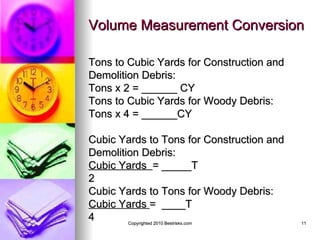
Volume Measurement Conversion Tons to Cubic Yards for Construction and Demolition Debris: Tons x 2 = ______ CY Tons to Cubic Yards for Woody Debris: Tons x 4 = ______CY Cubic Yards to Tons for Construction and Demolition Debris: Cubic Yards  = _____T 2 Cubic Yards to Tons for Woody Debris: Cubic Yards  =  ____T 4
Volume reduction methods Burn:  open burning, air curtain pit burning, and incineration.  Grind Recycle
Recycling Debris Some effective ways to recycle debris include: Composting or mulching vegetative debris, Using materials such as concrete or asphalt as sub‐base for roads, prevent erosion on beaches and port areas Selling scrap metal to dealers, and  Using dirt as landfill cover or for agricultural purposes.
Recycling is the better solution Recycling and material separation at the point of generation and at staging/processing locations.  Maximize potential processing and recycling options. Is better for the environment
Northridge Earthquake, Los Angeles California City of Los Angeles Curbside Pickup Program Following 1994 Northridge Earthquake  Background : The City of Los Angeles chose to address the issue of collection and processing of earthquake debris through private contractors. The City determined that it was most effective to use the existing expertise of established businesses in the area to address debris collection and processing. The anticipated result would be a shorter learning curve for waste handling and a potential expansion of permanent facilities to process mixed and segregated wastes after cleanup activities were completed. Recycling Program Overview : The City of Los Angeles developed a Demolition and Debris Removal Program to handle the debris generated from the 1994 Northridge earthquake. The purpose of the program was to collect residence curbside earthquake debris, and demolish  400+ damaged buildings.   The City collected  2,880,000 tons , and  recycled 1,629,800 tons  for a 56.5% recycling rate.  The City saved approximately 6,350,000 cubic yards of landfill space through its recycling and demolition programs (1,629,800 tons).
Northridge Earthquake Study Lessons Learned: The City of Los Angeles stressed that it is extremely important to identify the types and locations of debris piled up in the streets prior to dispatching crews to collect it.  This allows for:  consolidation of similar types of debris (i.e. wood, aggregate, metal, wallboard, insulation), so that  full loads of like material can be brought to source separated processing stations, thus minimizing transportation and disposal costs and increasing the likelihood that the materials will be recycled.  Debris identification  Debris identification can be accomplished in various ways. In hilly areas, the City of Los Angeles scoped the neighborhoods using City staff contractors and marking types of materials and locations on a map. Some contractors will do this prior to dispatching crews, but not necessarily. This is probably something that should be negotiated in the contract.  Although the City of Los Angeles chose to blanket the neighborhoods with mobile crews, a Geographic Information System could also be used for identifying locations. Regardless of the method, the primary goal is to maximize capacity of the cleanup crews while collecting as much similar types of debris as possible.  Notify residents of program.  Get the word out This point may seem obvious, but there are several potential barriers to disseminating information on a curbside pickup program. A City's public outreach program should evaluate all forms of media including: newspaper ads, radio public service announcements, and television public access stations. Be aware of communities where multiple language ads will be necessary. Also, be prepared to pay for the ads. The City of Los Angeles was quoted a price of $16,000.00 for a quarter-page ad in the  L.A. Times .  Consider only collecting source separated material at the curb.
Proposed Solutions for Debris Removal Create mandatory order at government level for debris disposal protocol that all private and public contractors must follow Create Designated Dump Sites (DDS) for construction debris only, outside the Port au Prince congested areas After the debris is sorted at DDS, carry the sorted debris by class to recycling or burn sites. Create Hazardous Material containment and disposal protocols for DDS Communicate all the above to all commercial property owner, government contractors and private contractors via one agency Communicate above to all NGO’s involved in recovery and reconstruction
Reconstruction The importance of rebuilding according to adequate codes cannot be stressed enough times.  Yet, because of lack of guidelines and monitoring, the private sector is rebuilding with almost the  same sub-standard construction  methods as before the earthquake. The International Building Code should be adopted and used by engineers, builders, governmental inspectors, and insurance companies. Earthquake retrofitting and Earthquake construction protocols are a must for public and private buildings that receive or welcome the public, such as hotels, hospitals and schools.
Reconstruction Proper preparation and testing of the soil for evidence of liquefaction must be done before extensive reconstruction can begin. Repairs of concrete, masonry and structural supports must be done under the supervision of a qualified structural engineer or architect Owners of buildings should consider rebuilding with earthquake resistant material and designs Individual homeowners and business owners will need financial assistance with debris removal and rebuilding due to large quantity of homes and businesses being under insured or not insured at all.
What Can The Private Sector Do? Take initiative Plan and Organize as a community Communicate with all agencies Provide solutions by example Take action Put local people to work Rebuilt safer and greener
New Development Every community that has rebuilt hit by a major disaster ultimately rebuilds better and safer buildings.  The challenge in Haiti is finding the money to sustain this rebuilding process. New communities spring up from the ashes of the old, and sometimes are relocated completely to a safer place. There will be a housing shortage here for quite some time. There will be a need for modular housing, which can be shipped to Haiti ready to assemble. A well plan development addressing storage needs, businesses and homes will be welcome in Haiti.
Conclusion By studying how other communities facing similar disasters have successfully rebuild,  Haiti has an opportunity to start anew, with better construction and planning for any future disaster.  Not taking the time to do the reconstruction properly can create an even more damaging aftermath to the economy, the health and welfare of the people of Haiti. Foreign aid needs to be used judiciously and an government wide reconstruction plan must be in place.  That is the only way to start on the road to a efficient and prompt recovery for Haiti.

Cleaning Up & Reconstructing in Haiti after the 2010 Earthquake

  • 1.
    Cleaning up &Reconstructing After The Haiti Earthquake Prepared by Isabelle Heatherington Arnold, ARM Risk Manager Best Risks, LLC Assessment, Management & Planning of Catastrophes www.bestrisks.com
  • 2.
    Debris Clean UpA disaster can result in numerous types of debris such as hazardous hanging limbs, sand, construction materials, vehicles and personal property, any of which can wreak certain havoc on a community. Locating the staff, equipment, and funds to devote to debris removal can be a complex process for even the most well-prepared of jurisdictions. 
  • 3.
    Priorities Assesstotal volume of debris Develop debris removal and recycling plan Prepare pick up and drop off points for debris Equipment and Labor Coordinate with public and private sector Communication plan
  • 4.
    Debris Clean UpCritical Needs: Clear roads to allow heavy equipment Identify drop off point (s) for the debris Sort dropped off debris: concrete, metal, combustible & hazardous materials Bring in and set up specialized heavy equipment: - Crusher -Grinder - Air curtain pit with blower and incinerator
  • 5.
    Debris Management Siteconsiderations The following site characteristics items should be considered when selecting debris management sites: Publicly owned land (state or municipal) Large open space – should be at least 40 square meters (10 sq.yds) ; greater than 200 square meters (50 sq.yds) is ideal for sites serving multiple municipalities or final regional debris staging sites before disposal. Relatively flat topography Good ingress and egress Minimal effect on residential neighborhoods, educational facilities,health care facilities, and environmentally sensitive areas.
  • 6.
    Debris Management SiteConsideration Location near final disposal sites to reduce hauling distances No wetlands, endangered species, rare ecosystems, or other environmental restrictions No impact on historic or archaeological sites Accommodates separation and reduction of types of debris: vegetative, construction and demolition, household hazardous waste, commercial hazardous waste etc. can accommodate types of site operations that may take place: chipping, grinding, recycling, and under permitted conditions by DEP – air curtain burning, and open pit burning.
  • 7.
    Volume of DebrisConcrete and masonry makes up 70% of debris to be picked up and disposed of. There are no designated dump sites for such large volume of concrete The concrete must be crushed and recycled The volume of construction debris on private property is enormous and yet uncalculated
  • 8.
    Issues With UncontrolledDumping Private contractors are picking up debris and dumping on side of roads Dumping on empty lots Hazardous materials not sorted Contamination of soil Water contamination Will soon run out of space for dumping
  • 9.
    Calculating Volume Thefollowing formulas are provided to assist in arriving at uniform debris estimates: ·1 Story Building: L'xW'xH' = _____ CY x 0.33 = _______CY 27 Debris Pile: L'xW'xH ' = ______CY 27 1 cubic yard = 0.764554858 cubic meter
  • 10.
    Disposal The nextstep in the process is solid waste disposal, from both an operational and cost basis. The disposal site haul distance is a major cost and time factor in clean-up.
  • 11.
    Volume Measurement ConversionTons to Cubic Yards for Construction and Demolition Debris: Tons x 2 = ______ CY Tons to Cubic Yards for Woody Debris: Tons x 4 = ______CY Cubic Yards to Tons for Construction and Demolition Debris: Cubic Yards = _____T 2 Cubic Yards to Tons for Woody Debris: Cubic Yards = ____T 4
  • 12.
    Volume reduction methodsBurn: open burning, air curtain pit burning, and incineration. Grind Recycle
  • 13.
    Recycling Debris Someeffective ways to recycle debris include: Composting or mulching vegetative debris, Using materials such as concrete or asphalt as sub‐base for roads, prevent erosion on beaches and port areas Selling scrap metal to dealers, and Using dirt as landfill cover or for agricultural purposes.
  • 14.
    Recycling is thebetter solution Recycling and material separation at the point of generation and at staging/processing locations. Maximize potential processing and recycling options. Is better for the environment
  • 15.
    Northridge Earthquake, LosAngeles California City of Los Angeles Curbside Pickup Program Following 1994 Northridge Earthquake Background : The City of Los Angeles chose to address the issue of collection and processing of earthquake debris through private contractors. The City determined that it was most effective to use the existing expertise of established businesses in the area to address debris collection and processing. The anticipated result would be a shorter learning curve for waste handling and a potential expansion of permanent facilities to process mixed and segregated wastes after cleanup activities were completed. Recycling Program Overview : The City of Los Angeles developed a Demolition and Debris Removal Program to handle the debris generated from the 1994 Northridge earthquake. The purpose of the program was to collect residence curbside earthquake debris, and demolish 400+ damaged buildings. The City collected 2,880,000 tons , and recycled 1,629,800 tons for a 56.5% recycling rate. The City saved approximately 6,350,000 cubic yards of landfill space through its recycling and demolition programs (1,629,800 tons).
  • 16.
    Northridge Earthquake StudyLessons Learned: The City of Los Angeles stressed that it is extremely important to identify the types and locations of debris piled up in the streets prior to dispatching crews to collect it. This allows for: consolidation of similar types of debris (i.e. wood, aggregate, metal, wallboard, insulation), so that full loads of like material can be brought to source separated processing stations, thus minimizing transportation and disposal costs and increasing the likelihood that the materials will be recycled. Debris identification Debris identification can be accomplished in various ways. In hilly areas, the City of Los Angeles scoped the neighborhoods using City staff contractors and marking types of materials and locations on a map. Some contractors will do this prior to dispatching crews, but not necessarily. This is probably something that should be negotiated in the contract. Although the City of Los Angeles chose to blanket the neighborhoods with mobile crews, a Geographic Information System could also be used for identifying locations. Regardless of the method, the primary goal is to maximize capacity of the cleanup crews while collecting as much similar types of debris as possible. Notify residents of program. Get the word out This point may seem obvious, but there are several potential barriers to disseminating information on a curbside pickup program. A City's public outreach program should evaluate all forms of media including: newspaper ads, radio public service announcements, and television public access stations. Be aware of communities where multiple language ads will be necessary. Also, be prepared to pay for the ads. The City of Los Angeles was quoted a price of $16,000.00 for a quarter-page ad in the L.A. Times . Consider only collecting source separated material at the curb.
  • 17.
    Proposed Solutions forDebris Removal Create mandatory order at government level for debris disposal protocol that all private and public contractors must follow Create Designated Dump Sites (DDS) for construction debris only, outside the Port au Prince congested areas After the debris is sorted at DDS, carry the sorted debris by class to recycling or burn sites. Create Hazardous Material containment and disposal protocols for DDS Communicate all the above to all commercial property owner, government contractors and private contractors via one agency Communicate above to all NGO’s involved in recovery and reconstruction
  • 18.
    Reconstruction The importanceof rebuilding according to adequate codes cannot be stressed enough times. Yet, because of lack of guidelines and monitoring, the private sector is rebuilding with almost the same sub-standard construction methods as before the earthquake. The International Building Code should be adopted and used by engineers, builders, governmental inspectors, and insurance companies. Earthquake retrofitting and Earthquake construction protocols are a must for public and private buildings that receive or welcome the public, such as hotels, hospitals and schools.
  • 19.
    Reconstruction Proper preparationand testing of the soil for evidence of liquefaction must be done before extensive reconstruction can begin. Repairs of concrete, masonry and structural supports must be done under the supervision of a qualified structural engineer or architect Owners of buildings should consider rebuilding with earthquake resistant material and designs Individual homeowners and business owners will need financial assistance with debris removal and rebuilding due to large quantity of homes and businesses being under insured or not insured at all.
  • 20.
    What Can ThePrivate Sector Do? Take initiative Plan and Organize as a community Communicate with all agencies Provide solutions by example Take action Put local people to work Rebuilt safer and greener
  • 21.
    New Development Everycommunity that has rebuilt hit by a major disaster ultimately rebuilds better and safer buildings. The challenge in Haiti is finding the money to sustain this rebuilding process. New communities spring up from the ashes of the old, and sometimes are relocated completely to a safer place. There will be a housing shortage here for quite some time. There will be a need for modular housing, which can be shipped to Haiti ready to assemble. A well plan development addressing storage needs, businesses and homes will be welcome in Haiti.
  • 22.
    Conclusion By studyinghow other communities facing similar disasters have successfully rebuild, Haiti has an opportunity to start anew, with better construction and planning for any future disaster. Not taking the time to do the reconstruction properly can create an even more damaging aftermath to the economy, the health and welfare of the people of Haiti. Foreign aid needs to be used judiciously and an government wide reconstruction plan must be in place. That is the only way to start on the road to a efficient and prompt recovery for Haiti.