COMMUNICATING ACROSS THE DIGITAL DIVIDE Presented to the … (pending) Lloyd D. Brown, COML 506B Spring 2010 05/04/2010
Government organizations have raced to put social media tools into practice.  Most social media outreach programs  target a general market audience. But, by ignoring the digital divide in how  people access and use the Internet you  could miss critical stakeholders.  Overview 05/04/2010
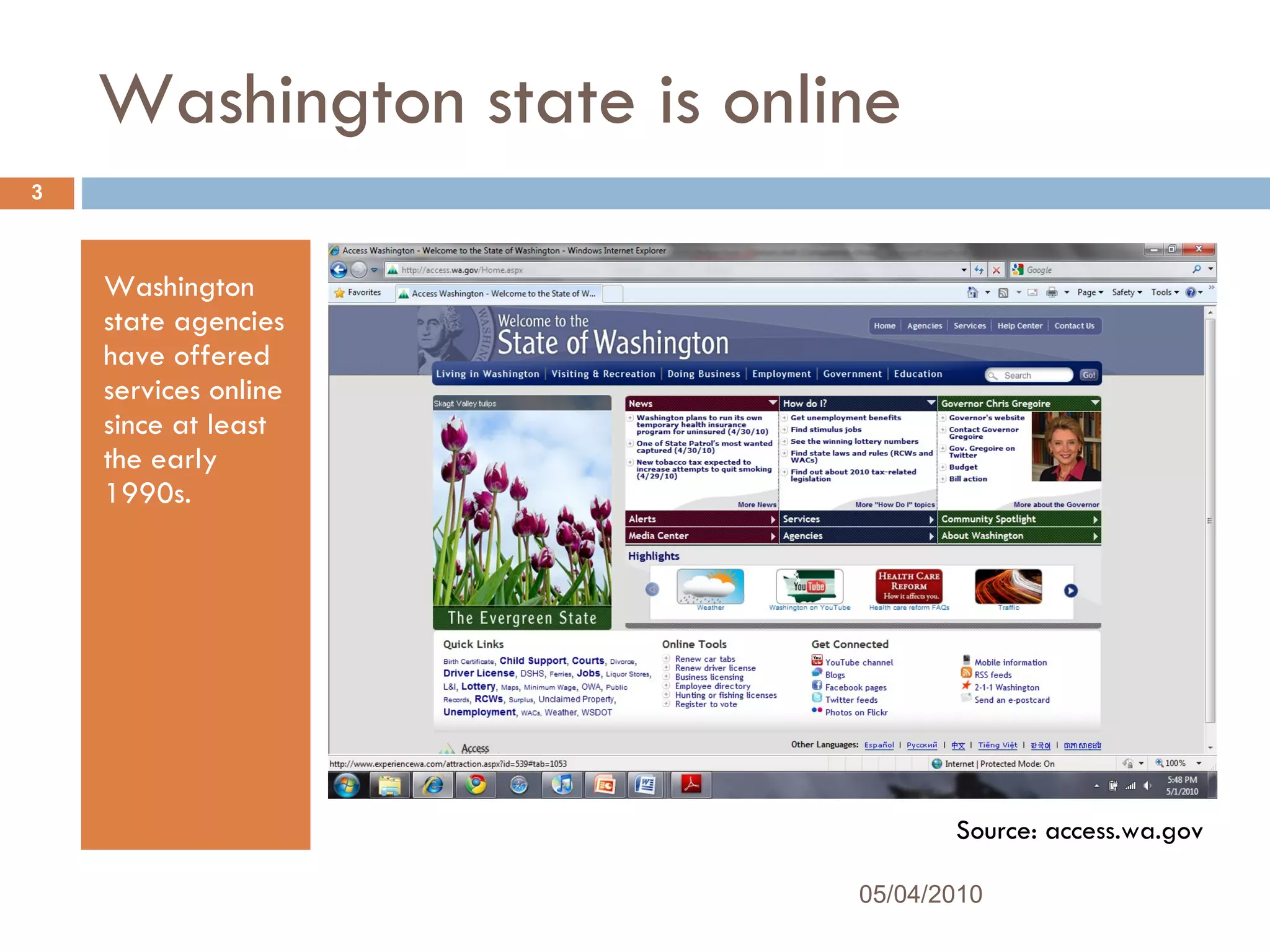
Washington state is online Washington state agencies have offered services online since at least the early 1990s.  Source: access.wa.gov 05/04/2010
WSDOT – If it’s there, we’re there WSDOT’s social media toolkit includes: Facebook, Friendfeed, Posterous, Blogger, Flickr, YouTube, Twitter … We launched our first mobile app in April 2010.  05/04/2010
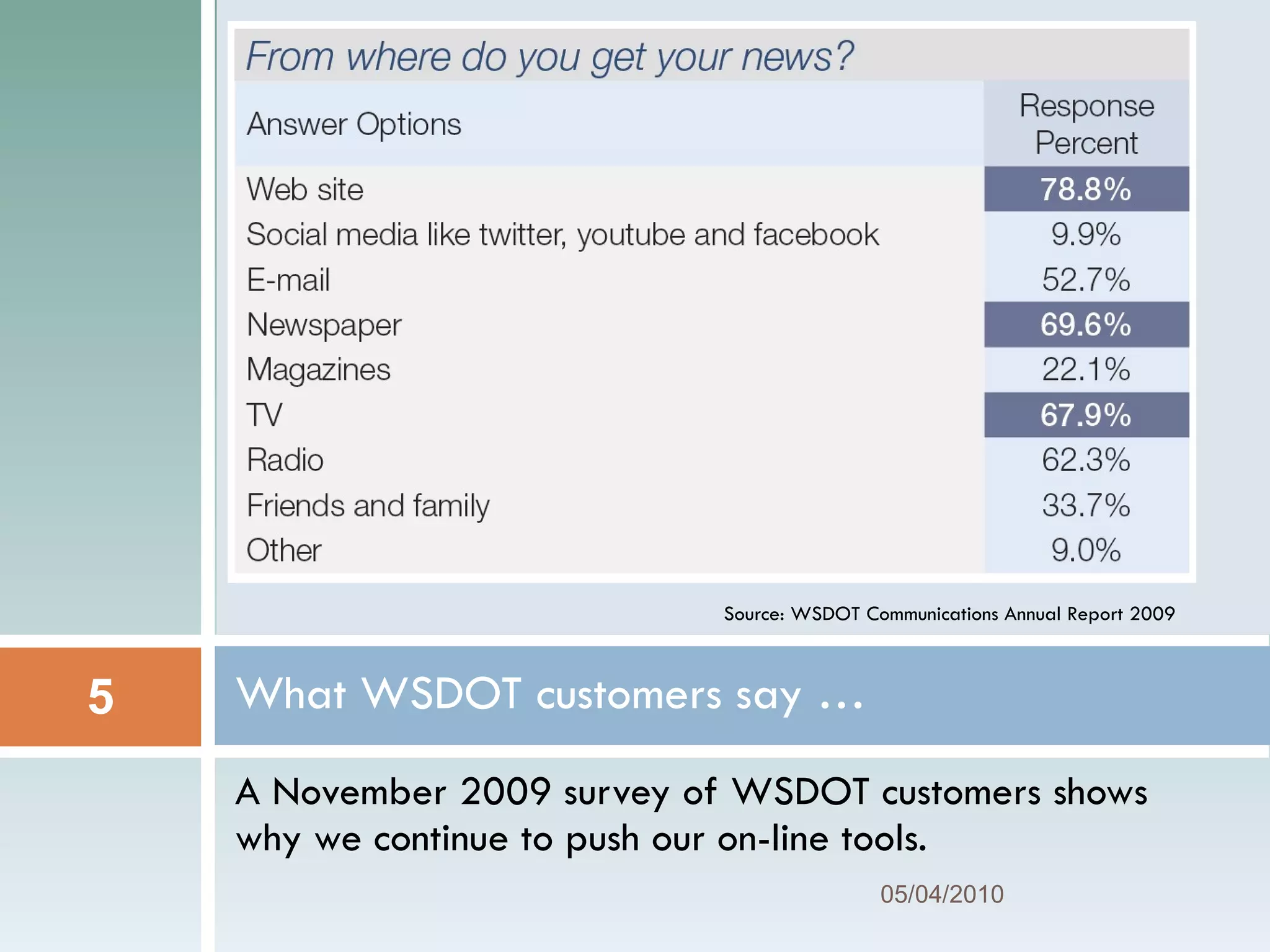
A November 2009 survey of WSDOT customers shows why we continue to push our on-line tools.  What WSDOT customers say … 05/04/2010 Source: WSDOT Communications Annual Report 2009
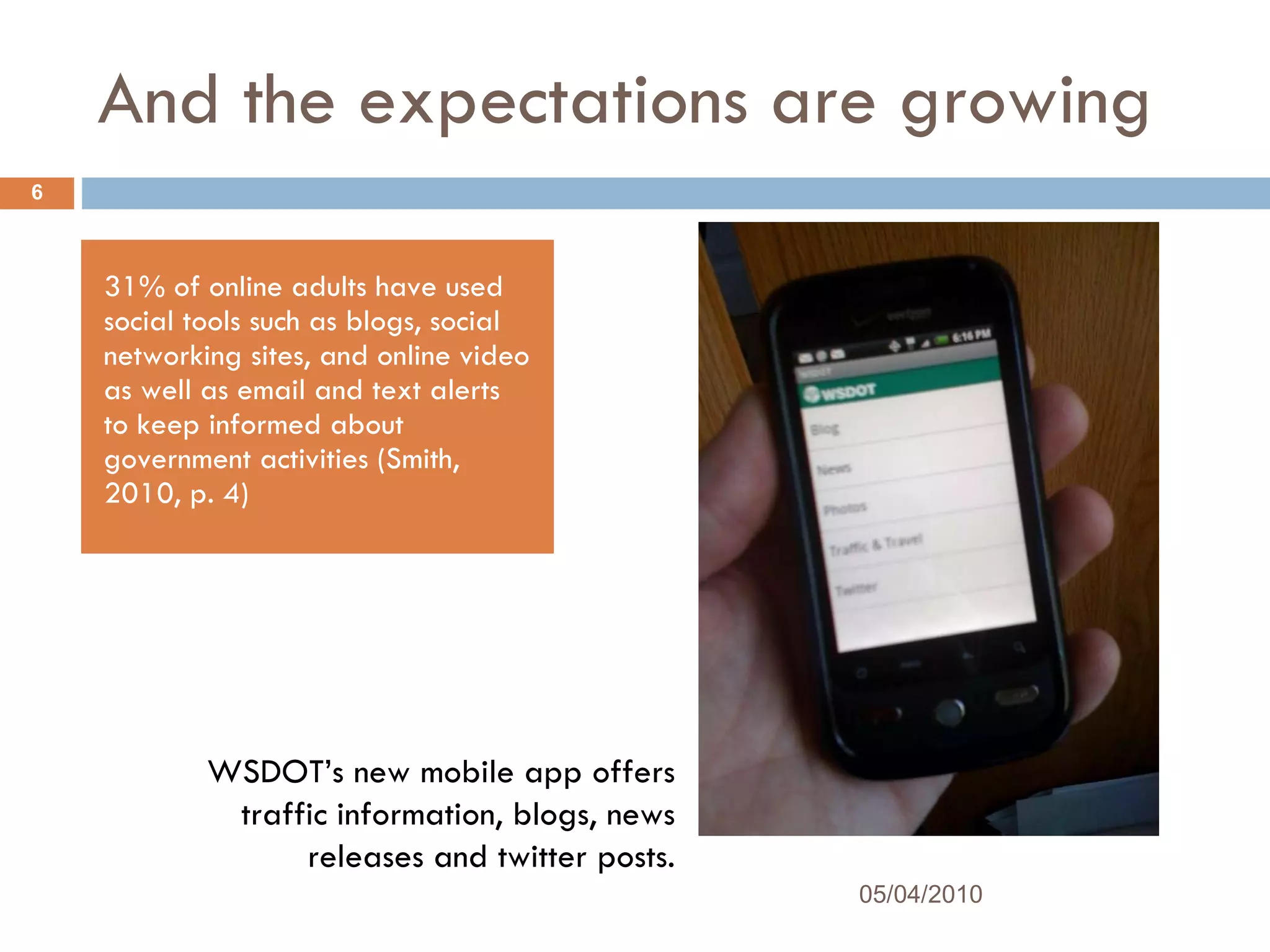
And the expectations are growing 31% of online adults have used social tools such as blogs, social networking sites, and online video as well as email and text alerts to keep informed about government activities (Smith, 2010, p. 4) WSDOT’s new mobile app offers traffic information, blogs, news releases and twitter posts. 05/04/2010
Whether you recognize it or not, the Internet is not anonymous. We create and cultivate our identities online, same as offline.  And, based on who we are and where we came from, we use the Internet differently. Differences matter 05/04/2010
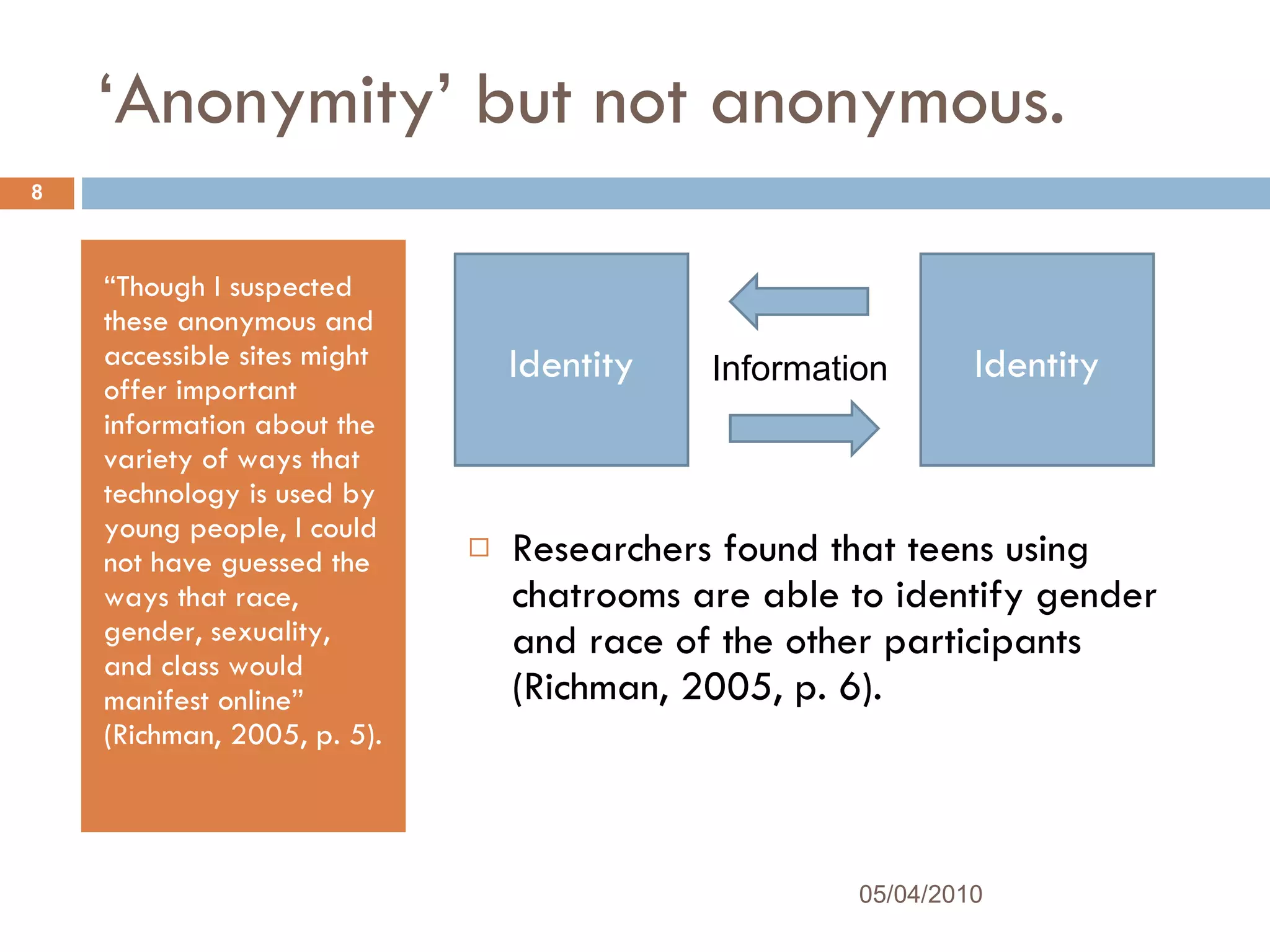
‘ Anonymity’ but not anonymous. “ Though I suspected these anonymous and accessible sites might offer important information about the variety of ways that technology is used by young people, I could not have guessed the ways that race, gender, sexuality, and class would manifest online” (Richman, 2005, p. 5). Researchers found that teens using chatrooms are able to identify gender and race of the other participants (Richman, 2005, p. 6).  05/04/2010 Identity Identity Information
Age, family income, and educational attainment are three major barriers that critically stifle minority Internet use and home broadband adoption (Gant, Turner-Lee, Li & Miller, 2010, p. 3) Who is using the Internet? 05/04/2010
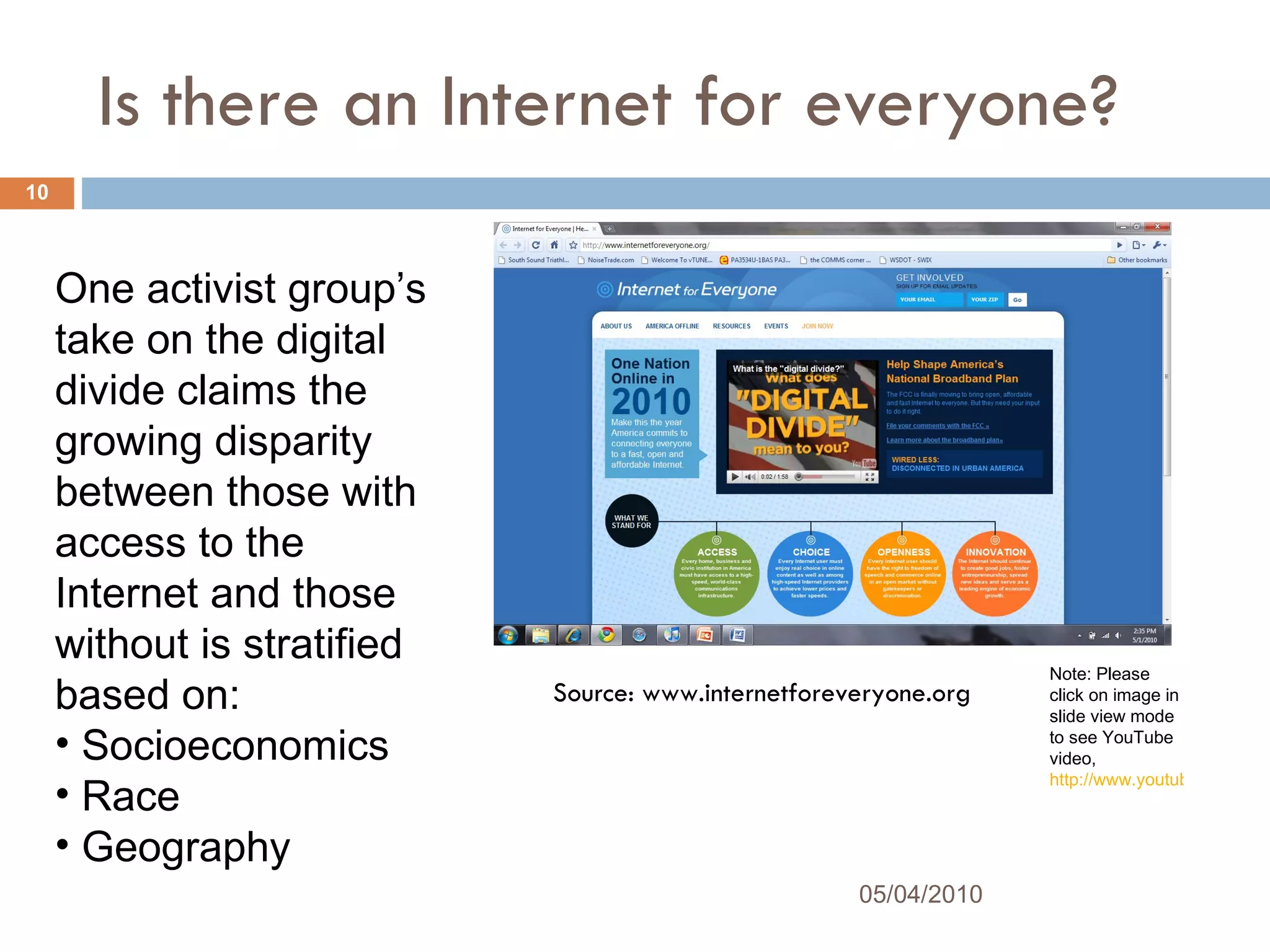
Is there an Internet for everyone? Source: www.internetforeveryone.org Note: Please click on image in slide view mode to see YouTube video,  http://www.youtube.com/watch?v=fCIB_vXUptY&feature=player_embedded#! 05/04/2010 One activist group’s take on the digital divide claims the growing disparity between those with access to the Internet and those without is stratified based on:  Socioeconomics Race  Geography
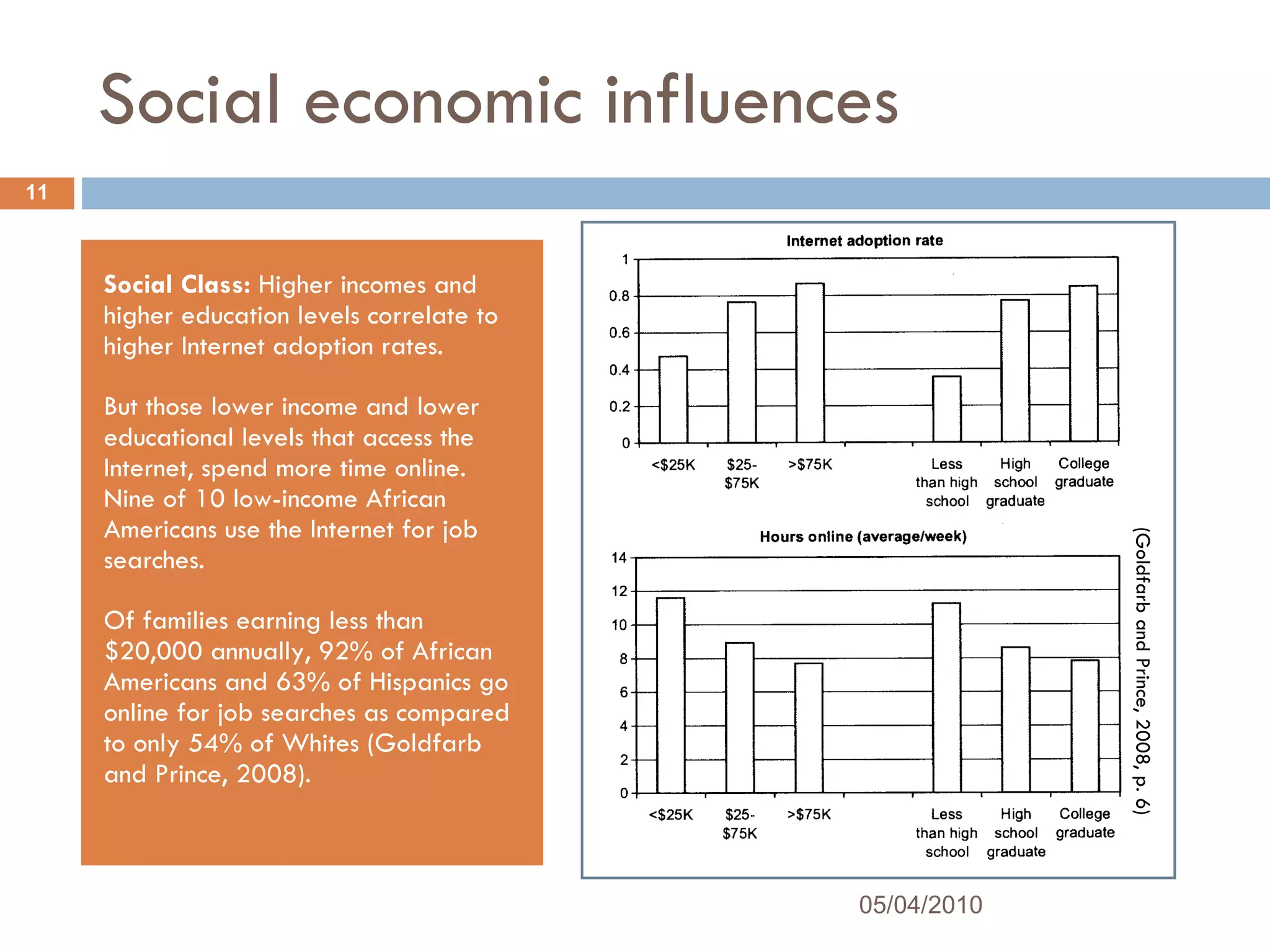
Social economic influences Social Class:  Higher incomes and higher education levels correlate to higher Internet adoption rates.  But those lower income and lower educational levels that access the Internet, spend more time online. Nine of 10 low-income African Americans use the Internet for job searches.  Of families earning less than $20,000 annually, 92% of African Americans and 63% of Hispanics go online for job searches as compared to only 54% of Whites (Goldfarb and Prince, 2008). (Goldfarb and Prince, 2008, p. 6) 05/04/2010
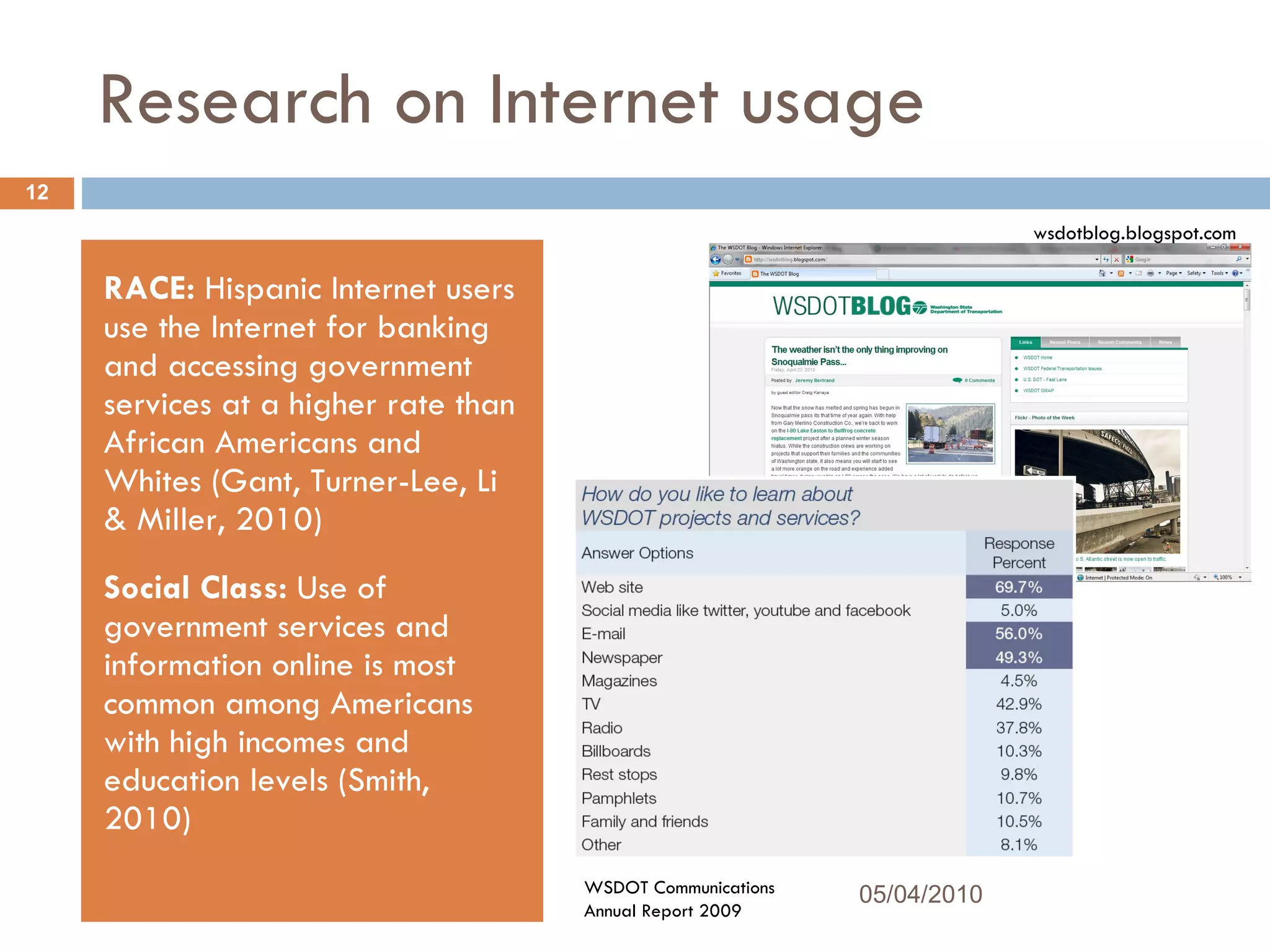
Research on Internet usage RACE:  Hispanic Internet users use the Internet for banking and accessing government services at a higher rate than African Americans and Whites (Gant, Turner-Lee, Li & Miller, 2010)  Social Class:  Use of government services and information online is most common among Americans with high incomes and education levels (Smith, 2010) wsdotblog.blogspot.com WSDOT Communications Annual Report 2009 05/04/2010
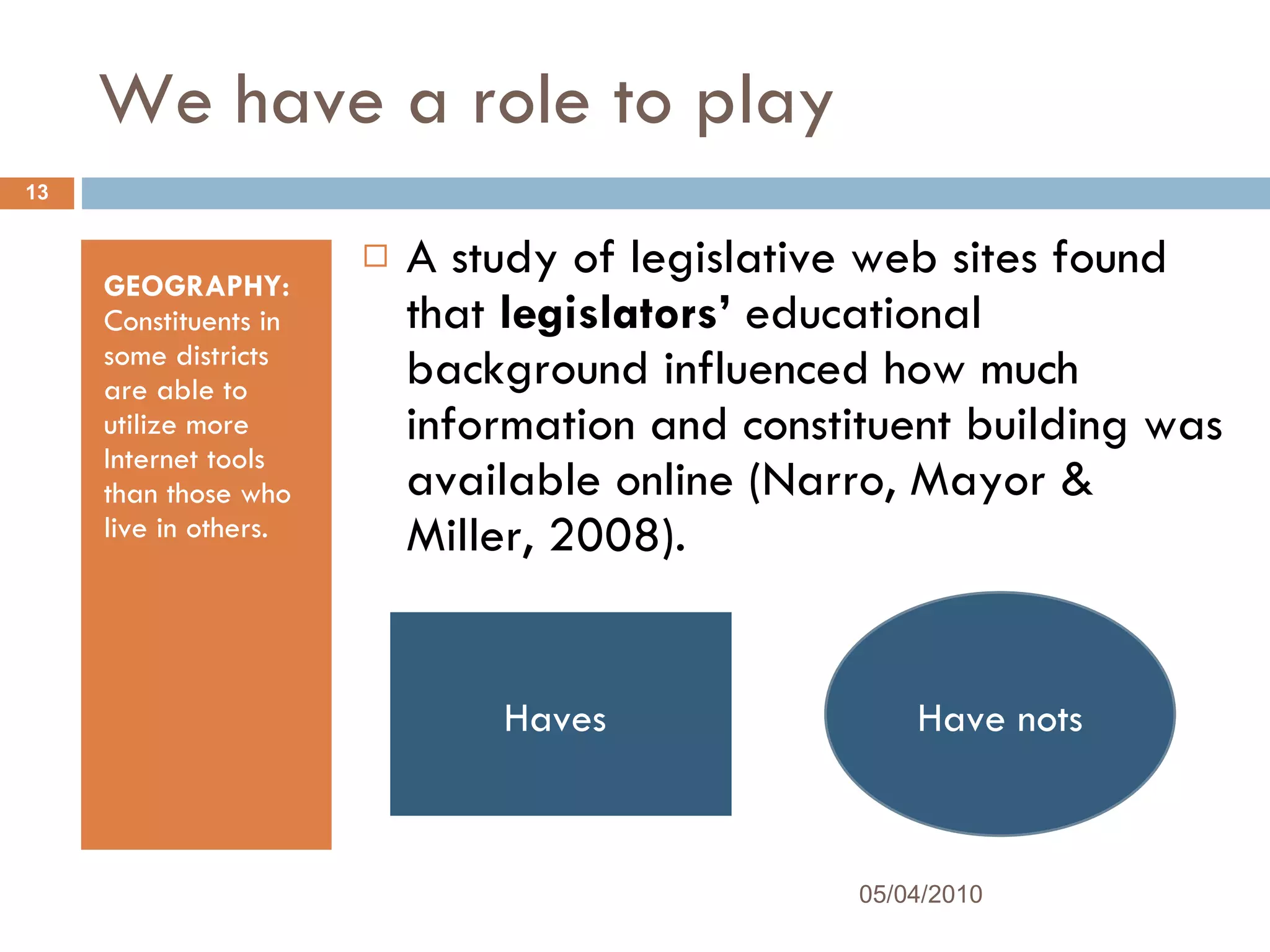
We have a role to play GEOGRAPHY:  Constituents in some districts are able to utilize more Internet tools than those who live in others. A study of legislative web sites found that  legislators’  educational background influenced how much information and constituent building was available online (Narro, Mayor & Miller, 2008).  05/04/2010 Haves  Have nots
If we know socioeconomic, race or ethnic backgrounds and geography play a part, how do we consider the differences and make our campaigns more robust … and more effective? So what do we do? 05/04/2010
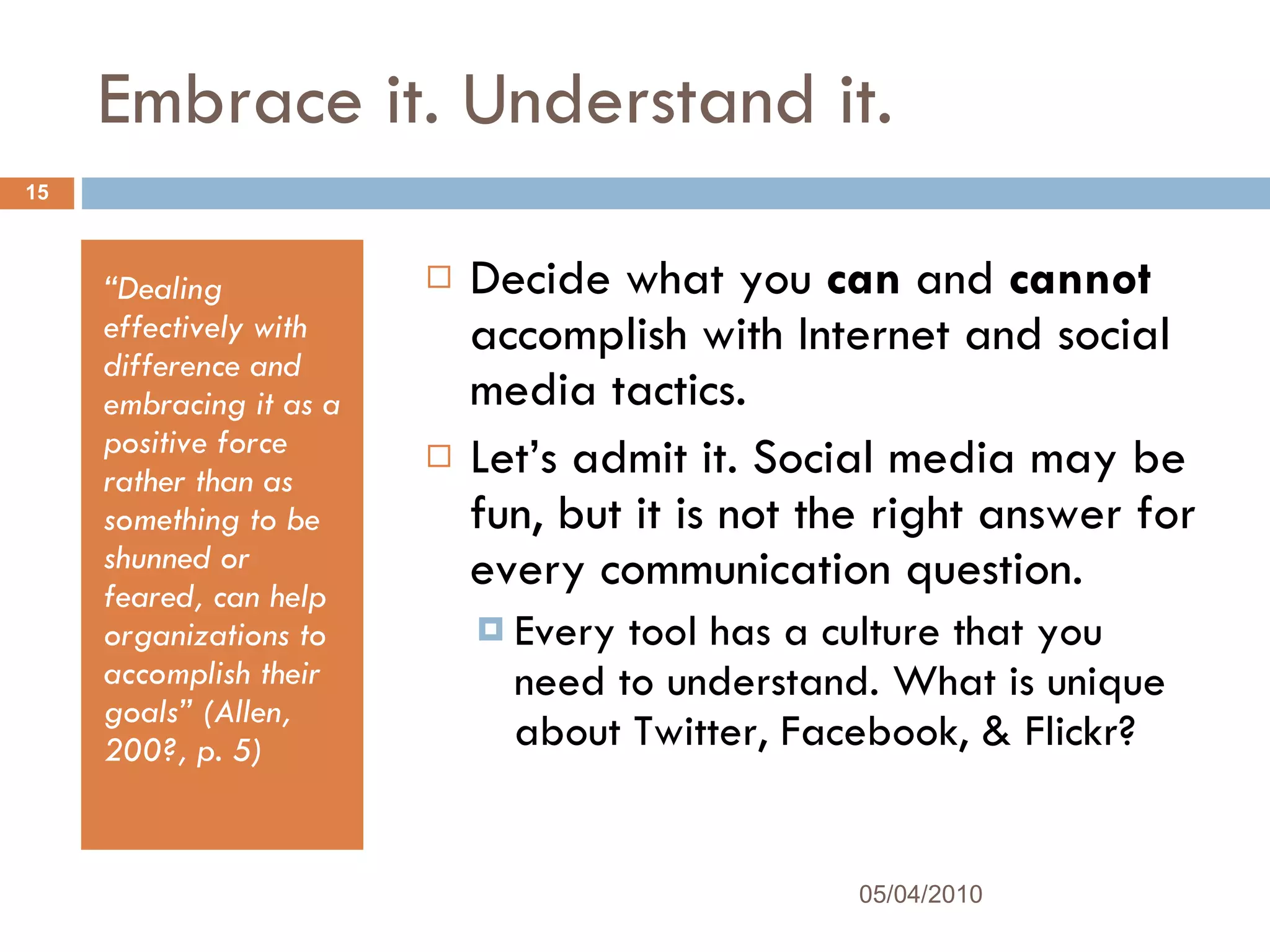
Embrace it. Understand it. “ Dealing effectively with difference and embracing it as a positive force rather than as something to be shunned or feared, can help organizations to accomplish their goals” (Allen, 200?, p. 5) Decide what you  can  and  cannot  accomplish with Internet and social media tactics.  Let’s admit it. Social media may be fun, but it is not the right answer for every communication question. Every tool has a culture that you need to understand. What is unique about Twitter, Facebook, & Flickr? 05/04/2010
Re-think the basics Know your audience. Listen, learn. Identify key community influencers and ask what they do to motivate and engage the target group. Go where the people are.  We’re online because our audience is. Slice the audience even narrower, and go there.  Understand the goal. Know the value of reaching that untapped community.  Measure your results and lead the way for others. 05/04/2010
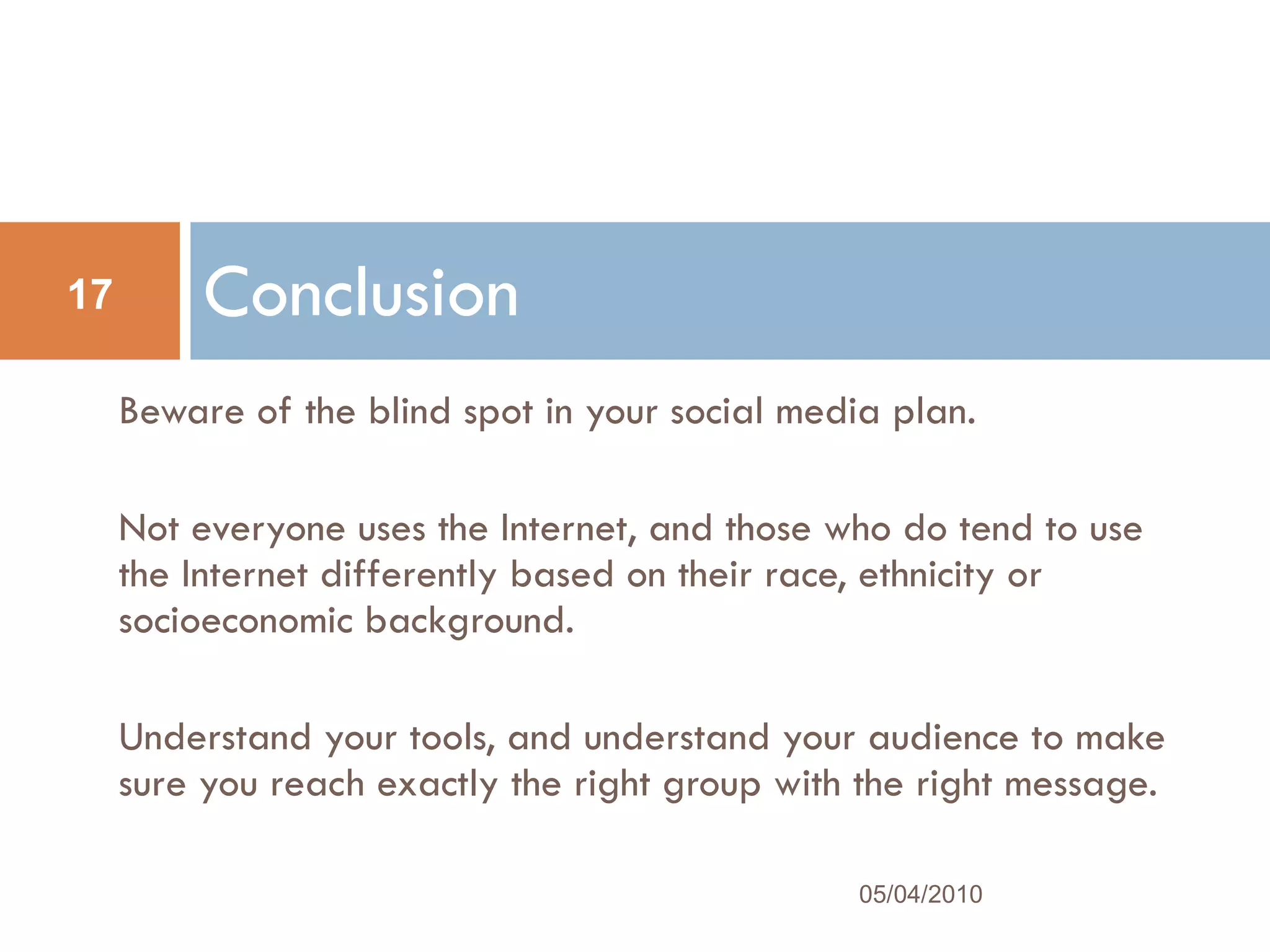
Beware of the blind spot in your social media plan.  Not everyone uses the Internet, and those who do tend to use the Internet differently based on their race, ethnicity or socioeconomic background.  Understand your tools, and understand your audience to make sure you reach exactly the right group with the right message.  Conclusion 05/04/2010
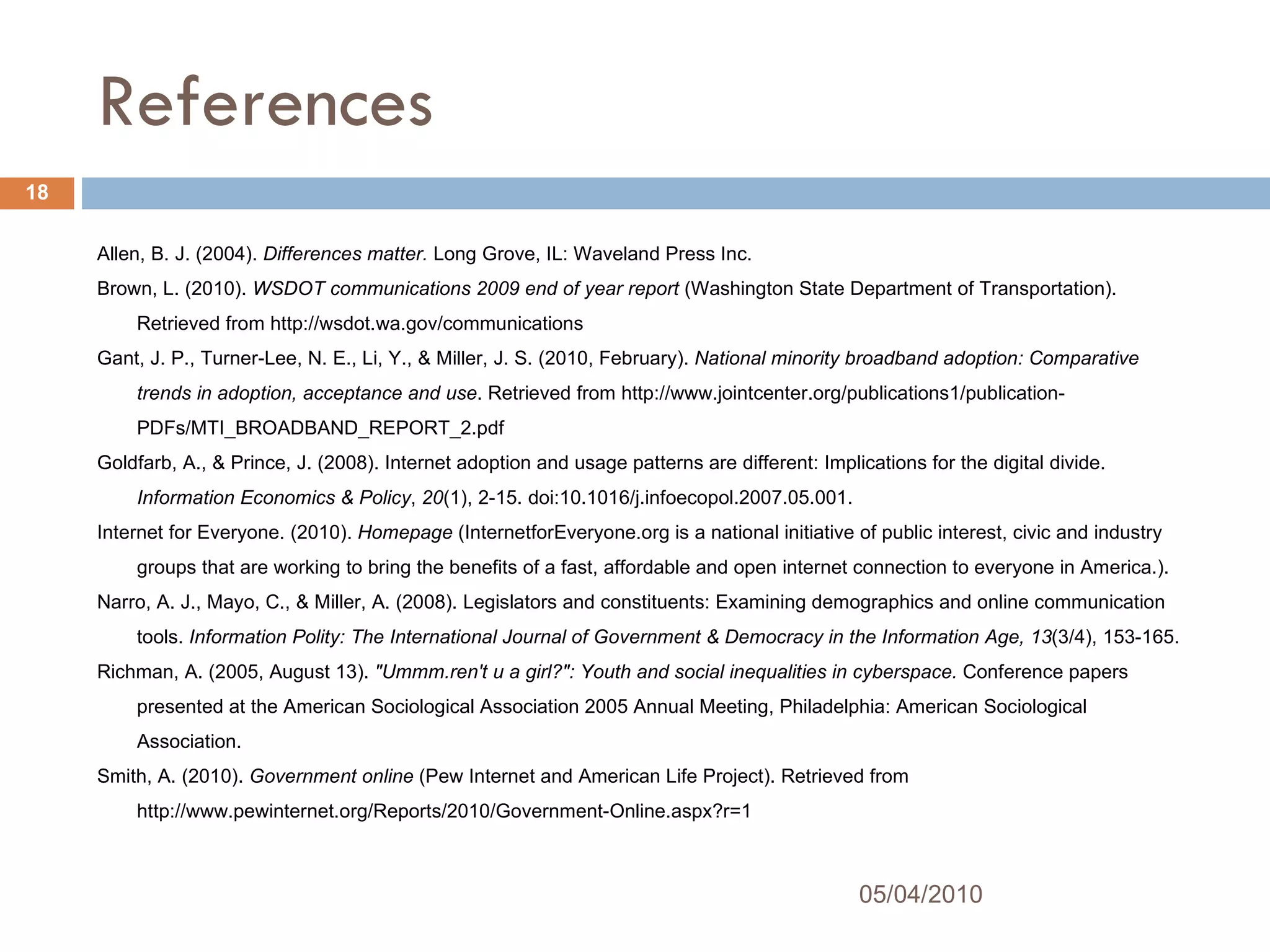
References Allen, B. J. (2004).  Differences matter.  Long Grove, IL: Waveland Press Inc. Brown, L. (2010).  WSDOT communications 2009 end of year report  (Washington State Department of Transportation). Retrieved from http://wsdot.wa.gov/communications Gant, J. P., Turner-Lee, N. E., Li, Y., & Miller, J. S. (2010, February).  National minority broadband adoption: Comparative trends in adoption, acceptance and use . Retrieved from http://www.jointcenter.org/publications1/publication-PDFs/MTI_BROADBAND_REPORT_2.pdf Goldfarb, A., & Prince, J. (2008). Internet adoption and usage patterns are different: Implications for the digital divide.  Information Economics & Policy ,  20 (1), 2-15. doi:10.1016/j.infoecopol.2007.05.001. Internet for Everyone. (2010).  Homepage  (InternetforEveryone.org is a national initiative of public interest, civic and industry groups that are working to bring the benefits of a fast, affordable and open internet connection to everyone in America.). Narro, A. J., Mayo, C., & Miller, A. (2008). Legislators and constituents: Examining demographics and online communication tools.  Information Polity: The International Journal of Government & Democracy in the Information Age, 13 (3/4), 153-165.  Richman, A. (2005, August 13).  "Ummm.ren't u a girl?": Youth and social inequalities in cyberspace.  Conference papers presented at the American Sociological Association 2005 Annual Meeting, Philadelphia: American Sociological Association.  Smith, A. (2010).  Government online  (Pew Internet and American Life Project). Retrieved from http://www.pewinternet.org/Reports/2010/Government-Online.aspx?r=1 05/04/2010

Communicating across the Digital Divide

  • 1.
    COMMUNICATING ACROSS THEDIGITAL DIVIDE Presented to the … (pending) Lloyd D. Brown, COML 506B Spring 2010 05/04/2010
  • 2.
    Government organizations haveraced to put social media tools into practice. Most social media outreach programs target a general market audience. But, by ignoring the digital divide in how people access and use the Internet you could miss critical stakeholders. Overview 05/04/2010
  • 3.
    Washington state isonline Washington state agencies have offered services online since at least the early 1990s. Source: access.wa.gov 05/04/2010
  • 4.
    WSDOT – Ifit’s there, we’re there WSDOT’s social media toolkit includes: Facebook, Friendfeed, Posterous, Blogger, Flickr, YouTube, Twitter … We launched our first mobile app in April 2010. 05/04/2010
  • 5.
    A November 2009survey of WSDOT customers shows why we continue to push our on-line tools. What WSDOT customers say … 05/04/2010 Source: WSDOT Communications Annual Report 2009
  • 6.
    And the expectationsare growing 31% of online adults have used social tools such as blogs, social networking sites, and online video as well as email and text alerts to keep informed about government activities (Smith, 2010, p. 4) WSDOT’s new mobile app offers traffic information, blogs, news releases and twitter posts. 05/04/2010
  • 7.
    Whether you recognizeit or not, the Internet is not anonymous. We create and cultivate our identities online, same as offline. And, based on who we are and where we came from, we use the Internet differently. Differences matter 05/04/2010
  • 8.
    ‘ Anonymity’ butnot anonymous. “ Though I suspected these anonymous and accessible sites might offer important information about the variety of ways that technology is used by young people, I could not have guessed the ways that race, gender, sexuality, and class would manifest online” (Richman, 2005, p. 5). Researchers found that teens using chatrooms are able to identify gender and race of the other participants (Richman, 2005, p. 6). 05/04/2010 Identity Identity Information
  • 9.
    Age, family income,and educational attainment are three major barriers that critically stifle minority Internet use and home broadband adoption (Gant, Turner-Lee, Li & Miller, 2010, p. 3) Who is using the Internet? 05/04/2010
  • 10.
    Is there anInternet for everyone? Source: www.internetforeveryone.org Note: Please click on image in slide view mode to see YouTube video, http://www.youtube.com/watch?v=fCIB_vXUptY&feature=player_embedded#! 05/04/2010 One activist group’s take on the digital divide claims the growing disparity between those with access to the Internet and those without is stratified based on: Socioeconomics Race Geography
  • 11.
    Social economic influencesSocial Class: Higher incomes and higher education levels correlate to higher Internet adoption rates. But those lower income and lower educational levels that access the Internet, spend more time online. Nine of 10 low-income African Americans use the Internet for job searches. Of families earning less than $20,000 annually, 92% of African Americans and 63% of Hispanics go online for job searches as compared to only 54% of Whites (Goldfarb and Prince, 2008). (Goldfarb and Prince, 2008, p. 6) 05/04/2010
  • 12.
    Research on Internetusage RACE: Hispanic Internet users use the Internet for banking and accessing government services at a higher rate than African Americans and Whites (Gant, Turner-Lee, Li & Miller, 2010) Social Class: Use of government services and information online is most common among Americans with high incomes and education levels (Smith, 2010) wsdotblog.blogspot.com WSDOT Communications Annual Report 2009 05/04/2010
  • 13.
    We have arole to play GEOGRAPHY: Constituents in some districts are able to utilize more Internet tools than those who live in others. A study of legislative web sites found that legislators’ educational background influenced how much information and constituent building was available online (Narro, Mayor & Miller, 2008). 05/04/2010 Haves Have nots
  • 14.
    If we knowsocioeconomic, race or ethnic backgrounds and geography play a part, how do we consider the differences and make our campaigns more robust … and more effective? So what do we do? 05/04/2010
  • 15.
    Embrace it. Understandit. “ Dealing effectively with difference and embracing it as a positive force rather than as something to be shunned or feared, can help organizations to accomplish their goals” (Allen, 200?, p. 5) Decide what you can and cannot accomplish with Internet and social media tactics. Let’s admit it. Social media may be fun, but it is not the right answer for every communication question. Every tool has a culture that you need to understand. What is unique about Twitter, Facebook, & Flickr? 05/04/2010
  • 16.
    Re-think the basicsKnow your audience. Listen, learn. Identify key community influencers and ask what they do to motivate and engage the target group. Go where the people are. We’re online because our audience is. Slice the audience even narrower, and go there. Understand the goal. Know the value of reaching that untapped community. Measure your results and lead the way for others. 05/04/2010
  • 17.
    Beware of theblind spot in your social media plan. Not everyone uses the Internet, and those who do tend to use the Internet differently based on their race, ethnicity or socioeconomic background. Understand your tools, and understand your audience to make sure you reach exactly the right group with the right message. Conclusion 05/04/2010
  • 18.
    References Allen, B.J. (2004). Differences matter. Long Grove, IL: Waveland Press Inc. Brown, L. (2010). WSDOT communications 2009 end of year report (Washington State Department of Transportation). Retrieved from http://wsdot.wa.gov/communications Gant, J. P., Turner-Lee, N. E., Li, Y., & Miller, J. S. (2010, February). National minority broadband adoption: Comparative trends in adoption, acceptance and use . Retrieved from http://www.jointcenter.org/publications1/publication-PDFs/MTI_BROADBAND_REPORT_2.pdf Goldfarb, A., & Prince, J. (2008). Internet adoption and usage patterns are different: Implications for the digital divide. Information Economics & Policy ,  20 (1), 2-15. doi:10.1016/j.infoecopol.2007.05.001. Internet for Everyone. (2010). Homepage (InternetforEveryone.org is a national initiative of public interest, civic and industry groups that are working to bring the benefits of a fast, affordable and open internet connection to everyone in America.). Narro, A. J., Mayo, C., & Miller, A. (2008). Legislators and constituents: Examining demographics and online communication tools. Information Polity: The International Journal of Government & Democracy in the Information Age, 13 (3/4), 153-165. Richman, A. (2005, August 13). "Ummm.ren't u a girl?": Youth and social inequalities in cyberspace. Conference papers presented at the American Sociological Association 2005 Annual Meeting, Philadelphia: American Sociological Association. Smith, A. (2010). Government online (Pew Internet and American Life Project). Retrieved from http://www.pewinternet.org/Reports/2010/Government-Online.aspx?r=1 05/04/2010