10th April, 2023
Hefei, China
School of Management
Presentation
Content
❑ Introduction
❑ Literature Review
❑ Hypotheses
❑ Data and
Analysis
❑ Personal
Thinking
❑Results
Introduction
• Explaining user satisfaction via information technology (IT) services delivery has been an important area of
information systems (IS) research for nearly two decades.
• Augmented by the endogenous role of users, this updated definition reflects the collaborative, relational nature
of IT service delivery required by contemporary firms.
• The modern business environment is characterized by intense rivalry, globalization, and time-to-market
pressures, and thus firms are driven to pursue business value by continuously investing heavily in sophisticated
IT solutions such as Web services, data warehousing, enterprise application interfaces, and extended enterprise
networks (Sambamurthy et al. 2003).
• Users in functional units must collaborate closely with their IT counterparts to continuously integrate their
emerging business needs into these IT solutions in order to create and sustain competitive advantages
(Sambamurthy et al. 2003).
Introduction
• In this context, the social relationship between users in the functional unit and those in the IT unit becomes
critical to achieving joint collaboration success.
• In light of this updated definition of IT service, we propose to model user satisfaction from the perspective of
ongoing social interactions between customers and service providers (Lusch et al. 2007, Tuli et al. 2007).
• Using this perspective, social capital—the set of resources embedded within the social relationships among
actors within a network—will impact the value perception of customers (Nahapiet and Ghoshal 1998).
• Thus, our study focuses on addressing the research question: how does social capital between users and
IT service delivery units impact user satisfaction with IT service delivery?
Introduction
• To answer this question, we draw upon the intellectual elements of social capital theory that specifically
address value cocreation embedded in social relationships through its relational underpinnings (Nahapiet and
Ghoshal 1998).
• Based on this theory, we argue that IT units satisfy their users by delivering IT services with the assistance of
users, a process of exchanging and integrating domain-specific knowledge via relational connections.
• Specifically, it is proposed that three primary dimensions of social capital (structural, cognitive, and relational)
form a bond between users and their IT unit, and directly or indirectly impact user satisfaction with IT service
delivery.
• Also, social capital is predicted to moderate the relationship between service quality and user satisfaction such
that this relationship would be stronger when social capital is high.
Literature Review
■ What are the related literature ?
⮚ Nahapiet and Ghoshal 1998
This paper provides nuanced insights into the hierarchy-of-effect of the three dimensions of social
capital in terms of their specific impacts on user satisfaction. Somewhat different from prior social
capital research showing both a direct and indirect effect of structural capital on value creation
Social capital—the set of resources embedded within the social relationships among actors within a
network—will impact the value perception of customers.
This study focuses on addressing the research question: how does social capital between users and IT
service delivery units impact user satisfaction with IT service delivery?
Literature Review
■ What are the related literature ?
⮚ (Davis et al 2009)
recent research finds that business professionals with an understanding of IT are more satisfied with
enterprise systems implementation because they are able to anticipate the value of system implementation in a
similar way to the IT staff
⮚ (Bassellier and Benbasat 2004, Pawlowski and Robey 2004).
IT professionals who are multilingual—conversant in the languages of multiple user
organizations—can better facilitate the knowledge exchange between various internal
organizations; accordingly, they are able to translate and frame meanings in a language and
in terms that others can understand
Literature Review
■ What are the related literature ?
⮚ Petter et al 2007
The regression analysis results showed that the variance inflation factor values for all of the
constructs were acceptable (i.e., between 1.594 and 2.182) . These results suggest that
multicollinearity is not a concern, leading to the conclusion that the psychometric
properties of the instrument as a whole were acceptable
⮚ (Edwards and Lambert (2007).
To ensure the robustness of the results derived from our earlier data analyses that test
mediating and moderating effects separately, we conducted a further analysis by following
Edwards and Lambert
⮚ )DeLone and McLea 2003)
Furthermore, our research model has resulted in a respectable level of explanatory power
on user satisfaction with IT service provision, but future research could and should
control for more alternative explanations by including additional control variables (e.g.,
information quality, system quality)
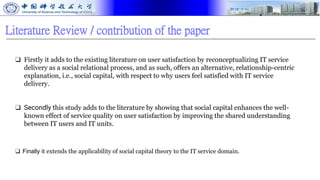
Literature Review / contribution of the paper
❑ Firstly it adds to the existing literature on user satisfaction by reconceptualizing IT service
delivery as a social relational process, and as such, offers an alternative, relationship-centric
explanation, i.e., social capital, with respect to why users feel satisfied with IT service
delivery.
❑ Secondly this study adds to the literature by showing that social capital enhances the well-
known effect of service quality on user satisfaction by improving the shared understanding
between IT users and IT units.
❑ Finally it extends the applicability of social capital theory to the IT service domain.
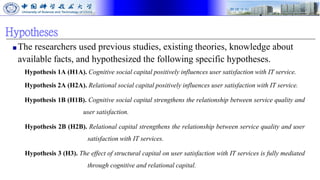
Hypotheses
■The researchers used previous studies, existing theories, knowledge about
available facts, and hypothesized the following specific hypotheses.
Hypothesis 1A (H1A). Cognitive social capital positively influences user satisfaction with IT service.
Hypothesis 2A (H2A). Relational social capital positively influences user satisfaction with IT service.
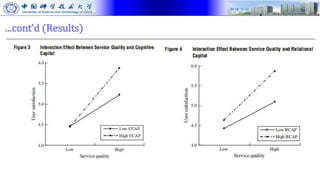
Hypothesis 1B (H1B). Cognitive social capital strengthens the relationship between service quality and
user satisfaction.
Hypothesis 2B (H2B). Relational capital strengthens the relationship between service quality and user
satisfaction with IT services.
Hypothesis 3 (H3). The effect of structural capital on user satisfaction with IT services is fully mediated
through cognitive and relational capital.
...cont’d (Hypotheses)
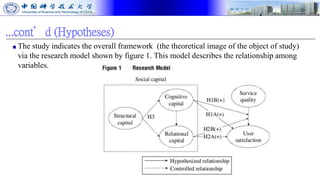
■ The study indicates the overall framework (the theoretical image of the object of study)
via the research model shown by figure 1. This model describes the relationship among
variables.
Data and analysis
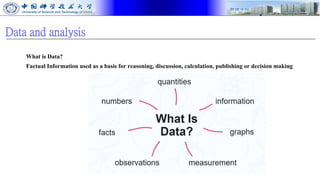
What is Data?
Factual Information used as a basis for reasoning, discussion, calculation, publishing or decision making
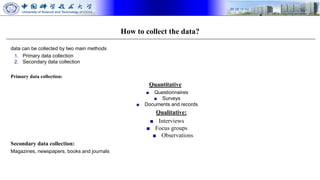
How to collect the data?
data can be collected by two main methods
1. Primary data collection
2. Secondary data collection
Primary data collection:
Quantitative
■ Questionnaires
■ Surveys
■ Documents and records
Qualitative:
■ Interviews
■ Focus groups
■ Observations
Secondary data collection:
Magazines, newspapers, books and journals
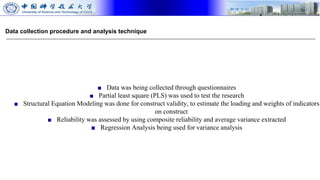
Data collection procedure and analysis technique
■ Data was being collected through questionnaires
■ Partial least square (PLS) was used to test the research
■ Structural Equation Modeling was done for construct validity, to estimate the loading and weights of indicators
on construct
■ Reliability was assessed by using composite reliability and average variance extracted
■ Regression Analysis being used for variance analysis
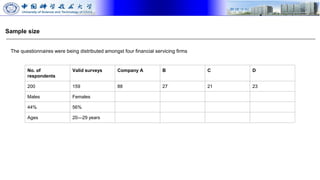
Sample size
The questionnaires were being distributed amongst four financial servicing firms
No. of
respondents
Valid surveys Company A B C D
200 159 88 27 21 23
Males Females
44% 56%
Ages 20—29 years
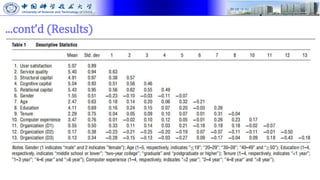
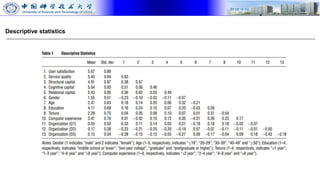
Descriptive statistics
Includes Mean Value, Standardized Deviation and Correlations of all the variables shown in the table
The correlations between Constructs are high
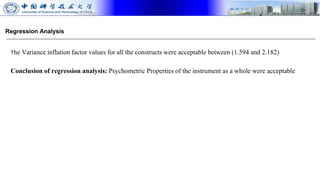
Regression Analysis
The Variance inflation factor values for all the constructs were acceptable between (1.594 and 2.182)
Conclusion of regression analysis: Psychometric Properties of the instrument as a whole were acceptable
Partial Least Square Results
1. H1A and H2A were Supported
2. H1b and H2B were also Supported
3. H3 was also supported by testing the mediation effect of cognitive and relational
capital between structural capital and user satisfaction
Results
■ At the end of their data analysis, the researchers obtained the following results
(findings).
1. Measurement Model
✔ All of formative constructs passed the reliability thresholds.
✔ Except for structural capital, reflective constructs (e.g., three dimensions of
social capital), convergent and discriminant for the other items passed a
reliability and validity tests.
✔ As per the descriptive statics shown by table 1, the correlations between
constructs are relatively high. Hence, a multicollinearity problem could exist.
...cont’d (Results)
...cont’d (Results)
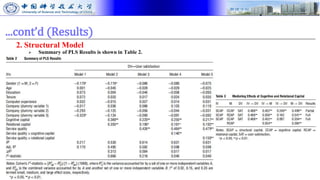
2. Structural Model
⮚ Summary of PLS Results is shown in Table 2.
...cont’d (Results)
...cont’d (Results)
■ The implications of the results of the study are classified under two categories: theoretical
and practical implications.
1. Theoretical Implications
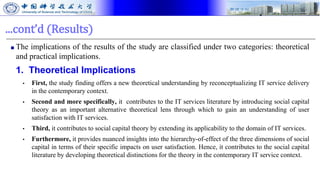
▪ First, the study finding offers a new theoretical understanding by reconceptualizing IT service delivery
in the contemporary context.
▪ Second and more specifically, it contributes to the IT services literature by introducing social capital
theory as an important alternative theoretical lens through which to gain an understanding of user
satisfaction with IT services.
▪ Third, it contributes to social capital theory by extending its applicability to the domain of IT services.
▪ Furthermore, it provides nuanced insights into the hierarchy-of-effect of the three dimensions of social
capital in terms of their specific impacts on user satisfaction. Hence, it contributes to the social capital
literature by developing theoretical distinctions for the theory in the contemporary IT service context.
...cont’d (Results)
2. Practical Implications
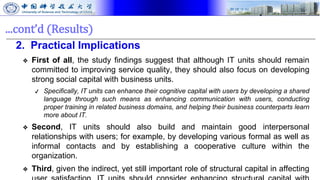
❖ First of all, the study findings suggest that although IT units should remain
committed to improving service quality, they should also focus on developing
strong social capital with business units.
✔ Specifically, IT units can enhance their cognitive capital with users by developing a shared
language through such means as enhancing communication with users, conducting
proper training in related business domains, and helping their business counterparts learn
more about IT.
❖ Second, IT units should also build and maintain good interpersonal
relationships with users; for example, by developing various formal as well as
informal contacts and by establishing a cooperative culture within the
organization.
❖ Third, given the indirect, yet still important role of structural capital in affecting
...cont’d (Results)
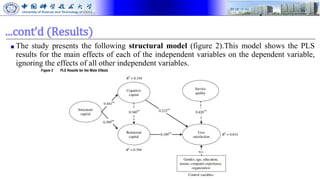
■ The study presents the following structural model (figure 2).This model shows the PLS
results for the main effects of each of the independent variables on the dependent variable,
ignoring the effects of all other independent variables.
■ What is your opinion about the work?
 This study examines the antecedents of user satisfaction with IT services by drawing on social capital
theory.
 Results indicated two positive moderating effects of social capital (cognitive and relational) on the well-
known relationship between service quality and user satisfaction.
 Results indicated that the effect of structural capital on user satisfaction was fully mediated through
cognitive capital and relational capital.
 it offers a new theoretical understanding by reconceptualizing IT service delivery in the contemporary
context
 we see the current understanding of IT services delivery as a relational process through which
specialized domain knowledge in IT and business units is exchanged and integrated.
Restraint on this Research
 China’s industrial features and cultural factors may limit the general applicability of the conclusions.
 The structural capital measure used in this study could be enhanced by adopting an alternative social network
approach.
 Given the limited number of departments in this study data set, our analytical approach appropriates
social capital at the level of individual user perception.
 This research model has resulted in a respectable level of explanatory power on user satisfaction
with IT service provision
 Due to the relatively small sample size and lack of two emitting paths from the formative constructs
(e.g., service quality) , it is not possible for us to use the covariance-based SEM to analyze the
model with formative constructs
INVENTIVE IDEAS
Apart from social capital, it's possible to optimize users satisfaction with one's IT service delivery via the
following ways.
 Implementing chatbots that conducts a conversation with an end user by way of text message or audio.
 Working on process automation that applies the use of technology to execute a procedure with little or no
human intervention. If this automation is well done, it can improve service delivery and user satisfaction.
 Moving support to the point of consumption.
 Instilling a service culture i. e., making sure that the service mission is well understood by those directly or
indirectly involved in service delivery and aligning people, process and technology to achieve optimum
service delivery could be good means of increasing user satisfaction.
30

BRM Group 10 Final Project.pptx

  • 1.
    10th April, 2023 Hefei,China School of Management
  • 2.
    Presentation Content ❑ Introduction ❑ LiteratureReview ❑ Hypotheses ❑ Data and Analysis ❑ Personal Thinking ❑Results
  • 3.
    Introduction • Explaining usersatisfaction via information technology (IT) services delivery has been an important area of information systems (IS) research for nearly two decades. • Augmented by the endogenous role of users, this updated definition reflects the collaborative, relational nature of IT service delivery required by contemporary firms. • The modern business environment is characterized by intense rivalry, globalization, and time-to-market pressures, and thus firms are driven to pursue business value by continuously investing heavily in sophisticated IT solutions such as Web services, data warehousing, enterprise application interfaces, and extended enterprise networks (Sambamurthy et al. 2003). • Users in functional units must collaborate closely with their IT counterparts to continuously integrate their emerging business needs into these IT solutions in order to create and sustain competitive advantages (Sambamurthy et al. 2003).
  • 4.
    Introduction • In thiscontext, the social relationship between users in the functional unit and those in the IT unit becomes critical to achieving joint collaboration success. • In light of this updated definition of IT service, we propose to model user satisfaction from the perspective of ongoing social interactions between customers and service providers (Lusch et al. 2007, Tuli et al. 2007). • Using this perspective, social capital—the set of resources embedded within the social relationships among actors within a network—will impact the value perception of customers (Nahapiet and Ghoshal 1998). • Thus, our study focuses on addressing the research question: how does social capital between users and IT service delivery units impact user satisfaction with IT service delivery?
  • 5.
    Introduction • To answerthis question, we draw upon the intellectual elements of social capital theory that specifically address value cocreation embedded in social relationships through its relational underpinnings (Nahapiet and Ghoshal 1998). • Based on this theory, we argue that IT units satisfy their users by delivering IT services with the assistance of users, a process of exchanging and integrating domain-specific knowledge via relational connections. • Specifically, it is proposed that three primary dimensions of social capital (structural, cognitive, and relational) form a bond between users and their IT unit, and directly or indirectly impact user satisfaction with IT service delivery. • Also, social capital is predicted to moderate the relationship between service quality and user satisfaction such that this relationship would be stronger when social capital is high.
  • 6.
    Literature Review ■ Whatare the related literature ? ⮚ Nahapiet and Ghoshal 1998 This paper provides nuanced insights into the hierarchy-of-effect of the three dimensions of social capital in terms of their specific impacts on user satisfaction. Somewhat different from prior social capital research showing both a direct and indirect effect of structural capital on value creation Social capital—the set of resources embedded within the social relationships among actors within a network—will impact the value perception of customers. This study focuses on addressing the research question: how does social capital between users and IT service delivery units impact user satisfaction with IT service delivery?
  • 7.
    Literature Review ■ Whatare the related literature ? ⮚ (Davis et al 2009) recent research finds that business professionals with an understanding of IT are more satisfied with enterprise systems implementation because they are able to anticipate the value of system implementation in a similar way to the IT staff ⮚ (Bassellier and Benbasat 2004, Pawlowski and Robey 2004). IT professionals who are multilingual—conversant in the languages of multiple user organizations—can better facilitate the knowledge exchange between various internal organizations; accordingly, they are able to translate and frame meanings in a language and in terms that others can understand
  • 8.
    Literature Review ■ Whatare the related literature ? ⮚ Petter et al 2007 The regression analysis results showed that the variance inflation factor values for all of the constructs were acceptable (i.e., between 1.594 and 2.182) . These results suggest that multicollinearity is not a concern, leading to the conclusion that the psychometric properties of the instrument as a whole were acceptable ⮚ (Edwards and Lambert (2007). To ensure the robustness of the results derived from our earlier data analyses that test mediating and moderating effects separately, we conducted a further analysis by following Edwards and Lambert ⮚ )DeLone and McLea 2003) Furthermore, our research model has resulted in a respectable level of explanatory power on user satisfaction with IT service provision, but future research could and should control for more alternative explanations by including additional control variables (e.g., information quality, system quality)
  • 9.
    Literature Review /contribution of the paper ❑ Firstly it adds to the existing literature on user satisfaction by reconceptualizing IT service delivery as a social relational process, and as such, offers an alternative, relationship-centric explanation, i.e., social capital, with respect to why users feel satisfied with IT service delivery. ❑ Secondly this study adds to the literature by showing that social capital enhances the well- known effect of service quality on user satisfaction by improving the shared understanding between IT users and IT units. ❑ Finally it extends the applicability of social capital theory to the IT service domain.
  • 10.
    Hypotheses ■The researchers usedprevious studies, existing theories, knowledge about available facts, and hypothesized the following specific hypotheses. Hypothesis 1A (H1A). Cognitive social capital positively influences user satisfaction with IT service. Hypothesis 2A (H2A). Relational social capital positively influences user satisfaction with IT service. Hypothesis 1B (H1B). Cognitive social capital strengthens the relationship between service quality and user satisfaction. Hypothesis 2B (H2B). Relational capital strengthens the relationship between service quality and user satisfaction with IT services. Hypothesis 3 (H3). The effect of structural capital on user satisfaction with IT services is fully mediated through cognitive and relational capital.
  • 11.
    ...cont’d (Hypotheses) ■ Thestudy indicates the overall framework (the theoretical image of the object of study) via the research model shown by figure 1. This model describes the relationship among variables.
  • 12.
    Data and analysis Whatis Data? Factual Information used as a basis for reasoning, discussion, calculation, publishing or decision making
  • 13.
    How to collectthe data? data can be collected by two main methods 1. Primary data collection 2. Secondary data collection Primary data collection: Quantitative ■ Questionnaires ■ Surveys ■ Documents and records Qualitative: ■ Interviews ■ Focus groups ■ Observations Secondary data collection: Magazines, newspapers, books and journals
  • 14.
    Data collection procedureand analysis technique ■ Data was being collected through questionnaires ■ Partial least square (PLS) was used to test the research ■ Structural Equation Modeling was done for construct validity, to estimate the loading and weights of indicators on construct ■ Reliability was assessed by using composite reliability and average variance extracted ■ Regression Analysis being used for variance analysis
  • 15.
    Sample size The questionnaireswere being distributed amongst four financial servicing firms No. of respondents Valid surveys Company A B C D 200 159 88 27 21 23 Males Females 44% 56% Ages 20—29 years
  • 16.
  • 17.
    Descriptive statistics Includes MeanValue, Standardized Deviation and Correlations of all the variables shown in the table The correlations between Constructs are high
  • 18.
    Regression Analysis The Varianceinflation factor values for all the constructs were acceptable between (1.594 and 2.182) Conclusion of regression analysis: Psychometric Properties of the instrument as a whole were acceptable
  • 19.
    Partial Least SquareResults 1. H1A and H2A were Supported 2. H1b and H2B were also Supported 3. H3 was also supported by testing the mediation effect of cognitive and relational capital between structural capital and user satisfaction
  • 20.
    Results ■ At theend of their data analysis, the researchers obtained the following results (findings). 1. Measurement Model ✔ All of formative constructs passed the reliability thresholds. ✔ Except for structural capital, reflective constructs (e.g., three dimensions of social capital), convergent and discriminant for the other items passed a reliability and validity tests. ✔ As per the descriptive statics shown by table 1, the correlations between constructs are relatively high. Hence, a multicollinearity problem could exist.
  • 21.
  • 22.
    ...cont’d (Results) 2. StructuralModel ⮚ Summary of PLS Results is shown in Table 2.
  • 23.
  • 24.
    ...cont’d (Results) ■ Theimplications of the results of the study are classified under two categories: theoretical and practical implications. 1. Theoretical Implications ▪ First, the study finding offers a new theoretical understanding by reconceptualizing IT service delivery in the contemporary context. ▪ Second and more specifically, it contributes to the IT services literature by introducing social capital theory as an important alternative theoretical lens through which to gain an understanding of user satisfaction with IT services. ▪ Third, it contributes to social capital theory by extending its applicability to the domain of IT services. ▪ Furthermore, it provides nuanced insights into the hierarchy-of-effect of the three dimensions of social capital in terms of their specific impacts on user satisfaction. Hence, it contributes to the social capital literature by developing theoretical distinctions for the theory in the contemporary IT service context.
  • 25.
    ...cont’d (Results) 2. PracticalImplications ❖ First of all, the study findings suggest that although IT units should remain committed to improving service quality, they should also focus on developing strong social capital with business units. ✔ Specifically, IT units can enhance their cognitive capital with users by developing a shared language through such means as enhancing communication with users, conducting proper training in related business domains, and helping their business counterparts learn more about IT. ❖ Second, IT units should also build and maintain good interpersonal relationships with users; for example, by developing various formal as well as informal contacts and by establishing a cooperative culture within the organization. ❖ Third, given the indirect, yet still important role of structural capital in affecting
  • 26.
    ...cont’d (Results) ■ Thestudy presents the following structural model (figure 2).This model shows the PLS results for the main effects of each of the independent variables on the dependent variable, ignoring the effects of all other independent variables.
  • 27.
    ■ What isyour opinion about the work?  This study examines the antecedents of user satisfaction with IT services by drawing on social capital theory.  Results indicated two positive moderating effects of social capital (cognitive and relational) on the well- known relationship between service quality and user satisfaction.  Results indicated that the effect of structural capital on user satisfaction was fully mediated through cognitive capital and relational capital.  it offers a new theoretical understanding by reconceptualizing IT service delivery in the contemporary context  we see the current understanding of IT services delivery as a relational process through which specialized domain knowledge in IT and business units is exchanged and integrated.
  • 28.
    Restraint on thisResearch  China’s industrial features and cultural factors may limit the general applicability of the conclusions.  The structural capital measure used in this study could be enhanced by adopting an alternative social network approach.  Given the limited number of departments in this study data set, our analytical approach appropriates social capital at the level of individual user perception.  This research model has resulted in a respectable level of explanatory power on user satisfaction with IT service provision  Due to the relatively small sample size and lack of two emitting paths from the formative constructs (e.g., service quality) , it is not possible for us to use the covariance-based SEM to analyze the model with formative constructs
  • 29.
    INVENTIVE IDEAS Apart fromsocial capital, it's possible to optimize users satisfaction with one's IT service delivery via the following ways.  Implementing chatbots that conducts a conversation with an end user by way of text message or audio.  Working on process automation that applies the use of technology to execute a procedure with little or no human intervention. If this automation is well done, it can improve service delivery and user satisfaction.  Moving support to the point of consumption.  Instilling a service culture i. e., making sure that the service mission is well understood by those directly or indirectly involved in service delivery and aligning people, process and technology to achieve optimum service delivery could be good means of increasing user satisfaction.
  • 30.