Group - iii 1
Which a leader do you like ?Which a leader do you like ?
an emotionally intelligent leaderan emotionally intelligent leader an emotional leaderan emotional leader
Group - iii 2
Group - iii 3
Leadership
• The process of influencing
the activities of an
organised group toward
goal achievement
• Doing jobs through other
people
Group - iii 4
Emotional
Intelligence (EI)
“Emotional intelligence is
the capacity for recognizing
our own feelings and those
of others, for motivating
ourselves, and for managing
emotions well in ourselves
and in our relationships”
(Goleman)
Group - iii 5
The History of EIThe History of EI
• In 1990, an article which comprises some ideas called
„emotional intelligence was published by Peter Salovey of Yale‟
and John Mayer of the University of New Hampshire.
• It was Daniel Goleman who popularised the term of Emotional
Intelligence (EI) to communities in 1995 by his famous book
with the same name
Group - iii 6
Advantages of using
Emotional Intelligence
• improves relationships with colleagues
• enables good communication and an ability to
influence others without conflict
• enhances reputation within the team and the
organisation
• maintains control
• lowers stress levels
• maintains motivation
Group - iii 7
Disadvantages of using
Emotional Intelligence
• cannot always be learned, though it can
be developed
• is sometimes dismissed as being just
another management fad
• is ridiculed by people with low levels
of emotional intelligence
Group - iii 8
The comparison of EI with the
other …
Group - iii 9
Five Components of EI
1. Self-awareness
2. Self-regulation
3. Motivation
4. Empathy
5. Social skill
‘Intrapersonal
Intelligence’
‘Interpersonal
Intelligence’}
}
Group - iii 10
Self-AwarenessSelf-Awareness
• Having a deep
understanding of our
emotions, strengths,
weakness, needs, and
drives
• Being honest with
ourselves and the
others
WW
HH
OO
AA
MM
II
??
Group - iii 11
Leaders with Self-AwarenessLeaders with Self-Awareness
• not taking actions which arenot taking actions which are
unsuitable withunsuitable with
organisation's capabilitiesorganisation's capabilities
• encourages to enhance the assetsencourages to enhance the assets
in orderin order
to succeed in obtaining the betterto succeed in obtaining the better
resultsresults
• Self-confidence about anythingSelf-confidence about anything
(e.g. speaking in public)(e.g. speaking in public)
Group - iii 12
Self-RegulationSelf-Regulation
• Controlling our feeling, moods and emotional
impulses
• Having adaptability and flexibility with challenges
“Take responsibility for your life. If you can't control
what happens, you can at least control how you
respond.”(Sanborn)
Group - iii 13
Leaders with Self-RegulationLeaders with Self-Regulation
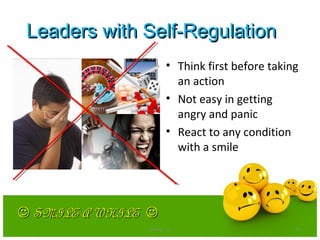
• Think first before taking
an action
• Not easy in getting
angry and panic
• React to any condition
with a smile
 SMILE A WHILESMILE A WHILE 
Group - iii 14
MotivationMotivation
• Drives which attempt
to achieve beyond
expectations
• A strong desire to
attain goals with
energy and
determination“
““Nothing great was ever achieved without enthusiasm”Nothing great was ever achieved without enthusiasm”
#nevergiveup#nevergiveupGroup - iii 15
Leaders with MotivationLeaders with Motivation
• Self-motivation
• Be optimistic in
responding the result
whether it is bad or
good
• Remain hopeful and
overcome failure
without frustration
Group - iii 16
EmpathyEmpathy
• Understanding others
and taking active
interest in their
concerns
• Being sensitive to the
diversity about what
the others feel
Group - iii 17
Leaders with EmpathyLeaders with Empathy
• Understanding what workers feel and what theyUnderstanding what workers feel and what they
want by being aware of their needs, perspectives,want by being aware of their needs, perspectives,
feelings, concerns, and senses of the developmentalfeelings, concerns, and senses of the developmental
needs of themneeds of them
• Behaving carefully in terms of instructing the staffBehaving carefully in terms of instructing the staff
• Becoming a good listener to employees initiation‟Becoming a good listener to employees initiation‟
without interruptionwithout interruption
Group - iii 18
Social SkillSocial Skill
• Ability in managing
relationship (no work
will be done alone)
• Sociability and
cooperation with a
purpose and moving
people to the desired
direction
Group - iii 19
Leaders with Social SkillLeaders with Social Skill
• Working together with the subordinatesWorking together with the subordinates
• Not only just socialising with the followers but alsoNot only just socialising with the followers but also
developing themdeveloping them
• Being supportive and having ability to communicateBeing supportive and having ability to communicate
as well as inspire peopleas well as inspire people
• A proficiency in resolving conflicts, collaboration andA proficiency in resolving conflicts, collaboration and
forming a good team workforming a good team work
Group - iii 20
Some Gender DifferencesSome Gender Differences
• More willing toMore willing to
compromise socialcompromise social
connectedness forconnectedness for
independenceindependence
• Not as good as women atNot as good as women at
thisthis
• Less adept than womenLess adept than women
overalloverall
• More physiologicallyMore physiologically
overwhelmed by maritaloverwhelmed by marital
conflictconflict
• Greater need forGreater need for
connectednessconnectedness
• Have a wider range ofHave a wider range of
emotionsemotions
• Better at developing socialBetter at developing social
strategies overallstrategies overall
• Better at reading emotionsBetter at reading emotions
• Perhaps more engaged inPerhaps more engaged in
marital conflictmarital conflict
Group - iii 21
ConclusionConclusion
““Emotional Intelligence is a way ofEmotional Intelligence is a way of
recognising, understanding, and choosingrecognising, understanding, and choosing
how we think, feel, and act.how we think, feel, and act.
It defines how and what we learn;It defines how and what we learn;
it allows us to set priorities; it determinesit allows us to set priorities; it determines
the majority of our daily actions.the majority of our daily actions.
It shapes leaders interactions with‟It shapes leaders interactions with‟
the subordinates andthe subordinates and
understanding of themselves.”understanding of themselves.”
Group - iii 22
It Doesn't MatterIt Doesn't Matter
Who You Are,Who You Are,
Where You ComeWhere You Come
From. The AbilityFrom. The Ability
To Triumph BeginsTo Triumph Begins
With You. Always.With You. Always.
Group - iii 23

Brief On Emotional Intelligence

  • 1.
  • 2.
    Which a leaderdo you like ?Which a leader do you like ? an emotionally intelligent leaderan emotionally intelligent leader an emotional leaderan emotional leader Group - iii 2
  • 3.
  • 4.
    Leadership • The processof influencing the activities of an organised group toward goal achievement • Doing jobs through other people Group - iii 4
  • 5.
    Emotional Intelligence (EI) “Emotional intelligenceis the capacity for recognizing our own feelings and those of others, for motivating ourselves, and for managing emotions well in ourselves and in our relationships” (Goleman) Group - iii 5
  • 6.
    The History ofEIThe History of EI • In 1990, an article which comprises some ideas called „emotional intelligence was published by Peter Salovey of Yale‟ and John Mayer of the University of New Hampshire. • It was Daniel Goleman who popularised the term of Emotional Intelligence (EI) to communities in 1995 by his famous book with the same name Group - iii 6
  • 7.
    Advantages of using EmotionalIntelligence • improves relationships with colleagues • enables good communication and an ability to influence others without conflict • enhances reputation within the team and the organisation • maintains control • lowers stress levels • maintains motivation Group - iii 7
  • 8.
    Disadvantages of using EmotionalIntelligence • cannot always be learned, though it can be developed • is sometimes dismissed as being just another management fad • is ridiculed by people with low levels of emotional intelligence Group - iii 8
  • 9.
    The comparison ofEI with the other … Group - iii 9
  • 10.
    Five Components ofEI 1. Self-awareness 2. Self-regulation 3. Motivation 4. Empathy 5. Social skill ‘Intrapersonal Intelligence’ ‘Interpersonal Intelligence’} } Group - iii 10
  • 11.
    Self-AwarenessSelf-Awareness • Having adeep understanding of our emotions, strengths, weakness, needs, and drives • Being honest with ourselves and the others WW HH OO AA MM II ?? Group - iii 11
  • 12.
    Leaders with Self-AwarenessLeaderswith Self-Awareness • not taking actions which arenot taking actions which are unsuitable withunsuitable with organisation's capabilitiesorganisation's capabilities • encourages to enhance the assetsencourages to enhance the assets in orderin order to succeed in obtaining the betterto succeed in obtaining the better resultsresults • Self-confidence about anythingSelf-confidence about anything (e.g. speaking in public)(e.g. speaking in public) Group - iii 12
  • 13.
    Self-RegulationSelf-Regulation • Controlling ourfeeling, moods and emotional impulses • Having adaptability and flexibility with challenges “Take responsibility for your life. If you can't control what happens, you can at least control how you respond.”(Sanborn) Group - iii 13
  • 14.
    Leaders with Self-RegulationLeaderswith Self-Regulation • Think first before taking an action • Not easy in getting angry and panic • React to any condition with a smile  SMILE A WHILESMILE A WHILE  Group - iii 14
  • 15.
    MotivationMotivation • Drives whichattempt to achieve beyond expectations • A strong desire to attain goals with energy and determination“ ““Nothing great was ever achieved without enthusiasm”Nothing great was ever achieved without enthusiasm” #nevergiveup#nevergiveupGroup - iii 15
  • 16.
    Leaders with MotivationLeaderswith Motivation • Self-motivation • Be optimistic in responding the result whether it is bad or good • Remain hopeful and overcome failure without frustration Group - iii 16
  • 17.
    EmpathyEmpathy • Understanding others andtaking active interest in their concerns • Being sensitive to the diversity about what the others feel Group - iii 17
  • 18.
    Leaders with EmpathyLeaderswith Empathy • Understanding what workers feel and what theyUnderstanding what workers feel and what they want by being aware of their needs, perspectives,want by being aware of their needs, perspectives, feelings, concerns, and senses of the developmentalfeelings, concerns, and senses of the developmental needs of themneeds of them • Behaving carefully in terms of instructing the staffBehaving carefully in terms of instructing the staff • Becoming a good listener to employees initiation‟Becoming a good listener to employees initiation‟ without interruptionwithout interruption Group - iii 18
  • 19.
    Social SkillSocial Skill •Ability in managing relationship (no work will be done alone) • Sociability and cooperation with a purpose and moving people to the desired direction Group - iii 19
  • 20.
    Leaders with SocialSkillLeaders with Social Skill • Working together with the subordinatesWorking together with the subordinates • Not only just socialising with the followers but alsoNot only just socialising with the followers but also developing themdeveloping them • Being supportive and having ability to communicateBeing supportive and having ability to communicate as well as inspire peopleas well as inspire people • A proficiency in resolving conflicts, collaboration andA proficiency in resolving conflicts, collaboration and forming a good team workforming a good team work Group - iii 20
  • 21.
    Some Gender DifferencesSomeGender Differences • More willing toMore willing to compromise socialcompromise social connectedness forconnectedness for independenceindependence • Not as good as women atNot as good as women at thisthis • Less adept than womenLess adept than women overalloverall • More physiologicallyMore physiologically overwhelmed by maritaloverwhelmed by marital conflictconflict • Greater need forGreater need for connectednessconnectedness • Have a wider range ofHave a wider range of emotionsemotions • Better at developing socialBetter at developing social strategies overallstrategies overall • Better at reading emotionsBetter at reading emotions • Perhaps more engaged inPerhaps more engaged in marital conflictmarital conflict Group - iii 21
  • 22.
    ConclusionConclusion ““Emotional Intelligence isa way ofEmotional Intelligence is a way of recognising, understanding, and choosingrecognising, understanding, and choosing how we think, feel, and act.how we think, feel, and act. It defines how and what we learn;It defines how and what we learn; it allows us to set priorities; it determinesit allows us to set priorities; it determines the majority of our daily actions.the majority of our daily actions. It shapes leaders interactions with‟It shapes leaders interactions with‟ the subordinates andthe subordinates and understanding of themselves.”understanding of themselves.” Group - iii 22
  • 23.
    It Doesn't MatterItDoesn't Matter Who You Are,Who You Are, Where You ComeWhere You Come From. The AbilityFrom. The Ability To Triumph BeginsTo Triumph Begins With You. Always.With You. Always. Group - iii 23