SCHOOL OF ARCHITECTURE, BUILDING AND DESIGN 
Centre for Modern Architecture Studies in Southeast Asia 
Foundation of Natural and Built Environments (FNBE) 
Introduction to Business [BUS30104] 
Prerequisite: None 
Lecturer: Chang Jau Ho 
Project 1: Business Plan Presentation 
10% Group Work + 10% Individual 
Presentation: Tuesday, 9th and Thursday, 11th September 2014 (Week 6) 
Introduction 
Business students from all walks of life can use the write up of a business plan as a method of exploring 
ideas when starting a new business. The plan is simply a questionnaire that clarifies the possibilities 
and requirements of any kind of business that you have been thinking about. And until you ponder on 
these questions, you will not be able to visualize the details necessary for the success in your business. 
Objectives of Project 
The objectives of this project: 
1 
To understand the different types of business (e.g. physical goods vs. service). 
To understand and evaluate the roles of human resources management, marketing, production 
and finance in a business. 
Learning Outcomes of Project 
On successful completion of this project, students will be able to demonstrate the following: 
Explain the internal and external factors that affect a business’ operations. 
Explain the goals and functions of businesses. 
Describe and analyze the theories of human resources management, marketing, production 
and finance and their applications.
Tasks - Methodology 
Your tasks are as follows: 
2 
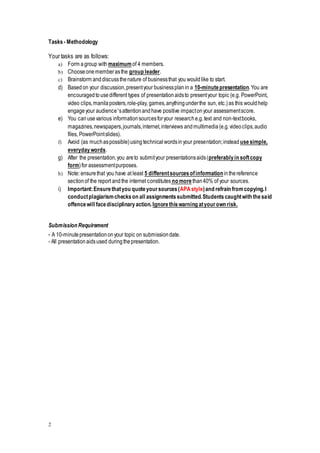
a) Form a group with maximum of 4 members. 
b) Choose one member as the group leader. 
c) Brainstorm and discuss the nature of business that you would like to start. 
d) Based on your discussion, present your business plan in a 10-minute presentation. You are 
encouraged to use different types of presentation aids to present your topic (e.g. PowerPoint, 
video clips, manila posters, role-play, games, anything under the sun, etc.) as this would help 
engage your audience’s attention and have positive impact on your assessment score. 
e) You can use various information sources for your research e.g. text and non-text books, 
magazines, newspapers, journals, internet, interviews and multimedia (e.g. video clips, audio 
files, PowerPoint slides). 
f) Avoid (as much as possible) using technical words in your presentation; instead use simple, 
everyday words. 
g) After the presentation, you are to submit your presentations aids (preferably in soft copy 
form) for assessment purposes. 
h) Note: ensure that you have at least 5 different sources of information in the reference 
section of the report and the internet constitutes no more than 40% of your sources. 
i) Important: Ensure that you quote your sources (APA style) and refrain from copying. I 
conduct plagiarism checks on all assignments submitted. Students caught with the said 
offence will face disciplinary action. Ignore this warning at your own risk. 
Submission Requirement 
- A 10-minute presentation on your topic on submission date. 
- All presentation aids used during the presentation.
Assessment criteria 
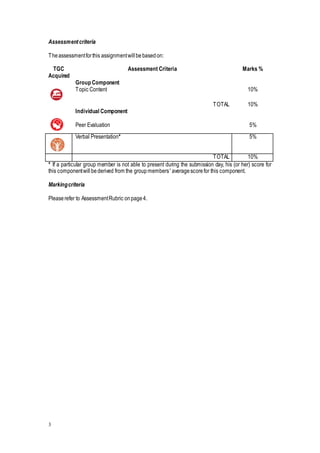
The assessment for this assignment will be based on: 
TGC 
Acquired 
3 
Assessment Criteria Marks % 
Group Component 
Topic Content 
10% 
TOTAL 10% 
Individual Component 
Peer Evaluation 
5% 
Verbal Presentation* 
5% 
TOTAL 10% 
* If a particular group member is not able to present during the submission day, his (or her) score for 
this component will be derived from the group members’ average score for this component. 
Marking criteria 
Please refer to Assessment Rubric on page 4.
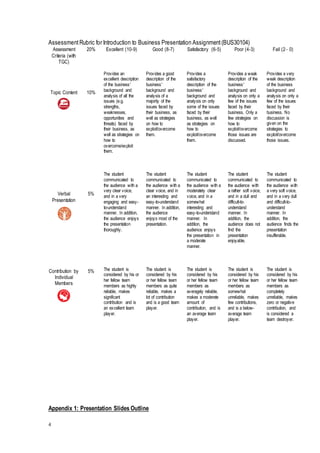
Assessment Rubric for Introduction to Business Presentation Assignment (BUS30104) 
Assessment 
Criteria (with 
4 
TGC) 
20% Excellent (10-9) Good (8-7) Satisfactory (6-5) Poor (4-3) Fail (2– 0) 
Topic Content 
10% 
Provides an 
excellent description 
of the business’ 
background and 
analysis of all the 
issues (e.g. 
strengths, 
weaknesses, 
opportunities and 
threats) faced by 
their business, as 
well as strategies on 
how to 
overcome/exploit 
them. 
Provides a good 
description of the 
business’ 
background and 
analysis of a 
majority of the 
issues faced by 
their business, as 
well as strategies 
on how to 
exploit/overcome 
them. 
Provides a 
satisfactory 
description of the 
business’ 
background and 
analysis on only 
some of the issues 
faced by their 
business, as well 
as strategies on 
how to 
exploit/overcome 
them. 
Provides a weak 
description of the 
business’ 
background and 
analysis on only a 
few of the issues 
faced by their 
business. Only a 
few strategies on 
how to 
exploit/overcome 
those issues are 
discussed. 
Provides a very 
weak description 
of the business 
background and 
analysis on only a 
few of the issues 
faced by their 
business. No 
discussion is 
given on the 
strategies to 
exploit/overcome 
those issues. 
Verbal 
Presentation 
5% 
The student 
communicated to 
the audience with a 
very clear voice, 
and in a very 
engaging and easy-to- 
understand 
manner. In addition, 
the audience enjoys 
the presentation 
thoroughly. 
The student 
communicated to 
the audience with a 
clear voice, and in 
an interesting and 
easy-to-understand 
manner. In addition, 
the audience 
enjoys most of the 
presentation. 
The student 
communicated to 
the audience with a 
moderately clear 
voice, and in a 
somewhat 
interesting and 
easy-to-understand 
manner. In 
addition, the 
audience enjoys 
the presentation in 
a moderate 
manner. 
The student 
communicated to 
the audience with 
a rather soft voice, 
and in a dull and 
difficult-to-understand 
manner. In 
addition, the 
audience does not 
find the 
presentation 
enjoyable. 
The student 
communicated to 
the audience with 
a very soft voice, 
and in a very dull 
and difficult-to-understand 
manner. In 
addition, the 
audience finds the 
presentation 
insufferable. 
Contribution by 
Individual 
Members 
5% 
The student is 
considered by his or 
her fellow team 
members as highly 
reliable, makes 
significant 
contribution and is 
an excellent team 
player. 
The student is 
considered by his 
or her fellow team 
members as quite 
reliable, makes a 
lot of contribution 
and is a good team 
player. 
The student is 
considered by his 
or her fellow team 
members as 
averagely reliable, 
makes a moderate 
amount of 
contribution, and is 
an average team 
player. 
The student is 
considered by his 
or her fellow team 
members as 
somewhat 
unreliable, makes 
few contributions, 
and is a below-average 
team 
player. 
The student is 
considered by his 
or her fellow team 
members as 
completely 
unreliable, makes 
zero or negative 
contribution, and 
is considered a 
team destroyer. 
Appendix 1: Presentation Slides Outline
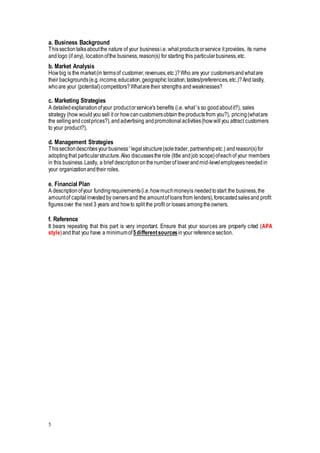
a. Business Background 
This section talks about the nature of your business i.e. what products or service it provides, its name 
and logo (if any), location of the business, reason(s) for starting this particular business, etc. 
b. Market Analysis 
How big is the market (in terms of customer, revenues, etc.)? Who are your customers and what are 
their backgrounds (e.g. income, education, geographic location, tastes/preferences, etc.)? And lastly, 
who are your (potential) competitors? What are their strengths and weaknesses? 
c. Marketing Strategies 
A detailed explanation of your product or service's benefits (i.e. what’s so good about it?), sales 
strategy (how would you sell it or how can customers obtain the products from you?), pricing (what are 
the selling and cost prices?), and advertising and promotional activities (how will you attract customers 
to your product?). 
d. Management Strategies 
This section describes your business’ legal structure (sole trader, partnership etc.) and reason(s) for 
adopting that particular structure. Also discusses the role (title and job scope) of each of your members 
in this business. Lastly, a brief description on the number of lower and mid-level employees needed in 
your organization and their roles. 
e. Financial Plan 
A description of your funding requirements (i.e. how much money is needed to start the business, the 
amount of capital invested by owners and the amount of loans from lenders), forecasted sales and profit 
figures over the next 3 years and how to split the profit or losses among the owners. 
f. Reference 
It bears repeating that this part is very important. Ensure that your sources are properly cited (APA 
style) and that you have a minimum of 5 different sources in your reference section. 
5

Brief business plan assignment

  • 1.
    SCHOOL OF ARCHITECTURE,BUILDING AND DESIGN Centre for Modern Architecture Studies in Southeast Asia Foundation of Natural and Built Environments (FNBE) Introduction to Business [BUS30104] Prerequisite: None Lecturer: Chang Jau Ho Project 1: Business Plan Presentation 10% Group Work + 10% Individual Presentation: Tuesday, 9th and Thursday, 11th September 2014 (Week 6) Introduction Business students from all walks of life can use the write up of a business plan as a method of exploring ideas when starting a new business. The plan is simply a questionnaire that clarifies the possibilities and requirements of any kind of business that you have been thinking about. And until you ponder on these questions, you will not be able to visualize the details necessary for the success in your business. Objectives of Project The objectives of this project: 1 To understand the different types of business (e.g. physical goods vs. service). To understand and evaluate the roles of human resources management, marketing, production and finance in a business. Learning Outcomes of Project On successful completion of this project, students will be able to demonstrate the following: Explain the internal and external factors that affect a business’ operations. Explain the goals and functions of businesses. Describe and analyze the theories of human resources management, marketing, production and finance and their applications.
  • 2.
    Tasks - Methodology Your tasks are as follows: 2 a) Form a group with maximum of 4 members. b) Choose one member as the group leader. c) Brainstorm and discuss the nature of business that you would like to start. d) Based on your discussion, present your business plan in a 10-minute presentation. You are encouraged to use different types of presentation aids to present your topic (e.g. PowerPoint, video clips, manila posters, role-play, games, anything under the sun, etc.) as this would help engage your audience’s attention and have positive impact on your assessment score. e) You can use various information sources for your research e.g. text and non-text books, magazines, newspapers, journals, internet, interviews and multimedia (e.g. video clips, audio files, PowerPoint slides). f) Avoid (as much as possible) using technical words in your presentation; instead use simple, everyday words. g) After the presentation, you are to submit your presentations aids (preferably in soft copy form) for assessment purposes. h) Note: ensure that you have at least 5 different sources of information in the reference section of the report and the internet constitutes no more than 40% of your sources. i) Important: Ensure that you quote your sources (APA style) and refrain from copying. I conduct plagiarism checks on all assignments submitted. Students caught with the said offence will face disciplinary action. Ignore this warning at your own risk. Submission Requirement - A 10-minute presentation on your topic on submission date. - All presentation aids used during the presentation.
  • 3.
    Assessment criteria Theassessment for this assignment will be based on: TGC Acquired 3 Assessment Criteria Marks % Group Component Topic Content 10% TOTAL 10% Individual Component Peer Evaluation 5% Verbal Presentation* 5% TOTAL 10% * If a particular group member is not able to present during the submission day, his (or her) score for this component will be derived from the group members’ average score for this component. Marking criteria Please refer to Assessment Rubric on page 4.
  • 4.
    Assessment Rubric forIntroduction to Business Presentation Assignment (BUS30104) Assessment Criteria (with 4 TGC) 20% Excellent (10-9) Good (8-7) Satisfactory (6-5) Poor (4-3) Fail (2– 0) Topic Content 10% Provides an excellent description of the business’ background and analysis of all the issues (e.g. strengths, weaknesses, opportunities and threats) faced by their business, as well as strategies on how to overcome/exploit them. Provides a good description of the business’ background and analysis of a majority of the issues faced by their business, as well as strategies on how to exploit/overcome them. Provides a satisfactory description of the business’ background and analysis on only some of the issues faced by their business, as well as strategies on how to exploit/overcome them. Provides a weak description of the business’ background and analysis on only a few of the issues faced by their business. Only a few strategies on how to exploit/overcome those issues are discussed. Provides a very weak description of the business background and analysis on only a few of the issues faced by their business. No discussion is given on the strategies to exploit/overcome those issues. Verbal Presentation 5% The student communicated to the audience with a very clear voice, and in a very engaging and easy-to- understand manner. In addition, the audience enjoys the presentation thoroughly. The student communicated to the audience with a clear voice, and in an interesting and easy-to-understand manner. In addition, the audience enjoys most of the presentation. The student communicated to the audience with a moderately clear voice, and in a somewhat interesting and easy-to-understand manner. In addition, the audience enjoys the presentation in a moderate manner. The student communicated to the audience with a rather soft voice, and in a dull and difficult-to-understand manner. In addition, the audience does not find the presentation enjoyable. The student communicated to the audience with a very soft voice, and in a very dull and difficult-to-understand manner. In addition, the audience finds the presentation insufferable. Contribution by Individual Members 5% The student is considered by his or her fellow team members as highly reliable, makes significant contribution and is an excellent team player. The student is considered by his or her fellow team members as quite reliable, makes a lot of contribution and is a good team player. The student is considered by his or her fellow team members as averagely reliable, makes a moderate amount of contribution, and is an average team player. The student is considered by his or her fellow team members as somewhat unreliable, makes few contributions, and is a below-average team player. The student is considered by his or her fellow team members as completely unreliable, makes zero or negative contribution, and is considered a team destroyer. Appendix 1: Presentation Slides Outline
  • 5.
    a. Business Background This section talks about the nature of your business i.e. what products or service it provides, its name and logo (if any), location of the business, reason(s) for starting this particular business, etc. b. Market Analysis How big is the market (in terms of customer, revenues, etc.)? Who are your customers and what are their backgrounds (e.g. income, education, geographic location, tastes/preferences, etc.)? And lastly, who are your (potential) competitors? What are their strengths and weaknesses? c. Marketing Strategies A detailed explanation of your product or service's benefits (i.e. what’s so good about it?), sales strategy (how would you sell it or how can customers obtain the products from you?), pricing (what are the selling and cost prices?), and advertising and promotional activities (how will you attract customers to your product?). d. Management Strategies This section describes your business’ legal structure (sole trader, partnership etc.) and reason(s) for adopting that particular structure. Also discusses the role (title and job scope) of each of your members in this business. Lastly, a brief description on the number of lower and mid-level employees needed in your organization and their roles. e. Financial Plan A description of your funding requirements (i.e. how much money is needed to start the business, the amount of capital invested by owners and the amount of loans from lenders), forecasted sales and profit figures over the next 3 years and how to split the profit or losses among the owners. f. Reference It bears repeating that this part is very important. Ensure that your sources are properly cited (APA style) and that you have a minimum of 5 different sources in your reference section. 5