Reflective Video Journals Dissertation Proposal by Brian J. Dixon
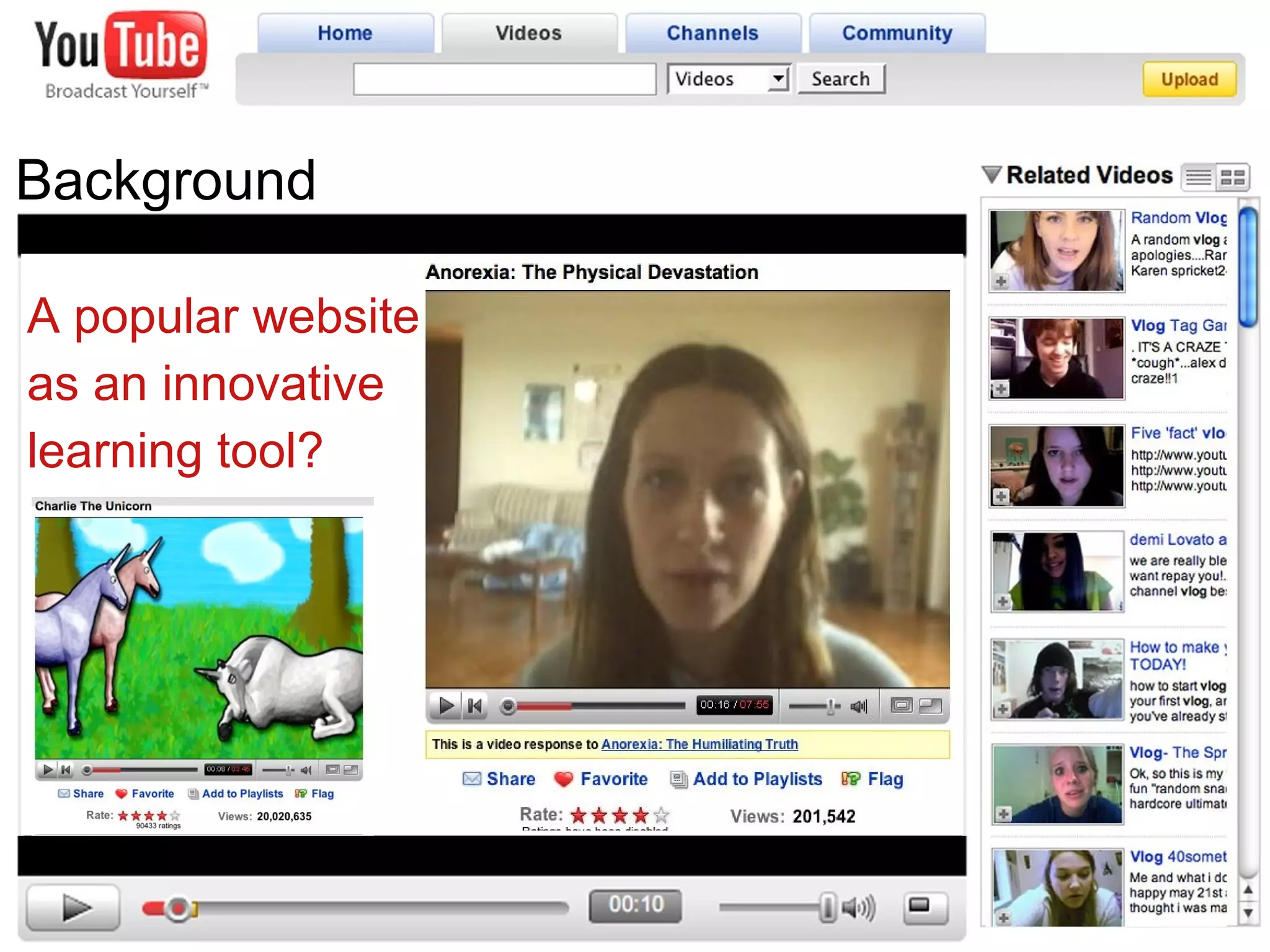
Background A popular website as an innovative learning tool?
Statement of the Problem How might reflective video  journals be used to enhance students’ metacognition?
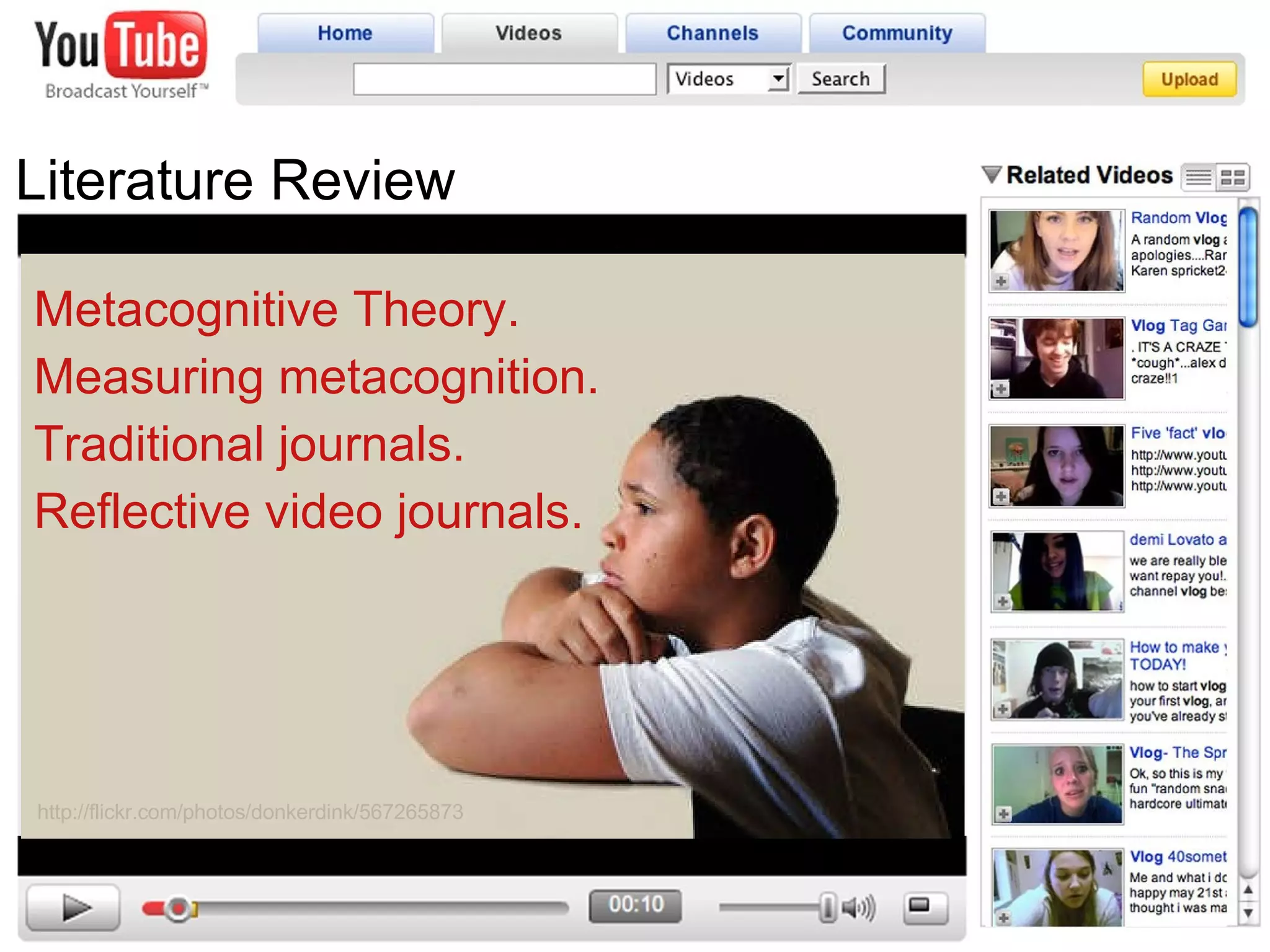
Literature Review Metacognitive Theory. Measuring metacognition. Traditional journals. Reflective video journals. http://flickr.com/photos/donkerdink/567265873
Literature Review Kolb’s learning cycle (1984)
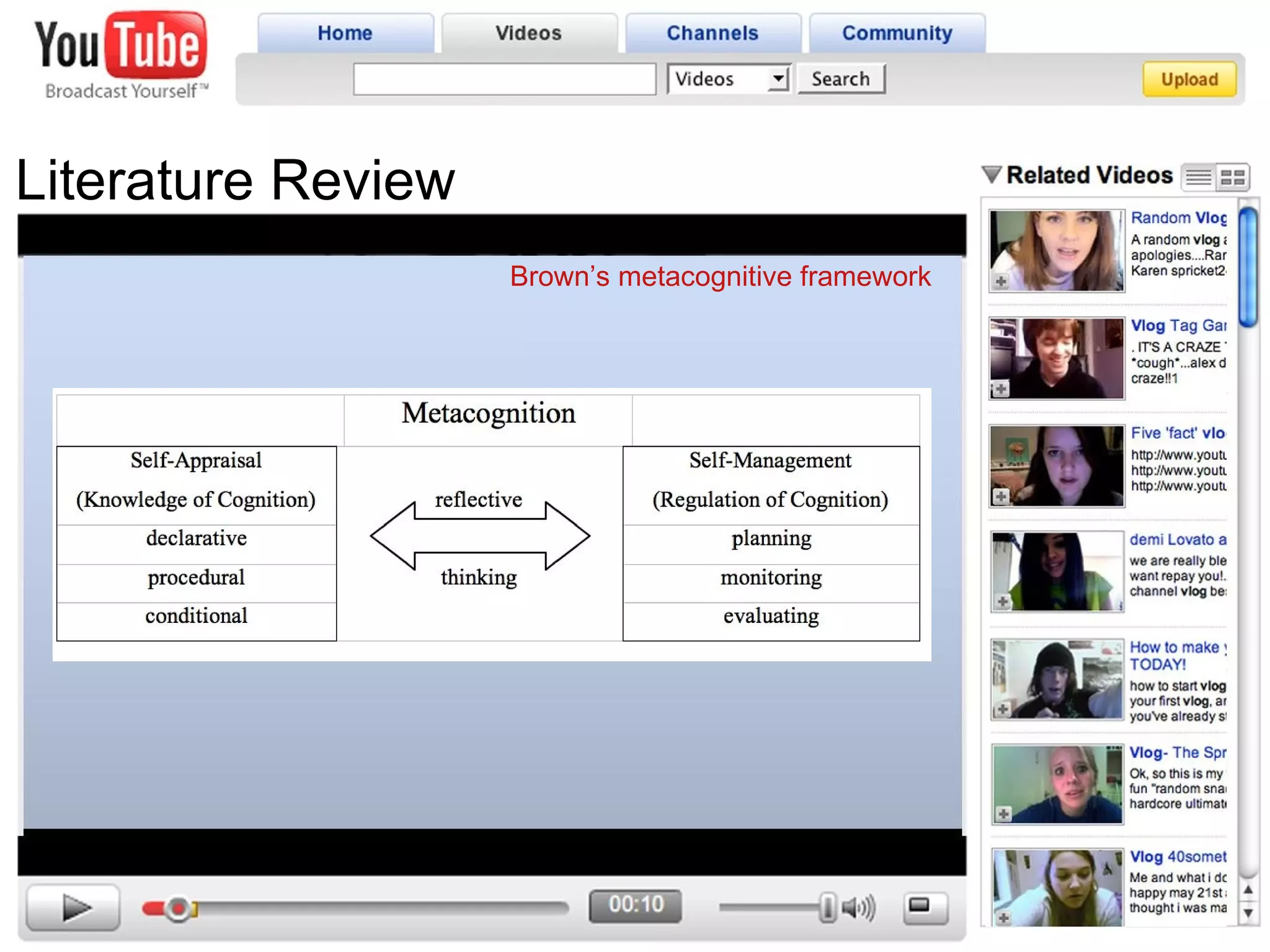
Literature Review Brown’s metacognitive framework
Literature Review Reflective journals http://flickr.com/photos/noellhyman/457816932
Reflective video journals YouTube Linking Feedback Responses Rating System Literature Review http://flickr.com/photos/noellhyman/457816932
Methodology Formative experiment  (six-phase methodology) (Reinking and Bradley, 2008)
Phase One Determining the pedagogical goal Planning the intervention Recruiting the participants
Phase Two Creating a “thick description” of the setting using ethnographic methods -description of school setting -student population -teacher technology survey
Phase Three Establishing a baseline -Junior Metacognitive Awareness Inventory -technology attitudes survey -initial interview
Phase Four Implementing the intervention -data collection and analysis -modifying the intervention -factors that enhance or inhibit -modifications and effects -unanticipated effects -changes in the environment
Phase Five Post assessment -Junior Metacognitive Awareness Inventory -technology attitudes survey -final interview
Phase Six Consolidating findings
Selected References Brown, A. L. (1978). Knowing when, where, and how to remember: A problem of  metacognition.  Advances in Instructional Psychology,   1 , 77–165.  Dewey, J. (1933).  How we think: A restatement of the relation of reflective  thinking to the educative process.  Boston: DC Heath and Company. Hiemstra, R. (2001). Uses and benefits of journal writing.  New Directions for  Adult and Continuing Education ,  90 , 19-26. Hubbs, D.L., & Brand, C.F. (2005). The paper mirror: understanding reflective  journaling.  Journal of Experiential Education, 28 (1), 60-71. King, F.B., & LaRocco, D.J. (2006). E-Journaling: A Strategy to Support Student  Reflection and Understanding.  Current Issues in Education  [On- line], 9(4). Available: http://cie.ed.asu.edu/volume9/number4/ Kolb, D. (1984).  Experiential learning: Experience as the source of learning and  development . Englewood Gliffs, NJ: Prentice Hall.  Moon, J. (1999).  Learning journal: A handbook for academics, students and professional  development.  London: Kogan Page.  Paris, S. G., & Winograd, P. (1990). How metacognition can promote  academic learning and instruction. In B. F. Jones & L. Idol (Eds.),  Dimensions of thinking and cognitive instruction  (pp. 15-51). Hillsdale,  NJ: Erlbaum.
Selected References Phipps, J. J. (2005). E-journaling: Achieving interactive education online. Educause Quarterly 28(1).  Retrieved March 12, 2008 from:  http://www.educause.edu/apps/eq/eqm05/eqm0519.asp?print=yes Reinking, D., & Bradley, B.A. (2008).  On formative and design experiments : approaches to  language and literacy research.  New York: Teachers College Press. Reinking, D., & Watkins, J. (2000). A formative experiment investigating the use of  multimedia book reviews to increase elementary students’ independent reading.  Reading Research Quarterly ,  35 , 384–419. Schraw, G., & Dennison (1994). Assessing metacognitive awareness.  Contemporary  Educational Psychology ,  19 , 460– 475.  Vygotsky, L. (1986).  Thought and language  (Rev. ed.). Cambridge, MA: MIT Press. Walters, J., Seidel, S., & Gardner, H. (1994). Children as reflective practitioners:  Bringing metacognition to the classroom. In C. Collins-Block and J.  Mangieri (Eds.),  Creating powerful thinking in teachers and students:  Diverse perspectives . Fort Worth: Harcourt Brace.
Questions?

Brian J Dixon Proposal 2

  • 1.
    Reflective Video JournalsDissertation Proposal by Brian J. Dixon
  • 2.
    Background A popularwebsite as an innovative learning tool?
  • 3.
    Statement of theProblem How might reflective video journals be used to enhance students’ metacognition?
  • 4.
    Literature Review MetacognitiveTheory. Measuring metacognition. Traditional journals. Reflective video journals. http://flickr.com/photos/donkerdink/567265873
  • 5.
    Literature Review Kolb’slearning cycle (1984)
  • 6.
    Literature Review Brown’smetacognitive framework
  • 7.
    Literature Review Reflectivejournals http://flickr.com/photos/noellhyman/457816932
  • 8.
    Reflective video journalsYouTube Linking Feedback Responses Rating System Literature Review http://flickr.com/photos/noellhyman/457816932
  • 9.
    Methodology Formative experiment (six-phase methodology) (Reinking and Bradley, 2008)
  • 10.
    Phase One Determiningthe pedagogical goal Planning the intervention Recruiting the participants
  • 11.
    Phase Two Creatinga “thick description” of the setting using ethnographic methods -description of school setting -student population -teacher technology survey
  • 12.
    Phase Three Establishinga baseline -Junior Metacognitive Awareness Inventory -technology attitudes survey -initial interview
  • 13.
    Phase Four Implementingthe intervention -data collection and analysis -modifying the intervention -factors that enhance or inhibit -modifications and effects -unanticipated effects -changes in the environment
  • 14.
    Phase Five Postassessment -Junior Metacognitive Awareness Inventory -technology attitudes survey -final interview
  • 15.
  • 16.
    Selected References Brown,A. L. (1978). Knowing when, where, and how to remember: A problem of metacognition. Advances in Instructional Psychology, 1 , 77–165. Dewey, J. (1933). How we think: A restatement of the relation of reflective thinking to the educative process. Boston: DC Heath and Company. Hiemstra, R. (2001). Uses and benefits of journal writing. New Directions for Adult and Continuing Education , 90 , 19-26. Hubbs, D.L., & Brand, C.F. (2005). The paper mirror: understanding reflective journaling. Journal of Experiential Education, 28 (1), 60-71. King, F.B., & LaRocco, D.J. (2006). E-Journaling: A Strategy to Support Student Reflection and Understanding. Current Issues in Education [On- line], 9(4). Available: http://cie.ed.asu.edu/volume9/number4/ Kolb, D. (1984). Experiential learning: Experience as the source of learning and development . Englewood Gliffs, NJ: Prentice Hall. Moon, J. (1999). Learning journal: A handbook for academics, students and professional development. London: Kogan Page. Paris, S. G., & Winograd, P. (1990). How metacognition can promote academic learning and instruction. In B. F. Jones & L. Idol (Eds.), Dimensions of thinking and cognitive instruction (pp. 15-51). Hillsdale, NJ: Erlbaum.
  • 17.
    Selected References Phipps,J. J. (2005). E-journaling: Achieving interactive education online. Educause Quarterly 28(1). Retrieved March 12, 2008 from: http://www.educause.edu/apps/eq/eqm05/eqm0519.asp?print=yes Reinking, D., & Bradley, B.A. (2008). On formative and design experiments : approaches to language and literacy research. New York: Teachers College Press. Reinking, D., & Watkins, J. (2000). A formative experiment investigating the use of multimedia book reviews to increase elementary students’ independent reading. Reading Research Quarterly , 35 , 384–419. Schraw, G., & Dennison (1994). Assessing metacognitive awareness. Contemporary Educational Psychology , 19 , 460– 475. Vygotsky, L. (1986). Thought and language (Rev. ed.). Cambridge, MA: MIT Press. Walters, J., Seidel, S., & Gardner, H. (1994). Children as reflective practitioners: Bringing metacognition to the classroom. In C. Collins-Block and J. Mangieri (Eds.), Creating powerful thinking in teachers and students: Diverse perspectives . Fort Worth: Harcourt Brace.
  • 18.